Design Thinking
By Lisa Carlgren, Maria Elmquist, Ingo Rauth
Design Thinking
What is Design Thinking?
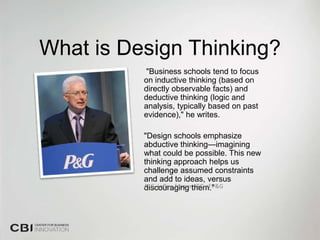
                               "Business schools tend to focus
                               on inductive thinking (based on
                               directly observable facts) and
                               deductive thinking (logic and
                               analysis, typically based on past
                               evidence)," he writes.

 A.G. Lafley, Former P&G CEO
                               "Design schools emphasize
                               abductive thinking—imagining
                               what could be possible. This new
                               thinking approach helps us
                               challenge assumed constraints
                               and add to ideas, versus
                               A. G. Lafley, formerthem.”
                               discouraging CEO of P&G
What is Design Thinking?
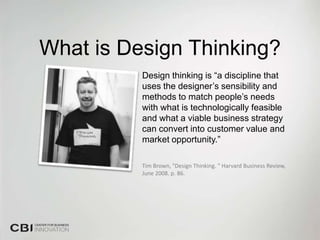
          Design thinking is “a discipline that
          uses the designer’s sensibility and
          methods to match people’s needs
          with what is technologically feasible
          and what a viable business strategy
          can convert into customer value and
          market opportunity.”

          Tim Brown, "Design Thinking. " Harvard Business Review,
          June 2008. p. 86.
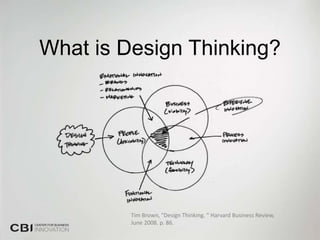
What is Design Thinking?


         Tim Brown, "Design Thinking. " Harvard Business Review,
         June 2008. p. 86.
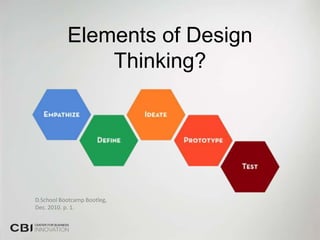
Elements of Design
               Thinking?


D.School Bootcamp Bootleg,
Dec. 2010. p. 1.
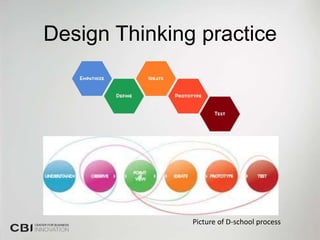
Design Thinking practice
Reflections
Ongoing study:

    Implementation of Design
   Thinking (DT) in large firms
Exploratory
Interview study with 18 companies in Germany and theUS
Interviewees: People central for the implementation of DT
Collaboration with D.School Potsdam
Design Thinking practice


               Picture of D-school process
Perceptions of the meaning of
“design thinking”
• Process
• Design Methodologies
• Mindset(s)
• Principles
• Mindset and Methods

… and problems with the
notion
Implementation of design
thinking
• Top-down or bottom up initiative

• Various sources of knowledge about DT

• Implementation set-up
   • Support Team
   • Facilitating team
   • Education


• Strategic use of projects for biggest
  impact
How design thinking is used
Strategic issues
- Developing Strategies for going green
- Redesigning HR policies

Projects
- Development projects
    -   New products, new software applications
-   Process improvement
    -   solving complex problems

Individual level
- As a different way to think about everyday
   problems

Cherry picking
Perceived benefits of design
            thinking
Value on both organizational & project level


Expected benefits:
• Increased user focus
• More innovative outputs – better concepts
Perceived benefits of design
Unexpected benefits:
                     thinking
• Improved communication
• Bridging of boundaries
• Increased speed of the development process
• Uncovering structural problems
• Culture change

Critique
• Less value created than expected, difficult to
  measure
• Not addressing the business side
Implementation challenges
Proving the value of design thinking
• Showing proof of success early on
• Traceability of impact on final product

Adaptation of the concept
• IDEO concept too focused on products –
  not software/services
• Company context & culture
• Time and cost constraints
Implementation challenges
Organizational issues
• Integration with existing processes and
   structures
• Tiredness of managerial concepts
• Political barriers
• Middle management not as convinced as
   top management
• Short term results vs. long term perspective
Getting the right resources
• Problem to get access to customers
• Difficult finding the right people for teams
Next steps
• Workshops with the participating
  companies in the US/Germany

• Refining research purpose

• Deeper case studies in some of
  the companies during 2012
Next steps
Gift-Giving
Brief: Redesign the gift-giving experience for your tablemate.
Build Customer
             Understanding
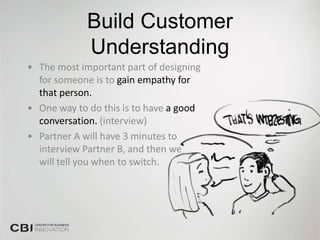
• The most important part of designing
  for someone is to gain empathy for
  that person.
• One way to do this is to have a good
  conversation. (interview)
• Partner A will have 3 minutes to
  interview Partner B, and then we
  will tell you when to switch.
Build Customer
              Understanding
As a starting point, ask your partner to tell you about
the last time they gave a gift.

Additional questions:
• To whom did they give it?
• Why was it meaningful?
• How did they come up with the idea for the gift?
• What was difficult about finding and giving this gift?


      2x3min
Defining the Insights
Try to synthesize your learning into a few ‘needs’
that you have discovered, and a few ‘insights’ that
you find interesting.

• “Needs” should be verbs – things they
  are trying to do.
• “Insights” new learning's about your
  partner’s feelings/worldview to leverage       in
  your design (make inferences).


      3min
Defining the problem statement
It should feel like a problem worth tackling!

Lisa, needs a way to give a gift to her son, because
she doesn’t want to support consumerism but still
wants to give him a present.
Defining the problem statement
It should feel like a problem worth tackling!

Lisa the responsible mother, needs a way to give a
sustainable gift to her 5 year old son, because she
doesn’t want to support consumerism but still wants
to give him a joyful present.


      3min
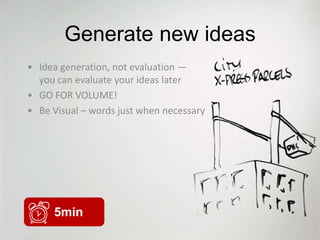
Generate new ideas
• Idea generation, not evaluation —
  you can evaluate your ideas later
• GO FOR VOLUME!
• Be Visual – words just when necessary


     5min
Collect user feedback
• This is not just about testing your ideas. This is another
  opportunity to learn more about your partner’s feelings
  and worldview.
• Spend the time listening to your tablemate’s reactions and
  questions.
• Fight the urge to explain and defend your ideas—see what
  they make of them!


      2x3min
REFLECTIONS

CBI-dagen Lisa Maria Ingo

  • 1.
    Design Thinking By LisaCarlgren, Maria Elmquist, Ingo Rauth
  • 2.
  • 3.
    What is DesignThinking? "Business schools tend to focus on inductive thinking (based on directly observable facts) and deductive thinking (logic and analysis, typically based on past evidence)," he writes. A.G. Lafley, Former P&G CEO "Design schools emphasize abductive thinking—imagining what could be possible. This new thinking approach helps us challenge assumed constraints and add to ideas, versus A. G. Lafley, formerthem.” discouraging CEO of P&G
  • 4.
    What is DesignThinking? Design thinking is “a discipline that uses the designer’s sensibility and methods to match people’s needs with what is technologically feasible and what a viable business strategy can convert into customer value and market opportunity.” Tim Brown, "Design Thinking. " Harvard Business Review, June 2008. p. 86.
  • 5.
    What is DesignThinking? Tim Brown, "Design Thinking. " Harvard Business Review, June 2008. p. 86.
  • 6.
    Elements of Design Thinking? D.School Bootcamp Bootleg, Dec. 2010. p. 1.
  • 7.
  • 8.
  • 9.
    Ongoing study: Implementation of Design Thinking (DT) in large firms Exploratory Interview study with 18 companies in Germany and theUS Interviewees: People central for the implementation of DT Collaboration with D.School Potsdam
  • 10.
    Design Thinking practice Picture of D-school process
  • 11.
    Perceptions of themeaning of “design thinking” • Process • Design Methodologies • Mindset(s) • Principles • Mindset and Methods … and problems with the notion
  • 12.
    Implementation of design thinking •Top-down or bottom up initiative • Various sources of knowledge about DT • Implementation set-up • Support Team • Facilitating team • Education • Strategic use of projects for biggest impact
  • 13.
    How design thinkingis used Strategic issues - Developing Strategies for going green - Redesigning HR policies Projects - Development projects - New products, new software applications - Process improvement - solving complex problems Individual level - As a different way to think about everyday problems Cherry picking
  • 14.
    Perceived benefits ofdesign thinking Value on both organizational & project level Expected benefits: • Increased user focus • More innovative outputs – better concepts
  • 15.
    Perceived benefits ofdesign Unexpected benefits: thinking • Improved communication • Bridging of boundaries • Increased speed of the development process • Uncovering structural problems • Culture change Critique • Less value created than expected, difficult to measure • Not addressing the business side
  • 16.
    Implementation challenges Proving thevalue of design thinking • Showing proof of success early on • Traceability of impact on final product Adaptation of the concept • IDEO concept too focused on products – not software/services • Company context & culture • Time and cost constraints
  • 17.
    Implementation challenges Organizational issues •Integration with existing processes and structures • Tiredness of managerial concepts • Political barriers • Middle management not as convinced as top management • Short term results vs. long term perspective Getting the right resources • Problem to get access to customers • Difficult finding the right people for teams
  • 18.
    Next steps • Workshopswith the participating companies in the US/Germany • Refining research purpose • Deeper case studies in some of the companies during 2012
  • 19.
  • 20.
    Gift-Giving Brief: Redesign thegift-giving experience for your tablemate.
  • 21.
    Build Customer Understanding • The most important part of designing for someone is to gain empathy for that person. • One way to do this is to have a good conversation. (interview) • Partner A will have 3 minutes to interview Partner B, and then we will tell you when to switch.
  • 22.
    Build Customer Understanding As a starting point, ask your partner to tell you about the last time they gave a gift. Additional questions: • To whom did they give it? • Why was it meaningful? • How did they come up with the idea for the gift? • What was difficult about finding and giving this gift? 2x3min
  • 23.
    Defining the Insights Tryto synthesize your learning into a few ‘needs’ that you have discovered, and a few ‘insights’ that you find interesting. • “Needs” should be verbs – things they are trying to do. • “Insights” new learning's about your partner’s feelings/worldview to leverage in your design (make inferences). 3min
  • 24.
    Defining the problemstatement It should feel like a problem worth tackling! Lisa, needs a way to give a gift to her son, because she doesn’t want to support consumerism but still wants to give him a present.
  • 25.
    Defining the problemstatement It should feel like a problem worth tackling! Lisa the responsible mother, needs a way to give a sustainable gift to her 5 year old son, because she doesn’t want to support consumerism but still wants to give him a joyful present. 3min
  • 26.
    Generate new ideas •Idea generation, not evaluation — you can evaluate your ideas later • GO FOR VOLUME! • Be Visual – words just when necessary 5min
  • 27.
    Collect user feedback •This is not just about testing your ideas. This is another opportunity to learn more about your partner’s feelings and worldview. • Spend the time listening to your tablemate’s reactions and questions. • Fight the urge to explain and defend your ideas—see what they make of them! 2x3min
  • 28.

Editor's Notes

  • #10 Interview study with 18 companies (9 Germany, 9 US)Interviewees: People central for the implementation of Design thinking R&D and Innovation Managers, leaders of internal design thinking teamsCollaboration with D.School Potsdam who helped us find companies for the studyThe purpose of the study was to explore the implementation of DT in large firms, with specific focus onThe perception of the concept, The expected and perceived value of using itHow they implemented and used itWhat was difficultThe study and the analysis is still ongoing, but we would like to share some insights
  • #11 This is the way design thinking is often taught in schools, and how it is presented by eg IDEO or in the business press.Thus, when the initiative to implement design thinking in a company starts, this is also how it is often perceived to begin with: some sort of a process.
  • #12 While DT is often described as a process, there was a diversity of views on what the concept actually meant; even within the same company. Often they had spent some time internally to define design thinking, but when they described it to us it was still quite vague.** The perception of design thinking was seen as:A process: a series of consecutive steps. Some stressed that it could be iterative and non-linear, but nevertheless a process. One interviewee stated that if you don’t do some of the steps, or not dwell on the step long enough, you are not really doing design thinking.Design Methodologies: This was described as using methods of designers for example “as a way to solve complex problemsPrinciples: where elements of Brown’s process are emphasized but not seen as steps in a process ,more as a way to relate to the problem at hand. For example: prototyping, iteration, developing empathy, going broad and narrow.Mindset: for example “a mindset that puts the user first, focuses on finding differentiated and true insights, having a bias for action and iterating constantly”A combination of mindset & methods: “you have a mindset and a set of techniques and tools that you can use where it is appropriate”The term design thinking could also be problematic:Some wanted to step away from what they saw as an “IDEO brand” – when design thinking was adapted to their own company context, they also chose to give it another name, or talk about it in different termsSome saw the word “design” as problematic; that it was too connected to the design profession, design being something that is done by someone else.**Some use the notion “design thinking”, others preferred not to or had come up with their own proprietary notions.
  • #13 There was a variety in how DT was introduced in the company and how the companies went about implementation.In some companies there was a clear top-down implementation - where a CEO or a founder got interested in Design Thinking, and pushed for a company-wide implementation.In other companies there was a bottom-up implementation; - for example when a development manager or an innovation expert had came across the concept, and tried to implement it in the own organisation on a small scale at first.Various sources of knowledge about DT From business press, board discussions, collaboration with design firms, contacts with d.schoolImplementation set-up –some common approaches could be discernedSupport TeamFacilitating teamEducationWithin the company or by outside providerIn some companies there was a strategic use of projects to make a big impactin terms of project outcome – the most innovative product, or the most complex problemIn terms of implementation effect – that would convince as many as possible that they should embrace DTMany were in an initial phase.Companies in US had generally been using DT for a longer time
  • #14 How it is used todayOrganizational level: Developing Strategies for going green, redesigning HR policiesProjectsDevelopment projectsNew products, new software applicationsProcess improvementFor solving complex problemsDrug administration process – reduce wrong medicationIndividual levelAs a different way to think about everyday problemsHow to become a better managerImproving team workHow to tackle big or small problems
  • #15 In the companies there was a range of expectations on what value DT would bring, mainly colored by the IDEO or Dschool descriptions of Design Thinking. This mainly consisted of increased customer focus and creativity in ideasLearn about new opportunities through user researchCreate relevant products based on user needsReduce risk through iterative and early testing, using prototypes.Create better ideas through trans-disciplinary teams and the involvement of experts.
  • #16 However, some perhaps more unexpected benefits were also perceived such as:New ideas through a different outlook on problems Improved communication within projects and during handoversBridging of boundaries Between departments, across functions and hierarchiesIncreased speed of the development process Uncovering structural problems in the development process that the company was not aware ofCulture change Overcoming a too polite culture, creating an atmosphere where failure is acceptedThere were also some critical voices, that they got less value than expected and that the business side was not addressed.
  • #17 The companies also perceived a variety of challenges related to implementation:Hard to proveMany of the interviewees saw it as a challenge that they could not prove the value of design thinking, and it was thus hard to convince people.It was often stated that the final proof that design thinking works would be “success on the market” – However - many companies were in the beginning of the implementation effort, or had very long development cycles – and no product had reached the market. Also, given some of the benefits that were mentioned, it was also clear that many of these were not related to specific products.Adapt the concept:In many of the firms it was also seen as necessary to adapt the concept to the company context since the way it was put forward by IDEO did not fit in their own context, for various reasons.Especially the companies in the study who were in the software or healthcare sector, they felt that the IDEO process was mainly for products.How you adapt the concept also builds on how you perceive the concept – and in some of the companies where DT was seen as a process, it was also mentioned that some parts involved too much time and cost.
  • #18 Further, some organizational issues were also seen as barriers to implementation:Integration with existing processes and structures For example the use of agile, lean or six sigma, and structures where marketing usually did all customer research.Tiredness of managerial conceptsPolitical barriers hierarchies, stepping on each other’s turfMiddle management not as convinced as top managementCompany too focused on short term results vs. long term perspective not realizing that implementation takes timeSometimes it was also difficult to get the right resources:Problem to get access to customersIn one company there was an outspoken rule that the developers should NOT talk to customers, and customer access became difficultDifficult finding the right people for teamsThe people that would have made a good contribution to a mixed tem was held up in other projects.
  • #22 At one company, people use their lunch breaks or coffee to talk to customers to get a better understanding about
  • #25 This is the statement that you’re going to address with your design, so make sure it’s juicy and actionable!
  • #26 This is the statement that you’re going to address with your design, so make sure it’s juicy and actionable!