Empathize / Understand
Contents
• What is Empathy Exactly?
• Empathize Methods
• Empathy vs Sympathy
• Why Empathy?
• Designing Without
Empathy
• Success With Empathy
2
1.
What is Empathy Exactly?
3
Empathy
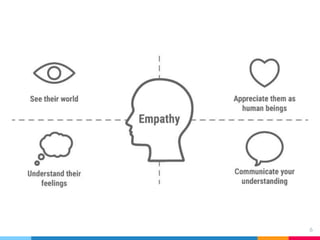
▷ Empathy is our ability to see the world through other people's
eyes, to see what they see, feel what they feel, and experience
things as they do.
▷ We do this by putting aside our own preconceived ideas and
choosing to understand the ideas, thoughts, and needs of others
instead.
▷ Empathy helps us gain a deeper appreciation and understanding
of people's emotional and physical needs, and the way they see,
understand, and interact with the world around them. It will also
help us to understand how all of this has an impact on their lives
generally, specifically within the contexts being investigated.
4
▷ “Empathise” is the first stage of the Design Thinking process.
▷ This process involves observing, engaging, and empathising with
the people you are designing for in order to understand their
experiences and motivations, as well as immersing yourself in
their physical environment in order to have a deeper personal
understanding of the issues, needs and challenges involved.
▷ Empathy is crucial to a human-centred design process such as
Design Thinking, and empathy helps design thinkers to set aside
his or her own assumptions about the world in order to gain
insight into their users and their needs.
▷ You will want to gather a substantial amount of information at
this stage of the Design Thinking process. In the Empathise stage
of a Design Thinking process, you will develop the empathy,
understandings, experiences, insights and observations on which
you will use to build the rest of your design project.
5
6
2.
Empathize Methods
7
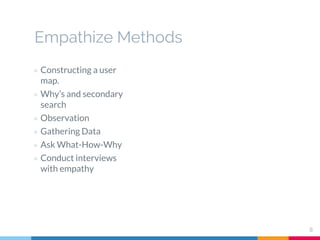
Empathize Methods
▷ Constructing a user
map.
▷ Why’s and secondary
search
▷ Observation
▷ Gathering Data
▷ Ask What-How-Why
▷ Conduct interviews
with empathy
8
3.
Empathy vs Sympathy
9
10
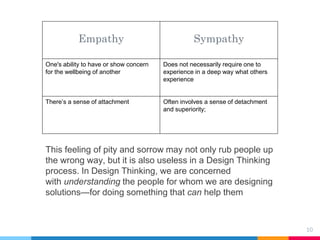
Empathy Sympathy
One's ability to have or show concern
for the wellbeing of another
Does not necessarily require one to
experience in a deep way what others
experience
There’s a sense of attachment Often involves a sense of detachment
and superiority;
This feeling of pity and sorrow may not only rub people up
the wrong way, but it is also useless in a Design Thinking
process. In Design Thinking, we are concerned
with understanding the people for whom we are designing
solutions—for doing something that can help them
4.
Why empathy?
11
A short story
Using the power of “averages” is a terrible way to design solutions
for people. In the 1940s, the US Air Force learnt this the hard way.
During this era, aviation accidents happened very frequently (as
many as 17 crashes a day). Initially, the air force presumed that the
reason for so many accidents was the air force’s switch to using
more complicated and faster planes. After some research, however,
the air force discovered the real reason behind the accidents; they
had designed the planes’ cockpits and helmets to conform to the
dimensions of the “average” soldier’s body. In a study of over 4,000
air force pilots, it was found that none of the air force pilots fell
within the dimensions of the supposed “average” man. It was no
wonder pilots had problems with using the planes! In the end, the air
force created adjustable equipment to fit most soldiers’ bodies,
thereby solving the problem.
12
From the above story it is pretty clear that once the US Military put
themselves into the shoes of the pilots they were able to come up
with a solution.
People do not always convey all the details. They may withhold
information out of fear, distrust or some other inhibiting factor, be it
internal or based on those with whom they are engaging.
Additionally, they may express themselves in ways not extremely
articulate, thus requiring the listener to make sense of what
is not being said or what is being hinted at, beneath the external
expressions and words. As designers, we need to develop intuition,
imagination, emotional sensitivity, and creativity in or to dig deeper
without prying too personally, in order to extract the right kinds of
insight so as to make a more meaningful difference.
13
5.
Designing without
Empathy
14
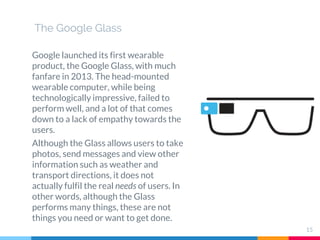
The Google Glass
Google launched its first wearable
product, the Google Glass, with much
fanfare in 2013. The head-mounted
wearable computer, while being
technologically impressive, failed to
perform well, and a lot of that comes
down to a lack of empathy towards the
users.
Although the Glass allows users to take
photos, send messages and view other
information such as weather and
transport directions, it does not
actually fulfil the real needs of users. In
other words, although the Glass
performs many things, these are not
things you need or want to get done.
15
Also, the Glass is generally a voice-
activated device, and in our current
social environment, saying commands
out loud in the streets such as, “Okay
Glass, send a message,” just isn’t a
socially acceptable thing to do. Google’s
lack of empathic understanding in the
user’s social environment is evident
here.
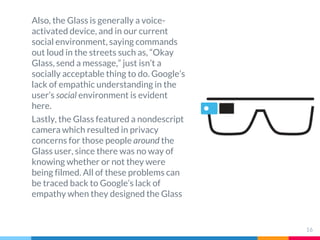
Lastly, the Glass featured a nondescript
camera which resulted in privacy
concerns for those people around the
Glass user, since there was no way of
knowing whether or not they were
being filmed. All of these problems can
be traced back to Google’s lack of
empathy when they designed the Glass
16
““No one could understand why
you’d want to have that thing on
your face, in the way of normal
social interaction.”
– MIT Technology Review
17
6.
Designing with Empathy
18
The Embrace Warmer
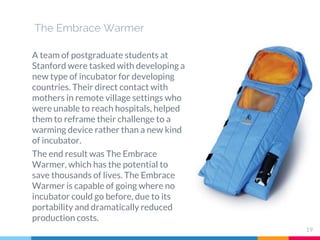
A team of postgraduate students at
Stanford were tasked with developing a
new type of incubator for developing
countries. Their direct contact with
mothers in remote village settings who
were unable to reach hospitals, helped
them to reframe their challenge to a
warming device rather than a new kind
of incubator.
The end result was The Embrace
Warmer, which has the potential to
save thousands of lives. The Embrace
Warmer is capable of going where no
incubator could go before, due to its
portability and dramatically reduced
production costs.
19
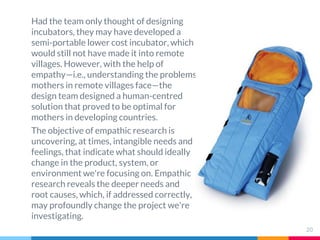
Had the team only thought of designing
incubators, they may have developed a
semi-portable lower cost incubator, which
would still not have made it into remote
villages. However, with the help of
empathy—i.e., understanding the problems
mothers in remote villages face—the
design team designed a human-centred
solution that proved to be optimal for
mothers in developing countries.
The objective of empathic research is
uncovering, at times, intangible needs and
feelings, that indicate what should ideally
change in the product, system, or
environment we're focusing on. Empathic
research reveals the deeper needs and
root causes, which, if addressed correctly,
may profoundly change the project we're
investigating.
20
7.
The Take Away
21
The Take Away
Empathy is important for us as designers and particularly for design
thinkers because it allows us to truly understand and uncover the
latent needs and emotions of the people we are designing for. As
such, we can design solutions that meet the three parameters of a
successful product or service: desirability, feasibility and viability. In
Design Thinking, we call this "the Empathise stage". Designing with
empathy is what separates a human-centred product like The
Embrace Warmer from another, such as Google’s Glass. The good
news is that everybody can master empathy and become a great
design thinker: we are all innately empathic.
22

Design Thinking : Empathising

  • 1.
  • 2.
    Contents • What isEmpathy Exactly? • Empathize Methods • Empathy vs Sympathy • Why Empathy? • Designing Without Empathy • Success With Empathy 2
  • 3.
  • 4.
    Empathy ▷ Empathy isour ability to see the world through other people's eyes, to see what they see, feel what they feel, and experience things as they do. ▷ We do this by putting aside our own preconceived ideas and choosing to understand the ideas, thoughts, and needs of others instead. ▷ Empathy helps us gain a deeper appreciation and understanding of people's emotional and physical needs, and the way they see, understand, and interact with the world around them. It will also help us to understand how all of this has an impact on their lives generally, specifically within the contexts being investigated. 4
  • 5.
    ▷ “Empathise” isthe first stage of the Design Thinking process. ▷ This process involves observing, engaging, and empathising with the people you are designing for in order to understand their experiences and motivations, as well as immersing yourself in their physical environment in order to have a deeper personal understanding of the issues, needs and challenges involved. ▷ Empathy is crucial to a human-centred design process such as Design Thinking, and empathy helps design thinkers to set aside his or her own assumptions about the world in order to gain insight into their users and their needs. ▷ You will want to gather a substantial amount of information at this stage of the Design Thinking process. In the Empathise stage of a Design Thinking process, you will develop the empathy, understandings, experiences, insights and observations on which you will use to build the rest of your design project. 5
  • 6.
  • 7.
  • 8.
    Empathize Methods ▷ Constructinga user map. ▷ Why’s and secondary search ▷ Observation ▷ Gathering Data ▷ Ask What-How-Why ▷ Conduct interviews with empathy 8
  • 9.
  • 10.
    10 Empathy Sympathy One's abilityto have or show concern for the wellbeing of another Does not necessarily require one to experience in a deep way what others experience There’s a sense of attachment Often involves a sense of detachment and superiority; This feeling of pity and sorrow may not only rub people up the wrong way, but it is also useless in a Design Thinking process. In Design Thinking, we are concerned with understanding the people for whom we are designing solutions—for doing something that can help them
  • 11.
  • 12.
    A short story Usingthe power of “averages” is a terrible way to design solutions for people. In the 1940s, the US Air Force learnt this the hard way. During this era, aviation accidents happened very frequently (as many as 17 crashes a day). Initially, the air force presumed that the reason for so many accidents was the air force’s switch to using more complicated and faster planes. After some research, however, the air force discovered the real reason behind the accidents; they had designed the planes’ cockpits and helmets to conform to the dimensions of the “average” soldier’s body. In a study of over 4,000 air force pilots, it was found that none of the air force pilots fell within the dimensions of the supposed “average” man. It was no wonder pilots had problems with using the planes! In the end, the air force created adjustable equipment to fit most soldiers’ bodies, thereby solving the problem. 12
  • 13.
    From the abovestory it is pretty clear that once the US Military put themselves into the shoes of the pilots they were able to come up with a solution. People do not always convey all the details. They may withhold information out of fear, distrust or some other inhibiting factor, be it internal or based on those with whom they are engaging. Additionally, they may express themselves in ways not extremely articulate, thus requiring the listener to make sense of what is not being said or what is being hinted at, beneath the external expressions and words. As designers, we need to develop intuition, imagination, emotional sensitivity, and creativity in or to dig deeper without prying too personally, in order to extract the right kinds of insight so as to make a more meaningful difference. 13
  • 14.
  • 15.
    The Google Glass Googlelaunched its first wearable product, the Google Glass, with much fanfare in 2013. The head-mounted wearable computer, while being technologically impressive, failed to perform well, and a lot of that comes down to a lack of empathy towards the users. Although the Glass allows users to take photos, send messages and view other information such as weather and transport directions, it does not actually fulfil the real needs of users. In other words, although the Glass performs many things, these are not things you need or want to get done. 15
  • 16.
    Also, the Glassis generally a voice- activated device, and in our current social environment, saying commands out loud in the streets such as, “Okay Glass, send a message,” just isn’t a socially acceptable thing to do. Google’s lack of empathic understanding in the user’s social environment is evident here. Lastly, the Glass featured a nondescript camera which resulted in privacy concerns for those people around the Glass user, since there was no way of knowing whether or not they were being filmed. All of these problems can be traced back to Google’s lack of empathy when they designed the Glass 16
  • 17.
    ““No one couldunderstand why you’d want to have that thing on your face, in the way of normal social interaction.” – MIT Technology Review 17
  • 18.
  • 19.
    The Embrace Warmer Ateam of postgraduate students at Stanford were tasked with developing a new type of incubator for developing countries. Their direct contact with mothers in remote village settings who were unable to reach hospitals, helped them to reframe their challenge to a warming device rather than a new kind of incubator. The end result was The Embrace Warmer, which has the potential to save thousands of lives. The Embrace Warmer is capable of going where no incubator could go before, due to its portability and dramatically reduced production costs. 19
  • 20.
    Had the teamonly thought of designing incubators, they may have developed a semi-portable lower cost incubator, which would still not have made it into remote villages. However, with the help of empathy—i.e., understanding the problems mothers in remote villages face—the design team designed a human-centred solution that proved to be optimal for mothers in developing countries. The objective of empathic research is uncovering, at times, intangible needs and feelings, that indicate what should ideally change in the product, system, or environment we're focusing on. Empathic research reveals the deeper needs and root causes, which, if addressed correctly, may profoundly change the project we're investigating. 20
  • 21.
  • 22.
    The Take Away Empathyis important for us as designers and particularly for design thinkers because it allows us to truly understand and uncover the latent needs and emotions of the people we are designing for. As such, we can design solutions that meet the three parameters of a successful product or service: desirability, feasibility and viability. In Design Thinking, we call this "the Empathise stage". Designing with empathy is what separates a human-centred product like The Embrace Warmer from another, such as Google’s Glass. The good news is that everybody can master empathy and become a great design thinker: we are all innately empathic. 22