| Notes |

Design Thinking Workshop
For AIP Partners
24 October 2012
| Module 1 |

Innovation and Design Thinking
Design Thinking
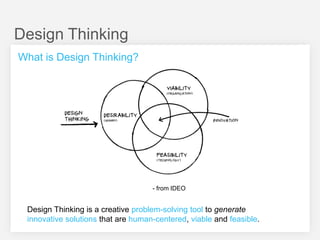
What is Design Thinking?

- from IDEO

Design Thinking is a creative problem-solving tool to generate
innovative solutions that are human-centered, viable and feasible.
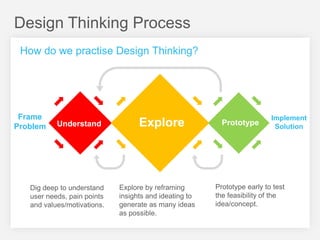
Design Thinking Process
How do we practise Design Thinking?

Frame
Problem

Understand

Dig deep to understand
user needs, pain points
and values/motivations.

Explore

Explore by reframing
insights and ideating to
generate as many ideas
as possible.

Prototype

Implement
Solution

Prototype early to test
the feasibility of the
idea/concept.
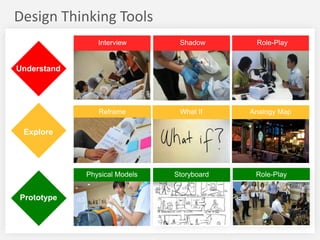
Design Thinking Tools
Interview

Shadow

Role-Play

Reframe

What If

Analogy Map

Physical Models

Storyboard

Role-Play

Understand

Explore

Prototype
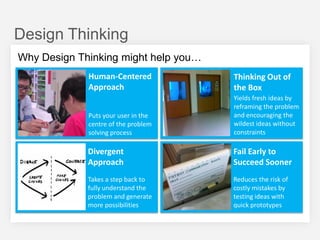
Design Thinking
Why Design Thinking might help you…
Human-Centered
Approach

Thinking Out of
the Box

Puts your user in the
centre of the problem
solving process

Yields fresh ideas by
reframing the problem
and encouraging the
wildest ideas without
constraints

Divergent
Approach

Fail Early to
Succeed Sooner

Takes a step back to
fully understand the
problem and generate
more possibilities

Reduces the risk of
costly mistakes by
testing ideas with
quick prototypes
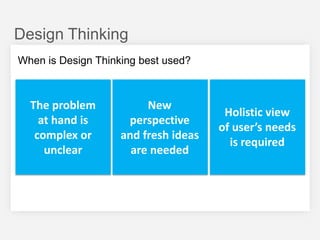
Design Thinking
When is Design Thinking best used?

The problem
at hand is
complex or
unclear

New
perspective
and fresh ideas
are needed

Holistic view
of user’s needs
is required
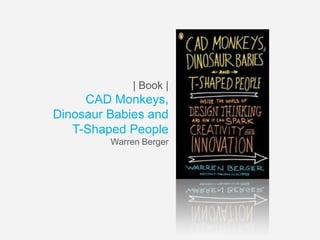
| Book |

CAD Monkeys,
Dinosaur Babies and
T-Shaped People
Warren Berger
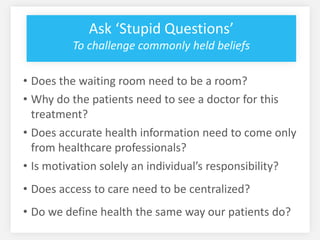
Ask ‘Stupid Questions’
To challenge commonly held beliefs
• Does the waiting room need to be a room?
• Why do the patients need to see a doctor for this
treatment?
• Does accurate health information need to come only
from healthcare professionals?
• Is motivation solely an individual’s responsibility?
• Does access to care need to be centralized?

• Do we define health the same way our patients do?
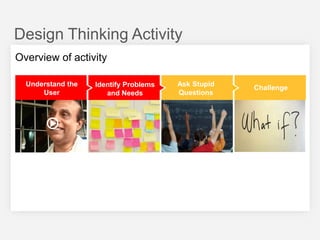
Design Thinking Activity
Overview of activity
Understand the
User

Identify Problems
and Needs

Ask Stupid
Questions

Challenge
Learning Points from Activity
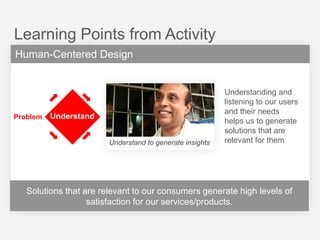
Human-Centered Design

Problem

Understand
Understand to generate insights

Understanding and
listening to our users
and their needs
helps us to generate
solutions that are
relevant for them

Solutions that are relevant to our consumers generate high levels of
satisfaction for our services/products.
Learning Points from Activity
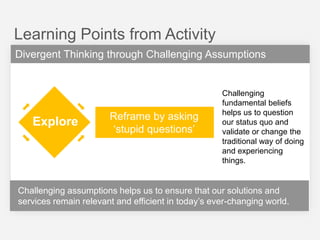
Divergent Thinking through Challenging Assumptions

Explore

Reframe by asking
„stupid questions‟

Challenging
fundamental beliefs
helps us to question
our status quo and
validate or change the
traditional way of doing
and experiencing
things.

Challenging assumptions helps us to ensure that our solutions and
services remain relevant and efficient in today‟s ever-changing world.
| Module 2 |

Experience Design Thinking
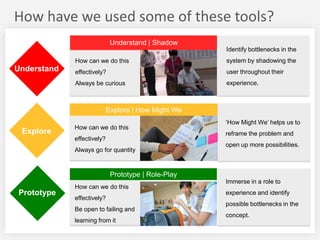
How have we used some of these tools?
Understand | Shadow
Identify bottlenecks in the
How can we do this
effectively?

user throughout their

Always be curious

Understand

system by shadowing the

experience.

Explore | How Might We

Explore

How can we do this

„How Might We‟ helps us to
reframe the problem and

effectively?
Always go for quantity

open up more possibilities.

Prototype | Role-Play

Prototype

How can we do this
effectively?
Be open to failing and
learning from it

Immerse in a role to

experience and identify
possible bottlenecks in the
concept.
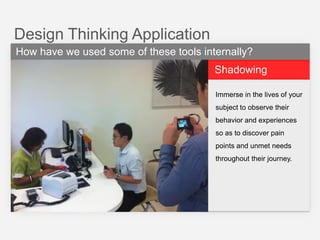
Design Thinking Application
How have we used some of these tools internally?
Shadowing
Immerse in the lives of your
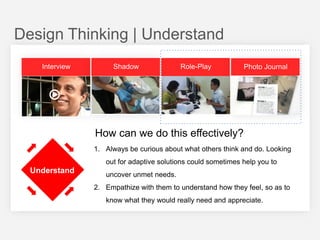
subject to observe their
behavior and experiences
so as to discover pain
points and unmet needs
throughout their journey.
Design Thinking | Understand
Interview

Shadow

Role-Play

Photo Journal

How can we do this effectively?
1. Always be curious about what others think and do. Looking
out for adaptive solutions could sometimes help you to

Understand

uncover unmet needs.
2. Empathize with them to understand how they feel, so as to

know what they would really need and appreciate.
Design Thinking Application
How have we used some of these tools internally?
How Might We

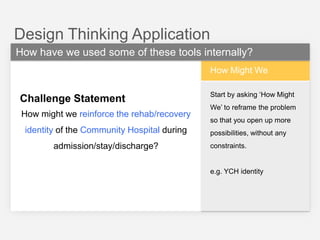
Challenge Statement
How might we reinforce the rehab/recovery
identity of the Community Hospital during
admission/stay/discharge?

Start by asking „How Might
We‟ to reframe the problem
so that you open up more
possibilities, without any
constraints.

e.g. YCH identity
Design Thinking | Explore
How Might We

What If

Brainstorm

Analogy Map

How can we do this effectively?
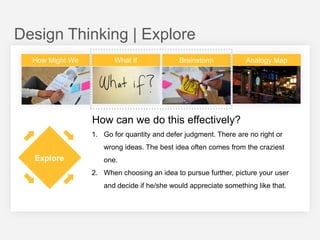
1. Go for quantity and defer judgment. There are no right or
wrong ideas. The best idea often comes from the craziest

Explore

one.
2. When choosing an idea to pursue further, picture your user

and decide if he/she would appreciate something like that.
Design Thinking Application
How have we used some of these tools internally?
Role-Play
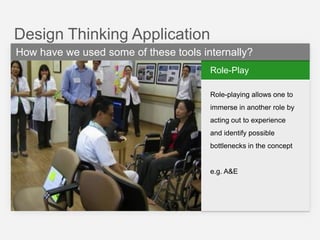
Role-playing allows one to
immerse in another role by
acting out to experience
and identify possible
bottlenecks in the concept

e.g. A&E
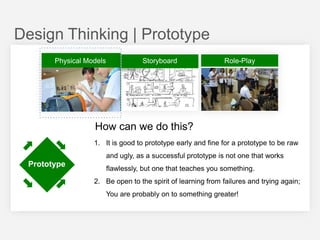
Design Thinking | Prototype
Physical Models

Storyboard

Role-Play

How can we do this?
1. It is good to prototype early and fine for a prototype to be raw
and ugly, as a successful prototype is not one that works

Prototype

flawlessly, but one that teaches you something.
2. Be open to the spirit of learning from failures and trying again;
You are probably on to something greater!
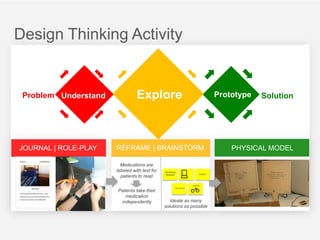
Design Thinking Activity

Problem Understand

JOURNAL | ROLE-PLAY

Explore

Prototype

REFRAME | BRAINSTORM
Medications are
labeled with text for
patients to read

Monitoring
Bracelet

database

systems

Patients take their
medication
independently

Tele monitor

Ideate as many
solutions as possible

Solution

PHYSICAL MODEL
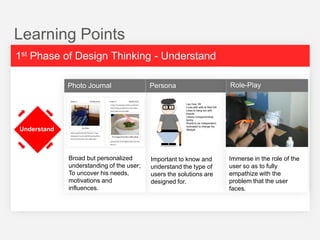
Learning Points
1st Phase of Design Thinking - Understand
Photo Journal

Role-Play

Persona
Lau Hua, 59
Lives with wife at Red Hill
Likes to hang out with
friends
Values companionship,
family
Wants to be independent,
motivated to change his
lifestyle

Understand

Broad but personalized
understanding of the user;
To uncover his needs,
motivations and
influences.

Important to know and
understand the type of
users the solutions are
designed for.

Immerse in the role of the
user so as to fully
empathize with the
problem that the user
faces.
Learning Points
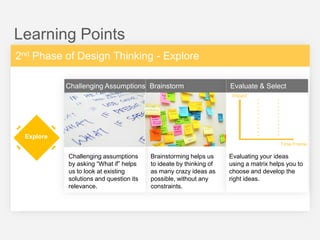
2nd Phase of Design Thinking - Explore
Challenging Assumptions Brainstorm

Evaluate & Select
Impact

Explore
Time Frame

Challenging assumptions
by asking “What if” helps
us to look at existing
solutions and question its
relevance.

Brainstorming helps us
to ideate by thinking of
as many crazy ideas as
possible, without any
constraints.

Evaluating your ideas
using a matrix helps you to
choose and develop the
right ideas.
Learning Points
3rd Phase of Design Thinking - Prototype
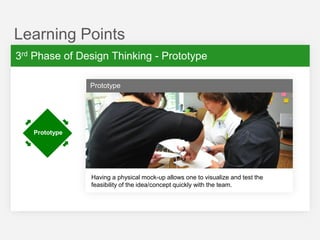
Prototype

Prototype

Having a physical mock-up allows one to visualize and test the
feasibility of the idea/concept quickly with the team.
Learning Points
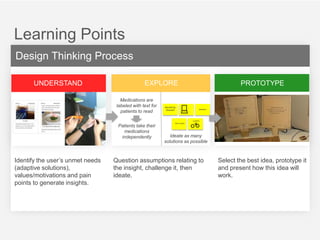
Design Thinking Process
UNDERSTAND

EXPLORE
Medications are
labeled with text for
patients to read

Monitoring
Bracelet

PROTOTYPE

database

systems

Patients take their
medications
independently

Identify the user‟s unmet needs
(adaptive solutions),
values/motivations and pain
points to generate insights.

Tele monitor

Ideate as many
solutions as possible

Question assumptions relating to
the insight, challenge it, then
ideate.

Select the best idea, prototype it
and present how this idea will
work.
| Thank You |

Notes - Design Thinking Workshop

  • 1.
    | Notes | DesignThinking Workshop For AIP Partners 24 October 2012
  • 2.
    | Module 1| Innovation and Design Thinking
  • 3.
    Design Thinking What isDesign Thinking? - from IDEO Design Thinking is a creative problem-solving tool to generate innovative solutions that are human-centered, viable and feasible.
  • 4.
    Design Thinking Process Howdo we practise Design Thinking? Frame Problem Understand Dig deep to understand user needs, pain points and values/motivations. Explore Explore by reframing insights and ideating to generate as many ideas as possible. Prototype Implement Solution Prototype early to test the feasibility of the idea/concept.
  • 5.
    Design Thinking Tools Interview Shadow Role-Play Reframe WhatIf Analogy Map Physical Models Storyboard Role-Play Understand Explore Prototype
  • 6.
    Design Thinking Why DesignThinking might help you… Human-Centered Approach Thinking Out of the Box Puts your user in the centre of the problem solving process Yields fresh ideas by reframing the problem and encouraging the wildest ideas without constraints Divergent Approach Fail Early to Succeed Sooner Takes a step back to fully understand the problem and generate more possibilities Reduces the risk of costly mistakes by testing ideas with quick prototypes
  • 7.
    Design Thinking When isDesign Thinking best used? The problem at hand is complex or unclear New perspective and fresh ideas are needed Holistic view of user’s needs is required
  • 8.
    | Book | CADMonkeys, Dinosaur Babies and T-Shaped People Warren Berger
  • 9.
    Ask ‘Stupid Questions’ Tochallenge commonly held beliefs • Does the waiting room need to be a room? • Why do the patients need to see a doctor for this treatment? • Does accurate health information need to come only from healthcare professionals? • Is motivation solely an individual’s responsibility? • Does access to care need to be centralized? • Do we define health the same way our patients do?
  • 10.
    Design Thinking Activity Overviewof activity Understand the User Identify Problems and Needs Ask Stupid Questions Challenge
  • 11.
    Learning Points fromActivity Human-Centered Design Problem Understand Understand to generate insights Understanding and listening to our users and their needs helps us to generate solutions that are relevant for them Solutions that are relevant to our consumers generate high levels of satisfaction for our services/products.
  • 12.
    Learning Points fromActivity Divergent Thinking through Challenging Assumptions Explore Reframe by asking „stupid questions‟ Challenging fundamental beliefs helps us to question our status quo and validate or change the traditional way of doing and experiencing things. Challenging assumptions helps us to ensure that our solutions and services remain relevant and efficient in today‟s ever-changing world.
  • 13.
    | Module 2| Experience Design Thinking
  • 14.
    How have weused some of these tools? Understand | Shadow Identify bottlenecks in the How can we do this effectively? user throughout their Always be curious Understand system by shadowing the experience. Explore | How Might We Explore How can we do this „How Might We‟ helps us to reframe the problem and effectively? Always go for quantity open up more possibilities. Prototype | Role-Play Prototype How can we do this effectively? Be open to failing and learning from it Immerse in a role to experience and identify possible bottlenecks in the concept.
  • 15.
    Design Thinking Application Howhave we used some of these tools internally? Shadowing Immerse in the lives of your subject to observe their behavior and experiences so as to discover pain points and unmet needs throughout their journey.
  • 16.
    Design Thinking |Understand Interview Shadow Role-Play Photo Journal How can we do this effectively? 1. Always be curious about what others think and do. Looking out for adaptive solutions could sometimes help you to Understand uncover unmet needs. 2. Empathize with them to understand how they feel, so as to know what they would really need and appreciate.
  • 17.
    Design Thinking Application Howhave we used some of these tools internally? How Might We Challenge Statement How might we reinforce the rehab/recovery identity of the Community Hospital during admission/stay/discharge? Start by asking „How Might We‟ to reframe the problem so that you open up more possibilities, without any constraints. e.g. YCH identity
  • 18.
    Design Thinking |Explore How Might We What If Brainstorm Analogy Map How can we do this effectively? 1. Go for quantity and defer judgment. There are no right or wrong ideas. The best idea often comes from the craziest Explore one. 2. When choosing an idea to pursue further, picture your user and decide if he/she would appreciate something like that.
  • 19.
    Design Thinking Application Howhave we used some of these tools internally? Role-Play Role-playing allows one to immerse in another role by acting out to experience and identify possible bottlenecks in the concept e.g. A&E
  • 20.
    Design Thinking |Prototype Physical Models Storyboard Role-Play How can we do this? 1. It is good to prototype early and fine for a prototype to be raw and ugly, as a successful prototype is not one that works Prototype flawlessly, but one that teaches you something. 2. Be open to the spirit of learning from failures and trying again; You are probably on to something greater!
  • 21.
    Design Thinking Activity ProblemUnderstand JOURNAL | ROLE-PLAY Explore Prototype REFRAME | BRAINSTORM Medications are labeled with text for patients to read Monitoring Bracelet database systems Patients take their medication independently Tele monitor Ideate as many solutions as possible Solution PHYSICAL MODEL
  • 22.
    Learning Points 1st Phaseof Design Thinking - Understand Photo Journal Role-Play Persona Lau Hua, 59 Lives with wife at Red Hill Likes to hang out with friends Values companionship, family Wants to be independent, motivated to change his lifestyle Understand Broad but personalized understanding of the user; To uncover his needs, motivations and influences. Important to know and understand the type of users the solutions are designed for. Immerse in the role of the user so as to fully empathize with the problem that the user faces.
  • 23.
    Learning Points 2nd Phaseof Design Thinking - Explore Challenging Assumptions Brainstorm Evaluate & Select Impact Explore Time Frame Challenging assumptions by asking “What if” helps us to look at existing solutions and question its relevance. Brainstorming helps us to ideate by thinking of as many crazy ideas as possible, without any constraints. Evaluating your ideas using a matrix helps you to choose and develop the right ideas.
  • 24.
    Learning Points 3rd Phaseof Design Thinking - Prototype Prototype Prototype Having a physical mock-up allows one to visualize and test the feasibility of the idea/concept quickly with the team.
  • 25.
    Learning Points Design ThinkingProcess UNDERSTAND EXPLORE Medications are labeled with text for patients to read Monitoring Bracelet PROTOTYPE database systems Patients take their medications independently Identify the user‟s unmet needs (adaptive solutions), values/motivations and pain points to generate insights. Tele monitor Ideate as many solutions as possible Question assumptions relating to the insight, challenge it, then ideate. Select the best idea, prototype it and present how this idea will work.
  • 26.