DESIGN THINKING- Introduction
Dr Prabhat K. Dwivedi
Associate Professor
Deptt. of Business Management,
CSJM University, Kanpur, India
Difference between Solution-Based and
Problem-Based Thinking
As the name suggests, solution-based thinking focuses on
finding solutions; coming up with something constructive to
effectively tackle a certain problem. This is the opposite of
problem-based thinking, which tends to fixate on obstacles
and limitations.
Meaning & Definition
• Design thinking is both an ideology and a process, concerned with
solving complex problems in a highly user-centric way. It is an
approach used for practical and creative problem-solving.
• It has actually evolved from a range of different fields—including
architecture, engineering and business. Design thinking can also be
applied to any field; it doesn’t necessarily have to be design-specific.
• Design thinking is extremely user-centric. It focuses on humans first
and foremost, seeking to understand people’s needs and come up
with effective solutions to meet those needs. It is what we call a
solution-based approach to problem-solving.
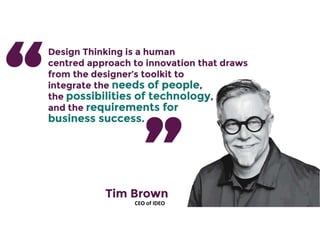
CEO of IDEO
The End Goal of Design Thinking
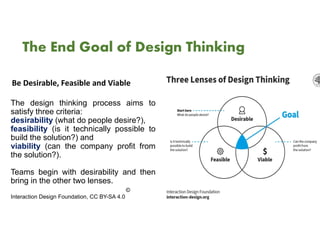
Be Desirable, Feasible and Viable
The design thinking process aims to
satisfy three criteria:
desirability (what do people desire?),
feasibility (is it technically possible to
build the solution?) and
viability (can the company profit from
the solution?).
Teams begin with desirability and then
bring in the other two lenses.
©
Interaction Design Foundation, CC BY-SA 4.0
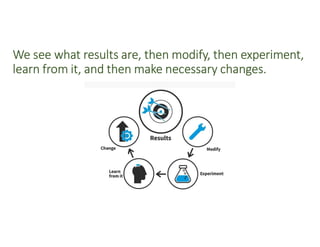
We see what results are, then modify, then experiment,
learn from it, and then make necessary changes.
Design Thinking Frameworks
1. Stanford University’s Five Stages of Design Thinking
(Empathize, Define, Ideate, Prototype, and Test)
2. Head, Heart and Hand by the American Institution of Graphic Arts (AIGA)
(It integrates the intellectual, emotional, and practical aspects of the
creative process.)
3. Inspire, Ideate, Implement by IDEO
(IDEO’s design thinking process is a cyclical three-step process that
involves Inspiration, Ideation and Implementation.)
4. The Double Diamond by the British Design Council
(Divergence-Convergence Model)
Design Thinking Mindsets: More than a Process
• The key mindsets that ensure a team can successfully implement design thinking are.
1. Be empathetic: Empathy is the ability to place yourself, your thinking and feelings in another person’s shoes. Design thinking begins from
a deep understanding of the needs and motivations of people—the parents, neighbors, children, colleagues, and strangers who make up
a community.
2. Be collaborative: No one person is responsible for the outcome when you work in a team. Several great minds are always stronger than
just one. Design thinking benefits from the views of multiple perspectives and lets others’ creativity bolster your own.
3. Be optimistic: Be confident about achieving favorable outcomes. Design thinking is the fundamental belief that we can all create
change—no matter how big a problem, how little time, or how small a budget. Designing can be a powerful process no matter what
constraints exist around you.
4. Embrace ambiguity: Get comfortable with ambiguous and complex situations. If you expect perfection, it is difficult to take risks, which
limits your ability to create radical change. Design thinking is all about experimenting and learning by doing. It gives you the confidence to
believe that new, better things are possible and that you can help make them a reality.
5. Be curious: Be open to different ideas. Recognize that you are not the user.
6. Reframe: Challenge and reframe assumptions associated with a given situation or problem. Don’t take problems at face value. Humans
are primed to look for patterns. The unfortunate side effect of these patterns is that we form (often false and sometimes dangerous)
stereotypes and assumptions. Design thinking aims to help you break through any preconceived notions and biases and reframe
challenges.
7. Embrace diversity: Work with and engage people with different cultural backgrounds, experiences, and ways of thinking and working.
Everyone brings a unique perspective to the team. When you include diverse voices in a team, you learn from each other’s experiences,
further helping you break through your assumptions.
8. Make tangible: When you make ideas tangible, it is faster and easier for everyone on the team to be on the same page. For example,
sketching an idea or enacting a scenario is far more convenient and easy to interpret than an elaborate presentation or document.
9. Take action: Run experiments and learn from them.
Key characteristics and principles of Design Thinking
• Innovation: Design Thinking encourages thinking outside the box and embracing new ideas and
solutions.
• User-Centric Approach: Design Thinking focuses on understanding and meeting the needs of the
users.
• Problem Solving: Design Thinking aims to identify and address problems creatively.
• Collaboration and Multidisciplinary Teams: Design Thinking involves teamwork and diverse
expertise to generate innovative solutions.
• Iterative and Agile Process: Design Thinking is an iterative process where ideas are tested,
refined, and improved upon.
• Humanizing Technology: Design Thinking seeks to create technology that is intuitive, accessible,
and improves the human experience.
• Enhancing User Experience: Design Thinking focuses on creating products and services that
provide a positive and seamless user experience.
• Business Success: Design Thinking can drive business success by creating innovative and user-
centric solutions.
• Adaptability and Future Readiness: Design Thinking enables organizations to adapt to change
and be prepared for the future.
• Continuous Learning and Improvement: Design Thinking values learning from failures, iterating,
and continuously improving the design.
The Importance of Design Thinking
Design thinking plays a crucial role in driving innovation and creating solutions
that truly meet user needs. By adopting a design thinking approach, businesses
can achieve a range of benefits and enhance their chances of success.
A. Impact on Innovation
• Foster innovation by understanding user needs and creating valuable
solutions
• Encouragement of out-of-the-box thinking and unconventional ideas
B. User-Centric Approach
• Empathy and gaining insights into user preferences
• Creation of products/services that truly meet user needs
• Development of effective and impactful solutions by understanding user
experiences and interactions
The Importance of Design Thinking… contd.
C. Problem-Solving Framework
• Structured framework for breaking down complex challenges
• Encourages systematic thinking, identification of root causes, and generation of
multiple solutions:
• Selection of the most appropriate solution to address the problem
D. Collaboration and Multidisciplinary Teams
• Encourages collaboration and teamwork
• Integration of diverse backgrounds and expertise to contribute unique
perspectives
• Collective creation of better solutions through diverse input
E. Iterative and Agile Process
• Continuous refinement and improvement of solutions
• Quick prototyping and testing for early feedback and adjustments
• Achievement of more successful outcomes through an iterative approach
The Importance of Design Thinking… contd.
F. Humanizing Technology
• Bringing a human touch to technology
• Emphasizing user-friendly and intuitive interfaces
• Ensuring technology serves people and enhances their experiences
G. Enhancing User Experience
• Vital role in creating memorable and delightful user experiences
• Focus on every aspect of user journey, from initial interactions to long-term
engagement
• Ensuring positive and meaningful experiences for users
• H. Business Success
• Link between Design Thinking and business success
• Differentiation in the market by addressing user needs and preferences
• Improved customer satisfaction and financial performance
References
• https://www.interaction-design.org/literature/topics/design-thinking
• https://growthnatives.com/blogs/design/why-is-design-thinking-so-
important/
• https://www.wired.com/insights/2014/04/origins-design-thinking/
• https://careerfoundry.com/en/blog/ux-design/what-is-design-
thinking-everything-you-need-to-know-to-get-started/

iNTEROF SDFFDEWRDFS FSDFSDFSASDAFFDFSSDA

  • 1.
    DESIGN THINKING- Introduction DrPrabhat K. Dwivedi Associate Professor Deptt. of Business Management, CSJM University, Kanpur, India
  • 2.
    Difference between Solution-Basedand Problem-Based Thinking As the name suggests, solution-based thinking focuses on finding solutions; coming up with something constructive to effectively tackle a certain problem. This is the opposite of problem-based thinking, which tends to fixate on obstacles and limitations.
  • 3.
    Meaning & Definition •Design thinking is both an ideology and a process, concerned with solving complex problems in a highly user-centric way. It is an approach used for practical and creative problem-solving. • It has actually evolved from a range of different fields—including architecture, engineering and business. Design thinking can also be applied to any field; it doesn’t necessarily have to be design-specific. • Design thinking is extremely user-centric. It focuses on humans first and foremost, seeking to understand people’s needs and come up with effective solutions to meet those needs. It is what we call a solution-based approach to problem-solving.
  • 4.
  • 5.
    The End Goalof Design Thinking Be Desirable, Feasible and Viable The design thinking process aims to satisfy three criteria: desirability (what do people desire?), feasibility (is it technically possible to build the solution?) and viability (can the company profit from the solution?). Teams begin with desirability and then bring in the other two lenses. © Interaction Design Foundation, CC BY-SA 4.0
  • 7.
    We see whatresults are, then modify, then experiment, learn from it, and then make necessary changes.
  • 8.
    Design Thinking Frameworks 1.Stanford University’s Five Stages of Design Thinking (Empathize, Define, Ideate, Prototype, and Test) 2. Head, Heart and Hand by the American Institution of Graphic Arts (AIGA) (It integrates the intellectual, emotional, and practical aspects of the creative process.) 3. Inspire, Ideate, Implement by IDEO (IDEO’s design thinking process is a cyclical three-step process that involves Inspiration, Ideation and Implementation.) 4. The Double Diamond by the British Design Council (Divergence-Convergence Model)
  • 9.
    Design Thinking Mindsets:More than a Process • The key mindsets that ensure a team can successfully implement design thinking are. 1. Be empathetic: Empathy is the ability to place yourself, your thinking and feelings in another person’s shoes. Design thinking begins from a deep understanding of the needs and motivations of people—the parents, neighbors, children, colleagues, and strangers who make up a community. 2. Be collaborative: No one person is responsible for the outcome when you work in a team. Several great minds are always stronger than just one. Design thinking benefits from the views of multiple perspectives and lets others’ creativity bolster your own. 3. Be optimistic: Be confident about achieving favorable outcomes. Design thinking is the fundamental belief that we can all create change—no matter how big a problem, how little time, or how small a budget. Designing can be a powerful process no matter what constraints exist around you. 4. Embrace ambiguity: Get comfortable with ambiguous and complex situations. If you expect perfection, it is difficult to take risks, which limits your ability to create radical change. Design thinking is all about experimenting and learning by doing. It gives you the confidence to believe that new, better things are possible and that you can help make them a reality. 5. Be curious: Be open to different ideas. Recognize that you are not the user. 6. Reframe: Challenge and reframe assumptions associated with a given situation or problem. Don’t take problems at face value. Humans are primed to look for patterns. The unfortunate side effect of these patterns is that we form (often false and sometimes dangerous) stereotypes and assumptions. Design thinking aims to help you break through any preconceived notions and biases and reframe challenges. 7. Embrace diversity: Work with and engage people with different cultural backgrounds, experiences, and ways of thinking and working. Everyone brings a unique perspective to the team. When you include diverse voices in a team, you learn from each other’s experiences, further helping you break through your assumptions. 8. Make tangible: When you make ideas tangible, it is faster and easier for everyone on the team to be on the same page. For example, sketching an idea or enacting a scenario is far more convenient and easy to interpret than an elaborate presentation or document. 9. Take action: Run experiments and learn from them.
  • 10.
    Key characteristics andprinciples of Design Thinking • Innovation: Design Thinking encourages thinking outside the box and embracing new ideas and solutions. • User-Centric Approach: Design Thinking focuses on understanding and meeting the needs of the users. • Problem Solving: Design Thinking aims to identify and address problems creatively. • Collaboration and Multidisciplinary Teams: Design Thinking involves teamwork and diverse expertise to generate innovative solutions. • Iterative and Agile Process: Design Thinking is an iterative process where ideas are tested, refined, and improved upon. • Humanizing Technology: Design Thinking seeks to create technology that is intuitive, accessible, and improves the human experience. • Enhancing User Experience: Design Thinking focuses on creating products and services that provide a positive and seamless user experience. • Business Success: Design Thinking can drive business success by creating innovative and user- centric solutions. • Adaptability and Future Readiness: Design Thinking enables organizations to adapt to change and be prepared for the future. • Continuous Learning and Improvement: Design Thinking values learning from failures, iterating, and continuously improving the design.
  • 11.
    The Importance ofDesign Thinking Design thinking plays a crucial role in driving innovation and creating solutions that truly meet user needs. By adopting a design thinking approach, businesses can achieve a range of benefits and enhance their chances of success. A. Impact on Innovation • Foster innovation by understanding user needs and creating valuable solutions • Encouragement of out-of-the-box thinking and unconventional ideas B. User-Centric Approach • Empathy and gaining insights into user preferences • Creation of products/services that truly meet user needs • Development of effective and impactful solutions by understanding user experiences and interactions
  • 12.
    The Importance ofDesign Thinking… contd. C. Problem-Solving Framework • Structured framework for breaking down complex challenges • Encourages systematic thinking, identification of root causes, and generation of multiple solutions: • Selection of the most appropriate solution to address the problem D. Collaboration and Multidisciplinary Teams • Encourages collaboration and teamwork • Integration of diverse backgrounds and expertise to contribute unique perspectives • Collective creation of better solutions through diverse input E. Iterative and Agile Process • Continuous refinement and improvement of solutions • Quick prototyping and testing for early feedback and adjustments • Achievement of more successful outcomes through an iterative approach
  • 13.
    The Importance ofDesign Thinking… contd. F. Humanizing Technology • Bringing a human touch to technology • Emphasizing user-friendly and intuitive interfaces • Ensuring technology serves people and enhances their experiences G. Enhancing User Experience • Vital role in creating memorable and delightful user experiences • Focus on every aspect of user journey, from initial interactions to long-term engagement • Ensuring positive and meaningful experiences for users • H. Business Success • Link between Design Thinking and business success • Differentiation in the market by addressing user needs and preferences • Improved customer satisfaction and financial performance
  • 14.
    References • https://www.interaction-design.org/literature/topics/design-thinking • https://growthnatives.com/blogs/design/why-is-design-thinking-so- important/ •https://www.wired.com/insights/2014/04/origins-design-thinking/ • https://careerfoundry.com/en/blog/ux-design/what-is-design- thinking-everything-you-need-to-know-to-get-started/