INSURANCE ACT
   The Insurance Act of 1938 was the first
    legislation governing all forms of insurance to
    provide strict state control over insurance
    business.
   Purpose:- to safe guard the interest of insured,
    setting the norms for carrying out the business
    of insurance smoothly, Minimizing disputes
INSURANCE ACT 1938


   Dictionary of business and Finance
    defines “Insurance as a form of contract
    agreement under which one party agrees
    in return for a consideration to pay an
    agreed amount of money to another party
    to make good a loss, damage or injury to
    something of value in which the insured
    has a interest as a result of some
    uncertain event.
IMPORTANCE OF
INSURANCE
   Provides protection against occurrence of
    uncertain events.
   Device for eliminating risks and sharing
    losses.
    Co-operative method of spreading risks.
   Facilitates international trade.
   Serves as an agency of capital formation.
   Financial support.
    Medical support.
   Source of employment.
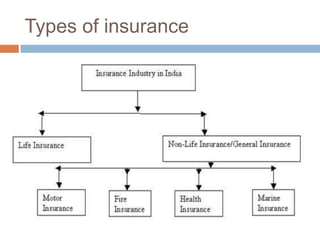
Types of insurance
Life insurance:
   Life insurance is a contract between the policy
    owner and the insurer,
   where the insurer agrees to reimburse the
    occurrence of the insured individual's death or
    other event such as terminal illness or critical
    illness.
   The insured agrees to pay the cost in terms of
    insurance premium for the service. Specific
    exclusions are often written in the contract to limit
    the liability of the insurer, for example claims
    related to suicide, fraud, war, riot and civil
    commotion is not covered.
general insurance
   Insuring anything other than human life is
    called general insurance.
   Examples are insuring property like house and
    belongings against fire and theft or vehicles
    against accidental damage or theft. Injury due
    to accident or hospitalisation for illness and
    surgery can also be insured. Your liabilities to
    others arising out of the law can also be
    insured and is compulsory in some cases like
    motor third party insurance
Fire insurance
   Insurance that is used to cover damage to a
    property caused by fire. Fire insurance is a
    specialized form of insurance beyond property
    insurance, and is designed to cover the cost of
    replacement, reconstruction or repair beyond
    what is covered by the property insurance
    policy. Policies cover damage to the building
    itself, and may also cover damage to nearby
    structures, personal property and expenses
    associated with not being able to live in or use
    the property if it is damaged.
Health insurance
   A type of insurance coverage that pays for
    medical and surgical expenses that are
    incurred by the insured. Health insurance can
    either reimburse the insured for expenses
    incurred from illness or injury or pay the care
    provider directly. Health insurance is often
    included in employer benefit packages as a
    means of enticing quality employees.
Marine Insurance
   Marine Insurance covers the loss or damage
    of ships, cargo, terminals, and any transport or
    cargo by which property is transferred
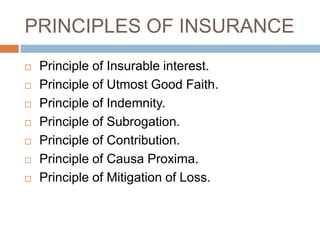
PRINCIPLES OF INSURANCE
   Principle of Insurable interest.
   Principle of Utmost Good Faith.
   Principle of Indemnity.
   Principle of Subrogation.
   Principle of Contribution.
   Principle of Causa Proxima.
   Principle of Mitigation of Loss.
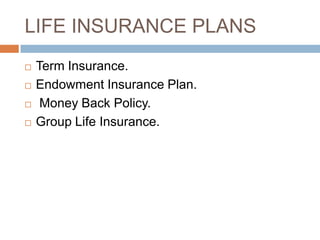
LIFE INSURANCE PLANS
   Term Insurance.
   Endowment Insurance Plan.
    Money Back Policy.
   Group Life Insurance.
REGULATIONS OF INSURANCE
BY IRDA
    Deposits.
   Investments.
    Valuation Of Assets.
   Submission of Returns.
   Insurance Advertisements.
   Foreign Exchange laws.
ACTS GOVERNING
INSURANCE
   The insurance Act, 1938 to govern all form of
    insurance and to provide strict control over insurance
    business.
    Insurance Regulatory and authority act, 1999 (to
    provide) for the establishment of an authority to
    protect the interest of the holder of insurance policy, to
    regulate, promote and ensure orderly growth of
    insurance industry and for matter connected therewith
    or incidental thereto and future to amend the
    Insurance Act, 1938, the Life Insurance Corporation
    Act, 1956 and the general insurance business
    (Nationalization) act, 1972.
   The Actuaries Act, 2006 (An Act to provide for
    regulating and developing the profession of Actuaries
    and for matters connected therewith or incidental
    thereto).
INSURANCE LAW
REGULATIONS
    Insurance law regulations in India manage all
    the matters related to various insurance
    companies in the country. The concept of
    insurance in India dates back to the ancient
    period.
   Entry of Private Companies.
   Regulatory Authorities.
   Insurance Regulatory and Development
    Authority.
INSURANCE REGULATORY &
DEVELOPMENTAUTHORITY
   Insurance Regulatory & Development
    Authority is regulatory and development
    authority under Government of India in order to
    protect the interests of the policyholders and to
    regulate, promote and ensure orderly growth
    of the insurance industry.
    Powers and Functions of IRDA.
   Impact Of IRDA On Indian Insurance Sector.

Ppt insurance ...

  • 1.
  • 2.
    The Insurance Act of 1938 was the first legislation governing all forms of insurance to provide strict state control over insurance business.  Purpose:- to safe guard the interest of insured, setting the norms for carrying out the business of insurance smoothly, Minimizing disputes
  • 3.
    INSURANCE ACT 1938  Dictionary of business and Finance defines “Insurance as a form of contract agreement under which one party agrees in return for a consideration to pay an agreed amount of money to another party to make good a loss, damage or injury to something of value in which the insured has a interest as a result of some uncertain event.
  • 4.
    IMPORTANCE OF INSURANCE  Provides protection against occurrence of uncertain events.  Device for eliminating risks and sharing losses.  Co-operative method of spreading risks.  Facilitates international trade.  Serves as an agency of capital formation.  Financial support.  Medical support.  Source of employment.
  • 5.
  • 6.
    Life insurance:  Life insurance is a contract between the policy owner and the insurer,  where the insurer agrees to reimburse the occurrence of the insured individual's death or other event such as terminal illness or critical illness.  The insured agrees to pay the cost in terms of insurance premium for the service. Specific exclusions are often written in the contract to limit the liability of the insurer, for example claims related to suicide, fraud, war, riot and civil commotion is not covered.
  • 7.
    general insurance  Insuring anything other than human life is called general insurance.  Examples are insuring property like house and belongings against fire and theft or vehicles against accidental damage or theft. Injury due to accident or hospitalisation for illness and surgery can also be insured. Your liabilities to others arising out of the law can also be insured and is compulsory in some cases like motor third party insurance
  • 8.
    Fire insurance  Insurance that is used to cover damage to a property caused by fire. Fire insurance is a specialized form of insurance beyond property insurance, and is designed to cover the cost of replacement, reconstruction or repair beyond what is covered by the property insurance policy. Policies cover damage to the building itself, and may also cover damage to nearby structures, personal property and expenses associated with not being able to live in or use the property if it is damaged.
  • 9.
    Health insurance  A type of insurance coverage that pays for medical and surgical expenses that are incurred by the insured. Health insurance can either reimburse the insured for expenses incurred from illness or injury or pay the care provider directly. Health insurance is often included in employer benefit packages as a means of enticing quality employees.
  • 10.
    Marine Insurance  Marine Insurance covers the loss or damage of ships, cargo, terminals, and any transport or cargo by which property is transferred
  • 11.
    PRINCIPLES OF INSURANCE  Principle of Insurable interest.  Principle of Utmost Good Faith.  Principle of Indemnity.  Principle of Subrogation.  Principle of Contribution.  Principle of Causa Proxima.  Principle of Mitigation of Loss.
  • 12.
    LIFE INSURANCE PLANS  Term Insurance.  Endowment Insurance Plan.  Money Back Policy.  Group Life Insurance.
  • 13.
    REGULATIONS OF INSURANCE BYIRDA  Deposits.  Investments.  Valuation Of Assets.  Submission of Returns.  Insurance Advertisements.  Foreign Exchange laws.
  • 14.
    ACTS GOVERNING INSURANCE  The insurance Act, 1938 to govern all form of insurance and to provide strict control over insurance business.  Insurance Regulatory and authority act, 1999 (to provide) for the establishment of an authority to protect the interest of the holder of insurance policy, to regulate, promote and ensure orderly growth of insurance industry and for matter connected therewith or incidental thereto and future to amend the Insurance Act, 1938, the Life Insurance Corporation Act, 1956 and the general insurance business (Nationalization) act, 1972.  The Actuaries Act, 2006 (An Act to provide for regulating and developing the profession of Actuaries and for matters connected therewith or incidental thereto).
  • 15.
    INSURANCE LAW REGULATIONS  Insurance law regulations in India manage all the matters related to various insurance companies in the country. The concept of insurance in India dates back to the ancient period.  Entry of Private Companies.  Regulatory Authorities.  Insurance Regulatory and Development Authority.
  • 16.
    INSURANCE REGULATORY & DEVELOPMENTAUTHORITY  Insurance Regulatory & Development Authority is regulatory and development authority under Government of India in order to protect the interests of the policyholders and to regulate, promote and ensure orderly growth of the insurance industry.  Powers and Functions of IRDA.  Impact Of IRDA On Indian Insurance Sector.