Mayuresh Singh
1281010025
CS 3rd Year
 Human-computer interaction (HCI) is a
multidisciplinary research area focused on
interaction modalities between humans and
computers; sometimes, the more general
term human-machine interface (HMI) is used
to refer to the user interface in a
manufacturing or process-control system.
 In other words, the HCI discipline
investigates and tackles all issues related to
the design and implementation of the
interface between humans and computers.
 The Association for Computing
Machinery defines human-computer
interaction as "a discipline concerned with
the design, evaluation and implementation
of interactive computing systems for human
use and with the study of major phenomena
surrounding them.
 Although studies about HCI date back to
1975, recent technological advances in
consumer electronics have opened exciting
new scenarios: gestures, hand and body
poses, speech, and gaze are just a few
natural interaction modes that can be used
to design affordable natural user
interfaces (NUIs).
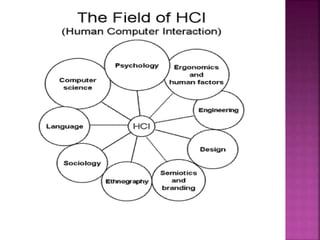
 HCI innately involves multiple computer
science-related disciplines (image
processing, computer vision, programming
languages, and so on) as well as disciplines
related to human sciences (ergonomics,
human factors, cognitive psychology, and so
on). Research about HCI primarily concerns
the design, implementation, and assessment
of new interfaces to improve the interaction
between humans and machines.
 Human-Computer Interaction studies the
ways in which humans make, or make not,
use of computational artifacts, systems and
infrastructures.
 In so doing, much of the research in the
field seek to `improve' human-computer
interaction by improving the `usability' of
computer interfaces. How `usability' is to be
precisely understood, how it relates to other
social and cultural values and when it is, and
when it may not be a desirable property of
computer interfaces is increasingly debated.
 Researchers in HCI are interested in
developing new design methodologies,
experimenting with new devices, prototyping
new software systems, exploring new
interaction paradigms, and developing
models and theories of interaction.
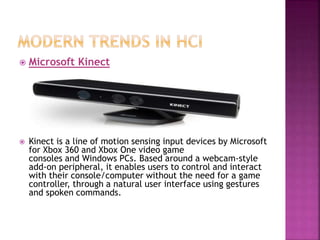
 Microsoft Kinect
 Kinect is a line of motion sensing input devices by Microsoft
for Xbox 360 and Xbox One video game
consoles and Windows PCs. Based around a webcam-style
add-on peripheral, it enables users to control and interact
with their console/computer without the need for a game
controller, through a natural user interface using gestures
and spoken commands.
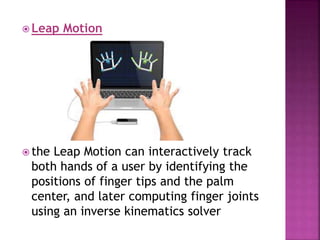
 Leap Motion
 the Leap Motion can interactively track
both hands of a user by identifying the
positions of finger tips and the palm
center, and later computing finger joints
using an inverse kinematics solver
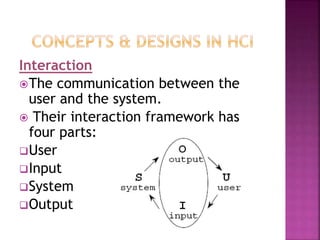
Interaction
The communication between the
user and the system.
 Their interaction framework has
four parts:
User
Input
System
Output
Interaction can be seen as a dialogue
between the computer and the user. Some
applications have very distinct styles of
interaction.
We can identify some common styles
 Command line interface
 Menus
 Natural language
 question/answer and query dialogue
 Form-fills and spreadsheets
 WIMP
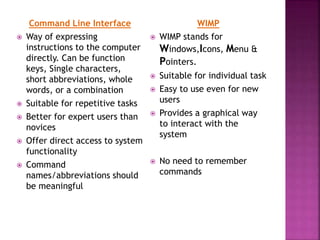
Command Line Interface
 Way of expressing
instructions to the computer
directly. Can be function
keys, Single characters,
short abbreviations, whole
words, or a combination
 Suitable for repetitive tasks
 Better for expert users than
novices
 Offer direct access to system
functionality
 Command
names/abbreviations should
be meaningful
WIMP
 WIMP stands for
Windows,Icons, Menu &
Pointers.
 Suitable for individual task
 Easy to use even for new
users
 Provides a graphical way
to interact with the
system
 No need to remember
commands
Gesture recognition
 Primary goal of gesture recognition
research is to create a system which can
identify specific human gestures and use
them to convey information or for device
control.
 Human gestures are certainly natural and
flexible, and may often be efficient and
powerful, especially as compared with
alternative interaction modes.
 To support gesture recognition, human
position and movement must be tracked and
interpreted in order to recognize
semantically meaningful gestures.
 Modern Devices such as ‘Microsoft Kinect’
and ‘Leap Motion’ are able to recognize
gestures quickly. These devices are also
available in market at affordable price. Sdk.
is also available for these devices.
 New areas like AI and Virtual Reality are
opening new doors for Human Computer
Interaction. New interfacing devices like
wearable clothes and etc. are the future of
HCI.
 Computers have a direct impact on our lives
nowadays.
 Human's interaction with the computer has
modified with the passage of time as
improvement in technology occurred the
better the human computer interaction
became.
 Though the human computer interaction has
improved but it's not done yet.
 The subject of Human Computer Interaction
is very rich both in terms of the disciplines it
draws from as well as opportunities for
research.
 Discussed here was just a small subset of the
topics contained within HCI.
Thanks for your cooperation

Human computer interaction

  • 1.
  • 2.
     Human-computer interaction(HCI) is a multidisciplinary research area focused on interaction modalities between humans and computers; sometimes, the more general term human-machine interface (HMI) is used to refer to the user interface in a manufacturing or process-control system.  In other words, the HCI discipline investigates and tackles all issues related to the design and implementation of the interface between humans and computers.
  • 3.
     The Associationfor Computing Machinery defines human-computer interaction as "a discipline concerned with the design, evaluation and implementation of interactive computing systems for human use and with the study of major phenomena surrounding them.  Although studies about HCI date back to 1975, recent technological advances in consumer electronics have opened exciting new scenarios: gestures, hand and body poses, speech, and gaze are just a few natural interaction modes that can be used to design affordable natural user interfaces (NUIs).
  • 4.
     HCI innatelyinvolves multiple computer science-related disciplines (image processing, computer vision, programming languages, and so on) as well as disciplines related to human sciences (ergonomics, human factors, cognitive psychology, and so on). Research about HCI primarily concerns the design, implementation, and assessment of new interfaces to improve the interaction between humans and machines.
  • 6.
     Human-Computer Interactionstudies the ways in which humans make, or make not, use of computational artifacts, systems and infrastructures.  In so doing, much of the research in the field seek to `improve' human-computer interaction by improving the `usability' of computer interfaces. How `usability' is to be precisely understood, how it relates to other social and cultural values and when it is, and when it may not be a desirable property of computer interfaces is increasingly debated.
  • 7.
     Researchers inHCI are interested in developing new design methodologies, experimenting with new devices, prototyping new software systems, exploring new interaction paradigms, and developing models and theories of interaction.
  • 8.
     Microsoft Kinect Kinect is a line of motion sensing input devices by Microsoft for Xbox 360 and Xbox One video game consoles and Windows PCs. Based around a webcam-style add-on peripheral, it enables users to control and interact with their console/computer without the need for a game controller, through a natural user interface using gestures and spoken commands.
  • 9.
     Leap Motion the Leap Motion can interactively track both hands of a user by identifying the positions of finger tips and the palm center, and later computing finger joints using an inverse kinematics solver
  • 10.
    Interaction The communication betweenthe user and the system.  Their interaction framework has four parts: User Input System Output
  • 11.
    Interaction can beseen as a dialogue between the computer and the user. Some applications have very distinct styles of interaction. We can identify some common styles  Command line interface  Menus  Natural language  question/answer and query dialogue  Form-fills and spreadsheets  WIMP
  • 12.
    Command Line Interface Way of expressing instructions to the computer directly. Can be function keys, Single characters, short abbreviations, whole words, or a combination  Suitable for repetitive tasks  Better for expert users than novices  Offer direct access to system functionality  Command names/abbreviations should be meaningful WIMP  WIMP stands for Windows,Icons, Menu & Pointers.  Suitable for individual task  Easy to use even for new users  Provides a graphical way to interact with the system  No need to remember commands
  • 13.
    Gesture recognition  Primarygoal of gesture recognition research is to create a system which can identify specific human gestures and use them to convey information or for device control.  Human gestures are certainly natural and flexible, and may often be efficient and powerful, especially as compared with alternative interaction modes.
  • 14.
     To supportgesture recognition, human position and movement must be tracked and interpreted in order to recognize semantically meaningful gestures.  Modern Devices such as ‘Microsoft Kinect’ and ‘Leap Motion’ are able to recognize gestures quickly. These devices are also available in market at affordable price. Sdk. is also available for these devices.
  • 15.
     New areaslike AI and Virtual Reality are opening new doors for Human Computer Interaction. New interfacing devices like wearable clothes and etc. are the future of HCI.  Computers have a direct impact on our lives nowadays.  Human's interaction with the computer has modified with the passage of time as improvement in technology occurred the better the human computer interaction became.
  • 16.
     Though thehuman computer interaction has improved but it's not done yet.  The subject of Human Computer Interaction is very rich both in terms of the disciplines it draws from as well as opportunities for research.  Discussed here was just a small subset of the topics contained within HCI.
  • 17.
    Thanks for yourcooperation