





Dependency Theory Dr. Christopher S. Rice
“ Voices from the Periphery”
Economic Commission for Latin America (ECLA)
 
The American debacle in Vietnam and the eruption of major racial troubles in the mid-1960s, followed by chronic inflation, the devaluation of the American dollar and the general loss of America’s self-confidence in the early 1970s ended the moral conviction on which modernization theory had come to base itself…
… A new type of theory became popular among younger sociologists, one that reversed all the old axioms. America became the very model of evil, and capitalism, which had been seen as the cause of social progress, became a sinister exploiter and the main agent of poverty in most of the world. Imperialism, not backwardness and lack of modernity, was the new enemy.” Daniel Chirot (1981)
 
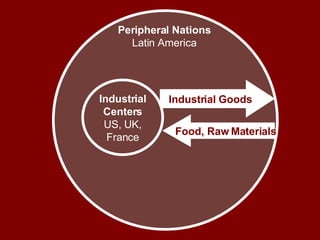
Industrial Centers US, UK, France Peripheral Nations Latin America Industrial Goods Food, Raw Materials
Prebisch’s Industrialization  Strategy (ECLA Amnifesto) One-sided international division of labor to be stopped, Latin America to undergo industrialization Industrialization to be sped up by substitution of a large part of current imports by domestic production Income from raw materials would pay for imported capital goods Governments should be active participants (as coordinators) of the industrialization program
Failure of the ECLA
“ The purchasing power was limited to certain social strata, and the domestic market showed no tendency to expand after its needs had been fulfilled. The import dependency had simply shifted from consumption goods to capital goods. The conventional export goods had been neglected in the general frenzy of industrialization, the result was acute balance-of-payment problems in one country after another. The optimism of growth changed into deep depression.” Blomstrom and Hettne (1984)
Neo-Marxism
Neo-Marxism vs. Orthodox Marxism Orthodox Marxists see imperialism from the “center’s” perspective, Neo-Marxists see imperialism from the “peripheral” point of view. Orthodox Marxists advocate a strategy of a two-stage revolution, Neo-Marxists believe the time is ripe for a socialist revolution NOW. Urban vs. Rural nature of the Revolution.
The “Development of Underdevelopment” (Andre Frank)
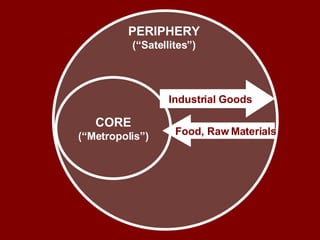
CORE (“Metropolis”) PERIPHERY (“Satellites”) Industrial Goods Food, Raw Materials
Hypotheses based on the Metropolis-Satellite Model
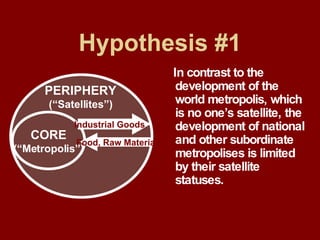
Hypothesis #1 In contrast to the development of the world metropolis, which is no one’s satellite, the development of national and other subordinate metropolises is limited by their satellite statuses. CORE (“Metropolis”) PERIPHERY (“Satellites”) Industrial Goods Food, Raw Materials
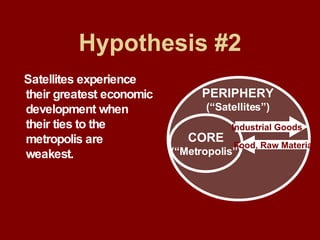
Hypothesis #2 Satellites experience their greatest economic development when their ties to the metropolis are weakest.  CORE (“Metropolis”) PERIPHERY (“Satellites”) Industrial Goods Food, Raw Materials
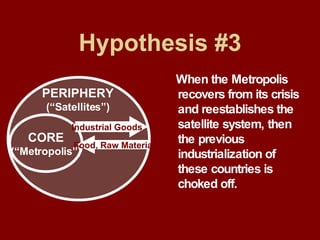
Hypothesis #3 When the Metropolis recovers from its crisis and reestablishes the satellite system, then the previous industrialization of these countries is choked off. CORE (“Metropolis”) PERIPHERY (“Satellites”) Industrial Goods Food, Raw Materials
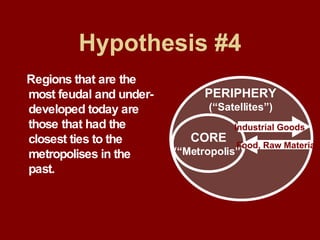
Hypothesis #4 Regions that are the most feudal and under-developed today are those that had the closest ties to the metropolises in the past.  CORE (“Metropolis”) PERIPHERY (“Satellites”) Industrial Goods Food, Raw Materials
The Structure of Dependence
The relationship between two or more countries “assumes the form of dependence when some countries (the dominant ones) can expand and be self-starting, while other countries (the dependent ones) can do this only as a reflection of that expansion.” Theotonio Dos Santos
3
Colonial Dependence
Financial-Industrial Dependence
Technological-Industrial Dependence
Policy Implications
#1: Redefining “Development”
#2: Politics of Self-Reliance
#3: “Talkin ‘Bout a Revolution”
Critique of Dependency Theory
#1: Ideology vs. Methodology
#2: The Concept of “Dependency”
#3: Policy Implications

Dependency Theory

  • 1.
    Dependency Theory Dr.Christopher S. Rice
  • 2.
    “ Voices fromthe Periphery”
  • 3.
    Economic Commission forLatin America (ECLA)
  • 4.
  • 5.
    The American debaclein Vietnam and the eruption of major racial troubles in the mid-1960s, followed by chronic inflation, the devaluation of the American dollar and the general loss of America’s self-confidence in the early 1970s ended the moral conviction on which modernization theory had come to base itself…
  • 6.
    … A newtype of theory became popular among younger sociologists, one that reversed all the old axioms. America became the very model of evil, and capitalism, which had been seen as the cause of social progress, became a sinister exploiter and the main agent of poverty in most of the world. Imperialism, not backwardness and lack of modernity, was the new enemy.” Daniel Chirot (1981)
  • 7.
  • 8.
    Industrial Centers US,UK, France Peripheral Nations Latin America Industrial Goods Food, Raw Materials
  • 9.
    Prebisch’s Industrialization Strategy (ECLA Amnifesto) One-sided international division of labor to be stopped, Latin America to undergo industrialization Industrialization to be sped up by substitution of a large part of current imports by domestic production Income from raw materials would pay for imported capital goods Governments should be active participants (as coordinators) of the industrialization program
  • 10.
  • 11.
    “ The purchasingpower was limited to certain social strata, and the domestic market showed no tendency to expand after its needs had been fulfilled. The import dependency had simply shifted from consumption goods to capital goods. The conventional export goods had been neglected in the general frenzy of industrialization, the result was acute balance-of-payment problems in one country after another. The optimism of growth changed into deep depression.” Blomstrom and Hettne (1984)
  • 12.
  • 13.
    Neo-Marxism vs. OrthodoxMarxism Orthodox Marxists see imperialism from the “center’s” perspective, Neo-Marxists see imperialism from the “peripheral” point of view. Orthodox Marxists advocate a strategy of a two-stage revolution, Neo-Marxists believe the time is ripe for a socialist revolution NOW. Urban vs. Rural nature of the Revolution.
  • 14.
    The “Development ofUnderdevelopment” (Andre Frank)
  • 15.
    CORE (“Metropolis”) PERIPHERY(“Satellites”) Industrial Goods Food, Raw Materials
  • 16.
    Hypotheses based onthe Metropolis-Satellite Model
  • 17.
    Hypothesis #1 Incontrast to the development of the world metropolis, which is no one’s satellite, the development of national and other subordinate metropolises is limited by their satellite statuses. CORE (“Metropolis”) PERIPHERY (“Satellites”) Industrial Goods Food, Raw Materials
  • 18.
    Hypothesis #2 Satellitesexperience their greatest economic development when their ties to the metropolis are weakest. CORE (“Metropolis”) PERIPHERY (“Satellites”) Industrial Goods Food, Raw Materials
  • 19.
    Hypothesis #3 Whenthe Metropolis recovers from its crisis and reestablishes the satellite system, then the previous industrialization of these countries is choked off. CORE (“Metropolis”) PERIPHERY (“Satellites”) Industrial Goods Food, Raw Materials
  • 20.
    Hypothesis #4 Regionsthat are the most feudal and under-developed today are those that had the closest ties to the metropolises in the past. CORE (“Metropolis”) PERIPHERY (“Satellites”) Industrial Goods Food, Raw Materials
  • 21.
    The Structure ofDependence
  • 22.
    The relationship betweentwo or more countries “assumes the form of dependence when some countries (the dominant ones) can expand and be self-starting, while other countries (the dependent ones) can do this only as a reflection of that expansion.” Theotonio Dos Santos
  • 23.
  • 24.
  • 25.
  • 26.
  • 27.
  • 28.
  • 29.
    #2: Politics ofSelf-Reliance
  • 30.
    #3: “Talkin ‘Bouta Revolution”
  • 31.
  • 32.
    #1: Ideology vs.Methodology
  • 33.
    #2: The Conceptof “Dependency”
  • 34.