Critique of modernization
and human capital theory in
education.
Focus on Papua New Guinea
• Modernization
Social, economic, cultural changes which lead to a
more complex, differentiated and specialized
society.
•
In SOCIOLOGY
• “Psycho-cultural approaches”: the modern
man
- Capitalistic spirit (Weber)
- Values and need for achievement
(McClelland)
• “Structural approaches”
• - Spencer, Durkheim, Smelzer, Parsons
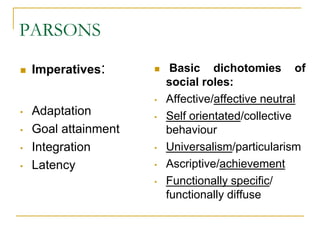
PARSONS
 Imperatives:
• Adaptation
• Goal attainment
• Integration
• Latency
 Basic dichotomies of
social roles:
• Affective/affective neutral
• Self orientated/collective
behaviour
• Universalism/particularism
• Ascriptive/achievement
• Functionally specific/
functionally diffuse
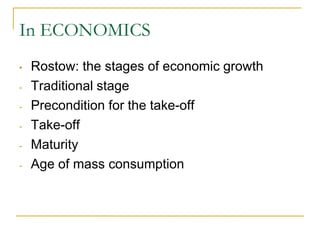
In ECONOMICS
• Rostow: the stages of economic growth
- Traditional stage
- Precondition for the take-off
- Take-off
- Maturity
- Age of mass consumption
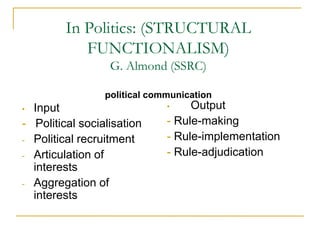
In Politics: (STRUCTURAL
FUNCTIONALISM)
G. Almond (SSRC)
political communication
• Input
- Political socialisation
- Political recruitment
- Articulation of
interests
- Aggregation of
interests
• Output
- Rule-making
- Rule-implementation
- Rule-adjudication
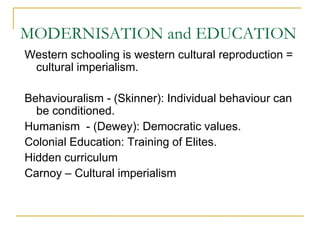
MODERNISATION and EDUCATION
Western schooling is western cultural reproduction =
cultural imperialism.
Behaviouralism - (Skinner): Individual behaviour can
be conditioned.
Humanism - (Dewey): Democratic values.
Colonial Education: Training of Elites.
Hidden curriculum
Carnoy – Cultural imperialism
PAPUA and EDUCATION
Demerath‟s writing on Papua New Guinea and
colonisation of the mind (Fanon)
Traditional and modern identity are chosen, not
simply granted or received
Historical beliefs about the „efficacy of knowledge‟
Ambivalence towards Western education
Allegiance with traditional identity
Colonisation of the Mind – Fanon
PAPUA and EDUCATION
Australia sends most of its development money to
Papua.
Extractive industry – rich and poor divide
Civil unrest and domestic violence high
Need more data…..
HUMAN CAPITAL THEORY
Mincer and Gary Becker of the "Chicago School“
Psacharopoulos: rates of return
HUMAN CAPITAL THEORY
Africa:
Brain drain
Dore - Diploma Disease1960‟s
Narrow focus on economic growth but no jobs.
World Bank and human capital investment. Education
is seen as a vehicle for economic growth.
Eg. basic needs education, functional literacy.
Can have high GDP but no social cohesion, or
creates educated pirates / criminals.
Gunder Frank Dependency Theory –
Critical historical approach
 Underdevelopment is a function of the
position a country occupies in the
international system
 Structural approach at the global level
 Centre-Periphery dialectic
 Role of elites and Lumpenbourgoisie /
compardor class
 Critique of Ideal Type approach
Dependency theory solutions
 Rupture with the capitalist world-economy
 Samir Amin, Delinking: Towards a polycentric
world (1985)
 Self-reliance through socialism (Tanzania)
 Import Substitution or Dependant
Development - Cardoso
 Socialist revolution – Gunder Frank
CRITIQUE OF MODERNISATION
DEVELOPMENT THEORY
• Ethnocentric and ahistorical
• Ignores the structural effect of capitalism /
colonialism with analysis on internal aspects
• Dualism of modern and traditional is based
on the modern western „logos‟.
• Evolutionist & utilitarian
• Cultural Imperialism (Michael Carnoy)
CRITIQUE OF MODERNISATION
DEVELOPMENT THEORY
Economic rationalism is distorted by non-
economic forces, racial, ethnic, gender bias.
Market liberalist economics ignores structural
effect of the distribution of wealth.
Poverty or underdevelopment is nothing to do
with Western or Enlightenment values, but to
do with colonialism and capitalism.
Explains the dept crisis in Third World and civil
unrest and dictatorships.
CRITIQUE OF MODERNISATION
DEVELOPMENT THEORY
Deconstructs modernization using rational
„systemic thinking‟ to reveal the externalities
in the macro picture.
Example: Corruption a big problem in
developing countries. Can be seen as a
market distortion or connected to a system of
domination.
Give the structure to counter
superstructure, reverses the ideal.
Colonialism and discourse of blaming the victim in
modernisation: organised hypocrisy.
The model externalises harm with a system, makes pre-
modern society liable for its „faults‟, obscures colonial
domination.
- Looks backwards from a „modern‟ perspective
- isolates harm in society with a focus on the individual or
the institution, not a function of the system. Eg corrupt
officials at fault = disfunctional officials
- harm is norm referenced - maintained as deviation from
an ideal type, not structural or created by domination
- focus on function as sufficient, no political responsibility
for the outcome, closed within societal function
Dependency theory can pop that bubble – not just
about growth but how we grow.
It is not just about the individual but the structure that
everyone participates in and the background conditions.
It is not what development can achieve but what it hides
and has not done, or does not change that it important.
It focuses on the pathway that actions take in the structure.
Political responsability is now open, the burden is not just
to follow the prescriptions of this model for economic
growth but to try to bring about an independent outcome
or change.
-
-
Dependency as an ideology – Tony
Smith’s criticism
 Tyranny of the whole over the parts
 “The error of this approach is not that it draws
attention to the interconnectedness of
economic and political processes and events
in global manner, but that it refuses to grant
the part any autonomy, any specificity, and
particularity independent of its whole.”
The Underdevelopment of Development Literature: The Case of
Dependency Theory (1979)
Post modernism or new
modernization?
Beyond the Search for a Paradigm? Post-Development and
beyond – Escobar
Modernist Discourse and the Crisis of Development Theory
– Kate Manzo
Universalism, Eurocentrism, and ideological bias in
development studies: from modernisation to
neoliberalism – Brohman
Ingelhart - Modernization, Cultural Change, and the
Persistence of Traditional Values
Joel Samoff – Institutionalising International Influence
CONCLUSION
Development is an ethnocentric/western based
project.
The process of development is not linear and it
must be linked to the specific society
involved.

Dependency theory and development

  • 1.
    Critique of modernization andhuman capital theory in education. Focus on Papua New Guinea
  • 2.
    • Modernization Social, economic,cultural changes which lead to a more complex, differentiated and specialized society. •
  • 3.
    In SOCIOLOGY • “Psycho-culturalapproaches”: the modern man - Capitalistic spirit (Weber) - Values and need for achievement (McClelland) • “Structural approaches” • - Spencer, Durkheim, Smelzer, Parsons
  • 4.
    PARSONS  Imperatives: • Adaptation •Goal attainment • Integration • Latency  Basic dichotomies of social roles: • Affective/affective neutral • Self orientated/collective behaviour • Universalism/particularism • Ascriptive/achievement • Functionally specific/ functionally diffuse
  • 5.
    In ECONOMICS • Rostow:the stages of economic growth - Traditional stage - Precondition for the take-off - Take-off - Maturity - Age of mass consumption
  • 6.
    In Politics: (STRUCTURAL FUNCTIONALISM) G.Almond (SSRC) political communication • Input - Political socialisation - Political recruitment - Articulation of interests - Aggregation of interests • Output - Rule-making - Rule-implementation - Rule-adjudication
  • 7.
    MODERNISATION and EDUCATION Westernschooling is western cultural reproduction = cultural imperialism. Behaviouralism - (Skinner): Individual behaviour can be conditioned. Humanism - (Dewey): Democratic values. Colonial Education: Training of Elites. Hidden curriculum Carnoy – Cultural imperialism
  • 8.
    PAPUA and EDUCATION Demerath‟swriting on Papua New Guinea and colonisation of the mind (Fanon) Traditional and modern identity are chosen, not simply granted or received Historical beliefs about the „efficacy of knowledge‟ Ambivalence towards Western education Allegiance with traditional identity Colonisation of the Mind – Fanon
  • 9.
    PAPUA and EDUCATION Australiasends most of its development money to Papua. Extractive industry – rich and poor divide Civil unrest and domestic violence high Need more data…..
  • 10.
    HUMAN CAPITAL THEORY Mincerand Gary Becker of the "Chicago School“ Psacharopoulos: rates of return
  • 11.
    HUMAN CAPITAL THEORY Africa: Braindrain Dore - Diploma Disease1960‟s Narrow focus on economic growth but no jobs. World Bank and human capital investment. Education is seen as a vehicle for economic growth. Eg. basic needs education, functional literacy. Can have high GDP but no social cohesion, or creates educated pirates / criminals.
  • 12.
    Gunder Frank DependencyTheory – Critical historical approach  Underdevelopment is a function of the position a country occupies in the international system  Structural approach at the global level  Centre-Periphery dialectic  Role of elites and Lumpenbourgoisie / compardor class  Critique of Ideal Type approach
  • 13.
    Dependency theory solutions Rupture with the capitalist world-economy  Samir Amin, Delinking: Towards a polycentric world (1985)  Self-reliance through socialism (Tanzania)  Import Substitution or Dependant Development - Cardoso  Socialist revolution – Gunder Frank
  • 14.
    CRITIQUE OF MODERNISATION DEVELOPMENTTHEORY • Ethnocentric and ahistorical • Ignores the structural effect of capitalism / colonialism with analysis on internal aspects • Dualism of modern and traditional is based on the modern western „logos‟. • Evolutionist & utilitarian • Cultural Imperialism (Michael Carnoy)
  • 15.
    CRITIQUE OF MODERNISATION DEVELOPMENTTHEORY Economic rationalism is distorted by non- economic forces, racial, ethnic, gender bias. Market liberalist economics ignores structural effect of the distribution of wealth. Poverty or underdevelopment is nothing to do with Western or Enlightenment values, but to do with colonialism and capitalism. Explains the dept crisis in Third World and civil unrest and dictatorships.
  • 16.
    CRITIQUE OF MODERNISATION DEVELOPMENTTHEORY Deconstructs modernization using rational „systemic thinking‟ to reveal the externalities in the macro picture. Example: Corruption a big problem in developing countries. Can be seen as a market distortion or connected to a system of domination. Give the structure to counter superstructure, reverses the ideal.
  • 17.
    Colonialism and discourseof blaming the victim in modernisation: organised hypocrisy. The model externalises harm with a system, makes pre- modern society liable for its „faults‟, obscures colonial domination. - Looks backwards from a „modern‟ perspective - isolates harm in society with a focus on the individual or the institution, not a function of the system. Eg corrupt officials at fault = disfunctional officials - harm is norm referenced - maintained as deviation from an ideal type, not structural or created by domination - focus on function as sufficient, no political responsibility for the outcome, closed within societal function
  • 18.
    Dependency theory canpop that bubble – not just about growth but how we grow. It is not just about the individual but the structure that everyone participates in and the background conditions. It is not what development can achieve but what it hides and has not done, or does not change that it important. It focuses on the pathway that actions take in the structure. Political responsability is now open, the burden is not just to follow the prescriptions of this model for economic growth but to try to bring about an independent outcome or change. - -
  • 19.
    Dependency as anideology – Tony Smith’s criticism  Tyranny of the whole over the parts  “The error of this approach is not that it draws attention to the interconnectedness of economic and political processes and events in global manner, but that it refuses to grant the part any autonomy, any specificity, and particularity independent of its whole.” The Underdevelopment of Development Literature: The Case of Dependency Theory (1979)
  • 20.
    Post modernism ornew modernization? Beyond the Search for a Paradigm? Post-Development and beyond – Escobar Modernist Discourse and the Crisis of Development Theory – Kate Manzo Universalism, Eurocentrism, and ideological bias in development studies: from modernisation to neoliberalism – Brohman Ingelhart - Modernization, Cultural Change, and the Persistence of Traditional Values Joel Samoff – Institutionalising International Influence
  • 21.
    CONCLUSION Development is anethnocentric/western based project. The process of development is not linear and it must be linked to the specific society involved.