Presented by-

                      Md. Monoar Hossain
                               CP08009

                 Dept. of Criminology and Police Science
     Mawlana Bhashani Science and Technology University
Presentation on
The Development of
 Under-development
 (Dependency Theory)
     Andre Gunder Frank (1966)
Introduction
  We are talking about development, and we are emphasizing
on developing the undeveloped and underdeveloped countries.
But if we want to take any policy, for these countries, at first we
have to look beyond the historical background of these
countries. We should also emphasize on the reasons, for which
the situation of these countries are being unchanged or
decreasing day by day. To giving the theoretical explanation on
this matter, A.G. Frank adopted his Dependency theory which
is named as “The Development of Under-development”.
Here, he emphasized on the development issues and obstacles
for the under-developing countries.
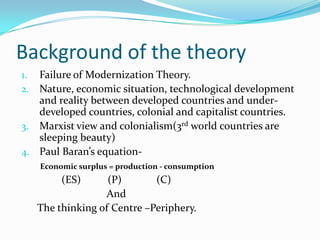
Background of the theory
1. Failure of Modernization Theory.
2. Nature, economic situation, technological development
   and reality between developed countries and under-
   developed countries, colonial and capitalist countries.
3. Marxist view and colonialism(3rd world countries are
   sleeping beauty)
4. Paul Baran’s equation-
     Economic surplus = production - consumption
          (ES)      (P)       (C)
                   And
     The thinking of Centre –Periphery.
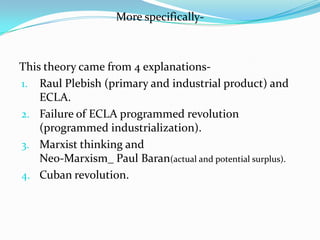
More specifically-


This theory came from 4 explanations-
1. Raul Plebish (primary and industrial product) and
    ECLA.
2. Failure of ECLA programmed revolution
    (programmed industrialization).
3. Marxist thinking and
    Neo-Marxism_ Paul Baran(actual and potential surplus).
4. Cuban revolution.
Few concepts-
 Development: condition of lifestyle and economic
  situation is increasing.
 Under-development: condition of lifestyle and
  economic situation is decreasing.
 undevelopment: unchanged situation.
 Now-developed: development is on a stable point.
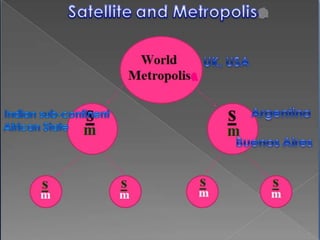
New terms from A. G. Frank
Two terms-
1. Satellite.
2. Metropolis.


Satellite- those regions which supplies primary
   products.
Metropolis-those regions which sucks satellites and its
   wealth.
Hypothesis of Frank’s theory

 Five hypothesis-
1..Which states are joined to world metropolis, they are
    under-developed. i.e.; development occurs when the
    state is no ones satellite.
2..The satellites experience their greatest industrial
    development and especially their most classically
    capitalist industrial development if and when their ties
    to their metropolis are weakest.
    It occurs in two ways-
I. Crisis of war and depression.
II. Geography and economic isolation.
Crisis of war and depression
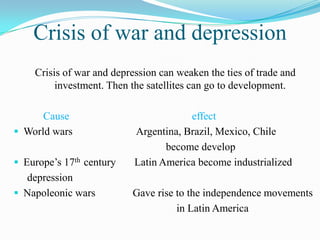
    Crisis of war and depression can weaken the ties of trade and
         investment. Then the satellites can go to development.

      Cause                            effect
 World wars               Argentina, Brazil, Mexico, Chile
                                  become develop
 Europe’s 17th century    Latin America become industrialized
  depression
 Napoleonic wars         Gave rise to the independence movements
                                    in Latin America
Geography and economic isolation
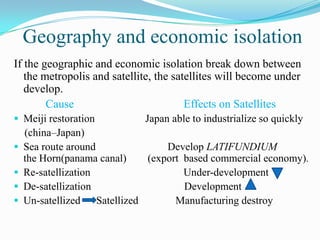
If the geographic and economic isolation break down between
   the metropolis and satellite, the satellites will become under
   develop.
        Cause                           Effects on Satellites
 Meiji restoration          Japan able to industrialize so quickly
    (china–Japan)
   Sea route around             Develop LATIFUNDIUM
    the Horn(panama canal)   (export based commercial economy).
   Re-satellization                 Under-development
   De-satellization                 Development
   Un-satellized Satellized       Manufacturing destroy
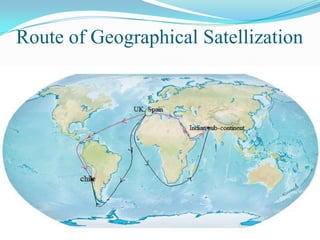
Route of Geographical Satellization
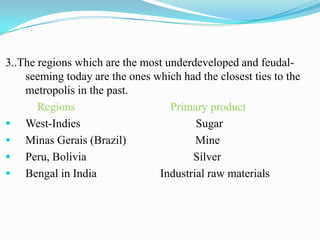
3..The regions which are the most underdeveloped and feudal-
    seeming today are the ones which had the closest ties to the
    metropolis in the past.
       Regions                     Primary product
 West-Indies                           Sugar
 Minas Gerais (Brazil)                 Mine
 Peru, Bolivia                        Silver
 Bengal in India               Industrial raw materials
4.. Latifundium evolved on based on the world metropolis
     and national metropolis.


5..The latifundia which appear isolated , subsistence
    based, and semi-feudal today saw the demand for their
    products or their productive capacity decline and they
    are to be found principally in the above-named former
    agricultural and mining export regions whose economic
    activity declined in general.
A.G.Frank’s theory and Crime

 Crime among the bureaucrats.
 Trafficking ( property, labor)
 Marginalization and crime.
 Inequality and crime.
 Reality of survival and crime.
 Poverty and crime.
Conclusion
    If the under-developed regions want to go through the
development, at first they have to isolate from the
Metropolis or the capitalist states. Then they have to gain
independence. If there is any Latifundium, they have to
abolish these practice. They should emphasize on their
internal industrialization through their primary
product, rather than exporting.
Thank you all
Questions
   &
 Answer

Welcome to my presentation on dependency theory

  • 1.
    Presented by- Md. Monoar Hossain CP08009 Dept. of Criminology and Police Science Mawlana Bhashani Science and Technology University
  • 2.
    Presentation on The Developmentof Under-development (Dependency Theory) Andre Gunder Frank (1966)
  • 3.
    Introduction Weare talking about development, and we are emphasizing on developing the undeveloped and underdeveloped countries. But if we want to take any policy, for these countries, at first we have to look beyond the historical background of these countries. We should also emphasize on the reasons, for which the situation of these countries are being unchanged or decreasing day by day. To giving the theoretical explanation on this matter, A.G. Frank adopted his Dependency theory which is named as “The Development of Under-development”. Here, he emphasized on the development issues and obstacles for the under-developing countries.
  • 4.
    Background of thetheory 1. Failure of Modernization Theory. 2. Nature, economic situation, technological development and reality between developed countries and under- developed countries, colonial and capitalist countries. 3. Marxist view and colonialism(3rd world countries are sleeping beauty) 4. Paul Baran’s equation- Economic surplus = production - consumption (ES) (P) (C) And The thinking of Centre –Periphery.
  • 5.
    More specifically- This theorycame from 4 explanations- 1. Raul Plebish (primary and industrial product) and ECLA. 2. Failure of ECLA programmed revolution (programmed industrialization). 3. Marxist thinking and Neo-Marxism_ Paul Baran(actual and potential surplus). 4. Cuban revolution.
  • 6.
    Few concepts-  Development:condition of lifestyle and economic situation is increasing.  Under-development: condition of lifestyle and economic situation is decreasing.  undevelopment: unchanged situation.  Now-developed: development is on a stable point.
  • 7.
    New terms fromA. G. Frank Two terms- 1. Satellite. 2. Metropolis. Satellite- those regions which supplies primary products. Metropolis-those regions which sucks satellites and its wealth.
  • 9.
    Hypothesis of Frank’stheory  Five hypothesis- 1..Which states are joined to world metropolis, they are under-developed. i.e.; development occurs when the state is no ones satellite.
  • 10.
    2..The satellites experiencetheir greatest industrial development and especially their most classically capitalist industrial development if and when their ties to their metropolis are weakest. It occurs in two ways- I. Crisis of war and depression. II. Geography and economic isolation.
  • 11.
    Crisis of warand depression Crisis of war and depression can weaken the ties of trade and investment. Then the satellites can go to development. Cause effect  World wars Argentina, Brazil, Mexico, Chile become develop  Europe’s 17th century Latin America become industrialized depression  Napoleonic wars Gave rise to the independence movements in Latin America
  • 12.
    Geography and economicisolation If the geographic and economic isolation break down between the metropolis and satellite, the satellites will become under develop. Cause Effects on Satellites  Meiji restoration Japan able to industrialize so quickly (china–Japan)  Sea route around Develop LATIFUNDIUM the Horn(panama canal) (export based commercial economy).  Re-satellization Under-development  De-satellization Development  Un-satellized Satellized Manufacturing destroy
  • 13.
    Route of GeographicalSatellization
  • 14.
    3..The regions whichare the most underdeveloped and feudal- seeming today are the ones which had the closest ties to the metropolis in the past. Regions Primary product  West-Indies Sugar  Minas Gerais (Brazil) Mine  Peru, Bolivia Silver  Bengal in India Industrial raw materials
  • 15.
    4.. Latifundium evolvedon based on the world metropolis and national metropolis. 5..The latifundia which appear isolated , subsistence based, and semi-feudal today saw the demand for their products or their productive capacity decline and they are to be found principally in the above-named former agricultural and mining export regions whose economic activity declined in general.
  • 16.
    A.G.Frank’s theory andCrime  Crime among the bureaucrats.  Trafficking ( property, labor)  Marginalization and crime.  Inequality and crime.  Reality of survival and crime.  Poverty and crime.
  • 17.
    Conclusion If the under-developed regions want to go through the development, at first they have to isolate from the Metropolis or the capitalist states. Then they have to gain independence. If there is any Latifundium, they have to abolish these practice. They should emphasize on their internal industrialization through their primary product, rather than exporting.
  • 18.
  • 19.
    Questions & Answer