




World System Theory Dr. Christopher S. Rice
 
Why World System Theory? East Asian Growth Crisis of Socialist States Crisis in U.S. Capitalism
Neo-Marxism +  Annales  School
 
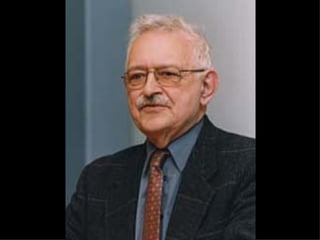
Braudel’s Mediterranean “not content to stop at the shores of the ‘inland sea’…starts in the mountains and extends not only to the hot deserts of Africa but to the cold deserts of China, half a world away; and westwards it extends to Mexico and Lima, to Acapulco and Manila, and back to China.” Immanuel Wallerstein
la longue duree
??????????
Society vs Historical System
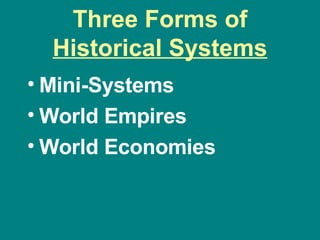
Three Forms of  Historical Systems Mini-Systems World Empires World Economies
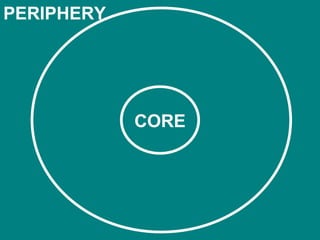
CORE PERIPHERY
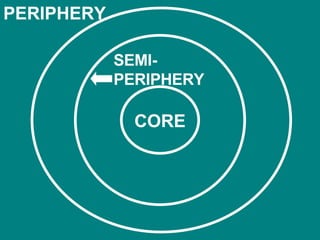
CORE PERIPHERY SEMI-PERIPHERY
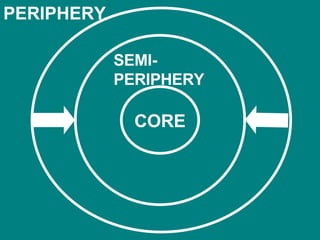
Seizing the Chance
Semi-Peripheral Development by Invitation
Semi-Peripheral Development through Self-Reliance
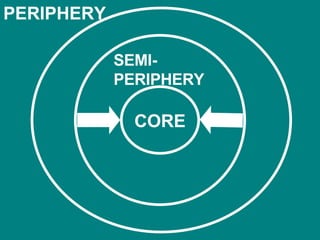
CORE PERIPHERY SEMI-PERIPHERY
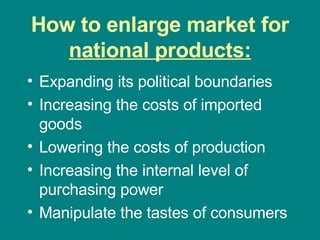
How to enlarge market for  national products: Expanding its political boundaries Increasing the costs of imported goods Lowering the costs of production  Increasing the internal level of purchasing power  Manipulate the tastes of consumers
England’s Low-Wage Route
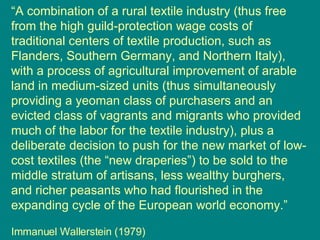
“ A combination of a rural textile industry (thus free from the high guild-protection wage costs of traditional centers of textile production, such as Flanders, Southern Germany, and Northern Italy), with a process of agricultural improvement of arable land in medium-sized units (thus simultaneously providing a yeoman class of purchasers and an evicted class of vagrants and migrants who provided much of the labor for the textile industry), plus a deliberate decision to push for the new market of low-cost textiles (the “new draperies”) to be sold to the middle stratum of artisans, less wealthy burghers, and richer peasants who had flourished in the expanding cycle of the European world economy.” Immanuel Wallerstein (1979)
High-Wage Route (United States, Australia, Canada, New Zealand)

World System Theory