DEPENDENCY THEORY OF DEVELOPMENT
Worku Kassaw (PhD Candidate in Land Policy and Governance)
Institute of Land Administration, Bahir Dar University
Bahir Dar, Ethiopia
February 2023
Content of the Lecture
• Background
• Distinction between Microcosmic system and Macrocosmic system
• How does a periphery become dependent on the center?
• Mechanisms by which DCs have been exploiting the LDCs
• Paul Baran’s Analysis of Economic Backwardness and Economic Growth
• Andere Gunder Frank’s Analysis of ‘Development of Underdevelopment’
• Critiques to the Dependency theory
Background
• The dissatisfaction of some scholars with the modernization
theory has greatly contributed to the emergence of a new
development paradigm.
• The social scientists and development theorists in Latin
America such as Paul Baran, Andere Gunder Frank, Samir Amin
and Dos Santos were those who took initiatives to find out
alternative explanations for the problems of underdevelopment
in the poorer regions of the world.
Background
• The scholars particularly placed special emphasis on two
important aspects:
– The problem of exploitation of the poor nations by the rich, and
– The extraction of surplus from the backward regions.
• The discourse that deals with these problems is known as
Dependency Theory.
Background
• Dependency in this context signifies, a form of unequal international
relationship between two sets of countries: the center or
metropolitan center and the periphery or satellite.
• The center represents developed capitalism and the periphery refers
to underdeveloped regions.
• Dependency theory considers the fact that the social and economic
development of Less developed Countries (LDCs) is conditioned by
the external forces of the central capitalism.
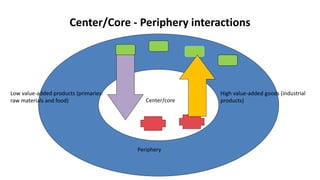
Center/Core - Periphery interactions
Center/core
Periphery
High value-added goods (industrial
products)
Low value-added products (primaries:
raw materials and food)
Background
• The Dependency theory is originally Marxian in character for
two obvious reasons:
– It is based on the concept of exploitation of the weaker LDCs by the
capitalist developed countries. [The difference lies on: production
relations vs exchange relations]
– It explains development and underdevelopment with reference to
capitalistic framework of the center.
• Dependency theory is mainly concerned with the impact of
imperialism and Neocolonialism on the economies and society of
LDCs.
Distinction between Microcosmic system and Macrocosmic
system
• According to Ghosh (2001), dependency involves two systems:
Macrocosmic System and Microcosmic System.
• Macrocosmic System: world capitalism which is controlling and
influencing its sub-system or microcosmic.
• Microcosmic System: poor and backward regions and countries.
Distinction between Microcosmic system and Macrocosmic system
• The idea of the relationship between core and periphery was based on
two competing regional planning theories.
• Hirschman (1958) argues that development, which at the initial stage
concentrates at core, will promote development at periphery through
trickle down effects. (convergence of development gaps).
• According to Gunnar Myrdal (1957) – theory of circular causation
– Once divergence occurs cumulative causation will lead to widening
inequalities (Backwash outweighs the spread effect).
– This theory argues that expansion in the locality produces two effects:
backwash effects, and spread effects.
Balance between backwash effect (unfavorable) and spread effect
(favorable)
• LDCs are impoverished due to the backwash effect generated by the
actions of the center. But there is no spread effect, which could help
the peripheral countries.
• When the center and the periphery, are developing side by side, the
stronger and more powerful (the core) will draw away resources, both
physical and human from the weaker and less powerful region
(periphery).
• As a result, a growth-retarding backwash effect would be produced in
the region where from the resources are drawn away.
• The backwash effects are generally produced through three factors:
migration (brain drain), capital outflow (withdrawal of surplus) and
unequal trade.
Balance between backwash effect (unfavorable) and spread effect
(favorable)
• The growth of the center, however should produce some effects for the
peripheries with respect to technology, demand, market and knowledge.
These favorable effects may be called the spread effects of development.
•
• These effects may produce new growth momentum for the poor peripheries.
– But this can be materialized only when the growth-retarding backwash effects are
outweighed by positive spread effects.
• This is not really happening for the peripheral poor countries. This is indeed
what causes the underdevelopment at peripheral regions.
How does a periphery become dependent on the center?
• Ghosh enumerates several ways by which periphery becomes
dependent on center.
• LDCs are dependent on DCs for technology.
– DCs are in most cases the origins of new scientific breakthroughs,
due to the existence of well-developed academic institutions, and the
direct application of these knowledge for technology transformation.
– Technology transfers take place from these hearth/core to periphery.
How does a periphery become dependent on the center?
• LDCs are dependent on DCs for economic and financial aid.
– LDCs are frequently hit hard by both natural calamities (drought, floods,
typhoons, etc) and human caused crisis such as conflict and related
displacement - refugee in and outflow.
– The economic situations of the poorer countries would not enable them
to withstand these hazards and disasters.
– Therefore, aid that originates in DCs becomes crucial both in emergency
intervention and in rehabilitation development activities.
– Even under normal conditions some poorer nations have serious fiscal
shortage. So, there are certain cases when nations set annual budget on
the basis of external sources (either donation or loan).
How does a periphery become dependent on the center?
• The balance of payments require the help from DCs - without
assistant, poorer nations cannot afford all finished import
goods.
• The LDCs cannot follow an independent policy of capital
accumulation.
– This is mainly because attracting big investors TNCs from wealthier
nations, which cannot be entirely governed by a single nations
monitory policy.
– The interdependence of the world economy through marketing has
paramount significance.
How does a periphery become dependent on the
center?
• LDCs are dependent on DCs for selling raw materials and their
primary products (market/trade dependency).
• Without the help of DCs, it is almost impossible for the LDCs to
develop economically.
– LDCs receive economic support/assistance in the form of both
donation and granting loan (at minimum interest), capacity building
(by sending experts, training manpower at home and abroad).
Mechanisms by which DCs have been exploiting the LDCs
• Despite the several benefits the poorer nations obtain from their
wealthier counterparts, dependency theorists strongly argue that the
back-wash effects (losses) by far outweigh the spread effects (gains).
• The DCs are investing capital in LDCs where the marginal productivity
of capital is very high, and are drawing out a large amount of surplus.
• The DCs are able to purchase raw materials and primary products from
LDCs at the low rates mainly because of the fact that wage level is
very low in LDCs.
• DCS are able to sell out their products in LDCs at high prices.
• The DCs are getting remittances from LDCs large sum of money in the
forms of profit, royalty and so on.
Mechanisms by which DCs have been exploiting the
LDCs
• The technology, which is being transferred to LDCs, is mostly old and obsolete,
unsuitable and very costly.
• One can mention the transfer of Green Revolution inputs (like chemical
fertilizers, herbicides, insecticides) , which in the short-run could substantially
boost productivity, but with disastrous long-term environmental and human
health implications.
• I can add the case of machinery - most machineries installed in our country’s
textile industries are very old with no spare parts. [The reason is that no
industries produce these materials to-date or you hardly can find in stock
market].
•
Mechanisms by which DCs have been exploiting the
LDCs
• The DCS are also exploiting the LDCs through the imposition of control
over the domestic economics of those poor countries through aid and
other means.
– Imposition through policy consultation (IMF and WB)
•
• Surplus extraction is the mechanism by which the DCs exploit the LDCs,
which would be in two forms.
– Direct or non-trading way: by looting and plundering of resources from LDCs;
and through profit repatriation and royalty repatriation
– Indirect way, which refers to unequal exchange
Paul Baran’s Analysis of Economic Backwardness and Economic
Growth
• The Dependency theory was first popularized by Paul Baran in
1957 in his book, The Political Economy of Growth. He is
therefore regarded as the father of modern DT, on the Marxist
tradition.
• The central argument of Paul is that underdevelopment is a
result of the world process of capital accumulation.
Paul Baran’s Analysis of Economic Backwardness and Economic Growth
Paul points out four important popular fallacies which are mostly cited as the obstacles
for economic development in poor countries.
• Lack of entrepreneurial talent - as one of the main obstacles in LDCs, which is not
acceptable for Paul. B/s there are many good entrepreneurs in LDCs.
• Lack of capital in LDCs which is not true to say since the potential surplus available is
quite large and extensive [if countries can realize and retain it].
• Paul does not agree with the popular belief that population problem is a serious threat
to economic development in LDCs.
– Like Marx, Paul argues that over population has to be considered only with reference to the
means of production and employment. [Anti-Malthus and pro-Marxian and Bosrupian ].
• Paul does not agree with the popular view that failing terms of trade are responsible for
economic underdevelopment.
Paul Baran’s Analysis of Economic Backwardness and Economic
Growth
Paul gives three principal explanations for the underdevelopment of
LDCs:
• The way in which their potential surplus is utilized. Much of the
potential economic surplus is not realized.
• Much of the realized economic surplus is misused by those who
appropriate it. [Much investment on non-productive matters and on
luxury items].
• The center tries to keep the periphery under its firm control.
Paul Baran’s Analysis of Economic Backwardness and Economic
Growth
What then is the way out? How can underdeveloped countries be
developed?
• Social revolution (social change)
• Establishment of a socialist planned economy. [Nonetheless,
socialism as a solution for the way out of poverty and
underdevelopment has historically proved ineffective].
• Mobilizing the potential economic surplus
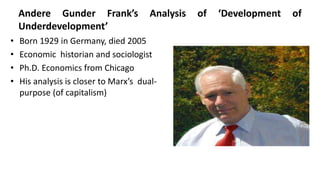
Andere Gunder Frank’s Analysis of ‘Development of
Underdevelopment’
• Born 1929 in Germany, died 2005
• Economic historian and sociologist
• Ph.D. Economics from Chicago
• His analysis is closer to Marx’s dual-
purpose (of capitalism)
Andere Gunder Frank’s Analysis …
• Frank characterized the poverty of less developed nations and
their dependence on wealthier nations as inescapable, and
claimed that relations of imperialism and domination trapped
poor nations at the bottom of global economy.
• Frank considered the Macro and Micro scale structures in
analyzing underdevelopment .
Andere Gunder Frank’s Analysis …
Micro-Structure of
Development/Underdevelopment
• Relates to the structure of a backward country having periphery (p)
and metropolis (m)
• A backward state center (m) is a periphery of the world capitalism
• Within the micro-system of the country, surplus is extracted from (p)
and sent to (m)
• Through loss of surplus, (p) becomes underdeveloped, and (m)
becomes comparatively developed.
• When surplus is extracted from the state metropolis (m) by the world
metropolis (M), (m) becomes underdeveloped.
• Thus, both (p) and (m) become underdeveloped through macro
structural exploitation
• Macro capitalist structure unfavorably influences the micro-structure
of the backward country and produces underdevelopment in LDCs
Macro-Structure of
Development/underdevelopment
• Relates to the structure of the Capitalist world
having its peripheries (P), and Metropolis (M). The
peripheries are the Metropolis (M) of so many
backward countries.
• Metropolis of the world capitalism is not periphery
of anybody or anything.
• Within the macro-structure of capitalist world,
surplus is extracted from all dependent
colonies/state centers (m), and it goes to metropolis
(M)
• No surplus is lost, but it is gained from all
dependent colonies/states. Hence, (M) becomes
developed.
• There is no mechanism/agent to extract the surplus
of macro-metropolitan center (M)
• No exploitation is possible by the micro-structure.
Macro center (M) develops uninterruptedly.
• Micro-structure of LDCs helps the development of
the macro-structure in DCs
Andere Gunder Frank’s Analysis …
Is there any hope for these backward countries?
Frank advises them:
• To break away from the capitalist and turn towards socialist
system.
• Internally, it is necessary to overthrow the bourgeoisie who are in
collusion with the imperialist foreign power and start a socialist
liberation movement by cutting all connections with the
industrial capitalist countries.
Main critiques to Frank`s Model
• Has not given emphasis on the production relations but has instead
put emphasis on exchange relations, and appears un-Marxist.
• Has neglected the specificities of internal mode of production and
class structure of the periphery and their impact.
• Frank has observed that Latin American and other developing
countries including India were capitalist in nature. But Indian
agriculture was Feudal rather.
• Frank’s theory of underdevelopment does not seem to be empirically
correct.
Main critiques to Frank`s Model
• Imperialist penetration has produced many advantages for the LDCs rather than
producing underdevelopment.
– Alec Nove says that underdevelopment of Zambia, Saudi Arabia and Ceylon is not
caused by capitalism.
– Underdevelopment of China was due to many factors like political paralysis, internal
disorder and so on rather than imperialist penetration.
• Frank’s attitude to trade seems to suggest that the sale of some products to the western
world is a cause of underdevelopment.
• Frank proposes a complete break with capitalism and a revolution for socialism.
– This seems contradictory with the central argument because socialism itself
would have imposed from outside.
• In spite of these points of criticisms it must be conceded that, Gunder Frank has
performed the most elaborate work on dependency theory.
Critiques to the Dependency theory
• Dependency analysis cannot give us a full-fledged formal theory of development
and underdevelopment. It is simply treated as a paradigm or model.
• The extraction of surplus cannot cause development and underdevelopment at
the same time. [In order to secure more profit, the capitalist should expand their
investments].
• The theory gives too much emphasis on the problem of exchange rather than on
the problem of production. Whereas development/underdevelopment is
essentially a production-related problem.
•
Critiques to the Dependency theory
• Production and appropriation of surplus is an aspect of the relationship
between classes, but class analysis has been ignored. The conflict between
center and periphery is in geographical term in this theory rather than in
terms of social classes.
• According to this theory, the LDCs cannot grow so long as they are in the grip of
DCs.
– Historically this is proved to be wrong. E.g. The case of Asian Tigers: Singapore,
Taiwan, South Korea and Hong Kong, and Brazil and RSA. The theory ignores the
possible spread effect.
• The theory has not provided any viable solution to overcome dependency.
(They suggest socialism as the way out of it?)
Critiques to the Dependency theory
• According to dependency theories, capital is invested in LDCs by the DCs because rate
of profit is higher there than in DCs. The resultant profit is again invested in LDCs by
the same token of argument. This means that profit is not really repatriated and
invested in DCs.
– Thus, there seems to be a lack of internal consistency in the theory of dependency.
• Dependency cannot be bad for the LDCs. Had it been so, the LDCs would not have
accepted it. The dependency must be mutually beneficial to both LDCs and DCs
[Interdependency].
• The theory ignores the mutually overlapping caste-class structure and cultural
structure which play a major role in the generation and perpetuation of poverty and
inequality in LDCs.
The renewal of dependency thinking in the 1990s
• Structuralist analysis or the political economy and international
political economy.
• Uneven global development and uneven globalization.
The End!

DEPENDENCY THEORY OF DEVELOPMENT.ppt

  • 1.
    DEPENDENCY THEORY OFDEVELOPMENT Worku Kassaw (PhD Candidate in Land Policy and Governance) Institute of Land Administration, Bahir Dar University Bahir Dar, Ethiopia February 2023
  • 2.
    Content of theLecture • Background • Distinction between Microcosmic system and Macrocosmic system • How does a periphery become dependent on the center? • Mechanisms by which DCs have been exploiting the LDCs • Paul Baran’s Analysis of Economic Backwardness and Economic Growth • Andere Gunder Frank’s Analysis of ‘Development of Underdevelopment’ • Critiques to the Dependency theory
  • 3.
    Background • The dissatisfactionof some scholars with the modernization theory has greatly contributed to the emergence of a new development paradigm. • The social scientists and development theorists in Latin America such as Paul Baran, Andere Gunder Frank, Samir Amin and Dos Santos were those who took initiatives to find out alternative explanations for the problems of underdevelopment in the poorer regions of the world.
  • 4.
    Background • The scholarsparticularly placed special emphasis on two important aspects: – The problem of exploitation of the poor nations by the rich, and – The extraction of surplus from the backward regions. • The discourse that deals with these problems is known as Dependency Theory.
  • 5.
    Background • Dependency inthis context signifies, a form of unequal international relationship between two sets of countries: the center or metropolitan center and the periphery or satellite. • The center represents developed capitalism and the periphery refers to underdeveloped regions. • Dependency theory considers the fact that the social and economic development of Less developed Countries (LDCs) is conditioned by the external forces of the central capitalism.
  • 6.
    Center/Core - Peripheryinteractions Center/core Periphery High value-added goods (industrial products) Low value-added products (primaries: raw materials and food)
  • 7.
    Background • The Dependencytheory is originally Marxian in character for two obvious reasons: – It is based on the concept of exploitation of the weaker LDCs by the capitalist developed countries. [The difference lies on: production relations vs exchange relations] – It explains development and underdevelopment with reference to capitalistic framework of the center. • Dependency theory is mainly concerned with the impact of imperialism and Neocolonialism on the economies and society of LDCs.
  • 8.
    Distinction between Microcosmicsystem and Macrocosmic system • According to Ghosh (2001), dependency involves two systems: Macrocosmic System and Microcosmic System. • Macrocosmic System: world capitalism which is controlling and influencing its sub-system or microcosmic. • Microcosmic System: poor and backward regions and countries.
  • 9.
    Distinction between Microcosmicsystem and Macrocosmic system • The idea of the relationship between core and periphery was based on two competing regional planning theories. • Hirschman (1958) argues that development, which at the initial stage concentrates at core, will promote development at periphery through trickle down effects. (convergence of development gaps). • According to Gunnar Myrdal (1957) – theory of circular causation – Once divergence occurs cumulative causation will lead to widening inequalities (Backwash outweighs the spread effect). – This theory argues that expansion in the locality produces two effects: backwash effects, and spread effects.
  • 10.
    Balance between backwasheffect (unfavorable) and spread effect (favorable) • LDCs are impoverished due to the backwash effect generated by the actions of the center. But there is no spread effect, which could help the peripheral countries. • When the center and the periphery, are developing side by side, the stronger and more powerful (the core) will draw away resources, both physical and human from the weaker and less powerful region (periphery). • As a result, a growth-retarding backwash effect would be produced in the region where from the resources are drawn away. • The backwash effects are generally produced through three factors: migration (brain drain), capital outflow (withdrawal of surplus) and unequal trade.
  • 11.
    Balance between backwasheffect (unfavorable) and spread effect (favorable) • The growth of the center, however should produce some effects for the peripheries with respect to technology, demand, market and knowledge. These favorable effects may be called the spread effects of development. • • These effects may produce new growth momentum for the poor peripheries. – But this can be materialized only when the growth-retarding backwash effects are outweighed by positive spread effects. • This is not really happening for the peripheral poor countries. This is indeed what causes the underdevelopment at peripheral regions.
  • 12.
    How does aperiphery become dependent on the center? • Ghosh enumerates several ways by which periphery becomes dependent on center. • LDCs are dependent on DCs for technology. – DCs are in most cases the origins of new scientific breakthroughs, due to the existence of well-developed academic institutions, and the direct application of these knowledge for technology transformation. – Technology transfers take place from these hearth/core to periphery.
  • 13.
    How does aperiphery become dependent on the center? • LDCs are dependent on DCs for economic and financial aid. – LDCs are frequently hit hard by both natural calamities (drought, floods, typhoons, etc) and human caused crisis such as conflict and related displacement - refugee in and outflow. – The economic situations of the poorer countries would not enable them to withstand these hazards and disasters. – Therefore, aid that originates in DCs becomes crucial both in emergency intervention and in rehabilitation development activities. – Even under normal conditions some poorer nations have serious fiscal shortage. So, there are certain cases when nations set annual budget on the basis of external sources (either donation or loan).
  • 14.
    How does aperiphery become dependent on the center? • The balance of payments require the help from DCs - without assistant, poorer nations cannot afford all finished import goods. • The LDCs cannot follow an independent policy of capital accumulation. – This is mainly because attracting big investors TNCs from wealthier nations, which cannot be entirely governed by a single nations monitory policy. – The interdependence of the world economy through marketing has paramount significance.
  • 15.
    How does aperiphery become dependent on the center? • LDCs are dependent on DCs for selling raw materials and their primary products (market/trade dependency). • Without the help of DCs, it is almost impossible for the LDCs to develop economically. – LDCs receive economic support/assistance in the form of both donation and granting loan (at minimum interest), capacity building (by sending experts, training manpower at home and abroad).
  • 16.
    Mechanisms by whichDCs have been exploiting the LDCs • Despite the several benefits the poorer nations obtain from their wealthier counterparts, dependency theorists strongly argue that the back-wash effects (losses) by far outweigh the spread effects (gains). • The DCs are investing capital in LDCs where the marginal productivity of capital is very high, and are drawing out a large amount of surplus. • The DCs are able to purchase raw materials and primary products from LDCs at the low rates mainly because of the fact that wage level is very low in LDCs. • DCS are able to sell out their products in LDCs at high prices. • The DCs are getting remittances from LDCs large sum of money in the forms of profit, royalty and so on.
  • 17.
    Mechanisms by whichDCs have been exploiting the LDCs • The technology, which is being transferred to LDCs, is mostly old and obsolete, unsuitable and very costly. • One can mention the transfer of Green Revolution inputs (like chemical fertilizers, herbicides, insecticides) , which in the short-run could substantially boost productivity, but with disastrous long-term environmental and human health implications. • I can add the case of machinery - most machineries installed in our country’s textile industries are very old with no spare parts. [The reason is that no industries produce these materials to-date or you hardly can find in stock market]. •
  • 18.
    Mechanisms by whichDCs have been exploiting the LDCs • The DCS are also exploiting the LDCs through the imposition of control over the domestic economics of those poor countries through aid and other means. – Imposition through policy consultation (IMF and WB) • • Surplus extraction is the mechanism by which the DCs exploit the LDCs, which would be in two forms. – Direct or non-trading way: by looting and plundering of resources from LDCs; and through profit repatriation and royalty repatriation – Indirect way, which refers to unequal exchange
  • 19.
    Paul Baran’s Analysisof Economic Backwardness and Economic Growth • The Dependency theory was first popularized by Paul Baran in 1957 in his book, The Political Economy of Growth. He is therefore regarded as the father of modern DT, on the Marxist tradition. • The central argument of Paul is that underdevelopment is a result of the world process of capital accumulation.
  • 20.
    Paul Baran’s Analysisof Economic Backwardness and Economic Growth Paul points out four important popular fallacies which are mostly cited as the obstacles for economic development in poor countries. • Lack of entrepreneurial talent - as one of the main obstacles in LDCs, which is not acceptable for Paul. B/s there are many good entrepreneurs in LDCs. • Lack of capital in LDCs which is not true to say since the potential surplus available is quite large and extensive [if countries can realize and retain it]. • Paul does not agree with the popular belief that population problem is a serious threat to economic development in LDCs. – Like Marx, Paul argues that over population has to be considered only with reference to the means of production and employment. [Anti-Malthus and pro-Marxian and Bosrupian ]. • Paul does not agree with the popular view that failing terms of trade are responsible for economic underdevelopment.
  • 21.
    Paul Baran’s Analysisof Economic Backwardness and Economic Growth Paul gives three principal explanations for the underdevelopment of LDCs: • The way in which their potential surplus is utilized. Much of the potential economic surplus is not realized. • Much of the realized economic surplus is misused by those who appropriate it. [Much investment on non-productive matters and on luxury items]. • The center tries to keep the periphery under its firm control.
  • 22.
    Paul Baran’s Analysisof Economic Backwardness and Economic Growth What then is the way out? How can underdeveloped countries be developed? • Social revolution (social change) • Establishment of a socialist planned economy. [Nonetheless, socialism as a solution for the way out of poverty and underdevelopment has historically proved ineffective]. • Mobilizing the potential economic surplus
  • 23.
    Andere Gunder Frank’sAnalysis of ‘Development of Underdevelopment’ • Born 1929 in Germany, died 2005 • Economic historian and sociologist • Ph.D. Economics from Chicago • His analysis is closer to Marx’s dual- purpose (of capitalism)
  • 24.
    Andere Gunder Frank’sAnalysis … • Frank characterized the poverty of less developed nations and their dependence on wealthier nations as inescapable, and claimed that relations of imperialism and domination trapped poor nations at the bottom of global economy. • Frank considered the Macro and Micro scale structures in analyzing underdevelopment .
  • 25.
    Andere Gunder Frank’sAnalysis … Micro-Structure of Development/Underdevelopment • Relates to the structure of a backward country having periphery (p) and metropolis (m) • A backward state center (m) is a periphery of the world capitalism • Within the micro-system of the country, surplus is extracted from (p) and sent to (m) • Through loss of surplus, (p) becomes underdeveloped, and (m) becomes comparatively developed. • When surplus is extracted from the state metropolis (m) by the world metropolis (M), (m) becomes underdeveloped. • Thus, both (p) and (m) become underdeveloped through macro structural exploitation • Macro capitalist structure unfavorably influences the micro-structure of the backward country and produces underdevelopment in LDCs Macro-Structure of Development/underdevelopment • Relates to the structure of the Capitalist world having its peripheries (P), and Metropolis (M). The peripheries are the Metropolis (M) of so many backward countries. • Metropolis of the world capitalism is not periphery of anybody or anything. • Within the macro-structure of capitalist world, surplus is extracted from all dependent colonies/state centers (m), and it goes to metropolis (M) • No surplus is lost, but it is gained from all dependent colonies/states. Hence, (M) becomes developed. • There is no mechanism/agent to extract the surplus of macro-metropolitan center (M) • No exploitation is possible by the micro-structure. Macro center (M) develops uninterruptedly. • Micro-structure of LDCs helps the development of the macro-structure in DCs
  • 26.
    Andere Gunder Frank’sAnalysis … Is there any hope for these backward countries? Frank advises them: • To break away from the capitalist and turn towards socialist system. • Internally, it is necessary to overthrow the bourgeoisie who are in collusion with the imperialist foreign power and start a socialist liberation movement by cutting all connections with the industrial capitalist countries.
  • 27.
    Main critiques toFrank`s Model • Has not given emphasis on the production relations but has instead put emphasis on exchange relations, and appears un-Marxist. • Has neglected the specificities of internal mode of production and class structure of the periphery and their impact. • Frank has observed that Latin American and other developing countries including India were capitalist in nature. But Indian agriculture was Feudal rather. • Frank’s theory of underdevelopment does not seem to be empirically correct.
  • 28.
    Main critiques toFrank`s Model • Imperialist penetration has produced many advantages for the LDCs rather than producing underdevelopment. – Alec Nove says that underdevelopment of Zambia, Saudi Arabia and Ceylon is not caused by capitalism. – Underdevelopment of China was due to many factors like political paralysis, internal disorder and so on rather than imperialist penetration. • Frank’s attitude to trade seems to suggest that the sale of some products to the western world is a cause of underdevelopment. • Frank proposes a complete break with capitalism and a revolution for socialism. – This seems contradictory with the central argument because socialism itself would have imposed from outside. • In spite of these points of criticisms it must be conceded that, Gunder Frank has performed the most elaborate work on dependency theory.
  • 29.
    Critiques to theDependency theory • Dependency analysis cannot give us a full-fledged formal theory of development and underdevelopment. It is simply treated as a paradigm or model. • The extraction of surplus cannot cause development and underdevelopment at the same time. [In order to secure more profit, the capitalist should expand their investments]. • The theory gives too much emphasis on the problem of exchange rather than on the problem of production. Whereas development/underdevelopment is essentially a production-related problem. •
  • 30.
    Critiques to theDependency theory • Production and appropriation of surplus is an aspect of the relationship between classes, but class analysis has been ignored. The conflict between center and periphery is in geographical term in this theory rather than in terms of social classes. • According to this theory, the LDCs cannot grow so long as they are in the grip of DCs. – Historically this is proved to be wrong. E.g. The case of Asian Tigers: Singapore, Taiwan, South Korea and Hong Kong, and Brazil and RSA. The theory ignores the possible spread effect. • The theory has not provided any viable solution to overcome dependency. (They suggest socialism as the way out of it?)
  • 31.
    Critiques to theDependency theory • According to dependency theories, capital is invested in LDCs by the DCs because rate of profit is higher there than in DCs. The resultant profit is again invested in LDCs by the same token of argument. This means that profit is not really repatriated and invested in DCs. – Thus, there seems to be a lack of internal consistency in the theory of dependency. • Dependency cannot be bad for the LDCs. Had it been so, the LDCs would not have accepted it. The dependency must be mutually beneficial to both LDCs and DCs [Interdependency]. • The theory ignores the mutually overlapping caste-class structure and cultural structure which play a major role in the generation and perpetuation of poverty and inequality in LDCs.
  • 32.
    The renewal ofdependency thinking in the 1990s • Structuralist analysis or the political economy and international political economy. • Uneven global development and uneven globalization.
  • 33.