Farhan Ahmad faiz 1
Modernizing Theory
Farhan Ahmad faiz 2
Historical background to
modernization theory
1 Post world war two’s deepening poverty in some
countries
2 Ideological competition from communism
3 Increasing unrest in some countries
4 The above posed a threat to capitalism, and
especially the USA
5 This led to the development of modernisation
theory (mainly by US economists and policy
makers)
Farhan Ahmad faiz 3
• In the 1950s and early 1960s modernization theory was
developed by a number of social scientists, particularly a
group of American scholars the most prominent of whom
was Talcott Parsons. Much of this interest in modernization
was prompted by the decline of the old colonial empires.
Modernization theory is a grand theory encompassing many
different disciplines as it seeks to explain how society
progresses, what variables affect that progress, and how
societies can react to that progress. Modernization theory
focuses specifically on a type of modernization thought to
have originated in Europe during the 17th century, which
brought social mores and technological achievements into a
new epoch.
Farhan Ahmad faiz 4
Modernization theory
• For a country to seen as modern, modernization
theorists it has to under go an evolutionary advance
in science and technology which in turn would lead
to an increased standard for all.
Farhan Ahmad faiz 5
• The modernization theorists aim
a) explain why poorer countries failed to evolve into modern societies
b) Reduce the spread of communism by presenting capitalist values as
the solution to poverty
• The Third World became a focus of attention by politicians who were
keen to show countries pushing for independence that sustained
development was possible under the western wing (rather. than that of
the Soviet Union). Academics reflected this interest by examining the
socio-economic conditions conducive to modernization.
Farhan Ahmad faiz 6
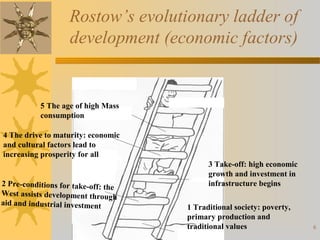
Rostow’s evolutionary ladder of
development (economic factors)
1 Traditional society: poverty,
primary production and
traditional values
2 Pre-conditions for take-off: the
West assists development through
aid and industrial investment
3 Take-off: high economic
growth and investment in
infrastructure begins
4 The drive to maturity: economic
and cultural factors lead to
increasing prosperity for all
5 The age of high Mass
consumption
Rostow's Stages of Growth
Walt Rostow wrote in the late 50's and early 60's
in response to the many seemingly successful
Marxist theories of economic development
Marxist writers had developed a number of
stages through which a country had to pass,
Rostow came up with a similar list.
7Farhan Ahmad faiz
Farhan Ahmad faiz 88
Rostow - Stages of Growth
• The work of American Walt
W. Rostow
• Rostow is an economic
historian
• Countries can be placed in
one of five categories in
terms of its stage of growth:
•A child in Sierra Leone making breakfast.
Which stage would a country like Sierra
Leone fit in?
Stage One: Traditional Society
“A traditional society is one whose structure is developed within limited
production functions.
• Low productivity agriculture is a large % of
the economy
• Political power dominates economic power
• Low rates of investment ( < 5% of GDP)
• Inefficient property rights
9Farhan Ahmad faiz
Farhan Ahmad faiz 1010
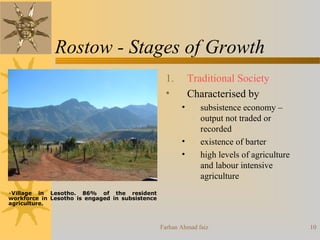
Rostow - Stages of Growth
1. Traditional Society
• Characterised by
• subsistence economy –
output not traded or
recorded
• existence of barter
• high levels of agriculture
and labour intensive
agriculture
•Village in Lesotho. 86% of the resident
workforce in Lesotho is engaged in subsistence
agriculture.
Stage Two: Preconditions for Take
Off
• Conditions:
• Transfer resources from agriculture to
manufacturing
• Shift from regional to national/international focus
• Must shift away from having children
• People must be rewarded not for their
“connections” but their economic abilities
11Farhan Ahmad faiz
Farhan Ahmad faiz 1212
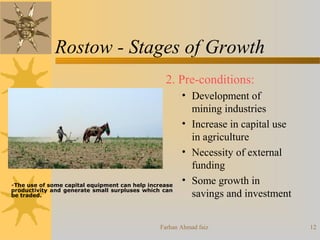
Rostow - Stages of Growth
2. Pre-conditions:
• Development of
mining industries
• Increase in capital use
in agriculture
• Necessity of external
funding
• Some growth in
savings and investment
•The use of some capital equipment can help increase
productivity and generate small surpluses which can
be traded.
Stage Three: Take-off
• Short period (20-30 years) of intensive growth
• In this short period we get
• increase in investment: “[I] regard as a necessary but not
sufficient condition for the take-off the fact that the net
investment rise from 5% to over 10%…”
• development of a leading sector
• emergence of new institutions
• “The take-off is the interval when the old blocks and
resistances to steady growth are finally overcome. The forces
making for economic progress, which yielded limited bursts
and enclaves of modern activity, expand and come to dominate
the society. Growth becomes its normal condition.
13Farhan Ahmad faiz
Farhan Ahmad faiz 1414
Rostow - Stages of Growth
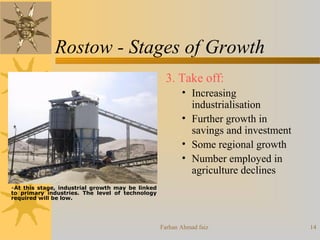
3. Take off:
• Increasing
industrialisation
• Further growth in
savings and investment
• Some regional growth
• Number employed in
agriculture declines
•At this stage, industrial growth may be linked
to primary industries. The level of technology
required will be low.
Stage Four: Drive to maturity
• “…for these purposes we define it as the period
when a society has effectively applied the range
of (then) modern technology to the bulk of its
resources.”
• Occurs roughly 60 years after take-off---
• Increase in investment (10% to 20%)
• Development of modern capitalist economy and
self-sustained growth Pass to Stage Five: High
Mass Consumption
15Farhan Ahmad faiz
Farhan Ahmad faiz 1616
Rostow - Stages of Growth
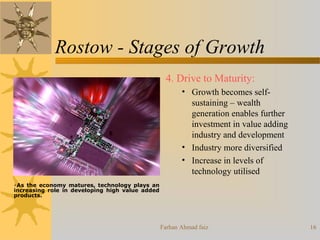
4. Drive to Maturity:
• Growth becomes self-
sustaining – wealth
generation enables further
investment in value adding
industry and development
• Industry more diversified
• Increase in levels of
technology utilised
•As the economy matures, technology plays an
increasing role in developing high value added
products.
Farhan Ahmad faiz 17
Rostow - Stages of Growth
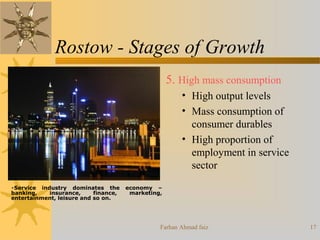
5. High mass consumption
• High output levels
• Mass consumption of
consumer durables
• High proportion of
employment in service
sector
•Service industry dominates the economy –
banking, insurance, finance, marketing,
entertainment, leisure and so on.
Farhan Ahmad faiz 18
Criticism:
• Too simplistic
• Necessity of a financial infrastructure to channel any savings that are
made into investment
• Will such investment yield growth? Not necessarily
• Need for other infrastructure – human resources (education), roads,
rail, communications networks
• Efficiency of use of investment – in palaces or productive activities?
• Rostow argued economies would learn from one another and reduce
the time taken to develop – has this happened?
Farhan Ahmad faiz 19
• Development then depends on ‘traditional’, ‘primitive’ values being displaced by
modern ones.
In a traditional society, three crucial features are noted:
(a) The value of traditionalism itself is dominant: that is, people are oriented to the past
and they lack the cultural ability to adjust to new circumstances;
(b) The kinship system is the decisive reference point for all social practices, being the
primary means through which economic, political and legal relationships arc
controlled. One's position in' the kinship system and, hence in the society is ascribed,
not achieved - that is, is a reflection of the status or standing of the family, clan or
tribe into which one is born; one's position only changes as one moves up the family
hierarchy. Status is then, not earned or achieved, but conferred by virtue of kin
relationships;
(c) Members of the traditional society have an emotional, superstitious and fatalistic
approach to the world: 'what will be will be; 'things have always been this way'.
Tradition versus Modernity
Farhan Ahmad faiz 20
In contrast, 'modern' society is made up of completely opposite
characteristics:
(a) People may still have traditions but they are not slaves to them and
will challenge any that seem unnecessary or get in the way of continued
cultural progress (that is they do not suffer from 'traditionalism');
(b) Kinship has a very much less important role in all areas of society
(even within the family) because of the need for geographical and social
mobility which weakens family ties; moreover, one's position in the
economy, polity etc" is earned through hard work and high achievement -
motivation and not determined by kinship;
(c) Members of -the modern society are not fatalistic but forward-looking
and innovative, ready to overcome the obstacles they find in their way,
particularly in business affairs, reflecting a strong entrepreneurial spirit
and rational, scientific approach to the world.
Farhan Ahmad faiz 21
• a) there is a clear mixture of sociological,
psychological and economic features to
modernization theory including, for example,
reference to value systems, individual motivations,
and capital accumulation;
MODERNISATION THEORY AND ITS IMPLICATIONS
Farhan Ahmad faiz 22
• (b) most accounts give greatest priority to the role
played by the values, norms and beliefs of people
in determining the sort of society - traditional or
modern - that they create, and thus value changes
are the most important conditions for social
change;
Farhan Ahmad faiz 23
• (c) the history of the development of industrialization in
the West is no longer regarded as something unique as
Weber thought, but as the blueprint for development
throughout the world.
As one of the contributors to modernisation theory,
Eisenstadt claimed: 'Historically, modernisation is the
process of change towards those types of social, economic
and political systems that have developed in Western
Europe and North America from the seventeenth to the
nineteenth centuries.'
Farhan Ahmad faiz 24
• (d) the evolution of societies occurs as traditional
behaviour patterns give way under the pressures of
modernisation. While these pressures built up gradually
within Western societies, the 'developing' countries of the
Third World can be exposed to· them from outside. That is,
they can he helped along the road to modernity with the
assistance of the developed countries whose ideas and
technologies can be introduced and diffused throughout
these poorer countries;
Farhan Ahmad faiz 25
• (e) this process of 'modernization by diffusion' should encour­age
the development of a number of features in the Third World,
including urbanization based on. nuclear family households,
educational growth for literacy and training, the development of
mass media to disseminate ideas and: encourage increased
awareness about society, heightened political awareness and
participation in a democratic system, increased business
opportunities through providing capital for investment, the
replacement of patterns of authority based on traditional loyalties
(for example monar­chies, local chiefdoms) with a rational
system of law coupled with representative national government;
Farhan Ahmad faiz 26
• (f) different societies are at different stages of
development because they have been more or less
successful in introducing the features of modernity
highlighted above in the previous slide.
Farhan Ahmad faiz 27
1. It is ethnocentric because
(a) it devalues traditional values and social
institutions e.g. extended families
(b) it ignores increasing inequality within and
between countries
(c) it is not a neutral theory as it suggests (it
promotes western capitalist values)
2 Education in the developing world mainly benefits
small local elites( those at the top)
Criticism
Farhan Ahmad faiz 28
3 They assume unidirectional path of development.There
is no, one single way to advancement and historical
context is also important.
4 The cultures of developing countries e.g the importance
of the family, may be a response to economic insecurity
and low levels of material well­being not the cause of it.
(Inglehart and Baker 2000)
Criticism
Farhan Ahmad faiz 29
In conclusion two general remarks can be made
First, modernization theory is clearly an oversimplified model of
development that lacks two essential ingredients: an adequate
historical input and a structural perspective.
1. Historically, it ignores a wealth of evidence, which indicates that
the process of economic growth cannot be encapsulated in
simplistic notion about the. displacement of 'traditional values
systems and institutions by 'modern' ones.
2. Structurally, the theory is insensitive to the specific ways in which
factors for economic growth such as the introduction of new
technology or markets may be interpreted, or modified or
accommodated within existing social relationships. In addition, the,
inequalities of power and social class that structure these
relationships are virtually ignored.
Conclusion

1 modernization theory of development

  • 1.
    Farhan Ahmad faiz1 Modernizing Theory
  • 2.
    Farhan Ahmad faiz2 Historical background to modernization theory 1 Post world war two’s deepening poverty in some countries 2 Ideological competition from communism 3 Increasing unrest in some countries 4 The above posed a threat to capitalism, and especially the USA 5 This led to the development of modernisation theory (mainly by US economists and policy makers)
  • 3.
    Farhan Ahmad faiz3 • In the 1950s and early 1960s modernization theory was developed by a number of social scientists, particularly a group of American scholars the most prominent of whom was Talcott Parsons. Much of this interest in modernization was prompted by the decline of the old colonial empires. Modernization theory is a grand theory encompassing many different disciplines as it seeks to explain how society progresses, what variables affect that progress, and how societies can react to that progress. Modernization theory focuses specifically on a type of modernization thought to have originated in Europe during the 17th century, which brought social mores and technological achievements into a new epoch.
  • 4.
    Farhan Ahmad faiz4 Modernization theory • For a country to seen as modern, modernization theorists it has to under go an evolutionary advance in science and technology which in turn would lead to an increased standard for all.
  • 5.
    Farhan Ahmad faiz5 • The modernization theorists aim a) explain why poorer countries failed to evolve into modern societies b) Reduce the spread of communism by presenting capitalist values as the solution to poverty • The Third World became a focus of attention by politicians who were keen to show countries pushing for independence that sustained development was possible under the western wing (rather. than that of the Soviet Union). Academics reflected this interest by examining the socio-economic conditions conducive to modernization.
  • 6.
    Farhan Ahmad faiz6 Rostow’s evolutionary ladder of development (economic factors) 1 Traditional society: poverty, primary production and traditional values 2 Pre-conditions for take-off: the West assists development through aid and industrial investment 3 Take-off: high economic growth and investment in infrastructure begins 4 The drive to maturity: economic and cultural factors lead to increasing prosperity for all 5 The age of high Mass consumption
  • 7.
    Rostow's Stages ofGrowth Walt Rostow wrote in the late 50's and early 60's in response to the many seemingly successful Marxist theories of economic development Marxist writers had developed a number of stages through which a country had to pass, Rostow came up with a similar list. 7Farhan Ahmad faiz
  • 8.
    Farhan Ahmad faiz88 Rostow - Stages of Growth • The work of American Walt W. Rostow • Rostow is an economic historian • Countries can be placed in one of five categories in terms of its stage of growth: •A child in Sierra Leone making breakfast. Which stage would a country like Sierra Leone fit in?
  • 9.
    Stage One: TraditionalSociety “A traditional society is one whose structure is developed within limited production functions. • Low productivity agriculture is a large % of the economy • Political power dominates economic power • Low rates of investment ( < 5% of GDP) • Inefficient property rights 9Farhan Ahmad faiz
  • 10.
    Farhan Ahmad faiz1010 Rostow - Stages of Growth 1. Traditional Society • Characterised by • subsistence economy – output not traded or recorded • existence of barter • high levels of agriculture and labour intensive agriculture •Village in Lesotho. 86% of the resident workforce in Lesotho is engaged in subsistence agriculture.
  • 11.
    Stage Two: Preconditionsfor Take Off • Conditions: • Transfer resources from agriculture to manufacturing • Shift from regional to national/international focus • Must shift away from having children • People must be rewarded not for their “connections” but their economic abilities 11Farhan Ahmad faiz
  • 12.
    Farhan Ahmad faiz1212 Rostow - Stages of Growth 2. Pre-conditions: • Development of mining industries • Increase in capital use in agriculture • Necessity of external funding • Some growth in savings and investment •The use of some capital equipment can help increase productivity and generate small surpluses which can be traded.
  • 13.
    Stage Three: Take-off •Short period (20-30 years) of intensive growth • In this short period we get • increase in investment: “[I] regard as a necessary but not sufficient condition for the take-off the fact that the net investment rise from 5% to over 10%…” • development of a leading sector • emergence of new institutions • “The take-off is the interval when the old blocks and resistances to steady growth are finally overcome. The forces making for economic progress, which yielded limited bursts and enclaves of modern activity, expand and come to dominate the society. Growth becomes its normal condition. 13Farhan Ahmad faiz
  • 14.
    Farhan Ahmad faiz1414 Rostow - Stages of Growth 3. Take off: • Increasing industrialisation • Further growth in savings and investment • Some regional growth • Number employed in agriculture declines •At this stage, industrial growth may be linked to primary industries. The level of technology required will be low.
  • 15.
    Stage Four: Driveto maturity • “…for these purposes we define it as the period when a society has effectively applied the range of (then) modern technology to the bulk of its resources.” • Occurs roughly 60 years after take-off--- • Increase in investment (10% to 20%) • Development of modern capitalist economy and self-sustained growth Pass to Stage Five: High Mass Consumption 15Farhan Ahmad faiz
  • 16.
    Farhan Ahmad faiz1616 Rostow - Stages of Growth 4. Drive to Maturity: • Growth becomes self- sustaining – wealth generation enables further investment in value adding industry and development • Industry more diversified • Increase in levels of technology utilised •As the economy matures, technology plays an increasing role in developing high value added products.
  • 17.
    Farhan Ahmad faiz17 Rostow - Stages of Growth 5. High mass consumption • High output levels • Mass consumption of consumer durables • High proportion of employment in service sector •Service industry dominates the economy – banking, insurance, finance, marketing, entertainment, leisure and so on.
  • 18.
    Farhan Ahmad faiz18 Criticism: • Too simplistic • Necessity of a financial infrastructure to channel any savings that are made into investment • Will such investment yield growth? Not necessarily • Need for other infrastructure – human resources (education), roads, rail, communications networks • Efficiency of use of investment – in palaces or productive activities? • Rostow argued economies would learn from one another and reduce the time taken to develop – has this happened?
  • 19.
    Farhan Ahmad faiz19 • Development then depends on ‘traditional’, ‘primitive’ values being displaced by modern ones. In a traditional society, three crucial features are noted: (a) The value of traditionalism itself is dominant: that is, people are oriented to the past and they lack the cultural ability to adjust to new circumstances; (b) The kinship system is the decisive reference point for all social practices, being the primary means through which economic, political and legal relationships arc controlled. One's position in' the kinship system and, hence in the society is ascribed, not achieved - that is, is a reflection of the status or standing of the family, clan or tribe into which one is born; one's position only changes as one moves up the family hierarchy. Status is then, not earned or achieved, but conferred by virtue of kin relationships; (c) Members of the traditional society have an emotional, superstitious and fatalistic approach to the world: 'what will be will be; 'things have always been this way'. Tradition versus Modernity
  • 20.
    Farhan Ahmad faiz20 In contrast, 'modern' society is made up of completely opposite characteristics: (a) People may still have traditions but they are not slaves to them and will challenge any that seem unnecessary or get in the way of continued cultural progress (that is they do not suffer from 'traditionalism'); (b) Kinship has a very much less important role in all areas of society (even within the family) because of the need for geographical and social mobility which weakens family ties; moreover, one's position in the economy, polity etc" is earned through hard work and high achievement - motivation and not determined by kinship; (c) Members of -the modern society are not fatalistic but forward-looking and innovative, ready to overcome the obstacles they find in their way, particularly in business affairs, reflecting a strong entrepreneurial spirit and rational, scientific approach to the world.
  • 21.
    Farhan Ahmad faiz21 • a) there is a clear mixture of sociological, psychological and economic features to modernization theory including, for example, reference to value systems, individual motivations, and capital accumulation; MODERNISATION THEORY AND ITS IMPLICATIONS
  • 22.
    Farhan Ahmad faiz22 • (b) most accounts give greatest priority to the role played by the values, norms and beliefs of people in determining the sort of society - traditional or modern - that they create, and thus value changes are the most important conditions for social change;
  • 23.
    Farhan Ahmad faiz23 • (c) the history of the development of industrialization in the West is no longer regarded as something unique as Weber thought, but as the blueprint for development throughout the world. As one of the contributors to modernisation theory, Eisenstadt claimed: 'Historically, modernisation is the process of change towards those types of social, economic and political systems that have developed in Western Europe and North America from the seventeenth to the nineteenth centuries.'
  • 24.
    Farhan Ahmad faiz24 • (d) the evolution of societies occurs as traditional behaviour patterns give way under the pressures of modernisation. While these pressures built up gradually within Western societies, the 'developing' countries of the Third World can be exposed to· them from outside. That is, they can he helped along the road to modernity with the assistance of the developed countries whose ideas and technologies can be introduced and diffused throughout these poorer countries;
  • 25.
    Farhan Ahmad faiz25 • (e) this process of 'modernization by diffusion' should encour­age the development of a number of features in the Third World, including urbanization based on. nuclear family households, educational growth for literacy and training, the development of mass media to disseminate ideas and: encourage increased awareness about society, heightened political awareness and participation in a democratic system, increased business opportunities through providing capital for investment, the replacement of patterns of authority based on traditional loyalties (for example monar­chies, local chiefdoms) with a rational system of law coupled with representative national government;
  • 26.
    Farhan Ahmad faiz26 • (f) different societies are at different stages of development because they have been more or less successful in introducing the features of modernity highlighted above in the previous slide.
  • 27.
    Farhan Ahmad faiz27 1. It is ethnocentric because (a) it devalues traditional values and social institutions e.g. extended families (b) it ignores increasing inequality within and between countries (c) it is not a neutral theory as it suggests (it promotes western capitalist values) 2 Education in the developing world mainly benefits small local elites( those at the top) Criticism
  • 28.
    Farhan Ahmad faiz28 3 They assume unidirectional path of development.There is no, one single way to advancement and historical context is also important. 4 The cultures of developing countries e.g the importance of the family, may be a response to economic insecurity and low levels of material well­being not the cause of it. (Inglehart and Baker 2000) Criticism
  • 29.
    Farhan Ahmad faiz29 In conclusion two general remarks can be made First, modernization theory is clearly an oversimplified model of development that lacks two essential ingredients: an adequate historical input and a structural perspective. 1. Historically, it ignores a wealth of evidence, which indicates that the process of economic growth cannot be encapsulated in simplistic notion about the. displacement of 'traditional values systems and institutions by 'modern' ones. 2. Structurally, the theory is insensitive to the specific ways in which factors for economic growth such as the introduction of new technology or markets may be interpreted, or modified or accommodated within existing social relationships. In addition, the, inequalities of power and social class that structure these relationships are virtually ignored. Conclusion