A PRIMER ON NEO-LIBERALISM 
FARHANA.K 
2120200095 
5-SEM,3-YEAR 
B.PLANNING 
SPA VIJAYAWADA
INTRODUCTION 
Neo-liberalism is a largely unregulated capitalist system with a set of 
economic policies that limits restrictions on manufacturing, reduces barriers 
to commerce, reduces tariffs, and free trade that came up to develop a 
nation's economy. 
• It is essentially about making trade between nations easier. 
• It is about freer movement of goods, resources and enterprises to 
maximize profits and efficiency.
THE NEO-LIBERAL TURN 
• Post-war period and the class compromise between capital and labour (‘embedded liberalism’). 
• 1776- British economist Adam smith, published a book named the wealth of nations. 
• 1950s and the 1960s- High rates of economic growth, redistributive politics, control over the mobility of 
capital, Keynesian fiscal and monetary policies. 
• Towards the end of the 1960s embedded liberalism began to collapse. 
• 1980- Due to the debt crisis faced, neo-liberal programmes of restructuring were extended globally 
through the efforts of US and G-7 States to subject their states to establish a discipline of capital markets. 
• The capitalist crisis, with its reducing profit rates, encouraged the corporate groups to revive economic 
liberalism, which is known as neo-liberalism. 
• Neoliberalism emerged as a project to restore the power of economic elites.
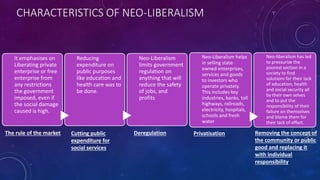
It emphasises on 
Liberating private 
enterprise or free 
enterprise from 
any restrictions 
the government 
imposed, even if 
the social damage 
caused is high. 
Reducing 
expenditure on 
public purposes 
like education and 
health care was to 
be done. 
Neo-Liberalism 
limits government 
regulation on 
anything that will 
reduce the safety 
of jobs, and 
profits 
Neo-Liberalism helps 
in selling state-owned 
enterprises, 
services and goods 
to investors who 
operate privately. 
This includes key 
industries, banks, toll 
highways, railroads, 
electricity, hospitals, 
schools and fresh 
water 
Neo-liberalism has led 
to pressurize the 
poorest section in a 
society to find 
solutions for their lack 
of education, health 
and social security all 
by their own selves 
and to put the 
responsibility of their 
failure on themselves 
and blame them for 
their lack of effort. 
The rule of the market Deregulation Privatisation Removing the concept of 
Cutting public 
expenditure for 
social services 
the community or public 
good and replacing it 
with individual 
responsibility 
CHARACTERISTICS OF NEO-LIBERALISM
INSTITUTIONS ESTABLISHED 
• INTERNATIONAL MONETARYFUND (IMF) 
• WORLD BANK (WB) 
• WORLD TRADE ORGANIZATION (WTO) 
1947: GENERAL AGREEMENT ON TARIFF AND TRADE (GATT) 
It is a multilateral agreement among countries that provides a framework 
for the conduct of international trade. It contains disciplines on matters 
related to import and export of goods. Through this, countries committed 
to reduce tariffs on certain imported goods. 
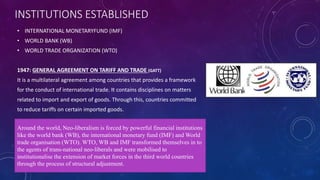
Around the world, Neo-liberalism is forced by powerful financial institutions 
like the world bank (WB), the international monetary fund (IMF) and World 
trade organisation (WTO). WTO, WB and IMF transformed themselves in to 
the agents of trans-national neo-liberals and were mobilised to 
institutionalise the extension of market forces in the third world countries 
through the process of structural adjustment.
CRITICAL ANALYSIS 
• The underlying assumption is that the free markets are good for the 
overall development. However, neo-liberalism can affects the market 
in a negative way, influence and manipulate trade for certain interests. 
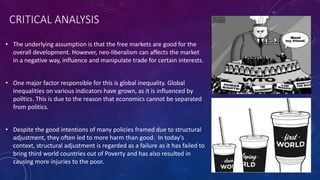
• One major factor responsible for this is global inequality. Global 
inequalities on various indicators have grown, as it is influenced by 
politics. This is due to the reason that economics cannot be separated 
from politics. 
• Despite the good intentions of many policies framed due to structural 
adjustment, they often led to more harm than good. In today’s 
context, structural adjustment is regarded as a failure as it has failed to 
bring third world countries out of Poverty and has also resulted in 
causing more injuries to the poor.
POVERTY, OVERPRODUCTION AND LOCAL DISINTEGRATION 
• Harsh economic measures have resulted in the gradual disintegration 
of the Welfare State. 
• Because of the large accumulation of public debts in western 
countries, the financial elites have been given the power to dictate 
government’s economic and social policy. 
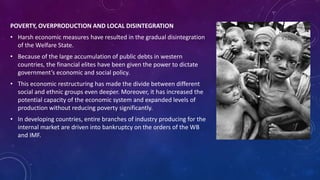
• This economic restructuring has made the divide between different 
social and ethnic groups even deeper. Moreover, it has increased the 
potential capacity of the economic system and expanded levels of 
production without reducing poverty significantly. 
• In developing countries, entire branches of industry producing for the 
internal market are driven into bankruptcy on the orders of the WB 
and IMF.
REFERENCE 
• “What is neo-liberalism”, Elizabeth Martinez and Arnoldo Garcia, National Network for Immigrant and 
Refugee Rights-corpwatch,1996 
• “Free trade and Globalisation”, Dominica, de ab la publication, 2010 
• “Neoliberalism: The economic model: origins, theory, definition”, Dandelion Salad, word press BlogSpot, 
2005 
• “A Primer on Neoliberalism”, Anup Shah, Global issues article, 2010 
• “Neo-liberalism: Origins, theory, definition”, Paul Treanor, 2005
THANK YOU

Neoliberalism

  • 1.
    A PRIMER ONNEO-LIBERALISM FARHANA.K 2120200095 5-SEM,3-YEAR B.PLANNING SPA VIJAYAWADA
  • 2.
    INTRODUCTION Neo-liberalism isa largely unregulated capitalist system with a set of economic policies that limits restrictions on manufacturing, reduces barriers to commerce, reduces tariffs, and free trade that came up to develop a nation's economy. • It is essentially about making trade between nations easier. • It is about freer movement of goods, resources and enterprises to maximize profits and efficiency.
  • 3.
    THE NEO-LIBERAL TURN • Post-war period and the class compromise between capital and labour (‘embedded liberalism’). • 1776- British economist Adam smith, published a book named the wealth of nations. • 1950s and the 1960s- High rates of economic growth, redistributive politics, control over the mobility of capital, Keynesian fiscal and monetary policies. • Towards the end of the 1960s embedded liberalism began to collapse. • 1980- Due to the debt crisis faced, neo-liberal programmes of restructuring were extended globally through the efforts of US and G-7 States to subject their states to establish a discipline of capital markets. • The capitalist crisis, with its reducing profit rates, encouraged the corporate groups to revive economic liberalism, which is known as neo-liberalism. • Neoliberalism emerged as a project to restore the power of economic elites.
  • 4.
    It emphasises on Liberating private enterprise or free enterprise from any restrictions the government imposed, even if the social damage caused is high. Reducing expenditure on public purposes like education and health care was to be done. Neo-Liberalism limits government regulation on anything that will reduce the safety of jobs, and profits Neo-Liberalism helps in selling state-owned enterprises, services and goods to investors who operate privately. This includes key industries, banks, toll highways, railroads, electricity, hospitals, schools and fresh water Neo-liberalism has led to pressurize the poorest section in a society to find solutions for their lack of education, health and social security all by their own selves and to put the responsibility of their failure on themselves and blame them for their lack of effort. The rule of the market Deregulation Privatisation Removing the concept of Cutting public expenditure for social services the community or public good and replacing it with individual responsibility CHARACTERISTICS OF NEO-LIBERALISM
  • 5.
    INSTITUTIONS ESTABLISHED •INTERNATIONAL MONETARYFUND (IMF) • WORLD BANK (WB) • WORLD TRADE ORGANIZATION (WTO) 1947: GENERAL AGREEMENT ON TARIFF AND TRADE (GATT) It is a multilateral agreement among countries that provides a framework for the conduct of international trade. It contains disciplines on matters related to import and export of goods. Through this, countries committed to reduce tariffs on certain imported goods. Around the world, Neo-liberalism is forced by powerful financial institutions like the world bank (WB), the international monetary fund (IMF) and World trade organisation (WTO). WTO, WB and IMF transformed themselves in to the agents of trans-national neo-liberals and were mobilised to institutionalise the extension of market forces in the third world countries through the process of structural adjustment.
  • 6.
    CRITICAL ANALYSIS •The underlying assumption is that the free markets are good for the overall development. However, neo-liberalism can affects the market in a negative way, influence and manipulate trade for certain interests. • One major factor responsible for this is global inequality. Global inequalities on various indicators have grown, as it is influenced by politics. This is due to the reason that economics cannot be separated from politics. • Despite the good intentions of many policies framed due to structural adjustment, they often led to more harm than good. In today’s context, structural adjustment is regarded as a failure as it has failed to bring third world countries out of Poverty and has also resulted in causing more injuries to the poor.
  • 7.
    POVERTY, OVERPRODUCTION ANDLOCAL DISINTEGRATION • Harsh economic measures have resulted in the gradual disintegration of the Welfare State. • Because of the large accumulation of public debts in western countries, the financial elites have been given the power to dictate government’s economic and social policy. • This economic restructuring has made the divide between different social and ethnic groups even deeper. Moreover, it has increased the potential capacity of the economic system and expanded levels of production without reducing poverty significantly. • In developing countries, entire branches of industry producing for the internal market are driven into bankruptcy on the orders of the WB and IMF.
  • 8.
    REFERENCE • “Whatis neo-liberalism”, Elizabeth Martinez and Arnoldo Garcia, National Network for Immigrant and Refugee Rights-corpwatch,1996 • “Free trade and Globalisation”, Dominica, de ab la publication, 2010 • “Neoliberalism: The economic model: origins, theory, definition”, Dandelion Salad, word press BlogSpot, 2005 • “A Primer on Neoliberalism”, Anup Shah, Global issues article, 2010 • “Neo-liberalism: Origins, theory, definition”, Paul Treanor, 2005
  • 9.