DEPENDENCY THEORY
FROM 1950s UNTIL NOW
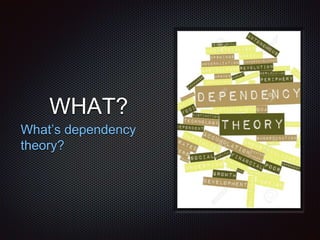
WHAT?
What’s dependency
theory?
This theory is…
Dependency can be defined as an explanation
of the economic development of a state in
terms of the external influences--political,
economic, and cultural--on national
development policies.
(Osvaldo Sunkel, "National Development Policy and External
Dependence in Latin America," The Journal of Development Studies,
Vol. 6, no. 1, October 1969, p. 23).
Dependency is ...an historical condition which shapes a
certain structure of the world economy such that it favors
some countries to the detriment of others and limits the
development possibilities of the subordinate
economics...a situation in which the economy of a certain
group of countries is conditioned by the development
and expansion of another economy, to which their own is
subjected.
(Theotonio Dos Santos, "The Structure of Dependence," in K.T.
Fann and Donald C. Hodges, eds., Readings in U.S. Imperialism.
Boston: Porter Sargent, 1971, p. 226)
In short, dependency theory attempts to
explain the present underdeveloped state of
many nations in the world by examining the
patterns of interactions among nations and by
arguing that inequality among nations is an
intrinsic part of those interactions.
The premises of dependency theory are
that:
Poor nations provide natural resources, cheap labour,
a destination for obsolete technology, and markets for
developed nations, without which the latter could not
have the standard of living they enjoy.
Wealthy nations actively perpetuate a state of
dependence by various means. This influence may be
multifaceted, involvingeconomics, media control,
politics, bankingand finance, education, culture, and
sport.
https://www.mtholyoke.edu/acad/intrel/depend.htm
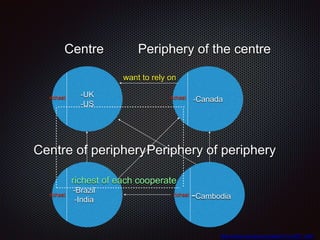
Centre
-UK
-US
Periphery of the centre
-Canada
Centre of peripheryPeriphery of periphery
-Brazil
-India
richest
richest richest
richest
want to rely on
-Cambodia
richest of each cooperate
https://www.youtube.com/watch?v=muiPj7_8ot0
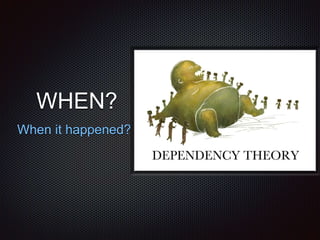
WHEN?
When it happened?
When?
Dependency Theory developed in the late 1950s under
the guidance of the Director of the United Nations
Economic Commission for Latin America, Raul
Prebisch
https://www.mtholyoke.edu/acad/intrel/depend.htm
-Raul Prebisch. Prebisch and his colleagues were troubled by the fact that
economic growth in the advanced industrialized countries did not necessarily
lead to growth in the poorer countries. Indeed, their studies suggested that
economic activity in the richer countries often led to serious economic
problems in the poorer countries.
-Prebisch's initial explanation for the phenomenon was very straightforward:
poor countries exported primary commodities to the rich countries who then
manufactured products out of those commodities and sold them back to the
poorer countries.Therefore, poorer countries would never be earning
enough from their export earnings to pay for their imports.
-Prebisch’s solution was similarly straightforward: poorer countries should
embark on programs of import substitution so that they need not purchase
the manufactured products from the richer countries. The poorer countries
would still sell their primary products on the world market, but their foreign
exchange reserves would not be used to purchase their manufactures from
abroad.
THEN
Three issues made this policy difficult to follow.
-THE FIRST ISSUE
-THE SECOND ISSUE
-THE LAST ISSUE
At this point dependency theory was viewed
as a possible way of explaining the
persistent poverty of the poorer countries.
CONCLUSION
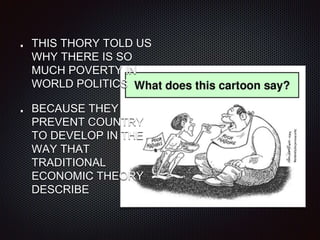
THIS THORY TOLD US
WHY THERE IS SO
MUCH POVERTY IN
WORLD POLITICS
BECAUSE THEY
PREVENT COUNTRY
TO DEVELOP IN THE
WAY THAT
TRADITIONAL
ECONOMIC THEORY
DESCRIBE

Dependency theory pwp

  • 1.
  • 2.
  • 3.
    This theory is… Dependencycan be defined as an explanation of the economic development of a state in terms of the external influences--political, economic, and cultural--on national development policies. (Osvaldo Sunkel, "National Development Policy and External Dependence in Latin America," The Journal of Development Studies, Vol. 6, no. 1, October 1969, p. 23).
  • 4.
    Dependency is ...anhistorical condition which shapes a certain structure of the world economy such that it favors some countries to the detriment of others and limits the development possibilities of the subordinate economics...a situation in which the economy of a certain group of countries is conditioned by the development and expansion of another economy, to which their own is subjected. (Theotonio Dos Santos, "The Structure of Dependence," in K.T. Fann and Donald C. Hodges, eds., Readings in U.S. Imperialism. Boston: Porter Sargent, 1971, p. 226)
  • 5.
    In short, dependencytheory attempts to explain the present underdeveloped state of many nations in the world by examining the patterns of interactions among nations and by arguing that inequality among nations is an intrinsic part of those interactions.
  • 6.
    The premises ofdependency theory are that: Poor nations provide natural resources, cheap labour, a destination for obsolete technology, and markets for developed nations, without which the latter could not have the standard of living they enjoy. Wealthy nations actively perpetuate a state of dependence by various means. This influence may be multifaceted, involvingeconomics, media control, politics, bankingand finance, education, culture, and sport. https://www.mtholyoke.edu/acad/intrel/depend.htm
  • 7.
    Centre -UK -US Periphery of thecentre -Canada Centre of peripheryPeriphery of periphery -Brazil -India richest richest richest richest want to rely on -Cambodia richest of each cooperate https://www.youtube.com/watch?v=muiPj7_8ot0
  • 8.
  • 9.
    When? Dependency Theory developedin the late 1950s under the guidance of the Director of the United Nations Economic Commission for Latin America, Raul Prebisch https://www.mtholyoke.edu/acad/intrel/depend.htm
  • 10.
    -Raul Prebisch. Prebischand his colleagues were troubled by the fact that economic growth in the advanced industrialized countries did not necessarily lead to growth in the poorer countries. Indeed, their studies suggested that economic activity in the richer countries often led to serious economic problems in the poorer countries. -Prebisch's initial explanation for the phenomenon was very straightforward: poor countries exported primary commodities to the rich countries who then manufactured products out of those commodities and sold them back to the poorer countries.Therefore, poorer countries would never be earning enough from their export earnings to pay for their imports. -Prebisch’s solution was similarly straightforward: poorer countries should embark on programs of import substitution so that they need not purchase the manufactured products from the richer countries. The poorer countries would still sell their primary products on the world market, but their foreign exchange reserves would not be used to purchase their manufactures from abroad.
  • 11.
    THEN Three issues madethis policy difficult to follow. -THE FIRST ISSUE -THE SECOND ISSUE -THE LAST ISSUE
  • 12.
    At this pointdependency theory was viewed as a possible way of explaining the persistent poverty of the poorer countries.
  • 13.
  • 14.
    THIS THORY TOLDUS WHY THERE IS SO MUCH POVERTY IN WORLD POLITICS BECAUSE THEY PREVENT COUNTRY TO DEVELOP IN THE WAY THAT TRADITIONAL ECONOMIC THEORY DESCRIBE