Demography
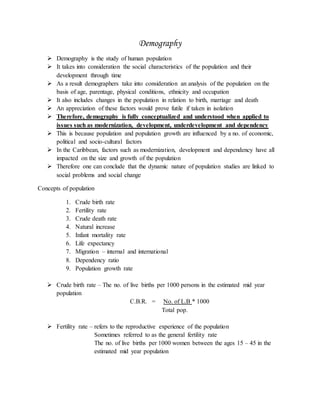
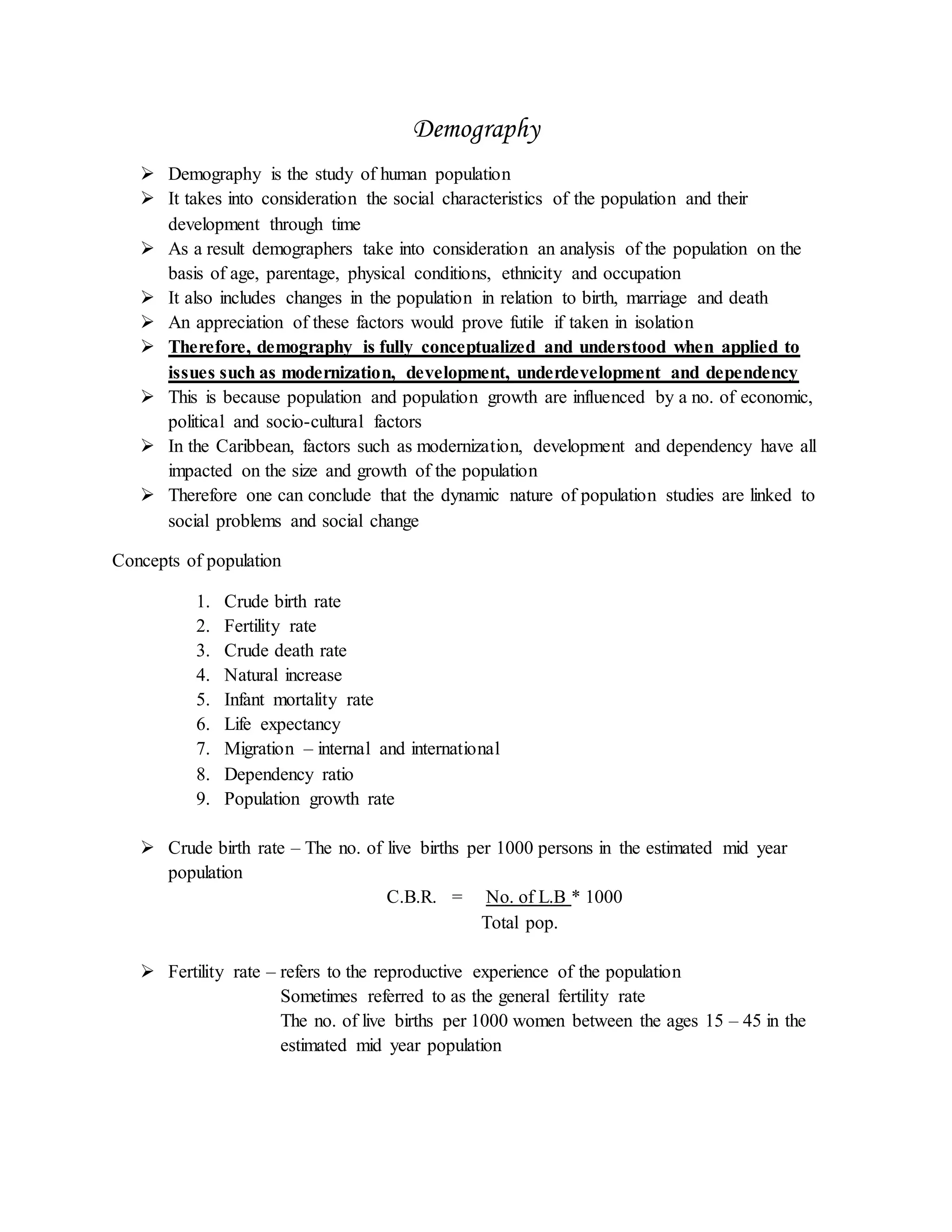
 Demography is the study of human population
 It takes into consideration the social characteristics of the population and their
development through time
 As a result demographers take into consideration an analysis of the population on the
basis of age, parentage, physical conditions, ethnicity and occupation
 It also includes changes in the population in relation to birth, marriage and death
 An appreciation of these factors would prove futile if taken in isolation
 Therefore, demography is fully conceptualized and understood when applied to
issues such as modernization, development, underdevelopment and dependency
 This is because population and population growth are influenced by a no. of economic,
political and socio-cultural factors
 In the Caribbean, factors such as modernization, development and dependency have all
impacted on the size and growth of the population
 Therefore one can conclude that the dynamic nature of population studies are linked to
social problems and social change
Concepts of population
1. Crude birth rate
2. Fertility rate
3. Crude death rate
4. Natural increase
5. Infant mortality rate
6. Life expectancy
7. Migration – internal and international
8. Dependency ratio
9. Population growth rate
 Crude birth rate – The no. of live births per 1000 persons in the estimated mid year
population
C.B.R. = No. of L.B * 1000
Total pop.
 Fertility rate – refers to the reproductive experience of the population
Sometimes referred to as the general fertility rate
The no. of live births per 1000 women between the ages 15 – 45 in the
estimated mid year population
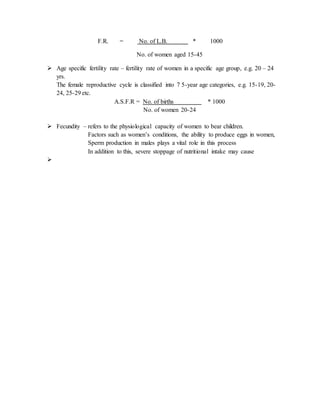
F.R. = No. of L.B. * 1000
No. of women aged 15-45
 Age specific fertility rate – fertility rate of women in a specific age group, e.g. 20 – 24
yrs.
The female reproductive cycle is classified into 7 5-year age categories, e.g. 15-19, 20-
24, 25-29 etc.
A.S.F.R = No. of births * 1000
No. of women 20-24
 Fecundity – refers to the physiological capacity of women to bear children.
Factors such as women’s conditions, the ability to produce eggs in women,
Sperm production in males plays a vital role in this process
In addition to this, severe stoppage of nutritional intake may cause


Demography

  • 1.
    Demography  Demography isthe study of human population  It takes into consideration the social characteristics of the population and their development through time  As a result demographers take into consideration an analysis of the population on the basis of age, parentage, physical conditions, ethnicity and occupation  It also includes changes in the population in relation to birth, marriage and death  An appreciation of these factors would prove futile if taken in isolation  Therefore, demography is fully conceptualized and understood when applied to issues such as modernization, development, underdevelopment and dependency  This is because population and population growth are influenced by a no. of economic, political and socio-cultural factors  In the Caribbean, factors such as modernization, development and dependency have all impacted on the size and growth of the population  Therefore one can conclude that the dynamic nature of population studies are linked to social problems and social change Concepts of population 1. Crude birth rate 2. Fertility rate 3. Crude death rate 4. Natural increase 5. Infant mortality rate 6. Life expectancy 7. Migration – internal and international 8. Dependency ratio 9. Population growth rate  Crude birth rate – The no. of live births per 1000 persons in the estimated mid year population C.B.R. = No. of L.B * 1000 Total pop.  Fertility rate – refers to the reproductive experience of the population Sometimes referred to as the general fertility rate The no. of live births per 1000 women between the ages 15 – 45 in the estimated mid year population
  • 2.
    F.R. = No.of L.B. * 1000 No. of women aged 15-45  Age specific fertility rate – fertility rate of women in a specific age group, e.g. 20 – 24 yrs. The female reproductive cycle is classified into 7 5-year age categories, e.g. 15-19, 20- 24, 25-29 etc. A.S.F.R = No. of births * 1000 No. of women 20-24  Fecundity – refers to the physiological capacity of women to bear children. Factors such as women’s conditions, the ability to produce eggs in women, Sperm production in males plays a vital role in this process In addition to this, severe stoppage of nutritional intake may cause 