CAPE Caribbean Sociology
Conflict and Functionalist
Theories
Wolmer’s Boys’ School
Prepared by
Christopher A Humber
Conflict/Functionalist Theories
KARL MARX EMILE DURKHEIM
CONFLICT THEORY
• Begins with Marx and his analysis of
history
• Thesis/antithesis = struggle (conflict)
• Synthesis = a new order is produced
because of the struggle between the
classes
• All of history can be understood in this way
• Three stages of history: feudalism,
capitalism & socialism (it was an inevitable
destination!)
Always a struggle
• The materialist view of history = the most
important determinant of social life is the
work people are doing, especially work
that results in provision of the basic
necessities of life, food, clothing and
shelter.
• Marx thought that the way the work is
socially organized and the technology
used in production will have a strong
impact on every other aspect of society.
Power=ownership
• He maintained that everything of value in
society results from human labour.
Thus, Marx saw working men and women as
engaged in making society, in creating the
conditions for their own existence.
• Every part of human history and existence
must be understood through the lens of
social/economic theory
• All relationships are based on
conflict/struggle
Only 1 institution: private
property
• The central institution of capitalist society
is private property, the system by
which capital (that is, money, machines,
tools, factories, and other material objects
used in production) is controlled by a small
minority of the population. This leads to
two opposed classes, the owners of
capital (called the bourgeoisie) and the
workers (called the proletariat), whose
only property is their own labour time,
which they have to sell to the capitalists.
• Economic exploitation leads directly to
political oppression, as owners make use
of their economic power to gain control of
the state and turn it into a servant of
bourgeois economic interests. Police
power, for instance, is used to enforce
property rights and guarantee unfair
contracts between capitalist and worker.
Conflict theory + marriage
The Marriage Scam
• 1884
• Built on Marx’s ideas
• Monogamy is an invention to control
sexual reproduction
• Marriage is a social construct to guarantee
private property to biological children
• Conclusion: marriage is exploitation of
women
Oppression is everywhere!
• The economic structure of society moulds
the superstructure, including ideas (e.g.,
morality, ideologies, art, and literature) and
the social institutions that support the
class structure of society (e.g., the state,
the educational system, the family, and
religious institutions).
• What do you think? Is school oppressive?
Conflict theory & private schools
• Because the dominant or ruling
class (the bourgeoisie) controls the social
relations of production, the
dominant ideology in capitalist society is
that of the ruling class.
• Ideology and social institutions, in turn,
serve to reproduce and perpetuate the
economic class structure.
• Does private school education perpetuate
the class system? What do you think?
Functionalist theory / Durkheim
• First theory in
sociology
• Two fundamentals:
• 1- application of
scientific method
(sociologists must be
objective & without
bias)
• 2- institutions fulfill
basic human needs
and all groups play a
role in achieving
equilibrium
Balance, equilibrium, stability
• Key words for functionalism
• Think of any system that must co-ordinate
its parts for survival (body & organs)
• A social system with needs that must be
met
• When change in one group happens, other
groups must adjust, adapt, respond...to
accommodate for the change, finding the
equilibrium again
• HOMOEOSTASIS IS THE KEY WORD
A society is
• A system of inter-related “parts”
• A change in one affects the others
• Most changes are the result of “evolution”
or natural progression of ideas and social
change
• Durkheim was influenced by Darwin`s
work
• Functionalism focuses on the individual
and how social forces influence him
(Macro perspective)
The social self
• Functionalism understands the individual
to be a product of social forces in the
environment
• Almost puppet-like (has been the criticism)
• The individual`s place in the social
structure will determine their actions
• Internalized social expectations and act
accordingly in order to satisfy the needs of
the group
• Social control may be explicit or implicit
• Functionalist want to PREDICT behaviour
• This explains the emphasis on the
scientific method
• Shared values (solidarity) is key to group
cohesiveness
• Example: laws, rules, constitutions are an
explicit expression of supreme values
(justice, freedom) that are held in common
by a group/society
• Functionalism is a macro approach to
studying society; it defines society as
a system of interrelated parts.
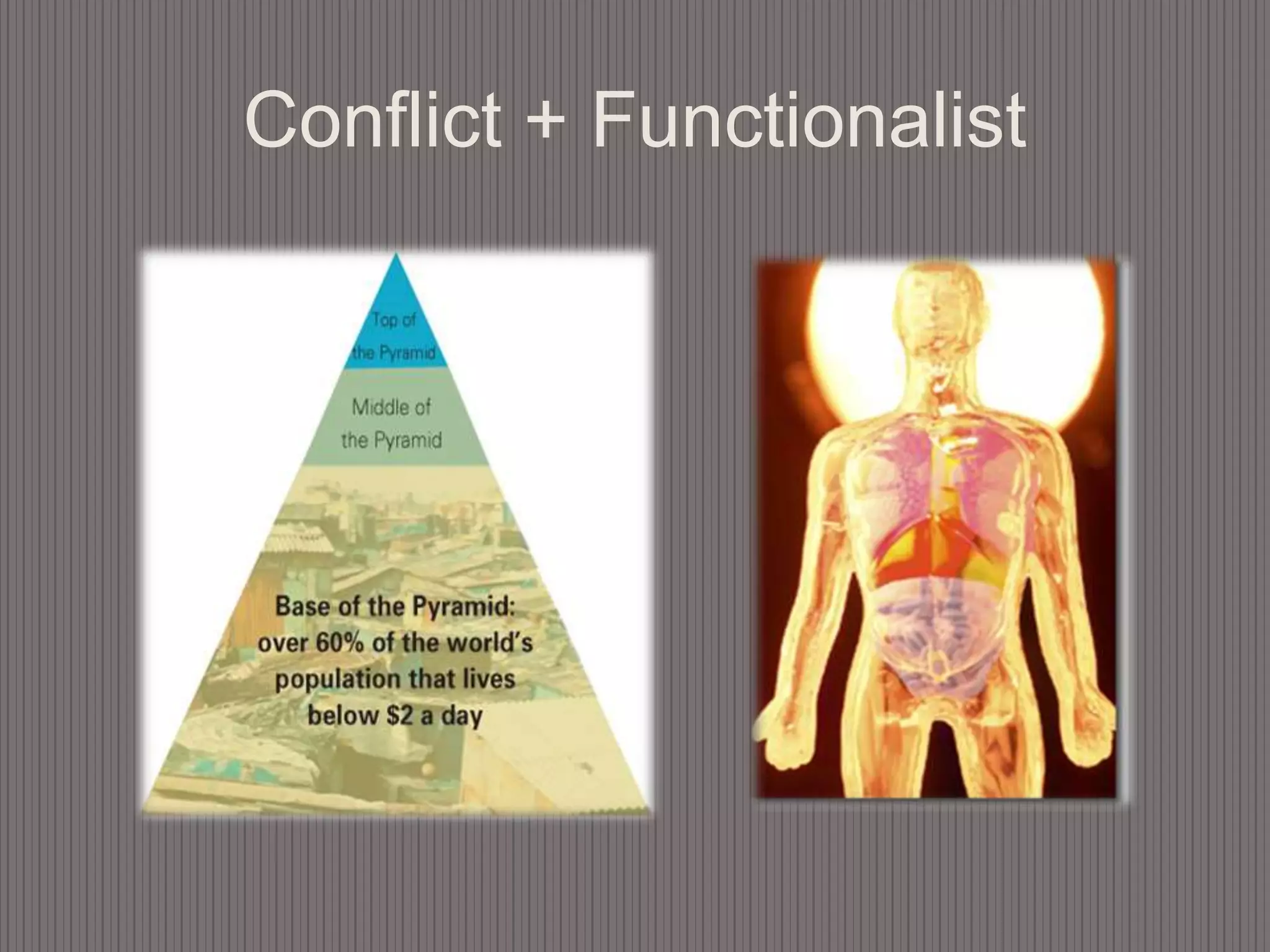
• A good metaphor is the body with its
interrelated organs that all work together
to produce the state of health of the
person. It has built in mechanisms that
maintain stasis or balance. (Sweating,
shivering, etc.)
• In society, when things happen to provoke
change or throw it off kilter, other
mechanisms come into play to help bring
back to a balance. Sometimes this new
balance is slow change, in the case of
people`s values changing faster than the
laws or the other way around. What
examples can you think of to prove this
theory?
Conflict + Functionalist

Conflictandfunctionalisttheory 101015102833-phpapp01

  • 1.
    CAPE Caribbean Sociology Conflictand Functionalist Theories Wolmer’s Boys’ School Prepared by Christopher A Humber
  • 2.
  • 3.
    CONFLICT THEORY • Beginswith Marx and his analysis of history • Thesis/antithesis = struggle (conflict) • Synthesis = a new order is produced because of the struggle between the classes • All of history can be understood in this way • Three stages of history: feudalism, capitalism & socialism (it was an inevitable destination!)
  • 4.
    Always a struggle •The materialist view of history = the most important determinant of social life is the work people are doing, especially work that results in provision of the basic necessities of life, food, clothing and shelter. • Marx thought that the way the work is socially organized and the technology used in production will have a strong impact on every other aspect of society.
  • 5.
    Power=ownership • He maintainedthat everything of value in society results from human labour. Thus, Marx saw working men and women as engaged in making society, in creating the conditions for their own existence. • Every part of human history and existence must be understood through the lens of social/economic theory • All relationships are based on conflict/struggle
  • 6.
    Only 1 institution:private property • The central institution of capitalist society is private property, the system by which capital (that is, money, machines, tools, factories, and other material objects used in production) is controlled by a small minority of the population. This leads to two opposed classes, the owners of capital (called the bourgeoisie) and the workers (called the proletariat), whose only property is their own labour time, which they have to sell to the capitalists.
  • 7.
    • Economic exploitationleads directly to political oppression, as owners make use of their economic power to gain control of the state and turn it into a servant of bourgeois economic interests. Police power, for instance, is used to enforce property rights and guarantee unfair contracts between capitalist and worker.
  • 8.
  • 9.
    The Marriage Scam •1884 • Built on Marx’s ideas • Monogamy is an invention to control sexual reproduction • Marriage is a social construct to guarantee private property to biological children • Conclusion: marriage is exploitation of women
  • 10.
    Oppression is everywhere! •The economic structure of society moulds the superstructure, including ideas (e.g., morality, ideologies, art, and literature) and the social institutions that support the class structure of society (e.g., the state, the educational system, the family, and religious institutions). • What do you think? Is school oppressive?
  • 11.
    Conflict theory &private schools • Because the dominant or ruling class (the bourgeoisie) controls the social relations of production, the dominant ideology in capitalist society is that of the ruling class. • Ideology and social institutions, in turn, serve to reproduce and perpetuate the economic class structure. • Does private school education perpetuate the class system? What do you think?
  • 12.
    Functionalist theory /Durkheim • First theory in sociology • Two fundamentals: • 1- application of scientific method (sociologists must be objective & without bias) • 2- institutions fulfill basic human needs and all groups play a role in achieving equilibrium
  • 13.
    Balance, equilibrium, stability •Key words for functionalism • Think of any system that must co-ordinate its parts for survival (body & organs) • A social system with needs that must be met • When change in one group happens, other groups must adjust, adapt, respond...to accommodate for the change, finding the equilibrium again • HOMOEOSTASIS IS THE KEY WORD
  • 14.
    A society is •A system of inter-related “parts” • A change in one affects the others • Most changes are the result of “evolution” or natural progression of ideas and social change • Durkheim was influenced by Darwin`s work • Functionalism focuses on the individual and how social forces influence him (Macro perspective)
  • 15.
    The social self •Functionalism understands the individual to be a product of social forces in the environment • Almost puppet-like (has been the criticism) • The individual`s place in the social structure will determine their actions • Internalized social expectations and act accordingly in order to satisfy the needs of the group • Social control may be explicit or implicit
  • 16.
    • Functionalist wantto PREDICT behaviour • This explains the emphasis on the scientific method • Shared values (solidarity) is key to group cohesiveness • Example: laws, rules, constitutions are an explicit expression of supreme values (justice, freedom) that are held in common by a group/society
  • 17.
    • Functionalism isa macro approach to studying society; it defines society as a system of interrelated parts. • A good metaphor is the body with its interrelated organs that all work together to produce the state of health of the person. It has built in mechanisms that maintain stasis or balance. (Sweating, shivering, etc.)
  • 18.
    • In society,when things happen to provoke change or throw it off kilter, other mechanisms come into play to help bring back to a balance. Sometimes this new balance is slow change, in the case of people`s values changing faster than the laws or the other way around. What examples can you think of to prove this theory?
  • 19.