MD Yusuf Ali
 Demography is the ”scientific study of
human population in which includes study
of changes in population size ,composition
and its distribution”
“Demo” means “the people” and “graphy”
means “measurement”
(Demos = population, Graphy = picture
 Health status of a community depends upon
the dynamic relationship between number of
people, their composition& distribution .
 Planning of health services can be guided by
demographic variables, for example: How
many health units do we need? How to
distribute them in the community in order to
be accessible to the target population? What
type of manpower is needed?
Size: increase or decrease
 Composition: sex and age group
 Distribution: territory
POPULATION CENSUSES
•NATIONAL SAMPLE
•SURVEYS REGISTRATION
•VITAL EVENTS
 Demography
 Economic Activity
 Literacy & Education
 Housing & Household
 Urbanization
 Fertility and Mortality
 Scheduled Castes and Scheduled Tribes
 Language, Religion & Migration
It deals with the five demographic
processes
• FERTILITY
• MORTALITY
• MARRIAGE
• MIGRATION
• SOCIAL MORBILITY
High stationary (first stage ): this stage is
characterized by a high birth rate and high
death rate ,no any change in size and
population .Indian was in this stage till
1920.
• Early expending (second stage ): the
death rate begins to decline (starts
decreasing )and birth rate no change .
initial increase in population
Late expanding (third stage): the birth rate
begins to decline while the death rate still
decreases . continue increase in
population
• Low stationary (fourth stage ) : This stage
is characterized by a low birth rate & low
death rate .stability in population .
Declining (fifth stage ):in the declining
stage birth rate is lower then the death rate
.fall in population
Primary data collection :collection is done
by the individual by using the methods
such as :
Observation
• Interviews
• Questionnaires
• Diaries .
 Census
 National survey
 Registration of vital events
 Demographic studies
 Records
• Data is collection directly or indirectly from
population . The data collected directed
from individuals by face to face survey .
• Data collected during census.
• Data related to health from an individual.
• Data related to illness from an individual.
. •
• Data taken from hospital records
• The data collected need to be arranged in
table ,charts ,diagrams, graphs picture
• In 1872 The Census of India
2011 th is the 15th Census and 7th after
Independence. the first Census was held
in India.
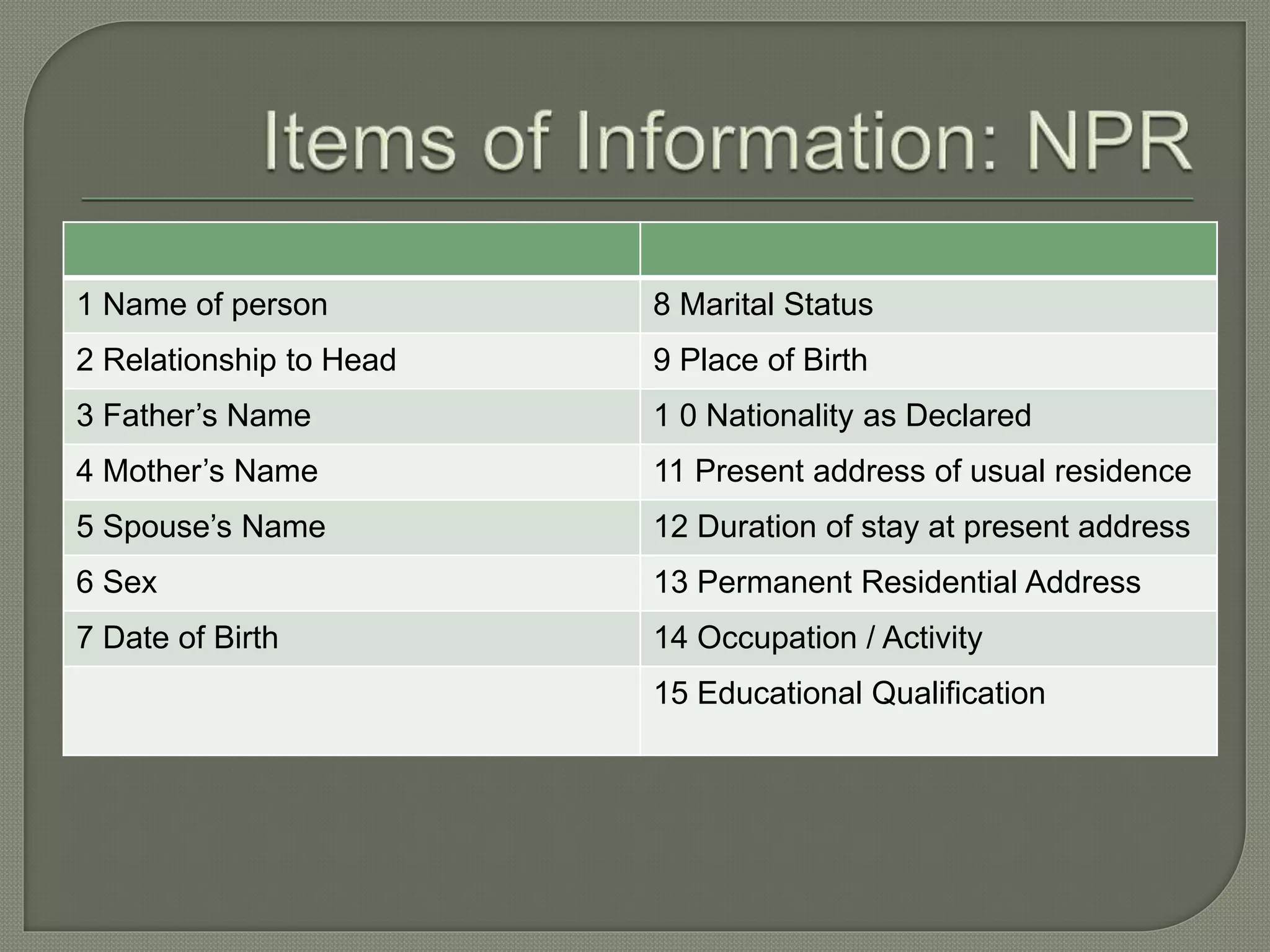
1 Name of person 8 Marital Status
2 Relationship to Head 9 Place of Birth
3 Father’s Name 1 0 Nationality as Declared
4 Mother’s Name 11 Present address of usual residence
5 Spouse’s Name 12 Duration of stay at present address
6 Sex 13 Permanent Residential Address
7 Date of Birth 14 Occupation / Activity
15 Educational Qualification
1 Name of person 8 Marital Status
2 Relationship to Head 9 Place of Birth
3 Father’s Name 1 0 Nationality as Declared
4 Mother’s Name 11 Present address of usual residence
5 Spouse’s Name 12 Duration of stay at present address
6 Sex 13 Permanent Residential Address
7 Date of Birth 14 Occupation / Activity
15 Educational Qualification
Thank you

Demography

  • 1.
  • 2.
     Demography isthe ”scientific study of human population in which includes study of changes in population size ,composition and its distribution”
  • 3.
    “Demo” means “thepeople” and “graphy” means “measurement” (Demos = population, Graphy = picture
  • 4.
     Health statusof a community depends upon the dynamic relationship between number of people, their composition& distribution .  Planning of health services can be guided by demographic variables, for example: How many health units do we need? How to distribute them in the community in order to be accessible to the target population? What type of manpower is needed?
  • 5.
    Size: increase ordecrease  Composition: sex and age group  Distribution: territory
  • 6.
  • 7.
     Demography  EconomicActivity  Literacy & Education  Housing & Household  Urbanization  Fertility and Mortality  Scheduled Castes and Scheduled Tribes  Language, Religion & Migration
  • 8.
    It deals withthe five demographic processes • FERTILITY • MORTALITY • MARRIAGE • MIGRATION • SOCIAL MORBILITY
  • 9.
    High stationary (firststage ): this stage is characterized by a high birth rate and high death rate ,no any change in size and population .Indian was in this stage till 1920. • Early expending (second stage ): the death rate begins to decline (starts decreasing )and birth rate no change . initial increase in population
  • 10.
    Late expanding (thirdstage): the birth rate begins to decline while the death rate still decreases . continue increase in population • Low stationary (fourth stage ) : This stage is characterized by a low birth rate & low death rate .stability in population . Declining (fifth stage ):in the declining stage birth rate is lower then the death rate .fall in population
  • 11.
    Primary data collection:collection is done by the individual by using the methods such as : Observation • Interviews • Questionnaires • Diaries .
  • 12.
     Census  Nationalsurvey  Registration of vital events  Demographic studies  Records
  • 13.
    • Data iscollection directly or indirectly from population . The data collected directed from individuals by face to face survey . • Data collected during census. • Data related to health from an individual. • Data related to illness from an individual. . •
  • 14.
    • Data takenfrom hospital records • The data collected need to be arranged in table ,charts ,diagrams, graphs picture
  • 15.
    • In 1872The Census of India 2011 th is the 15th Census and 7th after Independence. the first Census was held in India.
  • 16.
    1 Name ofperson 8 Marital Status 2 Relationship to Head 9 Place of Birth 3 Father’s Name 1 0 Nationality as Declared 4 Mother’s Name 11 Present address of usual residence 5 Spouse’s Name 12 Duration of stay at present address 6 Sex 13 Permanent Residential Address 7 Date of Birth 14 Occupation / Activity 15 Educational Qualification
  • 17.
    1 Name ofperson 8 Marital Status 2 Relationship to Head 9 Place of Birth 3 Father’s Name 1 0 Nationality as Declared 4 Mother’s Name 11 Present address of usual residence 5 Spouse’s Name 12 Duration of stay at present address 6 Sex 13 Permanent Residential Address 7 Date of Birth 14 Occupation / Activity 15 Educational Qualification
  • 18.