SOCIAL STRATIFICATION
CARIBBEAN CONTEXT
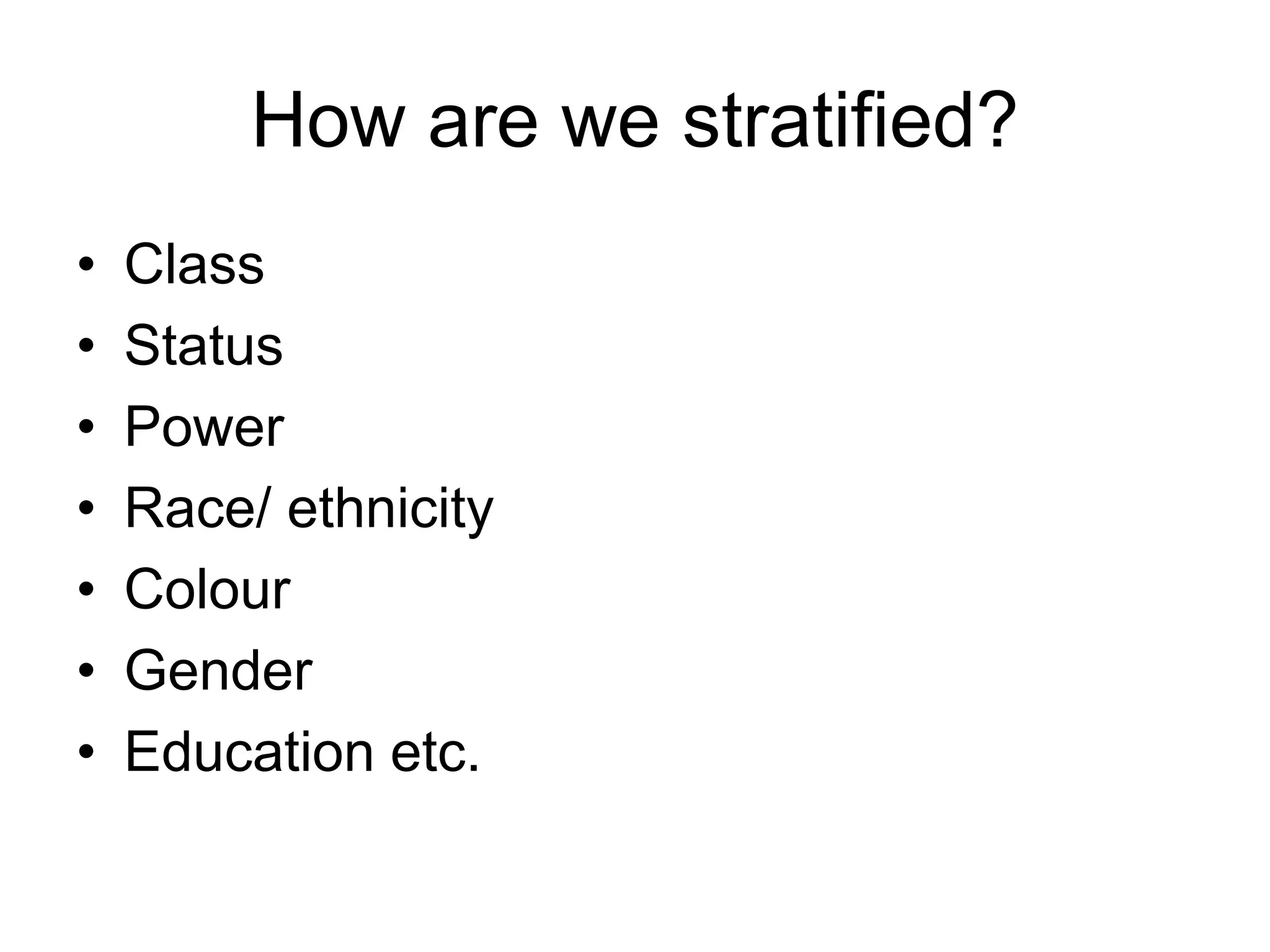
How are we stratified?
• Class
• Status
• Power
• Race/ ethnicity
• Colour
• Gender
• Education etc.
Stratification in general:
White
Coloured
Black
Upper Class
Middle Class
Lower Class
Upper Class
Middle Class
Lower Class
19th Century Present System
Jamaica
• M.G. Smith:
– Each strata in society reflects a different cultural
grouping. This is aligned to skin colour.
– (Plural Society)
– The only vertical mobility that occurred was the blacks
moving from lower class to middle class.
– Industrialization resulted in the widening of the
economy, increased job creation and thus the
emergence of new social classes. These groups
remained distinct to the prestigious upper class
grouping.
• Derek Gordon:
– He noted that the increased occupational
opportunities provided avenues for persons to
achieve upward mobility. Between 1943 –
1984 there was a significant upward
movement to the middle and upper middle
classes. The higher managerial and
professional group showed an increase in
black representation from 20% in 1943 to
42% in 1984.
– There are still inconsistencies as persons with
poor or low socio-economic backgrounds did
not receive a fair chance of mobility
Trinidad
- Lloyd Brathwaite
- Society largely defined by race: White- good;
Black- evil
- Syrians, Asians and the Chinese maintain their
status by keeping a relatively closed system
except for intermarriage with the white grouping.
– Selwyn Ryan
• 30years later, notes that Brathwaite’s system of
stratification has virtually disappeared especially
with the rise of the Blacks to power (People’s
National Movement)
• The expansion of various systems (education,
occupation etc) has undermined the old social
order.
• Meritocracy is evident.
• Rhoda Reddock
– notes that gender has become a more important
factor in distinguishing groups in the society
– Though female participation in the labour force
remains low, there is evidence of them experiencing
greatest mobility across all ethnic groupings.
NOTE: The Caribbean Sociology text is critical to
this topic.

CAPE Sociology Social stratification in_caribbean

  • 1.
  • 2.
    How are westratified? • Class • Status • Power • Race/ ethnicity • Colour • Gender • Education etc.
  • 3.
    Stratification in general: White Coloured Black UpperClass Middle Class Lower Class Upper Class Middle Class Lower Class 19th Century Present System
  • 4.
    Jamaica • M.G. Smith: –Each strata in society reflects a different cultural grouping. This is aligned to skin colour. – (Plural Society) – The only vertical mobility that occurred was the blacks moving from lower class to middle class. – Industrialization resulted in the widening of the economy, increased job creation and thus the emergence of new social classes. These groups remained distinct to the prestigious upper class grouping.
  • 5.
    • Derek Gordon: –He noted that the increased occupational opportunities provided avenues for persons to achieve upward mobility. Between 1943 – 1984 there was a significant upward movement to the middle and upper middle classes. The higher managerial and professional group showed an increase in black representation from 20% in 1943 to 42% in 1984. – There are still inconsistencies as persons with poor or low socio-economic backgrounds did not receive a fair chance of mobility
  • 6.
    Trinidad - Lloyd Brathwaite -Society largely defined by race: White- good; Black- evil - Syrians, Asians and the Chinese maintain their status by keeping a relatively closed system except for intermarriage with the white grouping. – Selwyn Ryan • 30years later, notes that Brathwaite’s system of stratification has virtually disappeared especially with the rise of the Blacks to power (People’s National Movement)
  • 7.
    • The expansionof various systems (education, occupation etc) has undermined the old social order. • Meritocracy is evident. • Rhoda Reddock – notes that gender has become a more important factor in distinguishing groups in the society – Though female participation in the labour force remains low, there is evidence of them experiencing greatest mobility across all ethnic groupings. NOTE: The Caribbean Sociology text is critical to this topic.