
DEMOGRAPHY AND ITS SCIENCES
 
 
Statistical study  of human population.   It can be a very general science that can be applied to any kind of  dynamic human population , that is, one that changes over time or space.    It encompasses the  study  of the size, structure and distribution of these populations, and spatial and/or temporal changes in them in response to birth, migration, aging and death.
 
IMPORTANCE An important part of sociology and the other social sciences because all persisting social aggregates— societies, states, communities, racial or ethnic groups, professions, formal organizations, kinship groups, and so  on—are also populations.  The size of the population, its growth or decline, the location and spatial movement of its people, and their changing characteristics are important features of an aggregate whether one  sees it as a culture, an economy, a polity, or a society.  Institutionally, demography is usually considered a field of  sociology. Demographic analysis  can be applied to whole societies or to groups defined by criteria such as  education, nationality, religion and ethnicity.
 
 
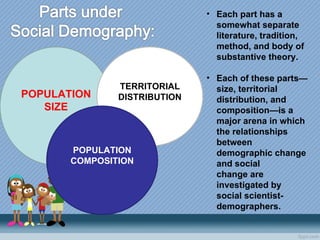
POPULATION SIZE TERRITORIAL DISTRIBUTION POPULATION COMPOSITION Each part has a somewhat separate literature, tradition, method, and body of substantive theory. Each of these parts—size, territorial distribution, and composition—is a major arena in which the relationships between demographic change and social change are investigated by social scientist-demographers.
 

Demography

  • 1.
  • 2.
  • 3.
  • 4.
    Statistical study of human population.   It can be a very general science that can be applied to any kind of dynamic human population , that is, one that changes over time or space.   It encompasses the study of the size, structure and distribution of these populations, and spatial and/or temporal changes in them in response to birth, migration, aging and death.
  • 5.
  • 6.
    IMPORTANCE An importantpart of sociology and the other social sciences because all persisting social aggregates— societies, states, communities, racial or ethnic groups, professions, formal organizations, kinship groups, and so on—are also populations.  The size of the population, its growth or decline, the location and spatial movement of its people, and their changing characteristics are important features of an aggregate whether one sees it as a culture, an economy, a polity, or a society.  Institutionally, demography is usually considered a field of  sociology. Demographic analysis  can be applied to whole societies or to groups defined by criteria such as  education, nationality, religion and ethnicity.
  • 7.
  • 8.
  • 9.
    POPULATION SIZE TERRITORIALDISTRIBUTION POPULATION COMPOSITION Each part has a somewhat separate literature, tradition, method, and body of substantive theory. Each of these parts—size, territorial distribution, and composition—is a major arena in which the relationships between demographic change and social change are investigated by social scientist-demographers.
  • 10.