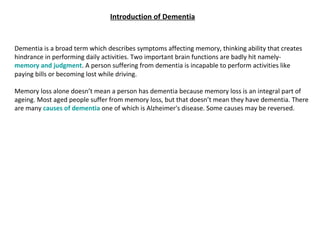
Dementia
Introduction of Dementia
Dementia is a broad term which describes symptoms affecting memory, thinking ability that creates
hindrance in performing daily activities. Two important brain functions are badly hit namely-
memory and judgment. A person suffering from dementia is incapable to perform activities like
paying bills or becoming lost while driving.
Memory loss alone doesn’t mean a person has dementia because memory loss is an integral part of
ageing. Most aged people suffer from memory loss, but that doesn’t mean they have dementia. There
are many causes of dementia one of which is Alzheimer's disease. Some causes may be reversed.
Symptoms of Dementia
Most common signs of dementia include:
•Memory Loss
•Difficulty in communication or searching words
•Unable to complete tasks
•Inability to do planning and organizing
•Getting lost or issues with disorientation
•Behavioral changes
•Hallucinations
•Inability to reason
When an individual suffers from dementia, his/her nerve cells in the brain get damaged. Dementia
affects people differently depending upon the affected area in the brain. Dementia can be
grouped in two categories-
• Which cannot be reversed and deteriorate overtime and
• Which can be reversed when treated timely
Causes of Dementia
Treatment of Dementia
Alzheimer's disease 
Vascular dementia 
Lewy body dementia 
Frontotemporal dementia 
Conditions linked to dementia which can be overturned in time
Infections and immune disorders 
Metabolic issues and endocrine deformity 
Nutritional deficiencies 
Reactions to medications 
Poisoning 
Brain tumors 
Anoxia 
Normal-pressure hydrocephalus
Examination and diagnoses for Dementia
Dementia and other related conditions have multiple causes and treating them can be a daunting task for 
your medical practitioner. You may require several sitting with the doctor. Your doctor will go through 
your medical history and conduct regular physical examination. He/she may perform a number of 
tests in order to diagnose dementia and rule out other health conditions.
Thinking and neuropsychological tests
In these tests, doctor will assess your thinking function. These tests are necessary to measure 
skills like memory, attention, judgment, reasoning and more. On the basis of these 
tests, neurologists get to know the magnitude of dementia and which part of brain it has 
affected. 
Neurological assessment
In this test, neurologists will gauge your senses, movements, reflexes, flexibility etc. It helps 
in knowing whether conditions, other than dementia, prevail or not.
• Lab Tests
General blood tests can rule out the possibility of any physical problem that can affect brain 
functionality. 
Psychiatric assessment
Your doctor may refer to a psychologist in order to determine whether depression or any 
other psychological condition may be causing your symptoms. 
Simple home remedies to deal with dementia
Enhance communication, encourage exercise, active participation in various games and 
thinking activities Encourage keeping a calendar Planning for the future. 
Thinking and neuropsychological tests
In these tests, doctor will assess your thinking function. These tests are necessary to measure
skills like memory, attention, judgment, reasoning and more. On the basis of these
tests, neurologists get to know the magnitude of dementia and which part of brain it has
affected.
Neurological assessment
In this test, neurologists will gauge your senses, movements, reflexes, flexibility etc. It helps
in knowing whether conditions, other than dementia, prevail or not.
• Lab Tests
General blood tests can rule out the possibility of any physical problem that can affect brain
functionality.
Psychiatric assessment
Your doctor may refer to a psychologist in order to determine whether depression or any
other psychological condition may be causing your symptoms.
Simple home remedies to deal with dementia
Enhance communication, encourage exercise, active participation in various games and
thinking activities Encourage keeping a calendar Planning for the future.

Dementia

  • 1.
  • 2.
    Introduction of Dementia Dementiais a broad term which describes symptoms affecting memory, thinking ability that creates hindrance in performing daily activities. Two important brain functions are badly hit namely- memory and judgment. A person suffering from dementia is incapable to perform activities like paying bills or becoming lost while driving. Memory loss alone doesn’t mean a person has dementia because memory loss is an integral part of ageing. Most aged people suffer from memory loss, but that doesn’t mean they have dementia. There are many causes of dementia one of which is Alzheimer's disease. Some causes may be reversed.
  • 3.
    Symptoms of Dementia Mostcommon signs of dementia include: •Memory Loss •Difficulty in communication or searching words •Unable to complete tasks •Inability to do planning and organizing •Getting lost or issues with disorientation •Behavioral changes •Hallucinations •Inability to reason
  • 4.
    When an individualsuffers from dementia, his/her nerve cells in the brain get damaged. Dementia affects people differently depending upon the affected area in the brain. Dementia can be grouped in two categories- • Which cannot be reversed and deteriorate overtime and • Which can be reversed when treated timely Causes of Dementia
  • 5.
    Treatment of Dementia Alzheimer'sdisease  Vascular dementia  Lewy body dementia  Frontotemporal dementia  Conditions linked to dementia which can be overturned in time Infections and immune disorders  Metabolic issues and endocrine deformity  Nutritional deficiencies  Reactions to medications  Poisoning  Brain tumors  Anoxia  Normal-pressure hydrocephalus Examination and diagnoses for Dementia Dementia and other related conditions have multiple causes and treating them can be a daunting task for  your medical practitioner. You may require several sitting with the doctor. Your doctor will go through  your medical history and conduct regular physical examination. He/she may perform a number of  tests in order to diagnose dementia and rule out other health conditions.
  • 6.
    Thinking and neuropsychologicaltests In these tests, doctor will assess your thinking function. These tests are necessary to measure  skills like memory, attention, judgment, reasoning and more. On the basis of these  tests, neurologists get to know the magnitude of dementia and which part of brain it has  affected.  Neurological assessment In this test, neurologists will gauge your senses, movements, reflexes, flexibility etc. It helps  in knowing whether conditions, other than dementia, prevail or not. • Lab Tests General blood tests can rule out the possibility of any physical problem that can affect brain  functionality.  Psychiatric assessment Your doctor may refer to a psychologist in order to determine whether depression or any  other psychological condition may be causing your symptoms.  Simple home remedies to deal with dementia Enhance communication, encourage exercise, active participation in various games and  thinking activities Encourage keeping a calendar Planning for the future. 
  • 7.
    Thinking and neuropsychologicaltests In these tests, doctor will assess your thinking function. These tests are necessary to measure skills like memory, attention, judgment, reasoning and more. On the basis of these tests, neurologists get to know the magnitude of dementia and which part of brain it has affected. Neurological assessment In this test, neurologists will gauge your senses, movements, reflexes, flexibility etc. It helps in knowing whether conditions, other than dementia, prevail or not. • Lab Tests General blood tests can rule out the possibility of any physical problem that can affect brain functionality. Psychiatric assessment Your doctor may refer to a psychologist in order to determine whether depression or any other psychological condition may be causing your symptoms. Simple home remedies to deal with dementia Enhance communication, encourage exercise, active participation in various games and thinking activities Encourage keeping a calendar Planning for the future.