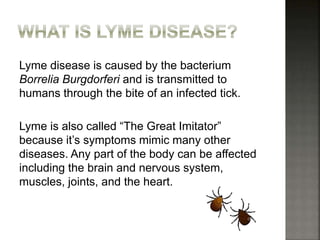
Lyme disease is caused by the bacterium
Borrelia Burgdorferi and is transmitted to
humans through the bite of an infected tick.
Lyme is also called “The Great Imitator”
because it’s symptoms mimic many other
diseases. Any part of the body can be affected
including the brain and nervous system,
muscles, joints, and the heart.
These ticks are usually found in wooded and
grassy areas. It has been found on every
continent except Antarctica. The rates have
increased significantly over time.
The CDC estimate that 300,000 people are
diagnosed with Lyme disease every year.
Diagnosing Lyme can be difficult, and many
people who have Lyme may have been
misdiagnosed with other conditions. Several
experts believe the number of cases is much
higher.
Ticks are able to attach themselves to any part
of the human body. They are most often found
in hard-to-see areas such as the groin, armpit,
and scalp.
In most cases, the tick must be attached for 36
to 48 hours or more before the bacterium can
be transmitted. If the tick is removed quickly
(within 24 hours), it greatly reduces the chances
of getting Lyme disease.
Symptoms of early Lyme disease may seem
very similar as a flu-like illness including fever,
chills, sweats, muscle aches, fatigue, nausea
end joint pain.
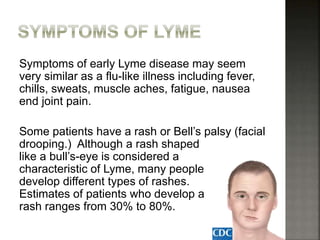
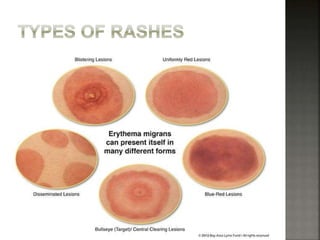
Some patients have a rash or Bell’s palsy (facial
drooping.) Although a rash shaped
like a bull’s-eye is considered a
characteristic of Lyme, many people
develop different types of rashes.
Estimates of patients who develop a
rash ranges from 30% to 80%.
The most common type of tests for Lyme
disease are indirect. They measure the patient’s
antibody response to the infection, not the
infection itself.
During the first four-to-six weeks, these tests
are unreliable because most people have not
yet developed the antibody response that the
test measures.
Enzyme-linked immunosorbent assay (ELISA) test
 Most often used, ELISA detects antibodies to the
bacterium
Western blot test
 Usually done to confirm ELISA test diagnosis
 Done in a two-step approach
Polymerase chain reaction (PCR)
 Detects bacterial DNA in fluid drawn from an infected
joint
Oral antibiotics
 Patients treated with antibiotics in the early stages
of lime usually recover rapidly and completely
 Common antibiotics used include doxycycline,
amoxicillin, or cefuroxime are taken for two to four
weeks
Intravenous antibiotics
 Used for more serious cases
 If the disease involves the central nervous
system, the doctor may recommend treatment
with an intravenous antibiotic
 This is effective in eliminating the infection
It is not uncommon for patients to have lingering
symptoms of fatigue, pain, or joint and muscle
aches after they finish treatment. These
symptoms can last more than 6 months. This is
sometimes called “chronic Lyme disease” or
“Post-treatment Lyme Disease Syndrome.”
Medical experts believe it is a result of residual
damage to tissues and the immune system that
occurred during the infection.
Avoid Tick Habitat
Ticks tend to be near the ground, in leaf litter,
grasses, bushes and fallen logs.
Dress Defensively
Wear shoes, socks, long pants, and long sleeves.
Tie back long hair and wear a hat. Light colored
clothing helps spot ticks before trouble is caused.
Hot Dryer
Running your clothes in a hot dryer for 10 minutes
prior to washing them will kill any ticks possibly left
there.
Use Repellent
You can purchase clothing that has been pre-
treated with permethrin, or you can purchase
permethrin and spray on clothing yourself. For
exposed skin, repellents with DEET, picaridin or
lemon eucalyptus oil are most effective.
Check for Ticks
When outdoors, check your clothing and skin
periodically for ticks. Brush off those that are not
attached, and remove any that are.
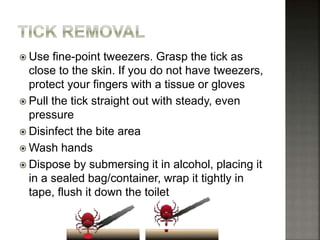
 Use fine-point tweezers. Grasp the tick as
close to the skin. If you do not have tweezers,
protect your fingers with a tissue or gloves
 Pull the tick straight out with steady, even
pressure
 Disinfect the bite area
 Wash hands
 Dispose by submersing it in alcohol, placing it
in a sealed bag/container, wrap it tightly in
tape, flush it down the toilet
DON’T:
 Squeeze, twist, or squash it
 Burn it
 Cover it with Vaseline
 Crush the tick with your fingers
 Avoid folktale remedies such as "painting" the
tick with nail polish or petroleum jelly, or using
heat to make the tick detach from the skin.
Remove the tick as quick as possible.
 http://www.cdc.gov/lyme/
 http://www.nlm.nih.gov/medlineplus/lymedisease.html
 http://www.lymedisease.org/lyme-basics/lyme-
disease/about-lyme/
 http://www.mayoclinic.org/diseases-conditions/lyme-
disease/basics/treatment/con-20019701

Lyme Disease

  • 2.
    Lyme disease iscaused by the bacterium Borrelia Burgdorferi and is transmitted to humans through the bite of an infected tick. Lyme is also called “The Great Imitator” because it’s symptoms mimic many other diseases. Any part of the body can be affected including the brain and nervous system, muscles, joints, and the heart.
  • 3.
    These ticks areusually found in wooded and grassy areas. It has been found on every continent except Antarctica. The rates have increased significantly over time. The CDC estimate that 300,000 people are diagnosed with Lyme disease every year. Diagnosing Lyme can be difficult, and many people who have Lyme may have been misdiagnosed with other conditions. Several experts believe the number of cases is much higher.
  • 4.
    Ticks are ableto attach themselves to any part of the human body. They are most often found in hard-to-see areas such as the groin, armpit, and scalp. In most cases, the tick must be attached for 36 to 48 hours or more before the bacterium can be transmitted. If the tick is removed quickly (within 24 hours), it greatly reduces the chances of getting Lyme disease.
  • 5.
    Symptoms of earlyLyme disease may seem very similar as a flu-like illness including fever, chills, sweats, muscle aches, fatigue, nausea end joint pain. Some patients have a rash or Bell’s palsy (facial drooping.) Although a rash shaped like a bull’s-eye is considered a characteristic of Lyme, many people develop different types of rashes. Estimates of patients who develop a rash ranges from 30% to 80%.
  • 7.
    The most commontype of tests for Lyme disease are indirect. They measure the patient’s antibody response to the infection, not the infection itself. During the first four-to-six weeks, these tests are unreliable because most people have not yet developed the antibody response that the test measures.
  • 8.
    Enzyme-linked immunosorbent assay(ELISA) test  Most often used, ELISA detects antibodies to the bacterium Western blot test  Usually done to confirm ELISA test diagnosis  Done in a two-step approach Polymerase chain reaction (PCR)  Detects bacterial DNA in fluid drawn from an infected joint
  • 9.
    Oral antibiotics  Patientstreated with antibiotics in the early stages of lime usually recover rapidly and completely  Common antibiotics used include doxycycline, amoxicillin, or cefuroxime are taken for two to four weeks Intravenous antibiotics  Used for more serious cases  If the disease involves the central nervous system, the doctor may recommend treatment with an intravenous antibiotic  This is effective in eliminating the infection
  • 10.
    It is notuncommon for patients to have lingering symptoms of fatigue, pain, or joint and muscle aches after they finish treatment. These symptoms can last more than 6 months. This is sometimes called “chronic Lyme disease” or “Post-treatment Lyme Disease Syndrome.” Medical experts believe it is a result of residual damage to tissues and the immune system that occurred during the infection.
  • 11.
    Avoid Tick Habitat Tickstend to be near the ground, in leaf litter, grasses, bushes and fallen logs. Dress Defensively Wear shoes, socks, long pants, and long sleeves. Tie back long hair and wear a hat. Light colored clothing helps spot ticks before trouble is caused. Hot Dryer Running your clothes in a hot dryer for 10 minutes prior to washing them will kill any ticks possibly left there.
  • 12.
    Use Repellent You canpurchase clothing that has been pre- treated with permethrin, or you can purchase permethrin and spray on clothing yourself. For exposed skin, repellents with DEET, picaridin or lemon eucalyptus oil are most effective. Check for Ticks When outdoors, check your clothing and skin periodically for ticks. Brush off those that are not attached, and remove any that are.
  • 13.
     Use fine-pointtweezers. Grasp the tick as close to the skin. If you do not have tweezers, protect your fingers with a tissue or gloves  Pull the tick straight out with steady, even pressure  Disinfect the bite area  Wash hands  Dispose by submersing it in alcohol, placing it in a sealed bag/container, wrap it tightly in tape, flush it down the toilet
  • 14.
    DON’T:  Squeeze, twist,or squash it  Burn it  Cover it with Vaseline  Crush the tick with your fingers  Avoid folktale remedies such as "painting" the tick with nail polish or petroleum jelly, or using heat to make the tick detach from the skin. Remove the tick as quick as possible.
  • 15.
     http://www.cdc.gov/lyme/  http://www.nlm.nih.gov/medlineplus/lymedisease.html http://www.lymedisease.org/lyme-basics/lyme- disease/about-lyme/  http://www.mayoclinic.org/diseases-conditions/lyme- disease/basics/treatment/con-20019701