LOGO 
Delphi Method 
Presented By : 
Farzad Minooei 
Graduate 
School of 
Management 
and 
Economics
Contents 
31 Definition 
2 Overview 
33 Application 
4 Objectives 
35 Technique
Contents 
6 Outcomes 
37 Benefits
31 Definition 
Delphi Method is 
 a method for structuring a group 
communication process so that the process is 
effective in allowing a group of individuals, as 
a whole, to deal with a complex problem. 
 based on the principle that forecasts (or 
decisions) from a structured group of 
individuals are more accurate than those from 
unstructured groups.
32 Overview 
In the standard version: 
 the experts answer questionnaires in two or 
more rounds 
 after each round, a facilitator provides an 
anonymous summary of the experts’ forecasts 
from the previous round as well as the 
reasons they provided for their judgments. 
 experts are encouraged to revise their earlier 
answers in light of the replies of other 
members of their panel.
32 Overview 
 It is believed that during this process the 
range of the answers will decrease and the 
group will converge towards the "correct" 
answer. 
 Finally, the process is stopped after a pre-defined 
stop criterion(e.g. number of rounds, 
achievement of consensus).
3 Application 
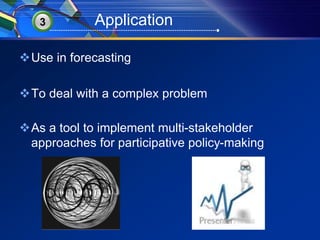
Use in forecasting 
To deal with a complex problem 
As a tool to implement multi-stakeholder 
approaches for participative policy-making
34 Objectives 
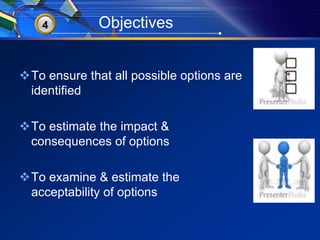
To ensure that all possible options are 
identified 
To estimate the impact & 
consequences of options 
To examine & estimate the 
acceptability of options
5 Technique 
Orientation: 
 Six Phases in Delphi : 
• Formulation of Issues 
• Exposing Options 
• Determining initial options on Issues especially 
areas of agreement & disagreement 
• Exploring reasons for disagreement 
• Evaluating such reasons 
• Re-Evaluating of Options in the Light of above 
 First 3 Phases constitute the crucial stage of 
preparation.
5 Technique 
Selecting & retaining a Panel: 
 Size of the panel 
 Selecting a member as an expert 
 Attrition rate over several rounds of 
consultation
5 Technique 
Selecting & retaining a Panel: 
 Selection member as an expert : 
• Key Issue: 
– Nature of participants Interest 
– Depth & range of expertise 
• Two basic type of participants: 
– Referees : disinterested experts on topic 
– Advocate : their knowledge derive from their Participant 
– Diversity between “Referee” & “Advocate” 
» To avoid Uniformity of response 
• Participant’s Different degree of Experience on 
topics
5 Technique 
Designing the Questionnaire : 
 Pre-test : for balance between closed-Open 
Questionnaire. 
 Take 30 min till 5 hours to complete
5 Technique 
Scaling Judgments: 
 Participants are asked to make evaluations 
about specific propositions & not simply 
choose from a number of alternatives.
5 Technique 
Progressing through successive rounds: 
 5 rounds of Delphi may be necessary to meet 
all its objectives
5 Technique 
Each grouping (Sponsor-Consultant-Expert) might 
be seen as stakeholders.
36 Outcomes 
Identifying the degree of consensus or 
dissensus 
Specifying the range of different positions 
Revealing the rationales which lie behind the 
judgments
7 Benefits 
Delphi is suitable for problem 
 does not lend itself to precise analytical 
technique 
 but benefit from subjective judgments on 
collective basis 
Suitable in conditions of Uncertainty 
It is more appropriate when it is not practicable 
or desirable to bring experts together
7 Benefits 
Delphi roles as a forum for 
exploration of Ideas & the 
strength of opinion 
It brings wide range of experts 
from different backgrounds 
It enables disagreement in a 
constructive forum & ensures 
equal participation
LOGO 
Graduate 
School of 
Management 
and 
Economics

Delphi method ed.3

  • 1.
    LOGO Delphi Method Presented By : Farzad Minooei Graduate School of Management and Economics
  • 2.
    Contents 31 Definition 2 Overview 33 Application 4 Objectives 35 Technique
  • 3.
    Contents 6 Outcomes 37 Benefits
  • 4.
    31 Definition DelphiMethod is  a method for structuring a group communication process so that the process is effective in allowing a group of individuals, as a whole, to deal with a complex problem.  based on the principle that forecasts (or decisions) from a structured group of individuals are more accurate than those from unstructured groups.
  • 5.
    32 Overview Inthe standard version:  the experts answer questionnaires in two or more rounds  after each round, a facilitator provides an anonymous summary of the experts’ forecasts from the previous round as well as the reasons they provided for their judgments.  experts are encouraged to revise their earlier answers in light of the replies of other members of their panel.
  • 6.
    32 Overview It is believed that during this process the range of the answers will decrease and the group will converge towards the "correct" answer.  Finally, the process is stopped after a pre-defined stop criterion(e.g. number of rounds, achievement of consensus).
  • 7.
    3 Application Usein forecasting To deal with a complex problem As a tool to implement multi-stakeholder approaches for participative policy-making
  • 8.
    34 Objectives Toensure that all possible options are identified To estimate the impact & consequences of options To examine & estimate the acceptability of options
  • 9.
    5 Technique Orientation:  Six Phases in Delphi : • Formulation of Issues • Exposing Options • Determining initial options on Issues especially areas of agreement & disagreement • Exploring reasons for disagreement • Evaluating such reasons • Re-Evaluating of Options in the Light of above  First 3 Phases constitute the crucial stage of preparation.
  • 10.
    5 Technique Selecting& retaining a Panel:  Size of the panel  Selecting a member as an expert  Attrition rate over several rounds of consultation
  • 11.
    5 Technique Selecting& retaining a Panel:  Selection member as an expert : • Key Issue: – Nature of participants Interest – Depth & range of expertise • Two basic type of participants: – Referees : disinterested experts on topic – Advocate : their knowledge derive from their Participant – Diversity between “Referee” & “Advocate” » To avoid Uniformity of response • Participant’s Different degree of Experience on topics
  • 12.
    5 Technique Designingthe Questionnaire :  Pre-test : for balance between closed-Open Questionnaire.  Take 30 min till 5 hours to complete
  • 13.
    5 Technique ScalingJudgments:  Participants are asked to make evaluations about specific propositions & not simply choose from a number of alternatives.
  • 14.
    5 Technique Progressingthrough successive rounds:  5 rounds of Delphi may be necessary to meet all its objectives
  • 15.
    5 Technique Eachgrouping (Sponsor-Consultant-Expert) might be seen as stakeholders.
  • 16.
    36 Outcomes Identifyingthe degree of consensus or dissensus Specifying the range of different positions Revealing the rationales which lie behind the judgments
  • 17.
    7 Benefits Delphiis suitable for problem  does not lend itself to precise analytical technique  but benefit from subjective judgments on collective basis Suitable in conditions of Uncertainty It is more appropriate when it is not practicable or desirable to bring experts together
  • 18.
    7 Benefits Delphiroles as a forum for exploration of Ideas & the strength of opinion It brings wide range of experts from different backgrounds It enables disagreement in a constructive forum & ensures equal participation
  • 20.
    LOGO Graduate Schoolof Management and Economics