The document outlines the processes, styles, and types of decision making, detailing the eight steps involved in the decision-making process from identifying a problem to evaluating decision effectiveness. It also describes four decision-making styles based on tolerance for ambiguity and individual thinking and categorizes decisions into six types such as programmed and non-programmed, major and minor, and organizational and personal decisions. The content aims to provide a comprehensive understanding of how decisions are made in various contexts.
The presentation introduces itself and outlines the topic on steps, styles, and types of decision-making.
Defines decision-making as the process of selecting a logical choice from multiple alternatives.
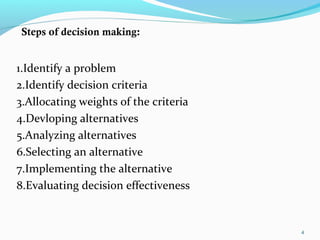
Outlines the eight steps: identifying a problem, criteria, allocating weights, developing and analyzing alternatives, selecting, implementing, and evaluating the decision.
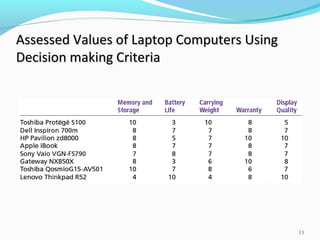
Provides an example related to the assessment of laptop computers using decision-making criteria.
Describes four decision-making styles: directive, analytic, conceptual, and behavioral.
Lists six types of decisions: programmed vs non-programmed, major vs minor, routine vs strategic, organizational vs personal, individual vs group, and policy vs operational.
A placeholder concluding the presentation, may signal the end of key discussion points.
Decision making?
Decision makingis the process of selecting
a logical choice from the available options, two or more
alternatives.
3
4.
Steps of decisionmaking:
1.Identify a problem
2.Identify decision criteria
3.Allocating weights of the criteria
4.Devloping alternatives
5.Analyzing alternatives
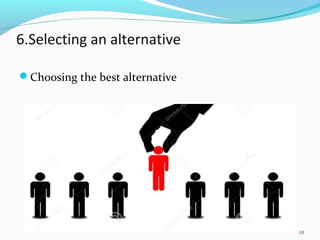
6.Selecting an alternative
7.Implementing the alternative
8.Evaluating decision effectiveness
4
5.
1.Identify a problem:
Adiscrepancy between an existing and desired stateA discrepancy between an existing and desired state
of affairs.of affairs.
5
6.
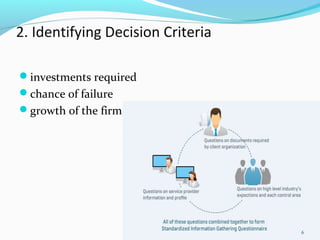
2. Identifying DecisionCriteria
investments required
chance of failure
growth of the firm.
6
7.Implementing the alternative
Puttingthe chosen alternative into action.
Conveying the decision to and gaining commitment
from those who will carry out the decision.
11
12.
8.Evaluating decision effectiveness
Thesoundness of the decision is judged by its
outcomes.
How effectively was the problem resolved by
outcomes resulting from the chosen alternatives?
If the problem was not resolved, what went wrong?
12
13.
Assessed Values ofLaptop Computers UsingAssessed Values of Laptop Computers Using
Decision making CriteriaDecision making Criteria
13
14.
Styles of decisionmaking:
Decision making style proposes people differ along
two dimensions in the way they approach decision
making. The first is an individual way of thinking.
The other dimension describes
anindividuals tolerance for ambiguity.
# decision making styles of four types.
14
15.
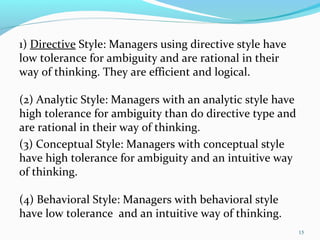
1) Directive Style:Managers using directive style have
low tolerance for ambiguity and are rational in their
way of thinking. They are efficient and logical.
(2) Analytic Style: Managers with an analytic style have
high tolerance for ambiguity than do directive type and
are rational in their way of thinking.
(3) Conceptual Style: Managers with conceptual style
have high tolerance for ambiguity and an intuitive way
of thinking.
(4) Behavioral Style: Managers with behavioral style
have low tolerance and an intuitive way of thinking.
15
16.
Types of decisionmaking:
Decision making have six types:
1. Programmed and non programmed
decisions: Programmed decisions are those which are
normally repetitive in nature and are taken as a routine
job and responsibilities.
2. Major and minor decisions: among different
decisions some decisions are considerably more
important than others and are prioritized.
3. Routine and strategic decisions: Routine
decisions are those decisions which are considered as
tactical decisions.
16
17.
4. Organizational andpersonal
decision: Organizational decision is taken by top
executives. For official purpose. They affect the
organizational activities directly.
5. Individual and group decisions: When a single
employee is involved in decision making it is called
individual decision.
6. Policy and operating decisions: Policy decisions
are taken by top level management to change the
rules, procedures, organizational
17
#2 The slides for this text are organized into chapters. This lecture covers Chapter 1, and is an overview of database systems. The material is standard, with one exception: The discussion of transactions, concurrency control, and recovery is perhaps more in-depth than usual in a first lecture, and this deserves some explanation.
Students will (in typical course sequences) not be exposed to this material until much later in the course, and I find it useful for them to have a little background knowledge. This helps, for instance, when explaining why a buffer manager needs to support selective forcing of pages (because write-ahead logging requires it). It is also an important and engaging topic that draws students into the subject immediately. Sometimes, the interactions go so far that I move up the overview material on CC and recovery from Chapter 16, and cover it as Lecture 2! (Note that this can be readily done since Chapter 16 does not rely on any intervening chapters.)