By Dr Little Lin Research
小林研究 制作
Adler, M., & Ziglio, E. (Eds.). (1996). Gazing Into the Oracle: The Delphi Method and Its
Application to Social Policy and Public Health. Bristol, PA: Kingsley.
READING NOTES Volume
01
Adler and Ziglio, 1996, p.15
The Delphi Method and its Contribution to
Decision-Making
(Adler and Ziglio, 1996, pp.3-33)
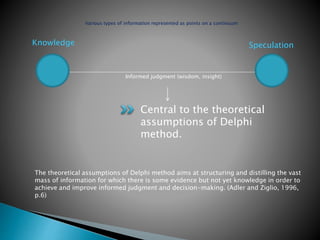
Central to the theoretical
assumptions of Delphi
method.
Knowledge Speculation
Informed judgment (wisdom, insight)
Various types of information represented as points on a continuum
The theoretical assumptions of Delphi method aims at structuring and distilling the vast
mass of information for which there is some evidence but not yet knowledge in order to
achieve and improve informed judgment and decision-making. (Adler and Ziglio, 1996,
p.6)
 Delphi method is an exercise in group communication among
a panel of geographically dispersed experts. It allows experts
to deal systematically with a complex program or task. It
comprises a series of questionnaires sent to a pre-selected
group of experts. Questionnaires are designed to elicit and
develop individual responses to the posed problems and to
enable the experts to refine their views as the group’s work
progresses in accordance with the assigned task. (Adler and
Ziglio, 1996, p.9)
 Ask:
◦ What kind of group communication process is desirable in
order to explore the problem at hand?
◦ Who are the people with expertise on the problem and
where are they located?
◦ What are the alternative techniques available and what
results can reasonably be expected from their application?
 For subject matter where the best available
information is the judgment of knowledgeable
individuals, the Delphi method has distinct
advantages over traditional group discussions,
conferences, brainstorming and other interactive
group processes.
 Delphi allows for (Adler and Ziglio, 1996, p.21) :
◦ Feedback of individual contributions
◦ Assessment of group judgment
◦ Opportunity for experts to revise views and reassess
previous contributions
◦ If necessary, provision of some degree of anonymity for the
individual responses
 10-15 individuals with a homogeneous group
 Reduction in group error with increasing group side
 Above certain threshold, including more individuals provides
only marginal benefit to the distillation process resulting from
the use of Delphi
 Criteria of selection:
◦ expertise (knowledge and practical engagement with the issues under
investigation)
◦ Capacity and willingness of experts to contribute to the exploration of a
particular problem
◦ Assurance from experts that sufficient time will be dedicated to the Delphi
exercise
◦ Skill in written communication and in expressing priorities through voting
procedures
 Being expert entails the acquisition of experience, special skill in
or knowledge of a particular subject, not necessarily to have
academic qualifications.
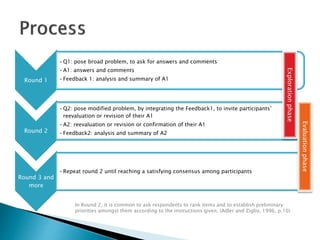
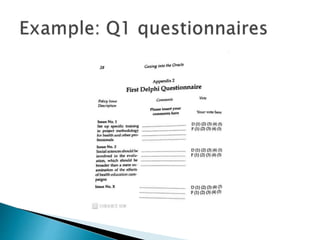
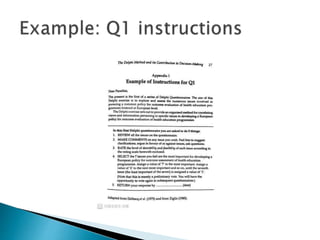
Round 1
•Q1: pose broad problem, to ask for answers and comments
•A1: answers and comments
•Feedback 1: analysis and summary of A1
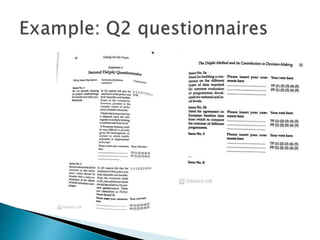
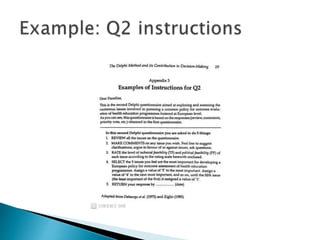
Round 2
•Q2: pose modified problem, by integrating the Feedback1, to invite participants’
reevaluation or revision of their A1
•A2: reevaluation or revision or confirmation of their A1
•Feedback2: analysis and summary of A2
Round 3 and
more
•Repeat round 2 until reaching a satisfying consensus among participants
Explorationphase
Evaluationphase
In Round 2, it is common to ask respondents to rank items and to establish preliminary
priorities amongst them according to the instructions given. (Adler and Ziglio, 1996, p.10)
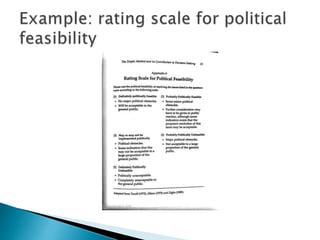
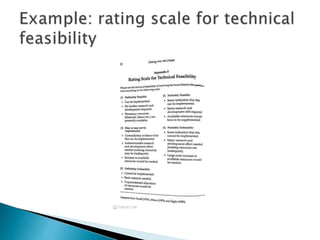
 The characteristics of the design of the process can have
important effects on both the nature of the communication
process amongst panelists and final outcomes. Hence,
instructions, scales and any other device used to collect
experts’ judgments should be properly pre-tested.
 The same should be done for different ways available to the
Delphi team of providing feedback to the experts. (Adler and
Ziglio, 1996, p.19)
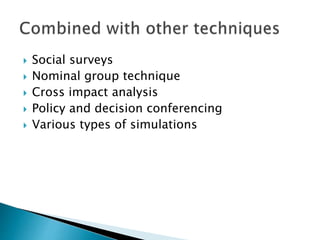
 Social surveys
 Nominal group technique
 Cross impact analysis
 Policy and decision conferencing
 Various types of simulations
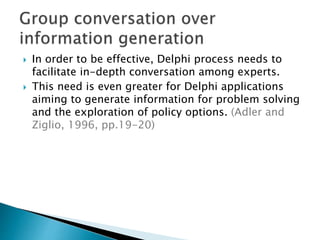
 In order to be effective, Delphi process needs to
facilitate in-depth conversation among experts.
 This need is even greater for Delphi applications
aiming to generate information for problem solving
and the exploration of policy options. (Adler and
Ziglio, 1996, pp.19-20)
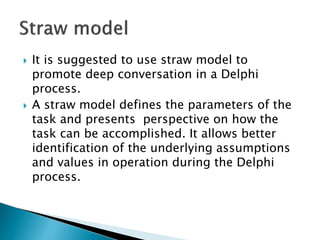
 It is suggested to use straw model to
promote deep conversation in a Delphi
process.
 A straw model defines the parameters of the
task and presents perspective on how the
task can be accomplished. It allows better
identification of the underlying assumptions
and values in operation during the Delphi
process.
Theoretical, methodological and practical
issues arising out of the Delphi method
(Adler and Ziglio, 1996, pp.34-55)
Adler, M., & Ziglio, E. (Eds.). (1996). Gazing Into the Oracle: The Delphi Method and Its
Application to Social Policy and Public Health. Bristol, PA: Kingsley.
READING NOTES Volume
02
UPCOMING
YouTube: https://www.youtube.com/channel/UCGuuCy4erjcT_g1NdRdGBxw
LinkedIn: https://www.linkedin.com/in/linjingjing/
SlideShare: https://www.slideshare.net/JingjingLin1

The Delphi Method and its Contribution to Decision-Making

  • 1.
    By Dr LittleLin Research 小林研究 制作 Adler, M., & Ziglio, E. (Eds.). (1996). Gazing Into the Oracle: The Delphi Method and Its Application to Social Policy and Public Health. Bristol, PA: Kingsley. READING NOTES Volume 01
  • 2.
  • 3.
    The Delphi Methodand its Contribution to Decision-Making (Adler and Ziglio, 1996, pp.3-33)
  • 4.
    Central to thetheoretical assumptions of Delphi method. Knowledge Speculation Informed judgment (wisdom, insight) Various types of information represented as points on a continuum The theoretical assumptions of Delphi method aims at structuring and distilling the vast mass of information for which there is some evidence but not yet knowledge in order to achieve and improve informed judgment and decision-making. (Adler and Ziglio, 1996, p.6)
  • 5.
     Delphi methodis an exercise in group communication among a panel of geographically dispersed experts. It allows experts to deal systematically with a complex program or task. It comprises a series of questionnaires sent to a pre-selected group of experts. Questionnaires are designed to elicit and develop individual responses to the posed problems and to enable the experts to refine their views as the group’s work progresses in accordance with the assigned task. (Adler and Ziglio, 1996, p.9)
  • 6.
     Ask: ◦ Whatkind of group communication process is desirable in order to explore the problem at hand? ◦ Who are the people with expertise on the problem and where are they located? ◦ What are the alternative techniques available and what results can reasonably be expected from their application?
  • 7.
     For subjectmatter where the best available information is the judgment of knowledgeable individuals, the Delphi method has distinct advantages over traditional group discussions, conferences, brainstorming and other interactive group processes.  Delphi allows for (Adler and Ziglio, 1996, p.21) : ◦ Feedback of individual contributions ◦ Assessment of group judgment ◦ Opportunity for experts to revise views and reassess previous contributions ◦ If necessary, provision of some degree of anonymity for the individual responses
  • 8.
     10-15 individualswith a homogeneous group  Reduction in group error with increasing group side  Above certain threshold, including more individuals provides only marginal benefit to the distillation process resulting from the use of Delphi  Criteria of selection: ◦ expertise (knowledge and practical engagement with the issues under investigation) ◦ Capacity and willingness of experts to contribute to the exploration of a particular problem ◦ Assurance from experts that sufficient time will be dedicated to the Delphi exercise ◦ Skill in written communication and in expressing priorities through voting procedures  Being expert entails the acquisition of experience, special skill in or knowledge of a particular subject, not necessarily to have academic qualifications.
  • 9.
    Round 1 •Q1: posebroad problem, to ask for answers and comments •A1: answers and comments •Feedback 1: analysis and summary of A1 Round 2 •Q2: pose modified problem, by integrating the Feedback1, to invite participants’ reevaluation or revision of their A1 •A2: reevaluation or revision or confirmation of their A1 •Feedback2: analysis and summary of A2 Round 3 and more •Repeat round 2 until reaching a satisfying consensus among participants Explorationphase Evaluationphase In Round 2, it is common to ask respondents to rank items and to establish preliminary priorities amongst them according to the instructions given. (Adler and Ziglio, 1996, p.10)
  • 12.
     The characteristicsof the design of the process can have important effects on both the nature of the communication process amongst panelists and final outcomes. Hence, instructions, scales and any other device used to collect experts’ judgments should be properly pre-tested.  The same should be done for different ways available to the Delphi team of providing feedback to the experts. (Adler and Ziglio, 1996, p.19)
  • 13.
     Social surveys Nominal group technique  Cross impact analysis  Policy and decision conferencing  Various types of simulations
  • 14.
     In orderto be effective, Delphi process needs to facilitate in-depth conversation among experts.  This need is even greater for Delphi applications aiming to generate information for problem solving and the exploration of policy options. (Adler and Ziglio, 1996, pp.19-20)
  • 15.
     It issuggested to use straw model to promote deep conversation in a Delphi process.  A straw model defines the parameters of the task and presents perspective on how the task can be accomplished. It allows better identification of the underlying assumptions and values in operation during the Delphi process.
  • 23.
    Theoretical, methodological andpractical issues arising out of the Delphi method (Adler and Ziglio, 1996, pp.34-55) Adler, M., & Ziglio, E. (Eds.). (1996). Gazing Into the Oracle: The Delphi Method and Its Application to Social Policy and Public Health. Bristol, PA: Kingsley. READING NOTES Volume 02 UPCOMING
  • 24.