Chapter - 6
Decision-Making
Introduction
Learning Objectives:
 Characteristics of the business decisions

 Rational decision making and its problems

 Herbert Simon Model of decision making

 Types of Decisions

 Evaluation and Selection of Decision alternatives

 Four ways of Decision making

 Behavioral Concepts and decision making

 Dealing with uncertainty and risk
Decision-Making Concepts
   The word “decision” is derived from latin
    word “decido”,meaning to cutoff it means
    settlement, a fixed intentition bringing to
    conclusive result.
   Main objective of decision is to give effective
    result which is help to organization to for
    achieve its goal.
Business Decisions
   Business decisions are those, Which are made
    in process of conducting business to achieve
    its objectives in a given environments
   Business decision is one kind of rational
    decision.
Business Decisions
    Characteristics of Business decisions
1)   Sequential in nature
2)   Exceedingly complex due to risks and trade
     offs
3)   Influenced by personal values
4)   Made in industrial setting and business
     environment
Business Decisions
   Sequential in nature:-
       In business the decisions are not isolated
    events its depend on situation so its on
    decision maker’s ability and skill and also
    decision is result of information so it focuses
    on effective analysis and process.
Business Decisions
   Exceedingly complex due to risks and trade
    offs:-
        This process is complex because there is
    risk factor available in every decisions and
    also complexity factors like inter-relationship
    among experts , job responsibility, a question
    of feasibility, morals and ethics are also effect
    on decisions.
Business Decisions
   Influenced by personal values:
        It plays major roles in decision making
    effect of personal value is that business
    principle and economic rationality may be
    rejected.
Business Decisions
   Made in industrial setting and business
    environment:-
        Decisions are highly effected by
    environment and creativeness of decision
    maker and also number of tangible and
    intangible factors are effected on decisions.
Rational Decision making
   It is one which,effectivly and efficiently
    ensures the achievement of the goal for which
    decision is made
   It is depended on situation
   It is vary mean not same at all time
   It is multi dimension concept
   For example decision in public and private
    companies are not same because in public
    decisions are highly effected on its share-
    holders nature where in private its depended
    on its managements
Rational Decision making
   Mr. Simon Herbert suggest some things
    which are effect decision to be rational
    which are:
-   Objectively Rational
-   Subjectively Rational
-   Consciously Rational
-   Organizationally Rational
-   Personally rational
Rational Decision making
    Problems in Rational Decision Making:
1)   Ascertaining the problem
2)   Insufficient Knowledge
3)   Not enough time to be rational
4)   Insufficient environments
5)   Other issues
Rational Decision making
   Ascertaining the problem:-
    Because of lack in communication the
    assessment of problem is not clear so its badly
    effect on decisions for example in org sales
    decrease continually result management sacks
    marketing manager but actual problem in
    production which effected on quality of
    product.
Rational Decision making
   Insufficient Knowledge:-
       This problem is based on person’s skills
    and ability to deal with certain conditions in
    org.If manager doesn’t have skill than decision
    can not turn into faithful and beneficial for
    org.
Rational Decision making
   Not enough time to be rational:
       Sometime decision maker is under huge
    pressure under limited time period result
    decision turn out to be wrong.
Rational Decision making
   Insufficient environments:
        Sometime organization can not cooperate
    with decision maker result right decision can
    not made in hasty condition of organizations.
Rational Decision making
   Other Issues:
-   Compromises among different positions
-   Misjudging in motives of decisions
-   Poor communications
-   Uncertaintities and risk
-   Human behaviors
Decision Making Process
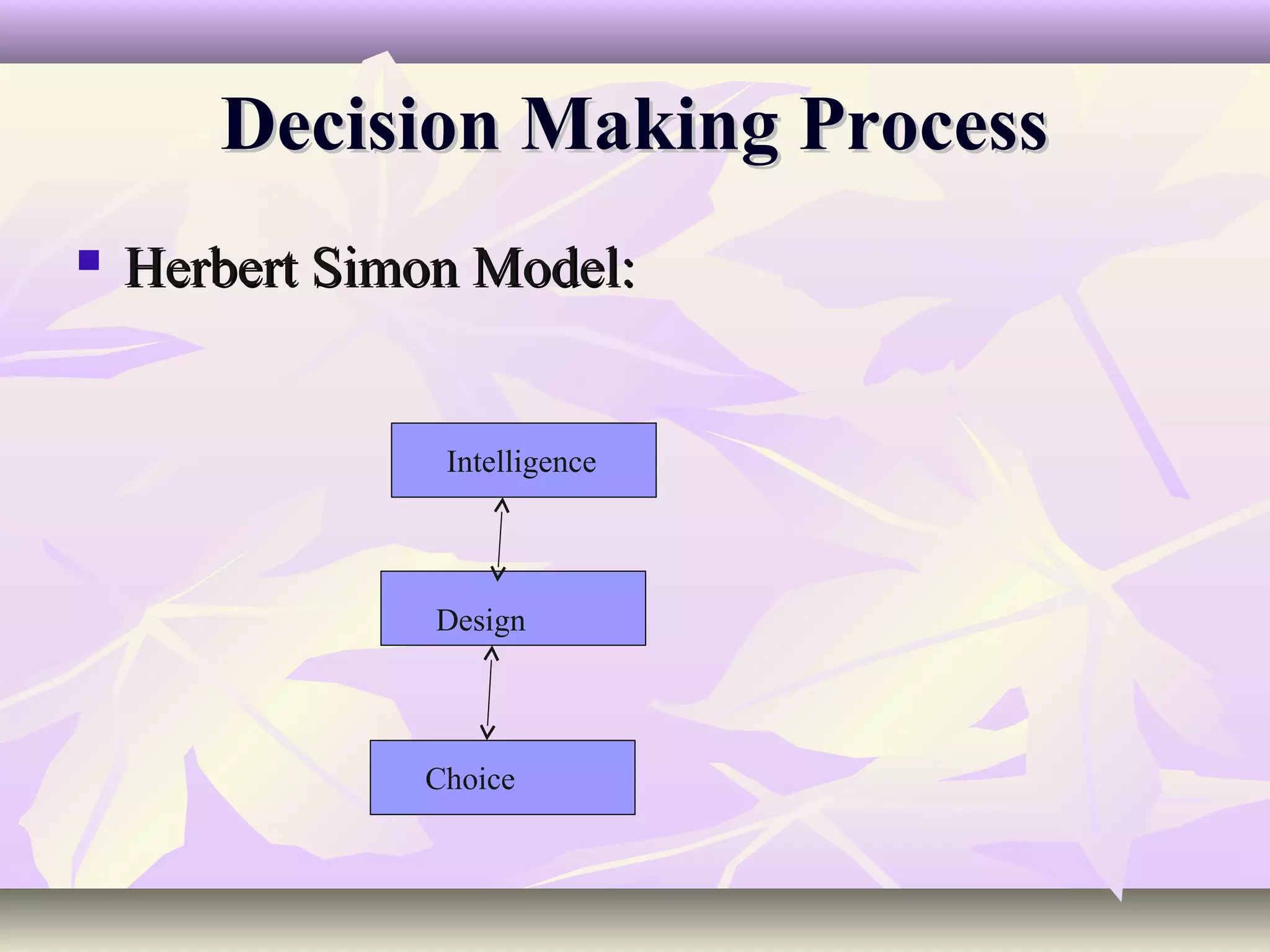
   Herbert Simon Model:


                Intelligence


                Design


               Choice
Herbert Simon Model

* Intelligence:
- Raw data collected,processed and examined

• Design:

- Inventing, Developing and analyzing

• Choice:

- Choice one alternatives as a decision based on
  the selection criteria
Decision-Making System Types
   There are 2 types of decision making system
-   Open decision making system
-   Close decision making system
Open decision making system

   The manager does not know all decision
    alternatives
   Outcome of decision is not known
   No method, rule or model is available to make
    decision
   Difficult to decide objective or goal of
    decision
Close decision making system

   The manager knows all decision alternatives
   Outcome of decision is known
   method, rule or model is available to make
    decision
   Easy to decide objective or goal of decision
Types of Decisions
    There are 3 types of decisions
1)   Uncertain
2)   Risk oriented
3)   Certain
Decision Alternatives

    There are 3 alternative of define decision
1)   Optimisation techniques
2)   The pay off analysis
3)   Decision tree analysis
Decision Analysis
   Decision is always based on some analysis
   There are 4 ways that decision can be analysed
-   What if analysis
-   Sensitivity analysis
-   Goal achieving analysis
-   Goal seeking analysis
What if analysis

   This model is built on some variable and
    relationship between variables
   In this model analysis also include outcome of
    decision
   For example analysis of inventory will contain
    information of purchase and sales department.
Sensitivity analysis

   It is next step after what if analysis
   Only one value can be change and conclude
    result of outcome.
   For example in inventory if cost increased 20
    percent effect can be calculated on sales and
    purchase.
Goal achieving analysis

   Goal is fixed and analysis is based on that goal
   Totally reverse process than what if and
    sensitivity analysis
   For example if org wants to kept inventory of
    Rs.10,00,000 this analysis help them to
    achieve this goal
Goal Seeking analysis

   Goal is not fixed but try to achieve it threw
    this analysis
   Based on some constraints and resources
   Highest goal can be achieve threw this
    analysis.
Behavior Concept in Decision
   Decision is human oriented process so
    behavior of manager take vital role in this
    process.
   Points which are effect in decision regarding
    behavior are:
-   Manager’s attitude toward org
-   Manager’s position in org
-   Manager’s personal value
-   Morale of manager
Behavior Concept in Decision
-   Manager’s communication skill toward
    employee
-   Manager’s ability to deal with risk
-   Manager’s attitude towards objective of
    decision
-   Manager’s communication ability with other
    manager
Organisation Decision -Making
   In org decision take place according to
    situation and ability of individuals
   There are 2 ways that decision making process
    directly effected in org which are:
-   Dealing with uncertainty
-   Organizational learning
Dealing with uncertainty
   First deal with market uncertainty
   Price uncertainty
   Change in government policy
   Moves of competitors
   Technological Change
   Uncertainty with business environment
   Behaviour of organisation
   Risk-avoidance trend of org
Methods of dealing with uncertainty

    There are 2 methods which is helpful to
     decision maker to deal with uncertainty
1)   Take decision for short time of period
2)   Negotiated decision making with limited
     liability
Organizational Learning
   It is depended on additional knowledge and
    experience of decision maker
   Also decision maker should have expert trainer
    and wide range of experience with
    implementation process of decision
   Decision maker should have known latest
    technology
   Result of this process brings huge change in
    org’s infrastructure to make all decision
    rational, which can be effective to achieve the
    objectives
Mis and Decision-Making
   Herbert-Simon model provides a conceptual
    design of mis and decision-making
   Decision alternatives help decision maker to
    take vital decision
   Mis should provide decision support system to
    handle variability in decision-making
   Decision making systems helps designer to
    provide design flexibility in org

Mis and Decision-Making
   The methods of decision making provide
    problem solving ability in decision making
    process to decision maker
   The concepts of organizational and behavioral
    aspects provide insight to the designer to
    handle organization's culture and constraints
    in the mis
   The mis design addressing these significant
    factors turns out to be the best design
Decision making

Decision making

  • 1.
  • 2.
    Introduction Learning Objectives:  Characteristicsof the business decisions  Rational decision making and its problems  Herbert Simon Model of decision making  Types of Decisions  Evaluation and Selection of Decision alternatives  Four ways of Decision making  Behavioral Concepts and decision making  Dealing with uncertainty and risk
  • 3.
    Decision-Making Concepts  The word “decision” is derived from latin word “decido”,meaning to cutoff it means settlement, a fixed intentition bringing to conclusive result.  Main objective of decision is to give effective result which is help to organization to for achieve its goal.
  • 4.
    Business Decisions  Business decisions are those, Which are made in process of conducting business to achieve its objectives in a given environments  Business decision is one kind of rational decision.
  • 5.
    Business Decisions  Characteristics of Business decisions 1) Sequential in nature 2) Exceedingly complex due to risks and trade offs 3) Influenced by personal values 4) Made in industrial setting and business environment
  • 6.
    Business Decisions  Sequential in nature:- In business the decisions are not isolated events its depend on situation so its on decision maker’s ability and skill and also decision is result of information so it focuses on effective analysis and process.
  • 7.
    Business Decisions  Exceedingly complex due to risks and trade offs:- This process is complex because there is risk factor available in every decisions and also complexity factors like inter-relationship among experts , job responsibility, a question of feasibility, morals and ethics are also effect on decisions.
  • 8.
    Business Decisions  Influenced by personal values: It plays major roles in decision making effect of personal value is that business principle and economic rationality may be rejected.
  • 9.
    Business Decisions  Made in industrial setting and business environment:- Decisions are highly effected by environment and creativeness of decision maker and also number of tangible and intangible factors are effected on decisions.
  • 10.
    Rational Decision making  It is one which,effectivly and efficiently ensures the achievement of the goal for which decision is made  It is depended on situation  It is vary mean not same at all time  It is multi dimension concept  For example decision in public and private companies are not same because in public decisions are highly effected on its share- holders nature where in private its depended on its managements
  • 11.
    Rational Decision making  Mr. Simon Herbert suggest some things which are effect decision to be rational which are: - Objectively Rational - Subjectively Rational - Consciously Rational - Organizationally Rational - Personally rational
  • 12.
    Rational Decision making  Problems in Rational Decision Making: 1) Ascertaining the problem 2) Insufficient Knowledge 3) Not enough time to be rational 4) Insufficient environments 5) Other issues
  • 13.
    Rational Decision making  Ascertaining the problem:- Because of lack in communication the assessment of problem is not clear so its badly effect on decisions for example in org sales decrease continually result management sacks marketing manager but actual problem in production which effected on quality of product.
  • 14.
    Rational Decision making  Insufficient Knowledge:- This problem is based on person’s skills and ability to deal with certain conditions in org.If manager doesn’t have skill than decision can not turn into faithful and beneficial for org.
  • 15.
    Rational Decision making  Not enough time to be rational: Sometime decision maker is under huge pressure under limited time period result decision turn out to be wrong.
  • 16.
    Rational Decision making  Insufficient environments: Sometime organization can not cooperate with decision maker result right decision can not made in hasty condition of organizations.
  • 17.
    Rational Decision making  Other Issues: - Compromises among different positions - Misjudging in motives of decisions - Poor communications - Uncertaintities and risk - Human behaviors
  • 18.
    Decision Making Process  Herbert Simon Model: Intelligence Design Choice
  • 19.
    Herbert Simon Model *Intelligence: - Raw data collected,processed and examined • Design: - Inventing, Developing and analyzing • Choice: - Choice one alternatives as a decision based on the selection criteria
  • 20.
    Decision-Making System Types  There are 2 types of decision making system - Open decision making system - Close decision making system
  • 21.
    Open decision makingsystem  The manager does not know all decision alternatives  Outcome of decision is not known  No method, rule or model is available to make decision  Difficult to decide objective or goal of decision
  • 22.
    Close decision makingsystem  The manager knows all decision alternatives  Outcome of decision is known  method, rule or model is available to make decision  Easy to decide objective or goal of decision
  • 23.
    Types of Decisions  There are 3 types of decisions 1) Uncertain 2) Risk oriented 3) Certain
  • 24.
    Decision Alternatives  There are 3 alternative of define decision 1) Optimisation techniques 2) The pay off analysis 3) Decision tree analysis
  • 25.
    Decision Analysis  Decision is always based on some analysis  There are 4 ways that decision can be analysed - What if analysis - Sensitivity analysis - Goal achieving analysis - Goal seeking analysis
  • 26.
    What if analysis  This model is built on some variable and relationship between variables  In this model analysis also include outcome of decision  For example analysis of inventory will contain information of purchase and sales department.
  • 27.
    Sensitivity analysis  It is next step after what if analysis  Only one value can be change and conclude result of outcome.  For example in inventory if cost increased 20 percent effect can be calculated on sales and purchase.
  • 28.
    Goal achieving analysis  Goal is fixed and analysis is based on that goal  Totally reverse process than what if and sensitivity analysis  For example if org wants to kept inventory of Rs.10,00,000 this analysis help them to achieve this goal
  • 29.
    Goal Seeking analysis  Goal is not fixed but try to achieve it threw this analysis  Based on some constraints and resources  Highest goal can be achieve threw this analysis.
  • 30.
    Behavior Concept inDecision  Decision is human oriented process so behavior of manager take vital role in this process.  Points which are effect in decision regarding behavior are: - Manager’s attitude toward org - Manager’s position in org - Manager’s personal value - Morale of manager
  • 31.
    Behavior Concept inDecision - Manager’s communication skill toward employee - Manager’s ability to deal with risk - Manager’s attitude towards objective of decision - Manager’s communication ability with other manager
  • 32.
    Organisation Decision -Making  In org decision take place according to situation and ability of individuals  There are 2 ways that decision making process directly effected in org which are: - Dealing with uncertainty - Organizational learning
  • 33.
    Dealing with uncertainty  First deal with market uncertainty  Price uncertainty  Change in government policy  Moves of competitors  Technological Change  Uncertainty with business environment  Behaviour of organisation  Risk-avoidance trend of org
  • 34.
    Methods of dealingwith uncertainty  There are 2 methods which is helpful to decision maker to deal with uncertainty 1) Take decision for short time of period 2) Negotiated decision making with limited liability
  • 35.
    Organizational Learning  It is depended on additional knowledge and experience of decision maker  Also decision maker should have expert trainer and wide range of experience with implementation process of decision  Decision maker should have known latest technology  Result of this process brings huge change in org’s infrastructure to make all decision rational, which can be effective to achieve the objectives
  • 36.
    Mis and Decision-Making  Herbert-Simon model provides a conceptual design of mis and decision-making  Decision alternatives help decision maker to take vital decision  Mis should provide decision support system to handle variability in decision-making  Decision making systems helps designer to provide design flexibility in org 
  • 37.
    Mis and Decision-Making  The methods of decision making provide problem solving ability in decision making process to decision maker  The concepts of organizational and behavioral aspects provide insight to the designer to handle organization's culture and constraints in the mis  The mis design addressing these significant factors turns out to be the best design