Delphi Technique of
Qualitative Forecasting
Objectives
• Become familiar with the qualitative
research method known as the Delphi
Technique.
Purpose
• Delphi is a group
process for eliciting,
collating, and
generally directing
informed (expert)
judgment towards a
consensus on a
particular topic.
Uses
• Identifying the dimensions and the
attributes of a problem
• Providing forecasts
• Gathering information from a group whose
members do not meet fact-to-face and
wish to retain their anonymity
Description
• Delphi is a method in which individuals focus on
and debate issues anonymously.
• Typically conducted by mail or e-mail utilising
several rounds of questionnaires.
• Results of each round are collected, collated
and analysed by a design team.
• Questions for the next round are based on the
previous responses.
• Generally provides convergence of opinions.
Advantages within Delphi
• Anonymity
• More accurate representation of expert
opinions
• No group meetings are required.
• Allows participants to be geographically
scattered.
Limitations within Delphi
• Time consuming.
• High participant interest and commitment
is assumed or the quantity and quality of
responses will decrease with each round.
• By design Delphi does not allow for instant
communication or intellectual stimulation.
Inputs
• Respondents should:
– Have special experience or knowledge to share.
– Represent a cross-section of opinions.
– Be motivated to participate.
• Questionnaire should:
– Be as short as possible
– Be adapted to the language most familiar to the
participants area of expertise
Schedule for Delphi
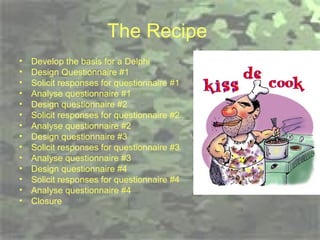
The Recipe
• Develop the basis for a Delphi
• Design Questionnaire #1
• Solicit responses for questionnaire #1
• Analyse questionnaire #1
• Design questionnaire #2
• Solicit responses for questionnaire #2
• Analyse questionnaire #2
• Design questionnaire #3
• Solicit responses for questionnaire #3
• Analyse questionnaire #3
• Design questionnaire #4
• Solicit responses for questionnaire #4
• Analyse questionnaire #4
• Closure

Delphi technique

  • 1.
  • 2.
    Objectives • Become familiarwith the qualitative research method known as the Delphi Technique.
  • 3.
    Purpose • Delphi isa group process for eliciting, collating, and generally directing informed (expert) judgment towards a consensus on a particular topic.
  • 4.
    Uses • Identifying thedimensions and the attributes of a problem • Providing forecasts • Gathering information from a group whose members do not meet fact-to-face and wish to retain their anonymity
  • 5.
    Description • Delphi isa method in which individuals focus on and debate issues anonymously. • Typically conducted by mail or e-mail utilising several rounds of questionnaires. • Results of each round are collected, collated and analysed by a design team. • Questions for the next round are based on the previous responses. • Generally provides convergence of opinions.
  • 6.
    Advantages within Delphi •Anonymity • More accurate representation of expert opinions • No group meetings are required. • Allows participants to be geographically scattered.
  • 7.
    Limitations within Delphi •Time consuming. • High participant interest and commitment is assumed or the quantity and quality of responses will decrease with each round. • By design Delphi does not allow for instant communication or intellectual stimulation.
  • 8.
    Inputs • Respondents should: –Have special experience or knowledge to share. – Represent a cross-section of opinions. – Be motivated to participate. • Questionnaire should: – Be as short as possible – Be adapted to the language most familiar to the participants area of expertise
  • 9.
  • 10.
    The Recipe • Developthe basis for a Delphi • Design Questionnaire #1 • Solicit responses for questionnaire #1 • Analyse questionnaire #1 • Design questionnaire #2 • Solicit responses for questionnaire #2 • Analyse questionnaire #2 • Design questionnaire #3 • Solicit responses for questionnaire #3 • Analyse questionnaire #3 • Design questionnaire #4 • Solicit responses for questionnaire #4 • Analyse questionnaire #4 • Closure