uruli N. LISc Ysore University 2010-11 M
Overview of my presentation: Mission Introduction History DRM functional architecture Interested Players in DRM Example of DRM Implementation Laws regarding DRM Controversy of DRM Future of DRM
Digital Rights Management  Mission : protect rights of digital media producers while enabling access for fair use grant exclusive rights in exchange for disclosure Reality : DRM is just protection technology, and is fast eroding our rights of fair use may never be able to reuse parts of  any  digital content (documents, film, images, audio, etc.) hinders progress of science and the useful arts
Introduction: Digital rights management  ( DRM ) is a term for  access control  technologies that are used by hardware manufacturers, publishers,  copyright  holders and individuals to limit the use of digital content and devices. The term is used to describe any technology that inhibits uses of digital content that is not desired or intended by the content provider .  The term does not generally refer to other forms of  copy protection , which can be circumvented without modifying the file or device, such as  serial numbers  or  key files .
Conti…. It can also refer to restrictions associated with specific instances of digital works or devices. Digital rights management is used by companies such as  Sony ,  Amazon ,  Apple Inc. ,  Microsoft ,  AOL  and the  BBC . The use of digital rights management is controversial. Proponents argue it is needed by copyright holders to prevent unauthorized duplication of their work, either to maintain  artistic integrity [1]  or to ensure continued revenue streams DRM technologies attempt to control use of digital media by preventing access, copying or conversion to other formats by  end users .
Conti… DRM technologies have enabled publishers to enforce access policies that not only disallow  copyright infringements , but also prevent lawful  fair use  of copyrighted works, or even implement use constraints on non-copyrighted works that they distribute DRM is most commonly used by the  entertainment industry  (e.g.,  film  and  recording ). [6]  Many  online music stores , such as  Apple Inc. 's  iTunes Store , as well as many  e-book  publishers have implemented DRM. In recent years, a number of  television producers  have implemented DRM on consumer electronic devices to control access to the freely-broadcast content of their shows, in response to the rising popularity of time-shifting  digital video recorder  systems
What does an organisation need to consider? Intellectual Property (IP) rights  Copyright Payment mechanisms Security E-commerce and ERP systems Licensing…
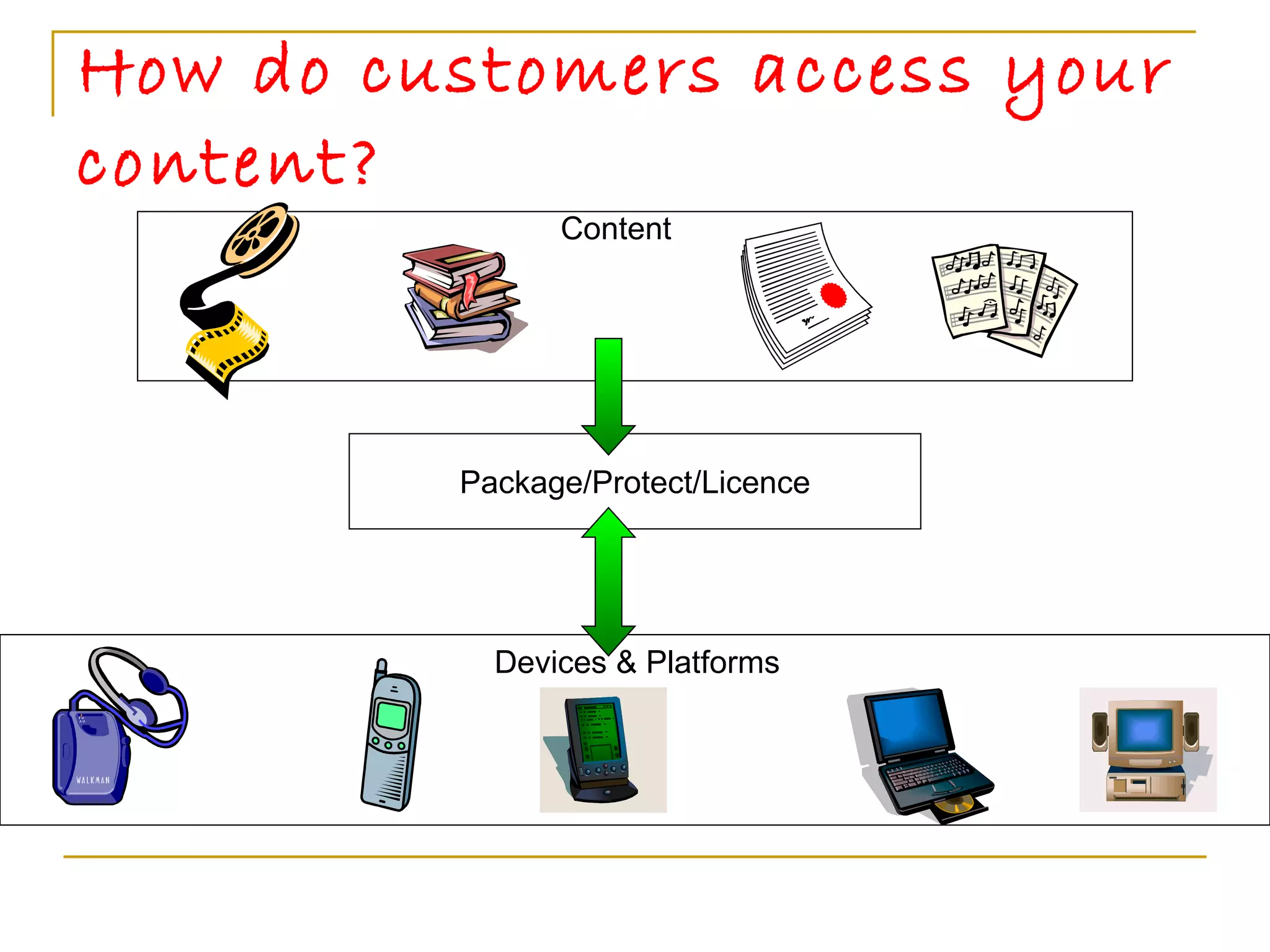
How do customers access your content? Devices & Platforms Package/Protect/Licence Content
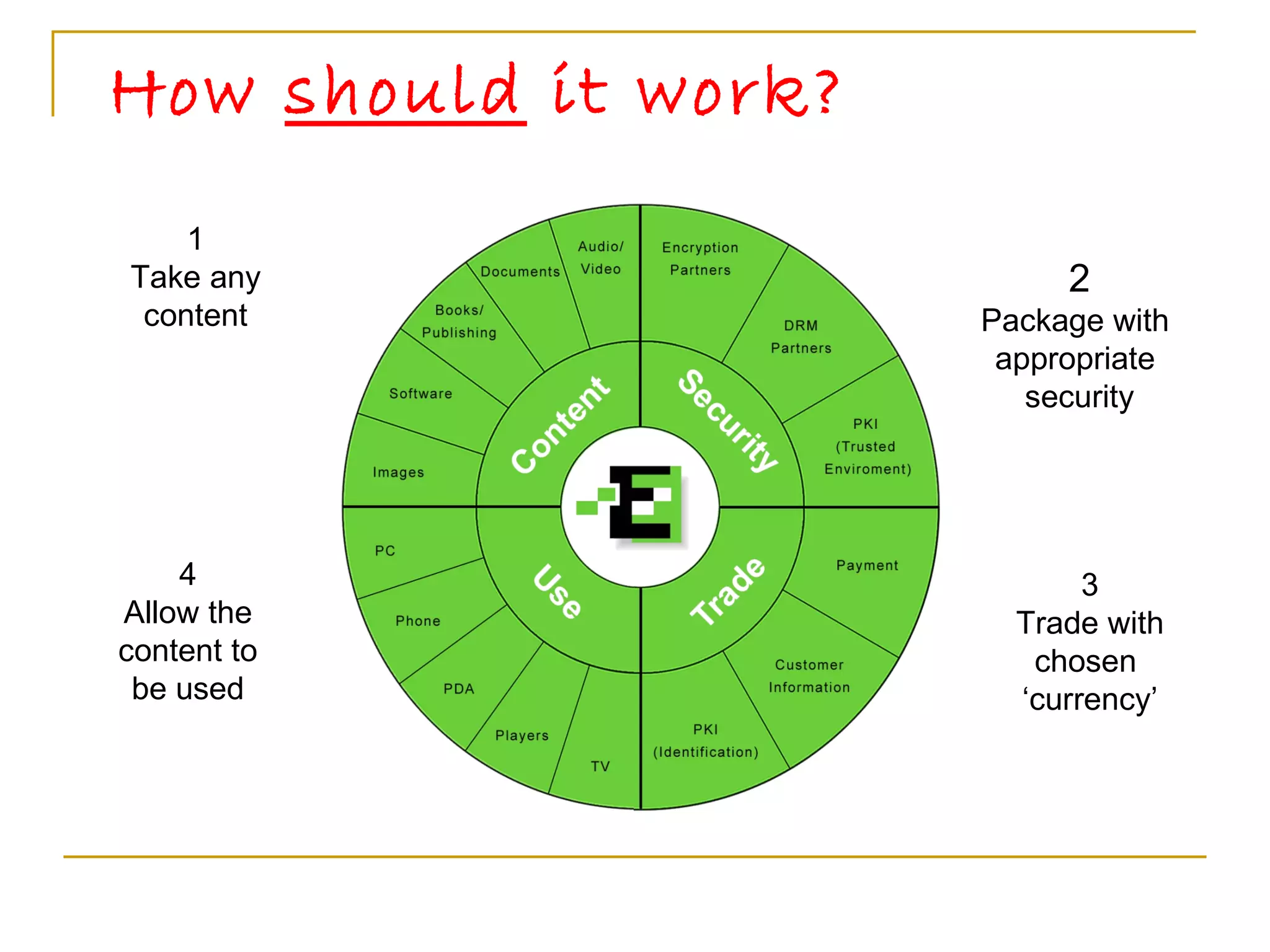
How  should  it work? 2 Package with  appropriate  security 3 Trade with chosen  ‘ currency’ 4 Allow the content to be used 1 Take any content
History of DRM In the pre-digital era, people's ability to do various things to or with content were limited. The networked digital age makes it possible to do just about anything to digital content, instantaneously and at virtually no cost. While this is a great opportunity for new content business models, it threatens the livelihood of content creators by making rampant piracy possible  Also, more and more public and private entities are going digital and doing business online. Information is increasing retrieved through computer networks by customers, employees and partners etc.
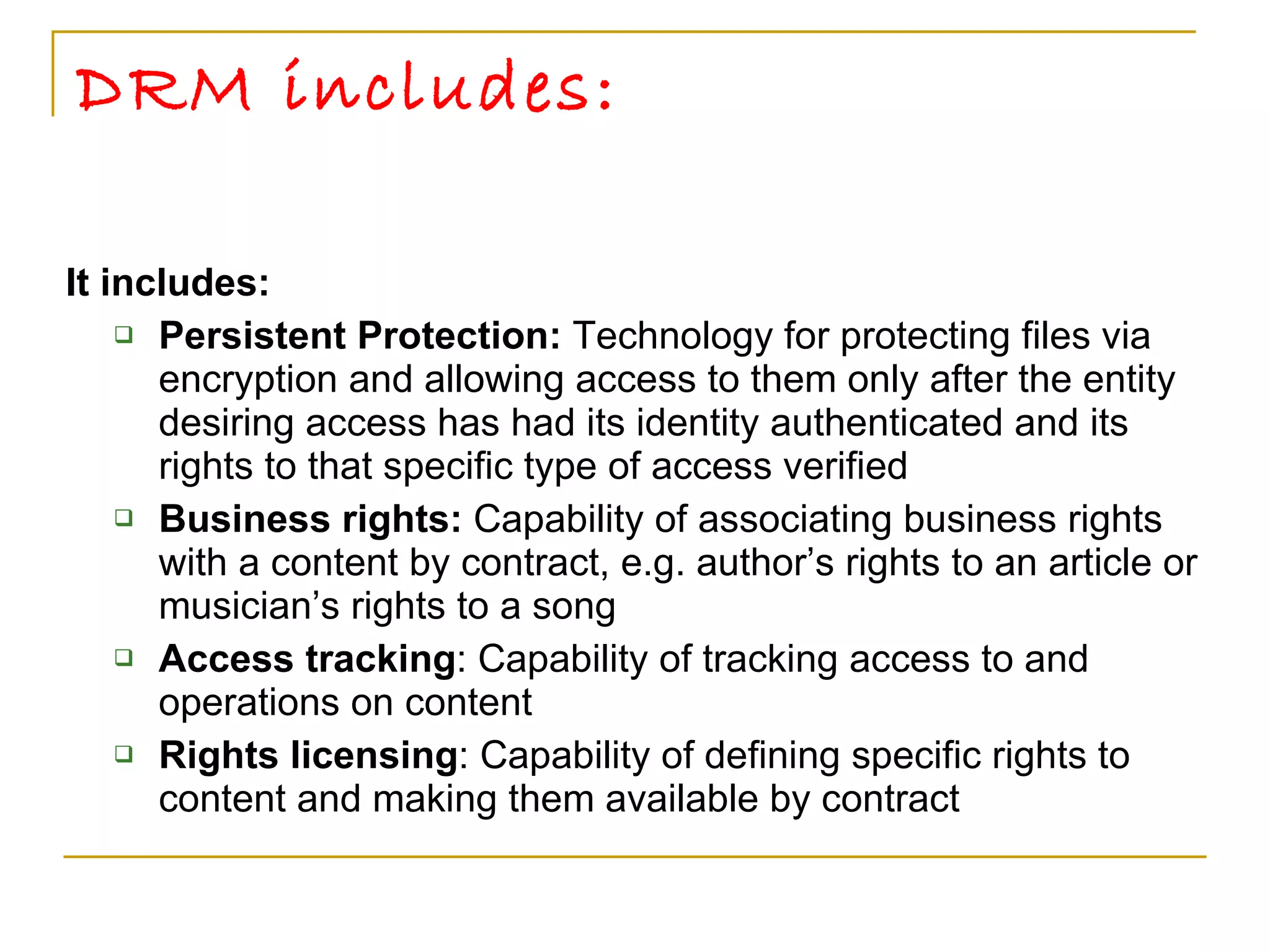
History of DRM Thus, we see the need for a technology that enables the secure creation, management, distribution and promotion of digital content on the Internet. A very early implementation of DRM was the Software Service System (SSS) devised by the Japanese engineer Ryoichi Mori in 1983.
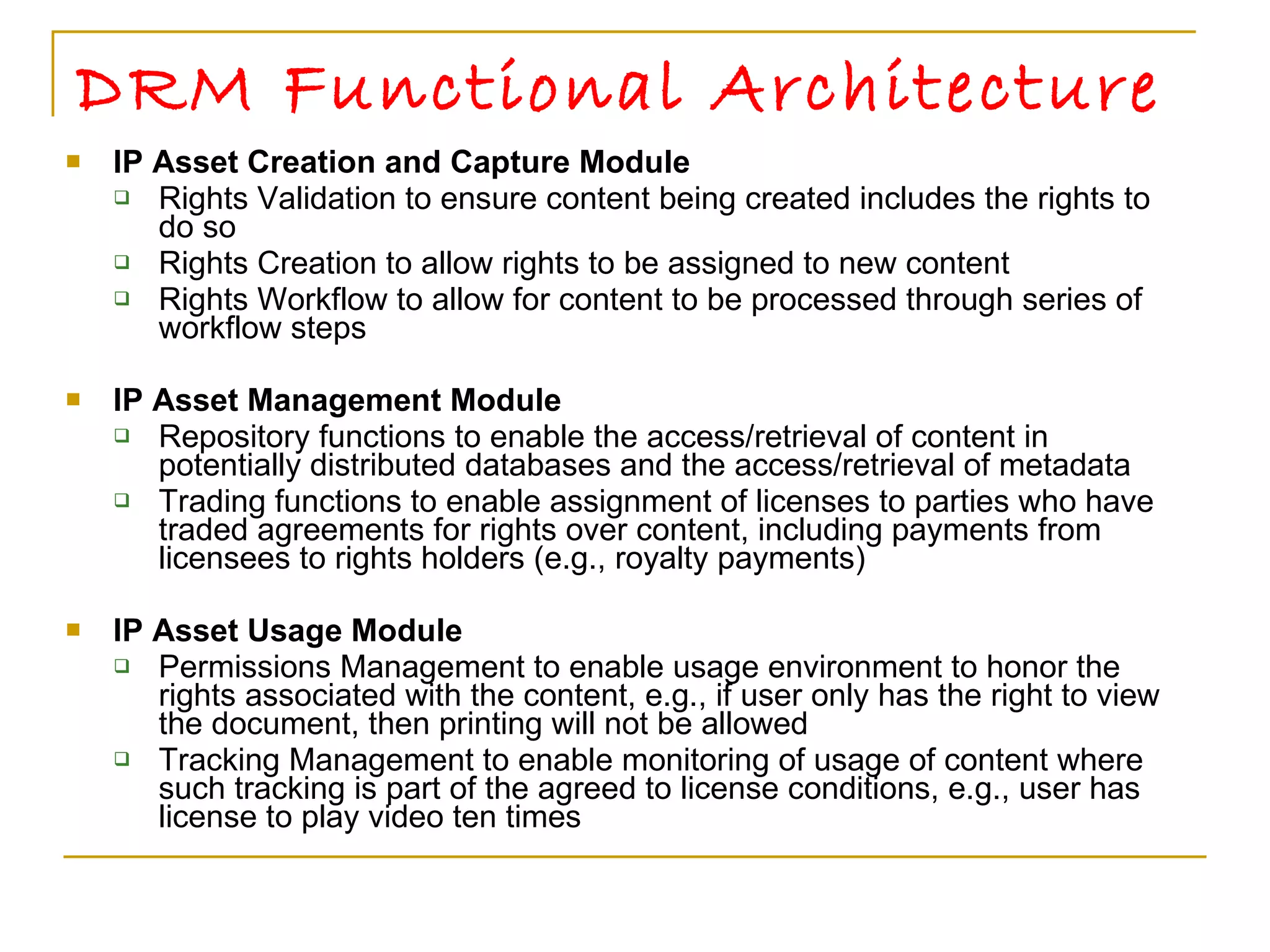
DRM includes: It includes: Persistent Protection:  Technology for protecting files via encryption and allowing access to them only after the entity desiring access has had its identity authenticated and its rights to that specific type of access verified Business rights:  Capability of associating business rights with a content by contract, e.g. author’s rights to an article or musician’s rights to a song Access tracking : Capability of tracking access to and operations on content  Rights licensing : Capability of defining specific rights to content and making them available by contract
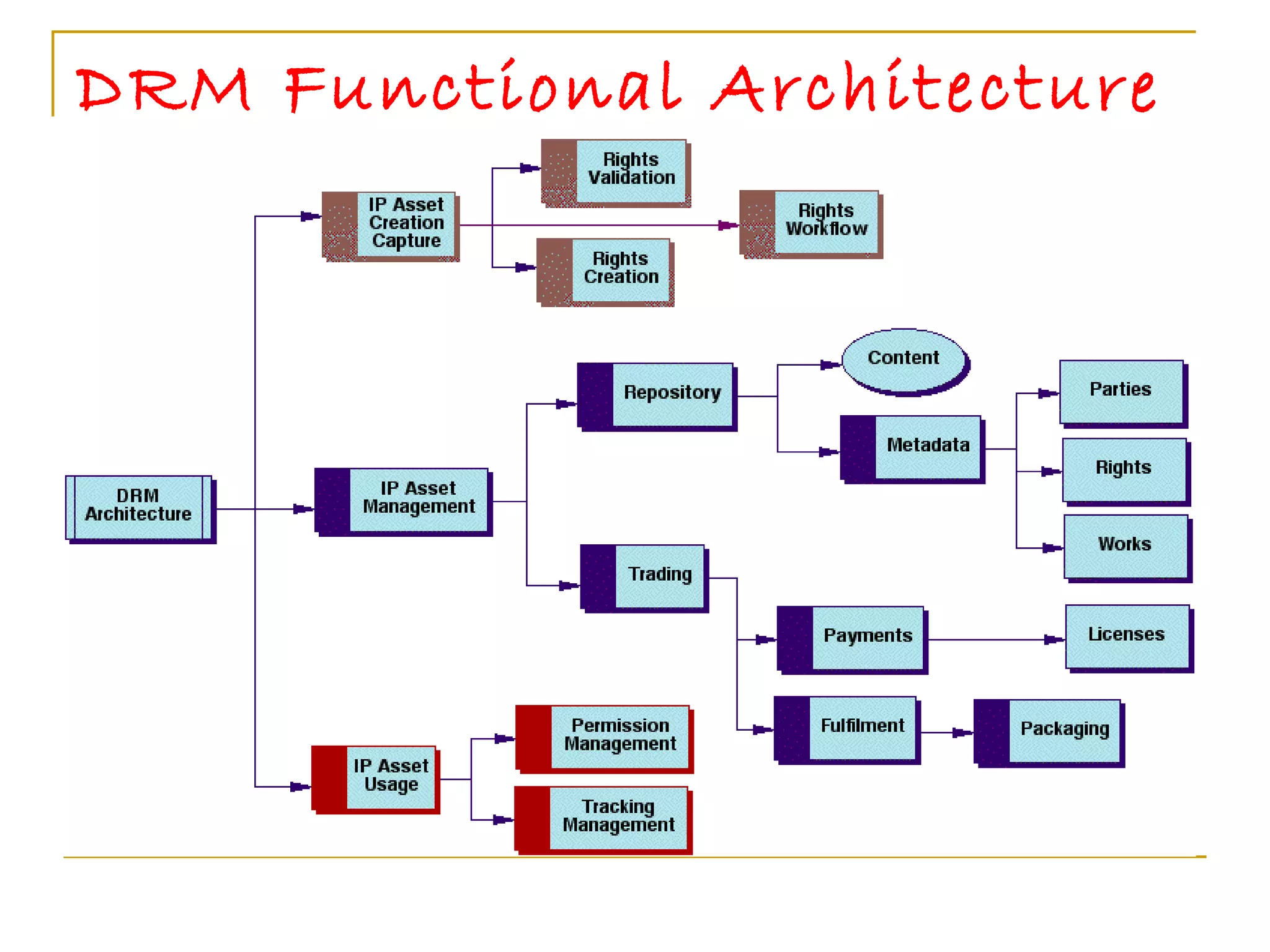
DRM Functional Architecture IP Asset Creation and Capture Module Rights Validation to ensure content being created includes the rights to do so Rights Creation to allow rights to be assigned to new content Rights Workflow to allow for content to be processed through series of workflow steps IP Asset Management Module Repository functions to enable the access/retrieval of content in potentially distributed databases and the access/retrieval of metadata Trading functions to enable assignment of licenses to parties who have traded agreements for rights over content, including payments from licensees to rights holders (e.g., royalty payments) IP Asset Usage Module Permissions Management to enable usage environment to honor the rights associated with the content, e.g., if user only has the right to view the document, then printing will not be allowed Tracking Management to enable monitoring of usage of content where such tracking is part of the agreed to license conditions, e.g., user has license to play video ten times
DRM Functional Architecture  
Interested Players in DRM Government Agencies Interested in controlled viewing and sharing of highly secure and confidential documents, audio and video data. “ Need to know basis” Private Corporations Want to limit the sharing of their proprietary information Track accesses and any modifications made to it.  E.g. news agencies like Reuters  Owners of commercial content  Content owners, artists, and publishers want to gain revenue through sale and promotions But are concerned about protecting their copyrighted works from illegal use
Interested Players in DRM  Intermediaries (service providers, content distributors etc.) Concerned about minimizing costs of providing services Cautious about protecting themselves from lawsuits over illegal distribution  Producers of end user equipment (PCs, players, etc.)  Concerned about minimizing design and production costs Unwilling to pay for features that only some users need End users Interested in immediate access to desired content Want to use the content conveniently
Thus, we see… DRM can help ensure companies, corporations, and other entities who share similar business that: Rights are tracked at ingestion Access is controlled during production processes Protection for the content extends throughout product lifecycles Additionally, DRM can integrate persistent content protection with content management to ensure: Proper business practices  Implementation of new business models Compliance with regulatory requirements in industries such as financial services, healthcare, and government
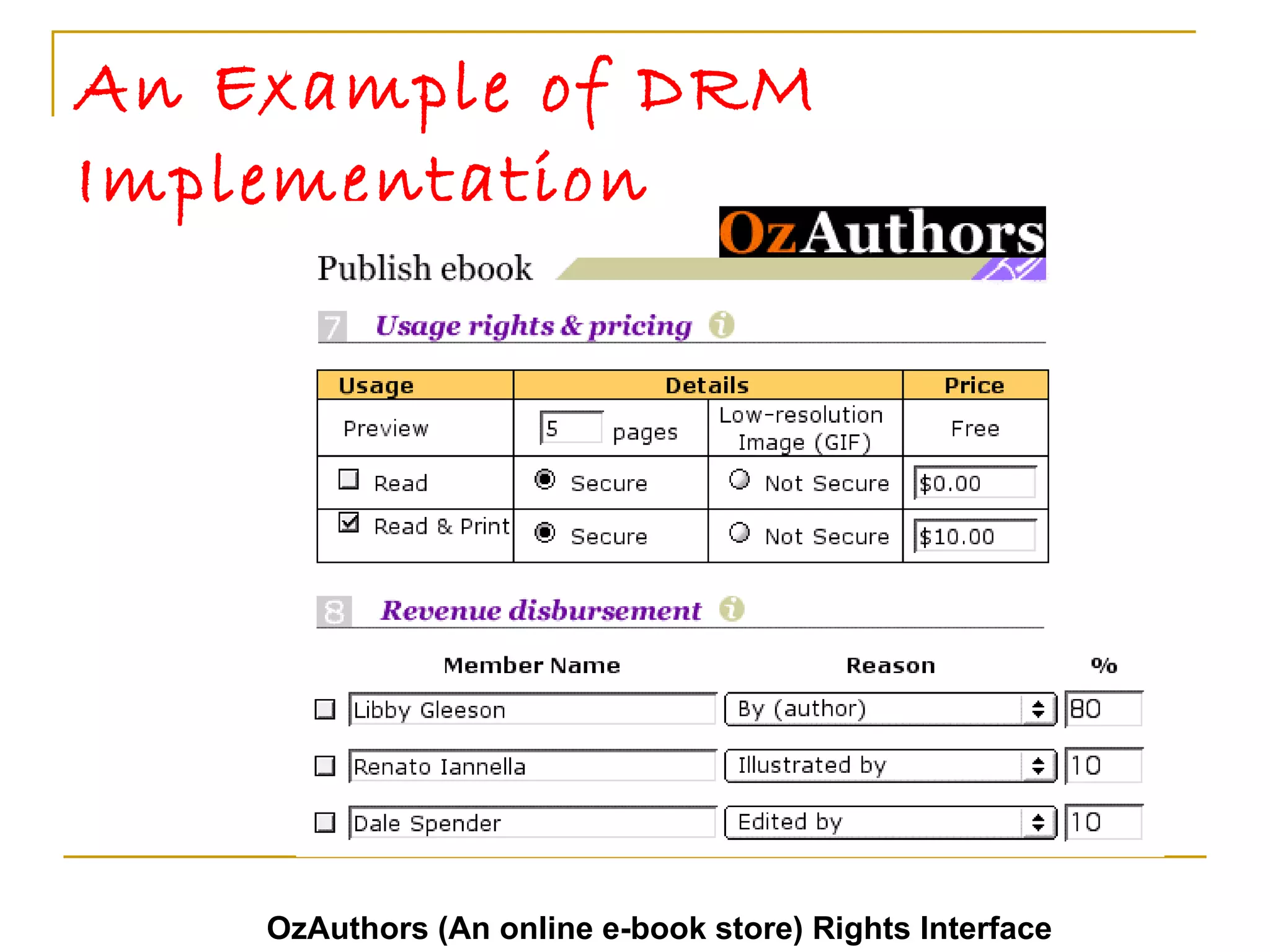
An Example of DRM Implementation  OzAuthors (An online e-book store) Rights Interface
Laws regarding DRM Digital rights management systems have received some international legal backing by implementation of the 1996  WIPO Copyright Treaty  (WCT). Article 11 of the Treaty requires nations party to the treaties to enact laws against DRM circumvention. The WCT has been implemented in most member states of the  World Intellectual Property Organization .  The American implementation is the  Digital Millennium Copyright Act  (DMCA),  while in Europe the treaty has been implemented by the 2001  European directive on copyright , which requires member states of the  European Union  to implement legal protections for technological prevention measures.  In 2006, the lower house of the French parliament adopted such legislation as part of the controversial  DADVSI  law, but added that protected DRM techniques should be made interoperable, a move which caused widespread controversy in the United States.
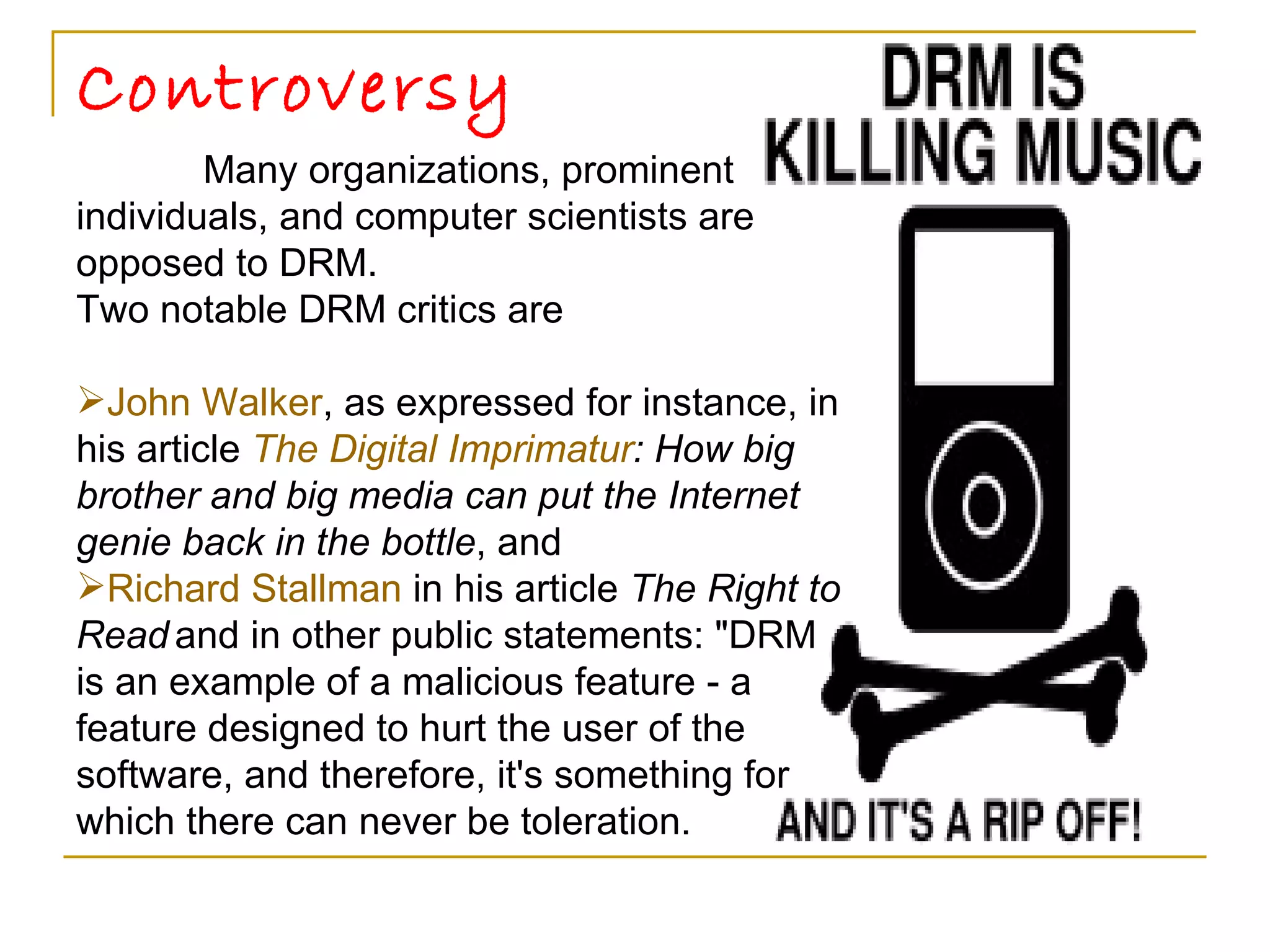
Controversy Many organizations, prominent individuals, and computer scientists are opposed to DRM.  Two notable DRM critics are  John Walker , as expressed for instance, in his article  The Digital Imprimatur : How big brother and big media can put the Internet genie back in the bottle , and  Richard Stallman  in his article  The Right to Read   and in other public statements: "DRM is an example of a malicious feature - a feature designed to hurt the user of the software, and therefore, it's something for which there can never be toleration.
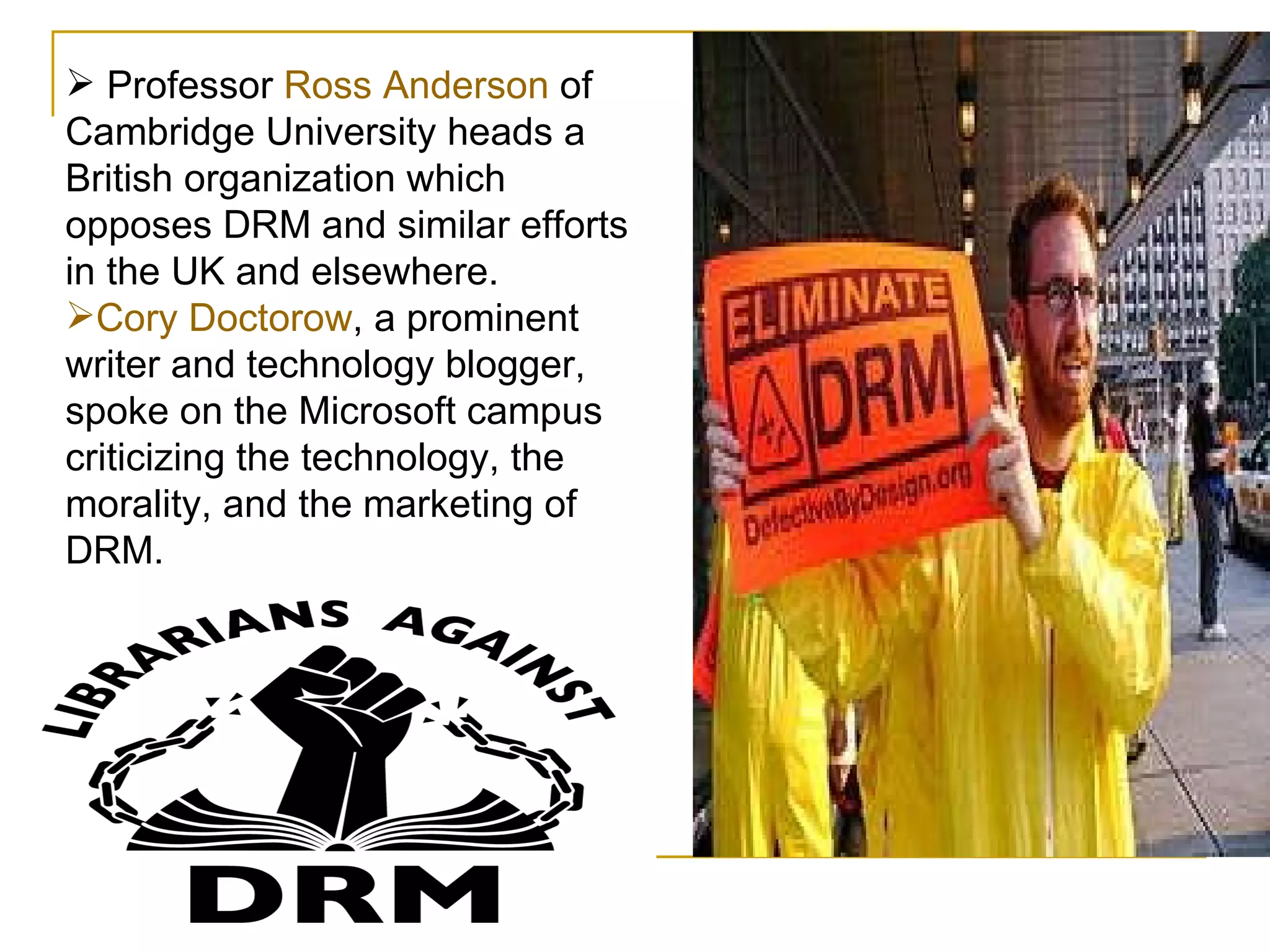
Professor  Ross Anderson  of Cambridge University heads a British organization which opposes DRM and similar efforts in the UK and elsewhere.  Cory Doctorow , a prominent writer and technology blogger, spoke on the Microsoft campus criticizing the technology, the morality, and the marketing of DRM.
The Future of DRM DRM is emerging as a formidable new challenge, and it is essential for DRM systems to provide interoperable services. Solutions to DRM challenges will enable untold amounts of new content to be made available in safe, open, and trusted environments.  The technology can be expected to be heavily used in the future to support digital library collections, code and software development, distance education, and networked collaboration, among other applications.
The Future of DRM DRM standardization is occurring in a number of open organizations.  The Open EBook Forum [OEBF] and the MPEG group [MPEG] are leading the charge for the eBook and multimedia sectors.  The Internet Engineering Task Force [IETF] and the World Wide Web Consortium [W3C] have also commenced work on DRM issues. Their work will be important for the entire DRM sector, and it is also important that all communities be heard during these standardization processes in industry and sector-neutral standards organizations.
References “ Integrating Content Management with Digital Rights Manangement”,  Bill Rosenblatt and Gail Dykstra, May 14 2003 http://www.epic.org/privacy/drm/ http://www.dlib.org/dlib/june01/iannella/06iannella.html http://www.eff.org/IP/DRM/


Digital Rights Management

  • 1.
    uruli N. LIScYsore University 2010-11 M
  • 2.
    Overview of mypresentation: Mission Introduction History DRM functional architecture Interested Players in DRM Example of DRM Implementation Laws regarding DRM Controversy of DRM Future of DRM
  • 3.
    Digital Rights Management Mission : protect rights of digital media producers while enabling access for fair use grant exclusive rights in exchange for disclosure Reality : DRM is just protection technology, and is fast eroding our rights of fair use may never be able to reuse parts of any digital content (documents, film, images, audio, etc.) hinders progress of science and the useful arts
  • 4.
    Introduction: Digital rightsmanagement ( DRM ) is a term for access control technologies that are used by hardware manufacturers, publishers, copyright holders and individuals to limit the use of digital content and devices. The term is used to describe any technology that inhibits uses of digital content that is not desired or intended by the content provider . The term does not generally refer to other forms of copy protection , which can be circumvented without modifying the file or device, such as serial numbers or key files .
  • 5.
    Conti…. It canalso refer to restrictions associated with specific instances of digital works or devices. Digital rights management is used by companies such as Sony , Amazon , Apple Inc. , Microsoft , AOL and the BBC . The use of digital rights management is controversial. Proponents argue it is needed by copyright holders to prevent unauthorized duplication of their work, either to maintain artistic integrity [1] or to ensure continued revenue streams DRM technologies attempt to control use of digital media by preventing access, copying or conversion to other formats by end users .
  • 6.
    Conti… DRM technologieshave enabled publishers to enforce access policies that not only disallow copyright infringements , but also prevent lawful fair use of copyrighted works, or even implement use constraints on non-copyrighted works that they distribute DRM is most commonly used by the entertainment industry (e.g., film and recording ). [6] Many online music stores , such as Apple Inc. 's iTunes Store , as well as many e-book publishers have implemented DRM. In recent years, a number of television producers have implemented DRM on consumer electronic devices to control access to the freely-broadcast content of their shows, in response to the rising popularity of time-shifting digital video recorder systems
  • 7.
    What does anorganisation need to consider? Intellectual Property (IP) rights Copyright Payment mechanisms Security E-commerce and ERP systems Licensing…
  • 8.
    How do customersaccess your content? Devices & Platforms Package/Protect/Licence Content
  • 9.
    How should it work? 2 Package with appropriate security 3 Trade with chosen ‘ currency’ 4 Allow the content to be used 1 Take any content
  • 10.
    History of DRMIn the pre-digital era, people's ability to do various things to or with content were limited. The networked digital age makes it possible to do just about anything to digital content, instantaneously and at virtually no cost. While this is a great opportunity for new content business models, it threatens the livelihood of content creators by making rampant piracy possible Also, more and more public and private entities are going digital and doing business online. Information is increasing retrieved through computer networks by customers, employees and partners etc.
  • 11.
    History of DRMThus, we see the need for a technology that enables the secure creation, management, distribution and promotion of digital content on the Internet. A very early implementation of DRM was the Software Service System (SSS) devised by the Japanese engineer Ryoichi Mori in 1983.
  • 12.
    DRM includes: Itincludes: Persistent Protection: Technology for protecting files via encryption and allowing access to them only after the entity desiring access has had its identity authenticated and its rights to that specific type of access verified Business rights: Capability of associating business rights with a content by contract, e.g. author’s rights to an article or musician’s rights to a song Access tracking : Capability of tracking access to and operations on content Rights licensing : Capability of defining specific rights to content and making them available by contract
  • 13.
    DRM Functional ArchitectureIP Asset Creation and Capture Module Rights Validation to ensure content being created includes the rights to do so Rights Creation to allow rights to be assigned to new content Rights Workflow to allow for content to be processed through series of workflow steps IP Asset Management Module Repository functions to enable the access/retrieval of content in potentially distributed databases and the access/retrieval of metadata Trading functions to enable assignment of licenses to parties who have traded agreements for rights over content, including payments from licensees to rights holders (e.g., royalty payments) IP Asset Usage Module Permissions Management to enable usage environment to honor the rights associated with the content, e.g., if user only has the right to view the document, then printing will not be allowed Tracking Management to enable monitoring of usage of content where such tracking is part of the agreed to license conditions, e.g., user has license to play video ten times
  • 14.
  • 15.
    Interested Players inDRM Government Agencies Interested in controlled viewing and sharing of highly secure and confidential documents, audio and video data. “ Need to know basis” Private Corporations Want to limit the sharing of their proprietary information Track accesses and any modifications made to it. E.g. news agencies like Reuters Owners of commercial content Content owners, artists, and publishers want to gain revenue through sale and promotions But are concerned about protecting their copyrighted works from illegal use
  • 16.
    Interested Players inDRM Intermediaries (service providers, content distributors etc.) Concerned about minimizing costs of providing services Cautious about protecting themselves from lawsuits over illegal distribution Producers of end user equipment (PCs, players, etc.) Concerned about minimizing design and production costs Unwilling to pay for features that only some users need End users Interested in immediate access to desired content Want to use the content conveniently
  • 17.
    Thus, we see…DRM can help ensure companies, corporations, and other entities who share similar business that: Rights are tracked at ingestion Access is controlled during production processes Protection for the content extends throughout product lifecycles Additionally, DRM can integrate persistent content protection with content management to ensure: Proper business practices Implementation of new business models Compliance with regulatory requirements in industries such as financial services, healthcare, and government
  • 18.
    An Example ofDRM Implementation OzAuthors (An online e-book store) Rights Interface
  • 19.
    Laws regarding DRMDigital rights management systems have received some international legal backing by implementation of the 1996 WIPO Copyright Treaty (WCT). Article 11 of the Treaty requires nations party to the treaties to enact laws against DRM circumvention. The WCT has been implemented in most member states of the World Intellectual Property Organization . The American implementation is the Digital Millennium Copyright Act (DMCA), while in Europe the treaty has been implemented by the 2001 European directive on copyright , which requires member states of the European Union to implement legal protections for technological prevention measures. In 2006, the lower house of the French parliament adopted such legislation as part of the controversial DADVSI law, but added that protected DRM techniques should be made interoperable, a move which caused widespread controversy in the United States.
  • 20.
    Controversy Many organizations,prominent individuals, and computer scientists are opposed to DRM. Two notable DRM critics are John Walker , as expressed for instance, in his article The Digital Imprimatur : How big brother and big media can put the Internet genie back in the bottle , and Richard Stallman in his article The Right to Read and in other public statements: "DRM is an example of a malicious feature - a feature designed to hurt the user of the software, and therefore, it's something for which there can never be toleration.
  • 21.
    Professor RossAnderson of Cambridge University heads a British organization which opposes DRM and similar efforts in the UK and elsewhere. Cory Doctorow , a prominent writer and technology blogger, spoke on the Microsoft campus criticizing the technology, the morality, and the marketing of DRM.
  • 22.
    The Future ofDRM DRM is emerging as a formidable new challenge, and it is essential for DRM systems to provide interoperable services. Solutions to DRM challenges will enable untold amounts of new content to be made available in safe, open, and trusted environments. The technology can be expected to be heavily used in the future to support digital library collections, code and software development, distance education, and networked collaboration, among other applications.
  • 23.
    The Future ofDRM DRM standardization is occurring in a number of open organizations. The Open EBook Forum [OEBF] and the MPEG group [MPEG] are leading the charge for the eBook and multimedia sectors. The Internet Engineering Task Force [IETF] and the World Wide Web Consortium [W3C] have also commenced work on DRM issues. Their work will be important for the entire DRM sector, and it is also important that all communities be heard during these standardization processes in industry and sector-neutral standards organizations.
  • 24.
    References “ IntegratingContent Management with Digital Rights Manangement”, Bill Rosenblatt and Gail Dykstra, May 14 2003 http://www.epic.org/privacy/drm/ http://www.dlib.org/dlib/june01/iannella/06iannella.html http://www.eff.org/IP/DRM/
  • 25.
  • 26.

Editor's Notes

  • #9 There is a range of emerging client devices and technologies. Its not only about making your content available to the Windows/PC based environment. If you want to trade digital content then how users access your information is important. For example: A PC might allow file download via HTTP where as a mobile phone might only support WAP. In Japan the mobile phone has overtaken the PC as the primary mode of access to the Internet. There are now 10M Japanese WAP (IMODE) CHECK???? based Internet users. You must be able to protect and manage your content whenever and however users are accessing content. Solutions should be able to package content on ‘the fly’ . This means that that the content can be securely packaged depending on where the content is being delivered to either a PDA, PC or Mobile Phone. It is protected according to the users individual requirements. For example delivering content via a PDF file makes it impossible to deliver via a mobile phone.