“SEMANTIC SEGMENTATION USING FULLY CONVOLUTIONAL NETWORK”
Co-ordinator
Mrs Kavyashree E D
Asst. Prof.
Dept. of CSE
ATMECE, Mysuru
Presenting By
Ankush Manjunath Naik[4AD19CS008]
Under the Guidance of
Dr. Nasreen Fathima
Associate Prof.
Dept. of CSE
ATMECE, Mysuru
1. Introduction
2. Methodology
3. Result and Discussion
4. Conclusion
5. References
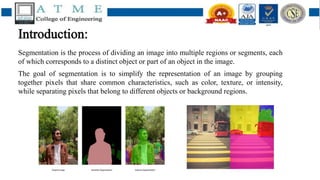
Segmentation is the process of dividing an image into multiple regions or segments, each
of which corresponds to a distinct object or part of an object in the image.
The goal of segmentation is to simplify the representation of an image by grouping
together pixels that share common characteristics, such as color, texture, or intensity,
while separating pixels that belong to different objects or background regions.
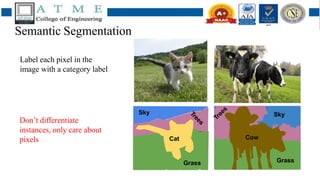
Semantic Segmentation:
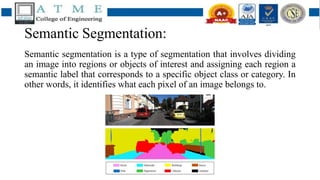
Semantic segmentation is a type of segmentation that involves dividing
an image into regions or objects of interest and assigning each region a
semantic label that corresponds to a specific object class or category. In
other words, it identifies what each pixel of an image belongs to.
Application of Semantic Segmentation:
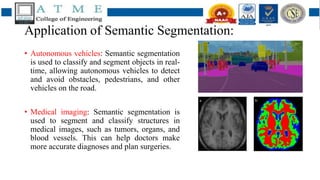
• Autonomous vehicles: Semantic segmentation
is used to classify and segment objects in real-
time, allowing autonomous vehicles to detect
and avoid obstacles, pedestrians, and other
vehicles on the road.
• Medical imaging: Semantic segmentation is
used to segment and classify structures in
medical images, such as tumors, organs, and
blood vessels. This can help doctors make
more accurate diagnoses and plan surgeries.
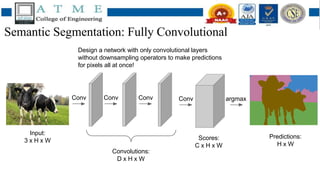
fully convolutional networks:
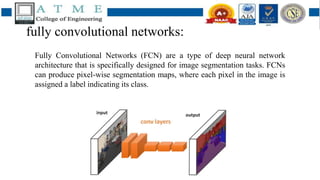
Fully Convolutional Networks (FCN) are a type of deep neural network
architecture that is specifically designed for image segmentation tasks. FCNs
can produce pixel-wise segmentation maps, where each pixel in the image is
assigned a label indicating its class.
Semantic Segmentation: Fully Convolutional
Input:
3 x H x W
Convolutions:
D x H x W
Conv Conv Conv Conv
Scores:
C x H x W
argmax
Lecture 9 -
Fei-Fei Li, Jiajun Wu, Ruohan Gao 7
Predictions:
H x W
Design a network with only convolutional layers
without downsampling operators to make predictions
for pixels all at once!
Semantic Segmentation Idea: Fully Convolutional
Input:
3 x H x W
Convolutions:
D x H x W
Conv Conv Conv Conv
Scores:
C x H x W
argmax
Lecture 9 -
8
Predictions:
H x W
Design a network with only convolutional layers
without downsampling operators to make predictions
for pixels all at once!
Problem: convolutions at
original image resolution will
be very expensive ...
Semantic Segmentation Idea: Fully Convolutional
Input:
3 x H x W
Predictions:
H x W
Design network as a bunch of convolutional layers, with
downsampling and upsampling inside the network!
High-res:
D1
x H/2 x W/2
1
High-res:
D x H/2 x W/2
Med-res:
D2
x H/4 x W/4
Med-res:
D2
x H/4 x W/4
Low-res:
D3
x H/4 x W/4
C x H x W
Semantic Segmentation Idea: Fully Convolutional
Input:
3 x H x W
Predictions:
H x W
Design network as a bunch of convolutional layers, with
downsampling and upsampling inside the network!
High-res:
D1
x H/2 x W/2
Med-res:
D2
x H/4 x W/4
Med-res:
D2
x H/4 x W/4
Low-res:
D3
x H/4 x W/4
Downsampling:
Pooling, strided
convolution
Upsampling:
???
C x H x W
1
High-res:
D x H/2 x W/2
Semantic Segmentation Idea: Fully Convolutional
Input:
3 x H x W
Predictions:
H x W
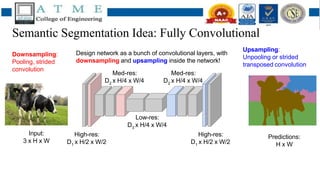
Design network as a bunch of convolutional layers, with
downsampling and upsampling inside the network!
High-res:
D1
x H/2 x W/2
High-res:
D1
x H/2 x W/2
Med-res:
D2
x H/4 x W/4
Med-res:
D2
x H/4 x W/4
Low-res:
D3
x H/4 x W/4
Downsampling:
Pooling, strided
convolution
Upsampling:
Unpooling or strided
transposed convolution
Semantic Segmentation
Sky
Cow
Grass
Label each pixel in the
image with a category label
Grass
Lecture 9 -
Cat
Sky
Don’t differentiate
instances, only care about
pixels
Result and Discussion:
Fully convolutional networks (FCNs) with downsampling and upsampling methods,
have been shown to be effective for semantic segmentation tasks. The following is a
general discussion of the results and performance of FCNs with downsampling and
upsampling methods in semantic segmentation.
1) Allow the network to learn features at different scales, which can improve the
segmentation accuracy.
2) Downsampling process reduces the resolution of the feature maps, allowing the
network to capture more abstract and global features.
3) Upsampling process restores the resolution of the feature maps, allowing the
network to generate accurate pixel-wise predictions.
13
Conclusion:
• In conclusion, semantic segmentation using fully convolutional networks (FCNs)
with downsampling and upsampling methods has shown to be a highly effective
approach for a wide range of segmentation tasks. By allowing the network to learn
features at different scales and generate pixel-wise predictions, including medical
imaging, autonomous driving, and object detection.
• Overall, FCNs with downsampling and upsampling methods have become one of
the most popular techniques for semantic segmentation in recent years. Their
effectiveness in solving a wide range of segmentation problems, combined with
their scalability and ability to handle large datasets, makes them a powerful tool in
the field of computer vision and machine learning.
14
Future Scope:
1) Real-time semantic segmentation: One of the most important directions for the
future of semantic segmentation is real-time performance. Real-time
segmentation can be critical for many applications, such as autonomous driving,
robotics, and surveillance, where fast and accurate decision-making is
necessary.
2) Multimodal semantic segmentation: Another important direction is multimodal
semantic segmentation, where information from different modalities, such as
depth, color, and texture, is integrated to improve segmentation accuracy.
Reference:
• Image Semantic Segmentation using Deep Convolutional Nets, Fully Connected
Conditional Random Fields, and Dilated Convolution. Degui Xiao, Pei Zhong.
[2019]
• Road Segmentation using Point Cloud BEV based on Fully Convolution Network.
Yin Zhang, Guoquan Ren, Guojie Kong, Hui Xie. [2020]
• Guided Co-Segmentation Network for Fast Video Object Segmentation. Weide
Liu, Guosheng Lin, Tianyi Zhang, Zichuan Liu. [2020]
• Real-Time Semantic Segmentation Network Based on Lite Reduced Atrous
Spatial Pyramid Pooling Module Group. Yangsheng Tian, Fangyuan Chen. [2020]
• Deep Guidance Network for Biomedical Image Segmentation. Pengshuai Yin, Rui
Yuan, Yiming Cheng, Qinguao Wu. [2020]
16
Reference:
• An Image Segmentation Algorithm for LED Bracket's Detection. Xinjia Fang,
Fupei Wu, Zhichao Zeng, Jintian Li. [2016]
• Two-Stream Deep Encoder-Decoder Architecture for Fully Automatic Video
Object Segmentation. Jingwei Xu, Li Song, Rong Xie. [2017]
• A Sonar Image Segmentation Algorithm based on Two-Dimensional Spatio-
Temporal Fuzzy Entropy. Lu Zhen, Chen Yuchao, Zhang Tiedong, Yu Jun. [2018]
• Skin Segmentation based on Improved Thresholding Method. Novira Dwina, Fitri
Arnia, Khairul Munadi. [2018]
• Image Segmentation Based on Superpixel Boundary Movement. Yueting Fang,
Deqiang Yang, JianHou Gan. [2019]
18

AaSeminar_Template.pptx

  • 1.
    “SEMANTIC SEGMENTATION USINGFULLY CONVOLUTIONAL NETWORK” Co-ordinator Mrs Kavyashree E D Asst. Prof. Dept. of CSE ATMECE, Mysuru Presenting By Ankush Manjunath Naik[4AD19CS008] Under the Guidance of Dr. Nasreen Fathima Associate Prof. Dept. of CSE ATMECE, Mysuru
  • 2.
    1. Introduction 2. Methodology 3.Result and Discussion 4. Conclusion 5. References
  • 3.
    Segmentation is theprocess of dividing an image into multiple regions or segments, each of which corresponds to a distinct object or part of an object in the image. The goal of segmentation is to simplify the representation of an image by grouping together pixels that share common characteristics, such as color, texture, or intensity, while separating pixels that belong to different objects or background regions.
  • 4.
    Semantic Segmentation: Semantic segmentationis a type of segmentation that involves dividing an image into regions or objects of interest and assigning each region a semantic label that corresponds to a specific object class or category. In other words, it identifies what each pixel of an image belongs to.
  • 5.
    Application of SemanticSegmentation: • Autonomous vehicles: Semantic segmentation is used to classify and segment objects in real- time, allowing autonomous vehicles to detect and avoid obstacles, pedestrians, and other vehicles on the road. • Medical imaging: Semantic segmentation is used to segment and classify structures in medical images, such as tumors, organs, and blood vessels. This can help doctors make more accurate diagnoses and plan surgeries.
  • 6.
    fully convolutional networks: FullyConvolutional Networks (FCN) are a type of deep neural network architecture that is specifically designed for image segmentation tasks. FCNs can produce pixel-wise segmentation maps, where each pixel in the image is assigned a label indicating its class.
  • 7.
    Semantic Segmentation: FullyConvolutional Input: 3 x H x W Convolutions: D x H x W Conv Conv Conv Conv Scores: C x H x W argmax Lecture 9 - Fei-Fei Li, Jiajun Wu, Ruohan Gao 7 Predictions: H x W Design a network with only convolutional layers without downsampling operators to make predictions for pixels all at once!
  • 8.
    Semantic Segmentation Idea:Fully Convolutional Input: 3 x H x W Convolutions: D x H x W Conv Conv Conv Conv Scores: C x H x W argmax Lecture 9 - 8 Predictions: H x W Design a network with only convolutional layers without downsampling operators to make predictions for pixels all at once! Problem: convolutions at original image resolution will be very expensive ...
  • 9.
    Semantic Segmentation Idea:Fully Convolutional Input: 3 x H x W Predictions: H x W Design network as a bunch of convolutional layers, with downsampling and upsampling inside the network! High-res: D1 x H/2 x W/2 1 High-res: D x H/2 x W/2 Med-res: D2 x H/4 x W/4 Med-res: D2 x H/4 x W/4 Low-res: D3 x H/4 x W/4 C x H x W
  • 10.
    Semantic Segmentation Idea:Fully Convolutional Input: 3 x H x W Predictions: H x W Design network as a bunch of convolutional layers, with downsampling and upsampling inside the network! High-res: D1 x H/2 x W/2 Med-res: D2 x H/4 x W/4 Med-res: D2 x H/4 x W/4 Low-res: D3 x H/4 x W/4 Downsampling: Pooling, strided convolution Upsampling: ??? C x H x W 1 High-res: D x H/2 x W/2
  • 11.
    Semantic Segmentation Idea:Fully Convolutional Input: 3 x H x W Predictions: H x W Design network as a bunch of convolutional layers, with downsampling and upsampling inside the network! High-res: D1 x H/2 x W/2 High-res: D1 x H/2 x W/2 Med-res: D2 x H/4 x W/4 Med-res: D2 x H/4 x W/4 Low-res: D3 x H/4 x W/4 Downsampling: Pooling, strided convolution Upsampling: Unpooling or strided transposed convolution
  • 12.
    Semantic Segmentation Sky Cow Grass Label eachpixel in the image with a category label Grass Lecture 9 - Cat Sky Don’t differentiate instances, only care about pixels
  • 13.
    Result and Discussion: Fullyconvolutional networks (FCNs) with downsampling and upsampling methods, have been shown to be effective for semantic segmentation tasks. The following is a general discussion of the results and performance of FCNs with downsampling and upsampling methods in semantic segmentation. 1) Allow the network to learn features at different scales, which can improve the segmentation accuracy. 2) Downsampling process reduces the resolution of the feature maps, allowing the network to capture more abstract and global features. 3) Upsampling process restores the resolution of the feature maps, allowing the network to generate accurate pixel-wise predictions. 13
  • 14.
    Conclusion: • In conclusion,semantic segmentation using fully convolutional networks (FCNs) with downsampling and upsampling methods has shown to be a highly effective approach for a wide range of segmentation tasks. By allowing the network to learn features at different scales and generate pixel-wise predictions, including medical imaging, autonomous driving, and object detection. • Overall, FCNs with downsampling and upsampling methods have become one of the most popular techniques for semantic segmentation in recent years. Their effectiveness in solving a wide range of segmentation problems, combined with their scalability and ability to handle large datasets, makes them a powerful tool in the field of computer vision and machine learning. 14
  • 15.
    Future Scope: 1) Real-timesemantic segmentation: One of the most important directions for the future of semantic segmentation is real-time performance. Real-time segmentation can be critical for many applications, such as autonomous driving, robotics, and surveillance, where fast and accurate decision-making is necessary. 2) Multimodal semantic segmentation: Another important direction is multimodal semantic segmentation, where information from different modalities, such as depth, color, and texture, is integrated to improve segmentation accuracy.
  • 16.
    Reference: • Image SemanticSegmentation using Deep Convolutional Nets, Fully Connected Conditional Random Fields, and Dilated Convolution. Degui Xiao, Pei Zhong. [2019] • Road Segmentation using Point Cloud BEV based on Fully Convolution Network. Yin Zhang, Guoquan Ren, Guojie Kong, Hui Xie. [2020] • Guided Co-Segmentation Network for Fast Video Object Segmentation. Weide Liu, Guosheng Lin, Tianyi Zhang, Zichuan Liu. [2020] • Real-Time Semantic Segmentation Network Based on Lite Reduced Atrous Spatial Pyramid Pooling Module Group. Yangsheng Tian, Fangyuan Chen. [2020] • Deep Guidance Network for Biomedical Image Segmentation. Pengshuai Yin, Rui Yuan, Yiming Cheng, Qinguao Wu. [2020] 16
  • 17.
    Reference: • An ImageSegmentation Algorithm for LED Bracket's Detection. Xinjia Fang, Fupei Wu, Zhichao Zeng, Jintian Li. [2016] • Two-Stream Deep Encoder-Decoder Architecture for Fully Automatic Video Object Segmentation. Jingwei Xu, Li Song, Rong Xie. [2017] • A Sonar Image Segmentation Algorithm based on Two-Dimensional Spatio- Temporal Fuzzy Entropy. Lu Zhen, Chen Yuchao, Zhang Tiedong, Yu Jun. [2018] • Skin Segmentation based on Improved Thresholding Method. Novira Dwina, Fitri Arnia, Khairul Munadi. [2018] • Image Segmentation Based on Superpixel Boundary Movement. Yueting Fang, Deqiang Yang, JianHou Gan. [2019]
  • 18.