Kevin McGuinness
kevin.mcguinness@dcu.ie
Assistant Professor
School of Electronic Engineering
Dublin City University
http://bit.ly/dlcv2018
#DLUPC
Generative Models
Day 4 Lecture 3
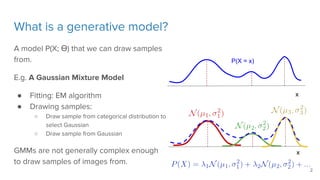
What is a generative model?
A model P(X; ϴ) that we can draw samples
from.
E.g. A Gaussian Mixture Model
● Fitting: EM algorithm
● Drawing samples:
○ Draw sample from categorical distribution to
select Gaussian
○ Draw sample from Gaussian
GMMs are not generally complex enough
to draw samples of images from.
P(X = x)
x
x
2
Why are generative models important?
● Model the probability density of images
● Understanding P(X) may help us understand P(Y | X)
● Generate novel content
● Generate training data for discriminative networks
● Artistic applications
● Image completion
● Monte-carlo estimators
3
Generative adversarial networks
Novel method of training deep generative models invented by Ian Goodfellow et al.
in 2014
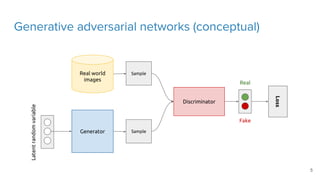
Idea: pit a generator and a discriminator against each other
● Generator tries to draw samples from P(X)
● Discriminator tries to tell if sample came from the generator or the real world
Both discriminator and generator are deep networks (differentiable functions)
Can train with backprop: train discriminator for a while, then train generator, then
discriminator, …
4
Generative adversarial networks (conceptual)
Generator
Real world
images
Discriminator
Real
Loss
Latentrandomvariable
Sample
Sample
Fake
5
The generator
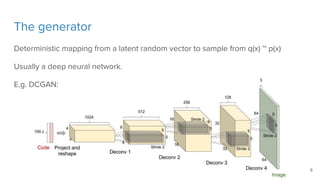
Deterministic mapping from a latent random vector to sample from q(x) ~ p(x)
Usually a deep neural network.
E.g. DCGAN:
6
The discriminator
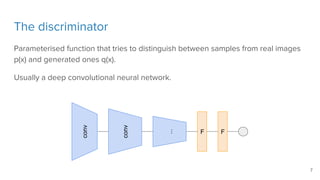
Parameterised function that tries to distinguish between samples from real images
p(x) and generated ones q(x).
Usually a deep convolutional neural network.
conv
conv
...
F F
7
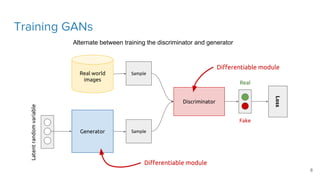
Training GANs
Generator
Real world
images
Discriminator
Real
Loss
Latentrandomvariable
Sample
Sample
Fake
Alternate between training the discriminator and generator
Differentiable module
8
Generator
Real world
images
Discriminator
Real
Loss
Latentrandomvariable
Sample
Sample
Fake
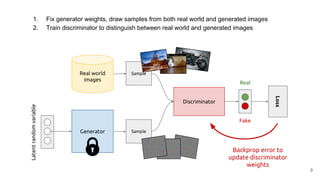
1. Fix generator weights, draw samples from both real world and generated images
2. Train discriminator to distinguish between real world and generated images
Backprop error to
update discriminator
weights
9
Generator
Real world
images
Discriminator
Real
Loss
Latentrandomvariable
Sample
Sample
Fake
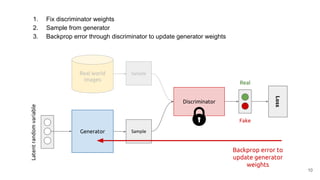
1. Fix discriminator weights
2. Sample from generator
3. Backprop error through discriminator to update generator weights
Backprop error to
update generator
weights
10
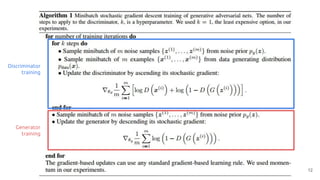
Training GANs
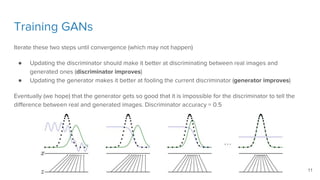
Iterate these two steps until convergence (which may not happen)
● Updating the discriminator should make it better at discriminating between real images and
generated ones (discriminator improves)
● Updating the generator makes it better at fooling the current discriminator (generator improves)
Eventually (we hope) that the generator gets so good that it is impossible for the discriminator to tell the
difference between real and generated images. Discriminator accuracy = 0.5
11
Discriminator
training
Generator
training
12
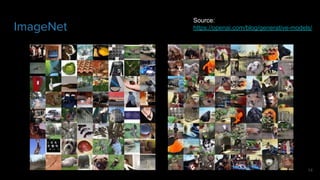
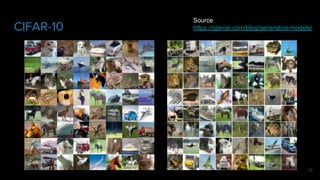
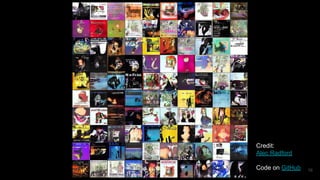
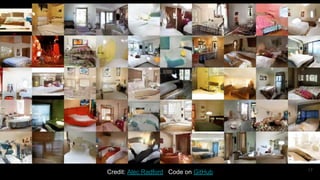
Some examples of generated images…
13
ImageNet
Source:
https://openai.com/blog/generative-models/
14
CIFAR-10
Source:
https://openai.com/blog/generative-models/
15
Credit:
Alec Radford
Code on GitHub 16
Credit: Alec Radford Code on GitHub 17
Issues
Known to be very difficult to train:
● Formulated as a “game” between two networks
● Unstable dynamics: hard to keep generator and discriminator in balance
● Optimization can oscillate between solutions
● Mode collapse in the generator
Difficult to evaluate results
18
Important variants
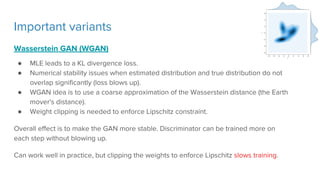
Wasserstein GAN (WGAN)
● MLE leads to a KL divergence loss.
● Numerical stability issues when estimated distribution and true distribution do not
overlap significantly (loss blows up).
● WGAN idea is to use a coarse approximation of the Wasserstein distance (the Earth
mover's distance).
● Weight clipping is needed to enforce Lipschitz constraint.
Overall effect is to make the GAN more stable. Discriminator can be trained more on
each step without blowing up.
Can work well in practice, but clipping the weights to enforce Lipschitz slows training.
Important variants
Least squares GAN (LSGAN)
● Similar motivation to WGAN: want a loss that gives nice gradients and doesn't
blow up.
● LSGAN Idea: just use squared error (L2
distance)!
● Turns out this is the same as minimizing the Pearson 2
divergence.
Important variants
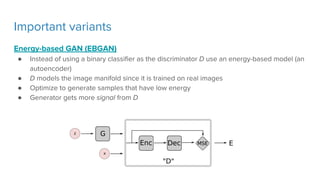
Energy-based GAN (EBGAN)
● Instead of using a binary classifier as the discriminator D use an energy-based model (an
autoencoder)
● D models the image manifold since it is trained on real images
● Optimize to generate samples that have low energy
● Generator gets more signal from D
Important variants
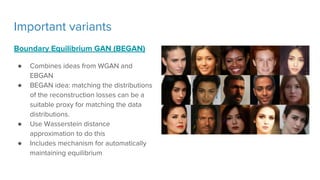
Boundary Equilibrium GAN (BEGAN)
● Combines ideas from WGAN and
EBGAN
● BEGAN idea: matching the distributions
of the reconstruction losses can be a
suitable proxy for matching the data
distributions.
● Use Wasserstein distance
approximation to do this
● Includes mechanism for automatically
maintaining equilibrium
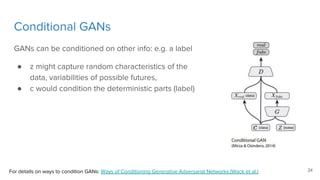
Conditional GANs
GANs can be conditioned on other info: e.g. a label
● z might capture random characteristics of the
data, variabilities of possible futures,
● c would condition the deterministic parts (label)
For details on ways to condition GANs: Ways of Conditioning Generative Adversarial Networks (Wack et al.) 24
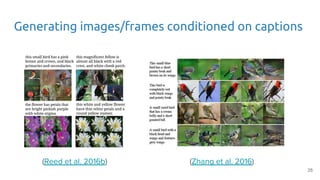
Generating images/frames conditioned on captions
(Reed et al. 2016b) (Zhang et al. 2016)
25
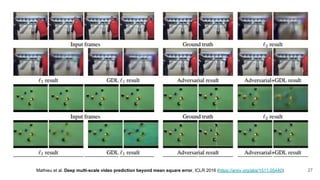
Predicting the future with adversarial training
Want to train a model to predict the pixels in frame (t+K) from pixels in frame t.
Many possible futures for same frame
Using supervised loss like MSE results in blurry solutions: loss if minimized if
predictor averages over possibilities when predicting.
We really want a sample, not the mean
Adversarial training can solve this: easy for an adversary to detect blurry frames
Mathieu et al. Deep multi-scale video prediction beyond mean square error, ICLR 2016 (https://arxiv.org/abs/1511.05440) 26
Mathieu et al. Deep multi-scale video prediction beyond mean square error, ICLR 2016 (https://arxiv.org/abs/1511.05440) 27
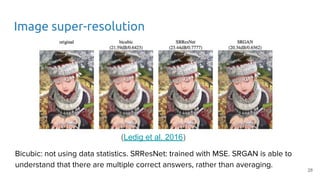
Image super-resolution
Bicubic: not using data statistics. SRResNet: trained with MSE. SRGAN is able to
understand that there are multiple correct answers, rather than averaging.
(Ledig et al. 2016)
28
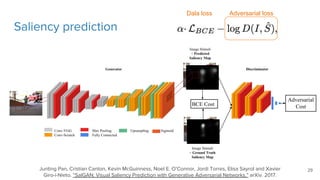
Saliency prediction
Adversarial lossDala loss
Junting Pan, Cristian Canton, Kevin McGuinness, Noel E. O’Connor, Jordi Torres, Elisa Sayrol and Xavier
Giro-i-Nieto. “SalGAN: Visual Saliency Prediction with Generative Adversarial Networks.” arXiv. 2017.
29
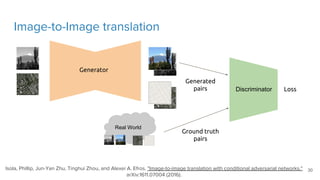
Image-to-Image translation
Isola, Phillip, Jun-Yan Zhu, Tinghui Zhou, and Alexei A. Efros. "Image-to-image translation with conditional adversarial networks."
arXiv:1611.07004 (2016).
Generator
Discriminator
Generated
pairs
Real World
Ground truth
pairs
Loss
30
Questions?

Deep Generative Models - Kevin McGuinness - UPC Barcelona 2018

  • 1.
    Kevin McGuinness kevin.mcguinness@dcu.ie Assistant Professor Schoolof Electronic Engineering Dublin City University http://bit.ly/dlcv2018 #DLUPC Generative Models Day 4 Lecture 3
  • 2.
    What is agenerative model? A model P(X; ϴ) that we can draw samples from. E.g. A Gaussian Mixture Model ● Fitting: EM algorithm ● Drawing samples: ○ Draw sample from categorical distribution to select Gaussian ○ Draw sample from Gaussian GMMs are not generally complex enough to draw samples of images from. P(X = x) x x 2
  • 3.
    Why are generativemodels important? ● Model the probability density of images ● Understanding P(X) may help us understand P(Y | X) ● Generate novel content ● Generate training data for discriminative networks ● Artistic applications ● Image completion ● Monte-carlo estimators 3
  • 4.
    Generative adversarial networks Novelmethod of training deep generative models invented by Ian Goodfellow et al. in 2014 Idea: pit a generator and a discriminator against each other ● Generator tries to draw samples from P(X) ● Discriminator tries to tell if sample came from the generator or the real world Both discriminator and generator are deep networks (differentiable functions) Can train with backprop: train discriminator for a while, then train generator, then discriminator, … 4
  • 5.
    Generative adversarial networks(conceptual) Generator Real world images Discriminator Real Loss Latentrandomvariable Sample Sample Fake 5
  • 6.
    The generator Deterministic mappingfrom a latent random vector to sample from q(x) ~ p(x) Usually a deep neural network. E.g. DCGAN: 6
  • 7.
    The discriminator Parameterised functionthat tries to distinguish between samples from real images p(x) and generated ones q(x). Usually a deep convolutional neural network. conv conv ... F F 7
  • 8.
    Training GANs Generator Real world images Discriminator Real Loss Latentrandomvariable Sample Sample Fake Alternatebetween training the discriminator and generator Differentiable module Differentiable module 8
  • 9.
    Generator Real world images Discriminator Real Loss Latentrandomvariable Sample Sample Fake 1. Fixgenerator weights, draw samples from both real world and generated images 2. Train discriminator to distinguish between real world and generated images Backprop error to update discriminator weights 9
  • 10.
    Generator Real world images Discriminator Real Loss Latentrandomvariable Sample Sample Fake 1. Fixdiscriminator weights 2. Sample from generator 3. Backprop error through discriminator to update generator weights Backprop error to update generator weights 10
  • 11.
    Training GANs Iterate thesetwo steps until convergence (which may not happen) ● Updating the discriminator should make it better at discriminating between real images and generated ones (discriminator improves) ● Updating the generator makes it better at fooling the current discriminator (generator improves) Eventually (we hope) that the generator gets so good that it is impossible for the discriminator to tell the difference between real and generated images. Discriminator accuracy = 0.5 11
  • 12.
  • 13.
    Some examples ofgenerated images… 13
  • 14.
  • 15.
  • 16.
  • 17.
    Credit: Alec RadfordCode on GitHub 17
  • 18.
    Issues Known to bevery difficult to train: ● Formulated as a “game” between two networks ● Unstable dynamics: hard to keep generator and discriminator in balance ● Optimization can oscillate between solutions ● Mode collapse in the generator Difficult to evaluate results 18
  • 19.
    Important variants Wasserstein GAN(WGAN) ● MLE leads to a KL divergence loss. ● Numerical stability issues when estimated distribution and true distribution do not overlap significantly (loss blows up). ● WGAN idea is to use a coarse approximation of the Wasserstein distance (the Earth mover's distance). ● Weight clipping is needed to enforce Lipschitz constraint. Overall effect is to make the GAN more stable. Discriminator can be trained more on each step without blowing up. Can work well in practice, but clipping the weights to enforce Lipschitz slows training.
  • 20.
    Important variants Least squaresGAN (LSGAN) ● Similar motivation to WGAN: want a loss that gives nice gradients and doesn't blow up. ● LSGAN Idea: just use squared error (L2 distance)! ● Turns out this is the same as minimizing the Pearson 2 divergence.
  • 22.
    Important variants Energy-based GAN(EBGAN) ● Instead of using a binary classifier as the discriminator D use an energy-based model (an autoencoder) ● D models the image manifold since it is trained on real images ● Optimize to generate samples that have low energy ● Generator gets more signal from D
  • 23.
    Important variants Boundary EquilibriumGAN (BEGAN) ● Combines ideas from WGAN and EBGAN ● BEGAN idea: matching the distributions of the reconstruction losses can be a suitable proxy for matching the data distributions. ● Use Wasserstein distance approximation to do this ● Includes mechanism for automatically maintaining equilibrium
  • 24.
    Conditional GANs GANs canbe conditioned on other info: e.g. a label ● z might capture random characteristics of the data, variabilities of possible futures, ● c would condition the deterministic parts (label) For details on ways to condition GANs: Ways of Conditioning Generative Adversarial Networks (Wack et al.) 24
  • 25.
    Generating images/frames conditionedon captions (Reed et al. 2016b) (Zhang et al. 2016) 25
  • 26.
    Predicting the futurewith adversarial training Want to train a model to predict the pixels in frame (t+K) from pixels in frame t. Many possible futures for same frame Using supervised loss like MSE results in blurry solutions: loss if minimized if predictor averages over possibilities when predicting. We really want a sample, not the mean Adversarial training can solve this: easy for an adversary to detect blurry frames Mathieu et al. Deep multi-scale video prediction beyond mean square error, ICLR 2016 (https://arxiv.org/abs/1511.05440) 26
  • 27.
    Mathieu et al.Deep multi-scale video prediction beyond mean square error, ICLR 2016 (https://arxiv.org/abs/1511.05440) 27
  • 28.
    Image super-resolution Bicubic: notusing data statistics. SRResNet: trained with MSE. SRGAN is able to understand that there are multiple correct answers, rather than averaging. (Ledig et al. 2016) 28
  • 29.
    Saliency prediction Adversarial lossDalaloss Junting Pan, Cristian Canton, Kevin McGuinness, Noel E. O’Connor, Jordi Torres, Elisa Sayrol and Xavier Giro-i-Nieto. “SalGAN: Visual Saliency Prediction with Generative Adversarial Networks.” arXiv. 2017. 29
  • 30.
    Image-to-Image translation Isola, Phillip,Jun-Yan Zhu, Tinghui Zhou, and Alexei A. Efros. "Image-to-image translation with conditional adversarial networks." arXiv:1611.07004 (2016). Generator Discriminator Generated pairs Real World Ground truth pairs Loss 30
  • 31.