GENERATIVE ADVERSARIAL NETWORKS (GANS):
• GANs - Generative Adversarial Networks
• Introduced by Ian Goodfellow and other researchers from the University of
Montreal in 2014
WHAT ARE GANs?
• It is a neural network that belongs to the set of generative AI
• They are capable of generating new content that has never
been generated before
• GANS fall under the category of Unsupervised Learning
• It can be applied to various domains such as images, music, speech,
and writing
• The architecture consists of two neural networks: the
Generator and the Discriminator
THE EVOLUTION OF GANs
• It was a major breakthrough in the field of Deep Learning and Artificial Neural
Networks.
• Since its publication, it has remained one of the most popular and relevant
topics within the field of Artificial Intelligence and Deep Learning.
• It caused a significant advancement as until then other technologies were not
achieving satisfactory results.
• GANs came as a revolution, being the first to produce high-quality results on
most of the datasets they were trained on.
CONVOLUTIONAL NEURAL NETWORK (CNN)
• To understand GANs first we must have little understanding of Convolutional
Neural Networks.
• CNNs are trained to classify images with respect to their labels if an image is
fed to a CNN, it analyzes the image pixel by pixel and is passed through nodes
present in CNN's hidden layers and as an output, it tells what the image is
about or what it sees in the image.
• For example: If a CNN is trained to classify dogs and cats and an image is fed
to this CNN, it can tell whether there is a dog or a cat in that image.
Therefore it can also be called as a classification algorithm
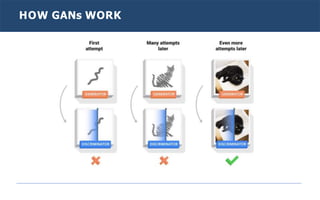
HOW GANs WORK
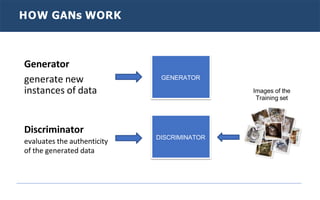
Generator
generate new
instances of data
Discriminator
evaluates the authenticity
of the generated data
GENERATOR
DISCRIMINATOR
Images of the
Training set
STEPS OF A GAN
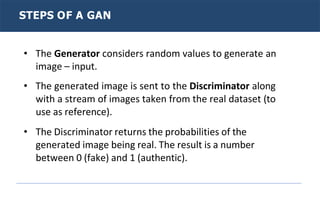
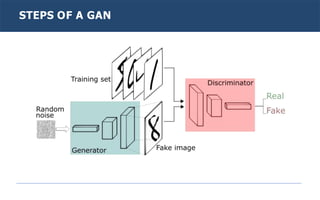
• The Generator considers random values to generate an
image – input.
• The generated image is sent to the Discriminator along
with a stream of images taken from the real dataset (to
use as reference).
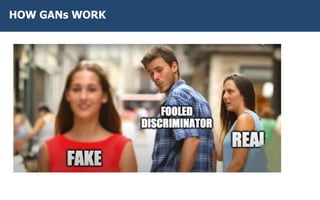
• The Discriminator returns the probabilities of the
generated image being real. The result is a number
between 0 (fake) and 1 (authentic).
STEPS OF A GAN
HOW GANs WORK
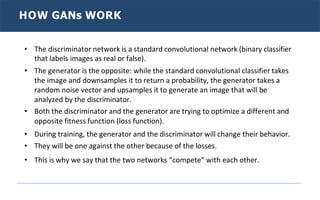
• The discriminator network is a standard convolutional network (binary classifier
that labels images as real or false).
• The generator is the opposite: while the standard convolutional classifier takes
the image and downsamples it to return a probability, the generator takes a
random noise vector and upsamples it to generate an image that will be
analyzed by the discriminator.
• Both the discriminator and the generator are trying to optimize a different and
opposite fitness function (loss function).
• During training, the generator and the discriminator will change their behavior.
• They will be one against the other because of the losses.
• This is why we say that the two networks “compete” with each other.
HOW GANs WORK
GENERATOR
NETWORK
DISCRIMINATOR
NETWORK
TRAINING DISCRIMINATOR
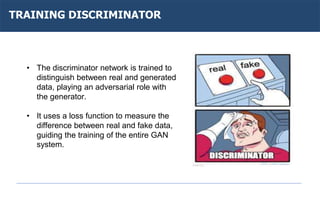
• The discriminator network is trained to
distinguish between real and generated
data, playing an adversarial role with
the generator.
• It uses a loss function to measure the
difference between real and fake data,
guiding the training of the entire GAN
system.
TRAINING GENERATOR
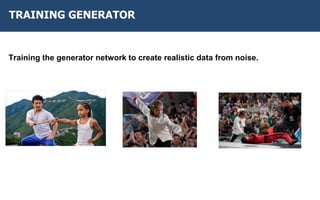
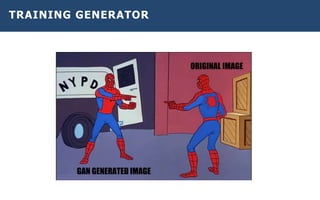
Training the generator network to create realistic data from noise.
TRAINING GENERATOR
HOW GANs WORK
HOW GANs WORK
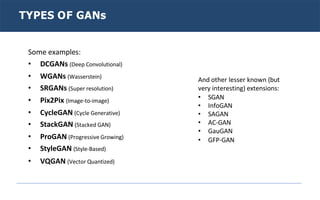
TYPES OF GANs
Some examples:
• DCGANs (Deep Convolutional)
• WGANs (Wasserstein)
• SRGANs (Super resolution)
• Pix2Pix (Image-to-image)
• CycleGAN (Cycle Generative)
• StackGAN (Stacked GAN)
• ProGAN (Progressive Growing)
• StyleGAN (Style-Based)
• VQGAN (Vector Quantized)
And other lesser known (but
very interesting) extensions:
• SGAN
• InfoGAN
• SAGAN
• AC-GAN
• GauGAN
• GFP-GAN
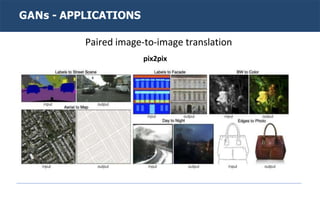
GANs - APPLICATIONS
Paired image-to-image translation
pix2pix
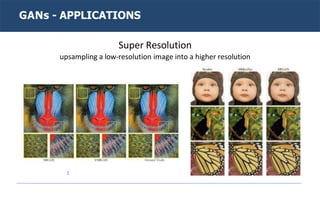
GANs - APPLICATIONS
Super Resolution
upsampling a low-resolution image into a higher resolution
r
GANs - APPLICATIONS
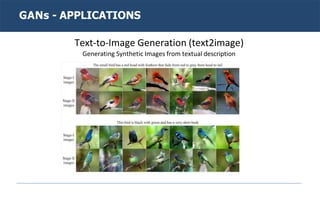
Text-to-Image Generation (text2image)
Generating Synthetic Images from textual description
GANs - APPLICATIONS
Facial rejuvenation and aging
(and other facial operations such as adding a beard, changing facial expression, etc.)
GANs - APPLICATIONS
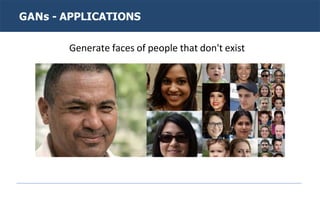
Generate faces of people that don't exist
GANs - APPLICATIONS
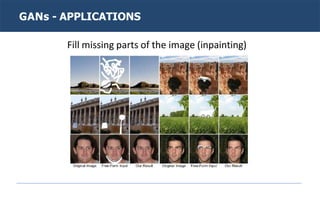
Fill missing parts of the image (inpainting)
GANs - APPLICATIONS
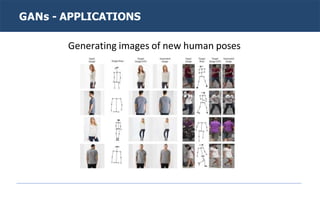
Generating images of new human poses
GANs - APPLICATIONS
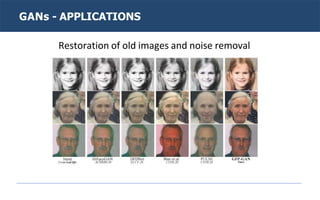
Restoration of old images and noise removal
Conclusion and Future Directions
Progress - Continued advancements in GAN technology.
Research - Exploring new applications and improvements.
Integration - Integrating GAN into various fields and industries.

Generative Adversarial Network (GANs).

  • 1.
  • 2.
    • GANs -Generative Adversarial Networks • Introduced by Ian Goodfellow and other researchers from the University of Montreal in 2014 WHAT ARE GANs? • It is a neural network that belongs to the set of generative AI • They are capable of generating new content that has never been generated before • GANS fall under the category of Unsupervised Learning • It can be applied to various domains such as images, music, speech, and writing • The architecture consists of two neural networks: the Generator and the Discriminator
  • 3.
    THE EVOLUTION OFGANs • It was a major breakthrough in the field of Deep Learning and Artificial Neural Networks. • Since its publication, it has remained one of the most popular and relevant topics within the field of Artificial Intelligence and Deep Learning. • It caused a significant advancement as until then other technologies were not achieving satisfactory results. • GANs came as a revolution, being the first to produce high-quality results on most of the datasets they were trained on.
  • 4.
    CONVOLUTIONAL NEURAL NETWORK(CNN) • To understand GANs first we must have little understanding of Convolutional Neural Networks. • CNNs are trained to classify images with respect to their labels if an image is fed to a CNN, it analyzes the image pixel by pixel and is passed through nodes present in CNN's hidden layers and as an output, it tells what the image is about or what it sees in the image. • For example: If a CNN is trained to classify dogs and cats and an image is fed to this CNN, it can tell whether there is a dog or a cat in that image. Therefore it can also be called as a classification algorithm
  • 5.
    HOW GANs WORK Generator generatenew instances of data Discriminator evaluates the authenticity of the generated data GENERATOR DISCRIMINATOR Images of the Training set
  • 6.
    STEPS OF AGAN • The Generator considers random values to generate an image – input. • The generated image is sent to the Discriminator along with a stream of images taken from the real dataset (to use as reference). • The Discriminator returns the probabilities of the generated image being real. The result is a number between 0 (fake) and 1 (authentic).
  • 7.
  • 8.
    HOW GANs WORK •The discriminator network is a standard convolutional network (binary classifier that labels images as real or false). • The generator is the opposite: while the standard convolutional classifier takes the image and downsamples it to return a probability, the generator takes a random noise vector and upsamples it to generate an image that will be analyzed by the discriminator. • Both the discriminator and the generator are trying to optimize a different and opposite fitness function (loss function). • During training, the generator and the discriminator will change their behavior. • They will be one against the other because of the losses. • This is why we say that the two networks “compete” with each other.
  • 9.
  • 10.
    TRAINING DISCRIMINATOR • Thediscriminator network is trained to distinguish between real and generated data, playing an adversarial role with the generator. • It uses a loss function to measure the difference between real and fake data, guiding the training of the entire GAN system.
  • 11.
    TRAINING GENERATOR Training thegenerator network to create realistic data from noise.
  • 12.
  • 13.
  • 14.
  • 15.
    TYPES OF GANs Someexamples: • DCGANs (Deep Convolutional) • WGANs (Wasserstein) • SRGANs (Super resolution) • Pix2Pix (Image-to-image) • CycleGAN (Cycle Generative) • StackGAN (Stacked GAN) • ProGAN (Progressive Growing) • StyleGAN (Style-Based) • VQGAN (Vector Quantized) And other lesser known (but very interesting) extensions: • SGAN • InfoGAN • SAGAN • AC-GAN • GauGAN • GFP-GAN
  • 16.
    GANs - APPLICATIONS Pairedimage-to-image translation pix2pix
  • 17.
    GANs - APPLICATIONS SuperResolution upsampling a low-resolution image into a higher resolution r
  • 18.
    GANs - APPLICATIONS Text-to-ImageGeneration (text2image) Generating Synthetic Images from textual description
  • 19.
    GANs - APPLICATIONS Facialrejuvenation and aging (and other facial operations such as adding a beard, changing facial expression, etc.)
  • 20.
    GANs - APPLICATIONS Generatefaces of people that don't exist
  • 21.
    GANs - APPLICATIONS Fillmissing parts of the image (inpainting)
  • 22.
    GANs - APPLICATIONS Generatingimages of new human poses
  • 23.
    GANs - APPLICATIONS Restorationof old images and noise removal
  • 24.
    Conclusion and FutureDirections Progress - Continued advancements in GAN technology. Research - Exploring new applications and improvements. Integration - Integrating GAN into various fields and industries.