GAN - Theory and Applications
Emanuele Ghelfi @manughelfi
Paolo Galeone @paolo_galeone
Federico Di Mattia @_iLeW_
Michele De Simoni @mr_ubik
https://bit.ly/2Y1nqay
May 4, 2019
1
Overview
1. Introduction
2. Models definition
3. GANs Training
4. Types of GANs
5. GANs Applications
3
Introduction
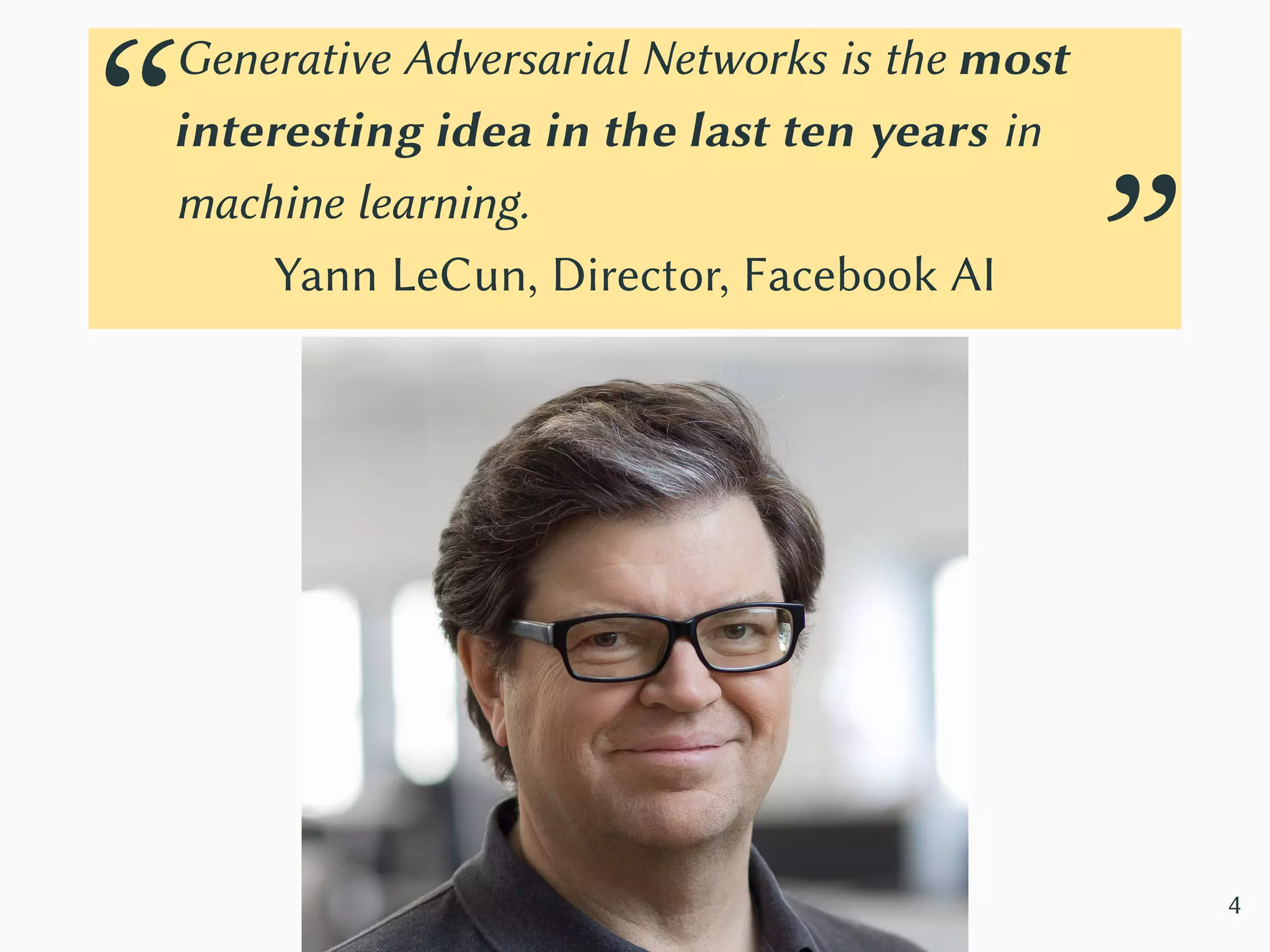
“
Generative Adversarial Networks is the most
interesting idea in the last ten years in
machine learning.
Yann LeCun, Director, Facebook AI
”
4
Generative Adversarial Networks
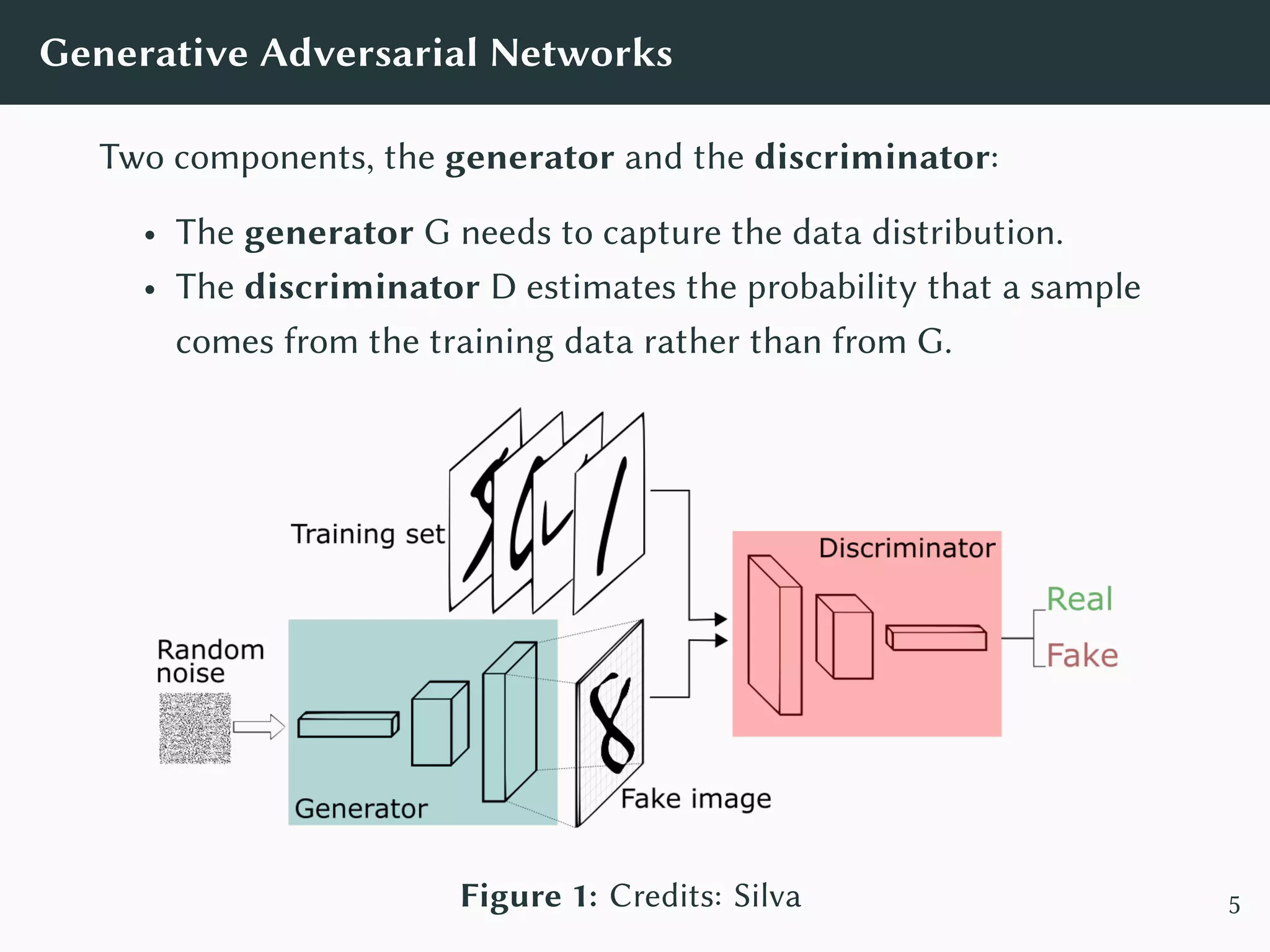
Two components, the generator and the discriminator:
• The generator G needs to capture the data distribution.
• The discriminator D estimates the probability that a sample
comes from the training data rather than from G.
Figure 1: Credits: Silva 5
Generative Adversarial Networks
GANs game:
min
G
max
D
VGAN(D, G) = E
x∼pdata(x)
[log D(x)] + E
z∼pz(z)
[log(1 − D(G(z)))]
6
Generative Adversarial Networks
GANs game:
min
G
max
D
VGAN(D, G) = E
x∼pdata(x)
[log D(x)]
real samples
+ E
z∼pz(z)
[log(1 − D(G(z)))]
6
Generative Adversarial Networks
GANs game:
min
G
max
D
VGAN(D, G) = E
x∼pdata(x)
[log D(x)]
real samples
+ E
z∼pz(z)
[log(1 − D(G(z)))]
generated samples
6
GANs - Discriminator
• Discriminator needs to:
• Correctly classify real data:
max
D
E
x∼pdata(x)
[log D(x)] D(x) → 1
• Correctly classify wrong data:
max
D
E
z∼pz(z)
[log(1 − D(G(z)))] D(G(z)) → 0
• The discriminator is an adaptive loss function.
7
GANs - Generator
• Generator needs to fool the discriminator:
• Generate samples similar to the real ones:
min
G
E
z∼pz(z)
[log(1 − D(G(z)))] D(G(z)) → 1
9
GANs - Generator
• Generator needs to fool the discriminator:
• Generate samples similar to the real ones:
min
G
E
z∼pz(z)
[log(1 − D(G(z)))] D(G(z)) → 1
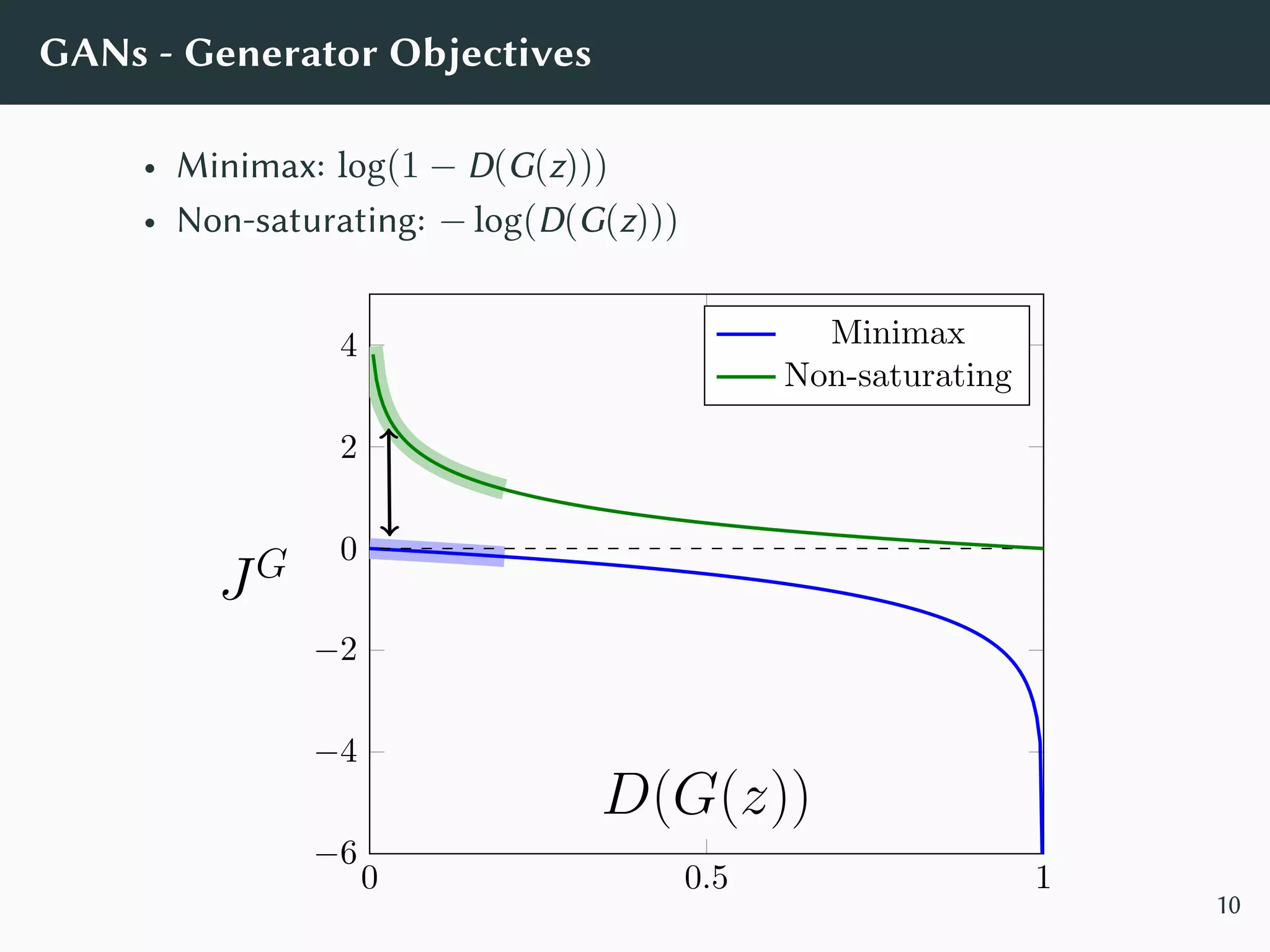
• Non saturating objective (Goodfellow et al., 2014):
min
G
E
z∼pz(z)
[− log(D(G(z)))]
9
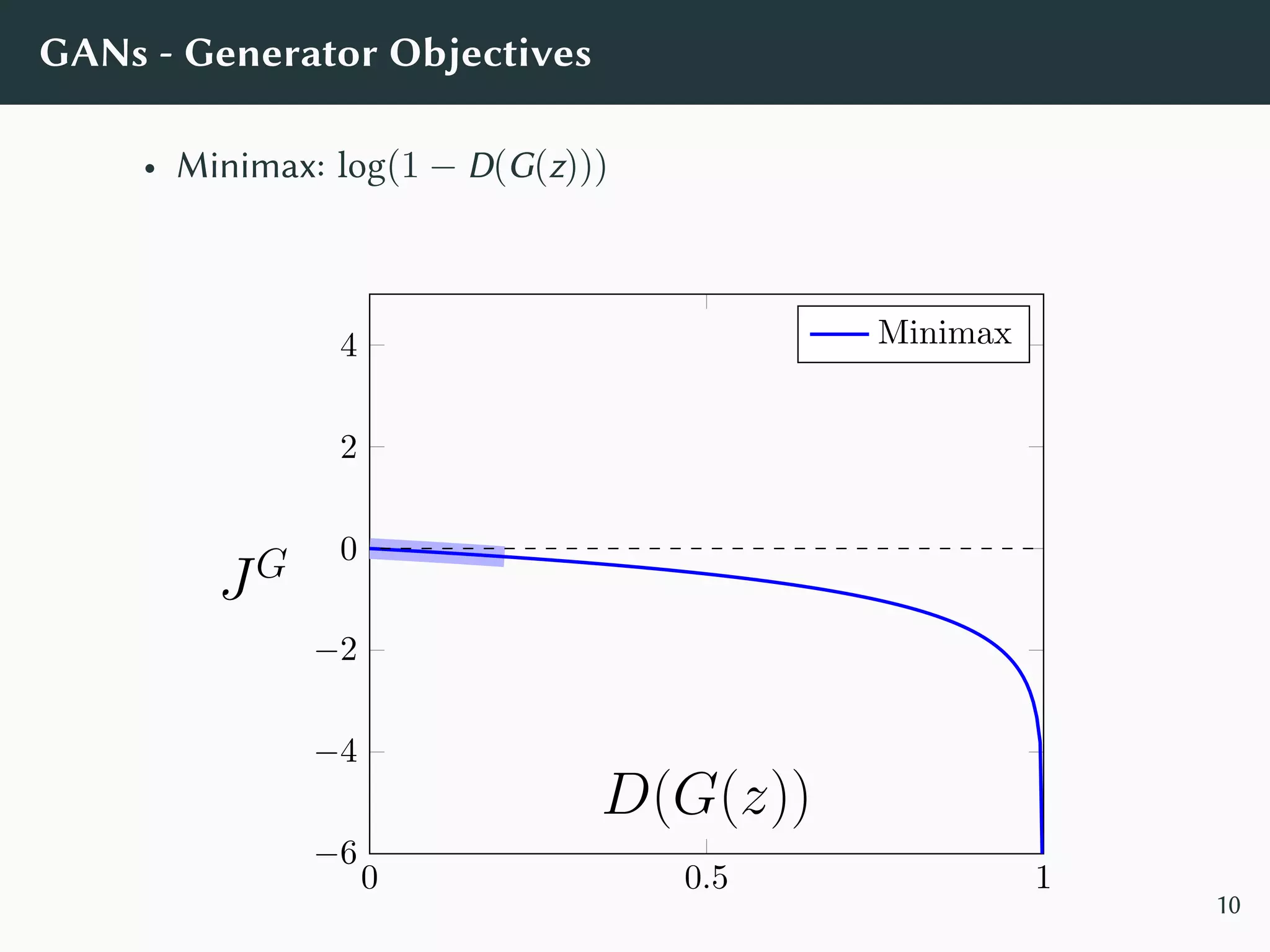
GANs - Generator Objectives
• Minimax: log(1 − D(G(z)))
0 0.5 1
−6
−4
−2
0
2
4
D(G(z))
JG
Minimax
10
GANs - Generator Objectives
• Minimax: log(1 − D(G(z)))
• Non-saturating: − log(D(G(z)))
0 0.5 1
−6
−4
−2
0
2
4
D(G(z))
JG
Minimax
Non-saturating
10
Models definition
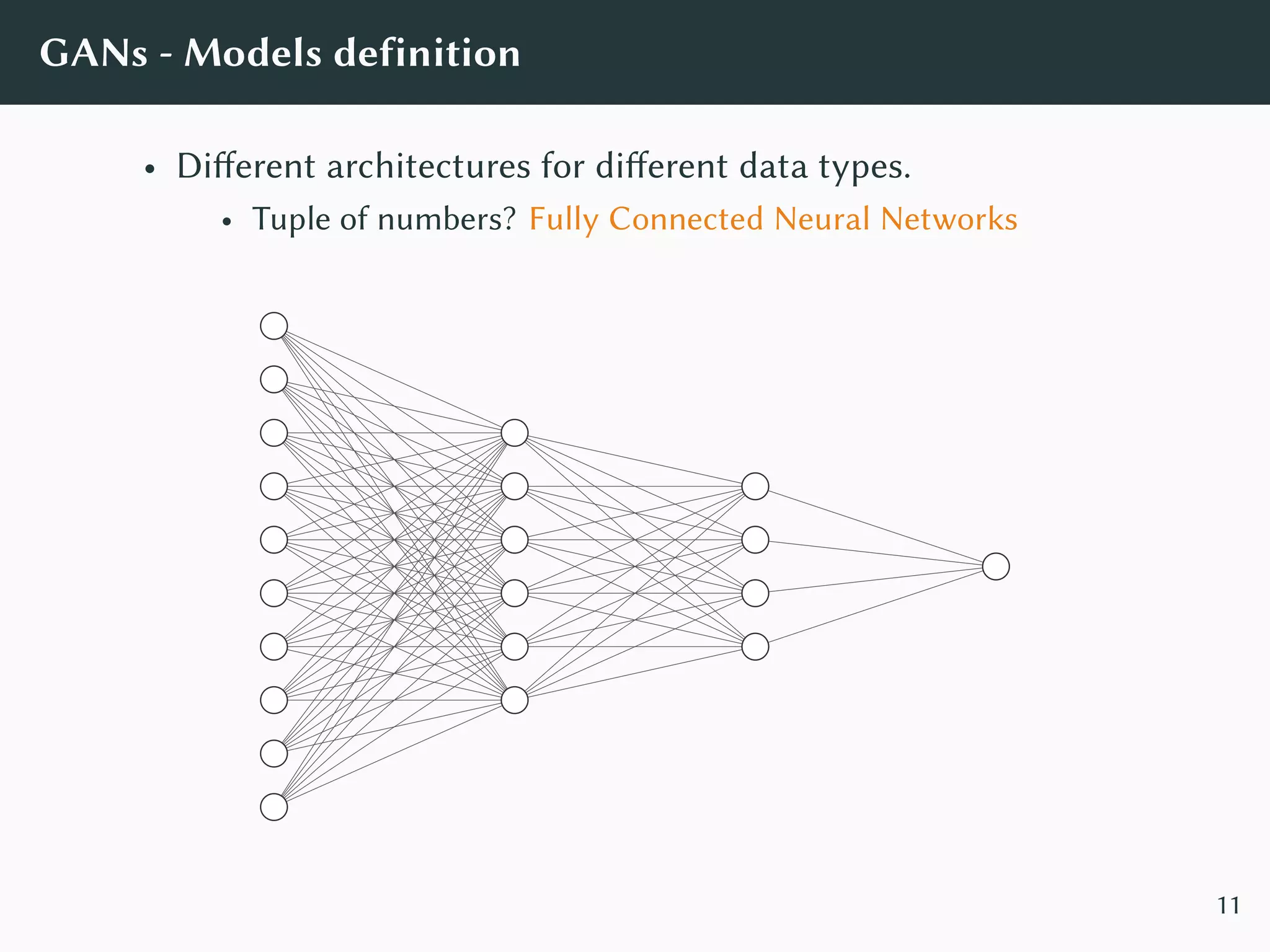
GANs - Models definition
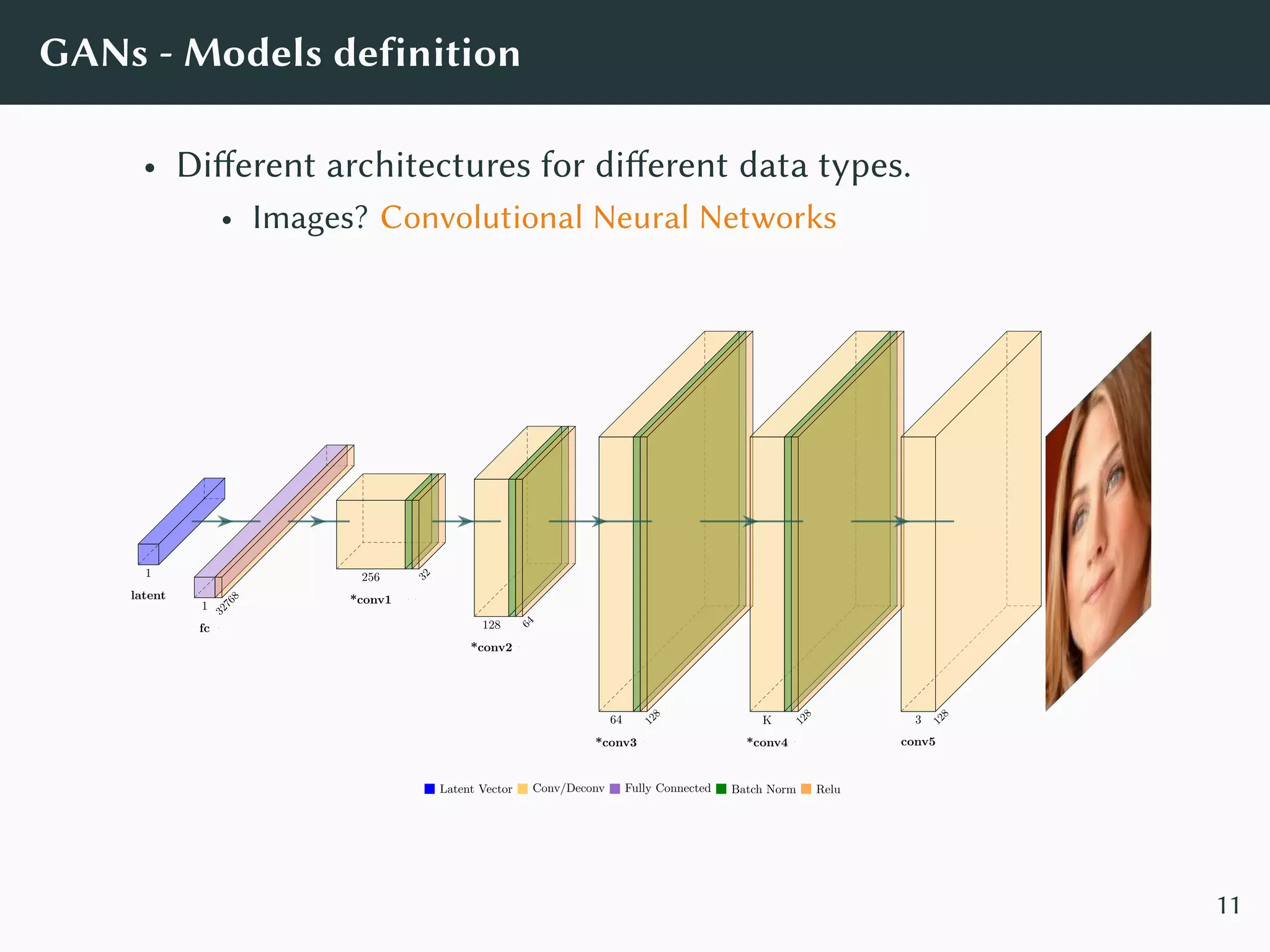
• Different architectures for different data types.
• Tuple of numbers? Fully Connected Neural Networks
11
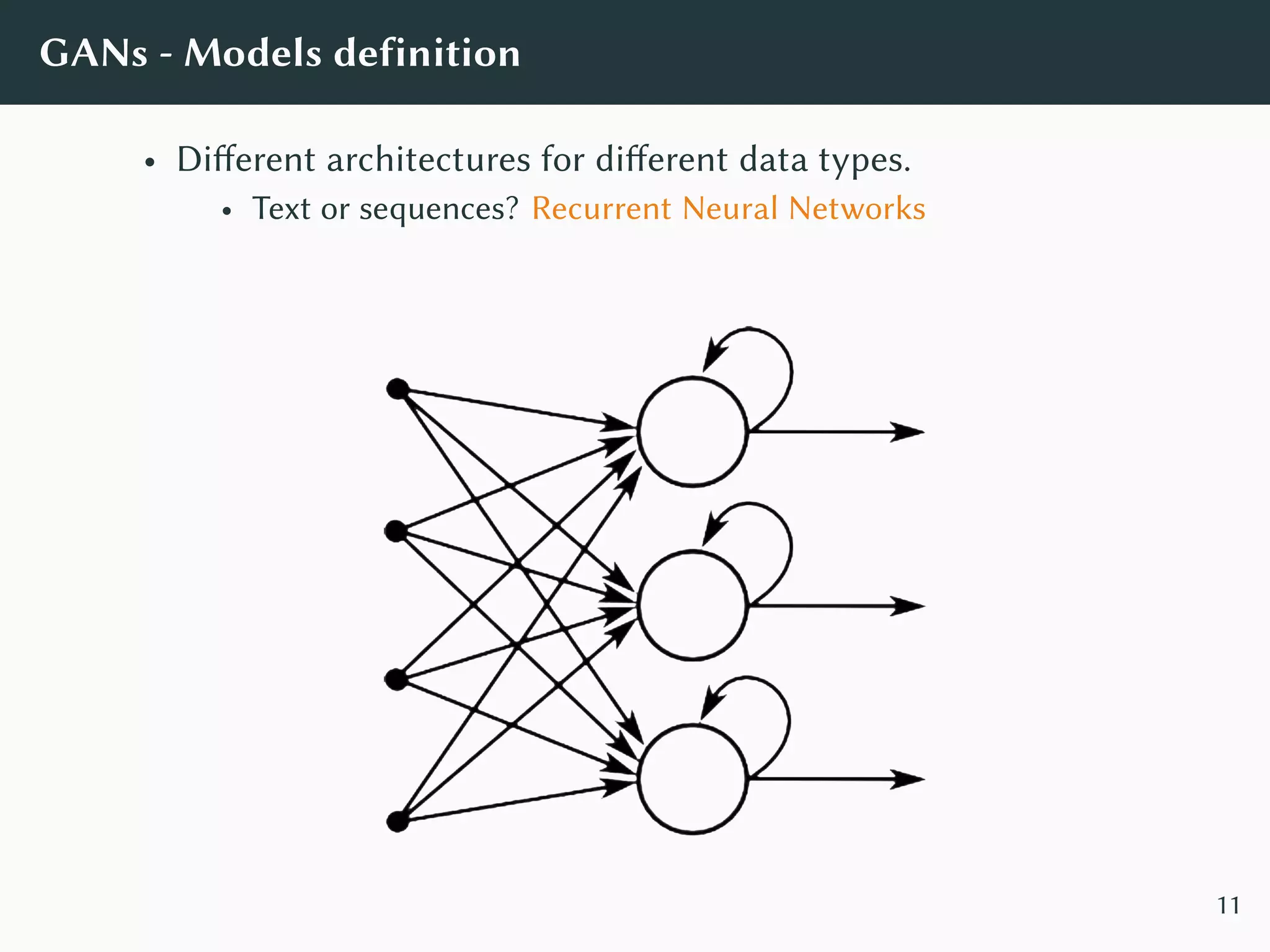
GANs - Models definition
• Different architectures for different data types.
• Text or sequences? Recurrent Neural Networks
11
GANs - Models definition
• Different architectures for different data types.
• Images? Convolutional Neural Networks
1
latent
1
fc
32768
256
*conv1
32
128
*conv2
64
64
*conv3
128
K
*conv4
128
3 128
conv5
Latent Vector Conv/Deconv Fully Connected Batch Norm Relu
11
GANs Training
GANs - Training
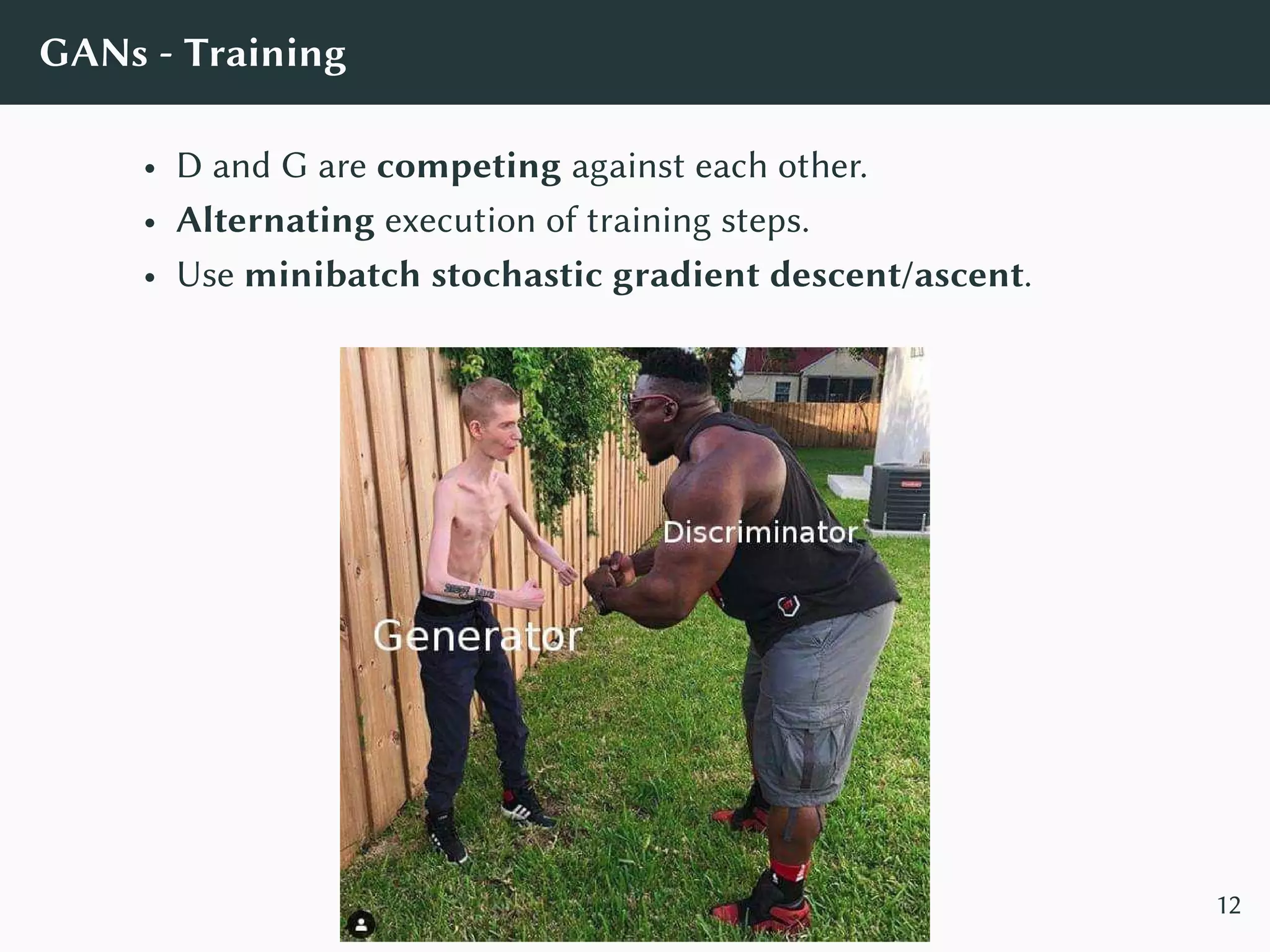
• D and G are competing against each other.
• Alternating execution of training steps.
• Use minibatch stochastic gradient descent/ascent.
12
GANs - Training - Discriminator
How to train the discriminator?
Repeat from 1 to k:
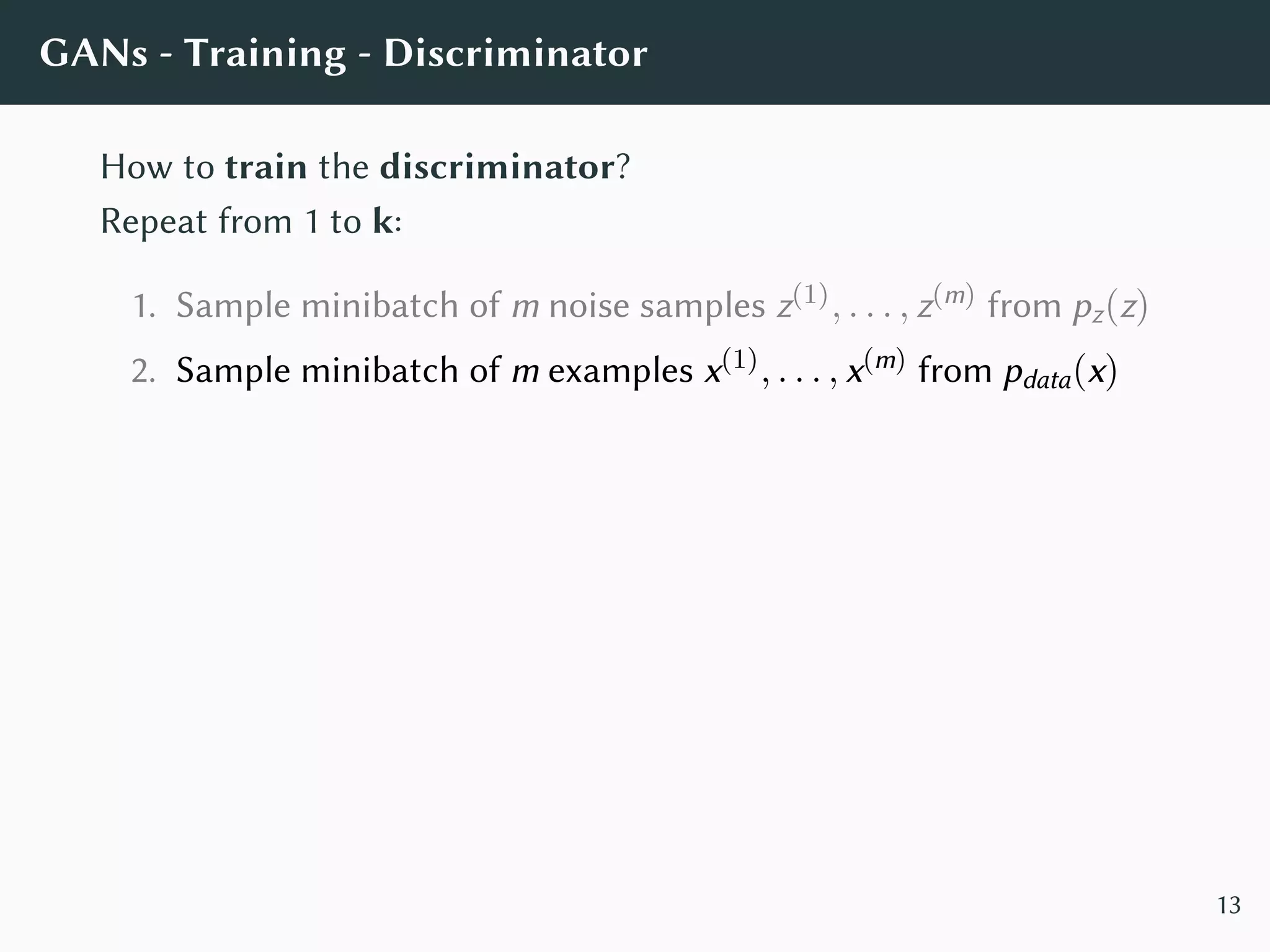
1. Sample minibatch of m noise samples z(1), . . . , z(m) from pz(z)
13
GANs - Training - Discriminator
How to train the discriminator?
Repeat from 1 to k:
1. Sample minibatch of m noise samples z(1), . . . , z(m) from pz(z)
2. Sample minibatch of m examples x(1), . . . , x(m) from pdata(x)
13
GANs - Training - Discriminator
How to train the discriminator?
Repeat from 1 to k:
1. Sample minibatch of m noise samples z(1), . . . , z(m) from pz(z)
2. Sample minibatch of m examples x(1), . . . , x(m) from pdata(x)
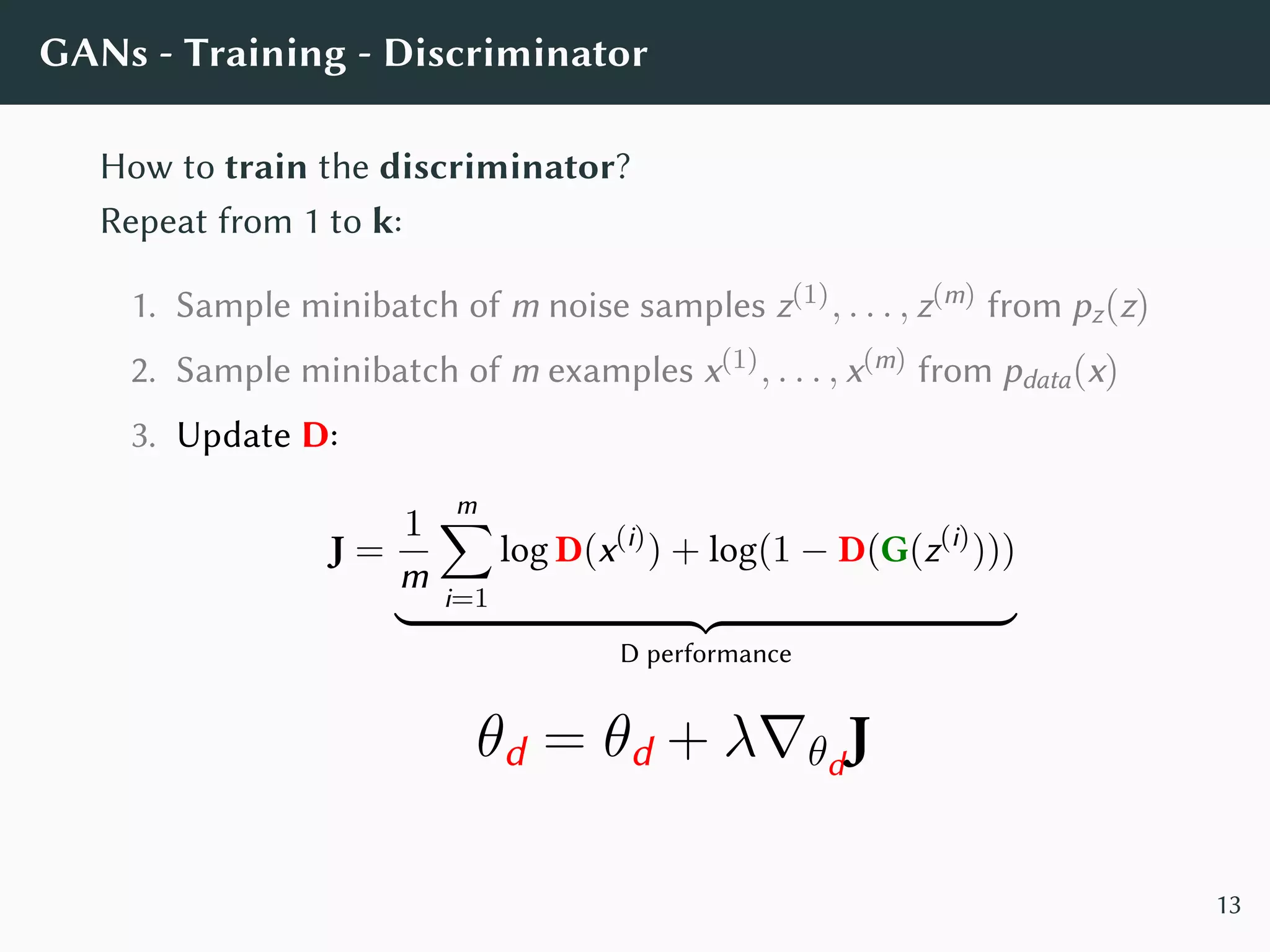
3. Update D:
J =
1
m
m∑
i=1
log D(x(i)
) + log(1 − D(G(z(i)
)))
D performance
θd = θd + λ∇θd
J
13
GANs - Training - Generator
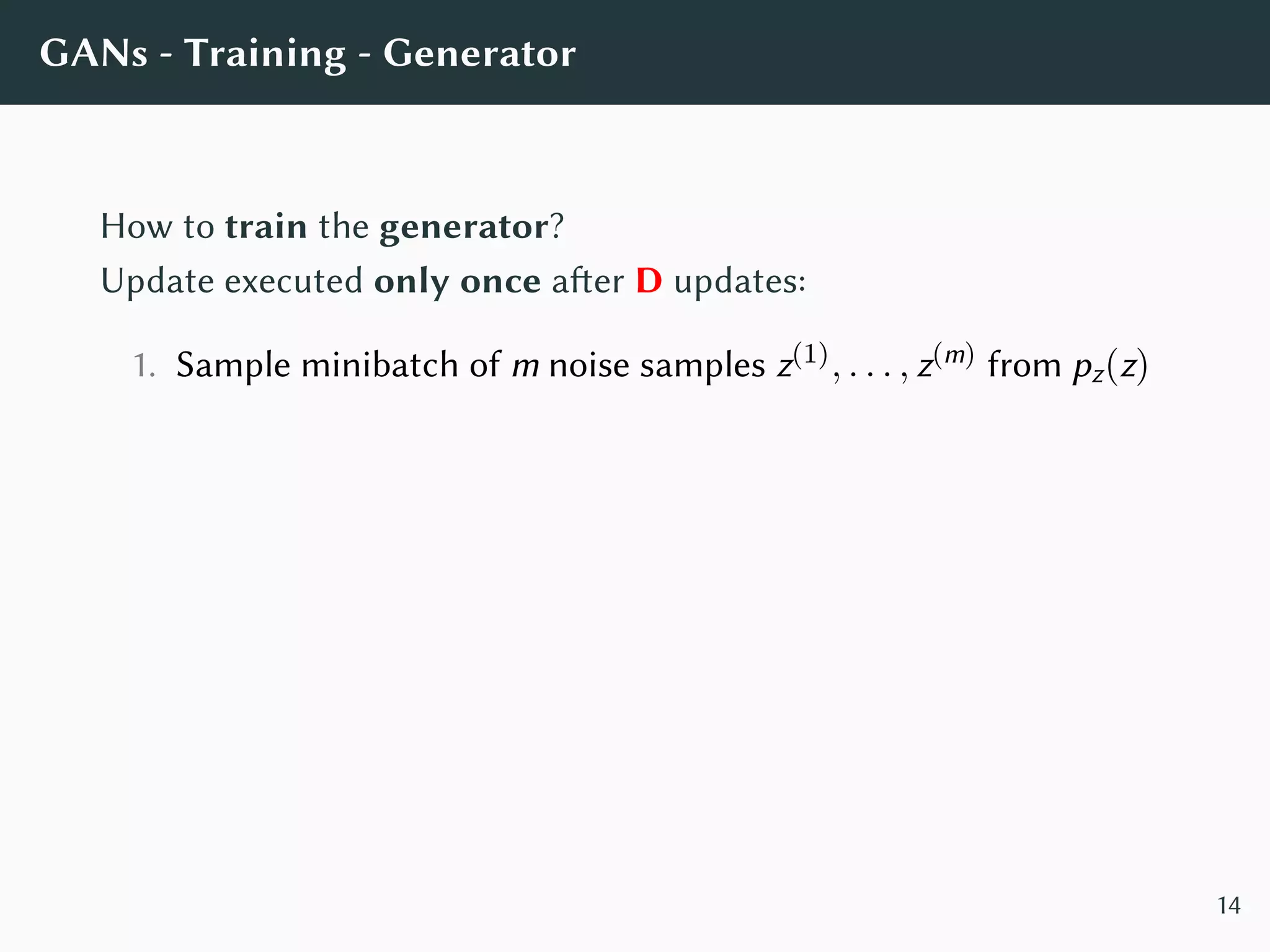
How to train the generator?
Update executed only once after D updates:
1. Sample minibatch of m noise samples z(1), . . . , z(m) from pz(z)
14
GANs - Training - Generator
How to train the generator?
Update executed only once after D updates:
1. Sample minibatch of m noise samples z(1), . . . , z(m) from pz(z)
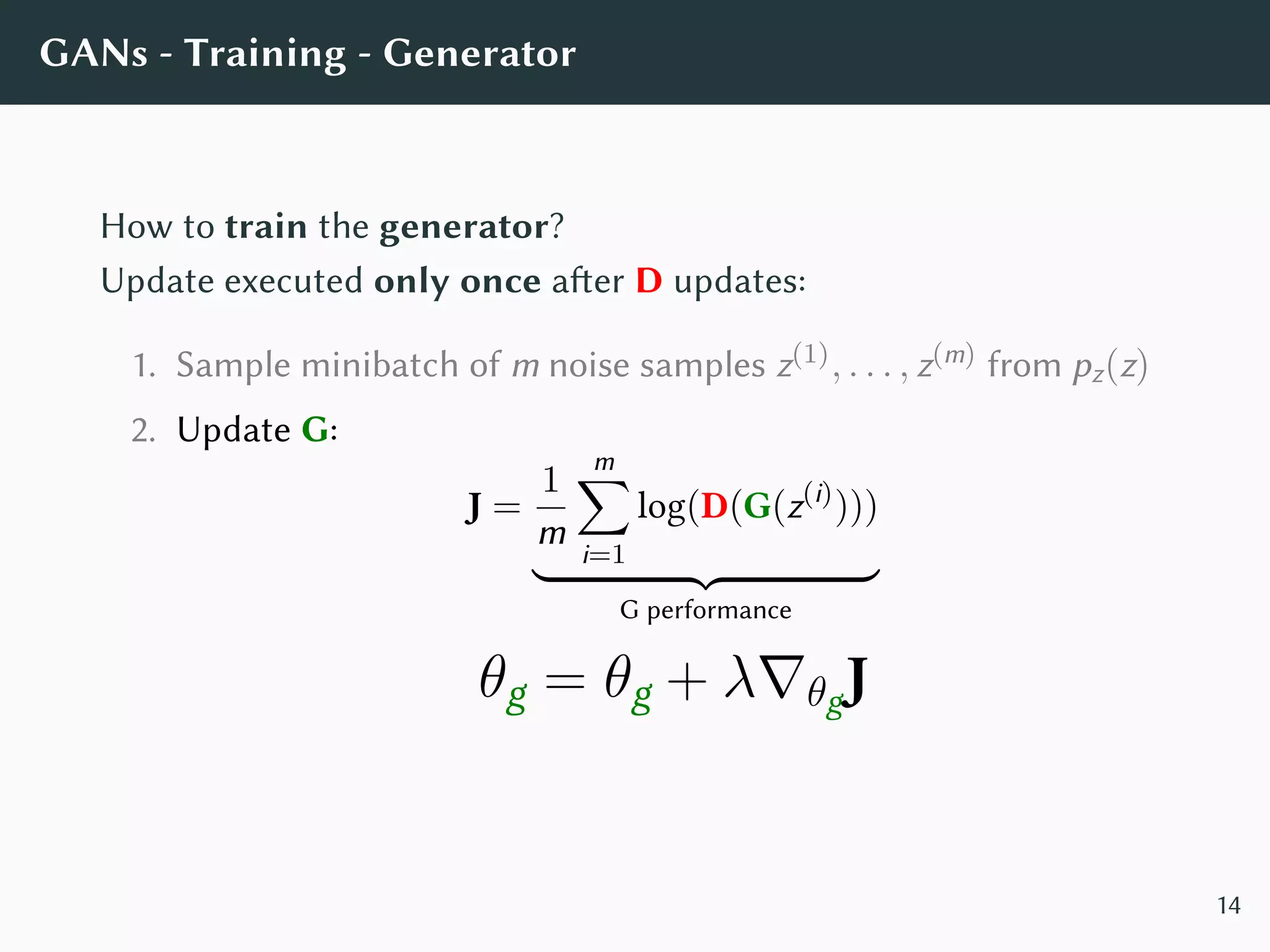
2. Update G:
J =
1
m
m∑
i=1
log(D(G(z(i)
)))
G performance
θg = θg + λ∇θgJ
14
GANs - Training - Considerations
• Optimizers: Adam, Momentum, RMSProp.
• Arbitrary number of steps or epochs.
• Training is completed when D is completely fooled by G.
• Goal: reach a Nash Equilibrium where the best D can do is
random guessing.
15
Types of GANs
Types of GANs
Two big families:
• Unconditional GANs (just described).
• Conditional GANs (Mirza and Osindero, 2014).
16
Conditional GANs
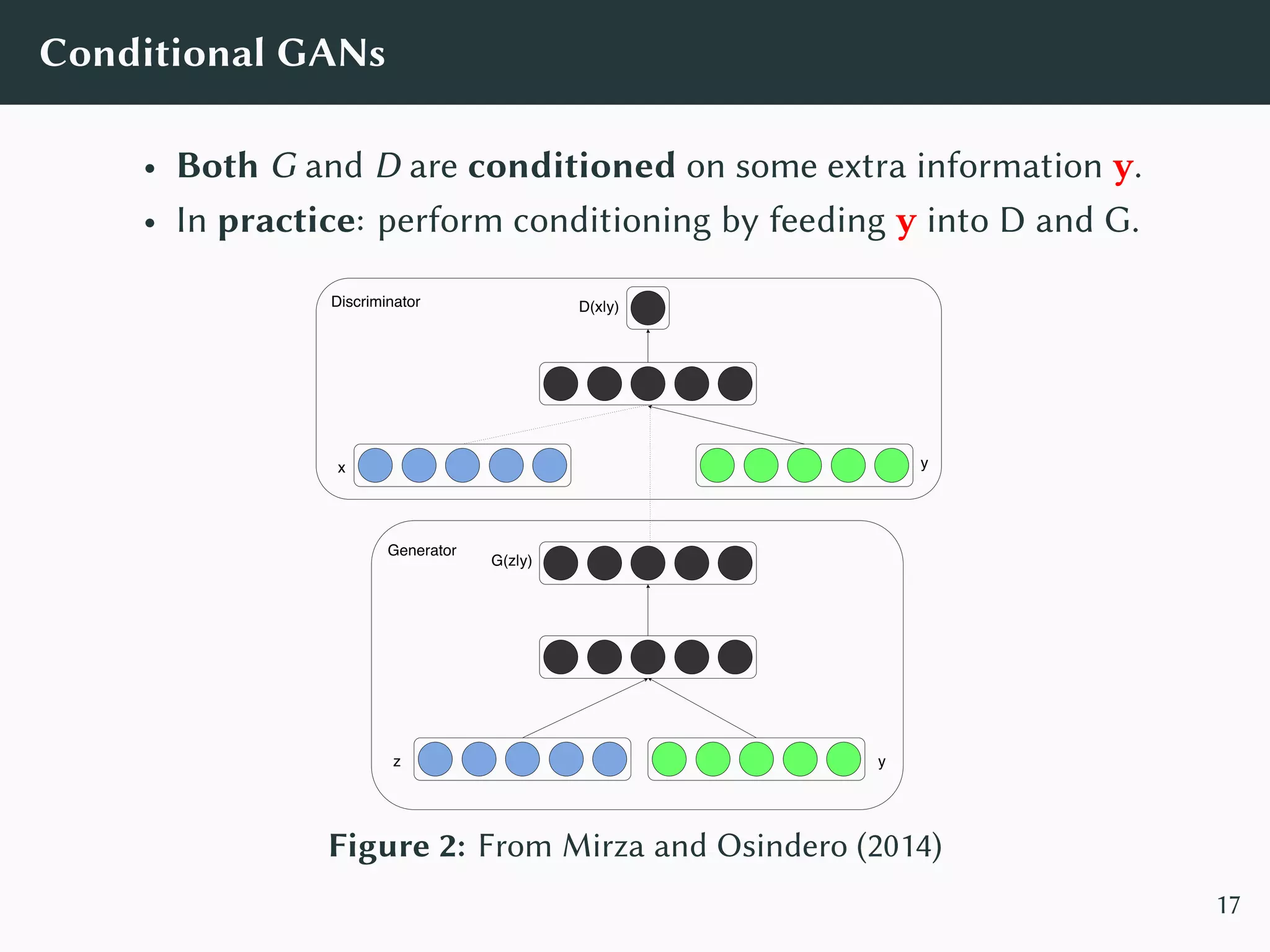
• Both G and D are conditioned on some extra information y.
• In practice: perform conditioning by feeding y into D and G.
Figure 2: From Mirza and Osindero (2014)
17
Conditional GANs
The GANs game becomes:
min
G
max
D
E
x∼pdata(x|y)
[log D(x, y)] + E
z∼pz(z)
[log(1 − D(G(z|y), y))]
Notice: the same representation of the condition has to be
presented to both network.
18
GANs Applications
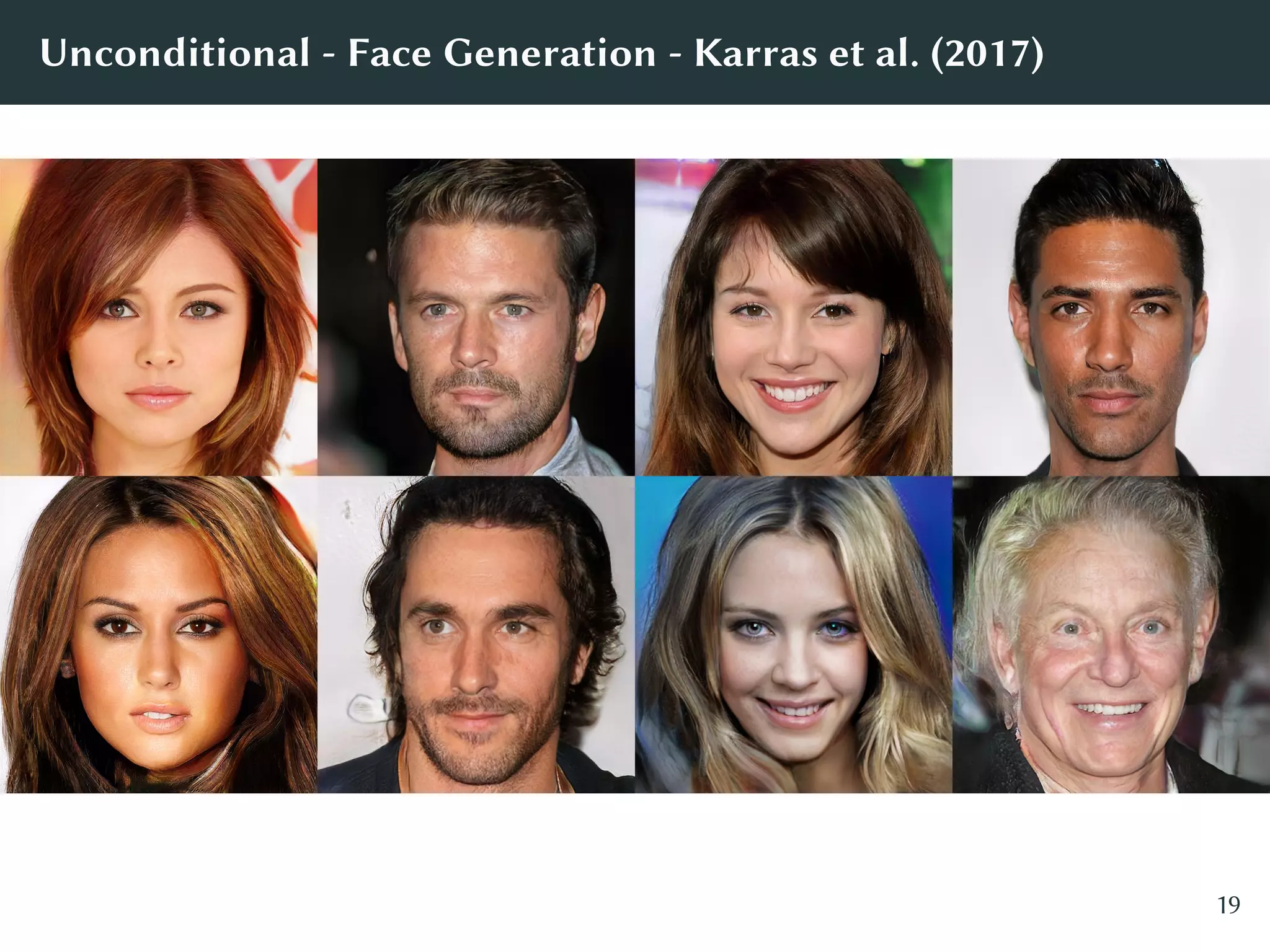
Unconditional - Face Generation - Karras et al. (2017)
19
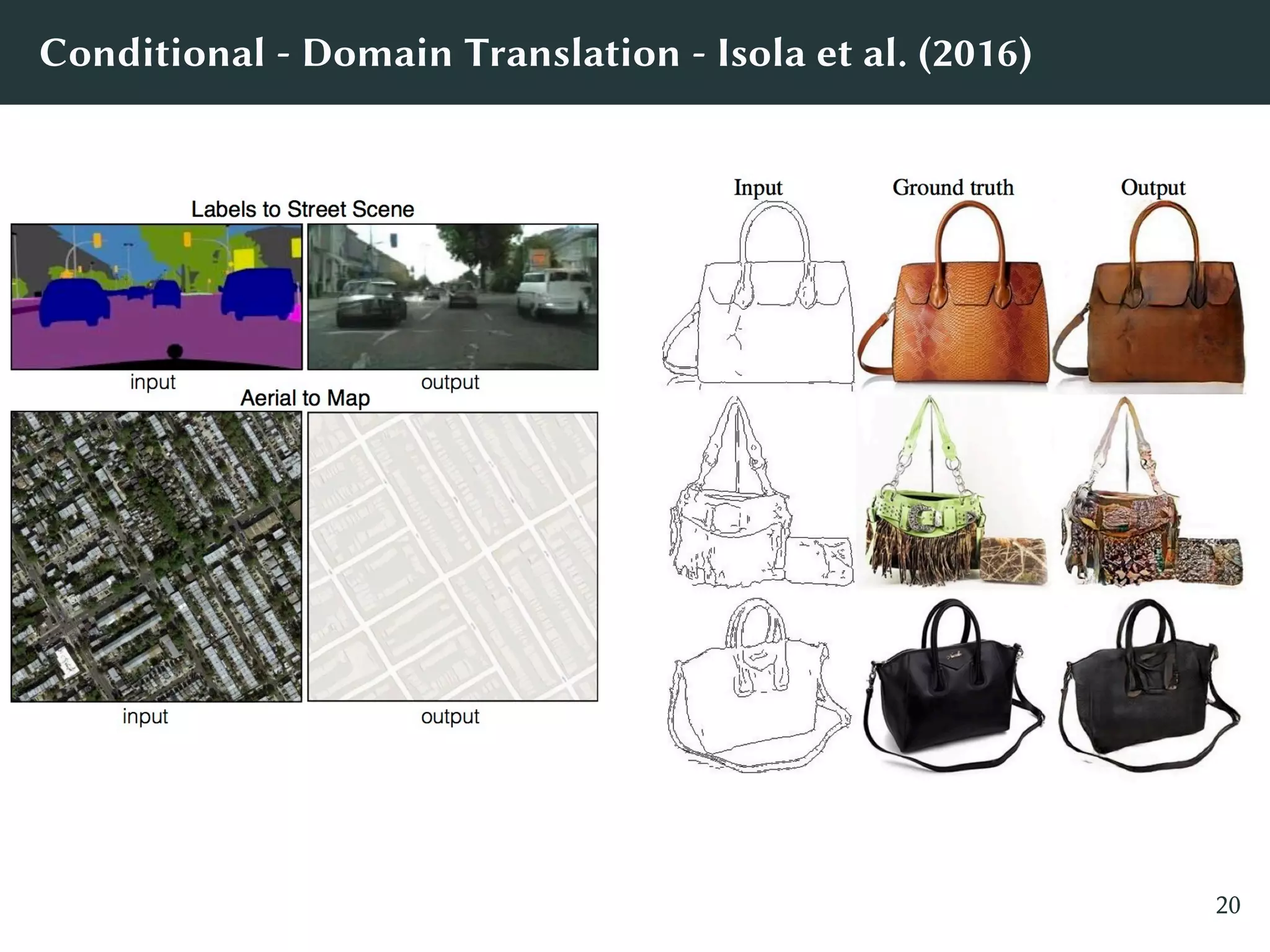
Conditional - Domain Translation - Isola et al. (2016)
20
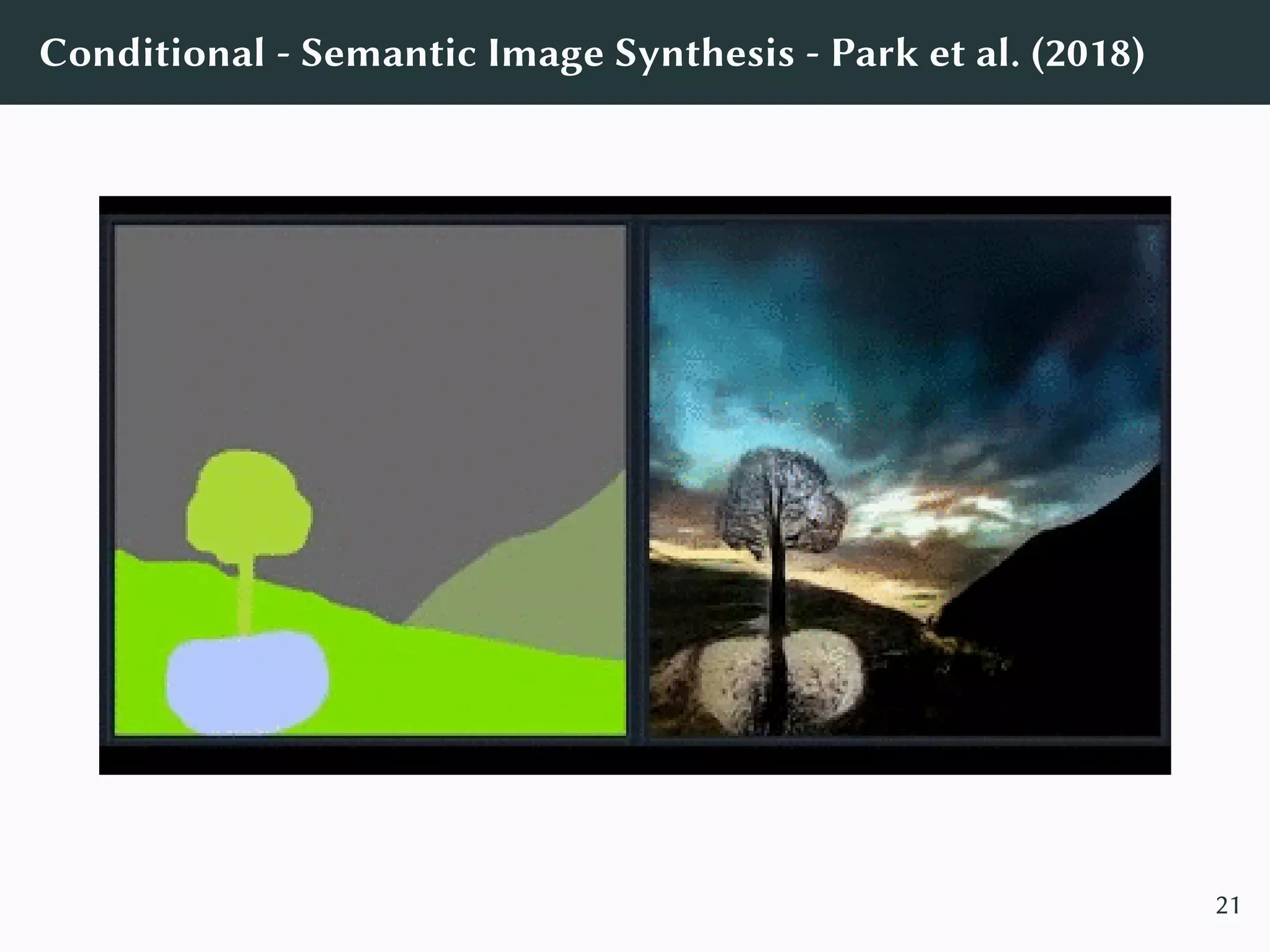
Conditional - Semantic Image Synthesis - Park et al. (2018)
21
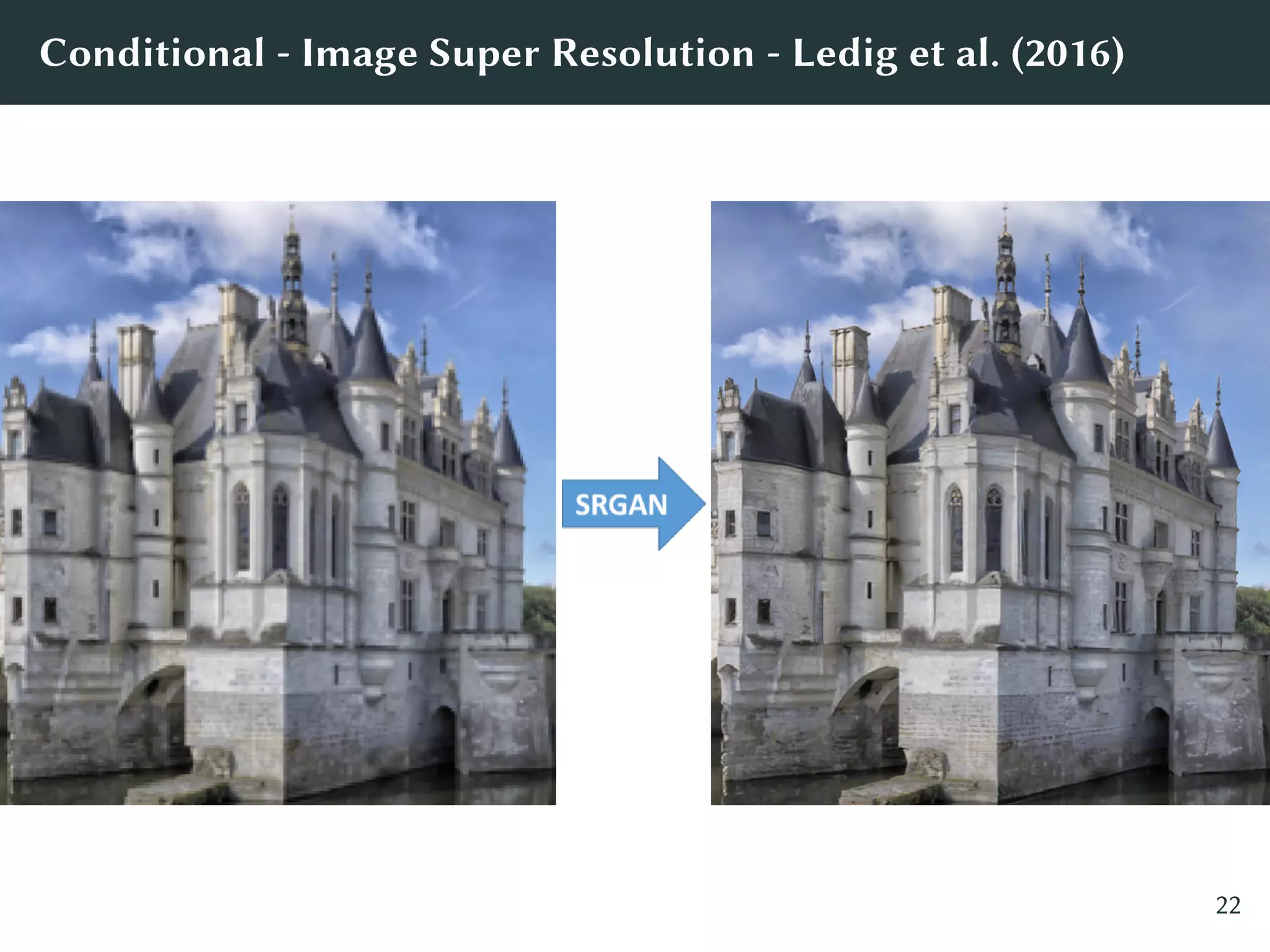
Conditional - Image Super Resolution - Ledig et al. (2016)
22
Real-world GANs
• Semi-Supervised Learning (Salimans et al., 2016)
• Image Generation (almost all GAN papers)
• Image Captioning
• Anomalies Detection (Zenati et al., 2018)
• Program Synthesis (Ganin et al., 2018)
• Genomics and Proteomics (Killoran et al., 2017) (De Cao and
Kipf, 2018)
• Personalized GANufactoring (Hwang et al., 2018)
• Planning
References
[De Cao and Kipf 2018] De Cao, Nicola ; Kipf, Thomas: MolGAN:
An Implicit Generative Model for Small Molecular Graphs.
(2018). – (2018)
[Ganin et al. 2018] Ganin, Yaroslav ; Kulkarni, Tejas ; Babuschkin,
Igor ; Eslami, S. M. A. ; Vinyals, Oriol: Synthesizing Programs for
Images Using Reinforced Adversarial Learning. (2018). – (2018)
[Goodfellow et al. 2014] Goodfellow, Ian J. ; Pouget-Abadie,
Jean ; Mirza, Mehdi ; Xu, Bing ; Warde-Farley, David ; Ozair,
Sherjil ; Courville, Aaron ; Bengio, Yoshua: Generative
Adversarial Networks. (2014). – (2014)
[Hwang et al. 2018] Hwang, Jyh-Jing ; Azernikov, Sergei ; Efros,
Alexei A. ; Yu, Stella X.: Learning Beyond Human Expertise with
Generative Models for Dental Restorations. (2018). – (2018)
[Isola et al. 2016] Isola, Phillip ; Zhu, Jun-Yan ; Zhou, Tinghui ;
Efros, Alexei A.: Image-to-Image Translation with Conditional
Adversarial Networks. (2016). – (2016)
[Karras et al. 2017] Karras, Tero ; Aila, Timo ; Laine, Samuli ;
Lehtinen, Jaakko: Progressive Growing of GANs for Improved
Quality, Stability, and Variation. (2017). – (2017)
[Killoran et al. 2017] Killoran, Nathan ; Lee, Leo J. ; Delong,
Andrew ; Duvenaud, David ; Frey, Brendan J.: Generating and
Designing DNA with Deep Generative Models. (2017). – (2017)
[Ledig et al. 2016] Ledig, Christian ; Theis, Lucas ; Huszar,
Ferenc ; Caballero, Jose ; Cunningham, Andrew ; Acosta,
Alejandro ; Aitken, Andrew ; Tejani, Alykhan ; Totz, Johannes ;
Wang, Zehan ; Shi, Wenzhe: Photo-Realistic Single Image
Super-Resolution Using a Generative Adversarial Network.
(2016). – (2016)
[Mirza and Osindero 2014] Mirza, Mehdi ; Osindero, Simon:
Conditional Generative Adversarial Nets. (2014). – (2014)
[Park et al. 2018] Park, Taesung ; Liu, Ming-Yu ; Wang,
Ting-Chun ; Zhu, Jun-Yan: Semantic Image Synthesis with
Spatially-Adaptive Normalization. (2018). – (2018)
[Salimans et al. 2016] Salimans, Tim ; Goodfellow, Ian ;
Zaremba, Wojciech ; Cheung, Vicki ; Radford, Alec ; Chen, Xi:
Improved Techniques for Training GANs. (2016). – (2016)
[Silva ] Silva, Thalles: An Intuitive Introduction to Generative
Adversarial Networks (GANs)
[Zenati et al. 2018] Zenati, Houssam ; Foo, Chuan S. ; Lecouat,
Bruno ; Manek, Gaurav ; Chandrasekhar, Vijay R.: Efficient
GAN-Based Anomaly Detection. (2018). – (2018)

GAN - Theory and Applications

  • 1.
    GAN - Theoryand Applications Emanuele Ghelfi @manughelfi Paolo Galeone @paolo_galeone Federico Di Mattia @_iLeW_ Michele De Simoni @mr_ubik https://bit.ly/2Y1nqay May 4, 2019 1
  • 3.
    Overview 1. Introduction 2. Modelsdefinition 3. GANs Training 4. Types of GANs 5. GANs Applications 3
  • 4.
  • 5.
    “ Generative Adversarial Networksis the most interesting idea in the last ten years in machine learning. Yann LeCun, Director, Facebook AI ” 4
  • 6.
    Generative Adversarial Networks Twocomponents, the generator and the discriminator: • The generator G needs to capture the data distribution. • The discriminator D estimates the probability that a sample comes from the training data rather than from G. Figure 1: Credits: Silva 5
  • 7.
    Generative Adversarial Networks GANsgame: min G max D VGAN(D, G) = E x∼pdata(x) [log D(x)] + E z∼pz(z) [log(1 − D(G(z)))] 6
  • 8.
    Generative Adversarial Networks GANsgame: min G max D VGAN(D, G) = E x∼pdata(x) [log D(x)] real samples + E z∼pz(z) [log(1 − D(G(z)))] 6
  • 9.
    Generative Adversarial Networks GANsgame: min G max D VGAN(D, G) = E x∼pdata(x) [log D(x)] real samples + E z∼pz(z) [log(1 − D(G(z)))] generated samples 6
  • 10.
    GANs - Discriminator •Discriminator needs to: • Correctly classify real data: max D E x∼pdata(x) [log D(x)] D(x) → 1 • Correctly classify wrong data: max D E z∼pz(z) [log(1 − D(G(z)))] D(G(z)) → 0 • The discriminator is an adaptive loss function. 7
  • 12.
    GANs - Generator •Generator needs to fool the discriminator: • Generate samples similar to the real ones: min G E z∼pz(z) [log(1 − D(G(z)))] D(G(z)) → 1 9
  • 13.
    GANs - Generator •Generator needs to fool the discriminator: • Generate samples similar to the real ones: min G E z∼pz(z) [log(1 − D(G(z)))] D(G(z)) → 1 • Non saturating objective (Goodfellow et al., 2014): min G E z∼pz(z) [− log(D(G(z)))] 9
  • 14.
    GANs - GeneratorObjectives • Minimax: log(1 − D(G(z))) 0 0.5 1 −6 −4 −2 0 2 4 D(G(z)) JG Minimax 10
  • 15.
    GANs - GeneratorObjectives • Minimax: log(1 − D(G(z))) • Non-saturating: − log(D(G(z))) 0 0.5 1 −6 −4 −2 0 2 4 D(G(z)) JG Minimax Non-saturating 10
  • 16.
  • 17.
    GANs - Modelsdefinition • Different architectures for different data types. • Tuple of numbers? Fully Connected Neural Networks 11
  • 18.
    GANs - Modelsdefinition • Different architectures for different data types. • Text or sequences? Recurrent Neural Networks 11
  • 19.
    GANs - Modelsdefinition • Different architectures for different data types. • Images? Convolutional Neural Networks 1 latent 1 fc 32768 256 *conv1 32 128 *conv2 64 64 *conv3 128 K *conv4 128 3 128 conv5 Latent Vector Conv/Deconv Fully Connected Batch Norm Relu 11
  • 20.
  • 21.
    GANs - Training •D and G are competing against each other. • Alternating execution of training steps. • Use minibatch stochastic gradient descent/ascent. 12
  • 22.
    GANs - Training- Discriminator How to train the discriminator? Repeat from 1 to k: 1. Sample minibatch of m noise samples z(1), . . . , z(m) from pz(z) 13
  • 23.
    GANs - Training- Discriminator How to train the discriminator? Repeat from 1 to k: 1. Sample minibatch of m noise samples z(1), . . . , z(m) from pz(z) 2. Sample minibatch of m examples x(1), . . . , x(m) from pdata(x) 13
  • 24.
    GANs - Training- Discriminator How to train the discriminator? Repeat from 1 to k: 1. Sample minibatch of m noise samples z(1), . . . , z(m) from pz(z) 2. Sample minibatch of m examples x(1), . . . , x(m) from pdata(x) 3. Update D: J = 1 m m∑ i=1 log D(x(i) ) + log(1 − D(G(z(i) ))) D performance θd = θd + λ∇θd J 13
  • 25.
    GANs - Training- Generator How to train the generator? Update executed only once after D updates: 1. Sample minibatch of m noise samples z(1), . . . , z(m) from pz(z) 14
  • 26.
    GANs - Training- Generator How to train the generator? Update executed only once after D updates: 1. Sample minibatch of m noise samples z(1), . . . , z(m) from pz(z) 2. Update G: J = 1 m m∑ i=1 log(D(G(z(i) ))) G performance θg = θg + λ∇θgJ 14
  • 27.
    GANs - Training- Considerations • Optimizers: Adam, Momentum, RMSProp. • Arbitrary number of steps or epochs. • Training is completed when D is completely fooled by G. • Goal: reach a Nash Equilibrium where the best D can do is random guessing. 15
  • 28.
  • 29.
    Types of GANs Twobig families: • Unconditional GANs (just described). • Conditional GANs (Mirza and Osindero, 2014). 16
  • 30.
    Conditional GANs • BothG and D are conditioned on some extra information y. • In practice: perform conditioning by feeding y into D and G. Figure 2: From Mirza and Osindero (2014) 17
  • 31.
    Conditional GANs The GANsgame becomes: min G max D E x∼pdata(x|y) [log D(x, y)] + E z∼pz(z) [log(1 − D(G(z|y), y))] Notice: the same representation of the condition has to be presented to both network. 18
  • 32.
  • 33.
    Unconditional - FaceGeneration - Karras et al. (2017) 19
  • 34.
    Conditional - DomainTranslation - Isola et al. (2016) 20
  • 35.
    Conditional - SemanticImage Synthesis - Park et al. (2018) 21
  • 36.
    Conditional - ImageSuper Resolution - Ledig et al. (2016) 22
  • 37.
    Real-world GANs • Semi-SupervisedLearning (Salimans et al., 2016) • Image Generation (almost all GAN papers) • Image Captioning • Anomalies Detection (Zenati et al., 2018) • Program Synthesis (Ganin et al., 2018) • Genomics and Proteomics (Killoran et al., 2017) (De Cao and Kipf, 2018) • Personalized GANufactoring (Hwang et al., 2018) • Planning
  • 38.
    References [De Cao andKipf 2018] De Cao, Nicola ; Kipf, Thomas: MolGAN: An Implicit Generative Model for Small Molecular Graphs. (2018). – (2018) [Ganin et al. 2018] Ganin, Yaroslav ; Kulkarni, Tejas ; Babuschkin, Igor ; Eslami, S. M. A. ; Vinyals, Oriol: Synthesizing Programs for Images Using Reinforced Adversarial Learning. (2018). – (2018) [Goodfellow et al. 2014] Goodfellow, Ian J. ; Pouget-Abadie, Jean ; Mirza, Mehdi ; Xu, Bing ; Warde-Farley, David ; Ozair, Sherjil ; Courville, Aaron ; Bengio, Yoshua: Generative Adversarial Networks. (2014). – (2014)
  • 39.
    [Hwang et al.2018] Hwang, Jyh-Jing ; Azernikov, Sergei ; Efros, Alexei A. ; Yu, Stella X.: Learning Beyond Human Expertise with Generative Models for Dental Restorations. (2018). – (2018) [Isola et al. 2016] Isola, Phillip ; Zhu, Jun-Yan ; Zhou, Tinghui ; Efros, Alexei A.: Image-to-Image Translation with Conditional Adversarial Networks. (2016). – (2016) [Karras et al. 2017] Karras, Tero ; Aila, Timo ; Laine, Samuli ; Lehtinen, Jaakko: Progressive Growing of GANs for Improved Quality, Stability, and Variation. (2017). – (2017) [Killoran et al. 2017] Killoran, Nathan ; Lee, Leo J. ; Delong, Andrew ; Duvenaud, David ; Frey, Brendan J.: Generating and Designing DNA with Deep Generative Models. (2017). – (2017)
  • 40.
    [Ledig et al.2016] Ledig, Christian ; Theis, Lucas ; Huszar, Ferenc ; Caballero, Jose ; Cunningham, Andrew ; Acosta, Alejandro ; Aitken, Andrew ; Tejani, Alykhan ; Totz, Johannes ; Wang, Zehan ; Shi, Wenzhe: Photo-Realistic Single Image Super-Resolution Using a Generative Adversarial Network. (2016). – (2016) [Mirza and Osindero 2014] Mirza, Mehdi ; Osindero, Simon: Conditional Generative Adversarial Nets. (2014). – (2014) [Park et al. 2018] Park, Taesung ; Liu, Ming-Yu ; Wang, Ting-Chun ; Zhu, Jun-Yan: Semantic Image Synthesis with Spatially-Adaptive Normalization. (2018). – (2018) [Salimans et al. 2016] Salimans, Tim ; Goodfellow, Ian ; Zaremba, Wojciech ; Cheung, Vicki ; Radford, Alec ; Chen, Xi: Improved Techniques for Training GANs. (2016). – (2016)
  • 41.
    [Silva ] Silva,Thalles: An Intuitive Introduction to Generative Adversarial Networks (GANs) [Zenati et al. 2018] Zenati, Houssam ; Foo, Chuan S. ; Lecouat, Bruno ; Manek, Gaurav ; Chandrasekhar, Vijay R.: Efficient GAN-Based Anomaly Detection. (2018). – (2018)