Generative
Adversarial Nets
Armin shoughi
Dec 2019
Introduction
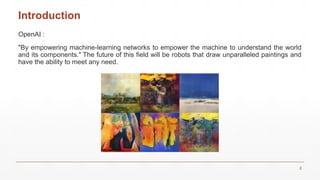
OpenAI :
"By empowering machine-learning networks to empower the machine to understand the world
and its components." The future of this field will be robots that draw unparalleled paintings and
have the ability to meet any need.
2
Introduction
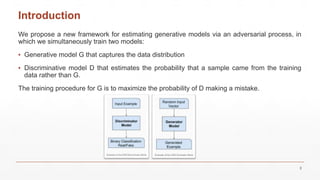
We propose a new framework for estimating generative models via an adversarial process, in
which we simultaneously train two models:
▪ Generative model G that captures the data distribution
▪ Discriminative model D that estimates the probability that a sample came from the training
data rather than G.
The training procedure for G is to maximize the probability of D making a mistake.
3
Police Example
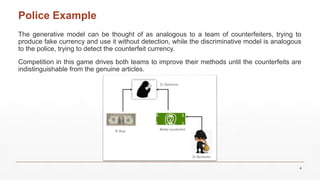
The generative model can be thought of as analogous to a team of counterfeiters, trying to
produce fake currency and use it without detection, while the discriminative model is analogous
to the police, trying to detect the counterfeit currency.
Competition in this game drives both teams to improve their methods until the counterfeits are
indistinguishable from the genuine articles.
4
Generative Adversarial VS Adversarial Examples
Generative adversarial networks has been sometimes confused with the related concept of
“adversarial examples”.
Adversarial examples are examples found by using gradient-based optimization directly on the
input to a classification network, in order to find examples that are similar to the data yet
misclassified.
This is different from the present work because adversarial examples are not a mechanism for
training a generative model. Instead, adversarial examples are primarily an analysis tool for
showing that neural networks behave in intriguing ways, often confidently classifying two
images differently with high confidence even though the difference between them is
imperceptible to a human observer.
5
Adversarial nets
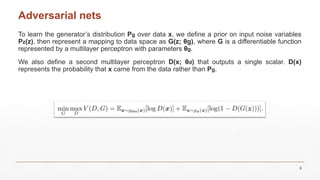
To learn the generator’s distribution Pg over data x, we define a prior on input noise variables
Pz(z), then represent a mapping to data space as G(z; θg), where G is a differentiable function
represented by a multilayer perceptron with parameters θg.
We also define a second multilayer perceptron D(x; θd) that outputs a single scalar. D(x)
represents the probability that x came from the data rather than Pg.
6
Adversarial nets
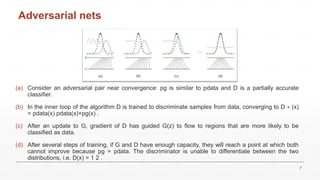
(a) Consider an adversarial pair near convergence: pg is similar to pdata and D is a partially accurate
classifier.
(b) In the inner loop of the algorithm D is trained to discriminate samples from data, converging to D ∗ (x)
= pdata(x) pdata(x)+pg(x) .
(c) After an update to G, gradient of D has guided G(z) to flow to regions that are more likely to be
classified as data.
(d) After several steps of training, if G and D have enough capacity, they will reach a point at which both
cannot improve because pg = pdata. The discriminator is unable to differentiate between the two
distributions, i.e. D(x) = 1 2 .
7
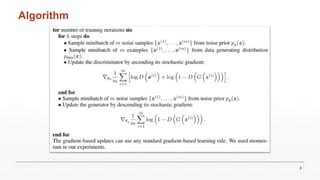
Algorithm
8
Experiments
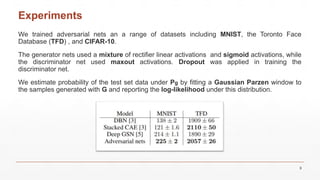
We trained adversarial nets an a range of datasets including MNIST, the Toronto Face
Database (TFD) , and CIFAR-10.
The generator nets used a mixture of rectifier linear activations and sigmoid activations, while
the discriminator net used maxout activations. Dropout was applied in training the
discriminator net.
We estimate probability of the test set data under Pg by fitting a Gaussian Parzen window to
the samples generated with G and reporting the log-likelihood under this distribution.
9
Advantages and disadvantages
This new framework comes with advantages and disadvantages relative to previous modeling
frameworks.
The disadvantages are primarily that there is no explicit representation of pg(x), and that D must
be synchronized well with G during training, much as the negative chains of a Boltzmann
machine must be kept up to date between learning steps.
The advantages are that Markov chains are never needed, only backprop is used to obtain
gradients, no inference is needed during learning, and a wide variety of functions can be
incorporated into the model.
10
Tensorflow
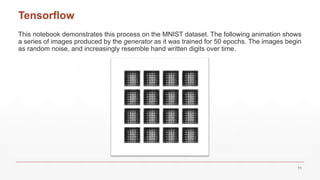
This notebook demonstrates this process on the MNIST dataset. The following animation shows
a series of images produced by the generator as it was trained for 50 epochs. The images begin
as random noise, and increasingly resemble hand written digits over time.
11

Generative Adversarial networks

  • 1.
  • 2.
    Introduction OpenAI : "By empoweringmachine-learning networks to empower the machine to understand the world and its components." The future of this field will be robots that draw unparalleled paintings and have the ability to meet any need. 2
  • 3.
    Introduction We propose anew framework for estimating generative models via an adversarial process, in which we simultaneously train two models: ▪ Generative model G that captures the data distribution ▪ Discriminative model D that estimates the probability that a sample came from the training data rather than G. The training procedure for G is to maximize the probability of D making a mistake. 3
  • 4.
    Police Example The generativemodel can be thought of as analogous to a team of counterfeiters, trying to produce fake currency and use it without detection, while the discriminative model is analogous to the police, trying to detect the counterfeit currency. Competition in this game drives both teams to improve their methods until the counterfeits are indistinguishable from the genuine articles. 4
  • 5.
    Generative Adversarial VSAdversarial Examples Generative adversarial networks has been sometimes confused with the related concept of “adversarial examples”. Adversarial examples are examples found by using gradient-based optimization directly on the input to a classification network, in order to find examples that are similar to the data yet misclassified. This is different from the present work because adversarial examples are not a mechanism for training a generative model. Instead, adversarial examples are primarily an analysis tool for showing that neural networks behave in intriguing ways, often confidently classifying two images differently with high confidence even though the difference between them is imperceptible to a human observer. 5
  • 6.
    Adversarial nets To learnthe generator’s distribution Pg over data x, we define a prior on input noise variables Pz(z), then represent a mapping to data space as G(z; θg), where G is a differentiable function represented by a multilayer perceptron with parameters θg. We also define a second multilayer perceptron D(x; θd) that outputs a single scalar. D(x) represents the probability that x came from the data rather than Pg. 6
  • 7.
    Adversarial nets (a) Consideran adversarial pair near convergence: pg is similar to pdata and D is a partially accurate classifier. (b) In the inner loop of the algorithm D is trained to discriminate samples from data, converging to D ∗ (x) = pdata(x) pdata(x)+pg(x) . (c) After an update to G, gradient of D has guided G(z) to flow to regions that are more likely to be classified as data. (d) After several steps of training, if G and D have enough capacity, they will reach a point at which both cannot improve because pg = pdata. The discriminator is unable to differentiate between the two distributions, i.e. D(x) = 1 2 . 7
  • 8.
  • 9.
    Experiments We trained adversarialnets an a range of datasets including MNIST, the Toronto Face Database (TFD) , and CIFAR-10. The generator nets used a mixture of rectifier linear activations and sigmoid activations, while the discriminator net used maxout activations. Dropout was applied in training the discriminator net. We estimate probability of the test set data under Pg by fitting a Gaussian Parzen window to the samples generated with G and reporting the log-likelihood under this distribution. 9
  • 10.
    Advantages and disadvantages Thisnew framework comes with advantages and disadvantages relative to previous modeling frameworks. The disadvantages are primarily that there is no explicit representation of pg(x), and that D must be synchronized well with G during training, much as the negative chains of a Boltzmann machine must be kept up to date between learning steps. The advantages are that Markov chains are never needed, only backprop is used to obtain gradients, no inference is needed during learning, and a wide variety of functions can be incorporated into the model. 10
  • 11.
    Tensorflow This notebook demonstratesthis process on the MNIST dataset. The following animation shows a series of images produced by the generator as it was trained for 50 epochs. The images begin as random noise, and increasingly resemble hand written digits over time. 11