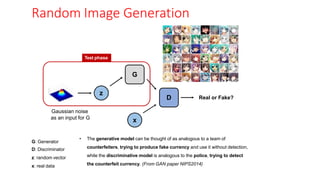
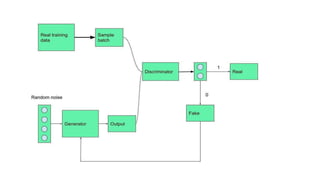
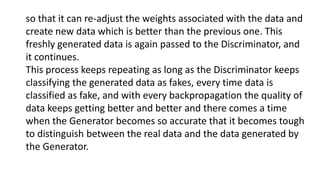
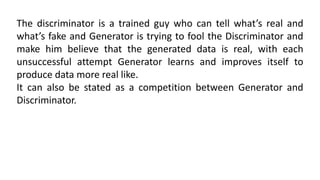
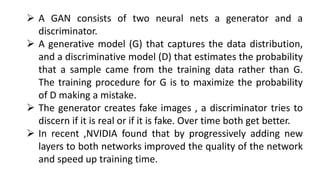
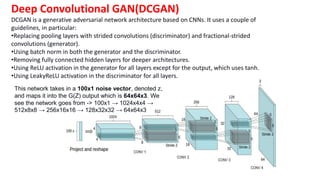
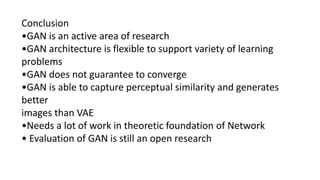
This document discusses generative adversarial networks (GANs) and their applications to image processing. It begins with an overview of machine learning techniques including supervised learning, unsupervised learning, and reinforcement learning. It then describes how GANs work using two competing neural networks - a generator that produces synthetic images and a discriminator that evaluates them as real or fake. The goal of the GAN training process is for the generator to improve so its samples cannot be distinguished from real data. In the end, GANs can be used for tasks like random image generation and image-to-image translation.
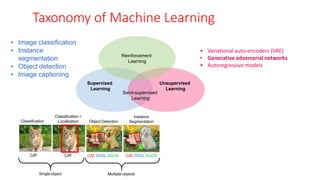
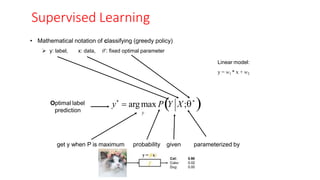
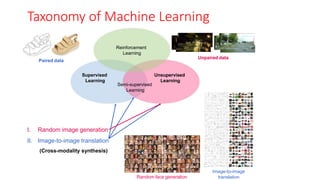
![Taxonomy of Machine Learning
Unsupervised
Learning
Supervised
Learning
Reinforcement
Learning
Semi-supervised
Learning
Unsupervised Learning
• Find deterministic function f : z = f(x), x: data, z: latent vector
Image classification
Image segmentation
Object detection
Image captioning
Variational auto-encoders (VAE)
Generative adversarial networks
Autoregressive models
f [0.1, 0.3, -0.8, 0.4, …]](https://image.slidesharecdn.com/gandeeplearningapproachestoimageprocessingapplications1-230628070025-c30459de/85/GAN-Deep-Learning-Approaches-to-Image-Processing-Applications-1-pptx-5-320.jpg)
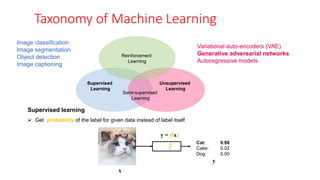
![Taxonomy of Machine Learning
Unsupervised
Learning
Supervised
Learning
Reinforcement
Learning
Semi-supervised
Learning
Unsupervised Learning
• Find deterministic function f : z = f(x), x: data, z: latent vector
Image classification
Image segmentation
Object detection
Image captioning
Variational auto-encoders (VAE)
Generative adversarial networks
Autoregressive models
y = g(z)
g
Weight initialization
[0.1, 0.3, -0.8, 0.4, …]
Cat: 0.98
Cake: 0.02
Dog: 0.00
f
Supervised Learning:
limited data
Unsupervised Learning: unlimited data](https://image.slidesharecdn.com/gandeeplearningapproachestoimageprocessingapplications1-230628070025-c30459de/85/GAN-Deep-Learning-Approaches-to-Image-Processing-Applications-1-pptx-6-320.jpg)
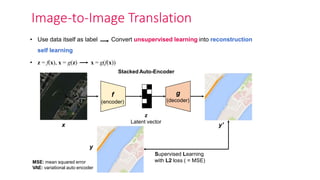
![Self Learning
• Use data itself as label
self learning
Convert unsupervised learning into reconstruction
• z = f(x), x = g(z) x = g(f(x))
f
(encoder)
g
(decoder)
x x'
Supervised Learning
with L2 loss ( = MSE)
MSE: mean squared error
Stacked Auto-Encoder
z
[0.1, 0.3, -0.8, 0.4, …]](https://image.slidesharecdn.com/gandeeplearningapproachestoimageprocessingapplications1-230628070025-c30459de/85/GAN-Deep-Learning-Approaches-to-Image-Processing-Applications-1-pptx-7-320.jpg)


![[Deck] What's New in Spark-Iceberg Integration via DSV2.pptx](https://cdn.slidesharecdn.com/ss_thumbnails/deckwhatsnewinspark-icebergintegrationviadsv2-260210005337-25955b12-thumbnail.jpg?width=640&height=640&fit=bounds)

