Generative Adversarial Networks ( GAN )
The coolest idea in ML in the last twenty years - Yann Lecun
2017.03 Namju Kim (namju.kim@kakaobrainl.com)
Introduction
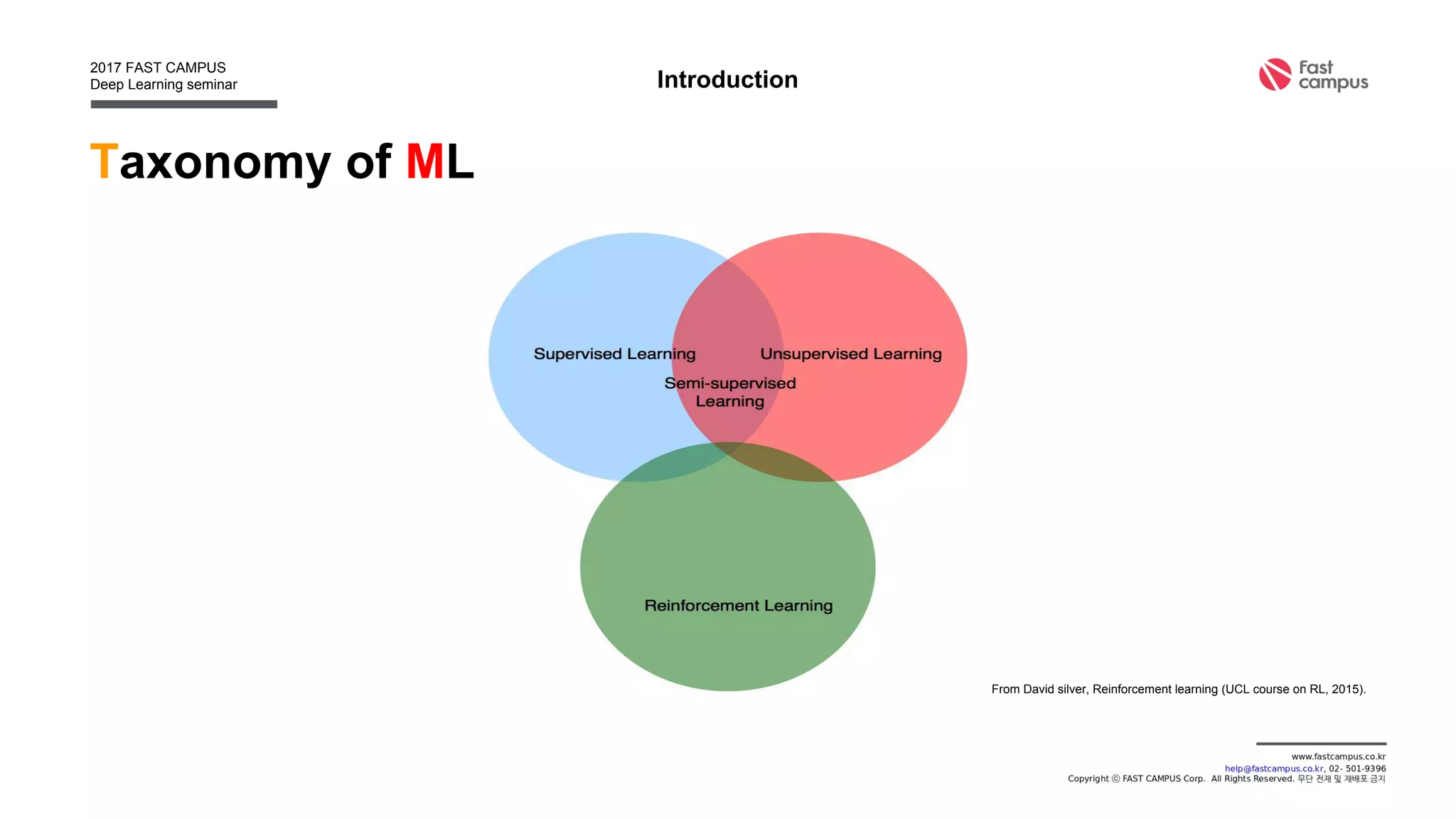
Taxonomy of ML
Introduction
From David silver, Reinforcement learning (UCL course on RL, 2015).
Supervised Learning
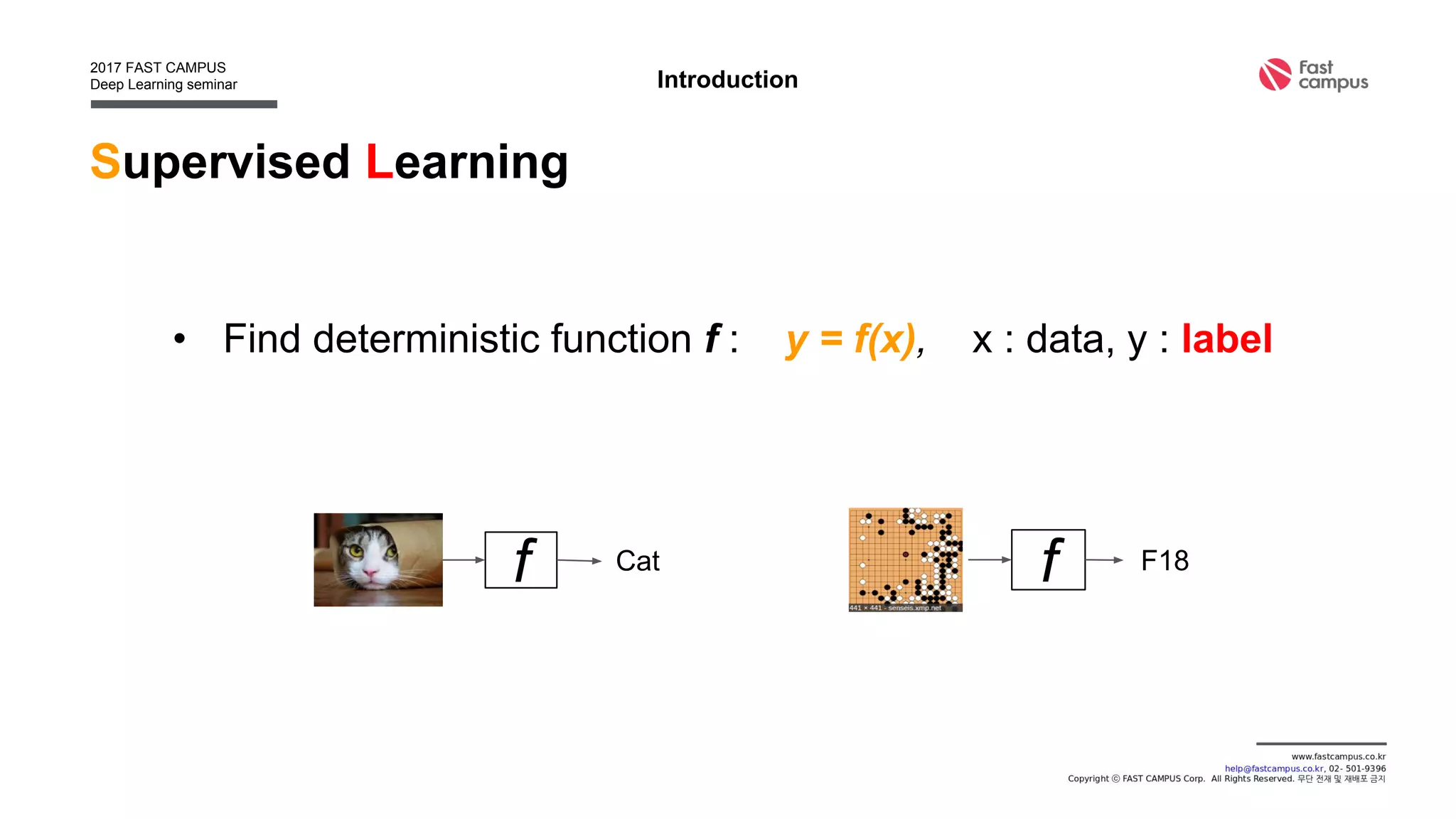
• Find deterministic function f : y = f(x), x : data, y : label
Introduction
Catf F18f
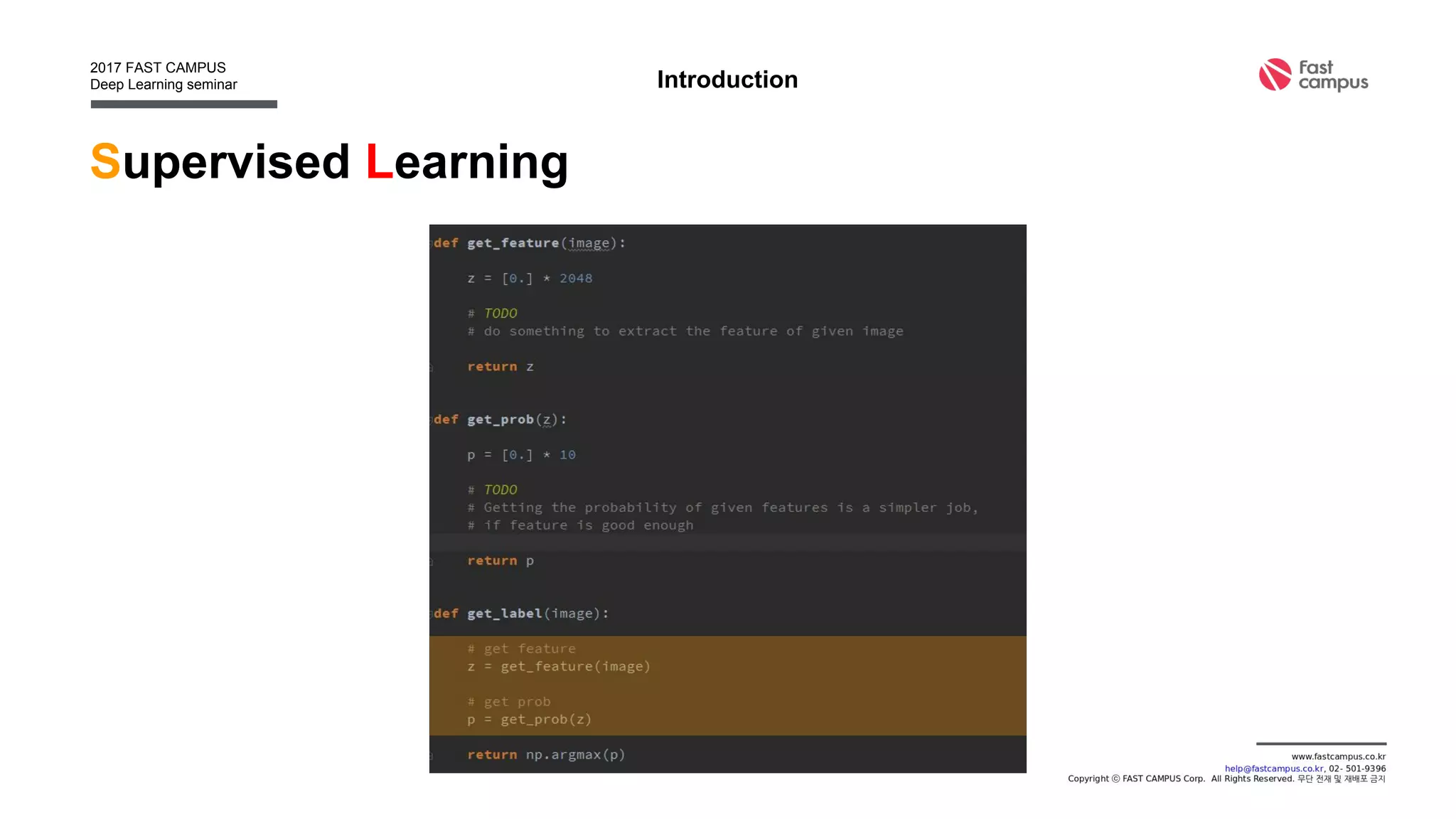
Supervised Learning
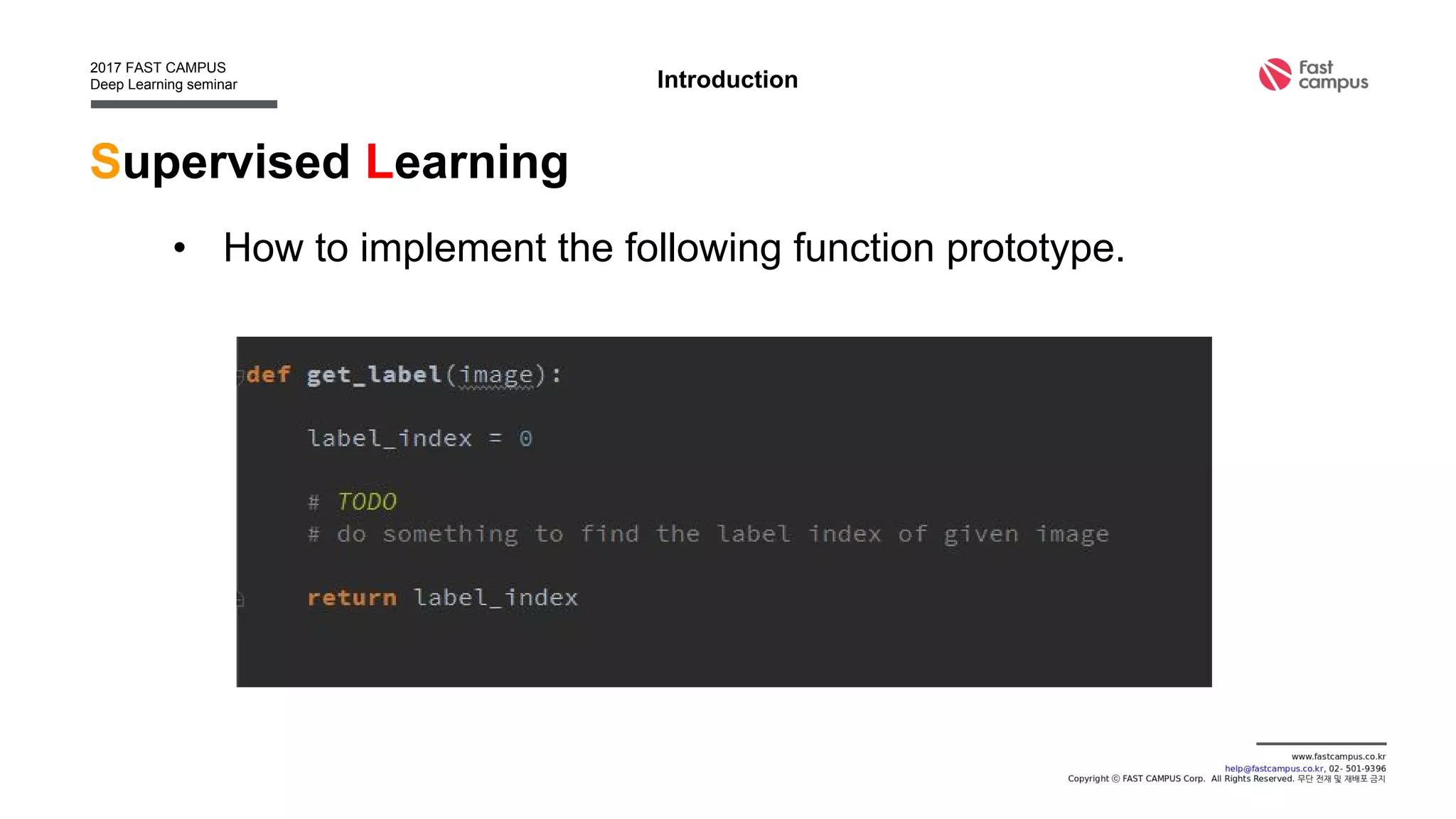
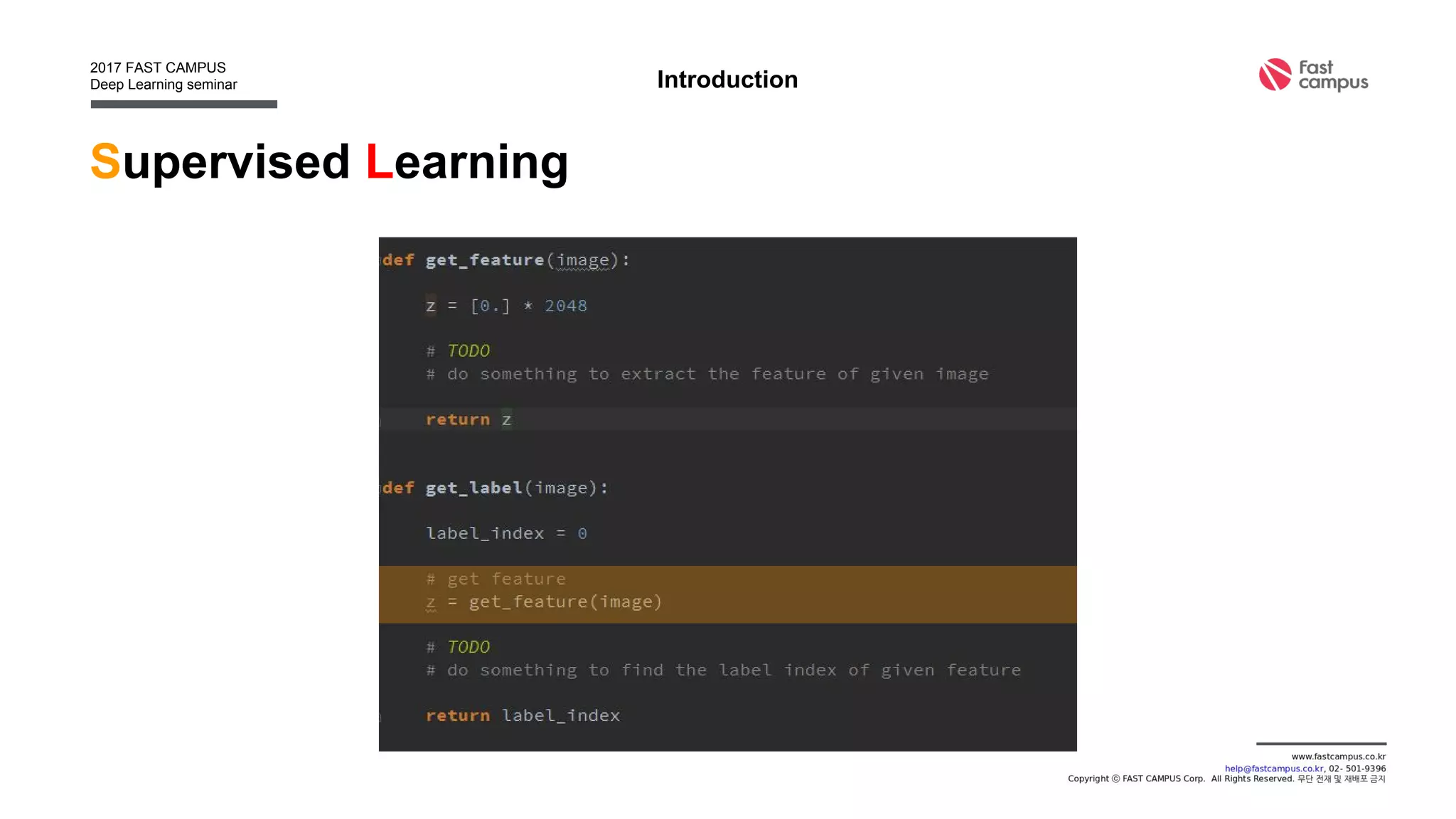
• How to implement the following function prototype.
Introduction
Supervised Learning
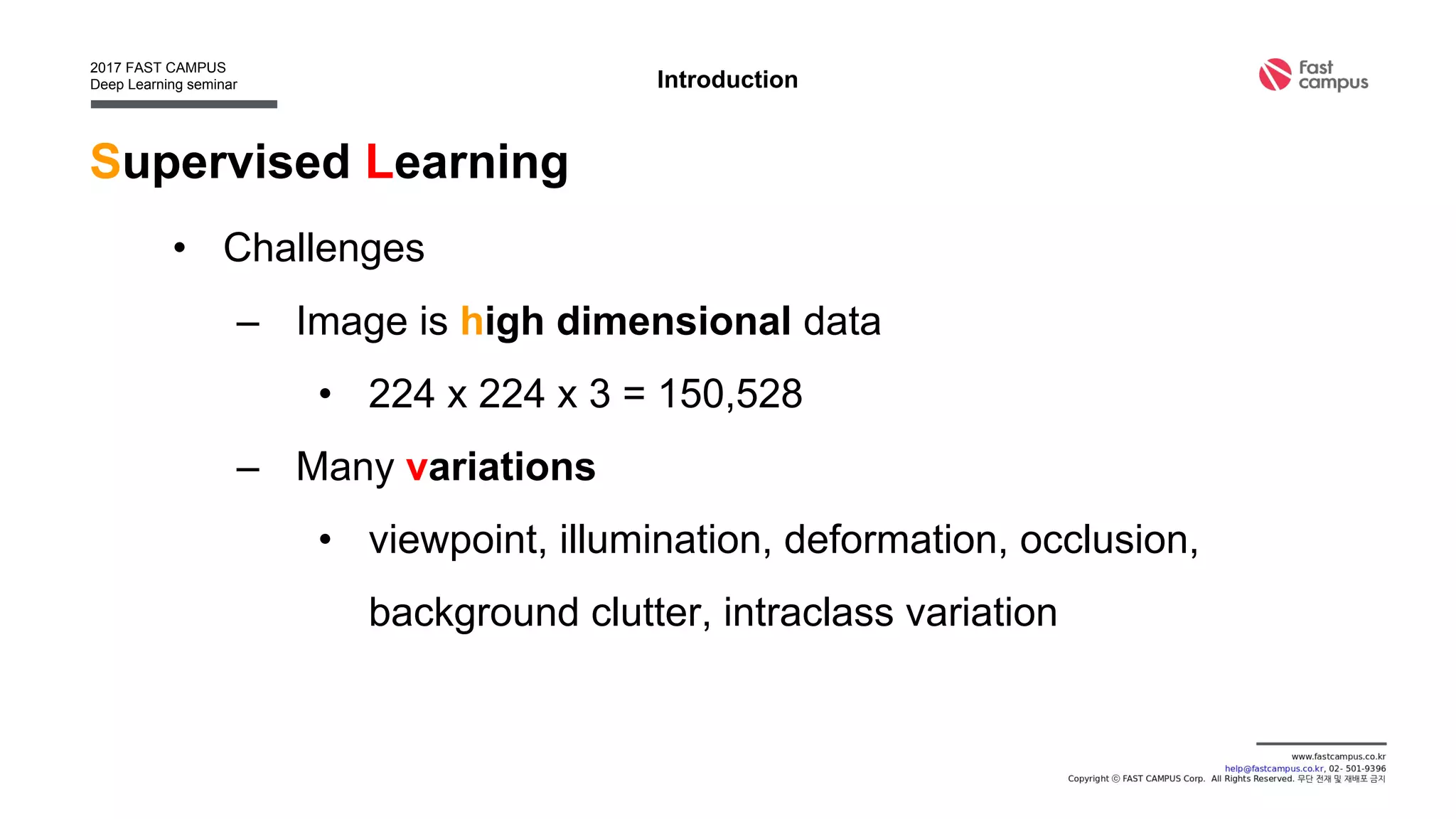
• Challenges
– Image is high dimensional data
• 224 x 224 x 3 = 150,528
– Many variations
• viewpoint, illumination, deformation, occlusion,
background clutter, intraclass variation
Introduction
Supervised Learning
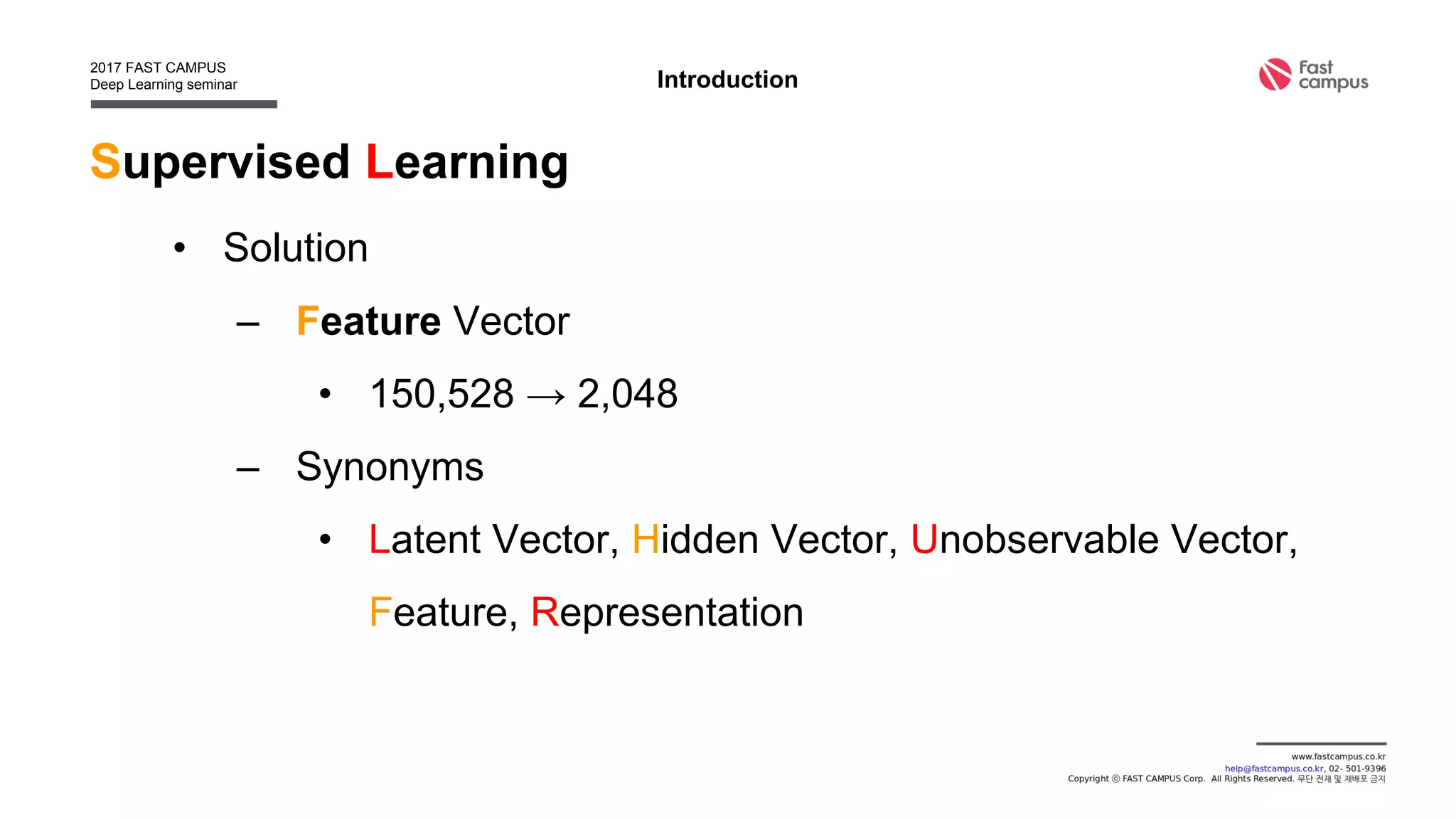
• Solution
– Feature Vector
• 150,528 → 2,048
– Synonyms
• Latent Vector, Hidden Vector, Unobservable Vector,
Feature, Representation
Introduction
Supervised Learning
Introduction
Supervised Learning
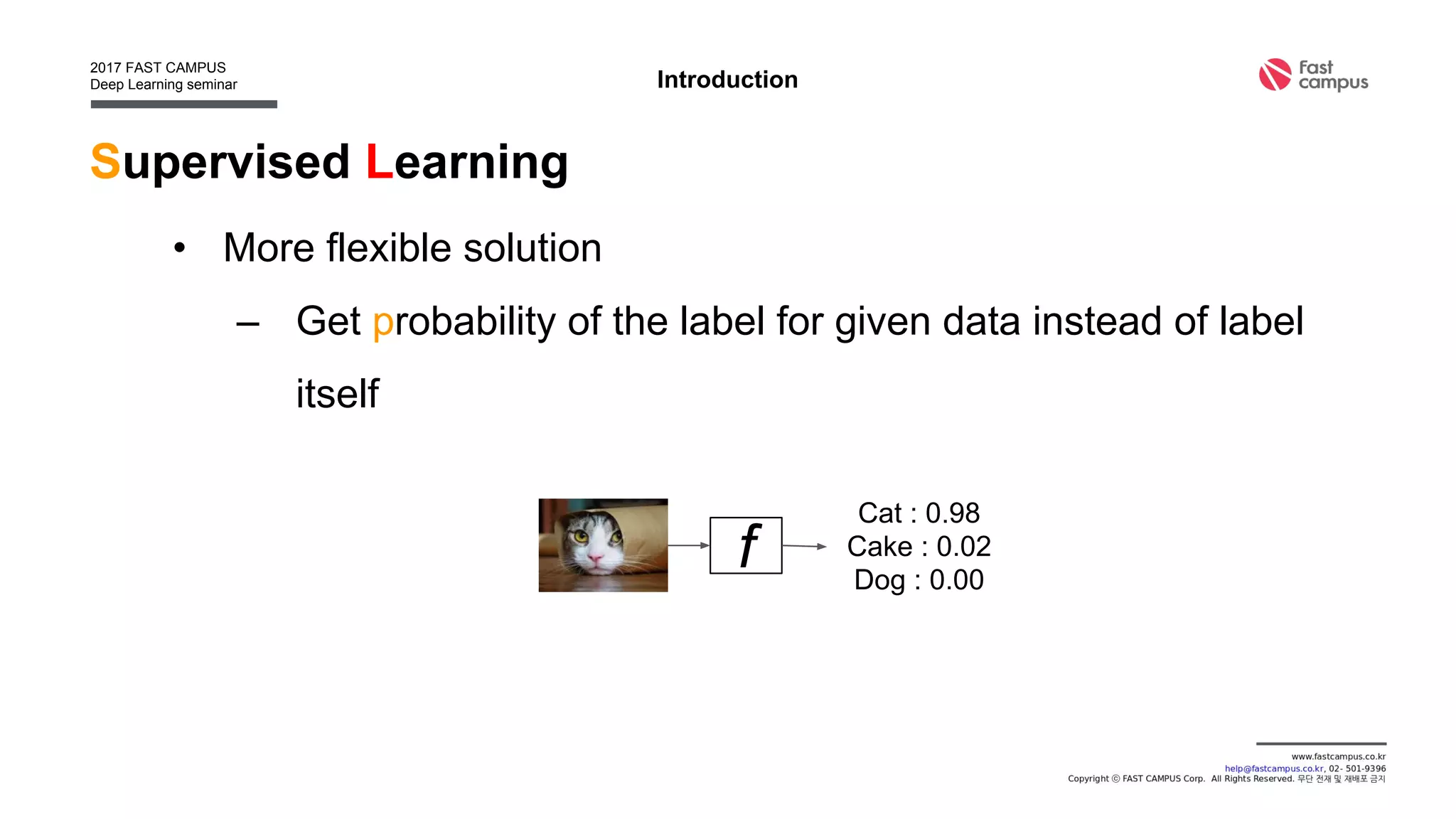
• More flexible solution
– Get probability of the label for given data instead of label
itself
Introduction
Cat : 0.98
Cake : 0.02
Dog : 0.00
f
Supervised Learning
Introduction
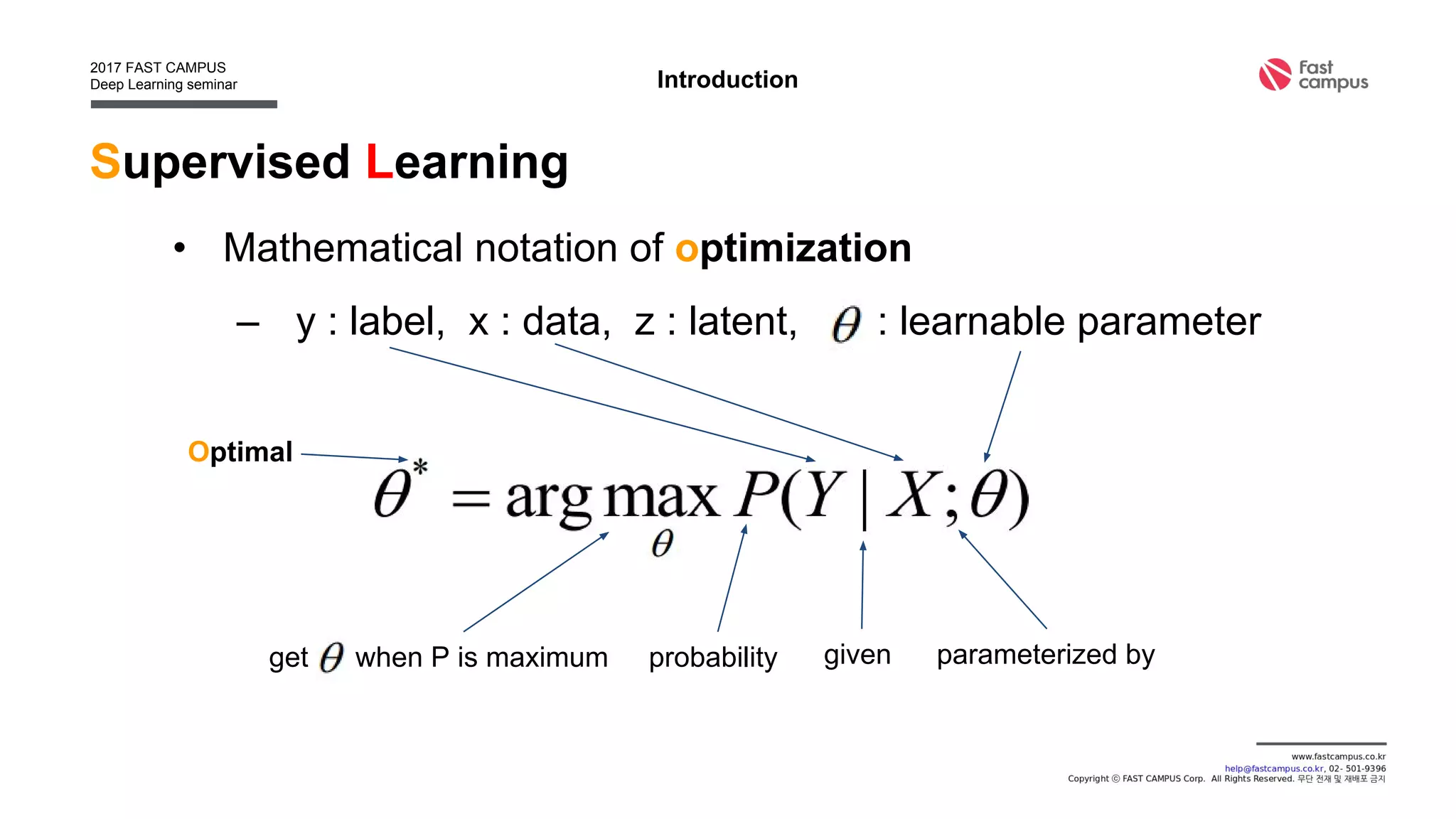
Supervised Learning
• Mathematical notation of optimization
– y : label, x : data, z : latent, : learnable parameter
Introduction
given parameterized byprobabilityget when P is maximum
Optimal
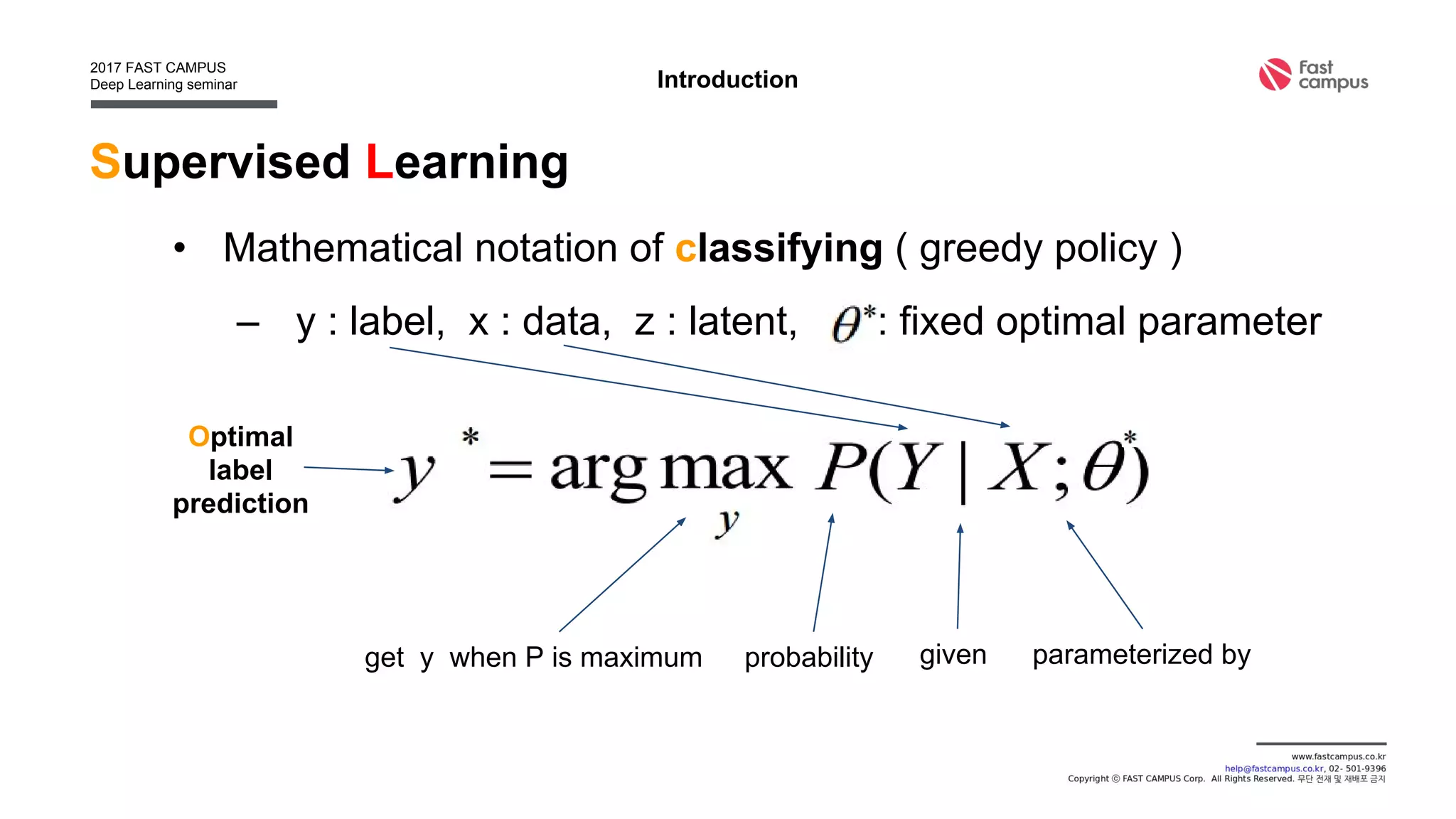
Supervised Learning
• Mathematical notation of classifying ( greedy policy )
– y : label, x : data, z : latent, : fixed optimal parameter
Introduction
given parameterized byprobabilityget y when P is maximum
Optimal
label
prediction
Unsupervised Learning
• Find deterministic function f : z = f(x), x : data, z : latent
Introduction
[0.1, 0.3, -0.8, 0.4, … ]f
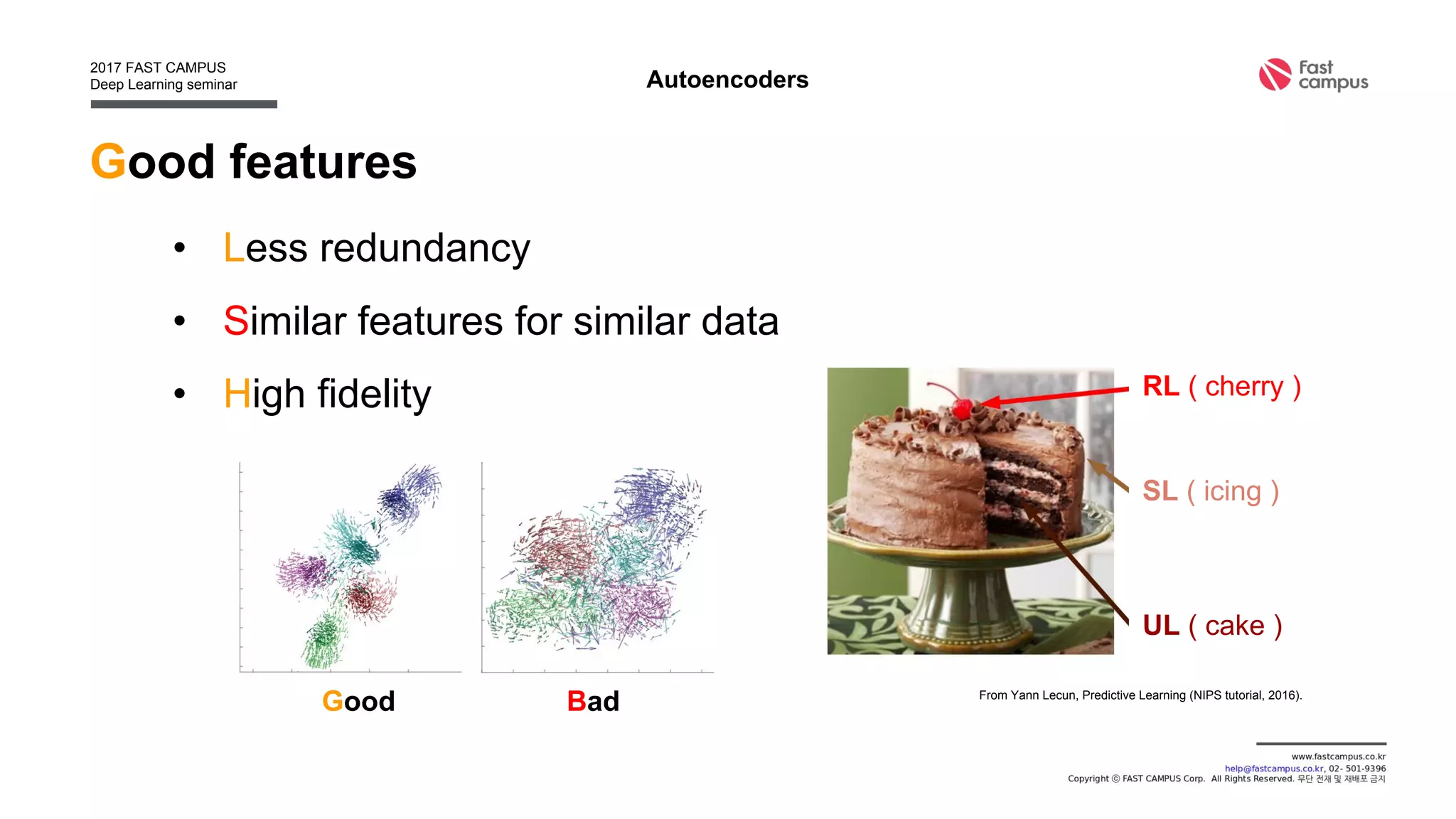
Good features
• Less redundancy
• Similar features for similar data
• High fidelity
From Yann Lecun, Predictive Learning (NIPS tutorial, 2016).
RL ( cherry )
SL ( icing )
UL ( cake )
Good Bad
Introduction
Unsupervised Learning
Introduction
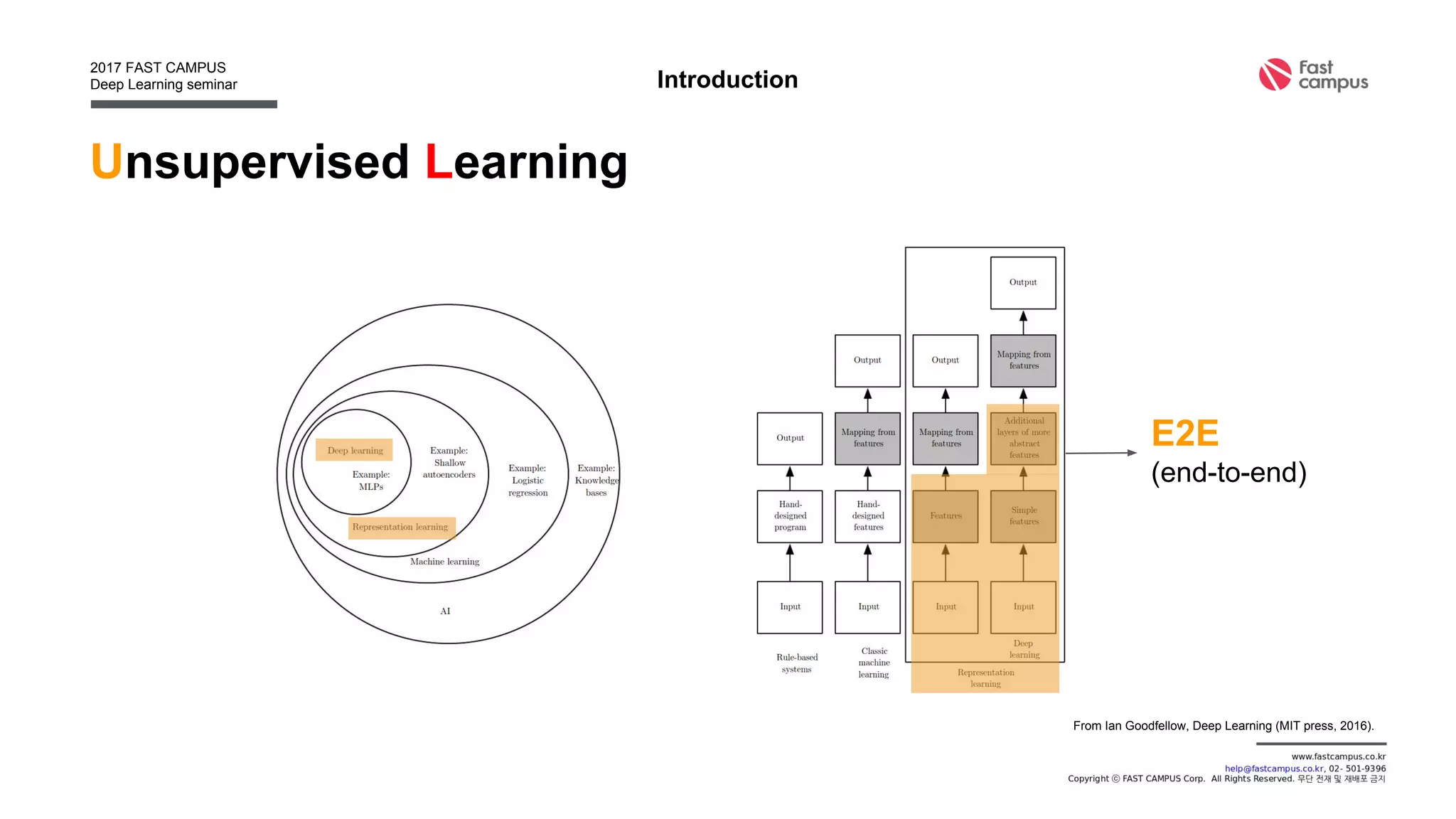
From Ian Goodfellow, Deep Learning (MIT press, 2016).
E2E
(end-to-end)
Unsupervised Learning
• More challenging than supervised learning :
– No label or curriculum → self learning
• Some NN solutions :
– Boltzmann machine
– Auto-encoder or Variational Inference
– Generative Adversarial Network
Introduction
Generative Model
• Find generation function g : x = g(z), x : data, z : latent
Introduction
[0.1, 0.3, -0.8, 0.4, … ]
g
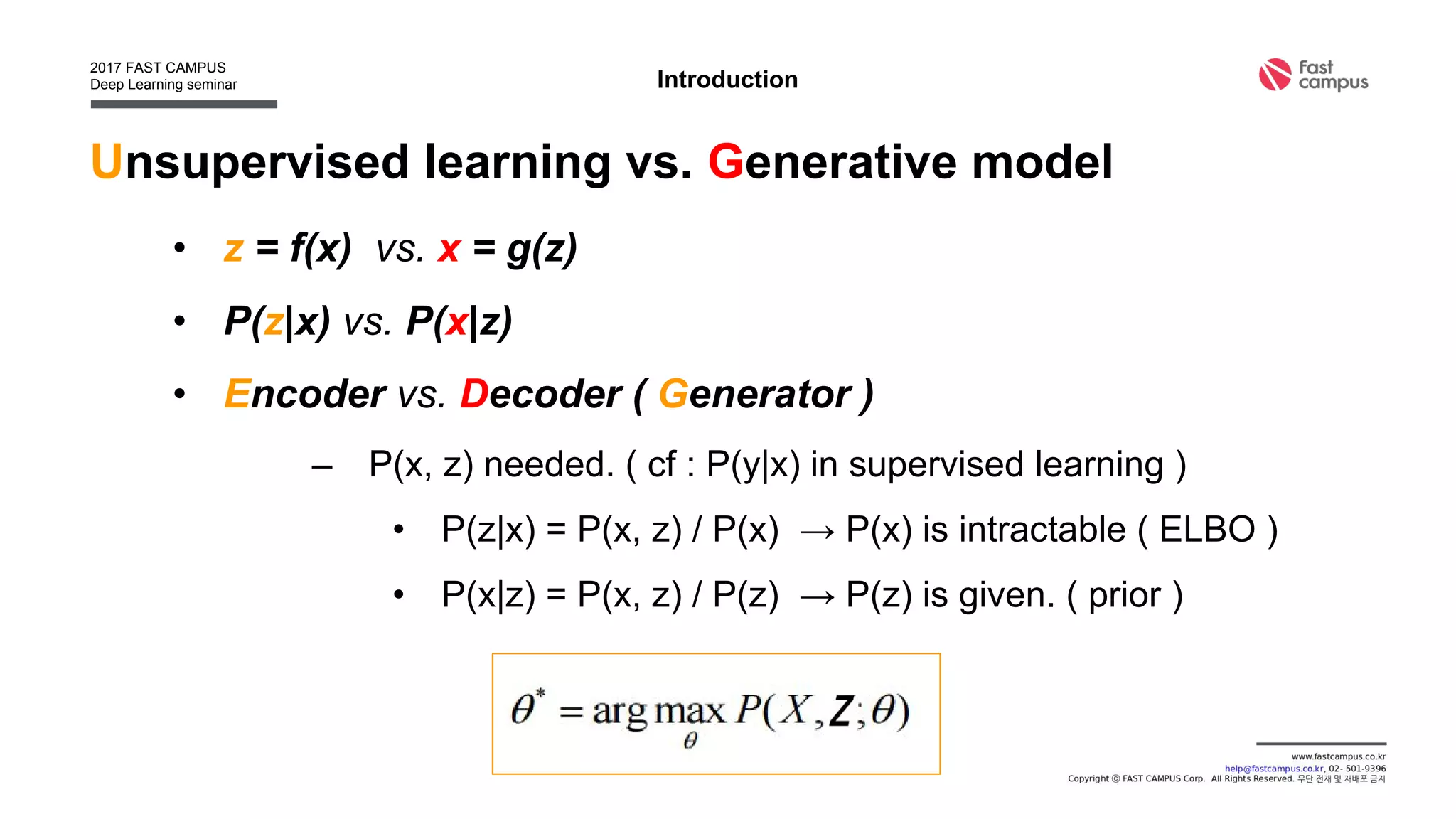
Unsupervised learning vs. Generative model
• z = f(x) vs. x = g(z)
• P(z|x) vs. P(x|z)
• Encoder vs. Decoder ( Generator )
– P(x, z) needed. ( cf : P(y|x) in supervised learning )
• P(z|x) = P(x, z) / P(x) → P(x) is intractable ( ELBO )
• P(x|z) = P(x, z) / P(z) → P(z) is given. ( prior )
Introduction
Autoencoders
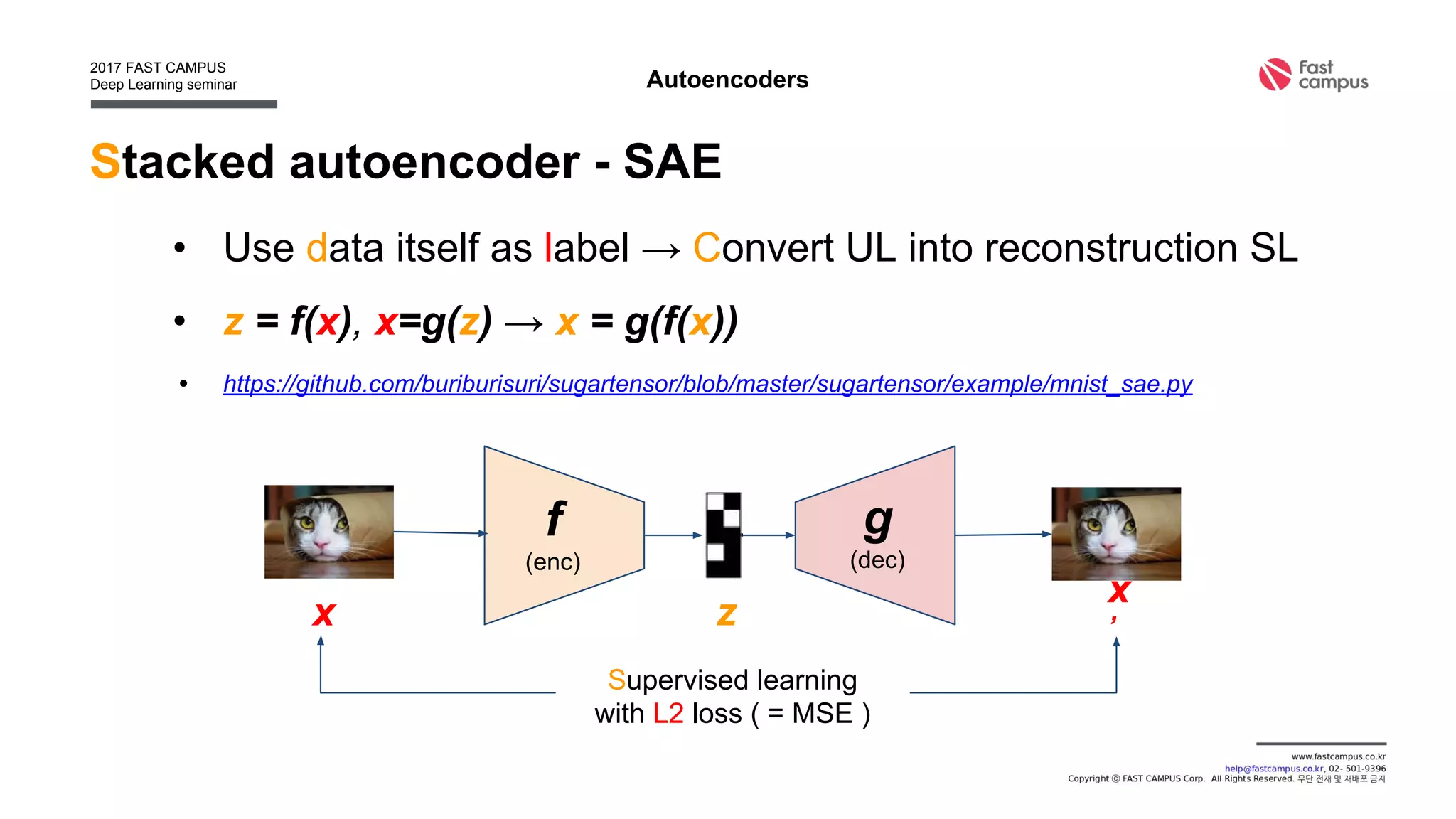
Stacked autoencoder - SAE
• Use data itself as label → Convert UL into reconstruction SL
• z = f(x), x=g(z) → x = g(f(x))
• https://github.com/buriburisuri/sugartensor/blob/master/sugartensor/example/mnist_sae.py
Autoencoders
f
(enc)
g
(dec)
x
x
’z
Supervised learning
with L2 loss ( = MSE )
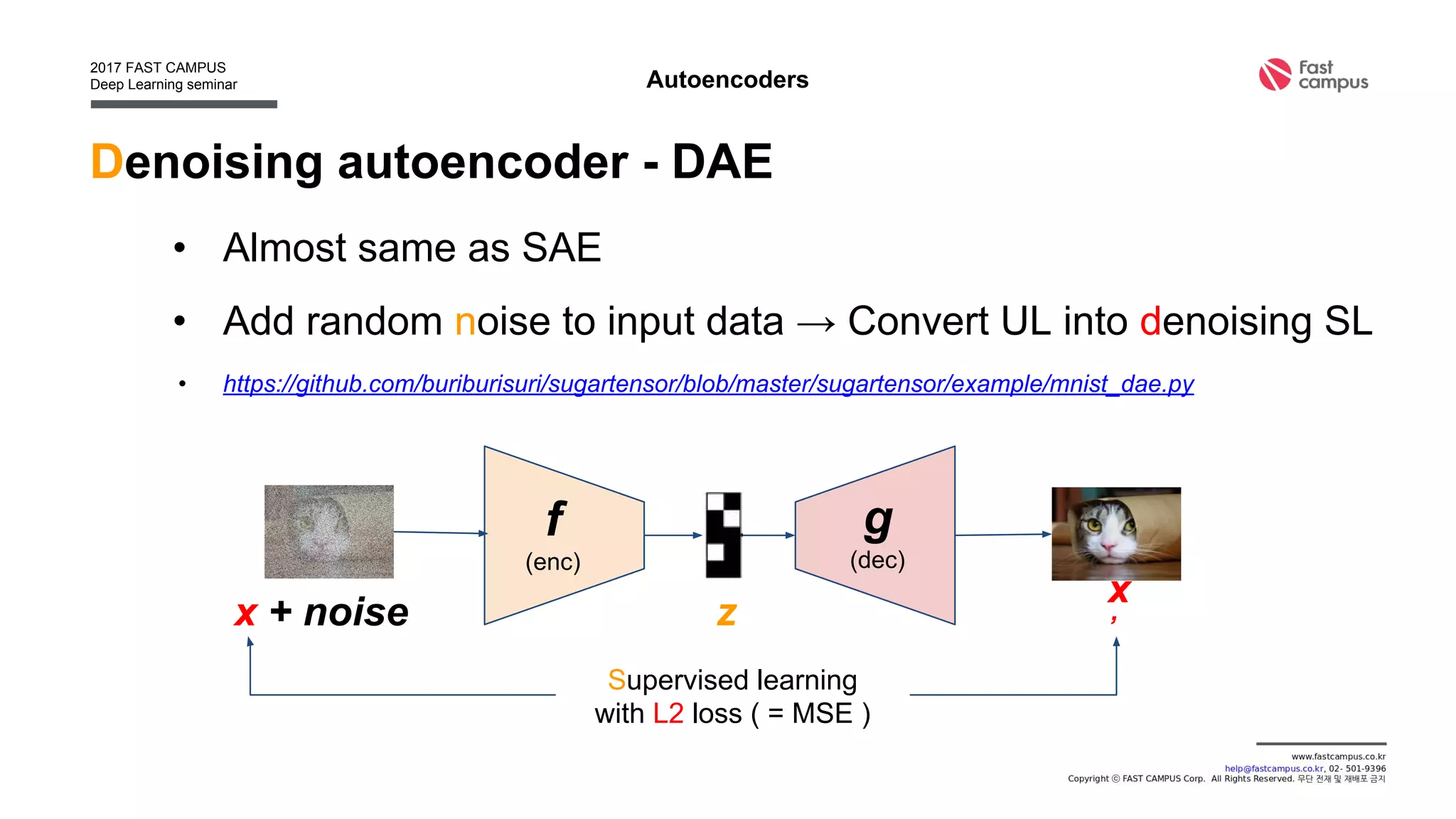
Denoising autoencoder - DAE
• Almost same as SAE
• Add random noise to input data → Convert UL into denoising SL
• https://github.com/buriburisuri/sugartensor/blob/master/sugartensor/example/mnist_dae.py
Autoencoders
f
(enc)
g
(dec)
x + noise
x
’z
Supervised learning
with L2 loss ( = MSE )
Variational autoencoder - VAE
• Kingma et al, “Auto-Encoding Variational Bayes”, 2013.
• Generative Model + Stacked Autoencoder
– Based on Variational approximation
– other approaches :
• Point estimation ( MAP )
• Markov Chain Monte Carlo ( MCMC )
Autoencoders
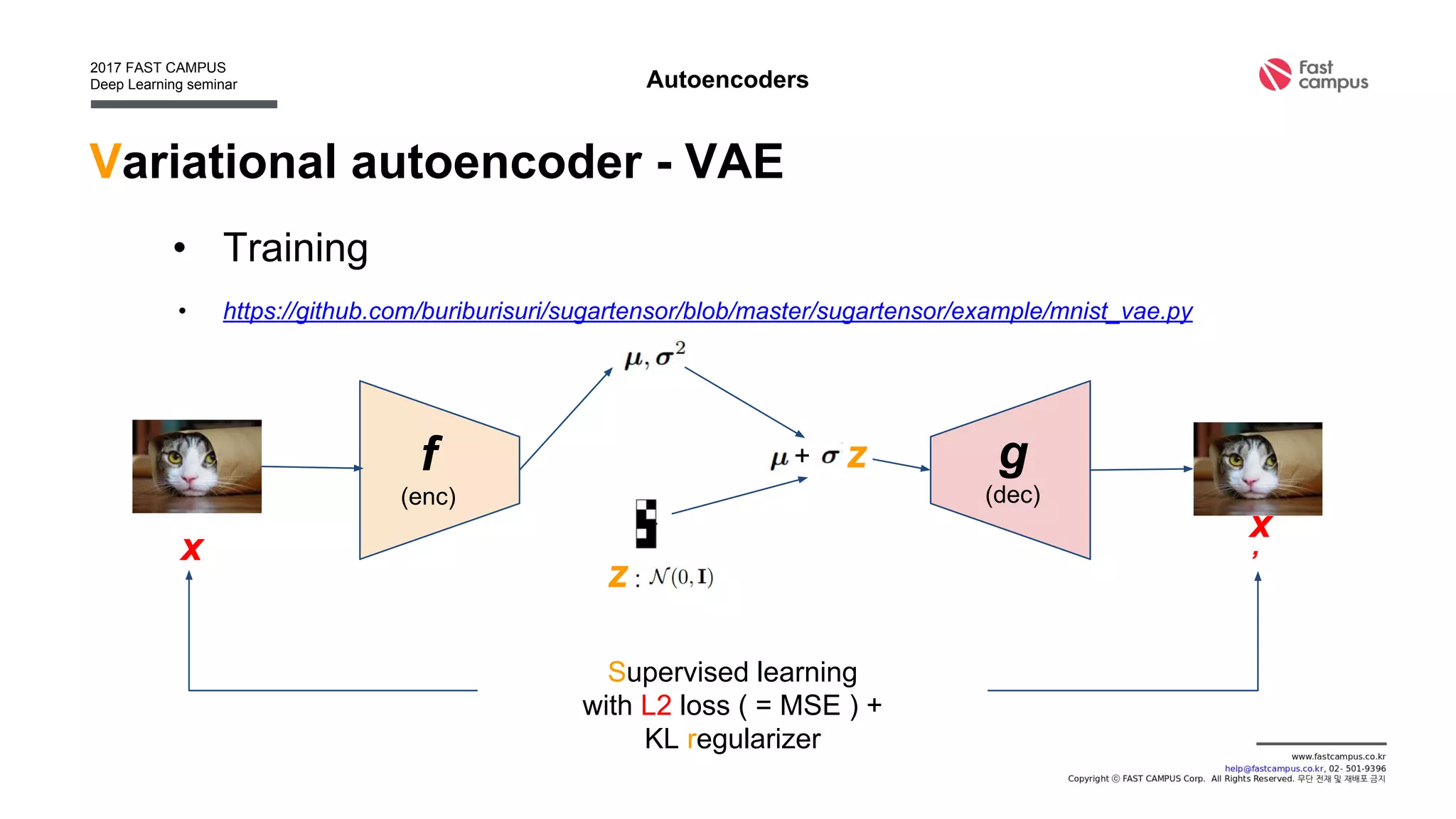
Variational autoencoder - VAE
• Training
• https://github.com/buriburisuri/sugartensor/blob/master/sugartensor/example/mnist_vae.py
Autoencoders
f
(enc)
g
(dec)
x
x
’
z :
Supervised learning
with L2 loss ( = MSE ) +
KL regularizer
z+
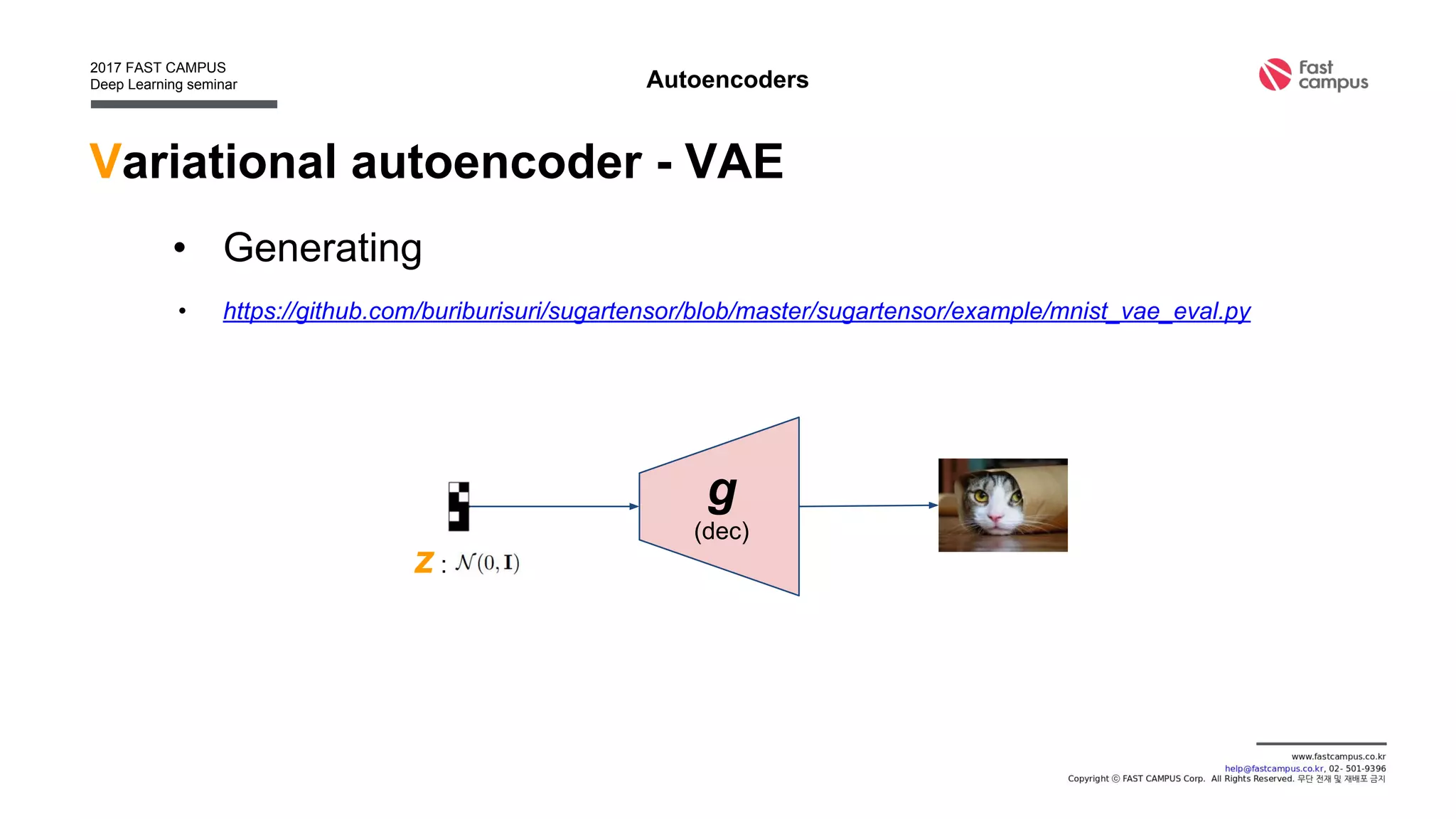
Variational autoencoder - VAE
• Generating
• https://github.com/buriburisuri/sugartensor/blob/master/sugartensor/example/mnist_vae_eval.py
Autoencoders
g
(dec)
z :
Variational autoencoder - VAE
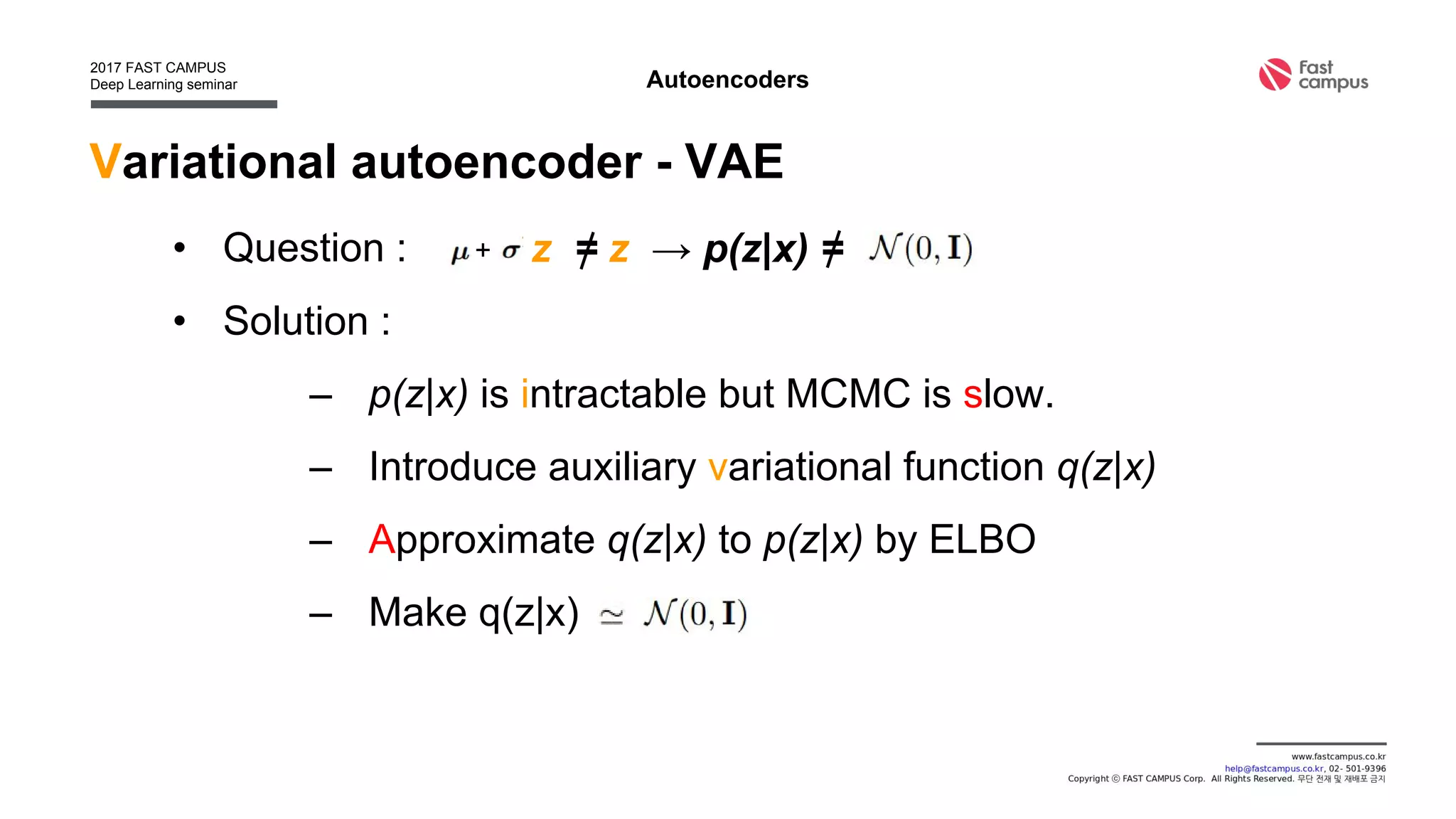
• Question :
• Solution :
– p(z|x) is intractable but MCMC is slow.
– Introduce auxiliary variational function q(z|x)
– Approximate q(z|x) to p(z|x) by ELBO
– Make q(z|x)
Autoencoders
z = z → p(z|x) =+
Variational autoencoder - VAE
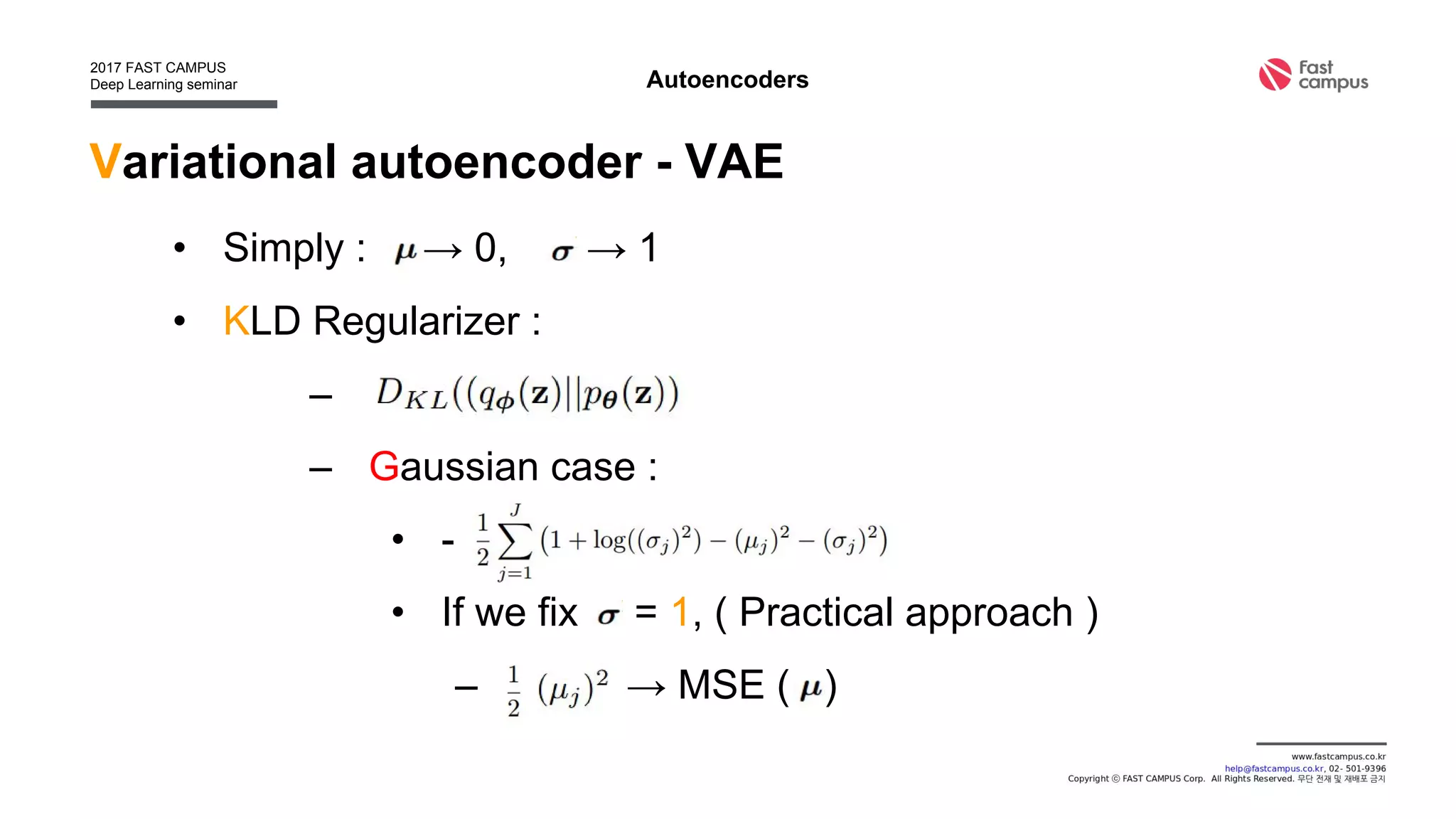
• Simply : → 0, → 1
• KLD Regularizer :
–
– Gaussian case :
• -
• If we fix = 1, ( Practical approach )
– → MSE ( )
Autoencoders
Variational autoencoder - VAE
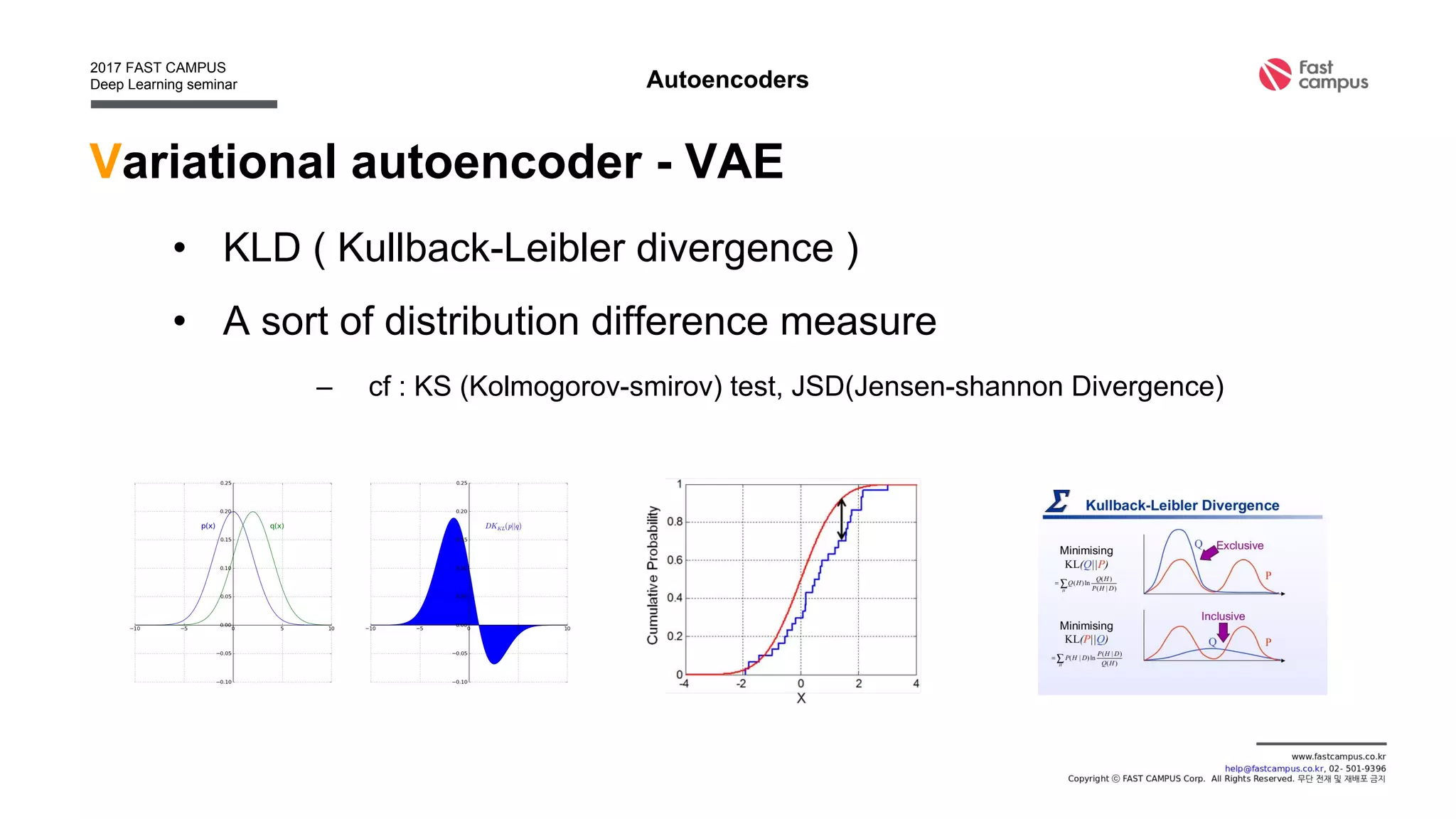
• KLD ( Kullback-Leibler divergence )
• A sort of distribution difference measure
– cf : KS (Kolmogorov-smirov) test, JSD(Jensen-shannon Divergence)
Autoencoders
Variational autoencoder - VAE
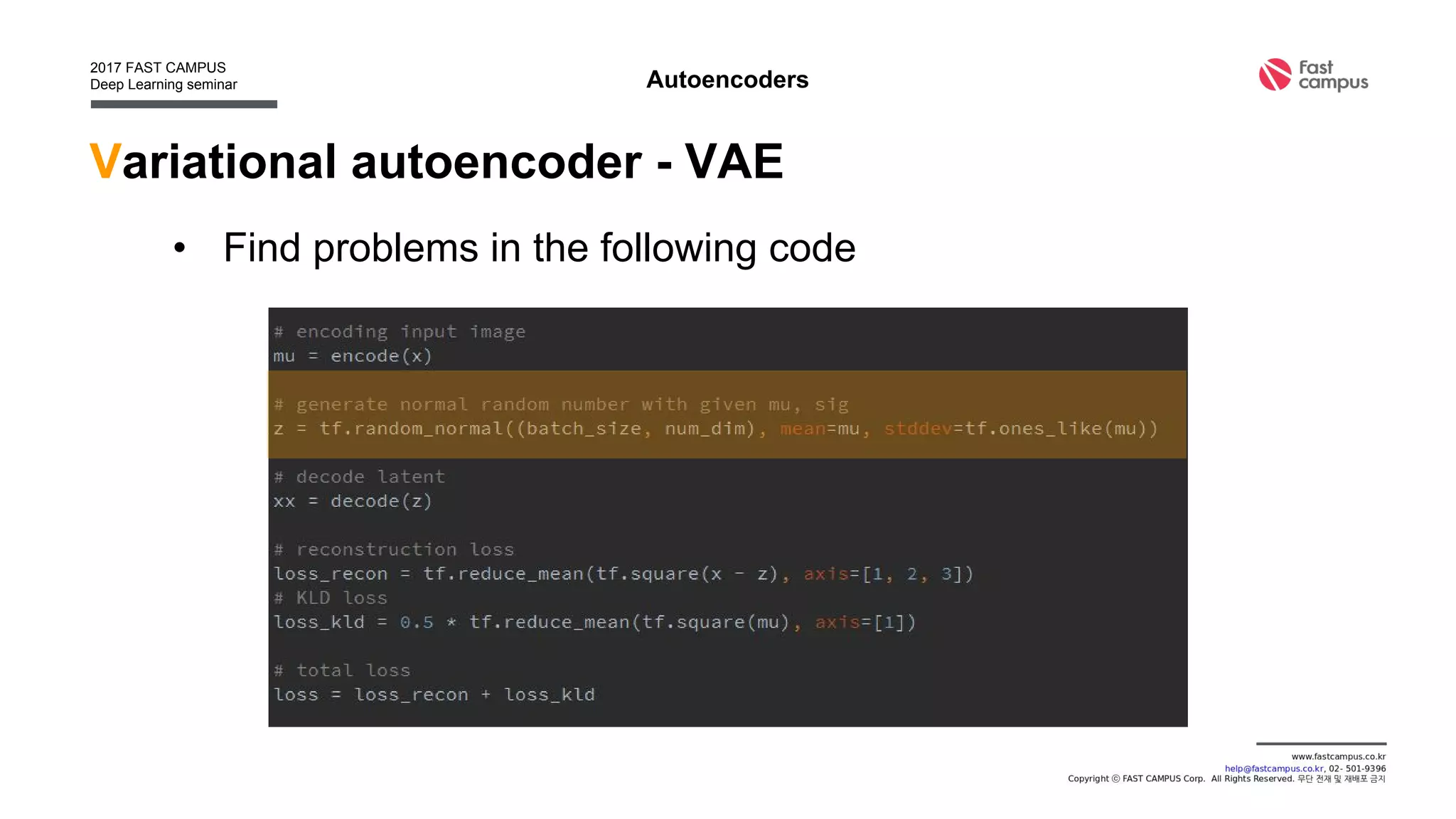
• Find problems in the following code
Autoencoders
Variational autoencoder - VAE
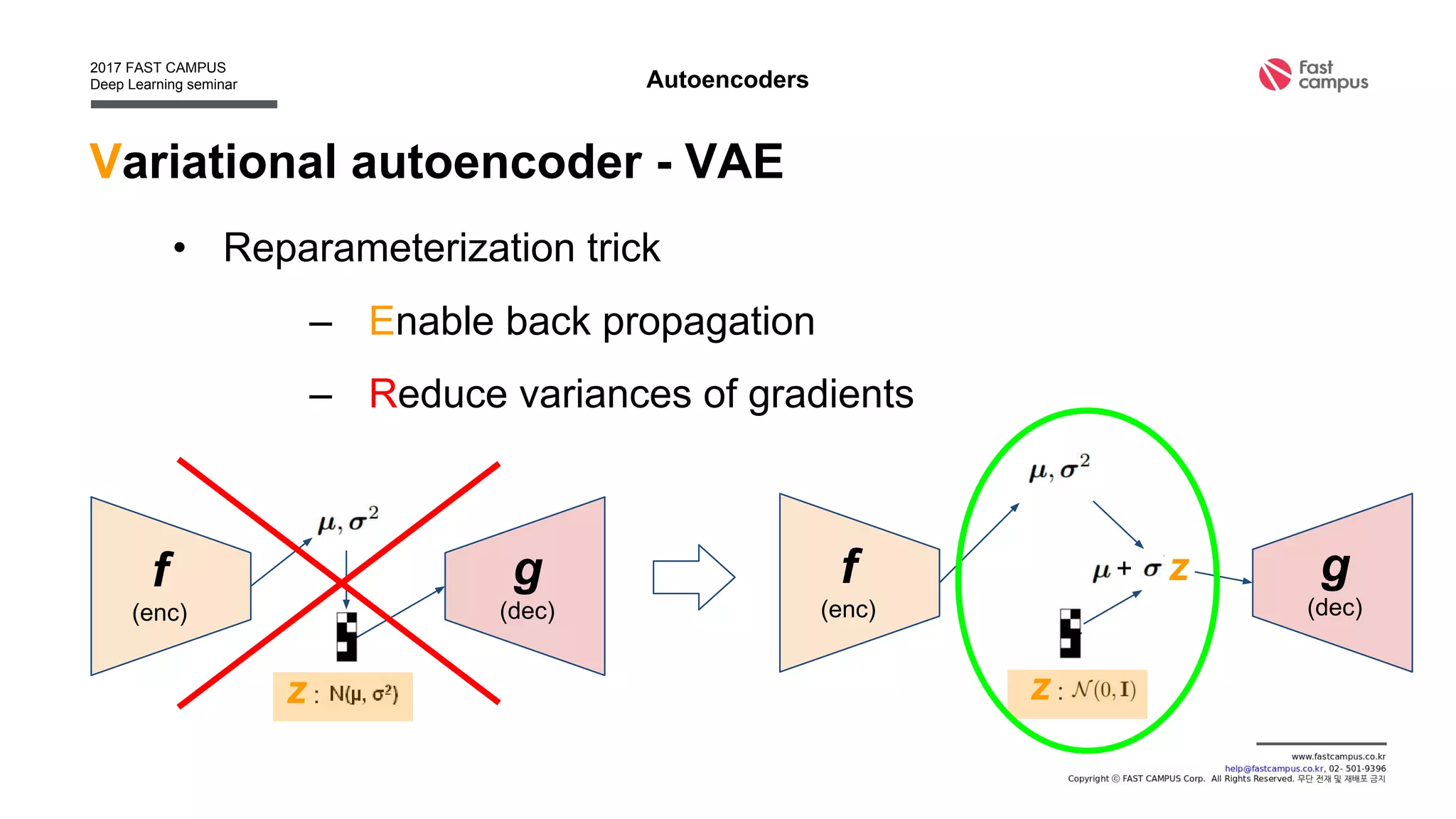
• Reparameterization trick
– Enable back propagation
– Reduce variances of gradients
Autoencoders
f
(enc)
g
(dec)
z :
z+f
(enc)
g
(dec)
z :
Variational autoencoder - VAE
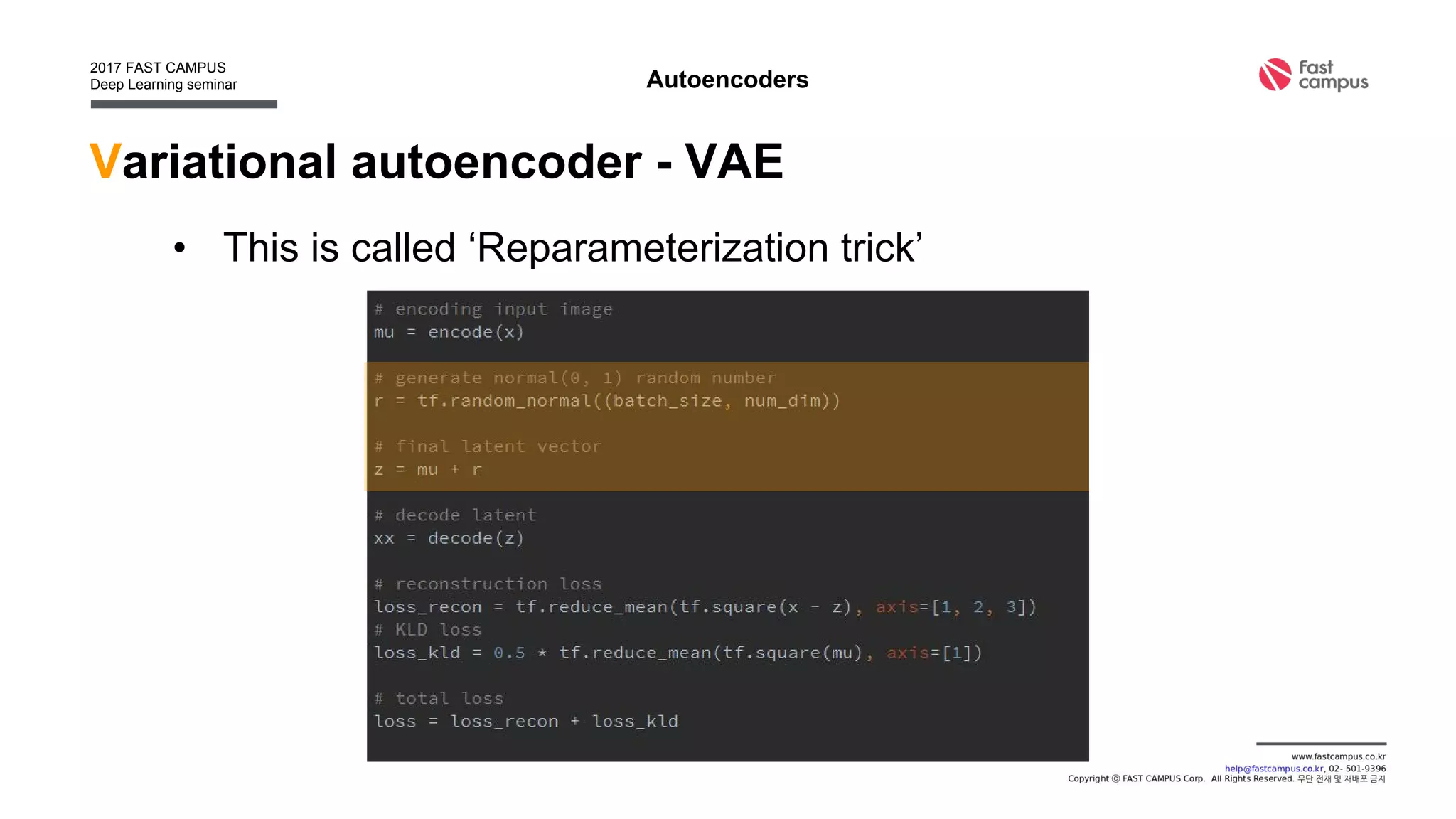
• This is called ‘Reparameterization trick’
Autoencoders
Variational autoencoder - VAE
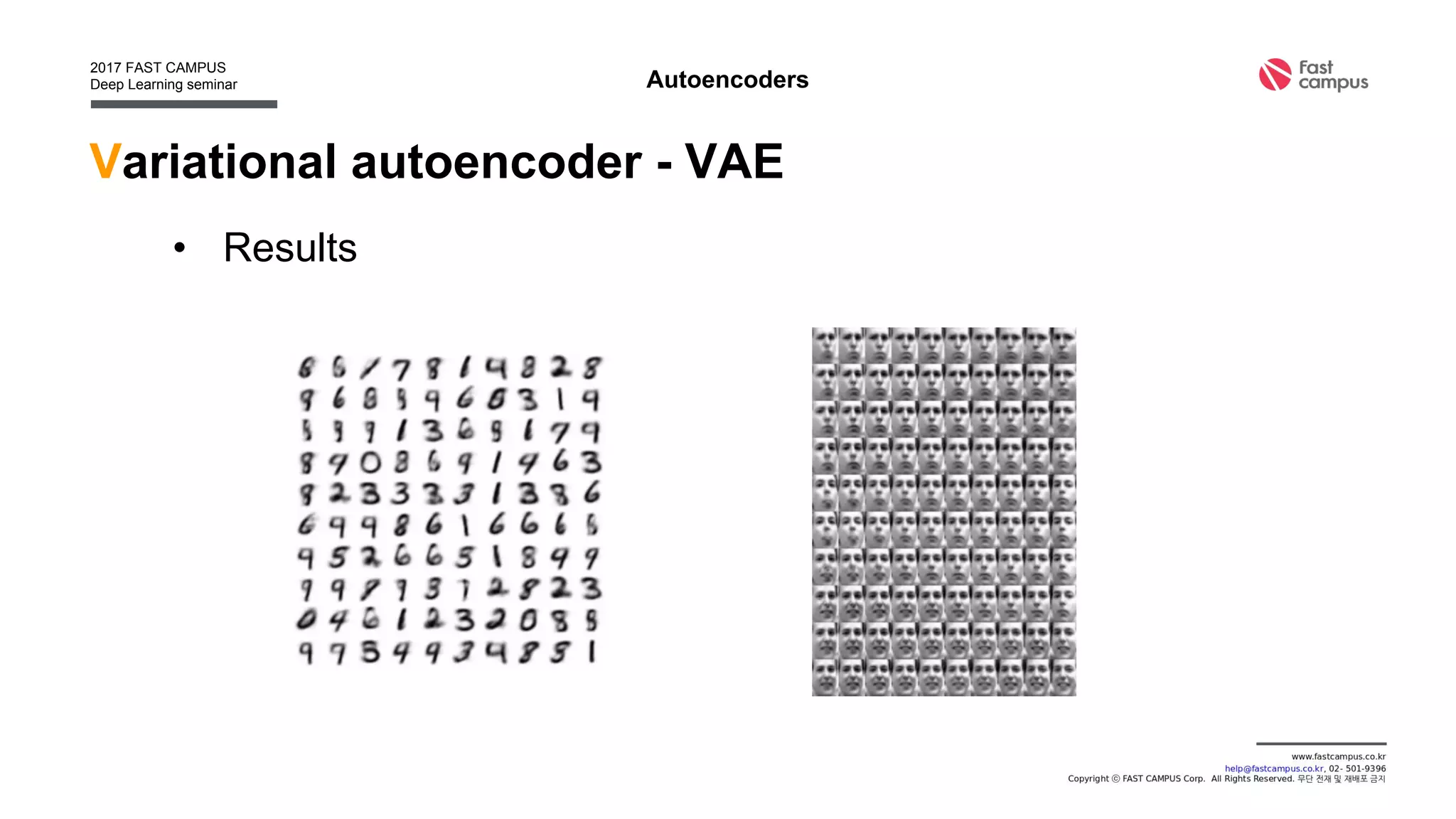
• Results
Autoencoders
Generative Adversarial Networks
Generative Adversarial Networks - GAN
• Ian Goodfellow et al, “Generative Adversarial Networks”, 2014.
– Learnable cost function
– Mini-Max game based on Nash Equilibrium
• Little assumption
• High fidelity
– Hard to training - no guarantee to equilibrium.
GAN
Generative Adversarial Networks - GAN
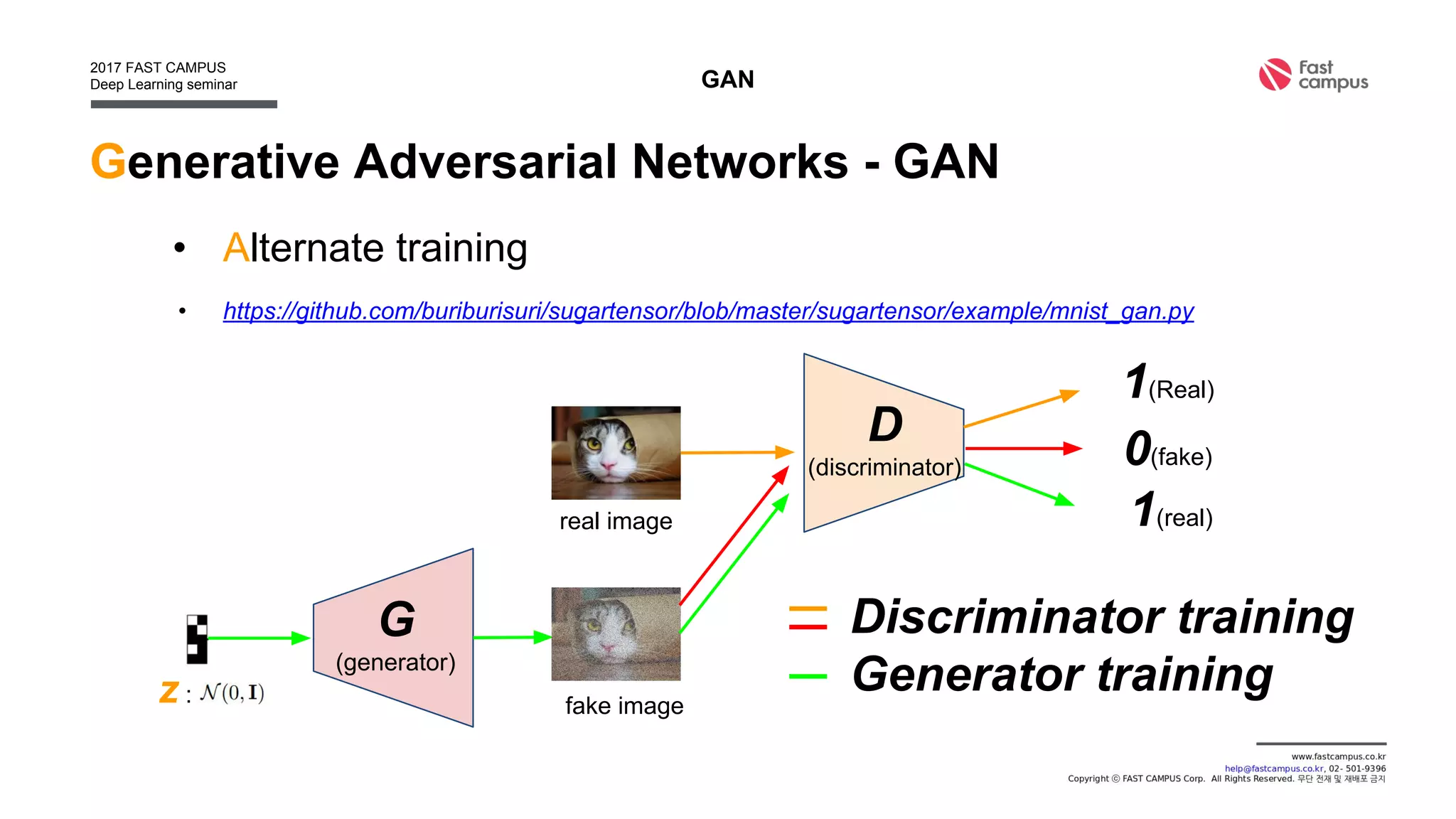
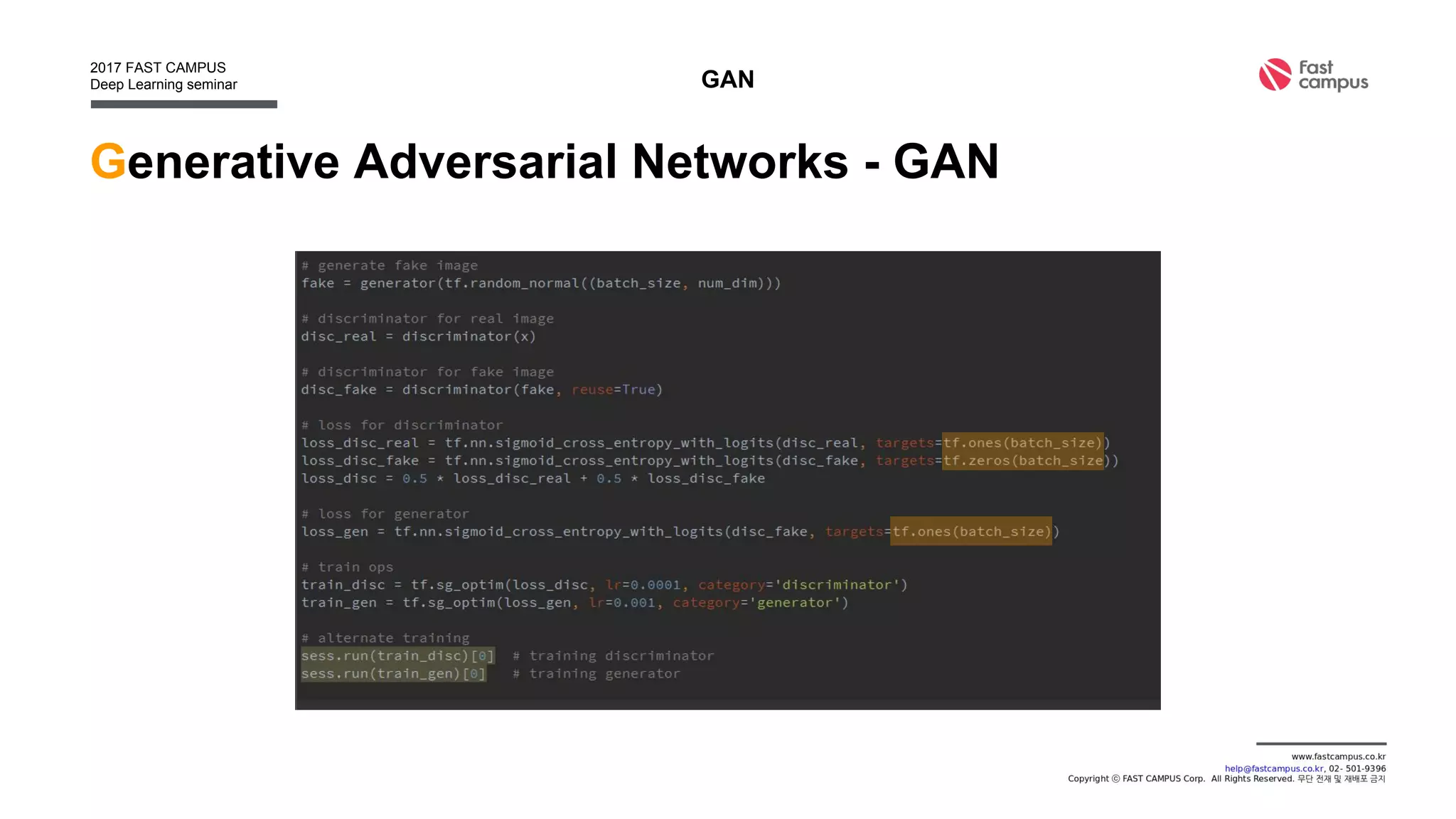
• Alternate training
• https://github.com/buriburisuri/sugartensor/blob/master/sugartensor/example/mnist_gan.py
GAN
G
(generator)
z :
D
(discriminator)
real image
fake image
1(Real)
0(fake)
1(real)
Discriminator training
Generator training
Generative Adversarial Networks - GAN
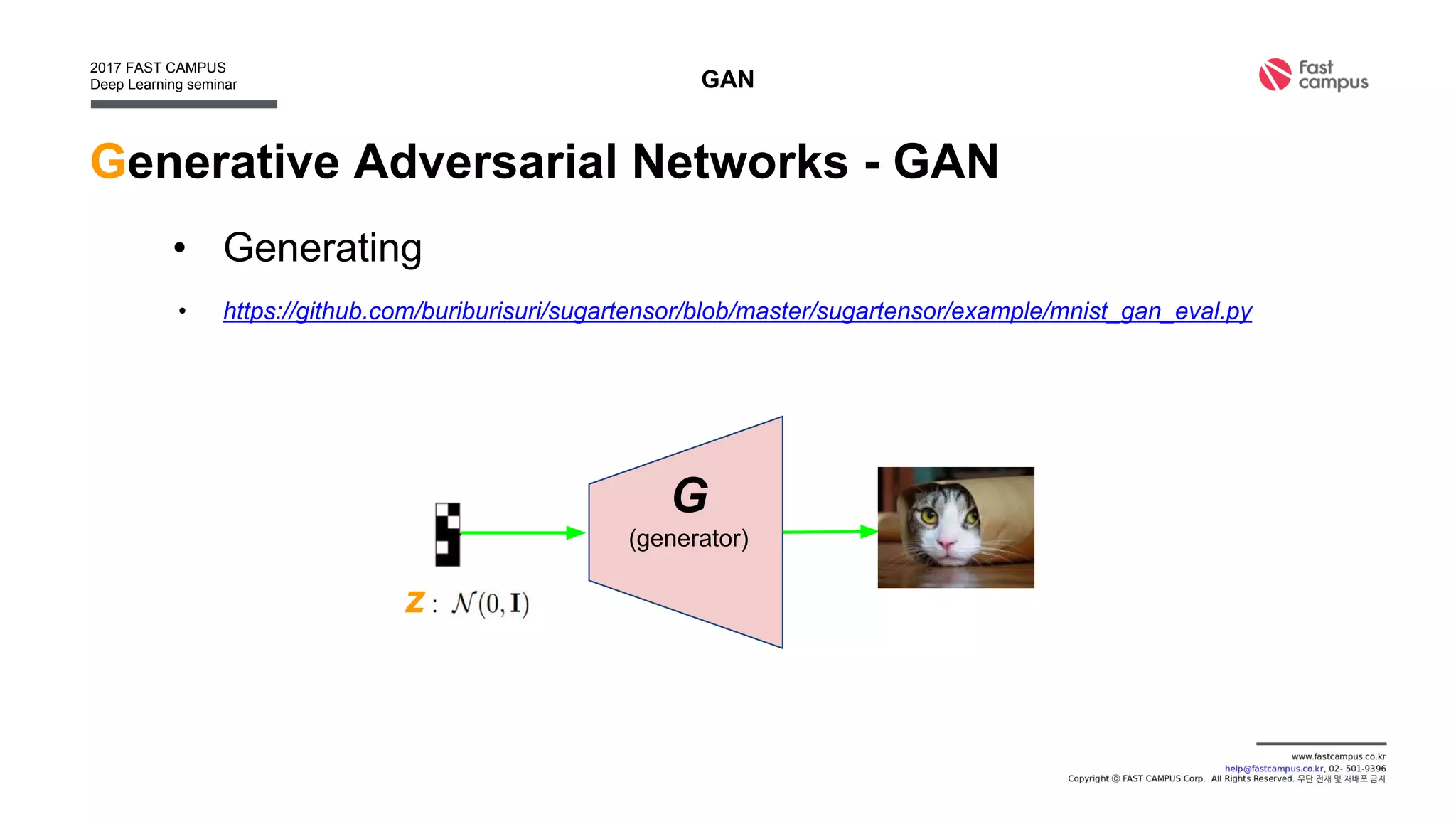
• Generating
• https://github.com/buriburisuri/sugartensor/blob/master/sugartensor/example/mnist_gan_eval.py
GAN
G
(generator)
z :
Generative Adversarial Networks - GAN
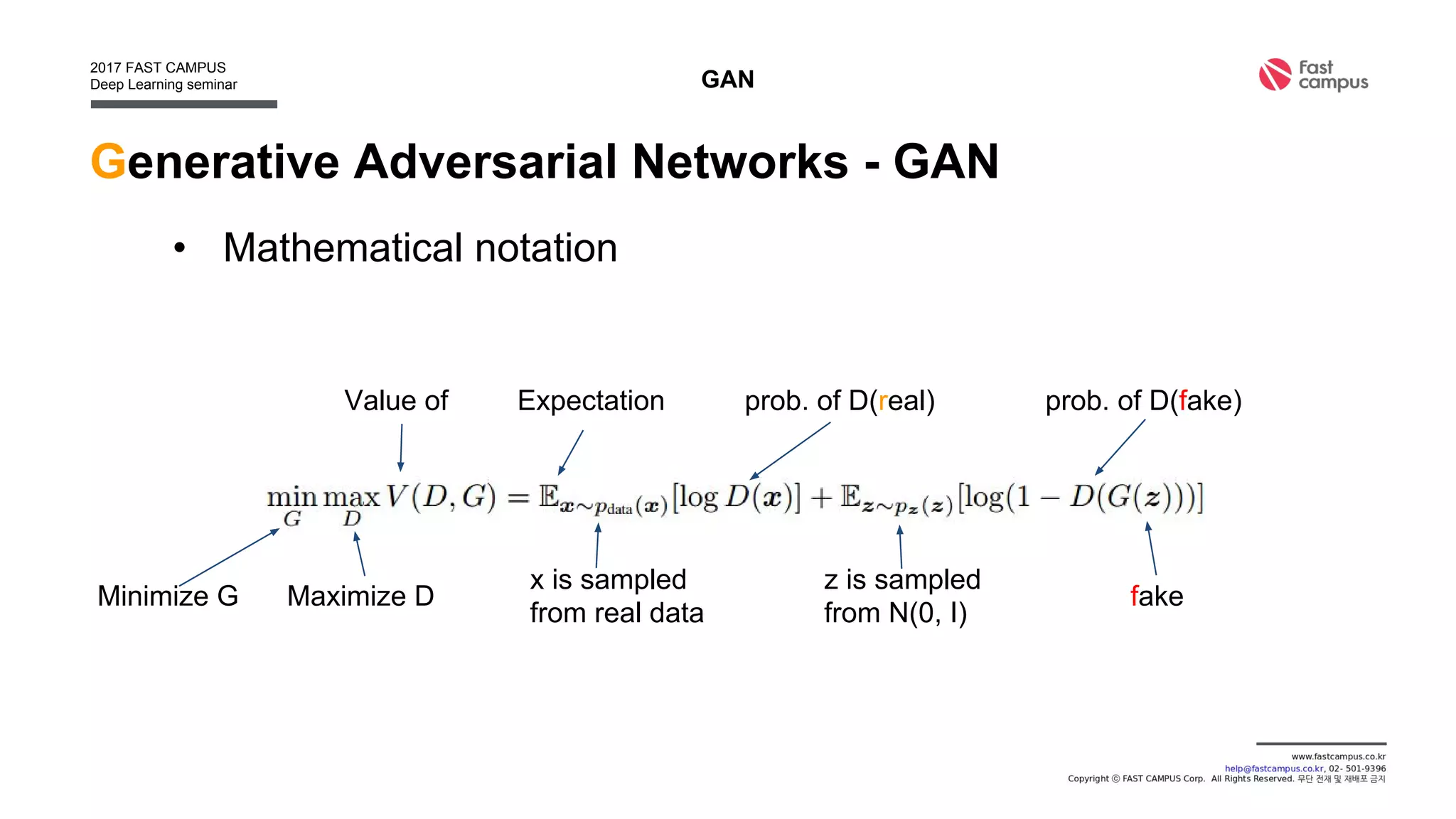
• Mathematical notation
GAN
x is sampled
from real data
z is sampled
from N(0, I)
Expectation prob. of D(real) prob. of D(fake)
Maximize DMinimize G
Value of
fake
Generative Adversarial Networks - GAN
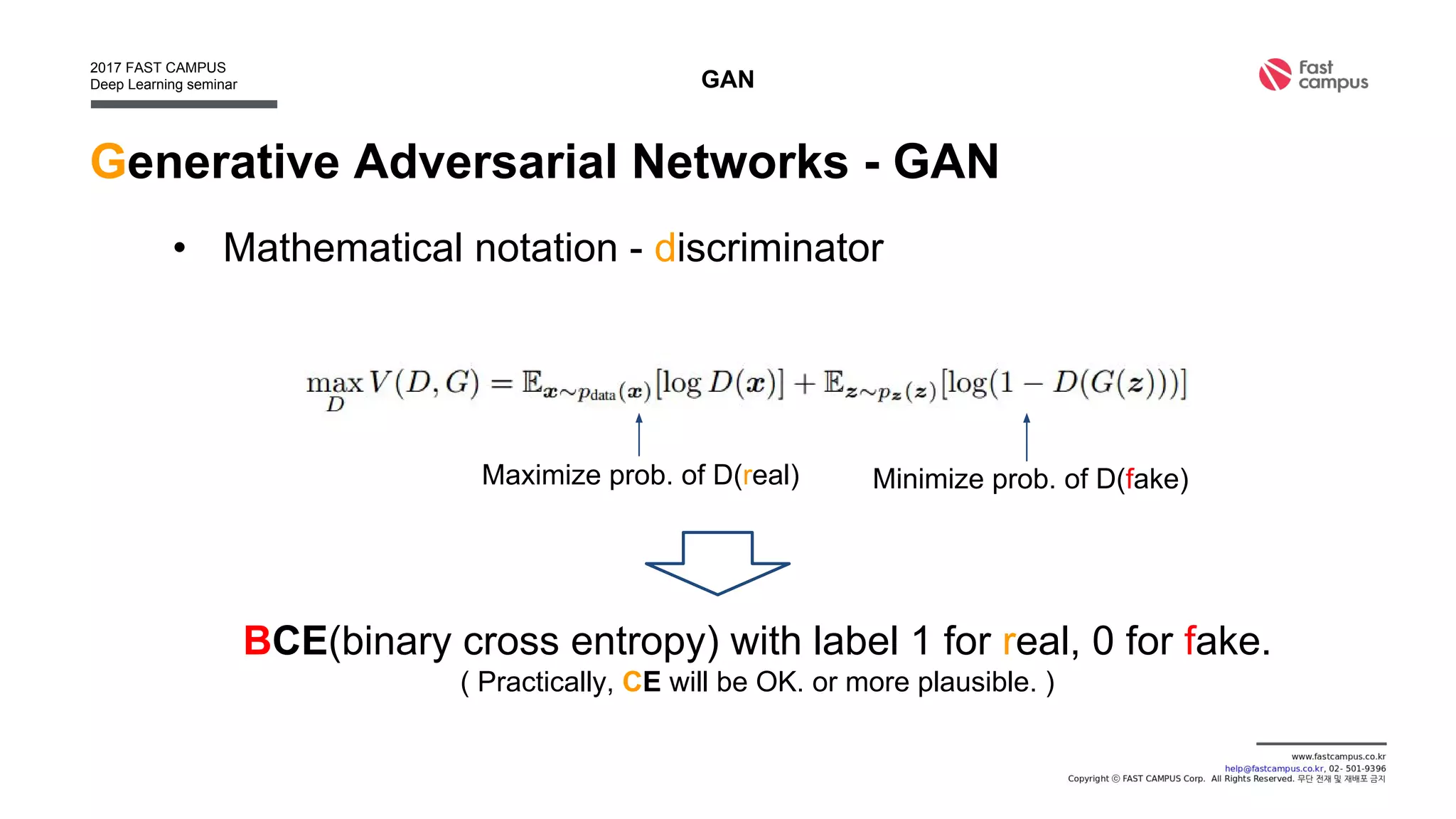
• Mathematical notation - discriminator
GAN
Maximize prob. of D(real) Minimize prob. of D(fake)
BCE(binary cross entropy) with label 1 for real, 0 for fake.
( Practically, CE will be OK. or more plausible. )
Generative Adversarial Networks - GAN
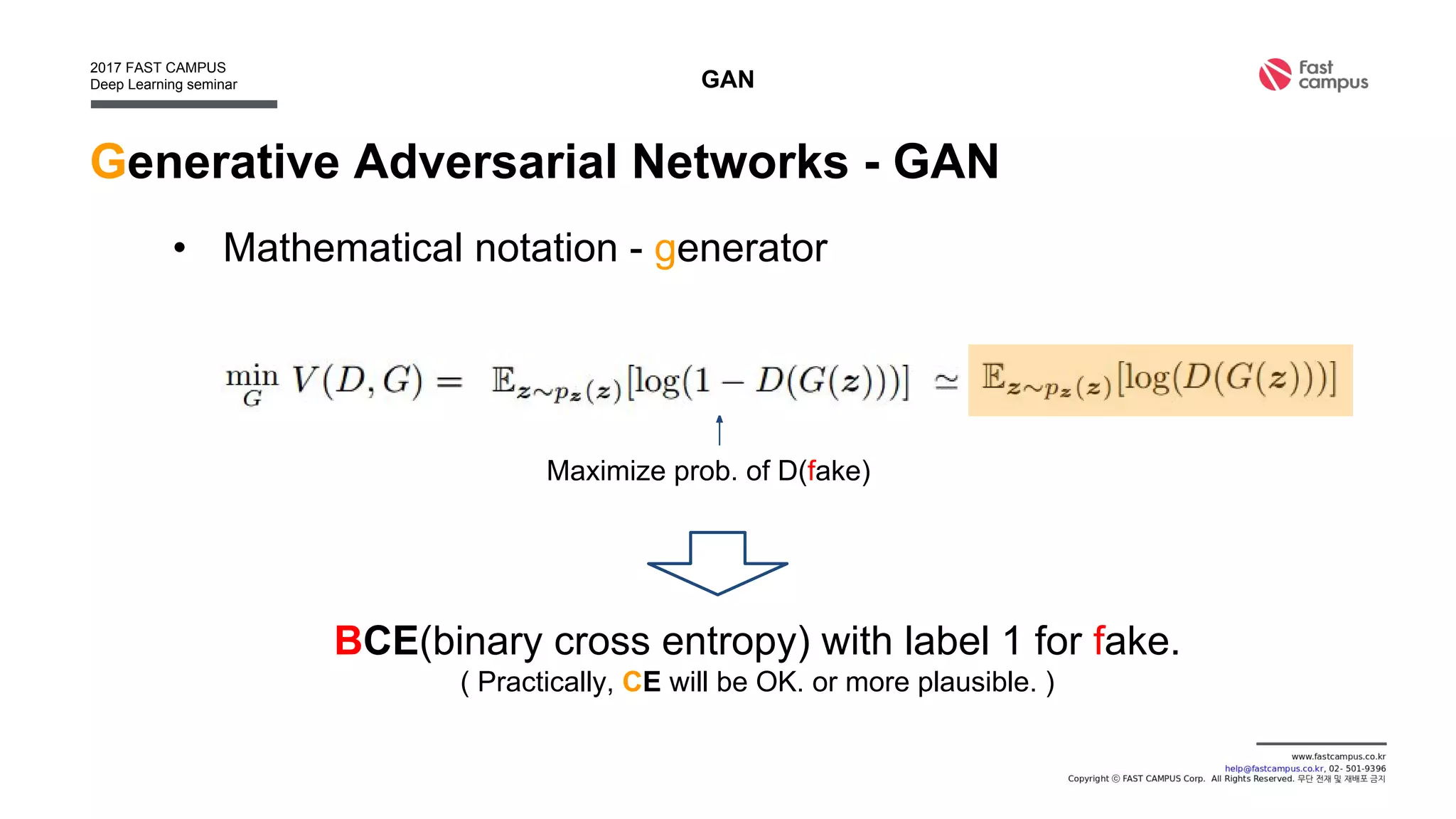
• Mathematical notation - generator
GAN
Maximize prob. of D(fake)
BCE(binary cross entropy) with label 1 for fake.
( Practically, CE will be OK. or more plausible. )
Generative Adversarial Networks - GAN
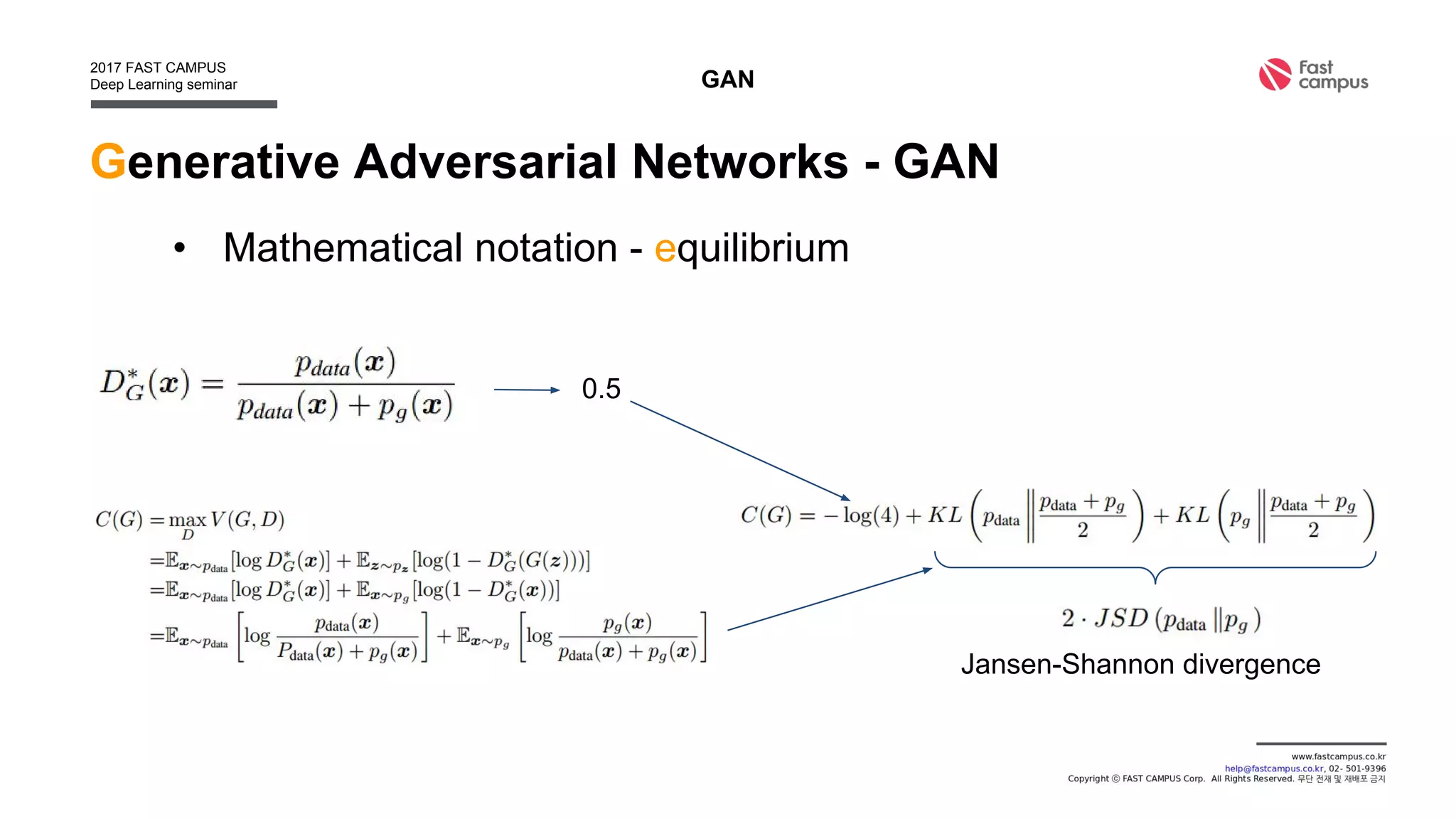
• Mathematical notation - equilibrium
GAN
Jansen-Shannon divergence
0.5
Generative Adversarial Networks - GAN
GAN
Generative Adversarial Networks - GAN
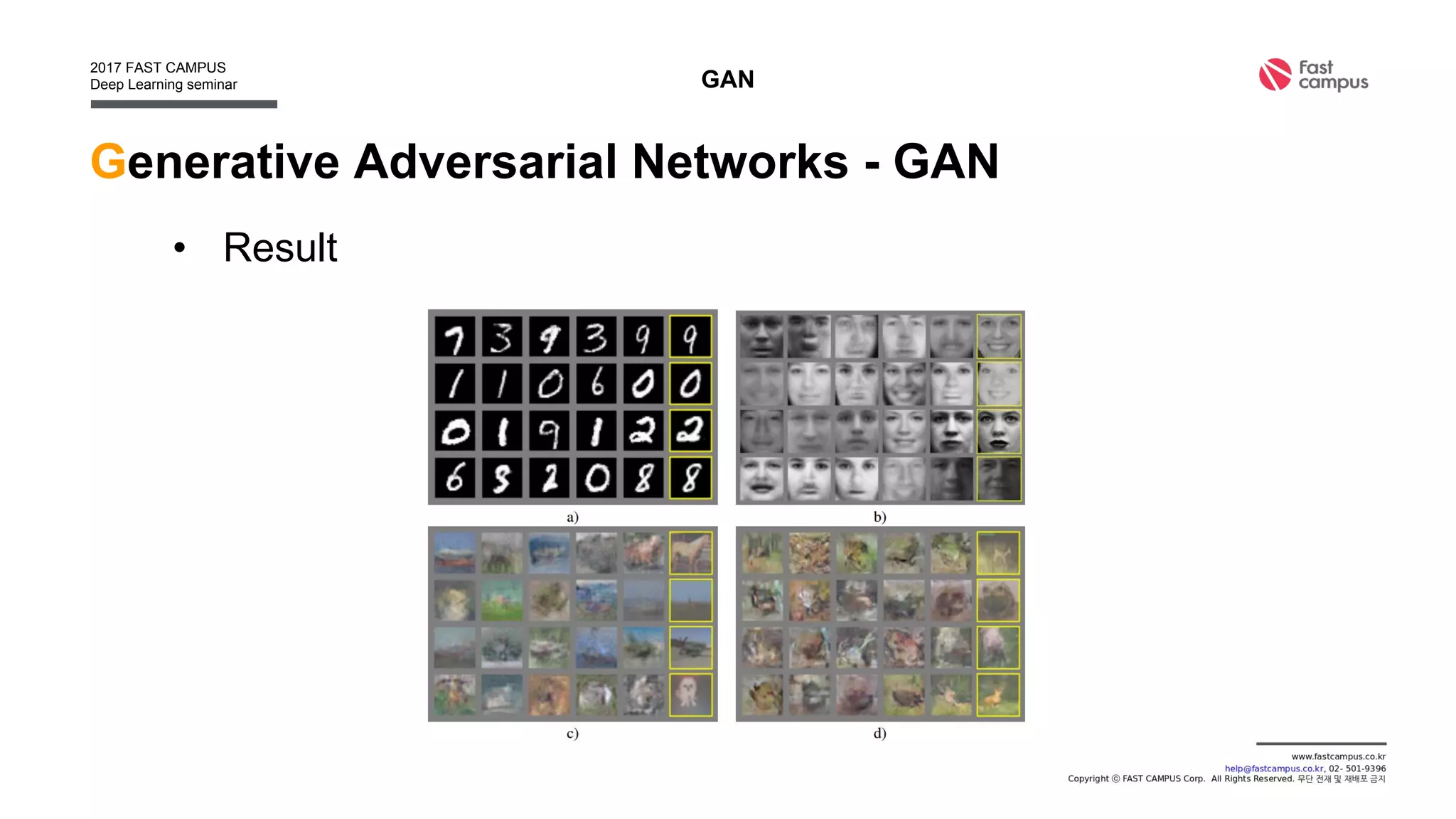
• Result
GAN
Generative Adversarial Networks - GAN
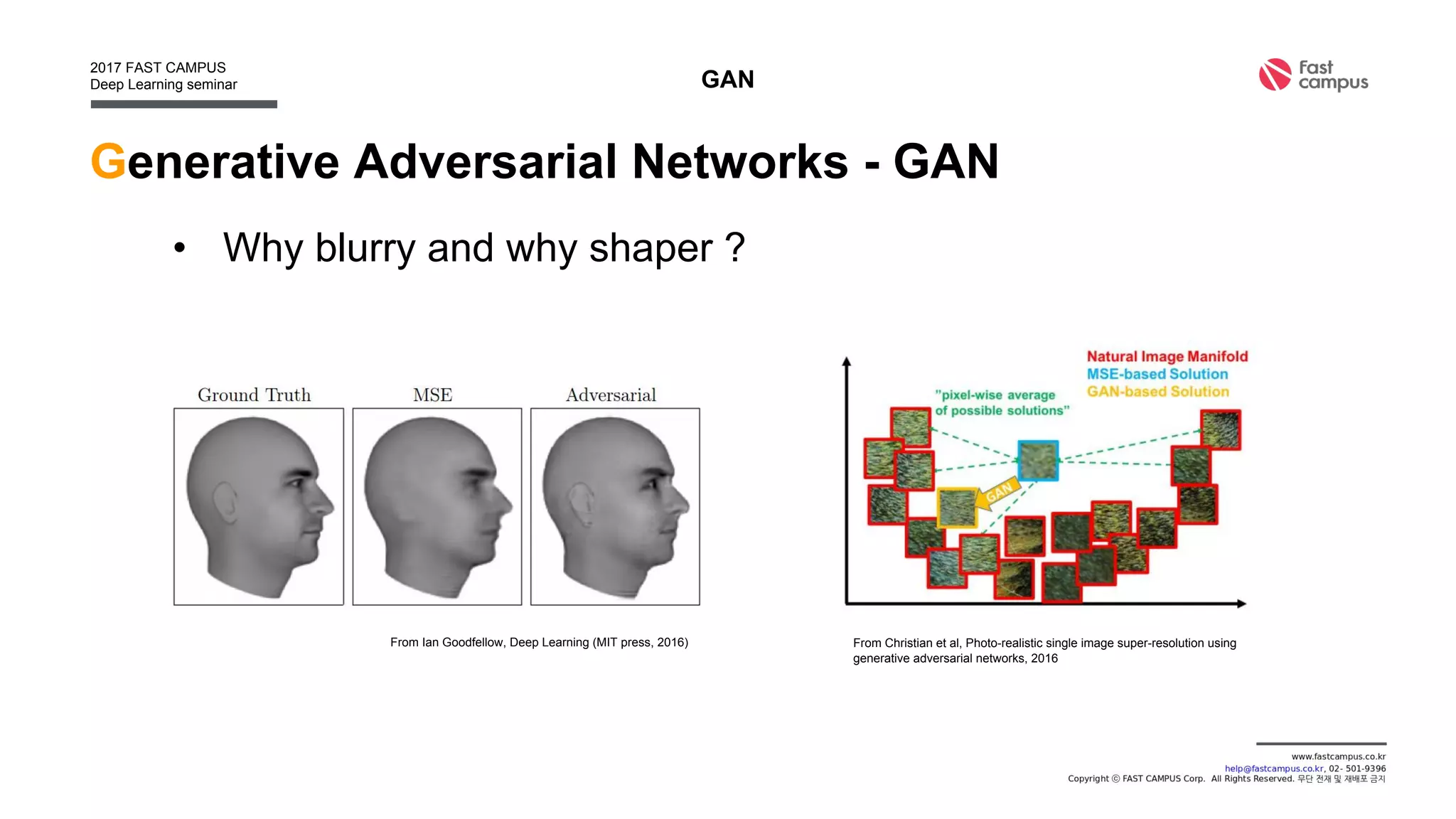
• Why blurry and why sharper ?
GAN
From Ian Goodfellow, Deep Learning (MIT press, 2016) From Christian et al, Photo-realistic single image super-resolution using
generative adversarial networks, 2016
Training GANs
Training GANs
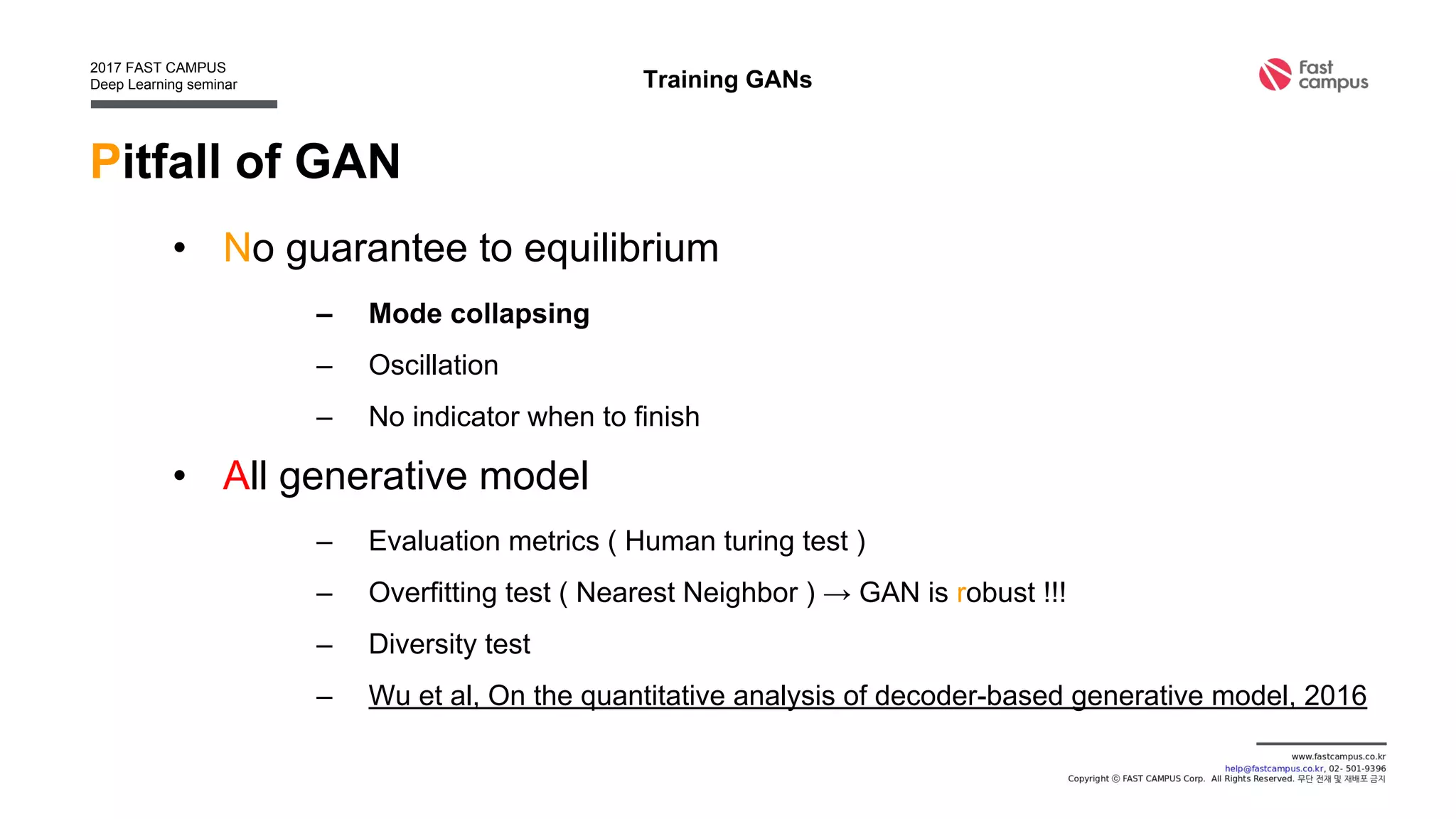
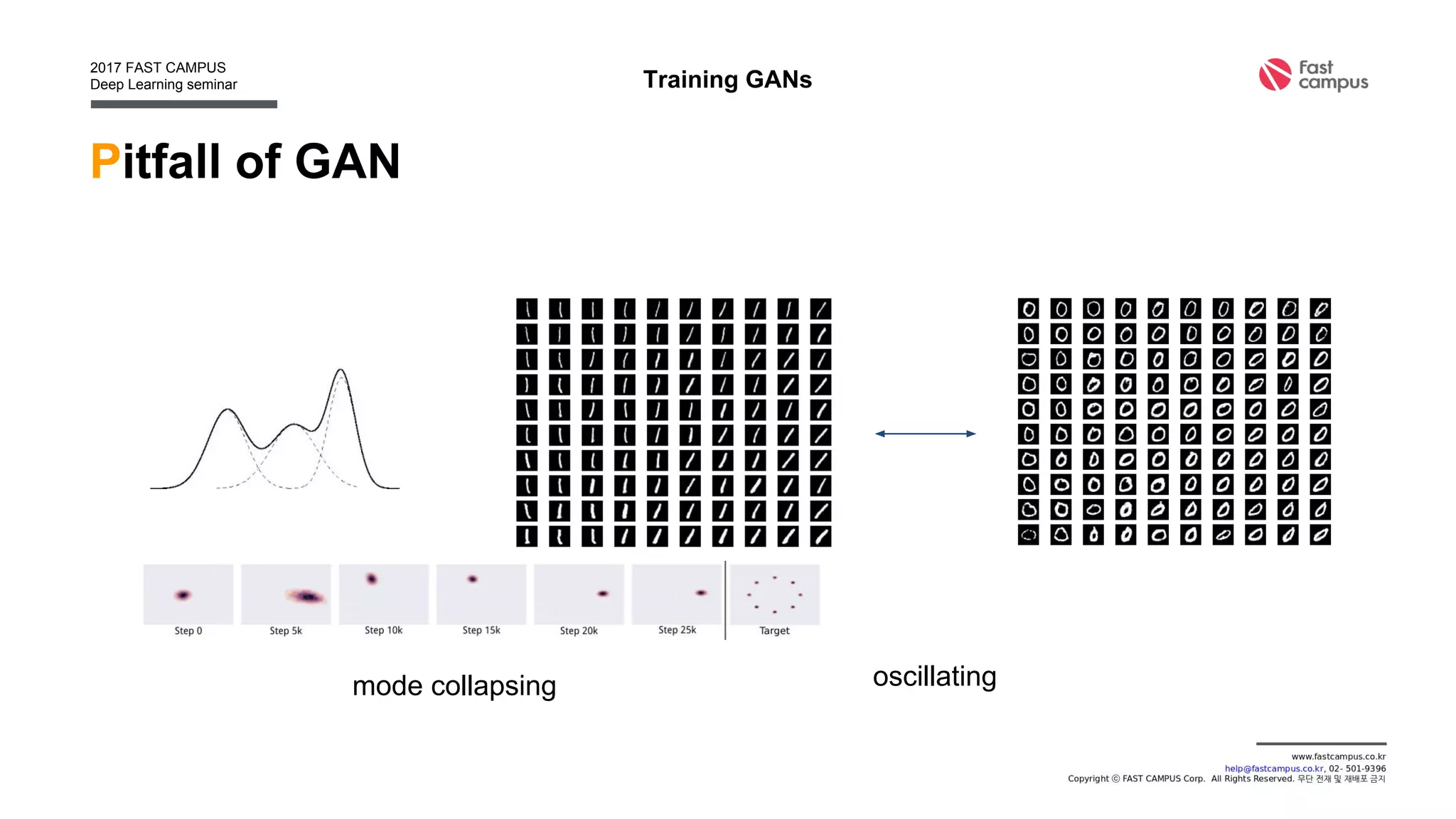
Pitfall of GAN
• No guarantee to equilibrium
– Mode collapsing
– Oscillation
– No indicator when to finish
• All generative model
– Evaluation metrics ( Human turing test )
– Overfitting test ( Nearest Neighbor ) → GAN is robust !!!
– Diversity test
– Wu et al, On the quantitative analysis of decoder-based generative model, 2016
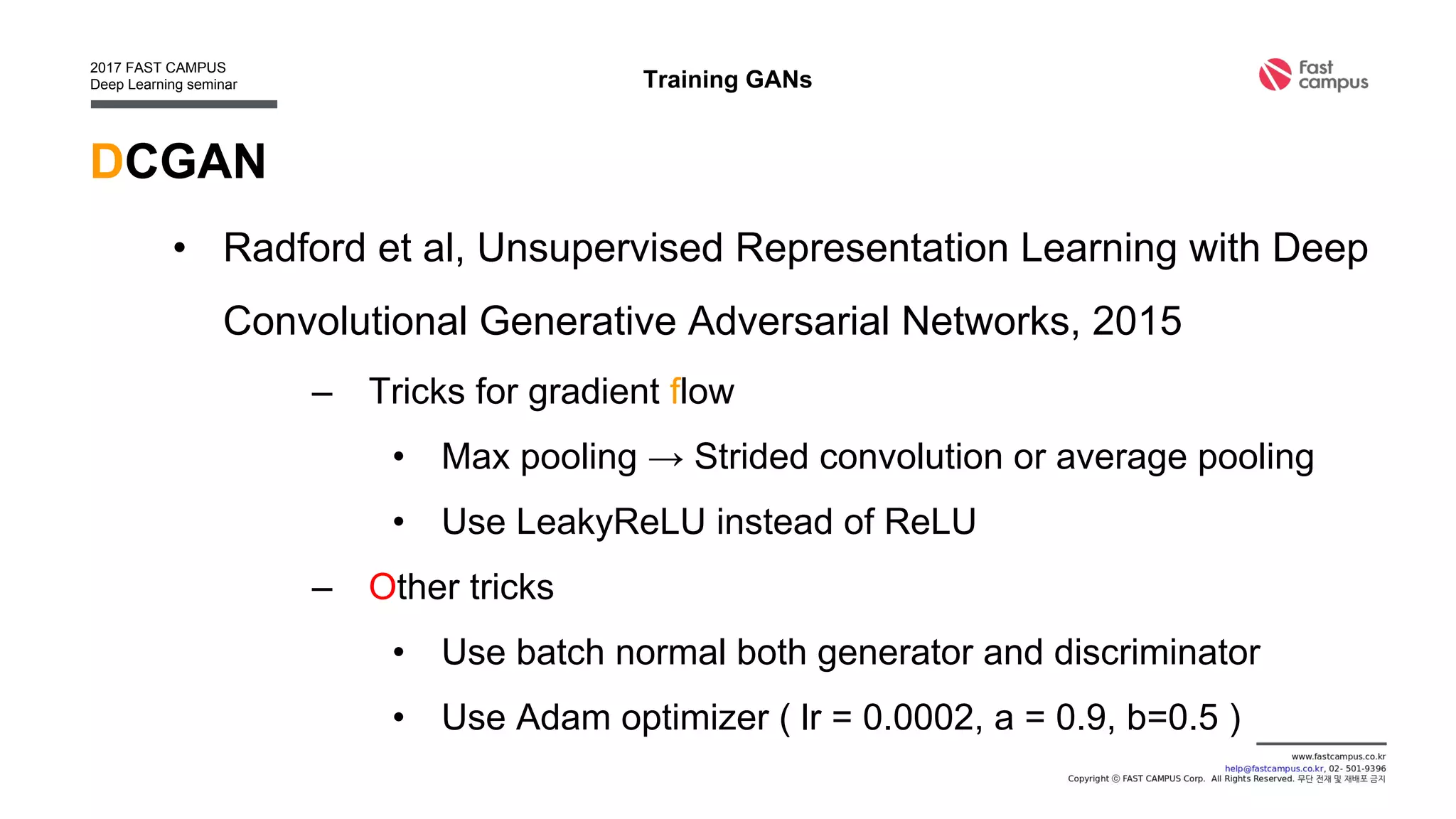
DCGAN
• Radford et al, Unsupervised Representation Learning with Deep
Convolutional Generative Adversarial Networks, 2015
– Tricks for gradient flow
• Max pooling → Strided convolution or average pooling
• Use LeakyReLU instead of ReLU
– Other tricks
• Use batch normal both generator and discriminator
• Use Adam optimizer ( lr = 0.0002, a = 0.9, b=0.5 )
Training GANs
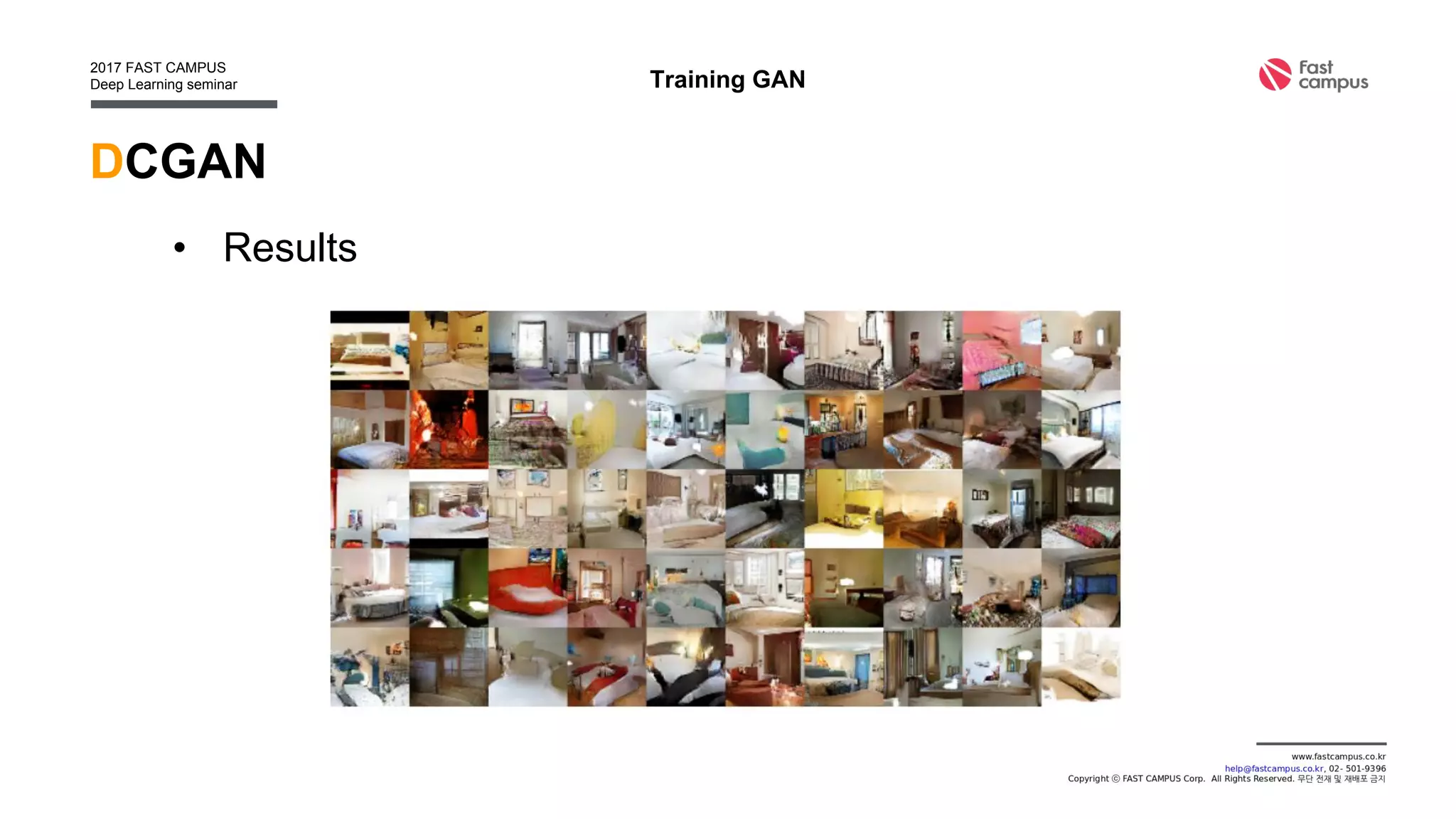
DCGAN
• Results
Training GAN
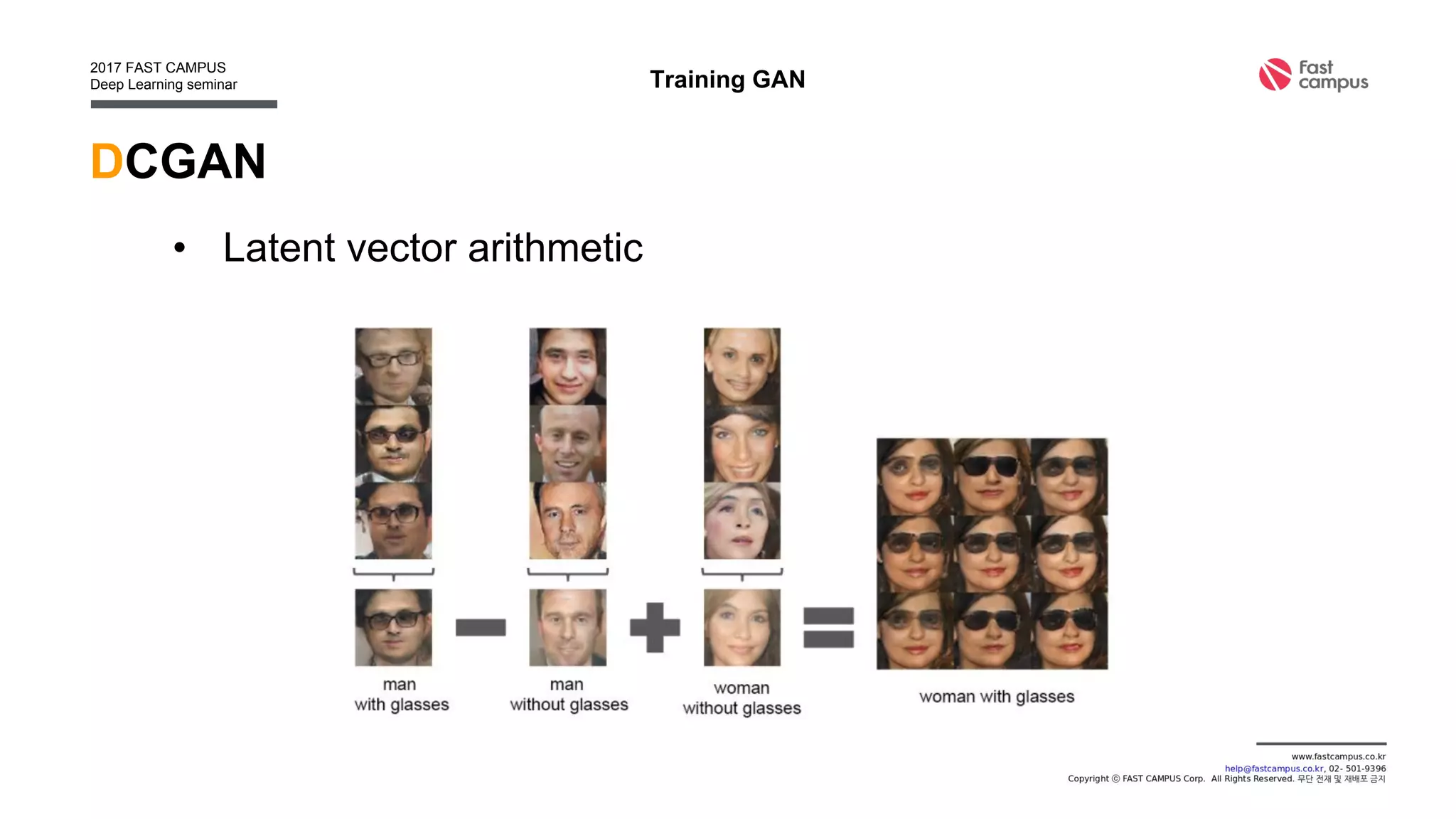
DCGAN
• Latent vector arithmetic
Training GAN
Pitfall of GAN
Training GANs
mode collapsing oscillating
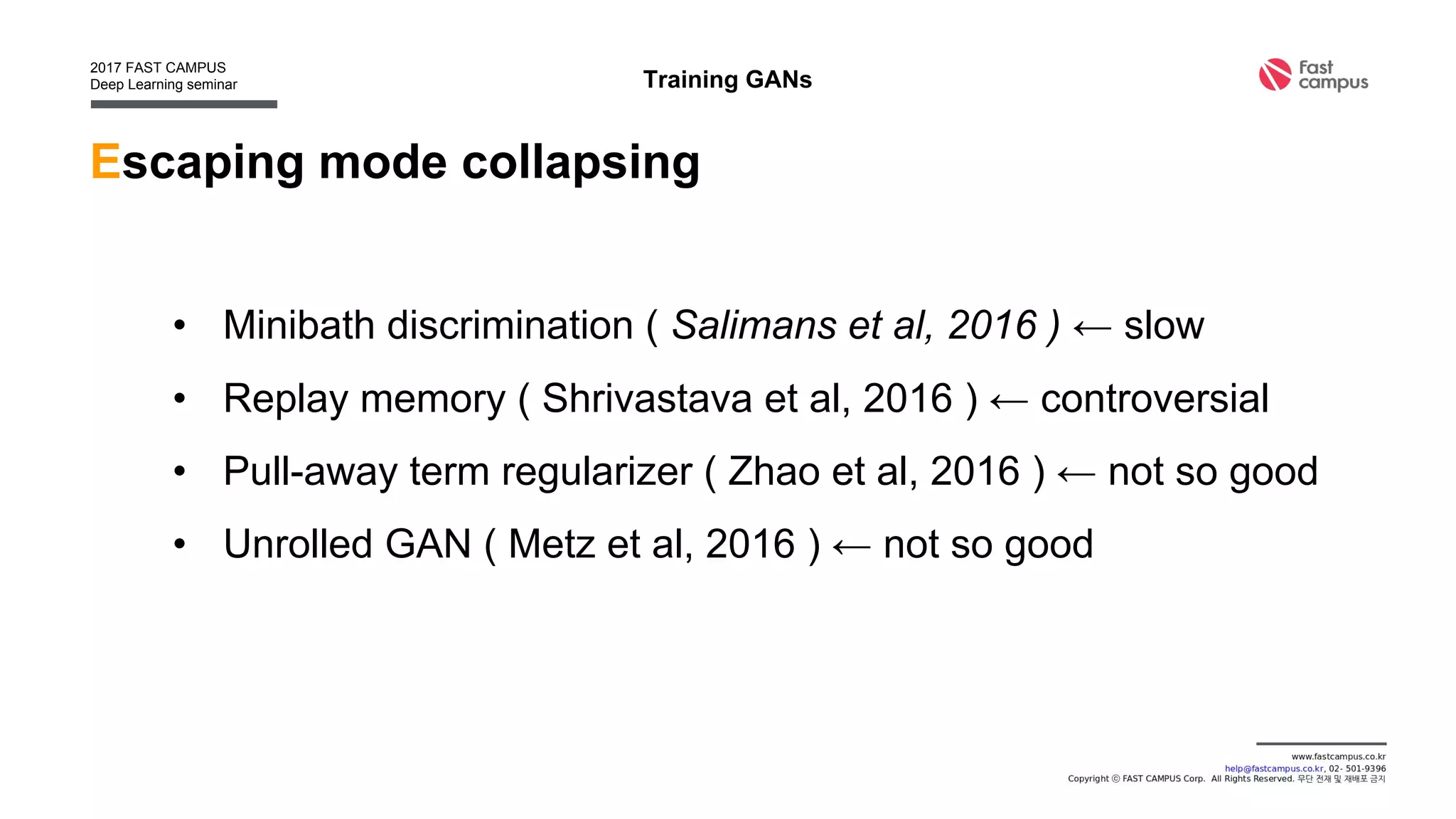
Escaping mode collapsing
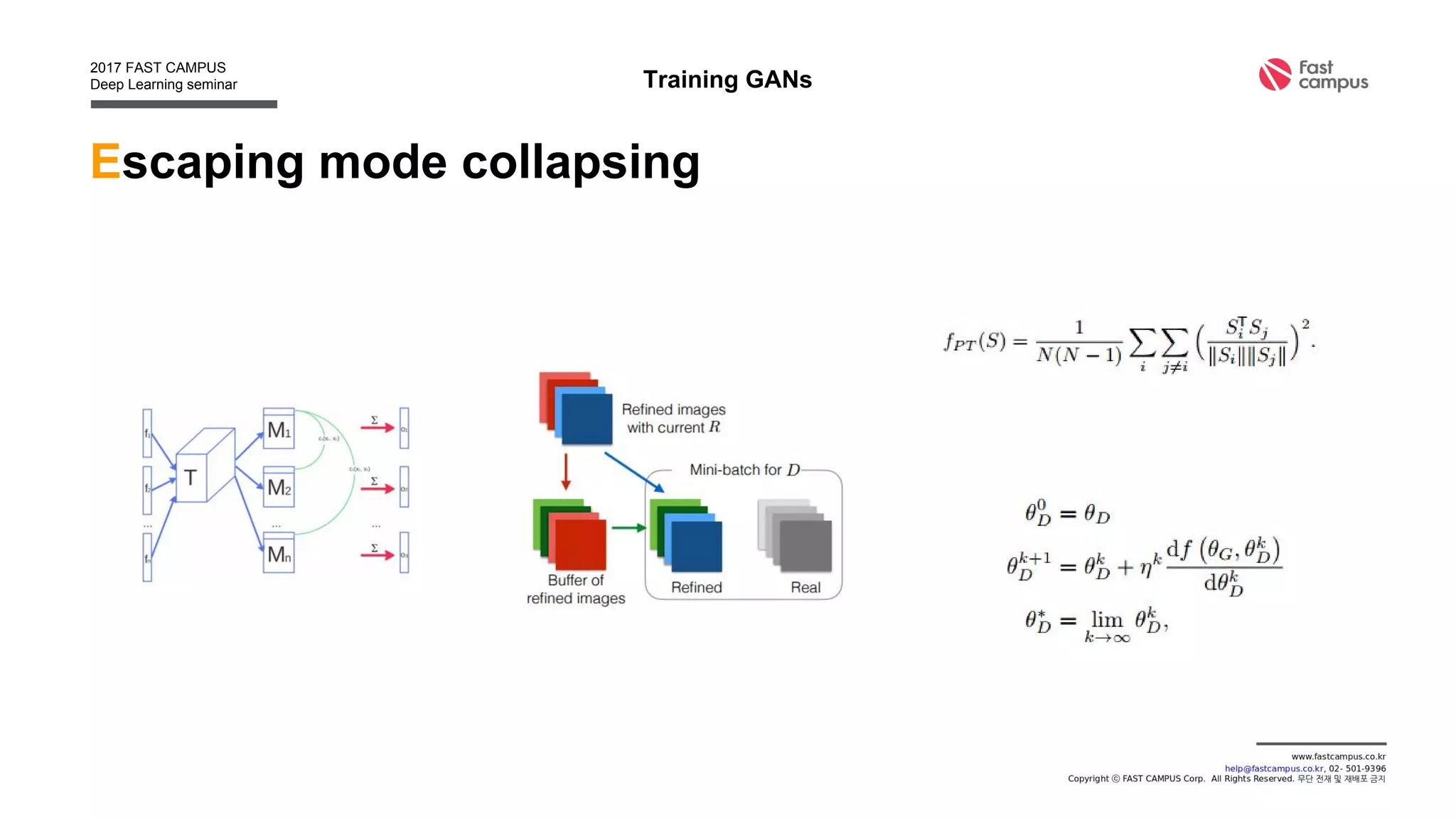
• Minibatch discrimination ( Salimans et al, 2016 ) ← slow
• Replay memory ( Shrivastava et al, 2016 ) ← controversial
• Pull-away term regularizer ( Zhao et al, 2016 ) ← not so good
• Unrolled GAN ( Metz et al, 2016 ) ← not so good
Training GANs
Escaping mode collapsing
• Discriminator ensemble ( Durugkar, 2016) ← not tested
• Latent-Image pair discrimination ( Donahue et al, 2016,
Dumoulin et al, 2016 ) ← Good ( additional computing time )
• InfoGAN ( Chen et al, 2016 ) ← Good
Training GANs
Escaping mode collapsing
Training GANs
Other tricks
• Salimans et al, Improved Techniques for Training GANs, 2016
• https://github.com/soumith/ganhacks
– One-sided label smoothing ← not sure
– Historical averaging ← Unrolled GAN is better
– Feature matching ← working
– Use noise or dropout into real/fake image ← working
– Don’t balance D and G loss ← I agree
Training GANs
Batch normalization in GAN
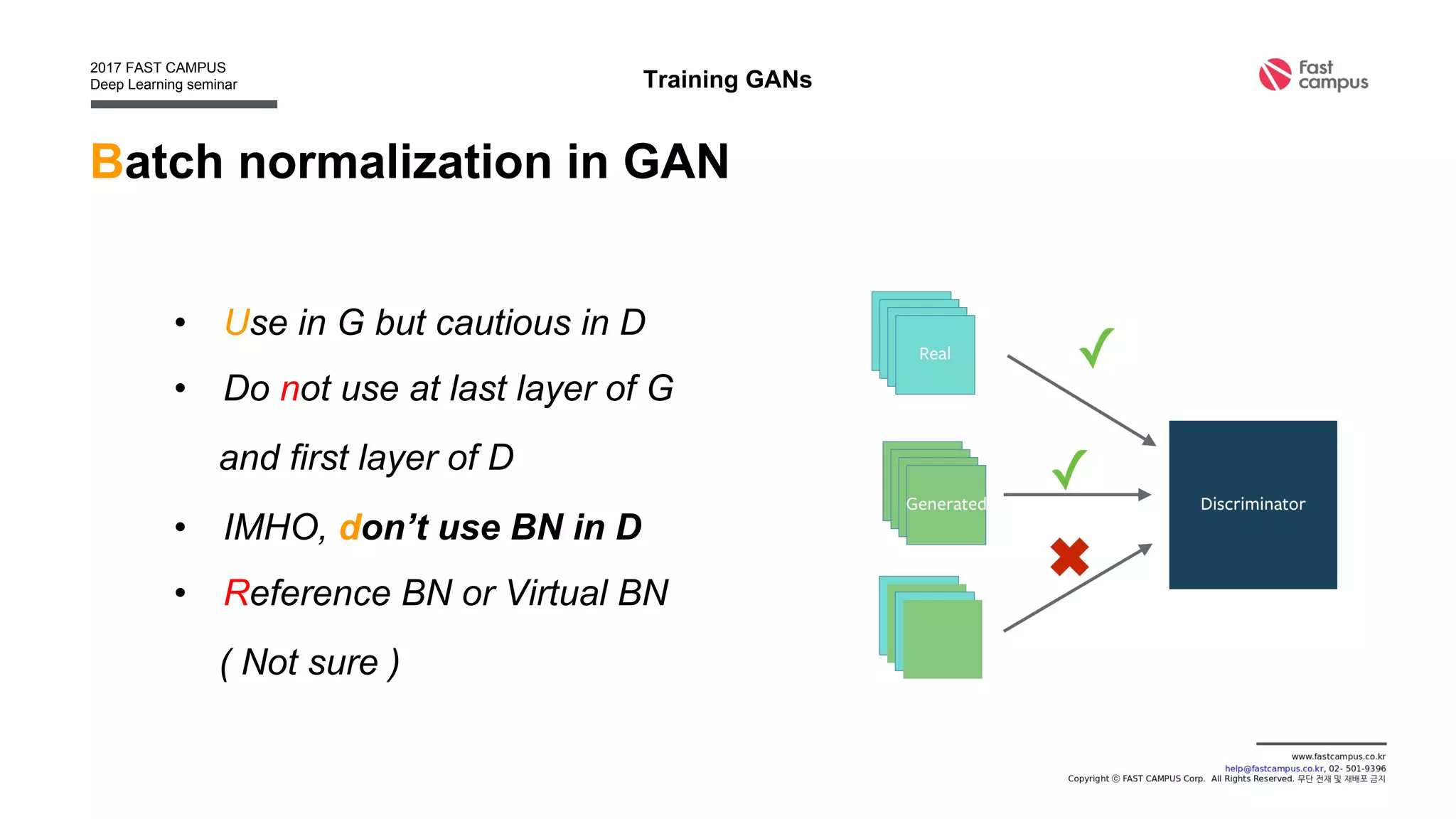
• Use in G but cautious in D
• Do not use at last layer of G
and first layer of D
• IMHO, don’t use BN in D
• Reference BN or Virtual BN
( Not sure )
Training GANs
Variants of GANs
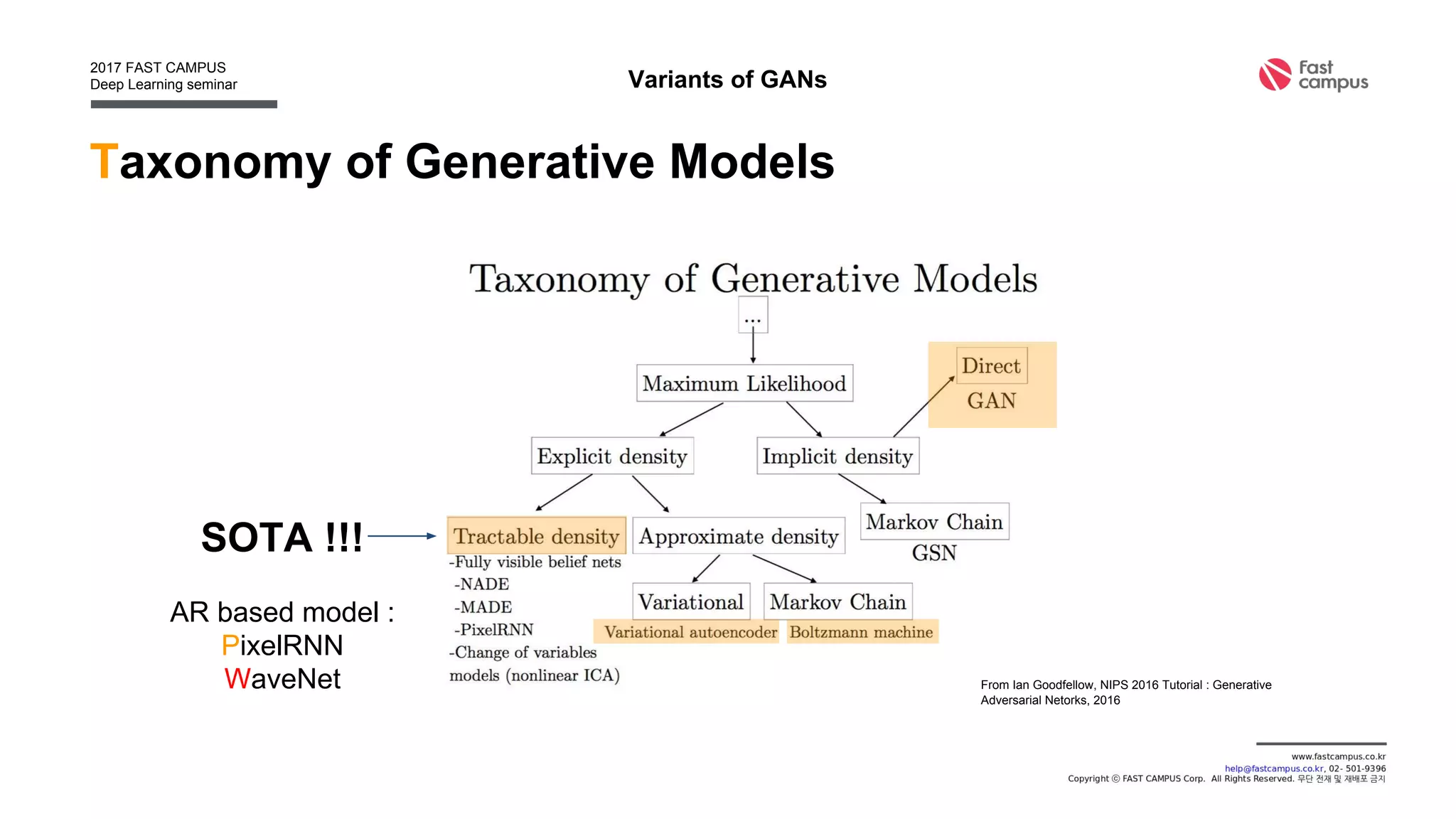
Taxonomy of Generative Models
Variants of GANs
From Ian Goodfellow, NIPS 2016 Tutorial : Generative
Adversarial Netorks, 2016
SOTA !!!
AR based model :
PixelRNN
WaveNet
Variants of GANs
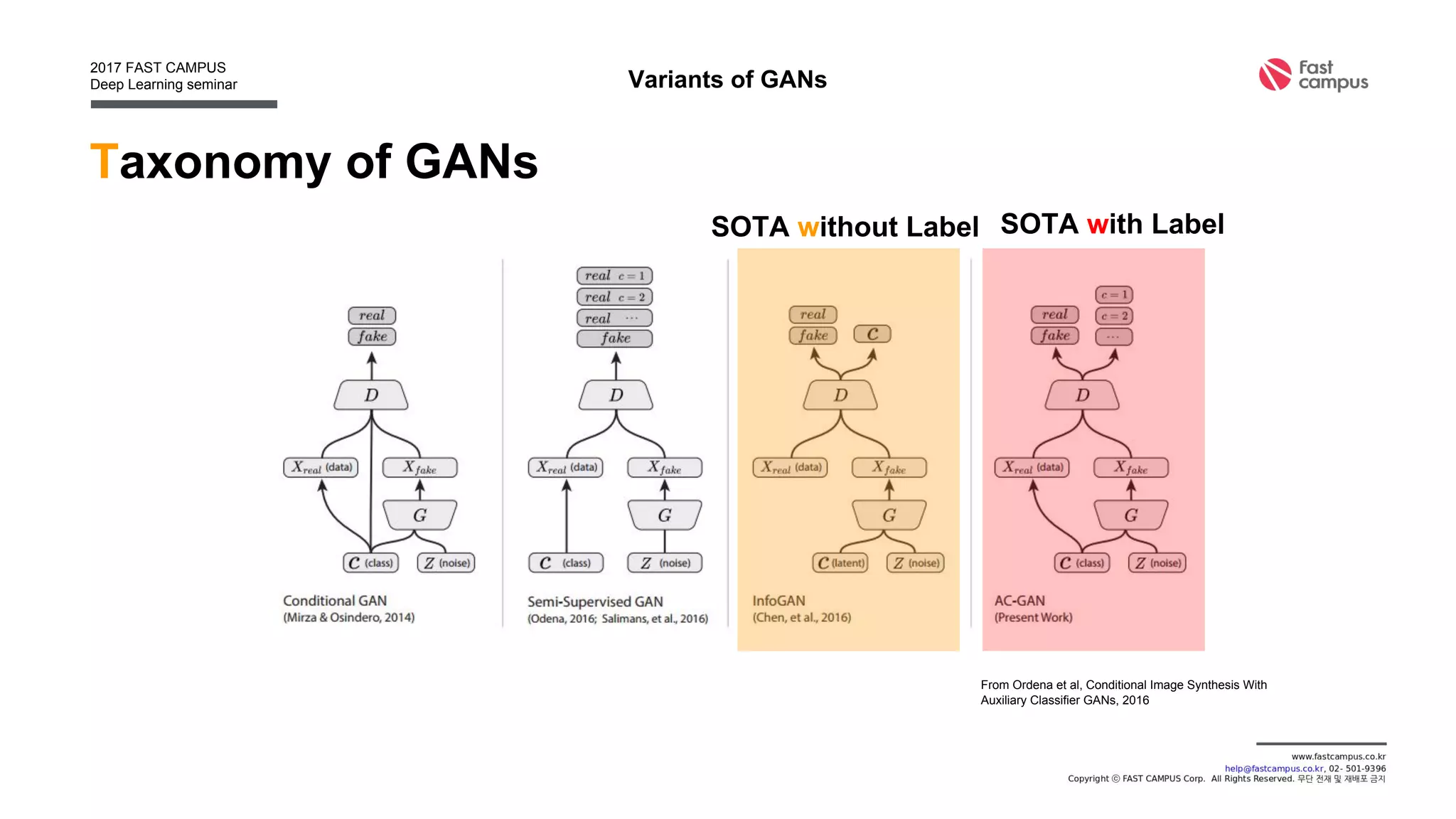
From Ordena et al, Conditional Image Synthesis With
Auxiliary Classifier GANs, 2016
SOTA with LabelSOTA without Label
Taxonomy of GANs
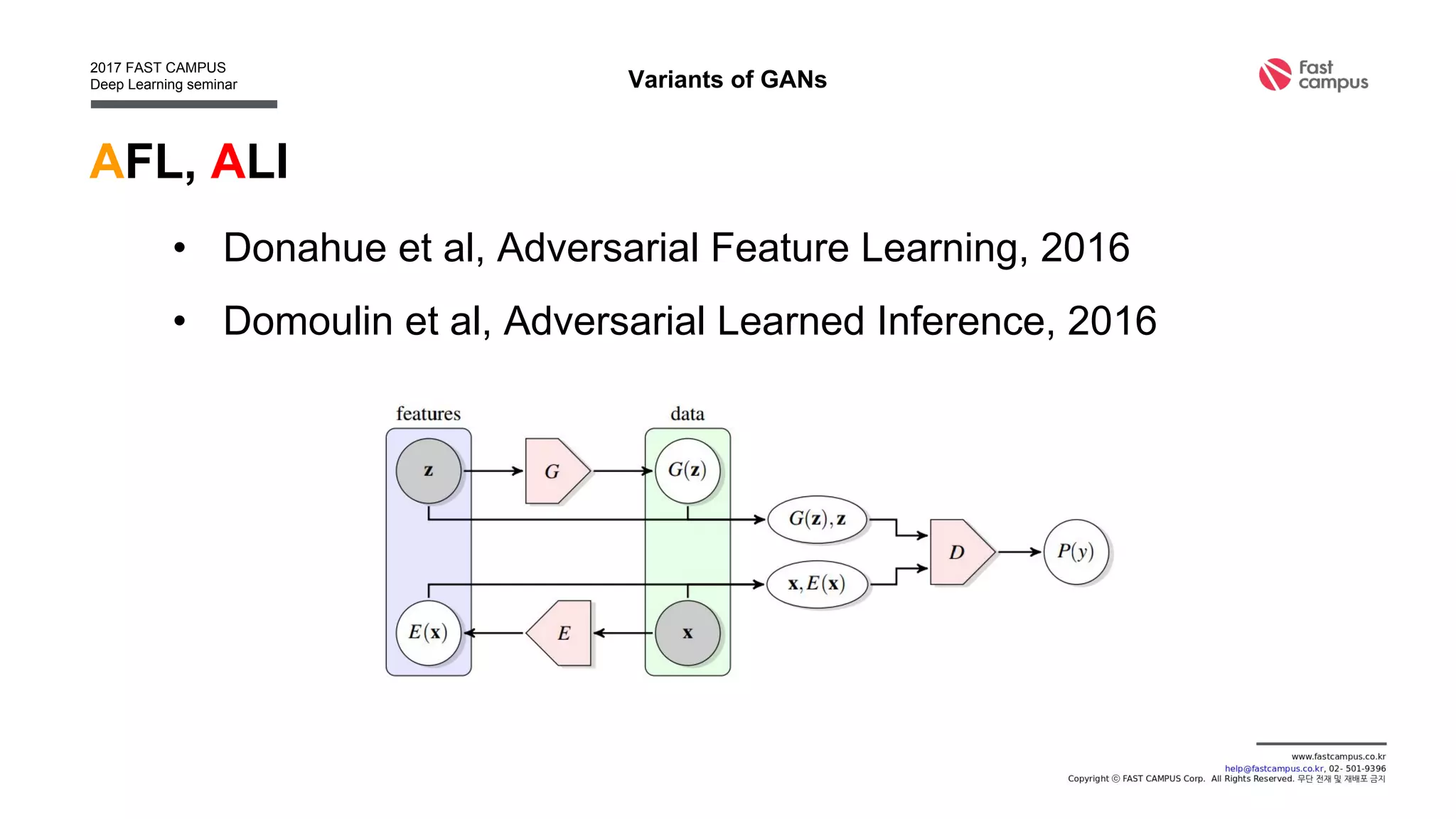
AFL, ALI
• Donahue et al, Adversarial Feature Learning, 2016
• Domoulin et al, Adversarial Learned Inference, 2016
Variants of GANs
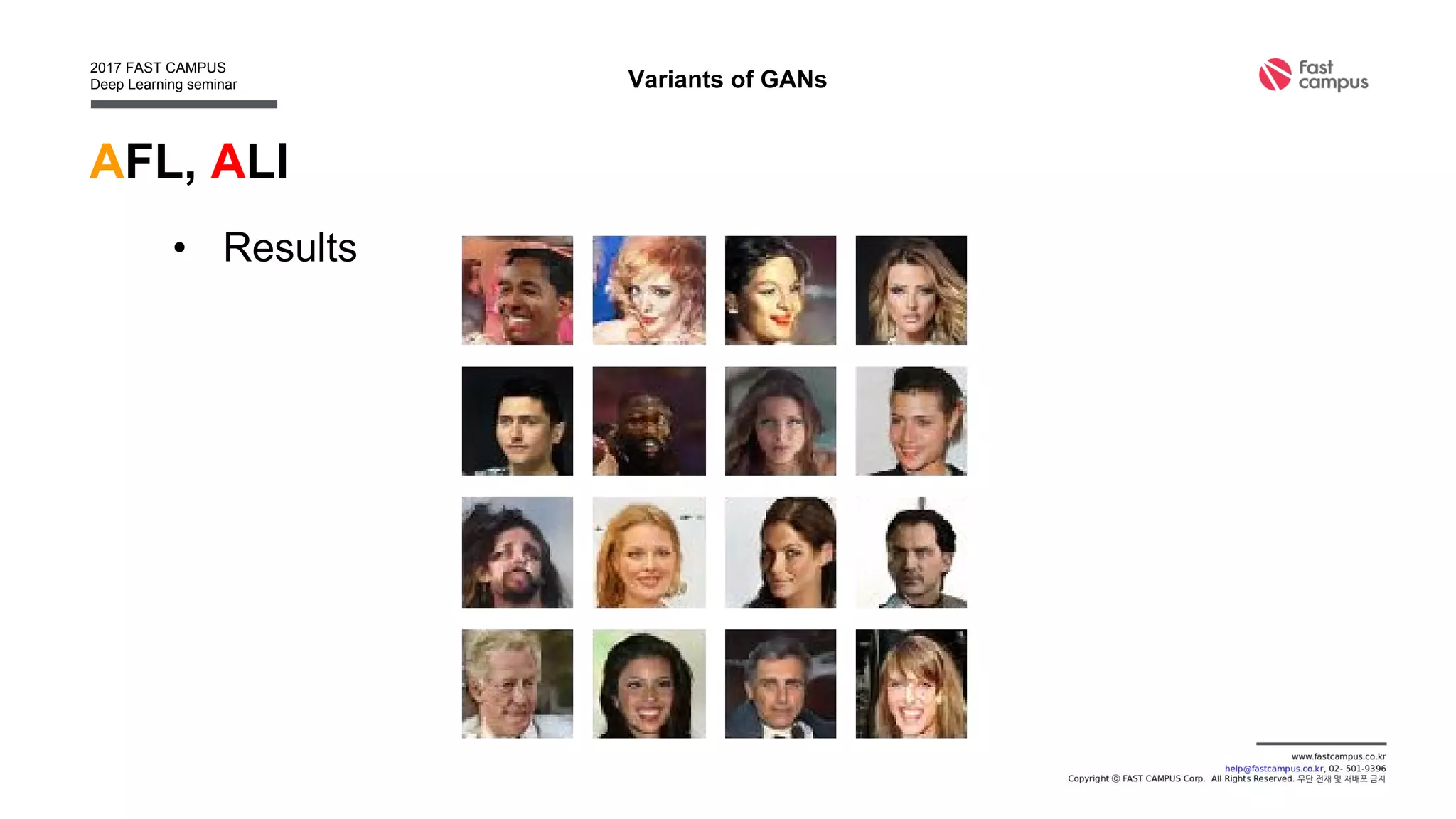
AFL, ALI
• Results
Variants of GANs
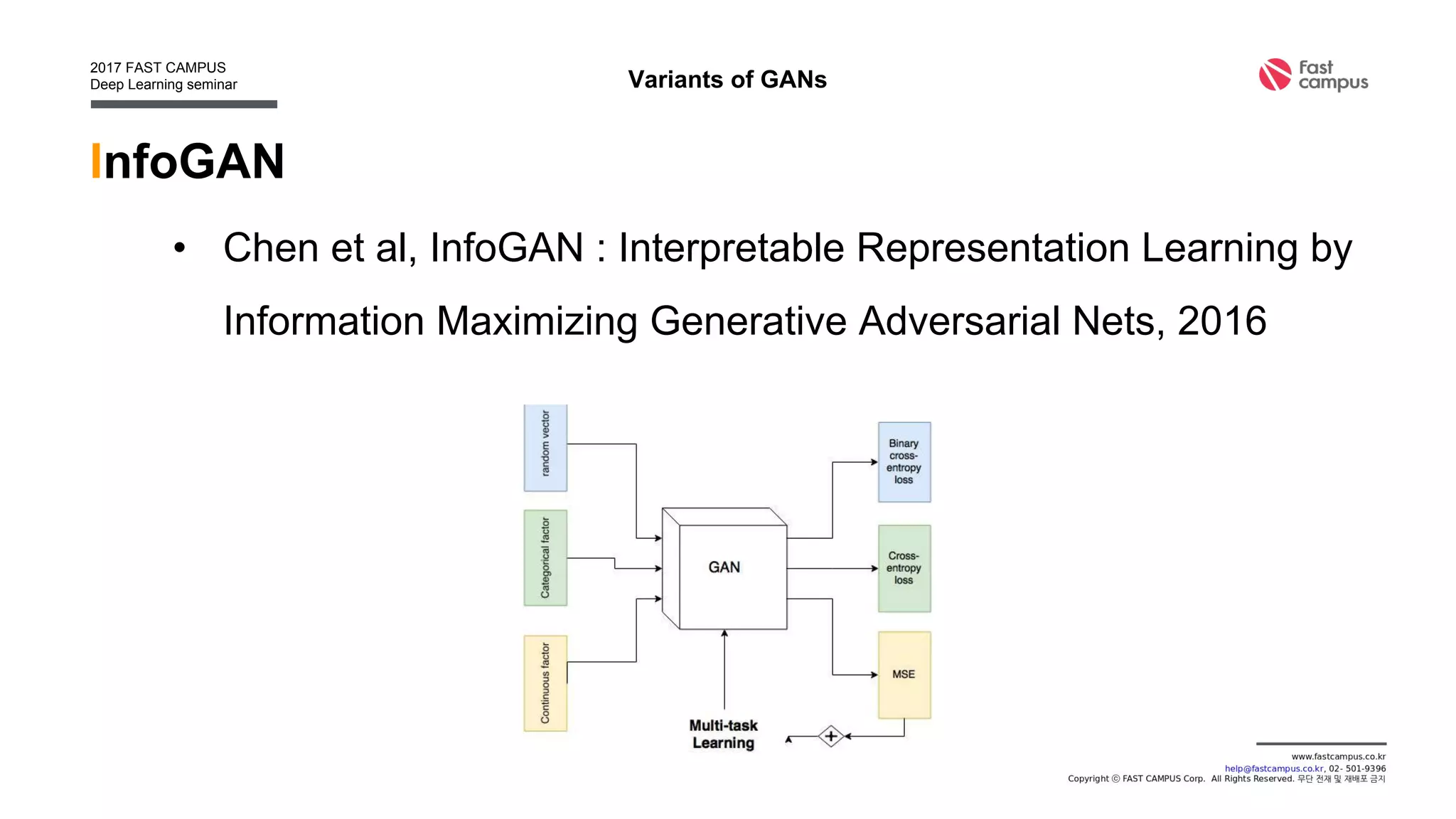
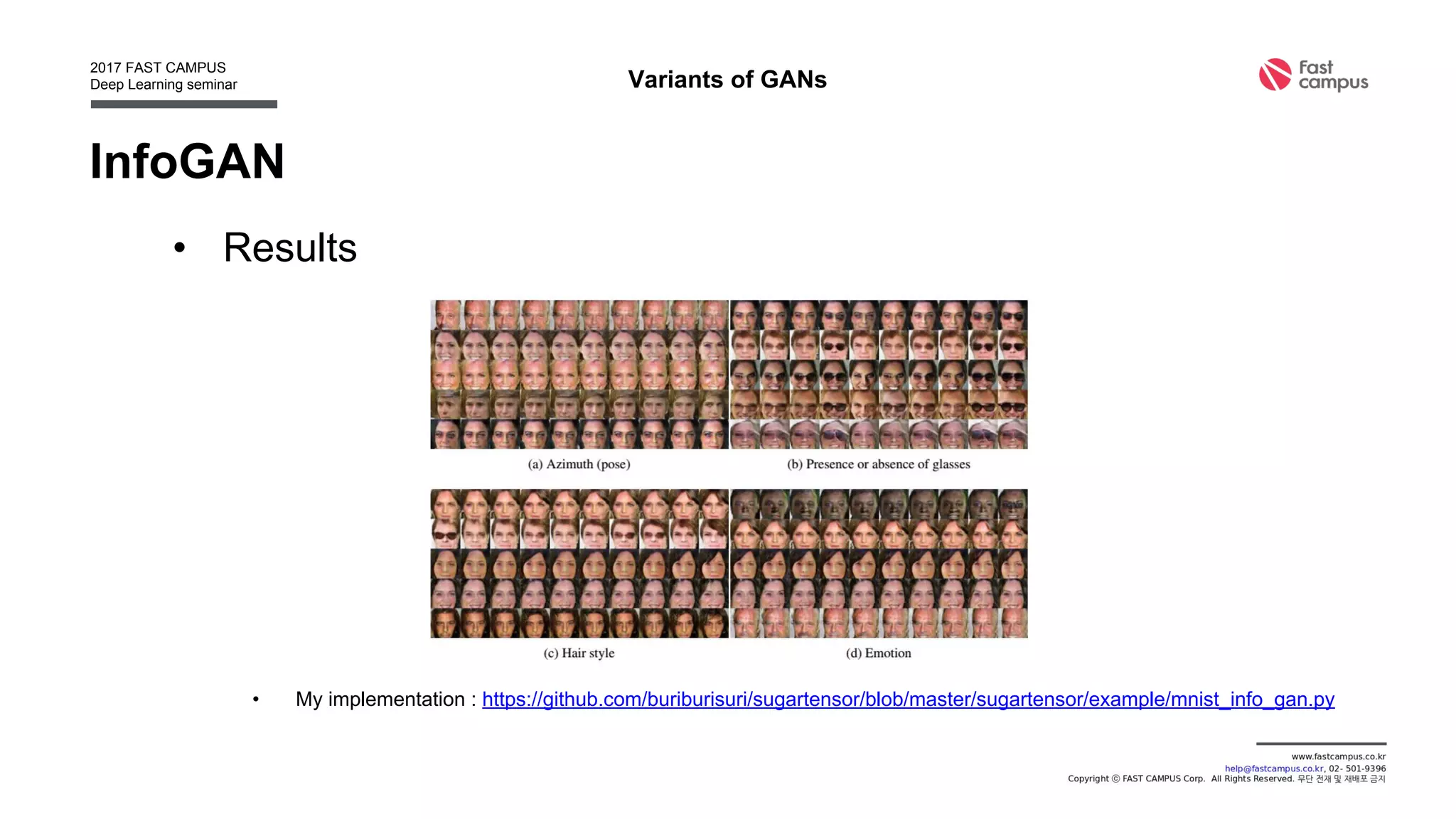
InfoGAN
• Chen et al, InfoGAN : Interpretable Representation Learning by
Information Maximizing Generative Adversarial Nets, 2016
Variants of GANs
InfoGAN
• Results
• My implementation : https://github.com/buriburisuri/sugartensor/blob/master/sugartensor/example/mnist_info_gan.py
Variants of GANs
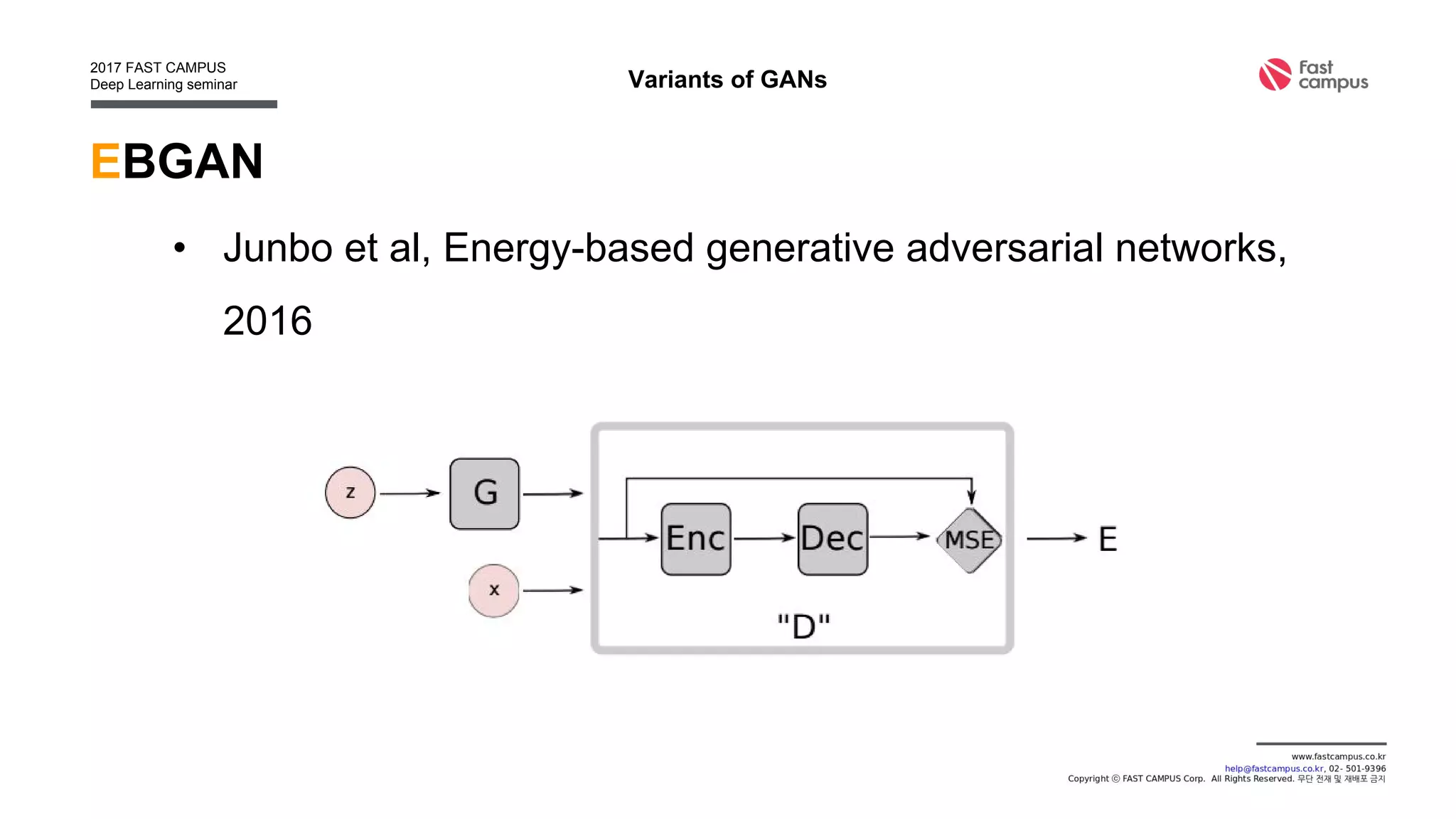
EBGAN
• Junbo et al, Energy-based generative adversarial networks,
2016
Variants of GANs
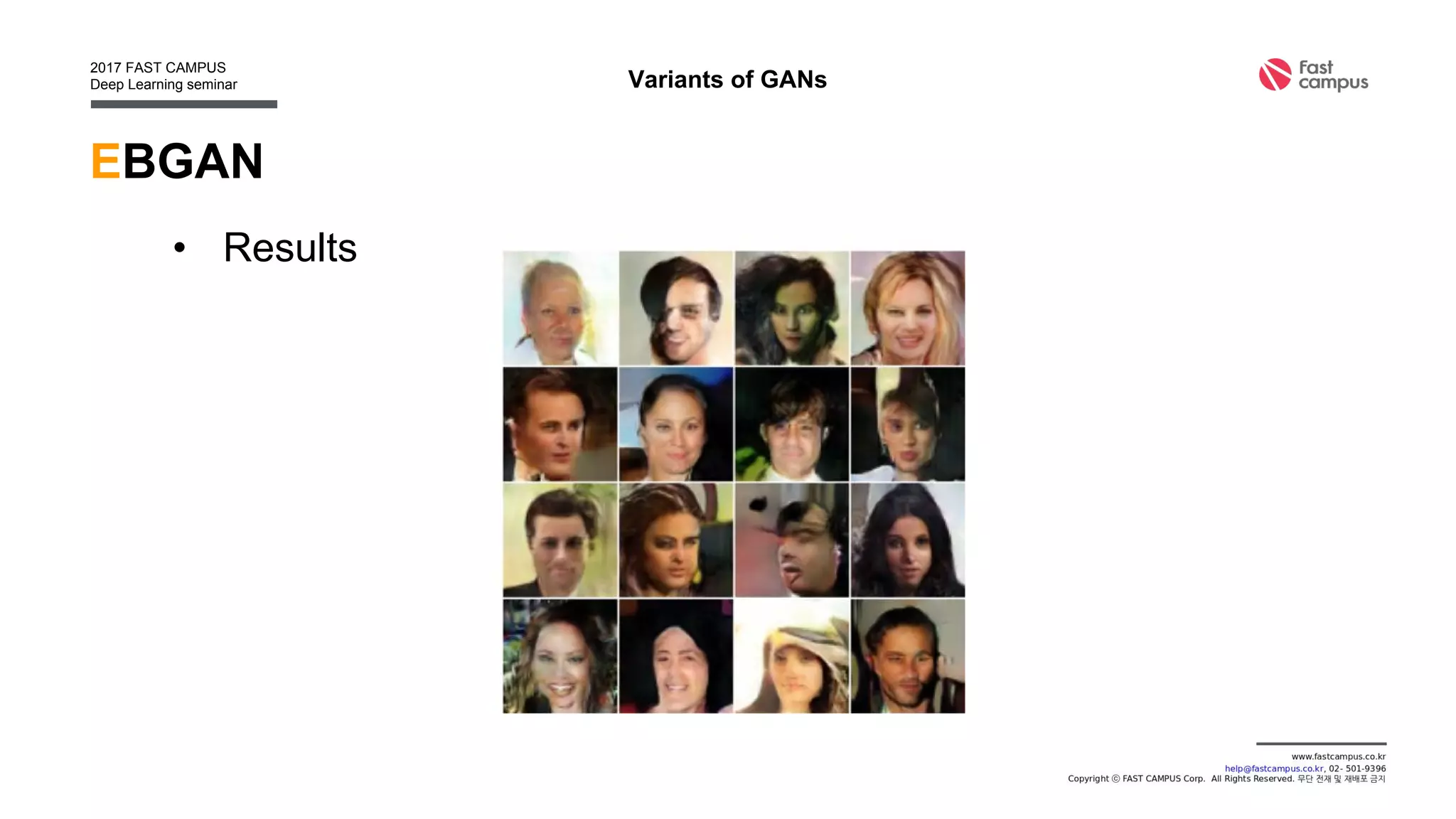
EBGAN
• Results
Variants of GANs
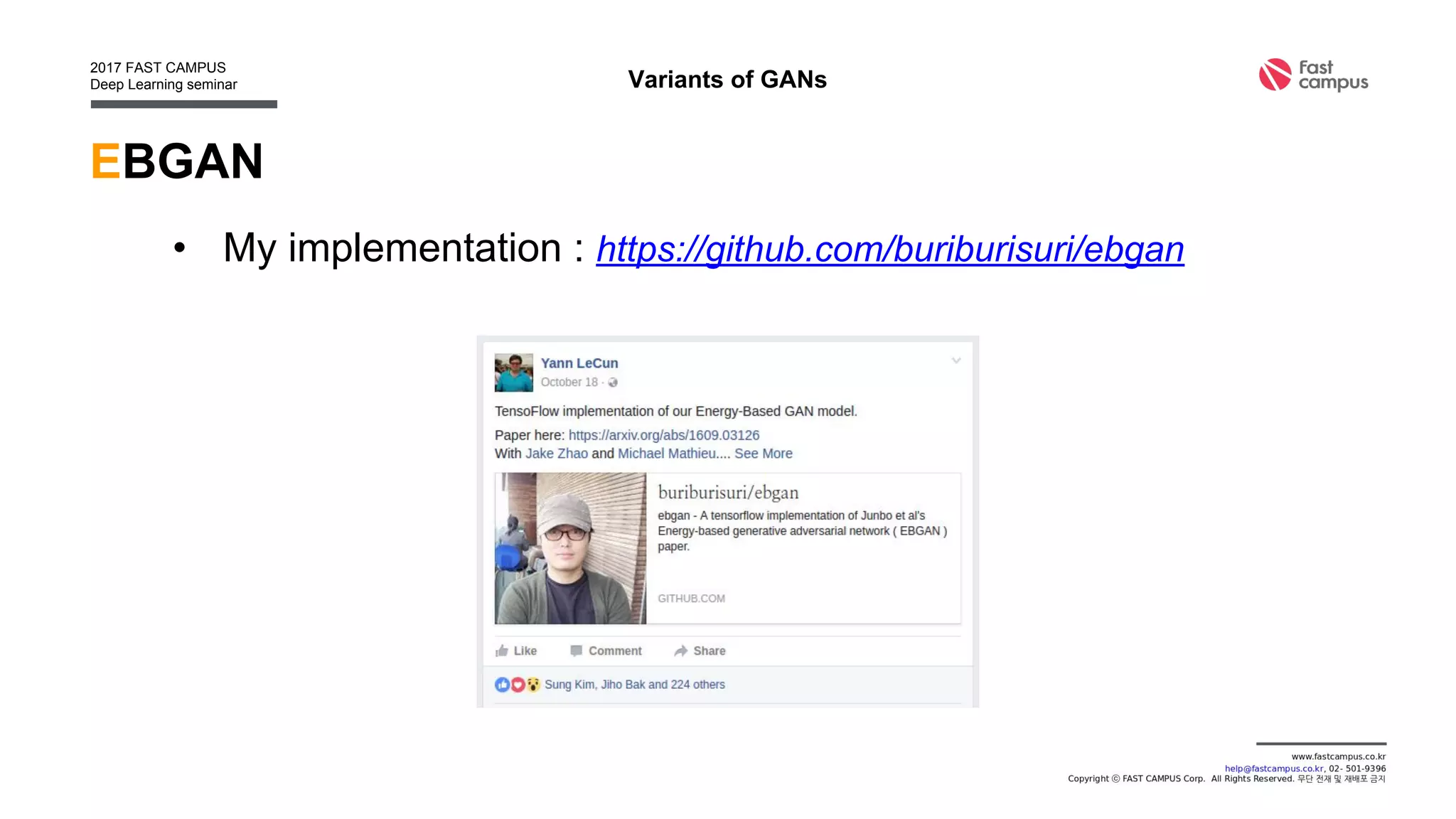
EBGAN
• My implementation : https://github.com/buriburisuri/ebgan
Variants of GANs
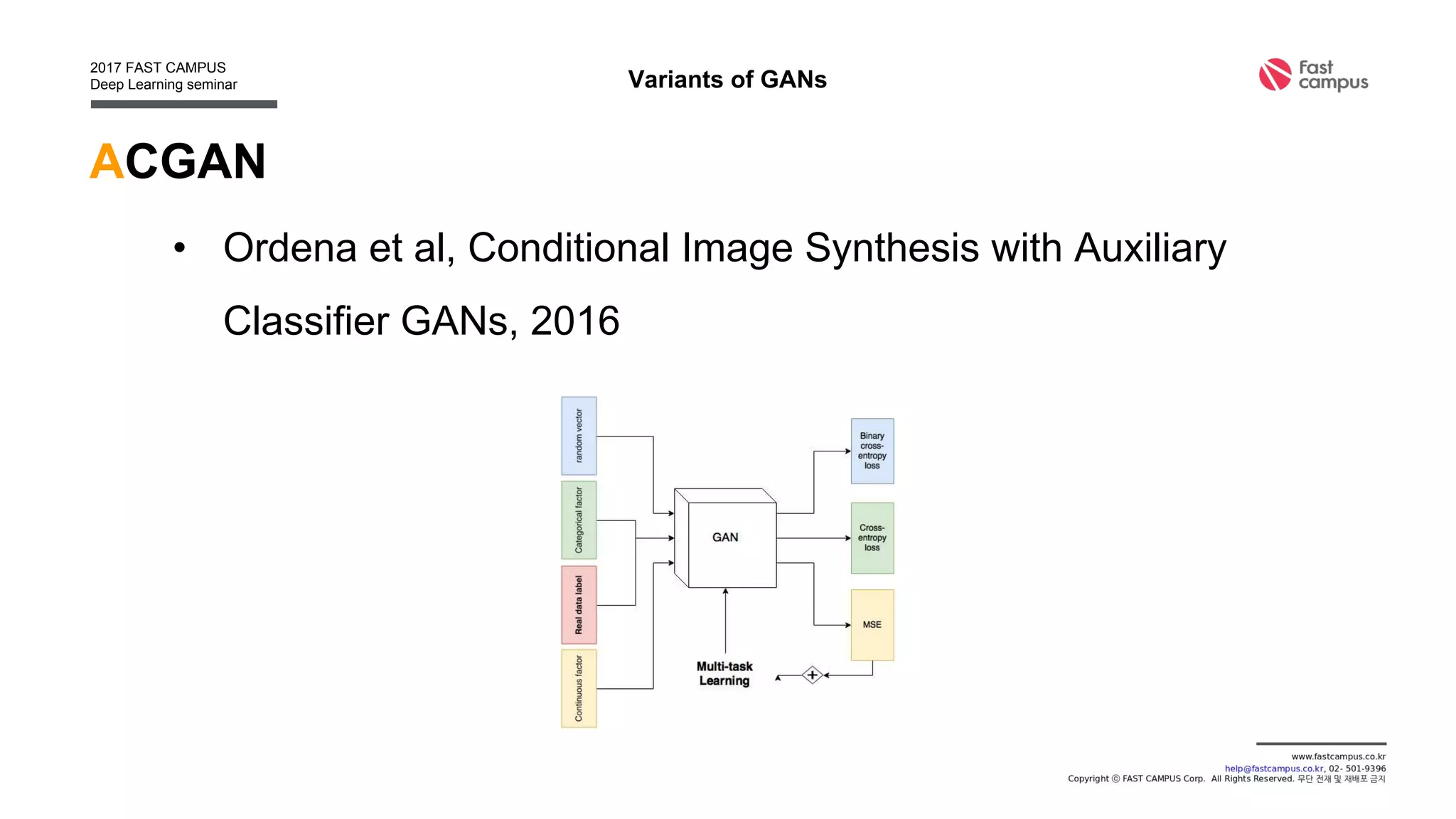
ACGAN
• Ordena et al, Conditional Image Synthesis with Auxiliary
Classifier GANs, 2016
Variants of GANs
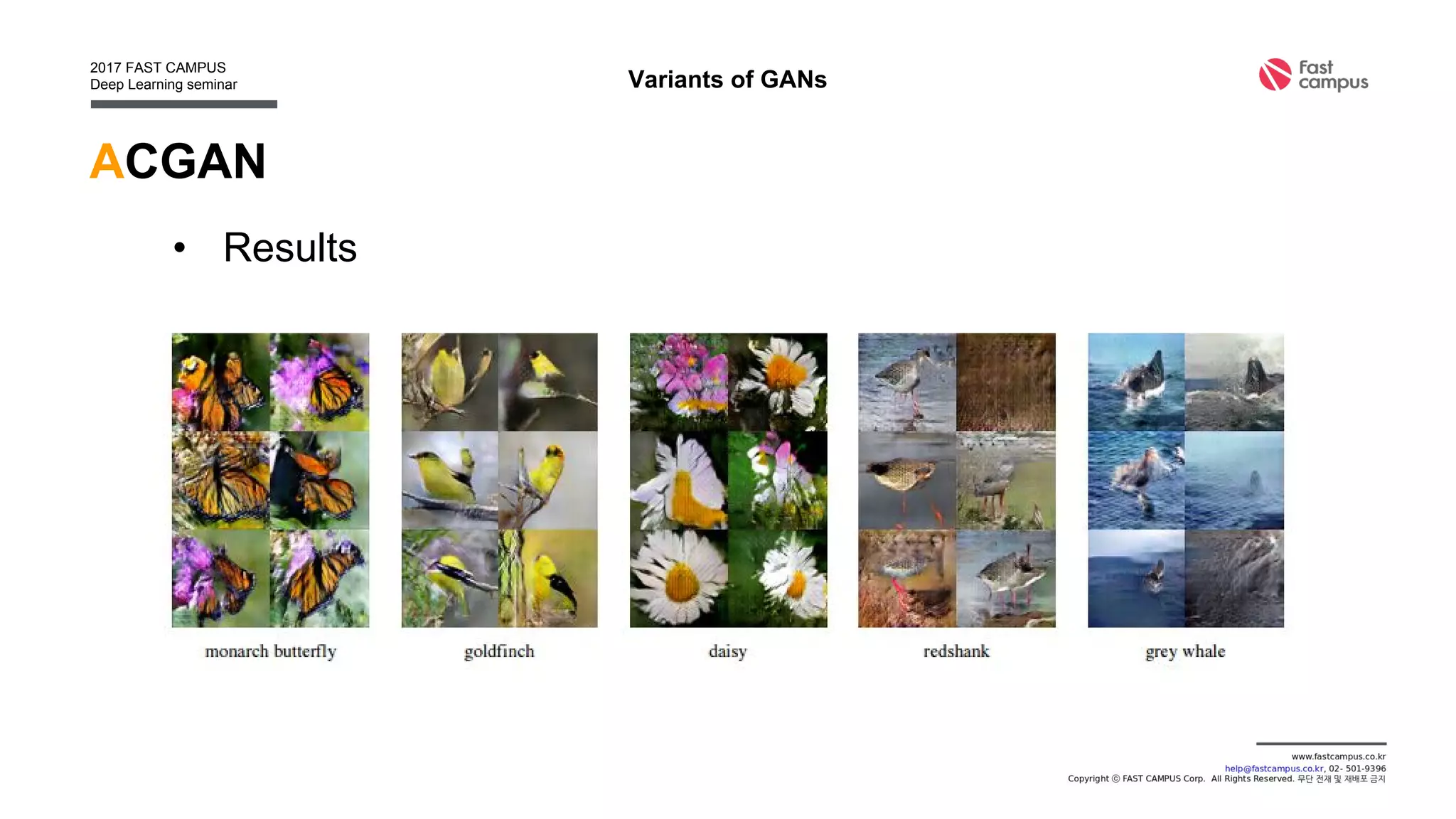
ACGAN
• Results
Variants of GANs
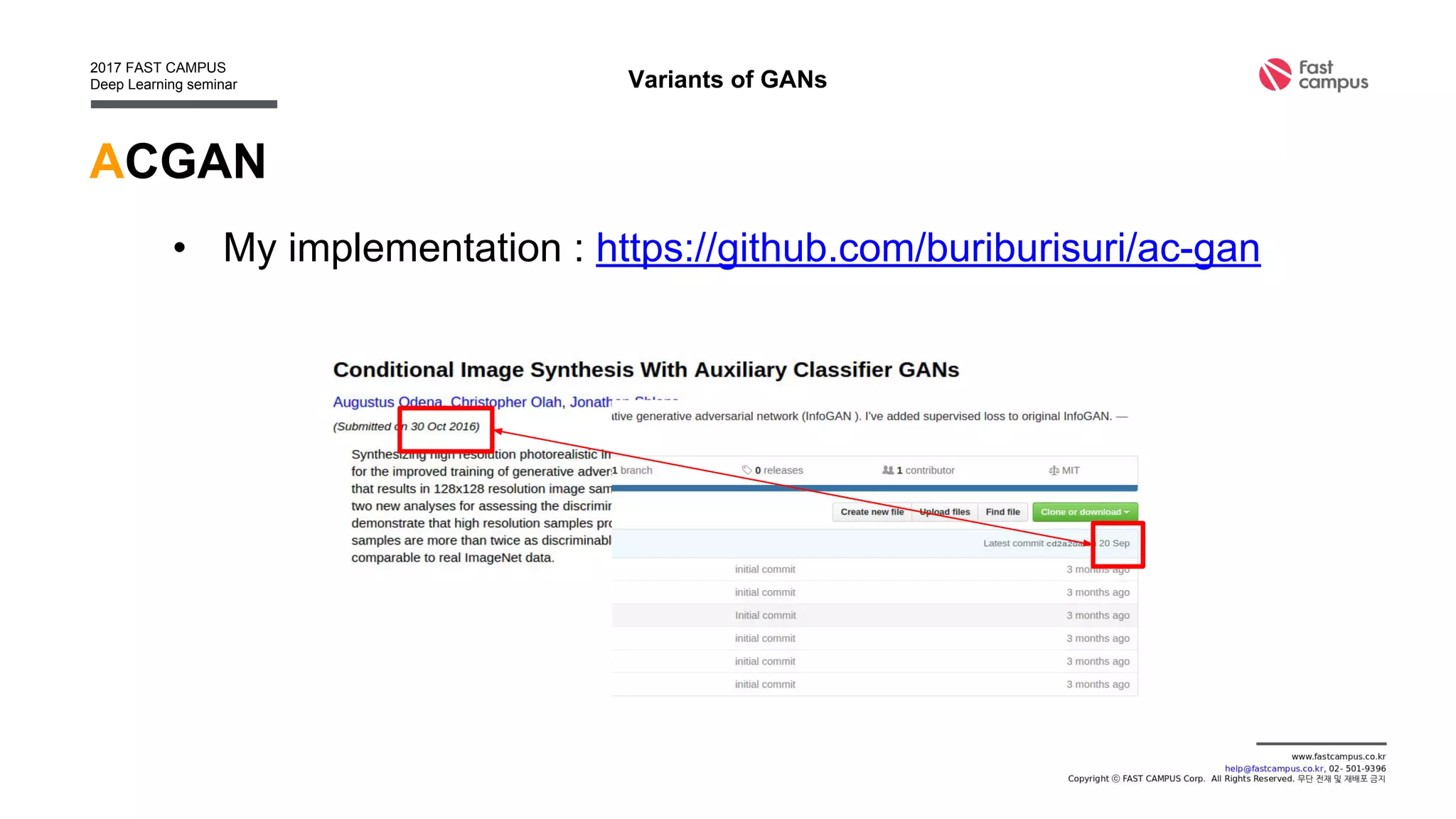
ACGAN
• My implementation : https://github.com/buriburisuri/ac-gan
Variants of GANs
WGAN
• Martin et al, Wasserstein GAN, 2017
Variants of GANs
G
(generator)
z :
C
(critic)
real image
fake image
High value
Low value
High value
Critic training
Generator training
Weight Clamping
( No BCE )
WGAN
• Martin et al, Wasserstein GAN, 2017
– JSD → Earth Mover Distance(=Wasserstein-1 distance)
– Prevent the gradient vanishing by using weak distance metrics
– Provide the parsimonious training indicator.
Variants of GANs
WGAN
• Results
Variants of GANs
BGAN
• R Devon et al, Boundary-Seeking GAN, 2017
– Importance Sampling + Boundary Seeking
– Discrete GAN training possible
– Stabilized continuous GAN training
Variants of GANs
Application of GANs
Generating image
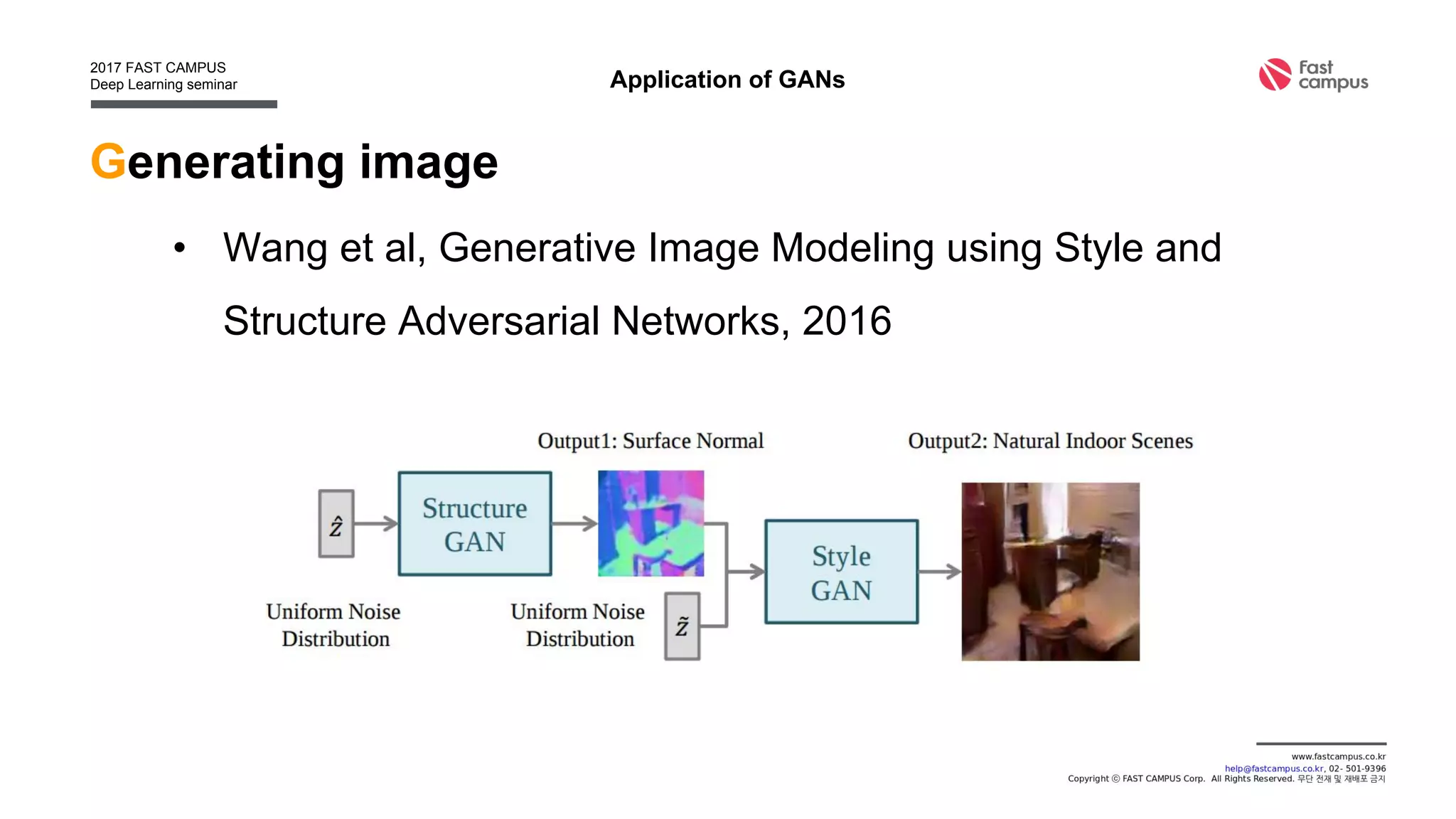
• Wang et al, Generative Image Modeling using Style and
Structure Adversarial Networks, 2016
Application of GANs
Generating image
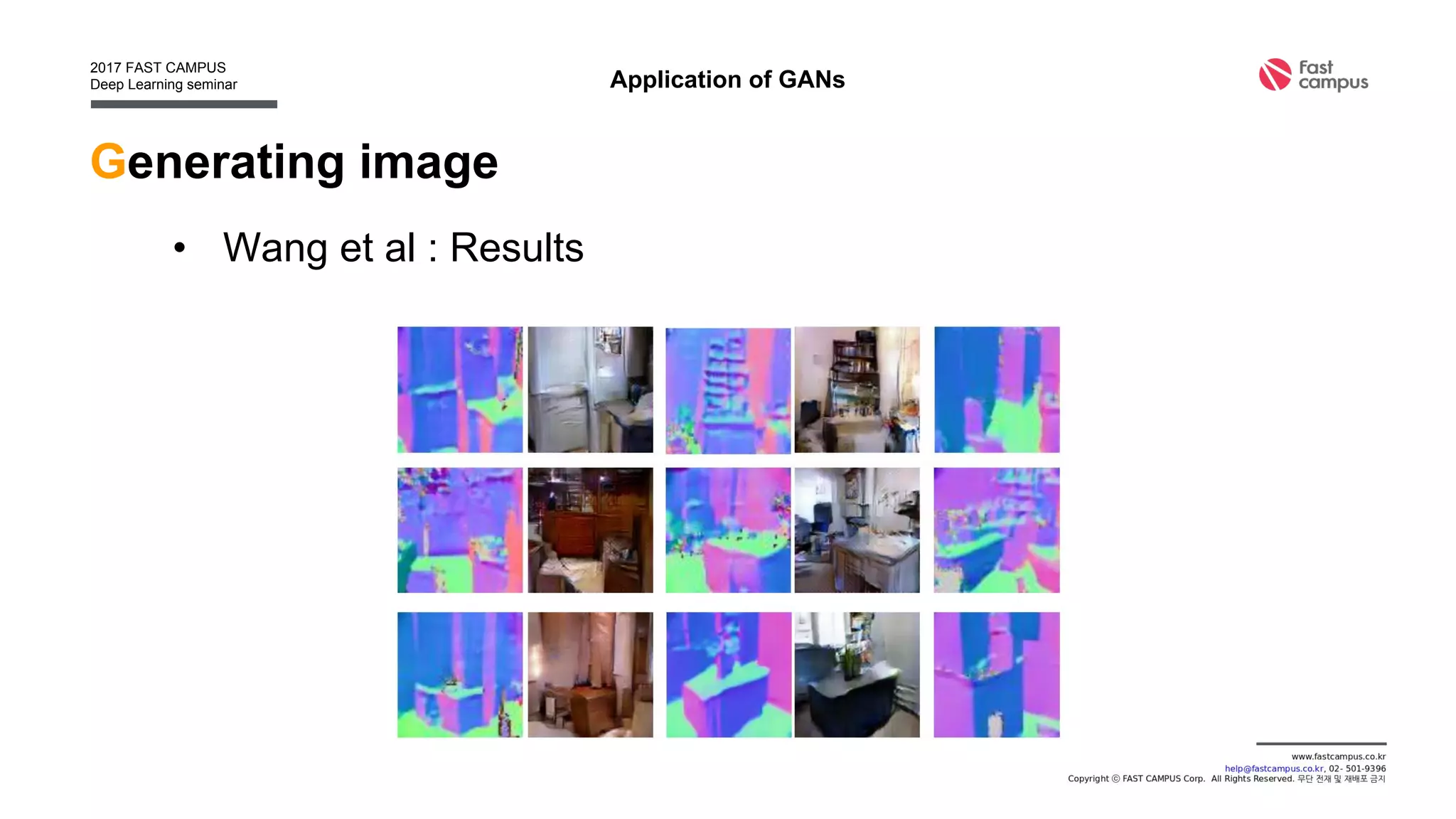
• Wang et al : Results
Application of GANs
Generating image
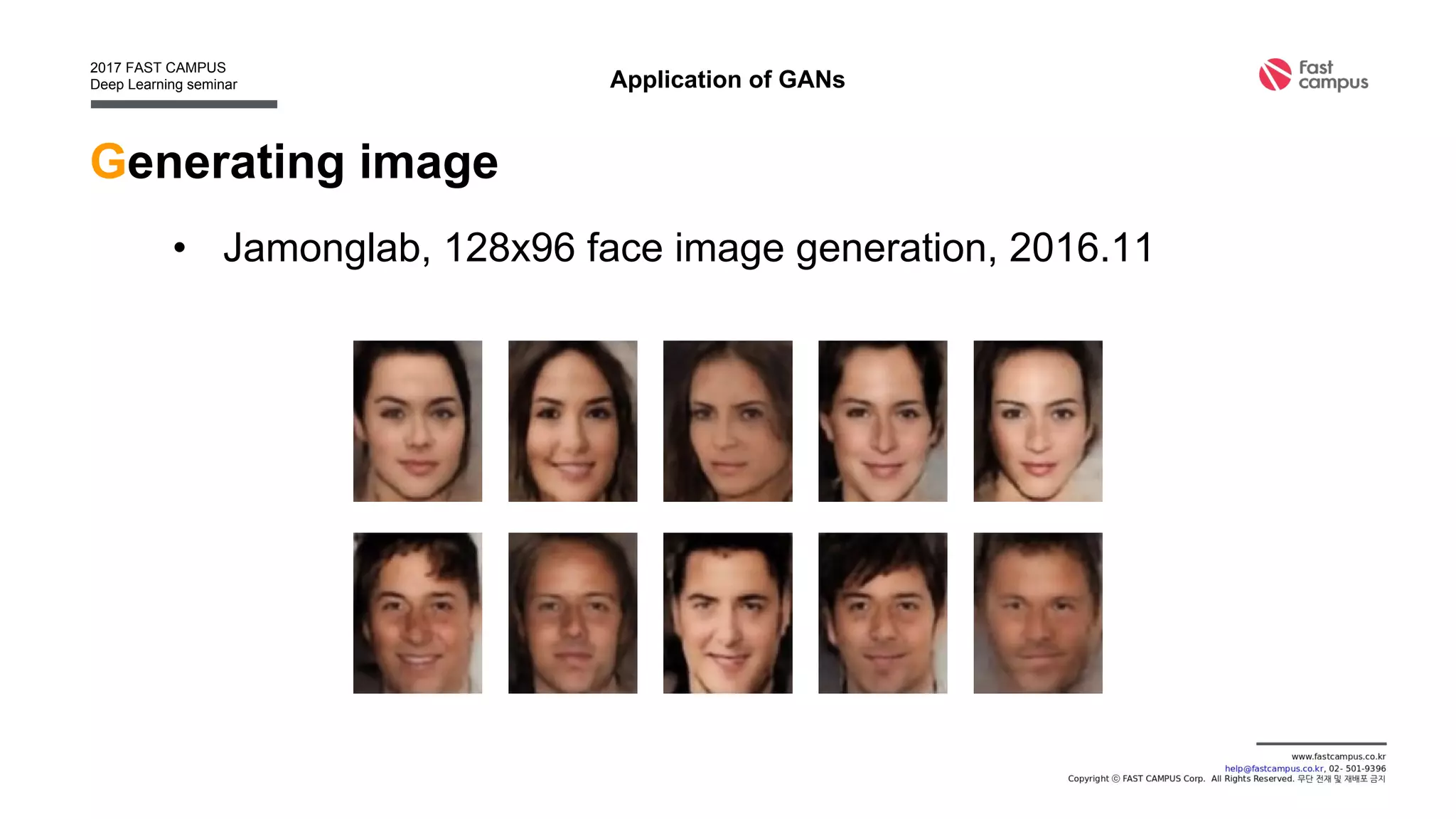
• Jamonglab, 128x96 face image generation, 2016.11
Application of GANs
Generating image
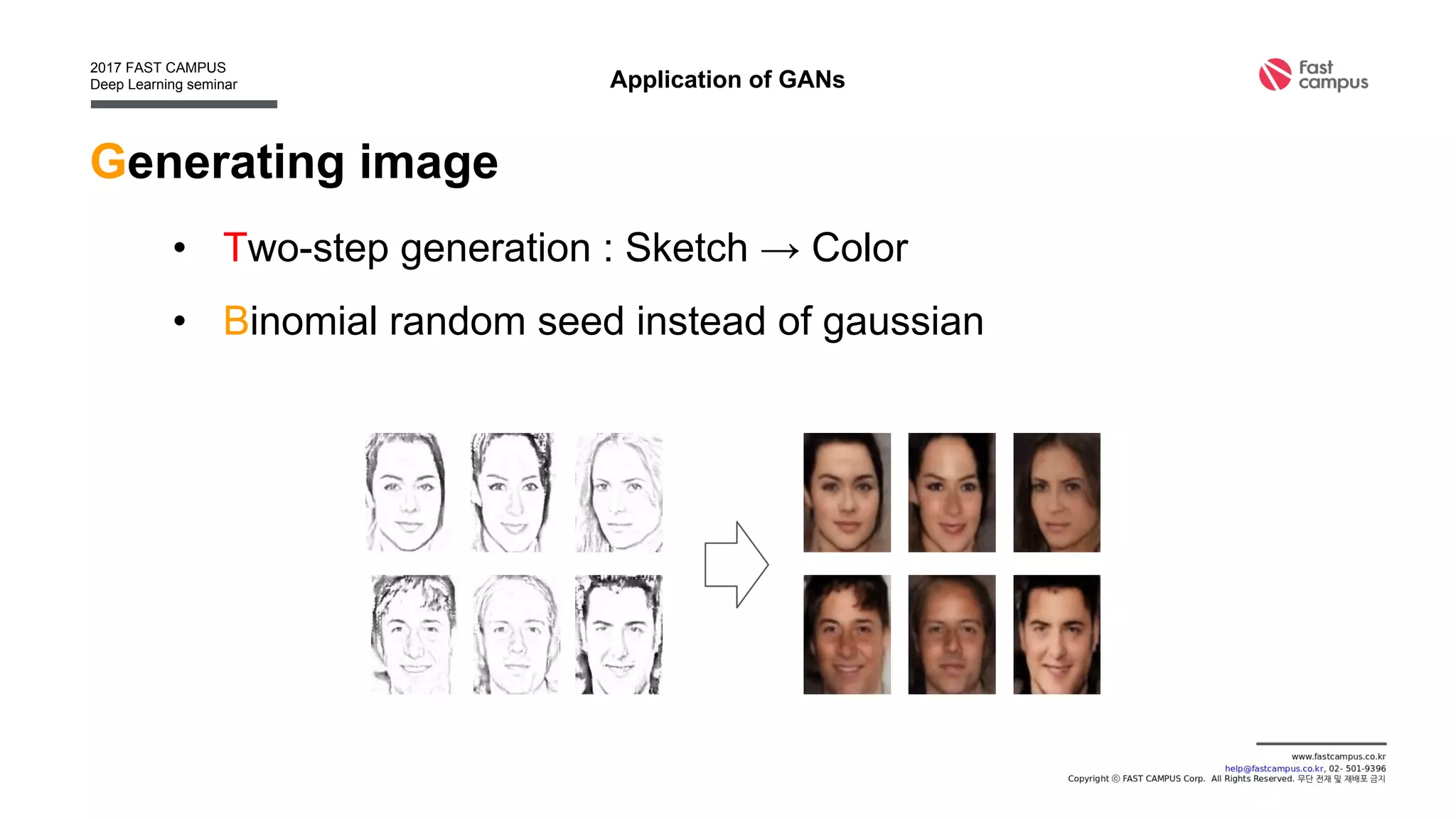
• Two-step generation : Sketch → Color
• Binomial random seed instead of gaussian
Application of GANs
Generating image
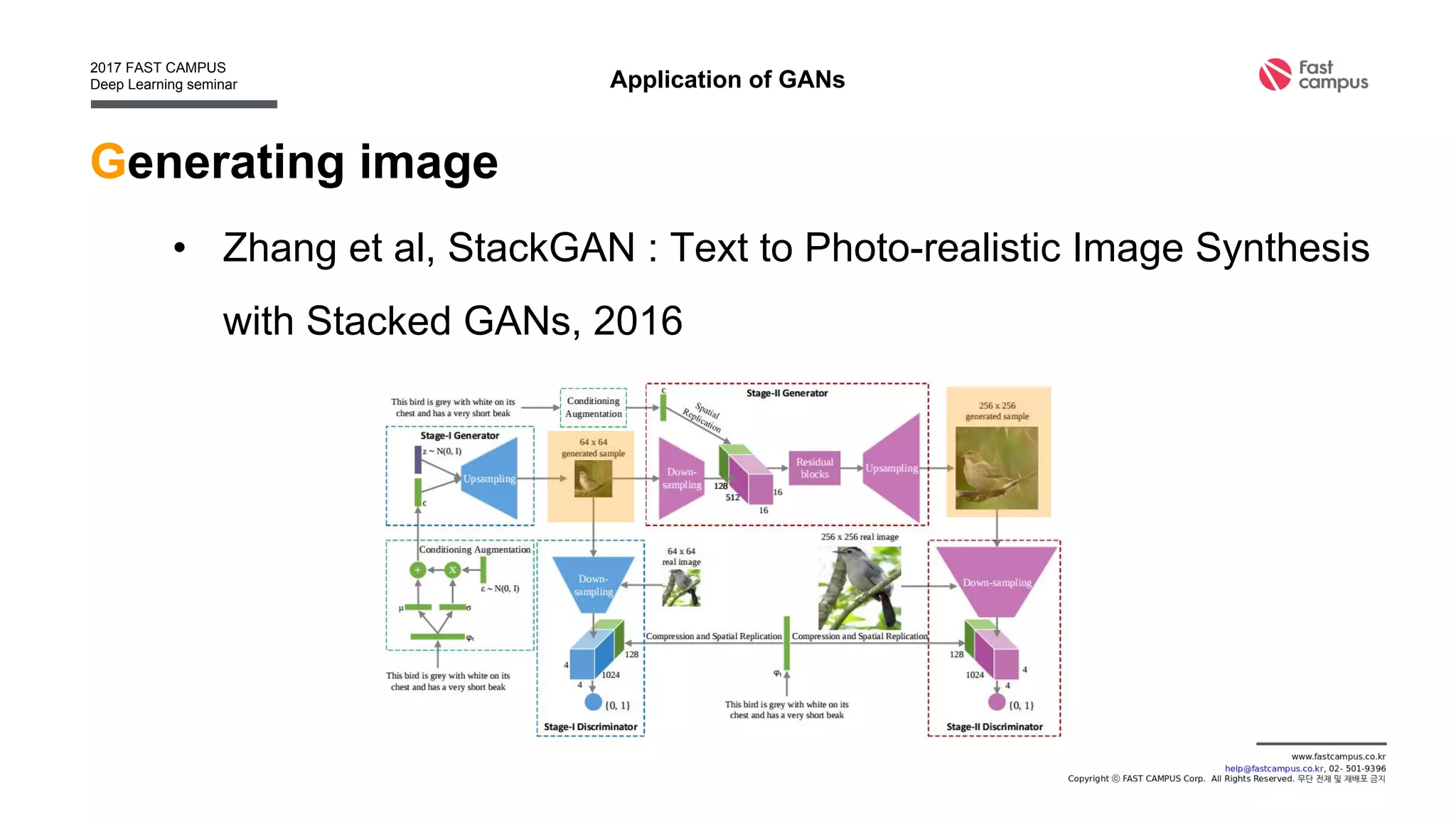
• Zhang et al, StackGAN : Text to Photo-realistic Image Synthesis
with Stacked GANs, 2016
Application of GANs
Generating image
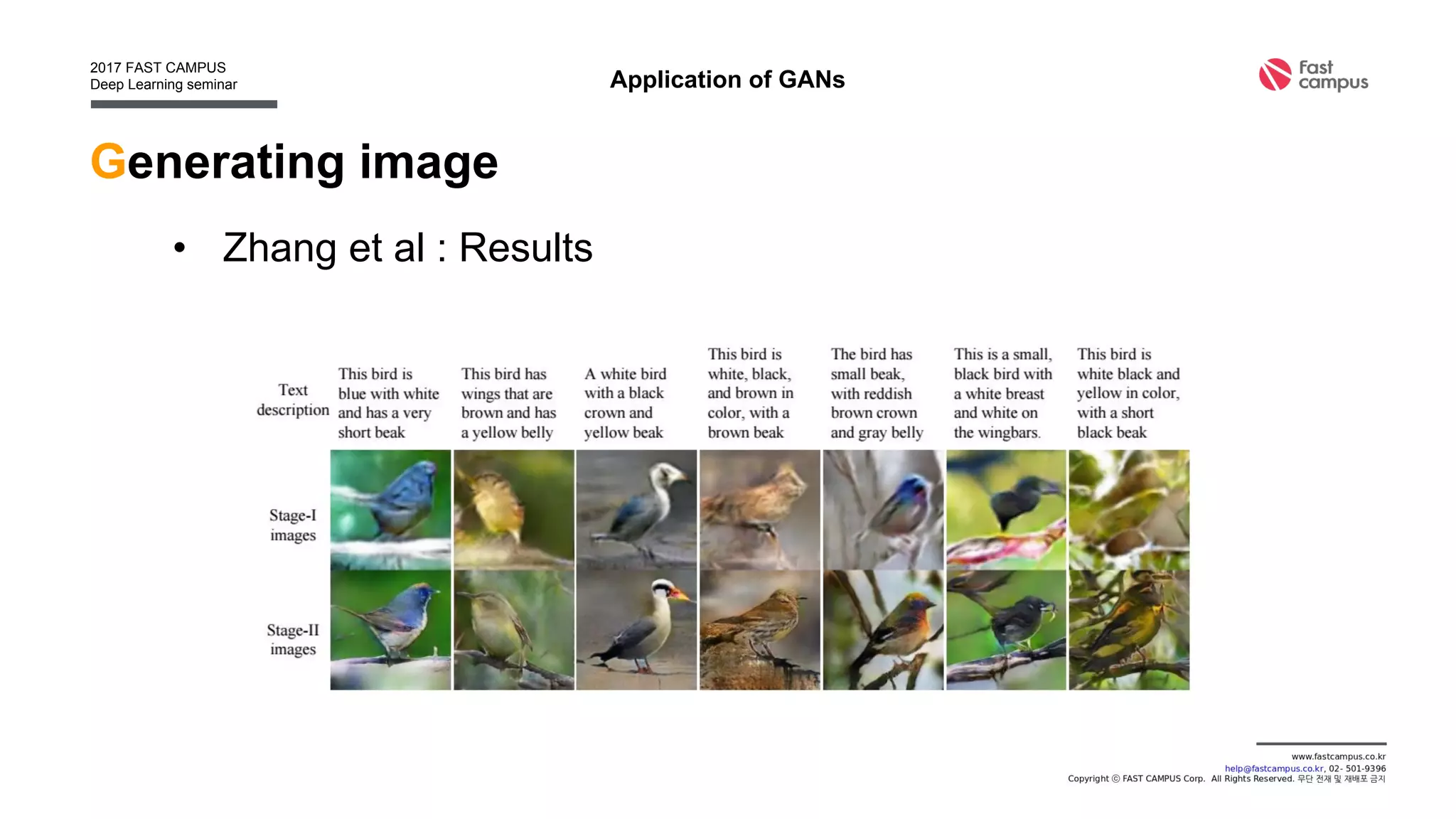
• Zhang et al : Results
Application of GANs
Generating image
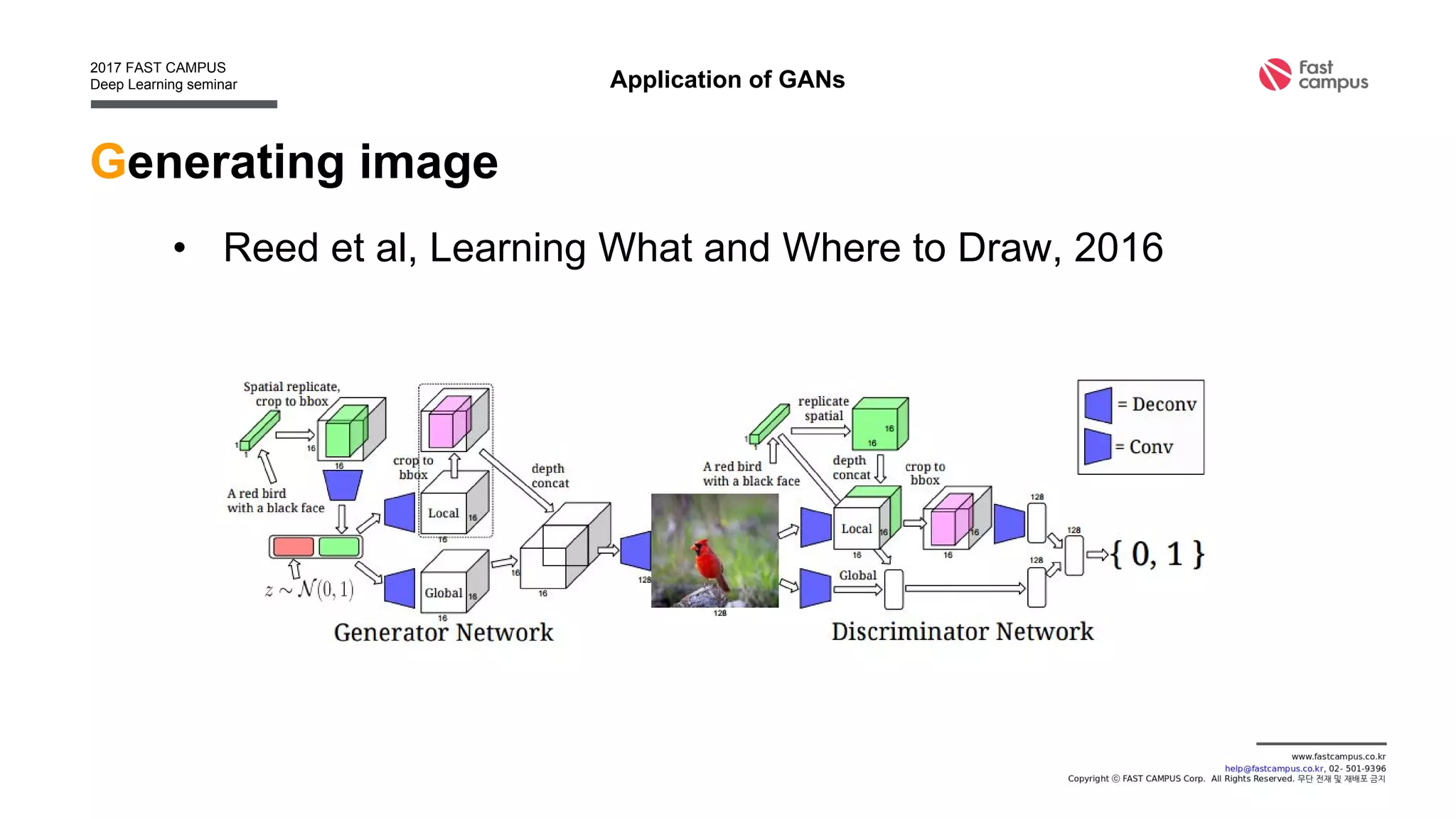
• Reed et al, Learning What and Where to Draw, 2016
Application of GANs
Generating image
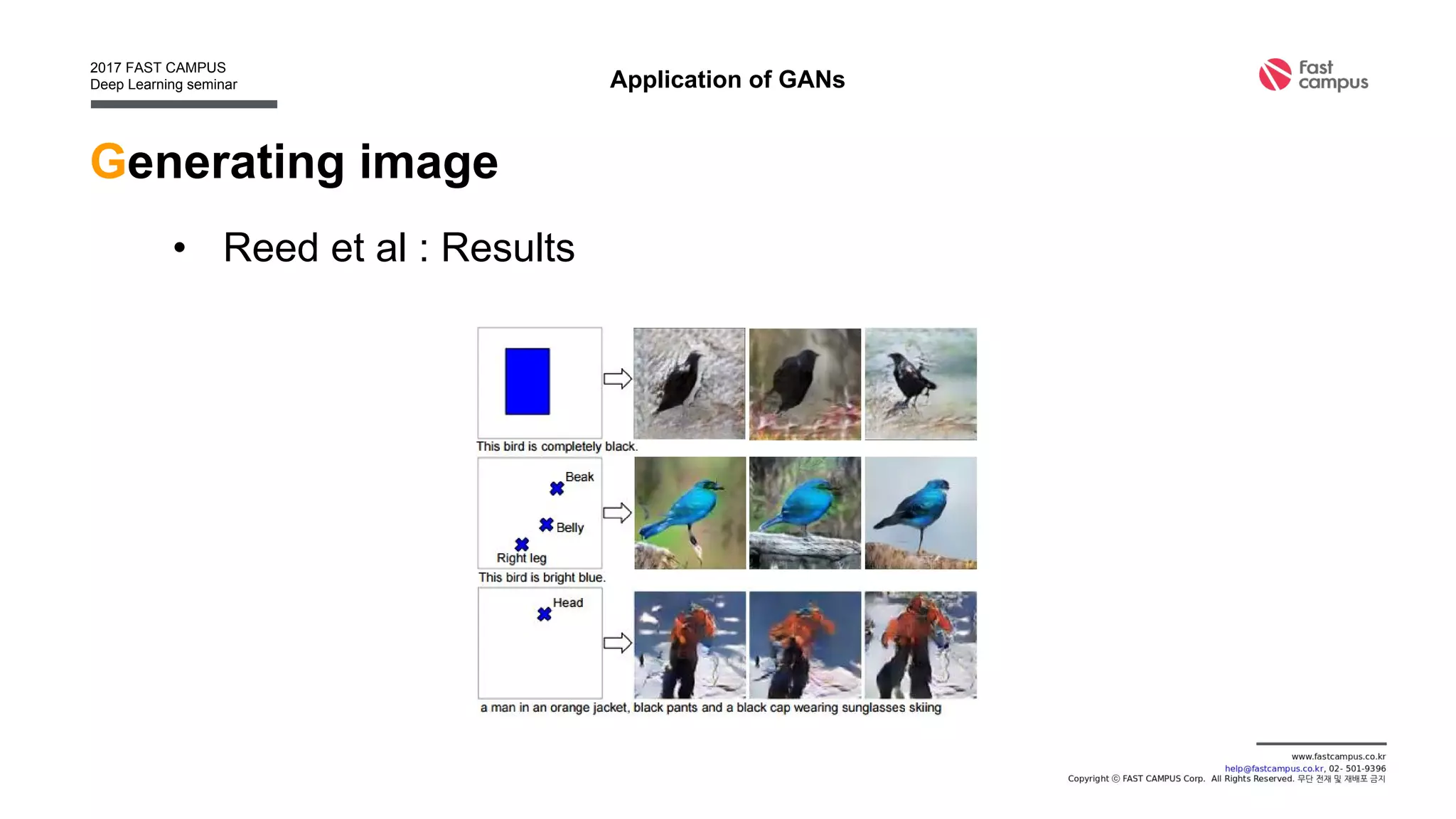
• Reed et al : Results
Application of GANs
Generating image
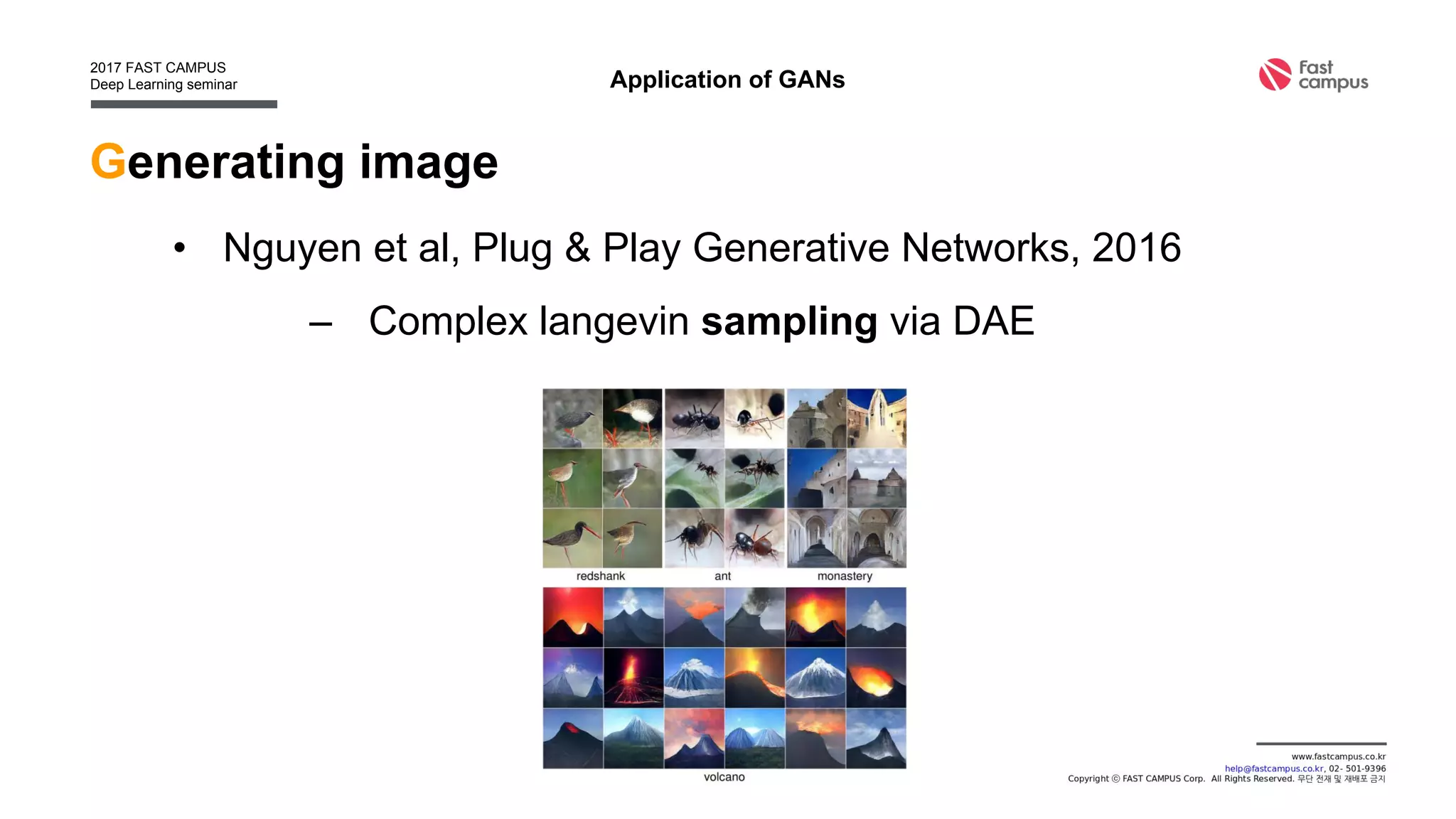
• Nguyen et al, Plug & Play Generative Networks, 2016
– Complex langevin sampling via DAE
Application of GANs
Generating image
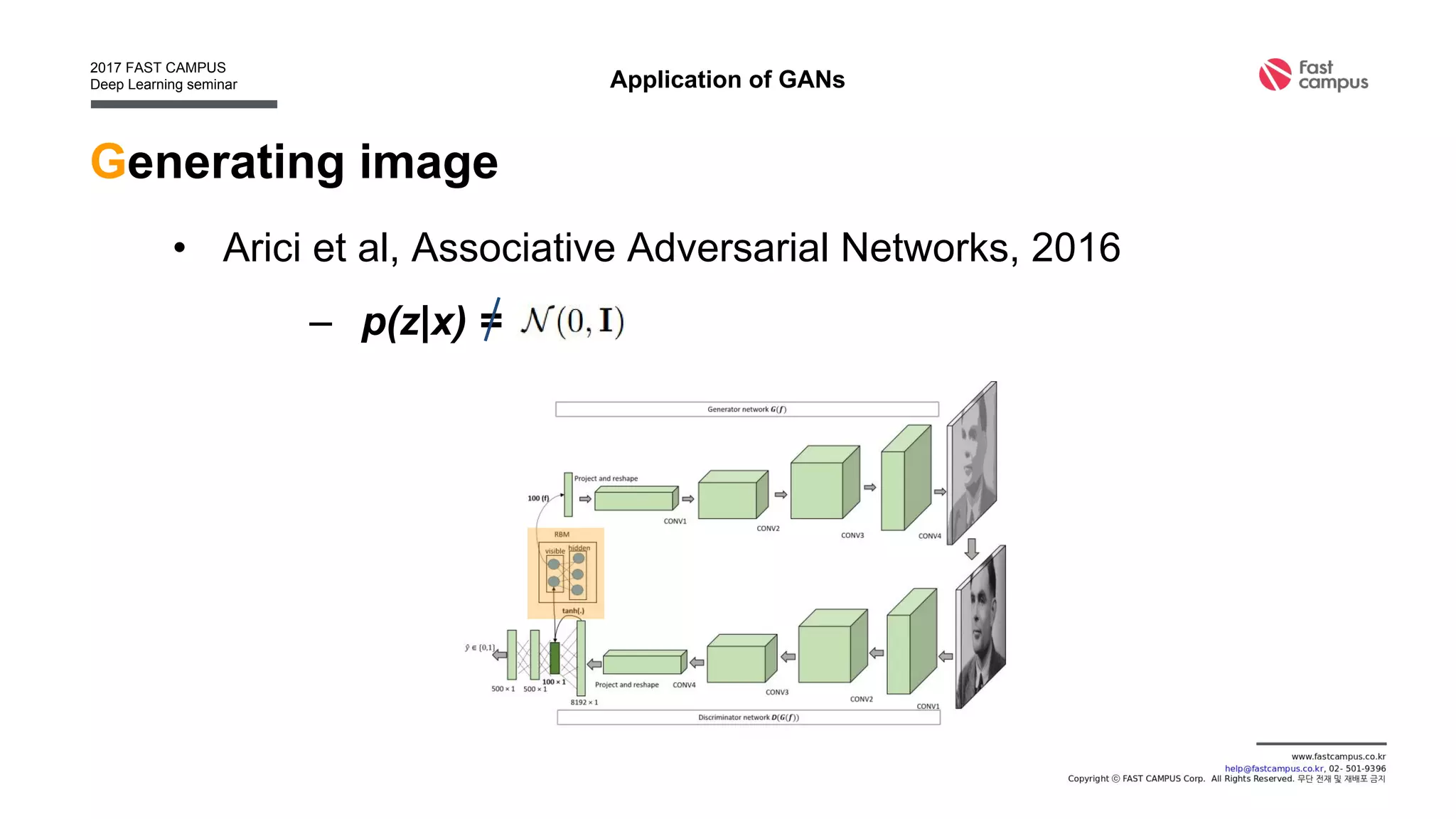
• Arici et al, Associative Adversarial Networks, 2016
–
Application of GANs
p(z|x) =
Generating image
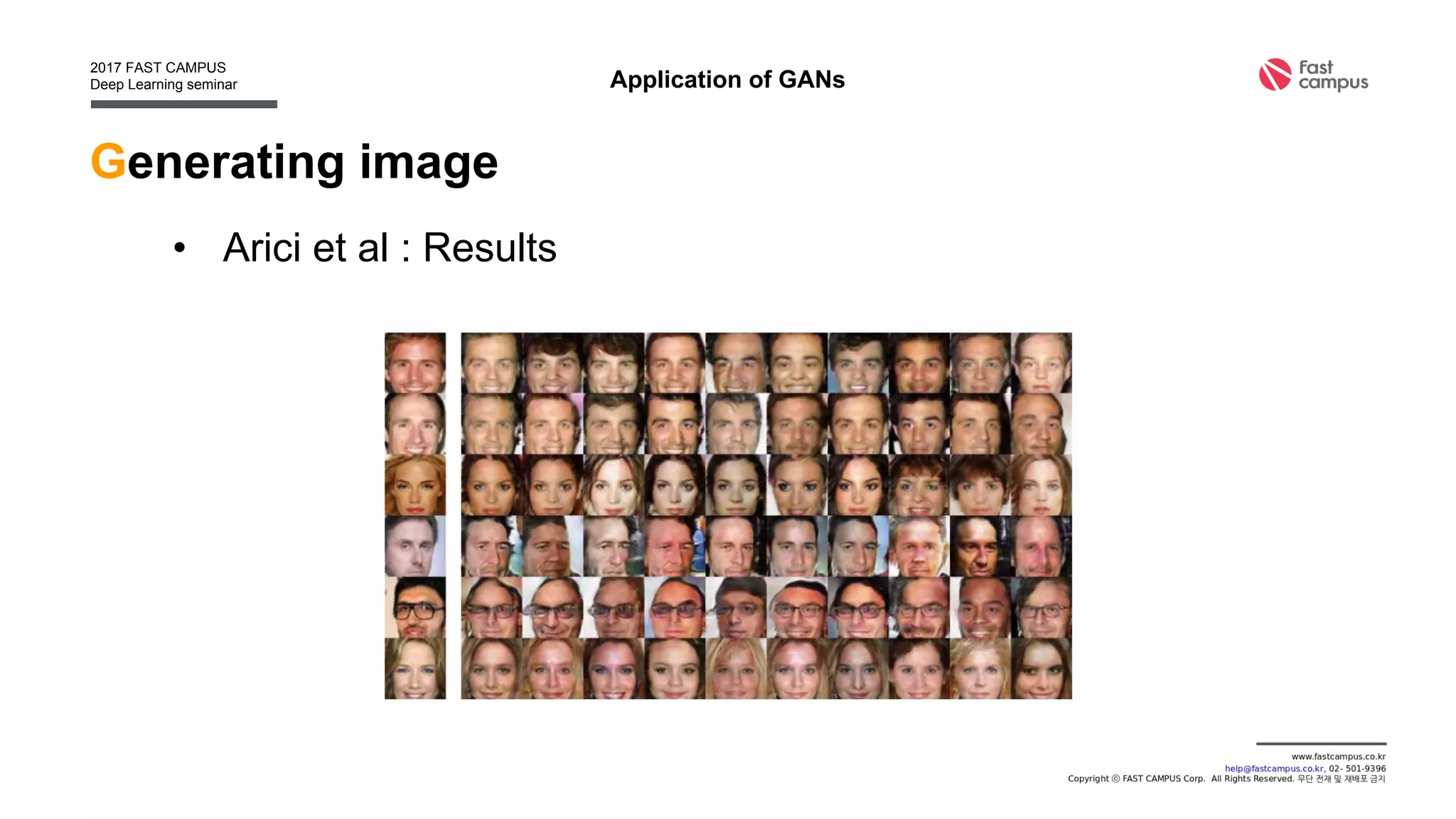
• Arici et al : Results
Application of GANs
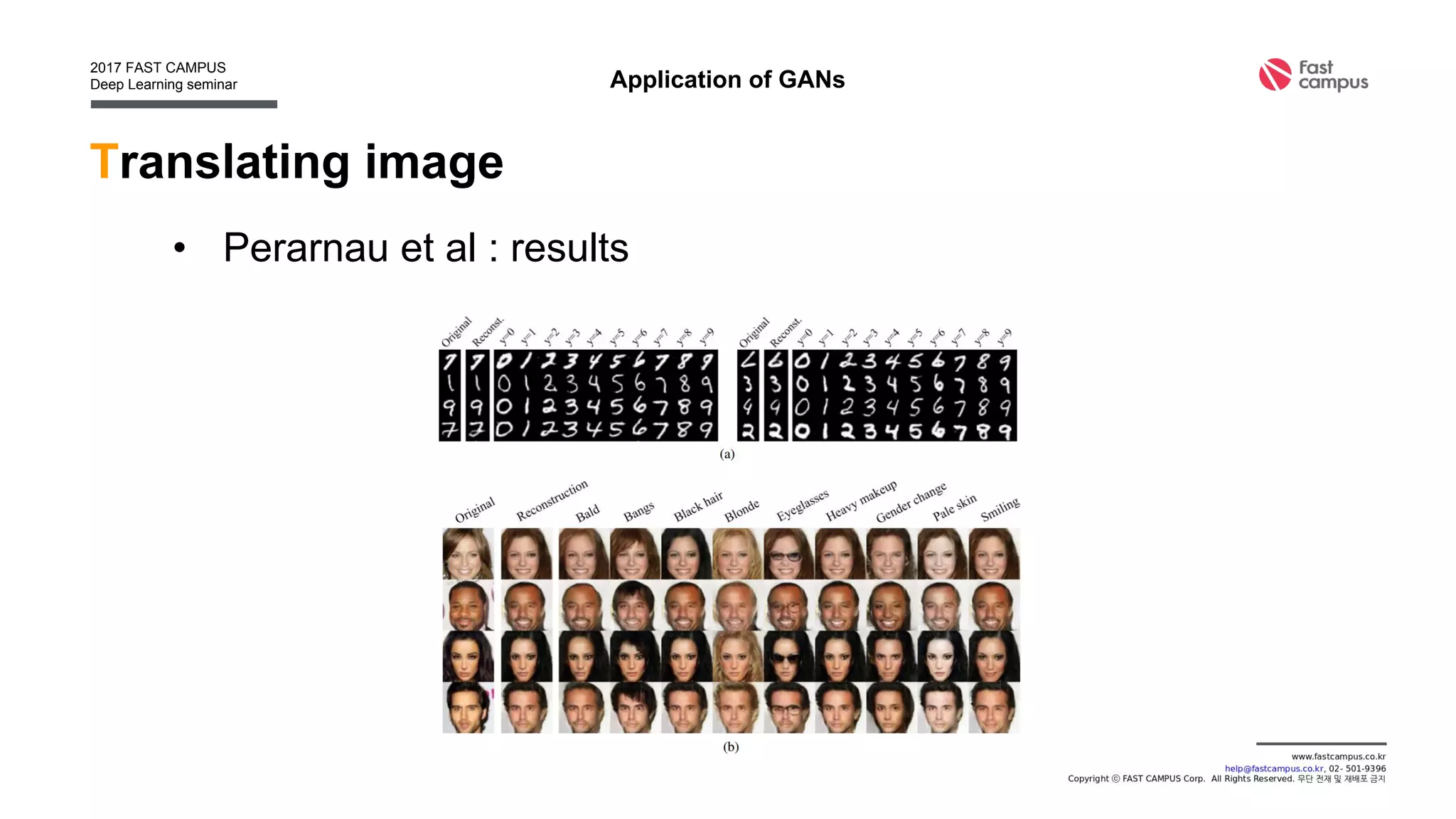
Translating image
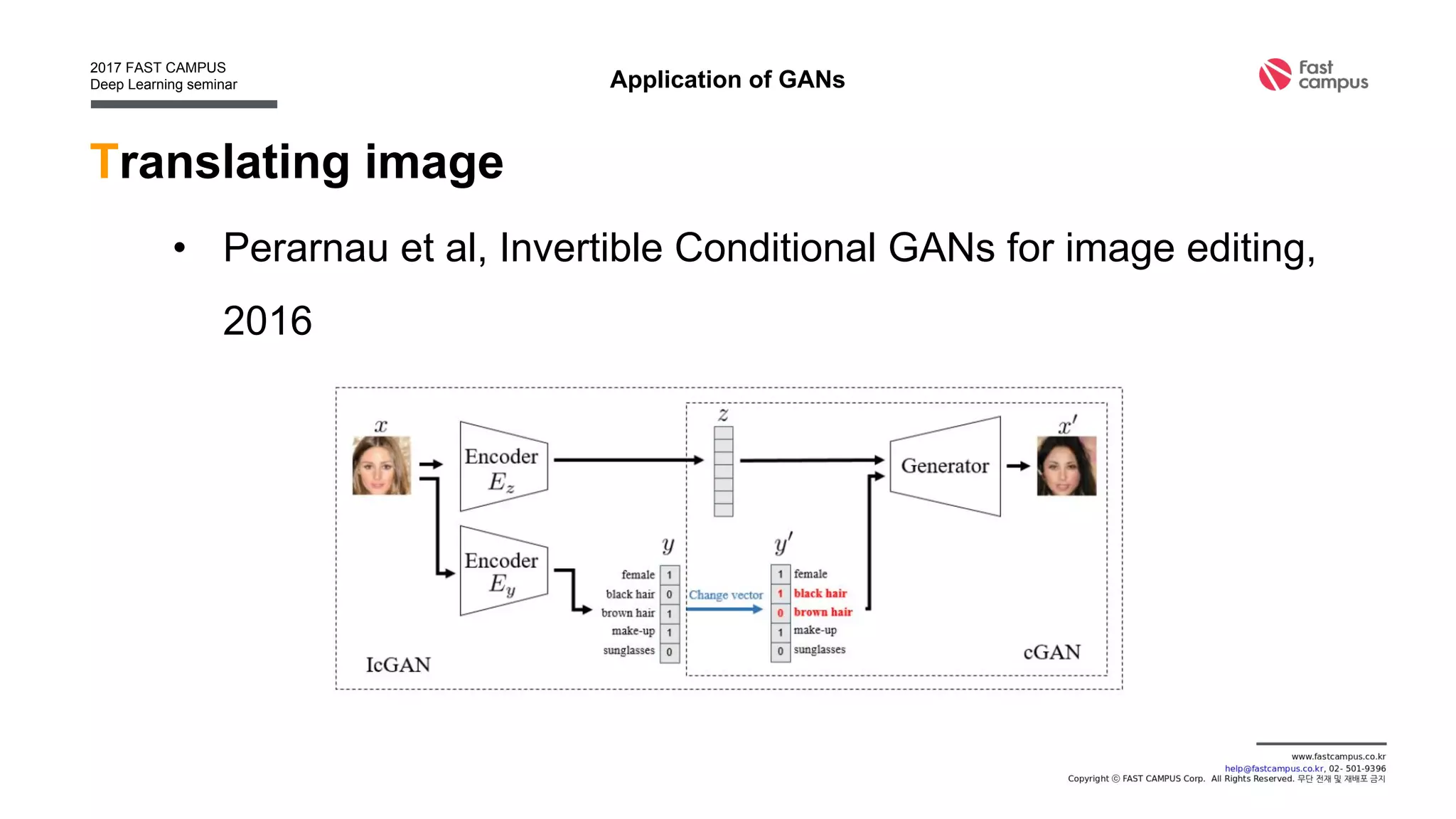
• Perarnau et al, Invertible Conditional GANs for image editing,
2016
Application of GANs
Translating image
• Perarnau et al : results
Application of GANs
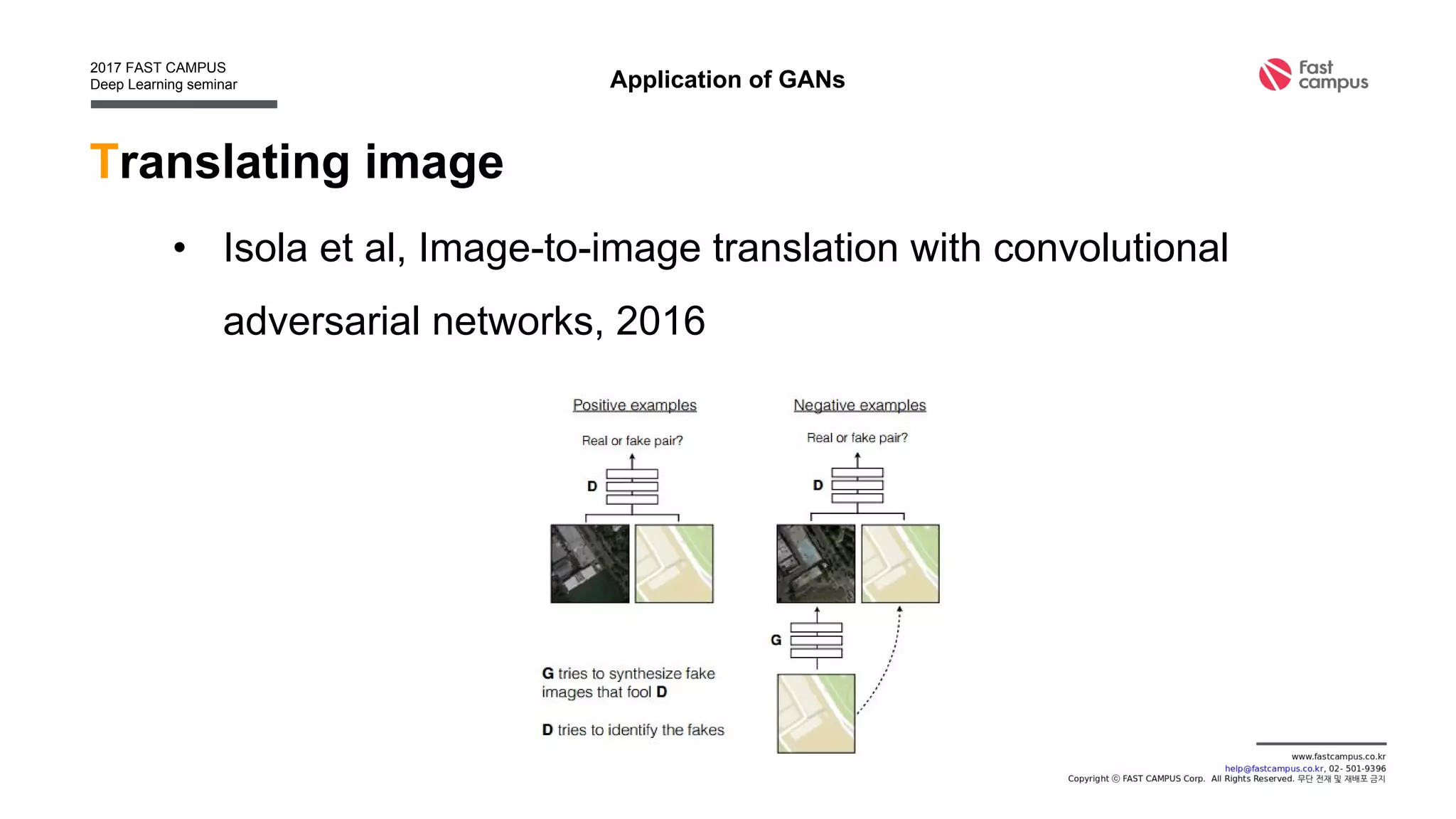
Translating image
• Isola et al, Image-to-image translation with convolutional
adversarial networks, 2016
Application of GANs
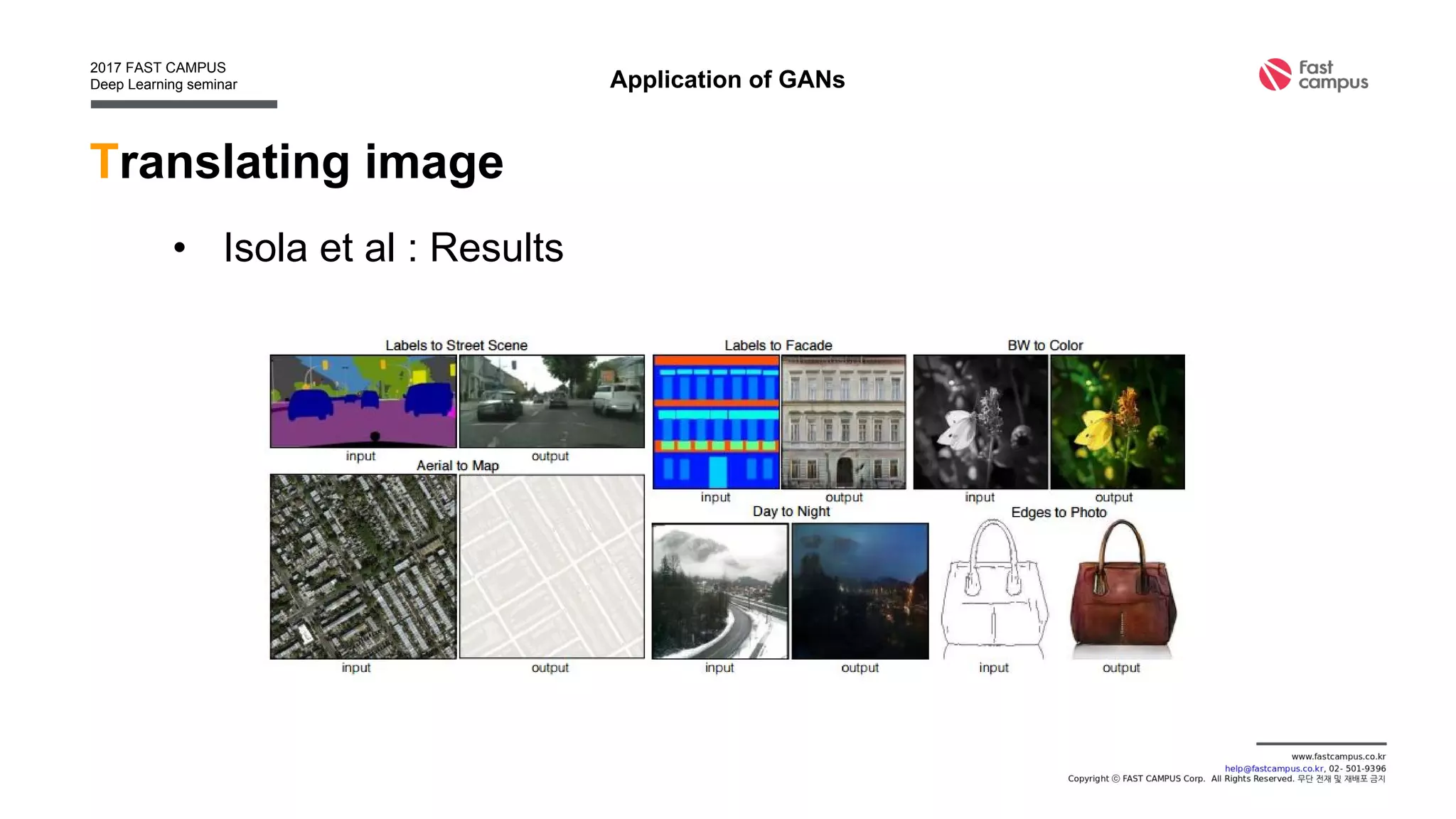
Translating image
• Isola et al : Results
Application of GANs
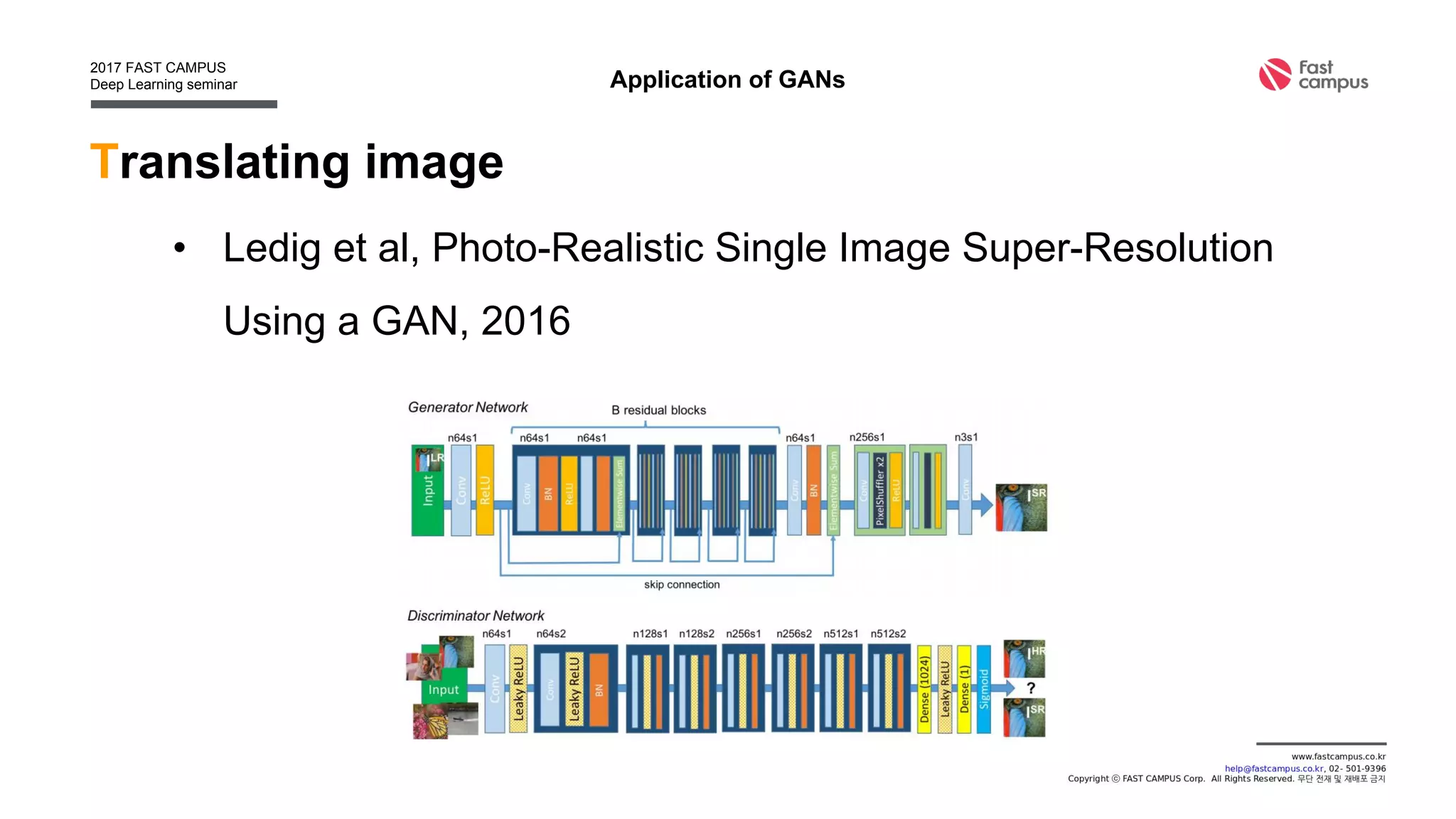
Translating image
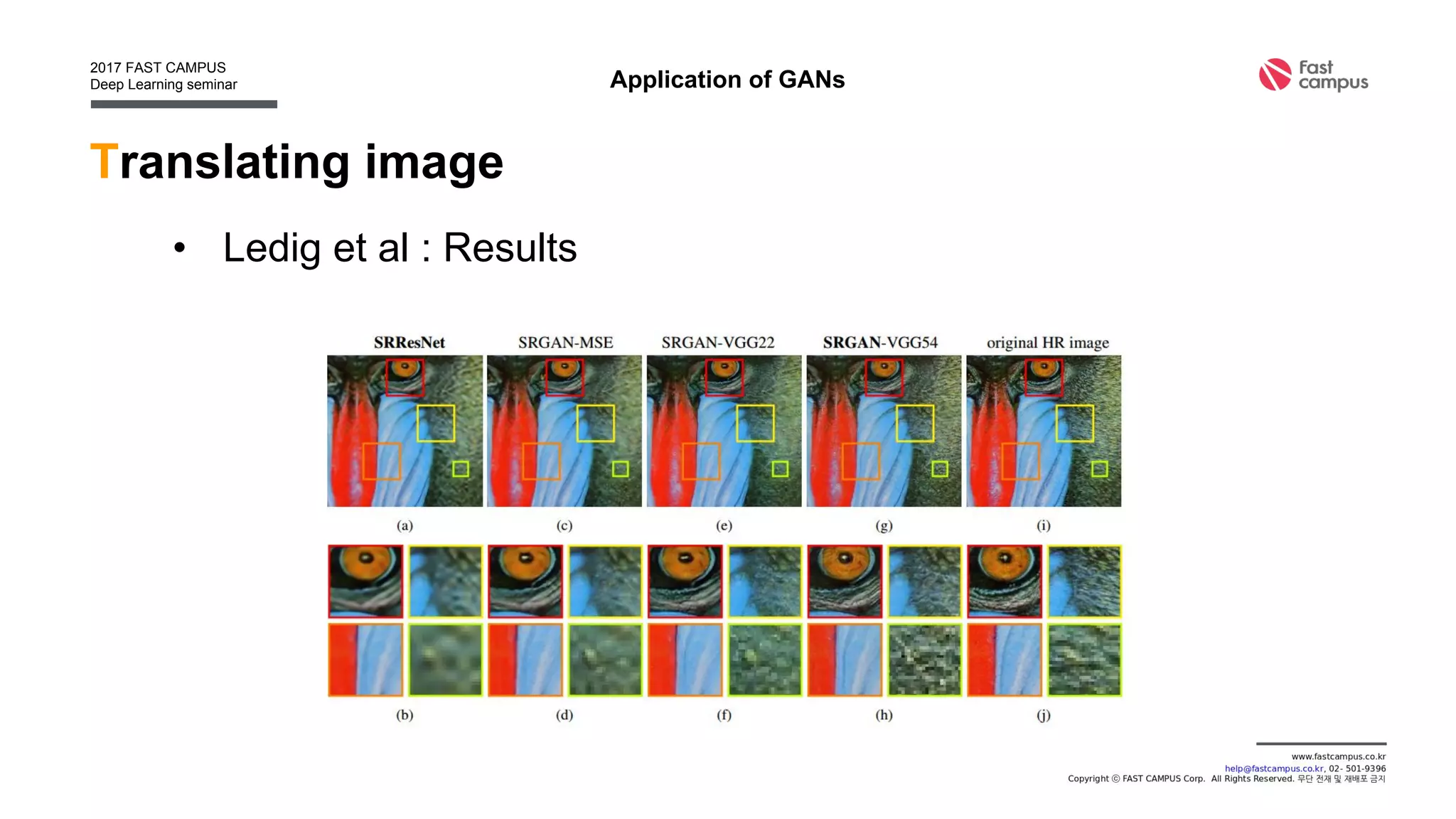
• Ledig et al, Photo-Realistic Single Image Super-Resolution
Using a GAN, 2016
Application of GANs
Translating image
• Ledig et al : Results
Application of GANs
Translating image
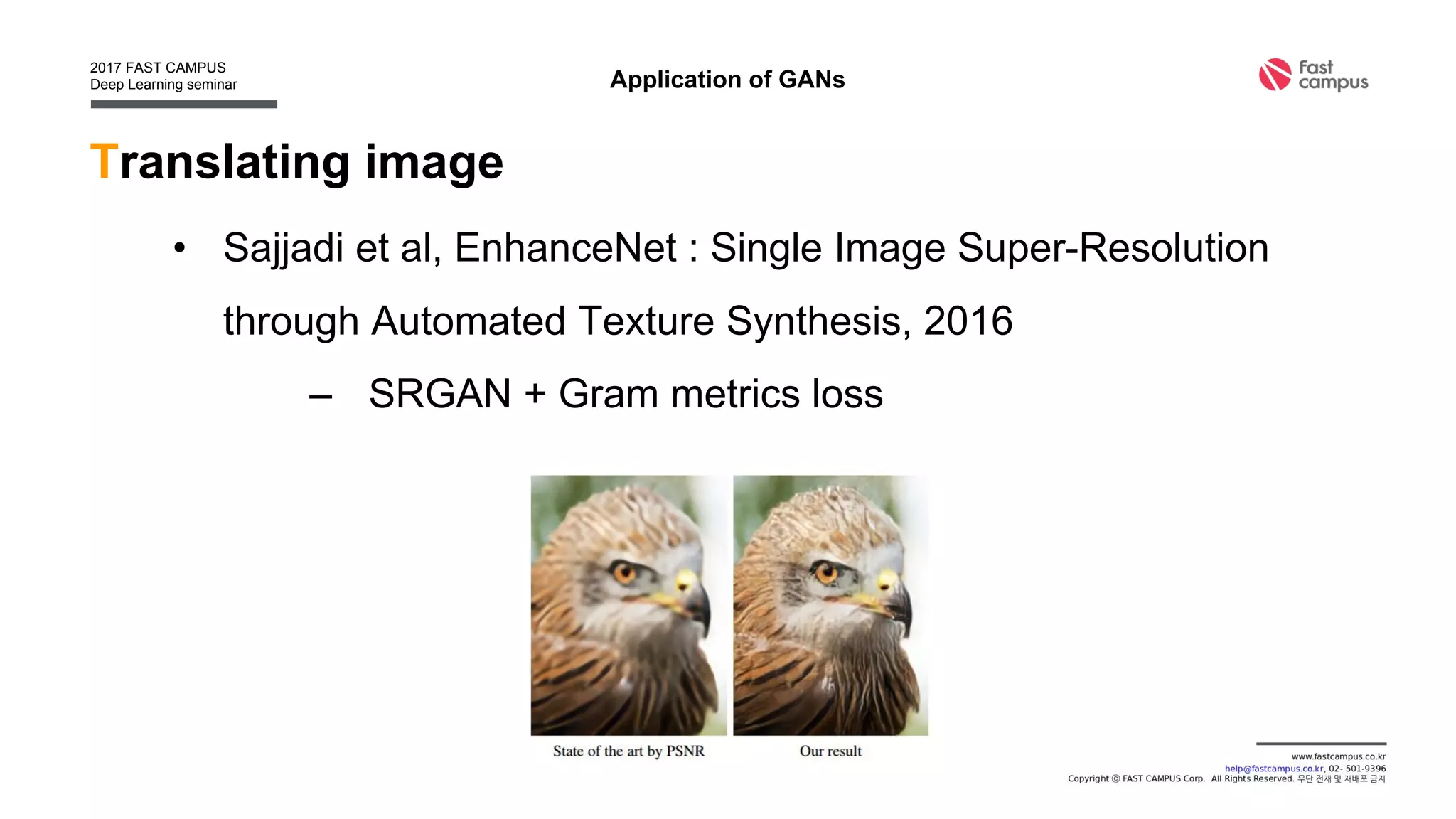
• Sajjadi et al, EnhanceNet : Single Image Super-Resolution
through Automated Texture Synthesis, 2016
– SRGAN + Gram metrics loss
Application of GANs
Domain adaptation
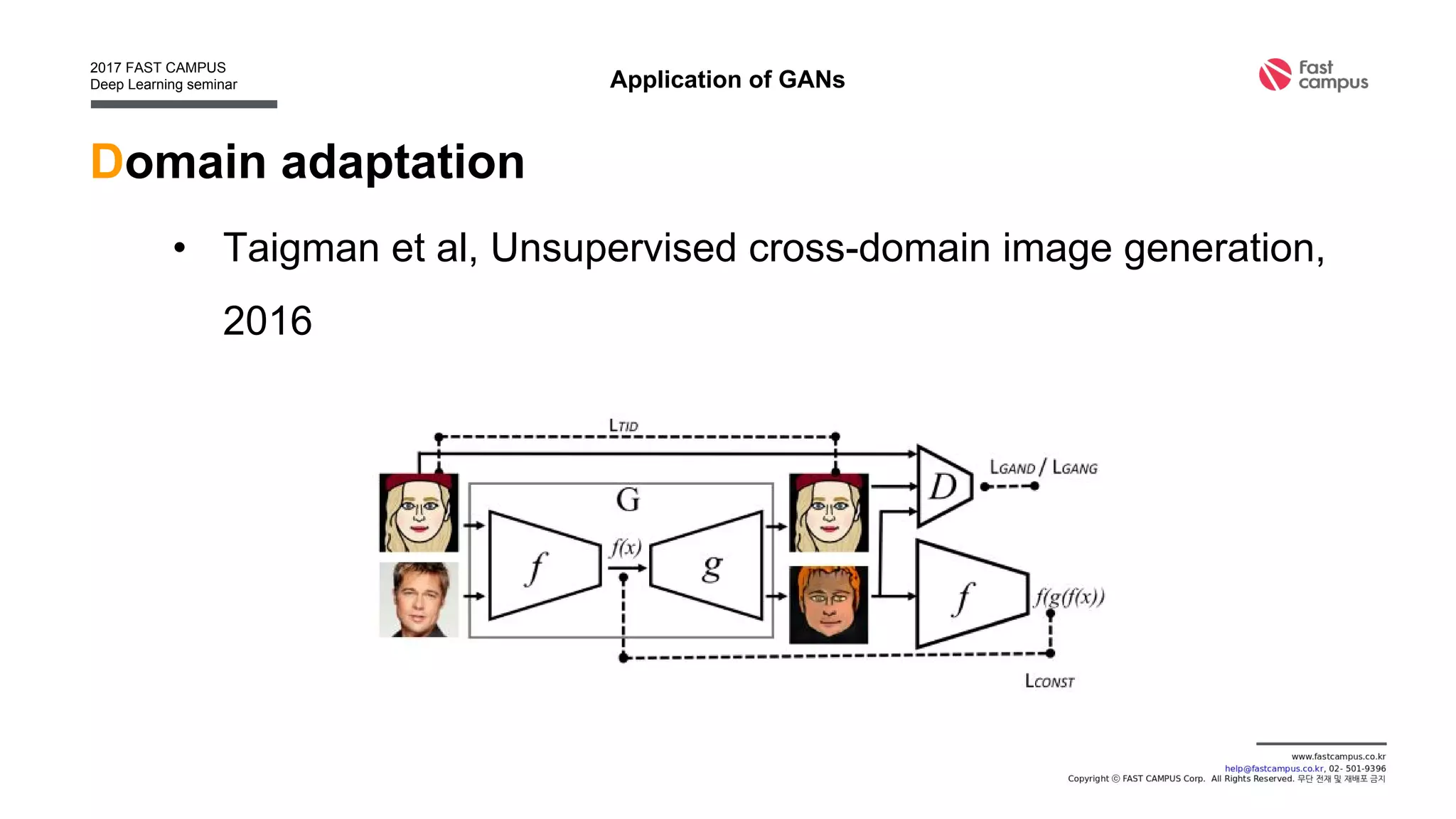
• Taigman et al, Unsupervised cross-domain image generation,
2016
Application of GANs
Domain adaptation
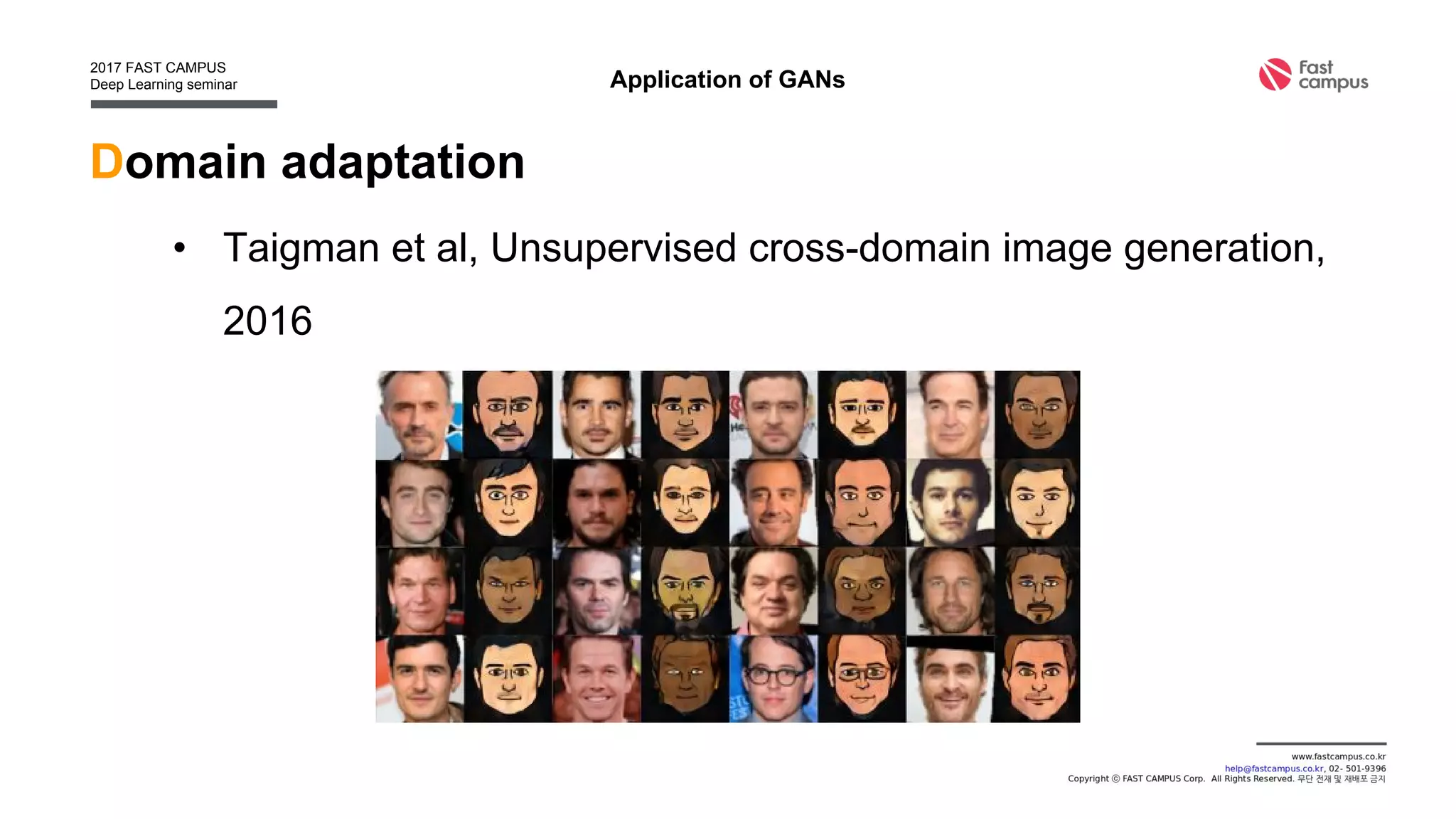
• Taigman et al, Unsupervised cross-domain image generation,
2016
Application of GANs
Domain adaptation
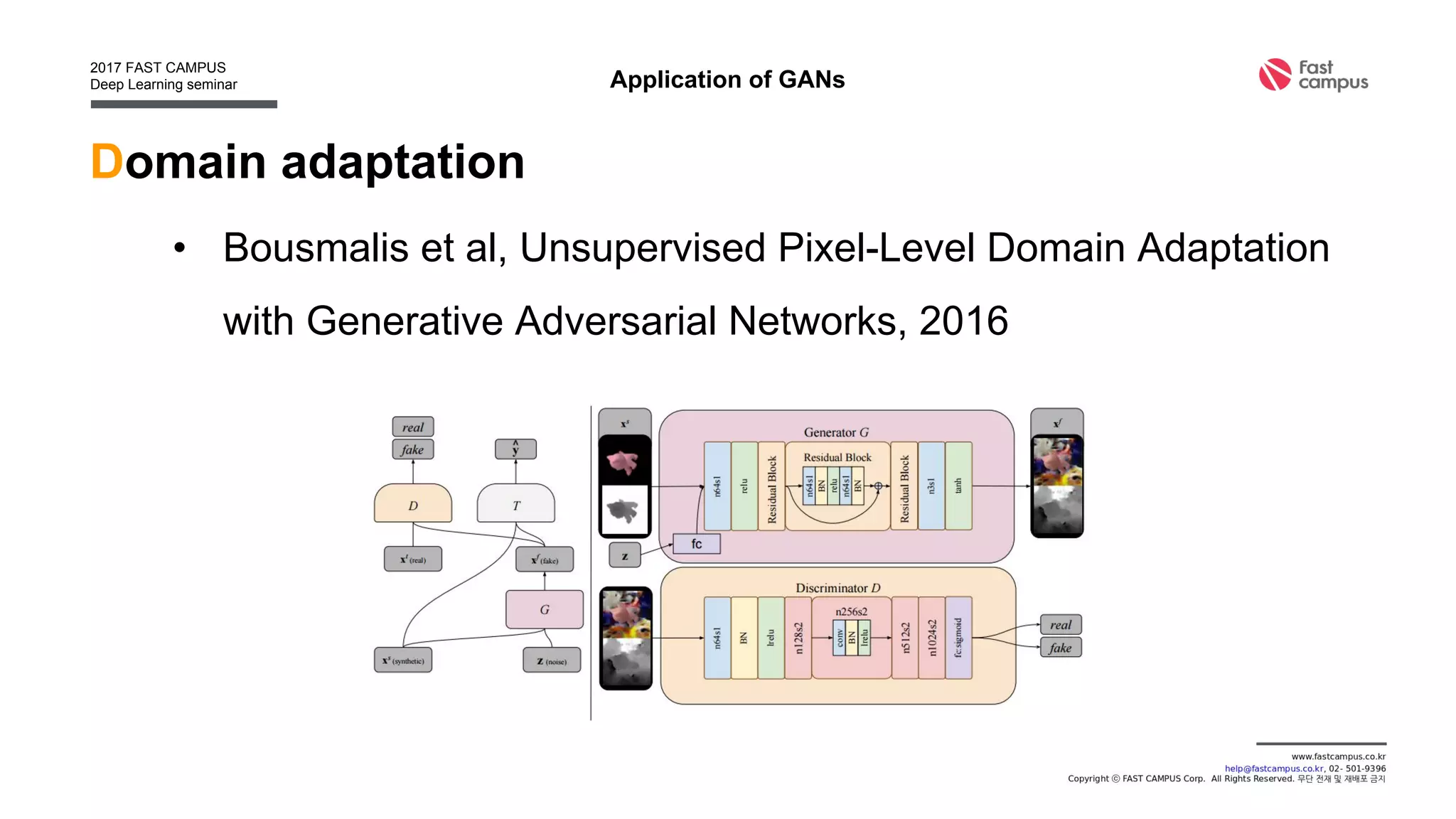
• Bousmalis et al, Unsupervised Pixel-Level Domain Adaptation
with Generative Adversarial Networks, 2016
Application of GANs
Domain adaptation
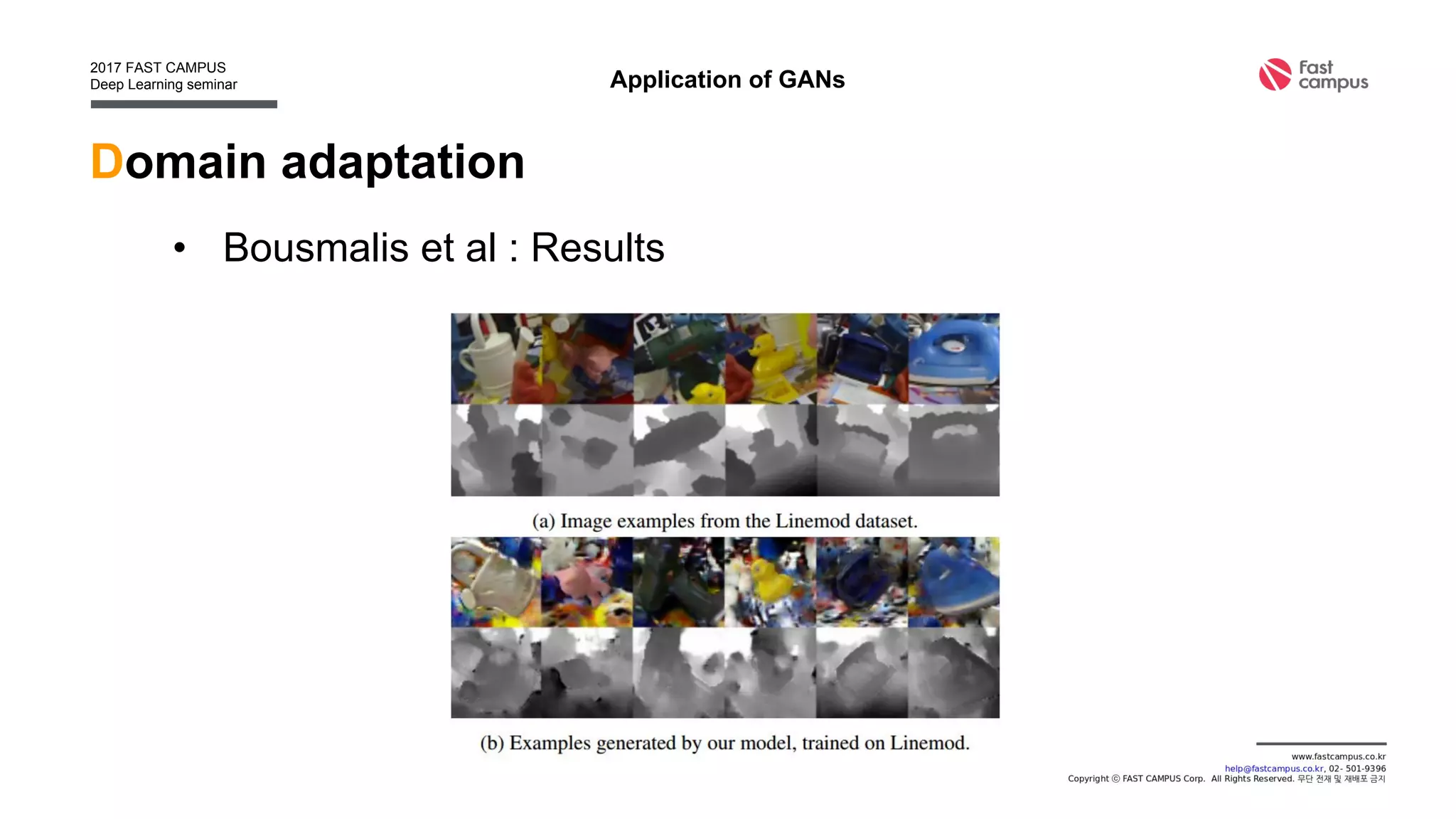
• Bousmalis et al : Results
Application of GANs
Domain adaptation
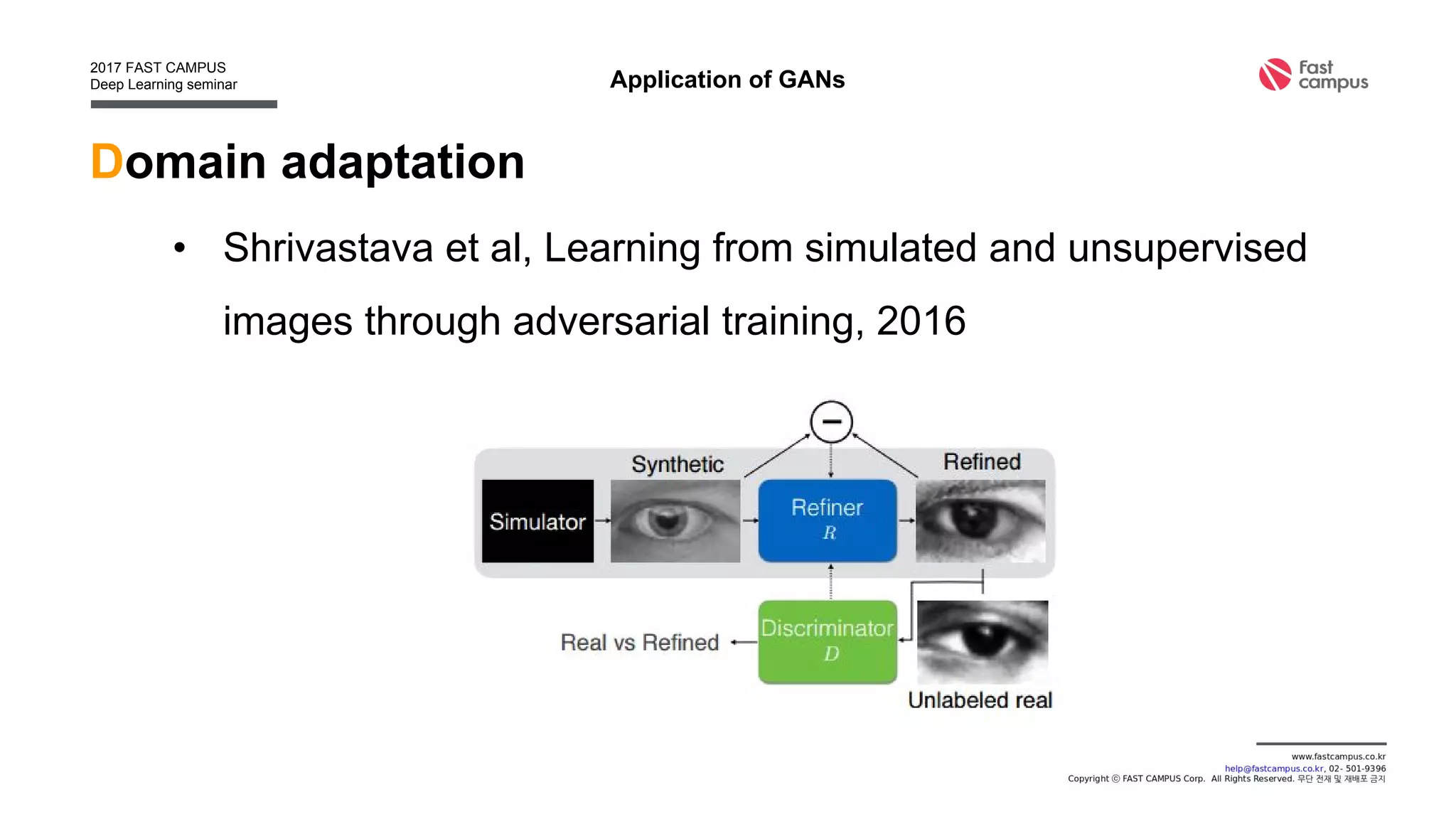
• Shrivastava et al, Learning from simulated and unsupervised
images through adversarial training, 2016
Application of GANs
Domain adaptation
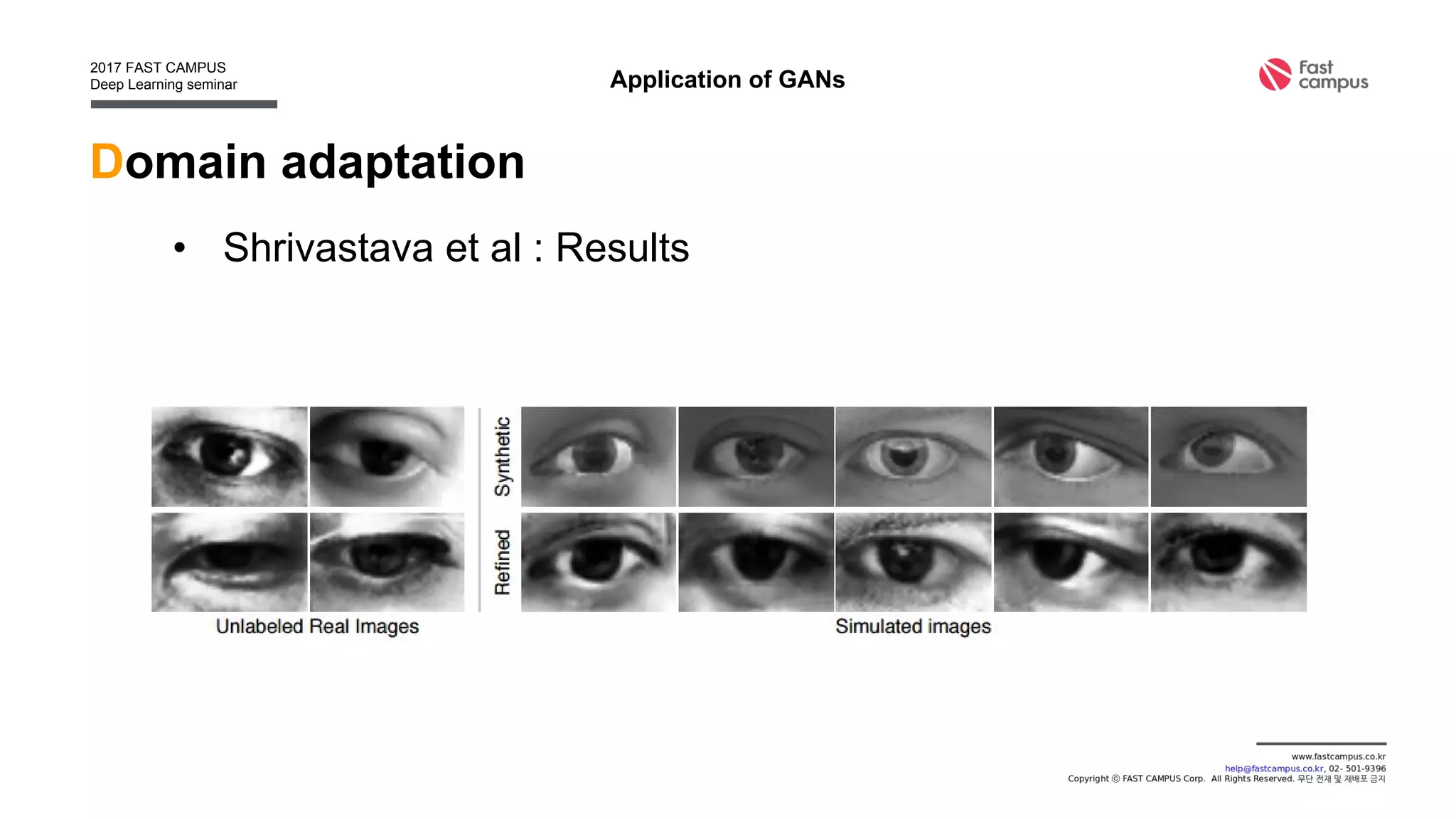
• Shrivastava et al : Results
Application of GANs
Domain adaptation
• Taeksoo Kim et al, Learning to Discover Cross-Domain
Relations with Generative Adversarial Networks, 2017
Application of GANs
Domain adaptation
• Extended Taigman’s idea
using smart bijective mapping
Application of GANs
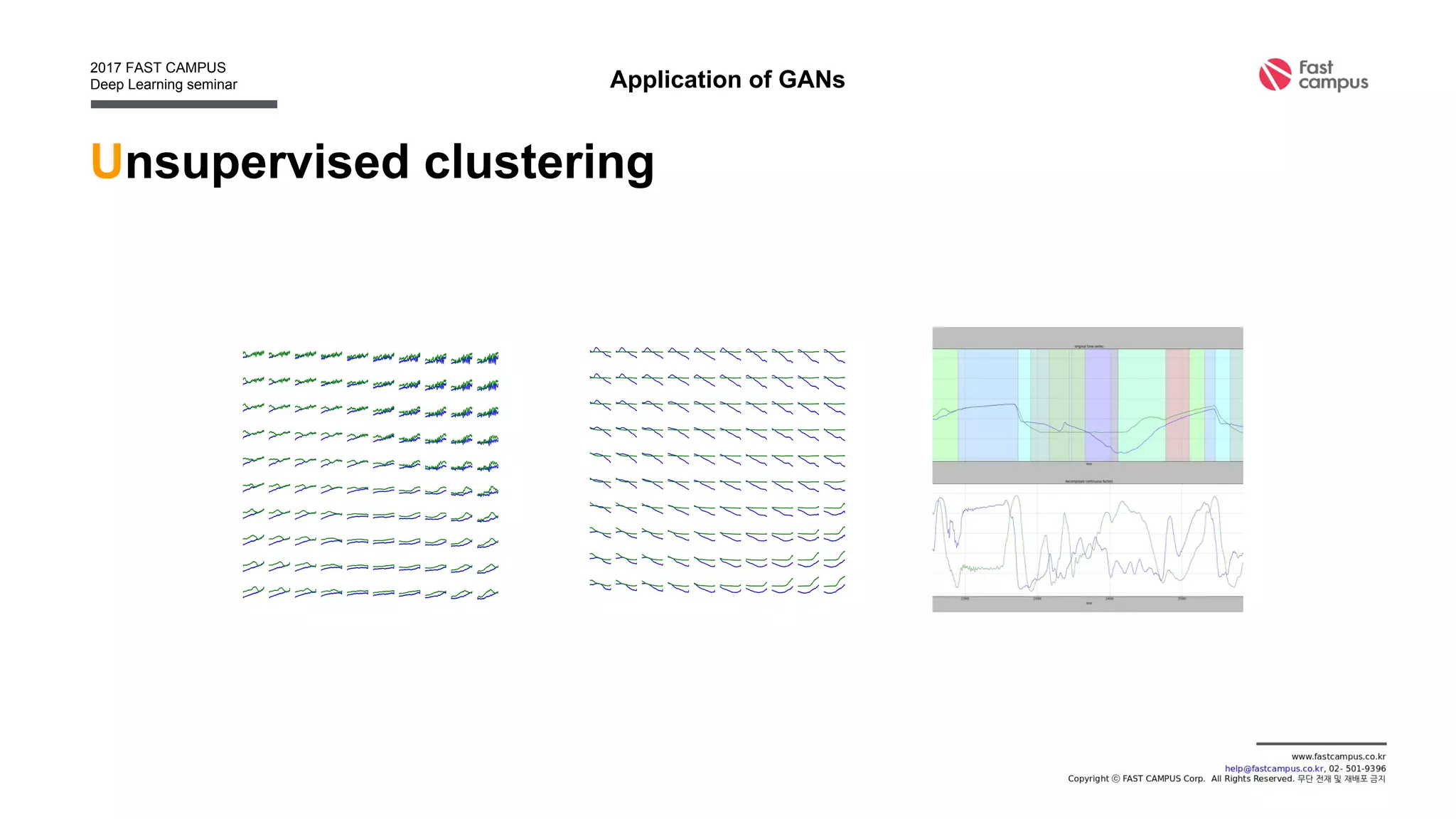
Unsupervised clustering
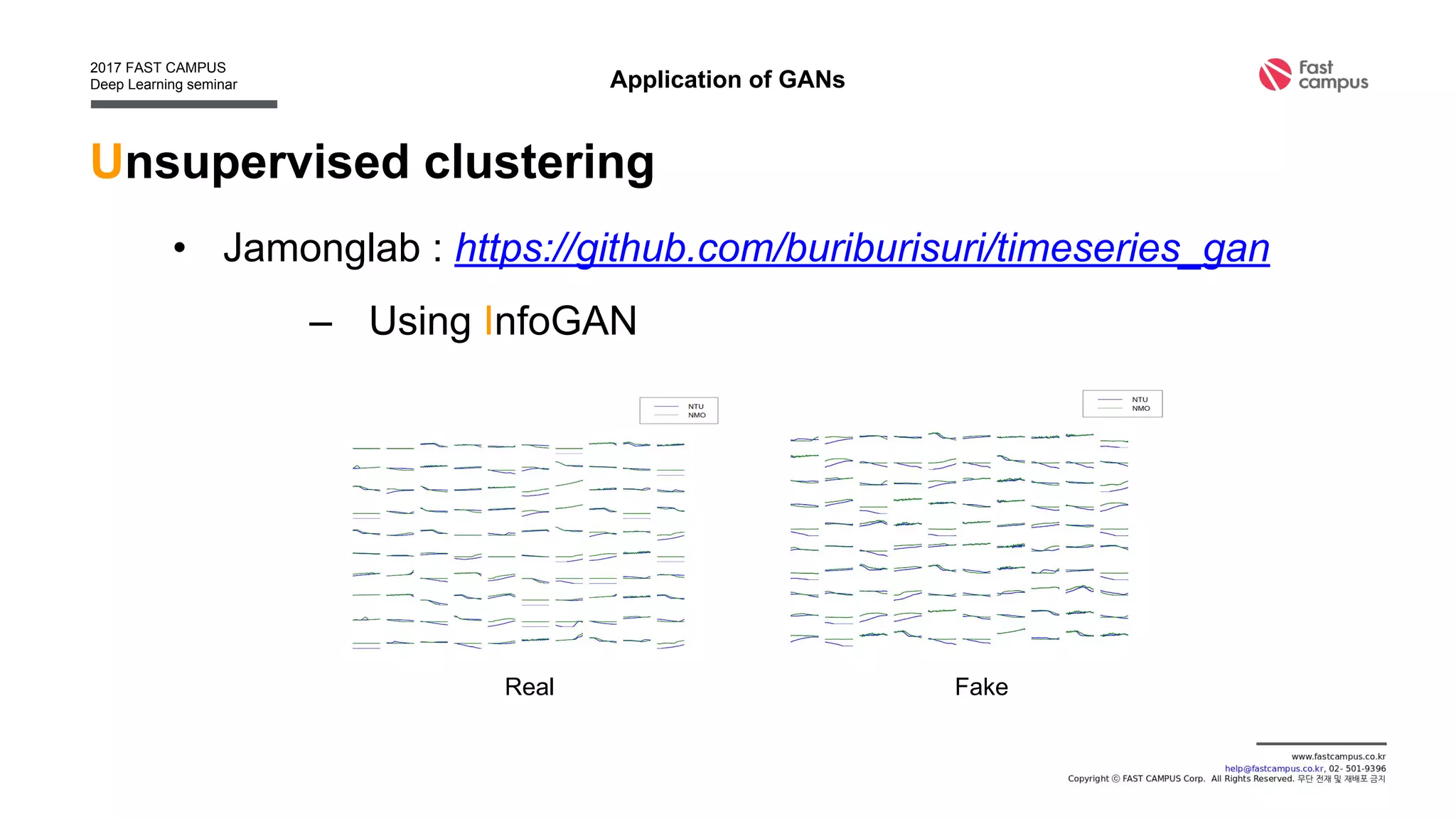
• Jamonglab : https://github.com/buriburisuri/timeseries_gan
– Using InfoGAN
Application of GANs
Real Fake
Unsupervised clustering
Application of GANs
Text generation
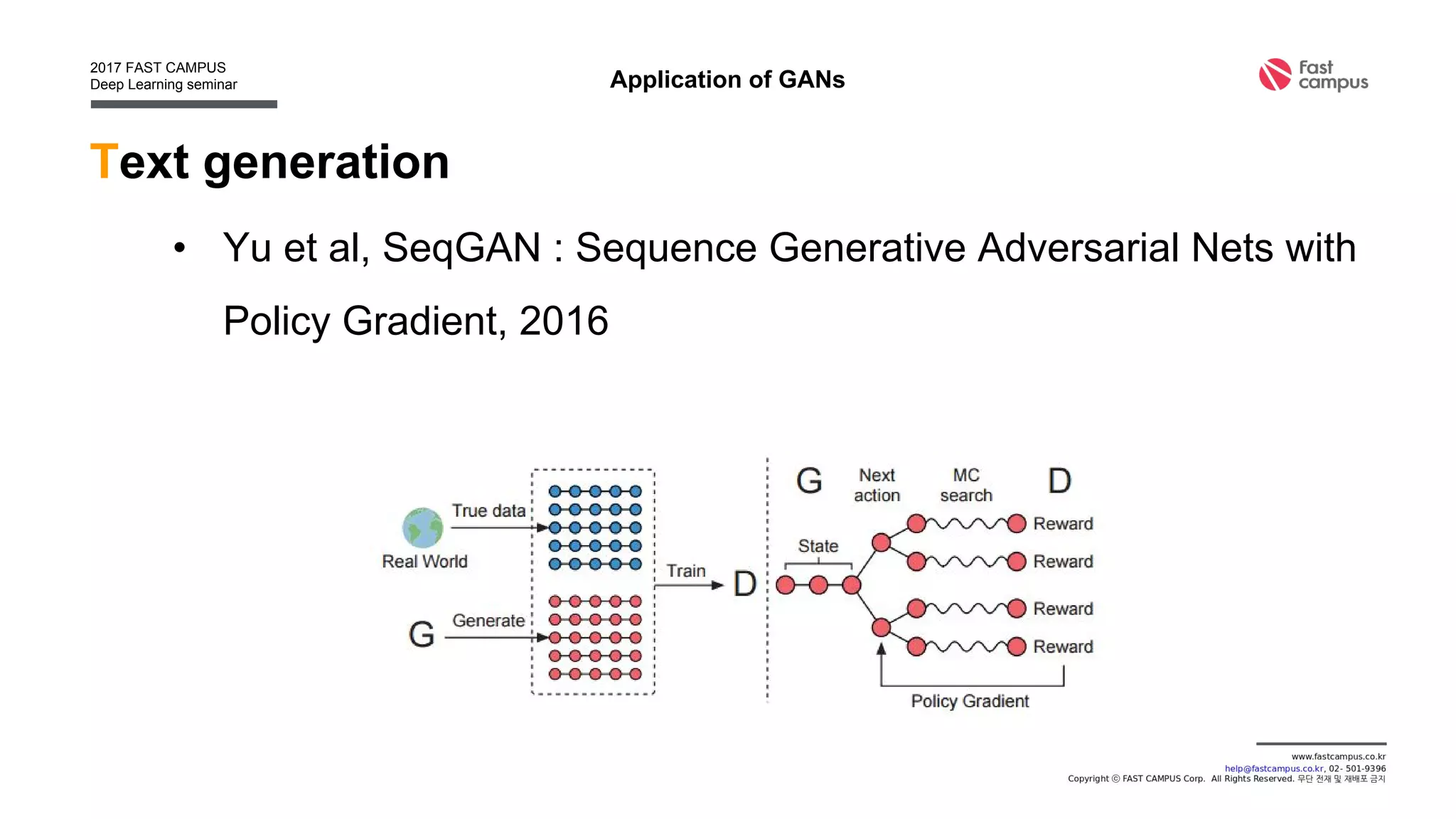
• Yu et al, SeqGAN : Sequence Generative Adversarial Nets with
Policy Gradient, 2016
Application of GANs
Text generation
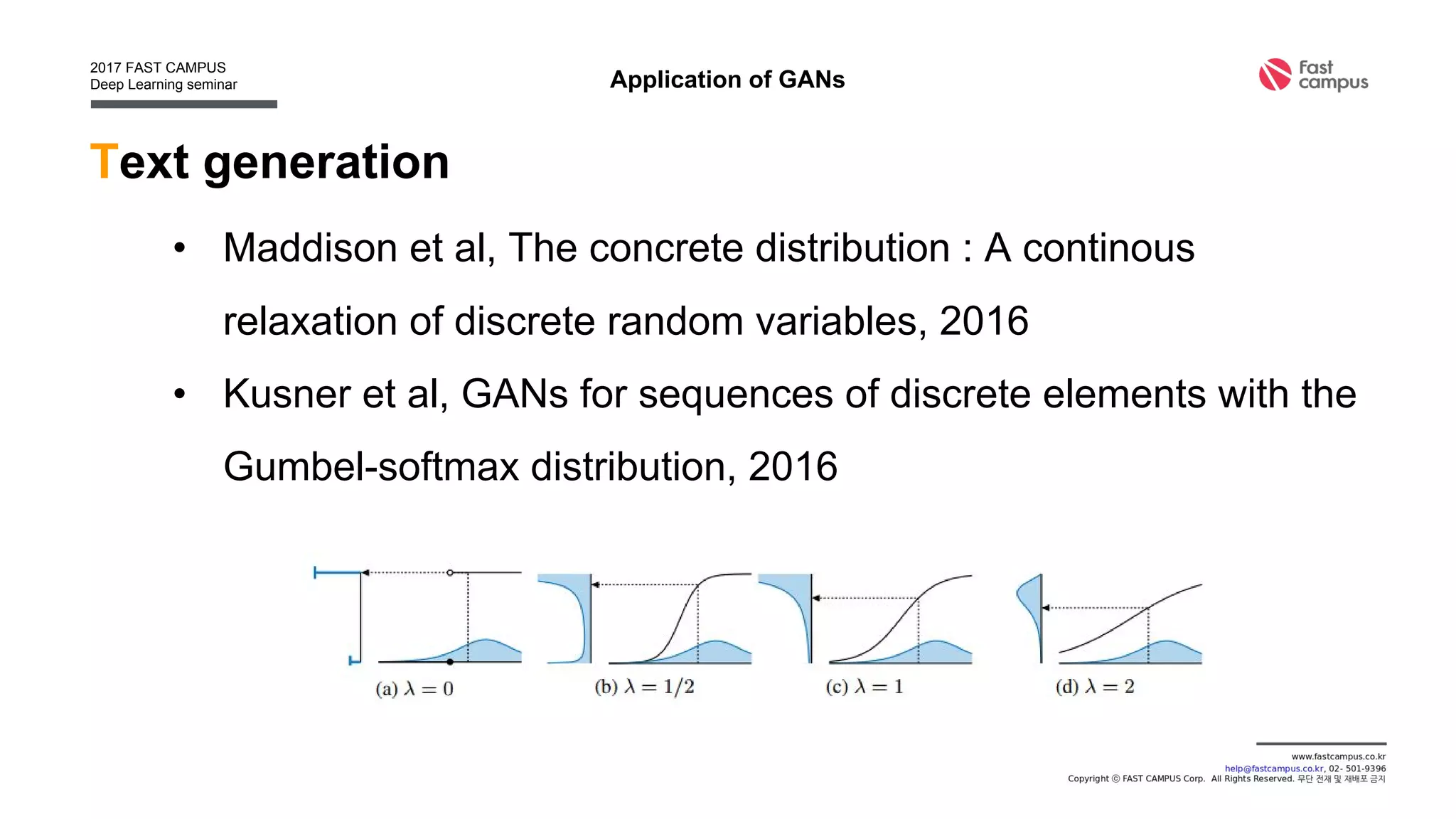
• Maddison et al, The concrete distribution : A continous
relaxation of discrete random variables, 2016
• Kusner et al, GANs for sequences of discrete elements with the
Gumbel-softmax distribution, 2016
Application of GANs
Text generation
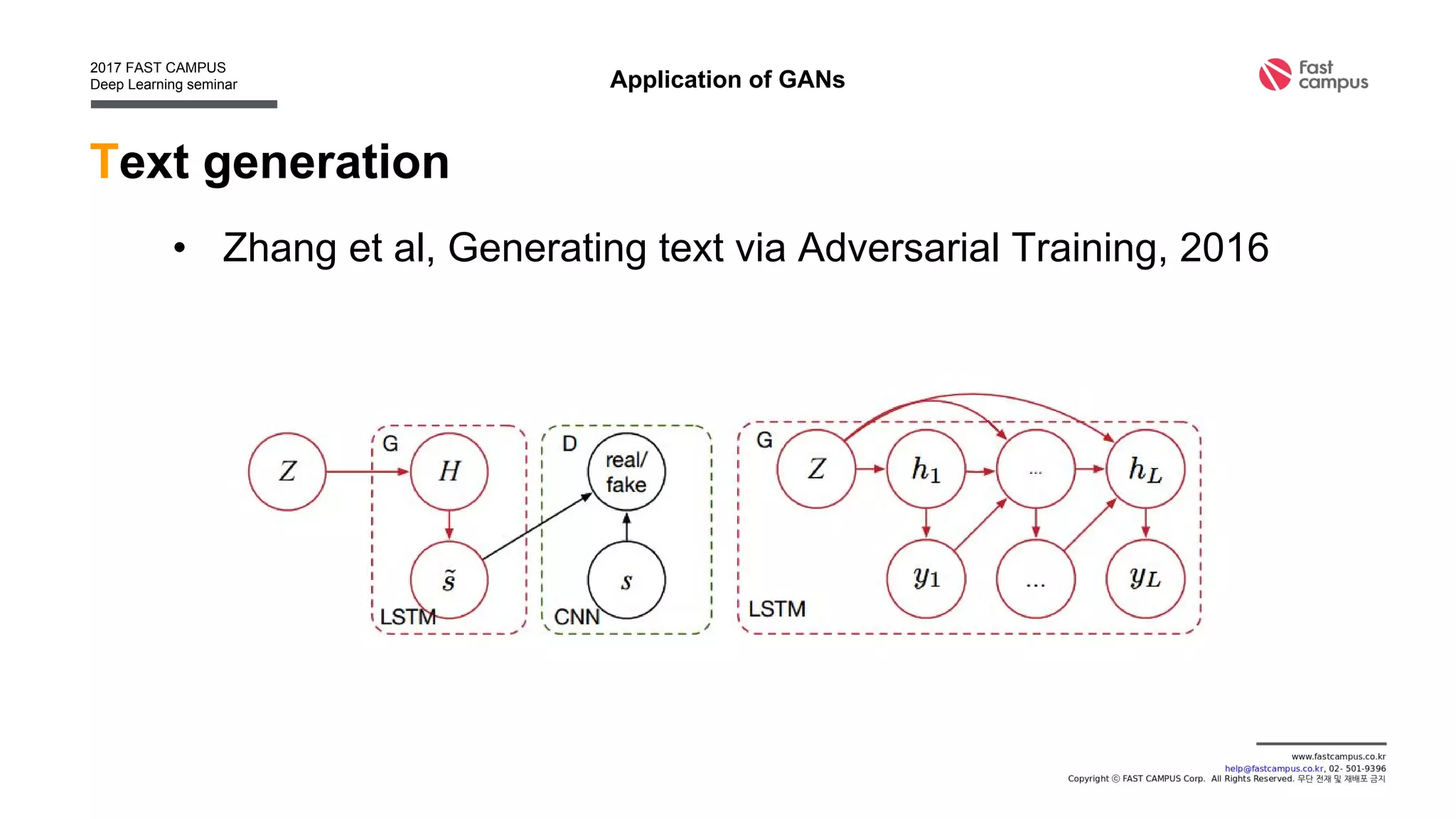
• Zhang et al, Generating text via Adversarial Training, 2016
Application of GANs
Imitation learning ( IRL or Optimal control )
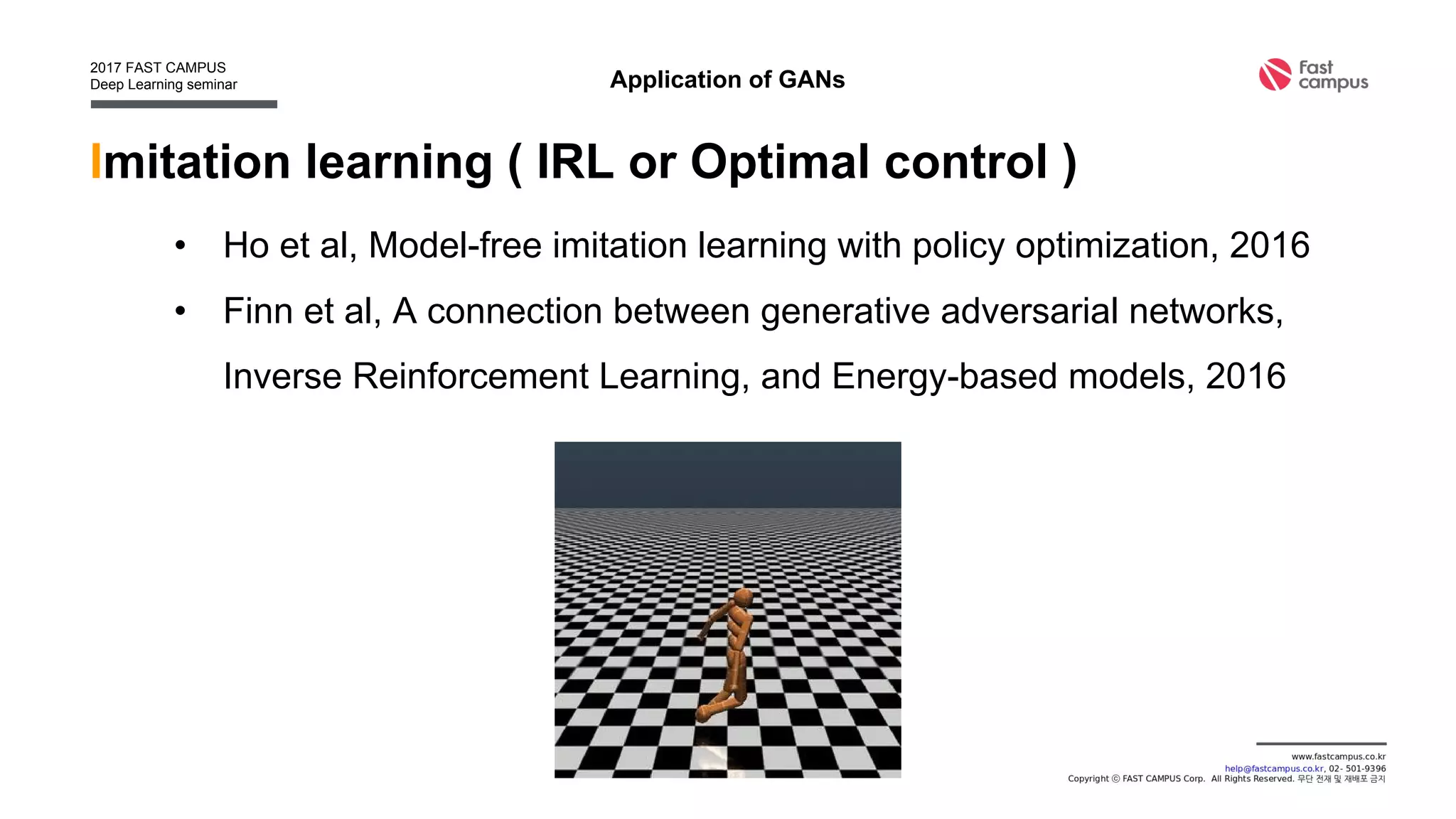
• Ho et al, Model-free imitation learning with policy optimization, 2016
• Finn et al, A connection between generative adversarial networks,
Inverse Reinforcement Learning, and Energy-based models, 2016
Application of GANs
Future of GANs
Pre-trained unified features
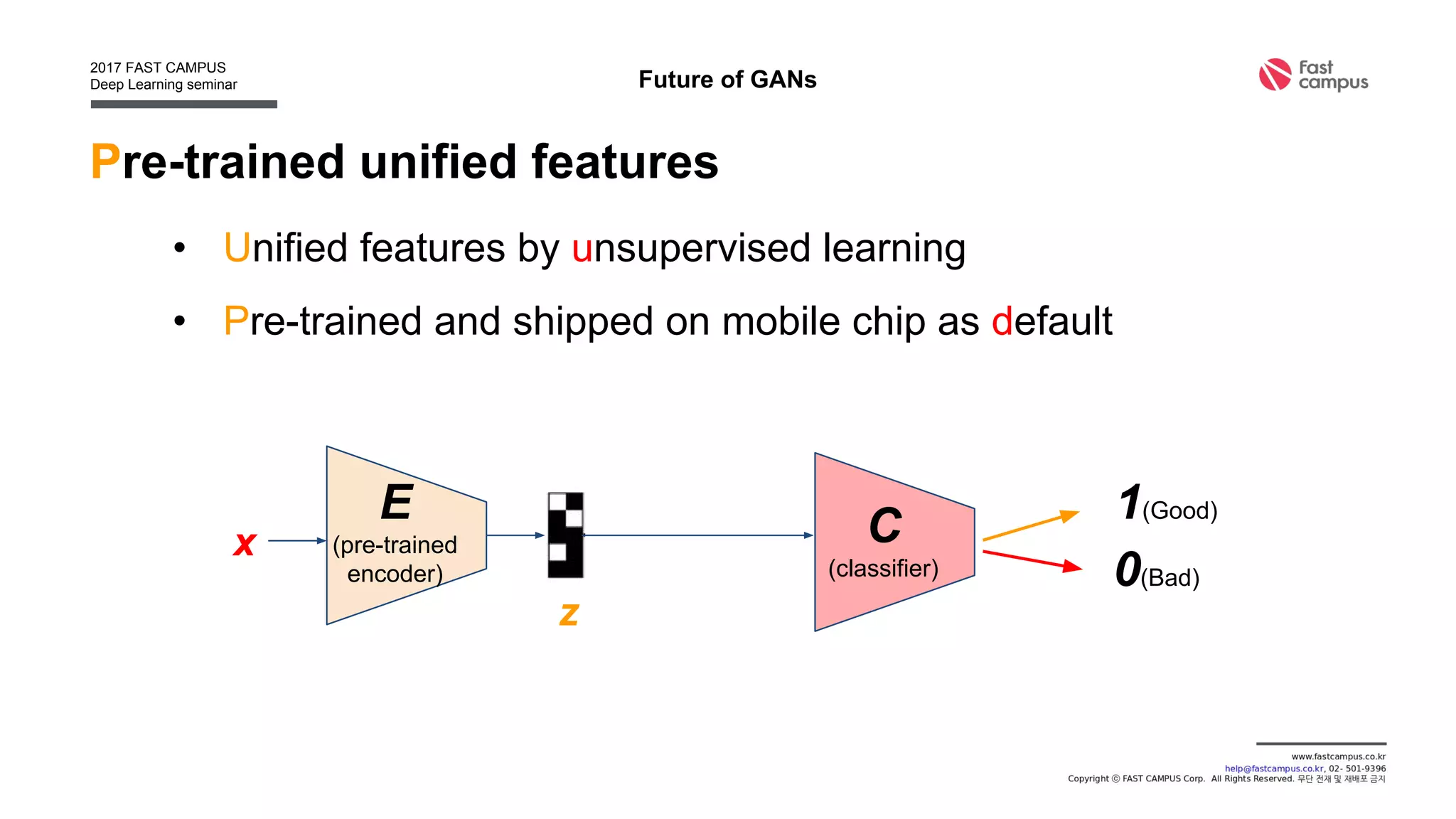
• Unified features by unsupervised learning
• Pre-trained and shipped on mobile chip as default
Future of GANs
E
(pre-trained
encoder)
z
x C
(classifier)
1(Good)
0(Bad)
Personalization at scale
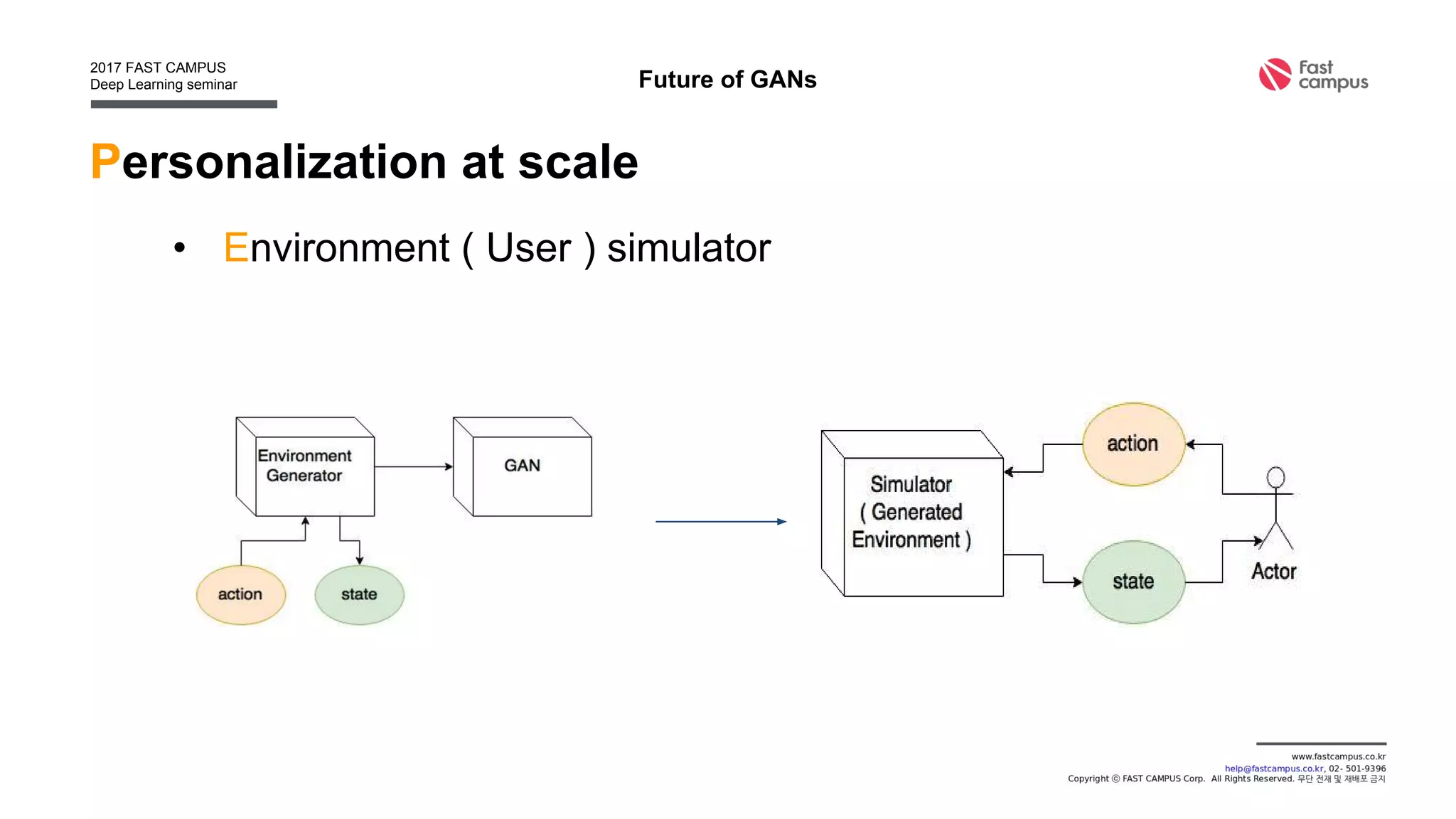
• Environment ( User ) simulator
Future of GANs
Personalization at scale
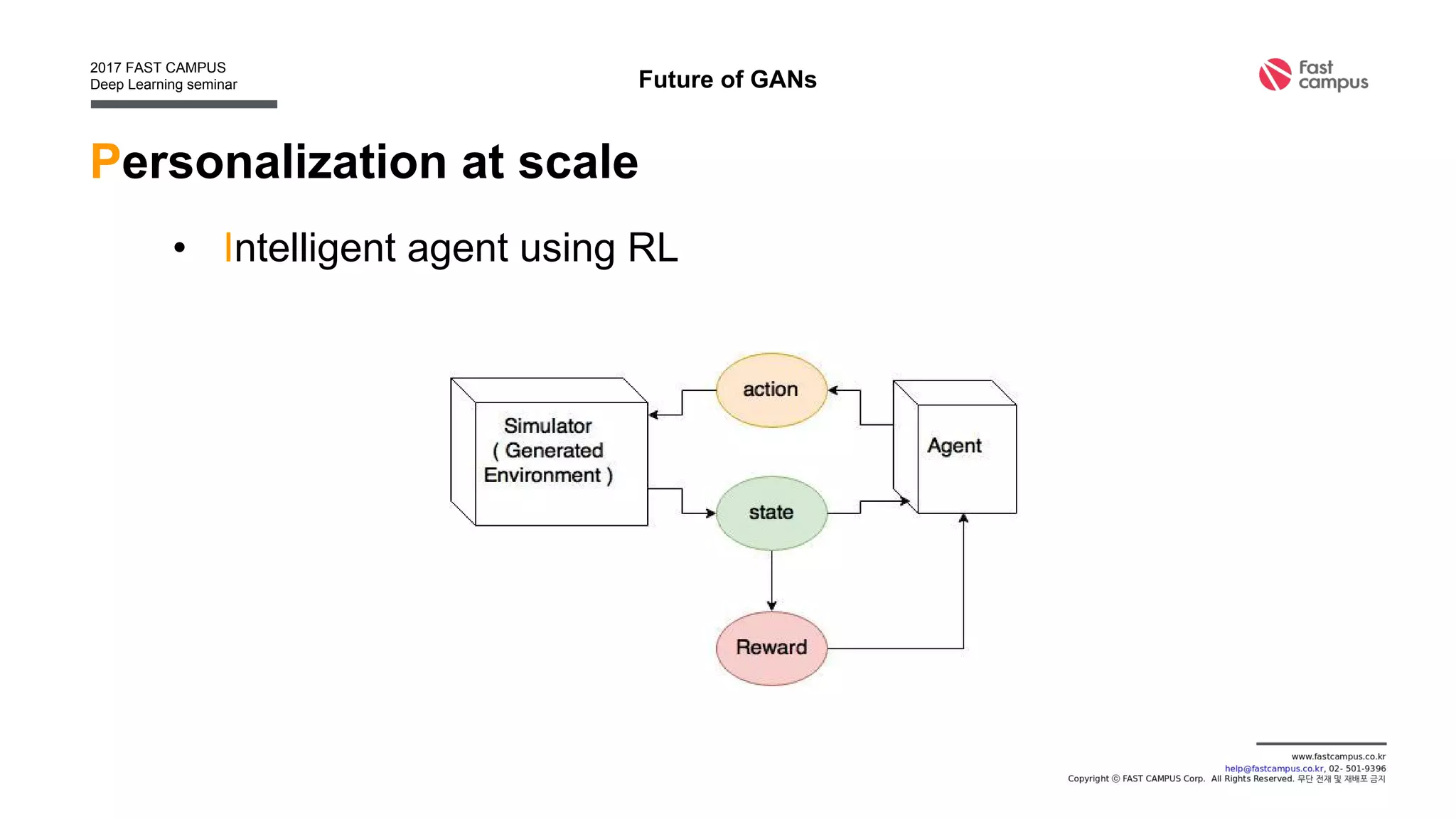
• Intelligent agent using RL
Future of GANs
Personalization at scale
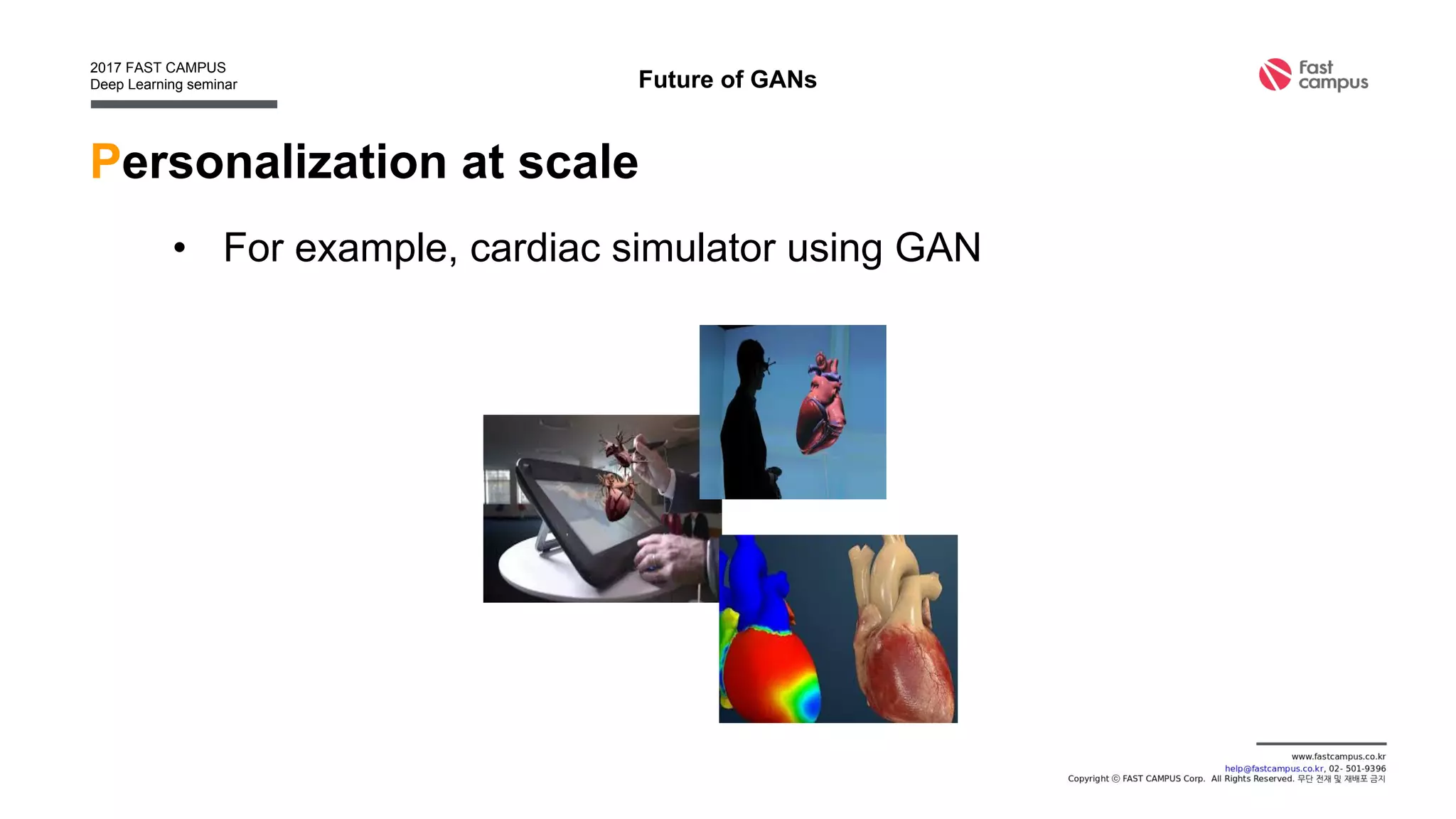
• For example, cardiac simulator using GAN
Future of GANs
Conclusion
• Unsupervised learning is next frontier in AI
– Same algos, multiple domains
• Creativity and experience are no longer human temperament
Towards Artificial General Intelligence
Future of GANs
Thank you.
http://www.slideshare.net/ssuser77ee21/generative-adversarial-networks-70896091

Generative adversarial networks

  • 1.
    Generative Adversarial Networks( GAN ) The coolest idea in ML in the last twenty years - Yann Lecun 2017.03 Namju Kim (namju.kim@kakaobrainl.com)
  • 2.
  • 3.
    Taxonomy of ML Introduction FromDavid silver, Reinforcement learning (UCL course on RL, 2015).
  • 4.
    Supervised Learning • Finddeterministic function f : y = f(x), x : data, y : label Introduction Catf F18f
  • 5.
    Supervised Learning • Howto implement the following function prototype. Introduction
  • 6.
    Supervised Learning • Challenges –Image is high dimensional data • 224 x 224 x 3 = 150,528 – Many variations • viewpoint, illumination, deformation, occlusion, background clutter, intraclass variation Introduction
  • 7.
    Supervised Learning • Solution –Feature Vector • 150,528 → 2,048 – Synonyms • Latent Vector, Hidden Vector, Unobservable Vector, Feature, Representation Introduction
  • 8.
  • 9.
    Supervised Learning • Moreflexible solution – Get probability of the label for given data instead of label itself Introduction Cat : 0.98 Cake : 0.02 Dog : 0.00 f
  • 10.
  • 11.
    Supervised Learning • Mathematicalnotation of optimization – y : label, x : data, z : latent, : learnable parameter Introduction given parameterized byprobabilityget when P is maximum Optimal
  • 12.
    Supervised Learning • Mathematicalnotation of classifying ( greedy policy ) – y : label, x : data, z : latent, : fixed optimal parameter Introduction given parameterized byprobabilityget y when P is maximum Optimal label prediction
  • 13.
    Unsupervised Learning • Finddeterministic function f : z = f(x), x : data, z : latent Introduction [0.1, 0.3, -0.8, 0.4, … ]f
  • 14.
    Good features • Lessredundancy • Similar features for similar data • High fidelity From Yann Lecun, Predictive Learning (NIPS tutorial, 2016). RL ( cherry ) SL ( icing ) UL ( cake ) Good Bad Introduction
  • 15.
    Unsupervised Learning Introduction From IanGoodfellow, Deep Learning (MIT press, 2016). E2E (end-to-end)
  • 16.
    Unsupervised Learning • Morechallenging than supervised learning : – No label or curriculum → self learning • Some NN solutions : – Boltzmann machine – Auto-encoder or Variational Inference – Generative Adversarial Network Introduction
  • 17.
    Generative Model • Findgeneration function g : x = g(z), x : data, z : latent Introduction [0.1, 0.3, -0.8, 0.4, … ] g
  • 18.
    Unsupervised learning vs.Generative model • z = f(x) vs. x = g(z) • P(z|x) vs. P(x|z) • Encoder vs. Decoder ( Generator ) – P(x, z) needed. ( cf : P(y|x) in supervised learning ) • P(z|x) = P(x, z) / P(x) → P(x) is intractable ( ELBO ) • P(x|z) = P(x, z) / P(z) → P(z) is given. ( prior ) Introduction
  • 19.
  • 20.
    Stacked autoencoder -SAE • Use data itself as label → Convert UL into reconstruction SL • z = f(x), x=g(z) → x = g(f(x)) • https://github.com/buriburisuri/sugartensor/blob/master/sugartensor/example/mnist_sae.py Autoencoders f (enc) g (dec) x x ’z Supervised learning with L2 loss ( = MSE )
  • 21.
    Denoising autoencoder -DAE • Almost same as SAE • Add random noise to input data → Convert UL into denoising SL • https://github.com/buriburisuri/sugartensor/blob/master/sugartensor/example/mnist_dae.py Autoencoders f (enc) g (dec) x + noise x ’z Supervised learning with L2 loss ( = MSE )
  • 22.
    Variational autoencoder -VAE • Kingma et al, “Auto-Encoding Variational Bayes”, 2013. • Generative Model + Stacked Autoencoder – Based on Variational approximation – other approaches : • Point estimation ( MAP ) • Markov Chain Monte Carlo ( MCMC ) Autoencoders
  • 23.
    Variational autoencoder -VAE • Training • https://github.com/buriburisuri/sugartensor/blob/master/sugartensor/example/mnist_vae.py Autoencoders f (enc) g (dec) x x ’ z : Supervised learning with L2 loss ( = MSE ) + KL regularizer z+
  • 24.
    Variational autoencoder -VAE • Generating • https://github.com/buriburisuri/sugartensor/blob/master/sugartensor/example/mnist_vae_eval.py Autoencoders g (dec) z :
  • 25.
    Variational autoencoder -VAE • Question : • Solution : – p(z|x) is intractable but MCMC is slow. – Introduce auxiliary variational function q(z|x) – Approximate q(z|x) to p(z|x) by ELBO – Make q(z|x) Autoencoders z = z → p(z|x) =+
  • 26.
    Variational autoencoder -VAE • Simply : → 0, → 1 • KLD Regularizer : – – Gaussian case : • - • If we fix = 1, ( Practical approach ) – → MSE ( ) Autoencoders
  • 27.
    Variational autoencoder -VAE • KLD ( Kullback-Leibler divergence ) • A sort of distribution difference measure – cf : KS (Kolmogorov-smirov) test, JSD(Jensen-shannon Divergence) Autoencoders
  • 28.
    Variational autoencoder -VAE • Find problems in the following code Autoencoders
  • 29.
    Variational autoencoder -VAE • Reparameterization trick – Enable back propagation – Reduce variances of gradients Autoencoders f (enc) g (dec) z : z+f (enc) g (dec) z :
  • 30.
    Variational autoencoder -VAE • This is called ‘Reparameterization trick’ Autoencoders
  • 31.
    Variational autoencoder -VAE • Results Autoencoders
  • 32.
  • 33.
    Generative Adversarial Networks- GAN • Ian Goodfellow et al, “Generative Adversarial Networks”, 2014. – Learnable cost function – Mini-Max game based on Nash Equilibrium • Little assumption • High fidelity – Hard to training - no guarantee to equilibrium. GAN
  • 34.
    Generative Adversarial Networks- GAN • Alternate training • https://github.com/buriburisuri/sugartensor/blob/master/sugartensor/example/mnist_gan.py GAN G (generator) z : D (discriminator) real image fake image 1(Real) 0(fake) 1(real) Discriminator training Generator training
  • 35.
    Generative Adversarial Networks- GAN • Generating • https://github.com/buriburisuri/sugartensor/blob/master/sugartensor/example/mnist_gan_eval.py GAN G (generator) z :
  • 36.
    Generative Adversarial Networks- GAN • Mathematical notation GAN x is sampled from real data z is sampled from N(0, I) Expectation prob. of D(real) prob. of D(fake) Maximize DMinimize G Value of fake
  • 37.
    Generative Adversarial Networks- GAN • Mathematical notation - discriminator GAN Maximize prob. of D(real) Minimize prob. of D(fake) BCE(binary cross entropy) with label 1 for real, 0 for fake. ( Practically, CE will be OK. or more plausible. )
  • 38.
    Generative Adversarial Networks- GAN • Mathematical notation - generator GAN Maximize prob. of D(fake) BCE(binary cross entropy) with label 1 for fake. ( Practically, CE will be OK. or more plausible. )
  • 39.
    Generative Adversarial Networks- GAN • Mathematical notation - equilibrium GAN Jansen-Shannon divergence 0.5
  • 40.
  • 41.
    Generative Adversarial Networks- GAN • Result GAN
  • 42.
    Generative Adversarial Networks- GAN • Why blurry and why sharper ? GAN From Ian Goodfellow, Deep Learning (MIT press, 2016) From Christian et al, Photo-realistic single image super-resolution using generative adversarial networks, 2016
  • 43.
  • 44.
    Training GANs Pitfall ofGAN • No guarantee to equilibrium – Mode collapsing – Oscillation – No indicator when to finish • All generative model – Evaluation metrics ( Human turing test ) – Overfitting test ( Nearest Neighbor ) → GAN is robust !!! – Diversity test – Wu et al, On the quantitative analysis of decoder-based generative model, 2016
  • 45.
    DCGAN • Radford etal, Unsupervised Representation Learning with Deep Convolutional Generative Adversarial Networks, 2015 – Tricks for gradient flow • Max pooling → Strided convolution or average pooling • Use LeakyReLU instead of ReLU – Other tricks • Use batch normal both generator and discriminator • Use Adam optimizer ( lr = 0.0002, a = 0.9, b=0.5 ) Training GANs
  • 46.
  • 47.
    DCGAN • Latent vectorarithmetic Training GAN
  • 48.
    Pitfall of GAN TrainingGANs mode collapsing oscillating
  • 49.
    Escaping mode collapsing •Minibatch discrimination ( Salimans et al, 2016 ) ← slow • Replay memory ( Shrivastava et al, 2016 ) ← controversial • Pull-away term regularizer ( Zhao et al, 2016 ) ← not so good • Unrolled GAN ( Metz et al, 2016 ) ← not so good Training GANs
  • 50.
    Escaping mode collapsing •Discriminator ensemble ( Durugkar, 2016) ← not tested • Latent-Image pair discrimination ( Donahue et al, 2016, Dumoulin et al, 2016 ) ← Good ( additional computing time ) • InfoGAN ( Chen et al, 2016 ) ← Good Training GANs
  • 51.
  • 52.
    Other tricks • Salimanset al, Improved Techniques for Training GANs, 2016 • https://github.com/soumith/ganhacks – One-sided label smoothing ← not sure – Historical averaging ← Unrolled GAN is better – Feature matching ← working – Use noise or dropout into real/fake image ← working – Don’t balance D and G loss ← I agree Training GANs
  • 53.
    Batch normalization inGAN • Use in G but cautious in D • Do not use at last layer of G and first layer of D • IMHO, don’t use BN in D • Reference BN or Virtual BN ( Not sure ) Training GANs
  • 54.
  • 55.
    Taxonomy of GenerativeModels Variants of GANs From Ian Goodfellow, NIPS 2016 Tutorial : Generative Adversarial Netorks, 2016 SOTA !!! AR based model : PixelRNN WaveNet
  • 56.
    Variants of GANs FromOrdena et al, Conditional Image Synthesis With Auxiliary Classifier GANs, 2016 SOTA with LabelSOTA without Label Taxonomy of GANs
  • 57.
    AFL, ALI • Donahueet al, Adversarial Feature Learning, 2016 • Domoulin et al, Adversarial Learned Inference, 2016 Variants of GANs
  • 58.
  • 59.
    InfoGAN • Chen etal, InfoGAN : Interpretable Representation Learning by Information Maximizing Generative Adversarial Nets, 2016 Variants of GANs
  • 60.
    InfoGAN • Results • Myimplementation : https://github.com/buriburisuri/sugartensor/blob/master/sugartensor/example/mnist_info_gan.py Variants of GANs
  • 61.
    EBGAN • Junbo etal, Energy-based generative adversarial networks, 2016 Variants of GANs
  • 62.
  • 63.
    EBGAN • My implementation: https://github.com/buriburisuri/ebgan Variants of GANs
  • 64.
    ACGAN • Ordena etal, Conditional Image Synthesis with Auxiliary Classifier GANs, 2016 Variants of GANs
  • 65.
  • 66.
    ACGAN • My implementation: https://github.com/buriburisuri/ac-gan Variants of GANs
  • 67.
    WGAN • Martin etal, Wasserstein GAN, 2017 Variants of GANs G (generator) z : C (critic) real image fake image High value Low value High value Critic training Generator training Weight Clamping ( No BCE )
  • 68.
    WGAN • Martin etal, Wasserstein GAN, 2017 – JSD → Earth Mover Distance(=Wasserstein-1 distance) – Prevent the gradient vanishing by using weak distance metrics – Provide the parsimonious training indicator. Variants of GANs
  • 69.
  • 70.
    BGAN • R Devonet al, Boundary-Seeking GAN, 2017 – Importance Sampling + Boundary Seeking – Discrete GAN training possible – Stabilized continuous GAN training Variants of GANs
  • 71.
  • 72.
    Generating image • Wanget al, Generative Image Modeling using Style and Structure Adversarial Networks, 2016 Application of GANs
  • 73.
    Generating image • Wanget al : Results Application of GANs
  • 74.
    Generating image • Jamonglab,128x96 face image generation, 2016.11 Application of GANs
  • 75.
    Generating image • Two-stepgeneration : Sketch → Color • Binomial random seed instead of gaussian Application of GANs
  • 76.
    Generating image • Zhanget al, StackGAN : Text to Photo-realistic Image Synthesis with Stacked GANs, 2016 Application of GANs
  • 77.
    Generating image • Zhanget al : Results Application of GANs
  • 78.
    Generating image • Reedet al, Learning What and Where to Draw, 2016 Application of GANs
  • 79.
    Generating image • Reedet al : Results Application of GANs
  • 80.
    Generating image • Nguyenet al, Plug & Play Generative Networks, 2016 – Complex langevin sampling via DAE Application of GANs
  • 81.
    Generating image • Ariciet al, Associative Adversarial Networks, 2016 – Application of GANs p(z|x) =
  • 82.
    Generating image • Ariciet al : Results Application of GANs
  • 83.
    Translating image • Perarnauet al, Invertible Conditional GANs for image editing, 2016 Application of GANs
  • 84.
    Translating image • Perarnauet al : results Application of GANs
  • 85.
    Translating image • Isolaet al, Image-to-image translation with convolutional adversarial networks, 2016 Application of GANs
  • 86.
    Translating image • Isolaet al : Results Application of GANs
  • 87.
    Translating image • Lediget al, Photo-Realistic Single Image Super-Resolution Using a GAN, 2016 Application of GANs
  • 88.
    Translating image • Lediget al : Results Application of GANs
  • 89.
    Translating image • Sajjadiet al, EnhanceNet : Single Image Super-Resolution through Automated Texture Synthesis, 2016 – SRGAN + Gram metrics loss Application of GANs
  • 90.
    Domain adaptation • Taigmanet al, Unsupervised cross-domain image generation, 2016 Application of GANs
  • 91.
    Domain adaptation • Taigmanet al, Unsupervised cross-domain image generation, 2016 Application of GANs
  • 92.
    Domain adaptation • Bousmaliset al, Unsupervised Pixel-Level Domain Adaptation with Generative Adversarial Networks, 2016 Application of GANs
  • 93.
    Domain adaptation • Bousmaliset al : Results Application of GANs
  • 94.
    Domain adaptation • Shrivastavaet al, Learning from simulated and unsupervised images through adversarial training, 2016 Application of GANs
  • 95.
    Domain adaptation • Shrivastavaet al : Results Application of GANs
  • 96.
    Domain adaptation • TaeksooKim et al, Learning to Discover Cross-Domain Relations with Generative Adversarial Networks, 2017 Application of GANs
  • 97.
    Domain adaptation • ExtendedTaigman’s idea using smart bijective mapping Application of GANs
  • 98.
    Unsupervised clustering • Jamonglab: https://github.com/buriburisuri/timeseries_gan – Using InfoGAN Application of GANs Real Fake
  • 99.
  • 100.
    Text generation • Yuet al, SeqGAN : Sequence Generative Adversarial Nets with Policy Gradient, 2016 Application of GANs
  • 101.
    Text generation • Maddisonet al, The concrete distribution : A continous relaxation of discrete random variables, 2016 • Kusner et al, GANs for sequences of discrete elements with the Gumbel-softmax distribution, 2016 Application of GANs
  • 102.
    Text generation • Zhanget al, Generating text via Adversarial Training, 2016 Application of GANs
  • 103.
    Imitation learning (IRL or Optimal control ) • Ho et al, Model-free imitation learning with policy optimization, 2016 • Finn et al, A connection between generative adversarial networks, Inverse Reinforcement Learning, and Energy-based models, 2016 Application of GANs
  • 104.
  • 105.
    Pre-trained unified features •Unified features by unsupervised learning • Pre-trained and shipped on mobile chip as default Future of GANs E (pre-trained encoder) z x C (classifier) 1(Good) 0(Bad)
  • 106.
    Personalization at scale •Environment ( User ) simulator Future of GANs
  • 107.
    Personalization at scale •Intelligent agent using RL Future of GANs
  • 108.
    Personalization at scale •For example, cardiac simulator using GAN Future of GANs
  • 109.
    Conclusion • Unsupervised learningis next frontier in AI – Same algos, multiple domains • Creativity and experience are no longer human temperament Towards Artificial General Intelligence Future of GANs
  • 110.