Neural Networks
and Deep Learning
Tijmen Blankevoort
Scyfer

Prof dr. Max Welling

Drs. Jorgen Sandig

Msc. Taco Cohen
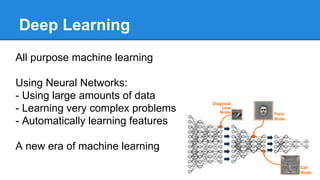
Deep Learning
All purpose machine learning
Using Neural Networks:
- Using large amounts of data
- Learning very complex problems
- Automatically learning features
A new era of machine learning
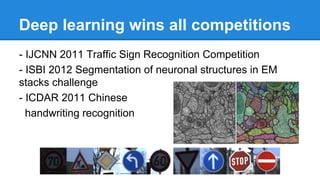
Deep learning wins all competitions
- IJCNN 2011 Traffic Sign Recognition Competition
- ISBI 2012 Segmentation of neuronal structures in EM
stacks challenge
- ICDAR 2011 Chinese
handwriting recognition
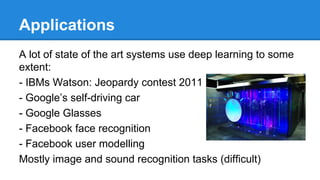
Applications
A lot of state of the art systems use deep learning to some
extent:
- IBMs Watson: Jeopardy contest 2011
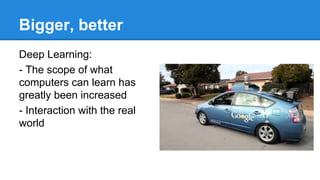
- Google’s self-driving car
- Google Glasses
- Facebook face recognition
- Facebook user modelling
Mostly image and sound recognition tasks (difficult)
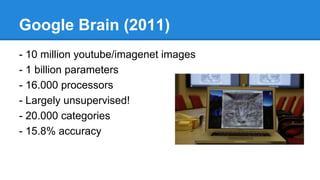
Google Brain (2011)
- 10 million youtube/imagenet images
- 1 billion parameters
- 16.000 processors
- Largely unsupervised!
- 20.000 categories
- 15.8% accuracy
Bigger, better
Deep Learning:
- The scope of what
computers can learn has
greatly been increased
- Interaction with the real
world
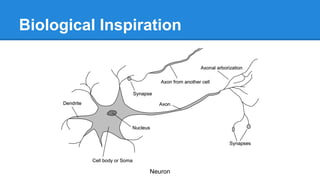
Biological Inspiration

Neuron
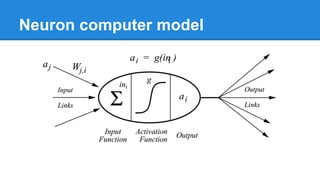
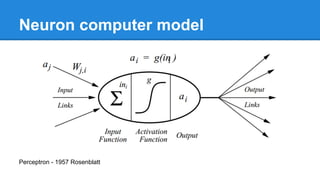
Neuron computer model
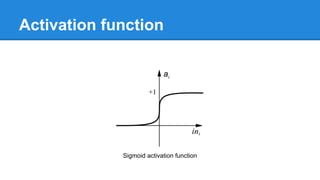
Activation function

Sigmoid activation function
Neuron computer model

Perceptron - 1957 Rosenblatt
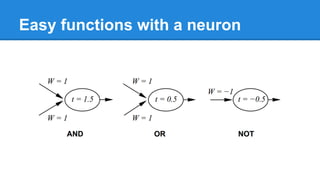
Easy functions with a neuron
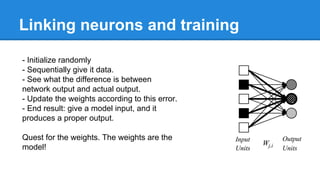
Linking neurons and training
- Initialize randomly
- Sequentially give it data.
- See what the difference is between
network output and actual output.
- Update the weights according to this error.
- End result: give a model input, and it
produces a proper output.
Quest for the weights. The weights are the
model!
The Perceptron (1958)

“A machine which senses, recognizes, remembers, and responds like the human mind”
“Remarkable machine… [was] capable of what amounts to thought” - The New Yorker
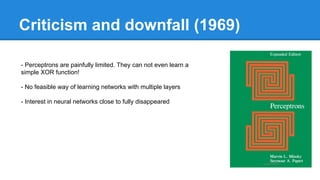
Criticism and downfall (1969)
- Perceptrons are painfully limited. They can not even learn a
simple XOR function!
- No feasible way of learning networks with multiple layers
- Interest in neural networks close to fully disappeared
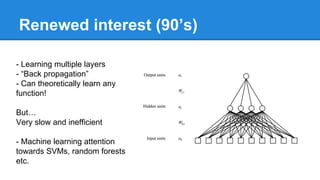
Renewed interest (90’s)
- Learning multiple layers
- “Back propagation”
- Can theoretically learn any
function!
But…
Very slow and inefficient
- Machine learning attention
towards SVMs, random forests
etc.
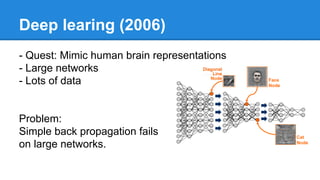
Deep learing (2006)
- Quest: Mimic human brain representations
- Large networks
- Lots of data

Problem:
Simple back propagation fails
on large networks.
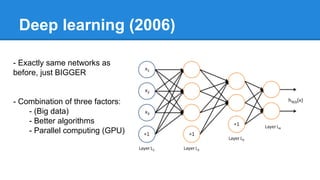
Deep learning (2006)
- Exactly same networks as
before, just BIGGER

- Combination of three factors:
- (Big data)
- Better algorithms
- Parallel computing (GPU)
Better algorithms

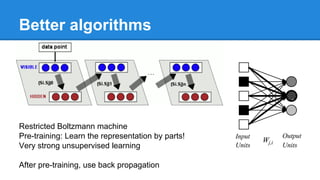
Restricted Boltzmann machine
Pre-training: Learn the representation by parts!
Very strong unsupervised learning
After pre-training, use back propagation
Parallel (GPU) power
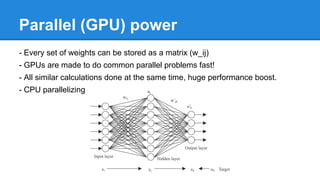
- Every set of weights can be stored as a matrix (w_ij)
- GPUs are made to do common parallel problems fast!
- All similar calculations done at the same time, huge performance boost.
- CPU parallelizing
Future of Deep Learning
- Currently an explosion of developments
- Hessian-Free networks (2010)
- Long Short Term Memory (2011)
- Large Convolutional nets, max-pooling (2011)
- Nesterov’s Gradient Descent (2013)
- Currently state of the art but...
- No way of doing logical inference (extrapolation)
- No easy integration of abstract knowledge
- Hypothetic space bias might not conform with reality
When to apply Deep Learning
- Generally, vision and sound
recognition, but...
- Works great for any other problem too!
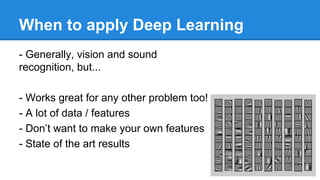
- A lot of data / features
- Don’t want to make your own features
- State of the art results
How to apply Deep Learning
Deep learning is very difficult!
- No easy plug and play software
- Far too many different networks/options/additions
- Mathematics and programming very challenging
- Research is fast paced
- Learning a network is both an art and a science
My advice:
Cooperation university <=> business
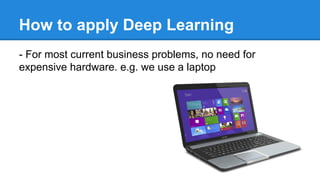
How to apply Deep Learning
- For most current business problems, no need for
expensive hardware. e.g. we use a laptop

Neural networks and deep learning

  • 1.
    Neural Networks and DeepLearning Tijmen Blankevoort
  • 2.
    Scyfer Prof dr. MaxWelling Drs. Jorgen Sandig Msc. Taco Cohen
  • 3.
    Deep Learning All purposemachine learning Using Neural Networks: - Using large amounts of data - Learning very complex problems - Automatically learning features A new era of machine learning
  • 4.
    Deep learning winsall competitions - IJCNN 2011 Traffic Sign Recognition Competition - ISBI 2012 Segmentation of neuronal structures in EM stacks challenge - ICDAR 2011 Chinese handwriting recognition
  • 5.
    Applications A lot ofstate of the art systems use deep learning to some extent: - IBMs Watson: Jeopardy contest 2011 - Google’s self-driving car - Google Glasses - Facebook face recognition - Facebook user modelling Mostly image and sound recognition tasks (difficult)
  • 6.
    Google Brain (2011) -10 million youtube/imagenet images - 1 billion parameters - 16.000 processors - Largely unsupervised! - 20.000 categories - 15.8% accuracy
  • 7.
    Bigger, better Deep Learning: -The scope of what computers can learn has greatly been increased - Interaction with the real world
  • 8.
  • 9.
  • 10.
  • 11.
  • 12.
  • 13.
    Linking neurons andtraining - Initialize randomly - Sequentially give it data. - See what the difference is between network output and actual output. - Update the weights according to this error. - End result: give a model input, and it produces a proper output. Quest for the weights. The weights are the model!
  • 14.
    The Perceptron (1958) “Amachine which senses, recognizes, remembers, and responds like the human mind” “Remarkable machine… [was] capable of what amounts to thought” - The New Yorker
  • 15.
    Criticism and downfall(1969) - Perceptrons are painfully limited. They can not even learn a simple XOR function! - No feasible way of learning networks with multiple layers - Interest in neural networks close to fully disappeared
  • 16.
    Renewed interest (90’s) -Learning multiple layers - “Back propagation” - Can theoretically learn any function! But… Very slow and inefficient - Machine learning attention towards SVMs, random forests etc.
  • 17.
    Deep learing (2006) -Quest: Mimic human brain representations - Large networks - Lots of data Problem: Simple back propagation fails on large networks.
  • 18.
    Deep learning (2006) -Exactly same networks as before, just BIGGER - Combination of three factors: - (Big data) - Better algorithms - Parallel computing (GPU)
  • 19.
    Better algorithms Restricted Boltzmannmachine Pre-training: Learn the representation by parts! Very strong unsupervised learning After pre-training, use back propagation
  • 20.
    Parallel (GPU) power -Every set of weights can be stored as a matrix (w_ij) - GPUs are made to do common parallel problems fast! - All similar calculations done at the same time, huge performance boost. - CPU parallelizing
  • 21.
    Future of DeepLearning - Currently an explosion of developments - Hessian-Free networks (2010) - Long Short Term Memory (2011) - Large Convolutional nets, max-pooling (2011) - Nesterov’s Gradient Descent (2013) - Currently state of the art but... - No way of doing logical inference (extrapolation) - No easy integration of abstract knowledge - Hypothetic space bias might not conform with reality
  • 22.
    When to applyDeep Learning - Generally, vision and sound recognition, but... - Works great for any other problem too! - A lot of data / features - Don’t want to make your own features - State of the art results
  • 23.
    How to applyDeep Learning Deep learning is very difficult! - No easy plug and play software - Far too many different networks/options/additions - Mathematics and programming very challenging - Research is fast paced - Learning a network is both an art and a science My advice: Cooperation university <=> business
  • 24.
    How to applyDeep Learning - For most current business problems, no need for expensive hardware. e.g. we use a laptop