Generative Adversarial
Networks
Manohar Mukku
CS1703
1
2
• GANs were introduced in a paper by Ian Goodfellow and
other researchers at the University of Montreal, including
Yoshua Bengio, in 2014.
3
–Yann LeCun
“The most interesting idea in the last 10 years in
Machine Learning”
4
• So what are GANs?
• What makes them so “interesting” ?
5
• GAN - Generative Adversarial Network
• GANs belong to the set of generative models.
• It means that they are able to produce / generate new
content.
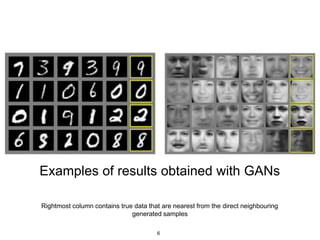
Examples of results obtained with GANs
Rightmost column contains true data that are nearest from the direct neighbouring
generated samples
6
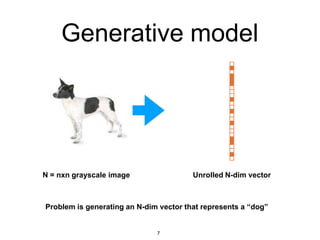
Generative model
N = nxn grayscale image
7
Unrolled N-dim vector
Problem is generating an N-dim vector that represents a “dog”
8
• It is equivalent to generating a random variable with
respect to the “dog probability distribution”
• The “dog probability distribution” over the N dimensional
vector space is a very complex one
• We don’t know how to explicitly express this distribution
• We don’t know how to directly generate complex random
variables
9
• It has been shown that Complex random variables can be
built as a function of some simpler random variables
C = F(S)
10
• Uniform random variables can be generated easily
• We need to express our N dim random variable as the
result of a very complex function applied to a simple N dim
random variable
Complex r.v = Function(Simple r.v’s)
• Solution - Use Neural network modelling
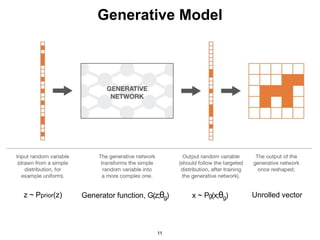
z ~ Pprior(z)
11
Generator function, G(z;θg) x ~ Pg(x;θg) Unrolled vector
Generative Model
12
• How to train this Generative Network?
• One Solution - GAN
• Generative - Generates new content
• Adversarial Networks - Two networks with opposing
objectives
13
GAN
• It consists of two deep networks:
1. Discriminator network
2. Generator network
• The discriminator is supplied with both true and fake
images and it tries to detect fake vs true images. Outputs
a probability between 0 and 1 that the image is “true”
• The generator tries to fool the discriminator into thinking
that the fake images it generates are true images
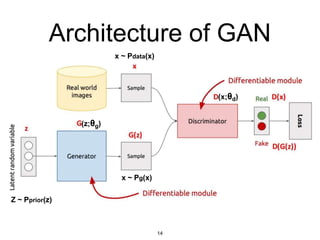
Architecture of GAN
x ~ Pdata(x)
x ~ Pg(x)
14
Z ~ Pprior(z)
(z;θg)
(x;θd)
15
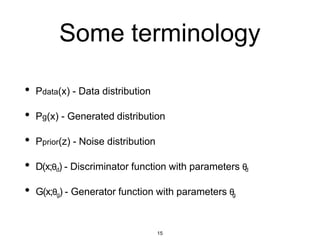
Some terminology
• Pdata(x) - Data distribution
• Pg(x) - Generated distribution
• Pprior(z) - Noise distribution
• D(x;θd) - Discriminator function with parameters θ
d
• G(x;θg) - Generator function with parameters θ
g
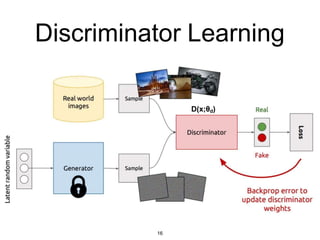
Discriminator Learning
D(x;θd)
16
Discriminator Learning
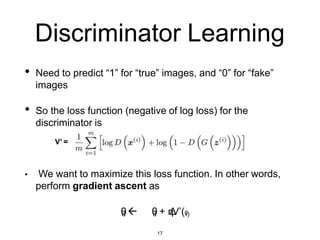
• Need to predict “1” for “true” images, and “0” for “fake”
images
• So the loss function (negative of log loss) for the
discriminator is
V’ =
• We want to maximize this loss function. In other words,
perform gradient ascent as
θ
d  θ
d + η
Δ
V’(θ
d)
17
Generator Learning
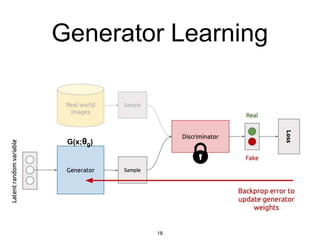
G(x;θg)
18
Generator Learning
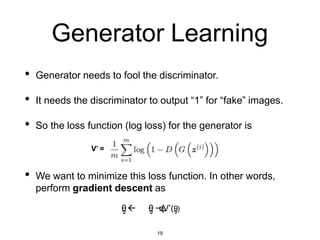
• Generator needs to fool the discriminator.
• It needs the discriminator to output “1” for “fake” images.
• So the loss function (log loss) for the generator is
V’ =
• We want to minimize this loss function. In other words,
perform gradient descent as
θ
g  θ
g −η
Δ
V’(θ
g)
19
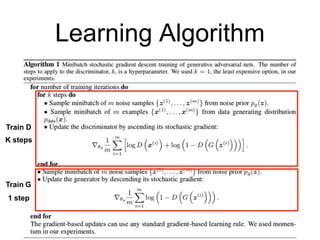
Learning Algorithm
20
Train D
K steps
Train G
1 step
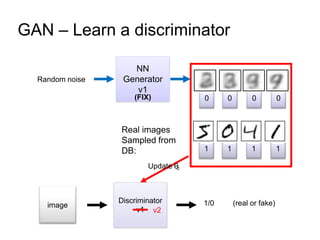
GAN – Learn a discriminator
Discriminator
v1
image 1/0 (real or fake)
Random noise
1 1 1 1
0 0 0 0
Real images
Sampled from
DB:
Update θ
d
v2
NN
Generator
v1
(FIX)
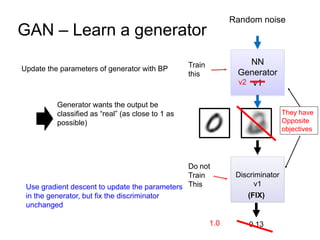
GAN – Learn a generator
NN
Generator
v1
Random noise
0.13
Update the parameters of generator with BP
Generator wants the output be
classified as “real” (as close to 1 as
possible)
Use gradient descent to update the parameters
in the generator, but fix the discriminator
unchanged
1.0
v2
Train
this
Do not
Train
This
They have
Opposite
objectives
Discriminator
v1
(FIX)
23
• It has been shown in the paper that, if both the generator
and discriminator are provided with enough capacity and
training time we can get Pg(x) converge to Pdata(x)
24
Takeaways
• Generator models try to generate data from a given
(complex) probability distribution
• The generator tries to model the input data probability
distribution
Pg(x) = Pdata(x)
• GAN uses adversarial method to train the Generator
25
Applications
• Generating images, videos, poems, some simple
conversation
• Text-to-image synthesis
• Face Aging
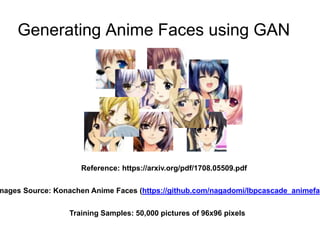
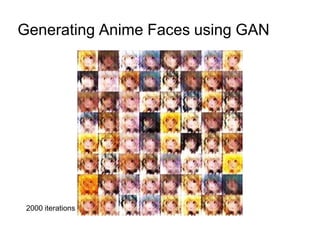
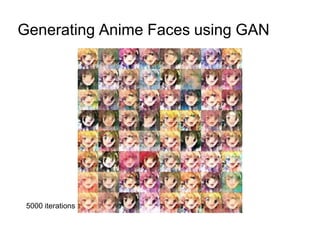
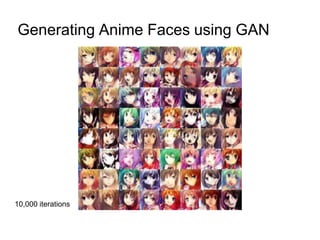
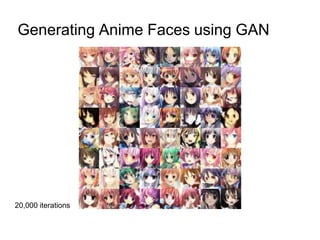
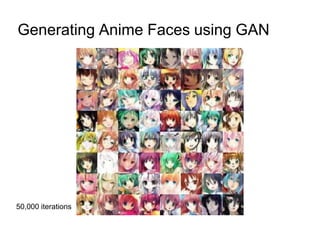
Generating Anime Faces using GAN
Reference: https://arxiv.org/pdf/1708.05509.pdf
mages Source: Konachen Anime Faces (https://github.com/nagadomi/lbpcascade_animefa
Training Samples: 50,000 pictures of 96x96 pixels
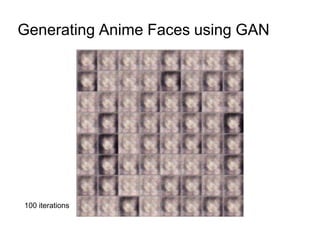
Generating Anime Faces using GAN
100 iterations
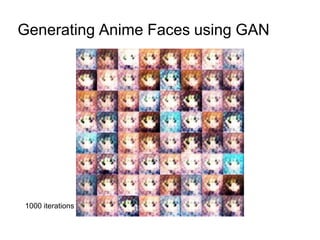
Generating Anime Faces using GAN
1000 iterations
Generating Anime Faces using GAN
2000 iterations
Generating Anime Faces using GAN
5000 iterations
Generating Anime Faces using GAN
10,000 iterations
Generating Anime Faces using GAN
20,000 iterations
Generating Anime Faces using GAN
50,000 iterations
Application
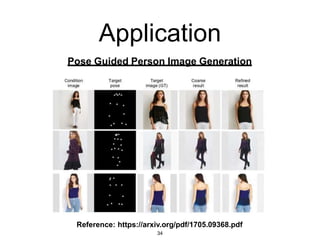
Pose Guided Person Image Generation
Reference: https://arxiv.org/pdf/1705.09368.pdf
34
Application
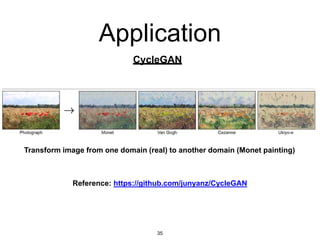
CycleGAN
Transform image from one domain (real) to another domain (Monet painting)
35
Reference: https://github.com/junyanz/CycleGAN
Application
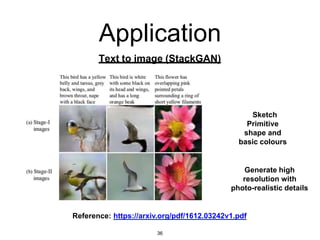
Text to image (StackGAN)
Sketch
Primitive
shape and
basic colours
Generate high
resolution with
photo-realistic details
Reference: https://arxiv.org/pdf/1612.03242v1.pdf
36
Application
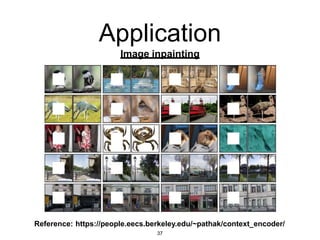
Image inpainting
Reference: https://people.eecs.berkeley.edu/~pathak/context_encoder/
37
Application
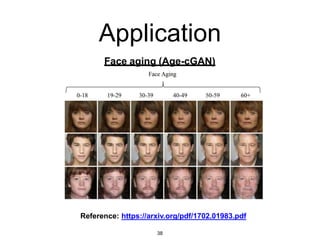
Face aging (Age-cGAN)
Reference: https://arxiv.org/pdf/1702.01983.pdf
38
39
References
• https://towardsdatascience.com/understanding-generative-adversarial-
networks-gans-cd6e4651a29
• https://arxiv.org/pdf/1406.2661.pdf
• https://skymind.ai/wiki/generative-adversarial-network-gan
• http://www.iangoodfellow.com/slides/2016-12-04-NIPS.pdf
• http://slazebni.cs.illinois.edu/spring17/lec11_gan.pdf
• https://cs.uwaterloo.ca/~mli/Deep-Learning-2017-Lecture7GAN.ppt
• https://medium.com/@jonathan_hui/gan-some-cool-applications-of-gans-
4c9ecca35900
40
Thank You!

gan-190318135433 (1).pptx

  • 1.
  • 2.
    2 • GANs wereintroduced in a paper by Ian Goodfellow and other researchers at the University of Montreal, including Yoshua Bengio, in 2014.
  • 3.
    3 –Yann LeCun “The mostinteresting idea in the last 10 years in Machine Learning”
  • 4.
    4 • So whatare GANs? • What makes them so “interesting” ?
  • 5.
    5 • GAN -Generative Adversarial Network • GANs belong to the set of generative models. • It means that they are able to produce / generate new content.
  • 6.
    Examples of resultsobtained with GANs Rightmost column contains true data that are nearest from the direct neighbouring generated samples 6
  • 7.
    Generative model N =nxn grayscale image 7 Unrolled N-dim vector Problem is generating an N-dim vector that represents a “dog”
  • 8.
    8 • It isequivalent to generating a random variable with respect to the “dog probability distribution” • The “dog probability distribution” over the N dimensional vector space is a very complex one • We don’t know how to explicitly express this distribution • We don’t know how to directly generate complex random variables
  • 9.
    9 • It hasbeen shown that Complex random variables can be built as a function of some simpler random variables C = F(S)
  • 10.
    10 • Uniform randomvariables can be generated easily • We need to express our N dim random variable as the result of a very complex function applied to a simple N dim random variable Complex r.v = Function(Simple r.v’s) • Solution - Use Neural network modelling
  • 11.
    z ~ Pprior(z) 11 Generatorfunction, G(z;θg) x ~ Pg(x;θg) Unrolled vector Generative Model
  • 12.
    12 • How totrain this Generative Network? • One Solution - GAN • Generative - Generates new content • Adversarial Networks - Two networks with opposing objectives
  • 13.
    13 GAN • It consistsof two deep networks: 1. Discriminator network 2. Generator network • The discriminator is supplied with both true and fake images and it tries to detect fake vs true images. Outputs a probability between 0 and 1 that the image is “true” • The generator tries to fool the discriminator into thinking that the fake images it generates are true images
  • 14.
    Architecture of GAN x~ Pdata(x) x ~ Pg(x) 14 Z ~ Pprior(z) (z;θg) (x;θd)
  • 15.
    15 Some terminology • Pdata(x)- Data distribution • Pg(x) - Generated distribution • Pprior(z) - Noise distribution • D(x;θd) - Discriminator function with parameters θ d • G(x;θg) - Generator function with parameters θ g
  • 16.
  • 17.
    Discriminator Learning • Needto predict “1” for “true” images, and “0” for “fake” images • So the loss function (negative of log loss) for the discriminator is V’ = • We want to maximize this loss function. In other words, perform gradient ascent as θ d  θ d + η Δ V’(θ d) 17
  • 18.
  • 19.
    Generator Learning • Generatorneeds to fool the discriminator. • It needs the discriminator to output “1” for “fake” images. • So the loss function (log loss) for the generator is V’ = • We want to minimize this loss function. In other words, perform gradient descent as θ g  θ g −η Δ V’(θ g) 19
  • 20.
    Learning Algorithm 20 Train D Ksteps Train G 1 step
  • 21.
    GAN – Learna discriminator Discriminator v1 image 1/0 (real or fake) Random noise 1 1 1 1 0 0 0 0 Real images Sampled from DB: Update θ d v2 NN Generator v1 (FIX)
  • 22.
    GAN – Learna generator NN Generator v1 Random noise 0.13 Update the parameters of generator with BP Generator wants the output be classified as “real” (as close to 1 as possible) Use gradient descent to update the parameters in the generator, but fix the discriminator unchanged 1.0 v2 Train this Do not Train This They have Opposite objectives Discriminator v1 (FIX)
  • 23.
    23 • It hasbeen shown in the paper that, if both the generator and discriminator are provided with enough capacity and training time we can get Pg(x) converge to Pdata(x)
  • 24.
    24 Takeaways • Generator modelstry to generate data from a given (complex) probability distribution • The generator tries to model the input data probability distribution Pg(x) = Pdata(x) • GAN uses adversarial method to train the Generator
  • 25.
    25 Applications • Generating images,videos, poems, some simple conversation • Text-to-image synthesis • Face Aging
  • 26.
    Generating Anime Facesusing GAN Reference: https://arxiv.org/pdf/1708.05509.pdf mages Source: Konachen Anime Faces (https://github.com/nagadomi/lbpcascade_animefa Training Samples: 50,000 pictures of 96x96 pixels
  • 27.
    Generating Anime Facesusing GAN 100 iterations
  • 28.
    Generating Anime Facesusing GAN 1000 iterations
  • 29.
    Generating Anime Facesusing GAN 2000 iterations
  • 30.
    Generating Anime Facesusing GAN 5000 iterations
  • 31.
    Generating Anime Facesusing GAN 10,000 iterations
  • 32.
    Generating Anime Facesusing GAN 20,000 iterations
  • 33.
    Generating Anime Facesusing GAN 50,000 iterations
  • 34.
    Application Pose Guided PersonImage Generation Reference: https://arxiv.org/pdf/1705.09368.pdf 34
  • 35.
    Application CycleGAN Transform image fromone domain (real) to another domain (Monet painting) 35 Reference: https://github.com/junyanz/CycleGAN
  • 36.
    Application Text to image(StackGAN) Sketch Primitive shape and basic colours Generate high resolution with photo-realistic details Reference: https://arxiv.org/pdf/1612.03242v1.pdf 36
  • 37.
  • 38.
    Application Face aging (Age-cGAN) Reference:https://arxiv.org/pdf/1702.01983.pdf 38
  • 39.
    39 References • https://towardsdatascience.com/understanding-generative-adversarial- networks-gans-cd6e4651a29 • https://arxiv.org/pdf/1406.2661.pdf •https://skymind.ai/wiki/generative-adversarial-network-gan • http://www.iangoodfellow.com/slides/2016-12-04-NIPS.pdf • http://slazebni.cs.illinois.edu/spring17/lec11_gan.pdf • https://cs.uwaterloo.ca/~mli/Deep-Learning-2017-Lecture7GAN.ppt • https://medium.com/@jonathan_hui/gan-some-cool-applications-of-gans- 4c9ecca35900
  • 40.