Decoding Skills Developing Phonics Knowledge Structural Analysis Contractions and use of Context Clues By  PresenterMedia.com Problem Solution CRISS Strategy
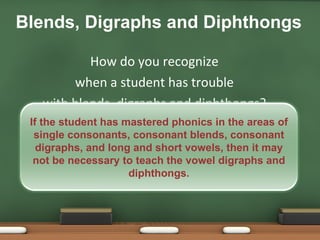
How do you recognize  when a student has trouble  with blends, digraphs and diphthongs?  Blends, Digraphs and Diphthongs If the student has mastered phonics in the areas of single consonants, consonant blends, consonant digraphs, and long and short vowels, then it may not be necessary to teach the vowel digraphs and diphthongs.
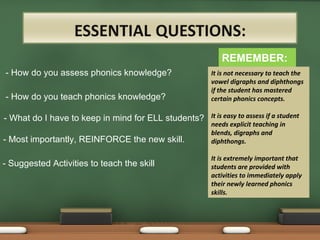
It is not necessary to teach the vowel digraphs and diphthongs if the student has mastered certain phonics concepts. It is easy to assess if a student needs explicit teaching in blends, digraphs and diphthongs. It is extremely important that students are provided with activities to immediately apply their newly learned phonics skills.  - How do you assess phonics knowledge? - How do you teach phonics knowledge? - What do I have to keep in mind for ELL students? - Most importantly, REINFORCE the new skill. - Suggested Activities to teach the skill REMEMBER:
Problem Solution
What do we know about structural analysis? Morphology is a field of linguistics focused on the study of the forms and formation of words in a language.  A  morpheme  is the smallest indivisible unit of a language that retains meaning. Any time a student learns a new word and immediately comes up with any number of forms for that word – past tense, plural, a noun form – they are applying the rules of morphology subconsciously to determine what the new form should be. Developing Structural Analysis
What is the best way to determine whether a student is having difficulty  ? Assessing Structural Analysis Ability
Structural Analysis Assessment REFINEMENT Re – fine – ment It also provides a blueprint for instruction  in specific aspects where the student is weak.
ELL and Structural Analysis To be successful, these students will need to  master the decoding skills  of basic sight vocabulary,  phonics and context clues  before they can receive  direct instruction.
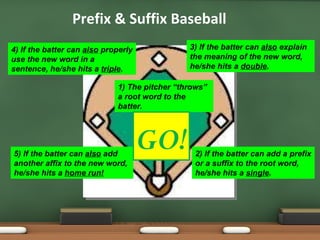
Prefix & Suffix Baseball 1) The pitcher “throws” a root word to the batter. 2) If the batter can add a prefix or a suffix to the root word, he/she hits a  single . 3) If the batter can  also  explain the meaning of the new word, he/she hits a  double . 4) If the batter can  also  properly use the new word in a sentence, he/she hits a  triple . 5) If the batter can  also  add another affix to the new word, he/she hits a  home run! GO!
Problem Solution
 
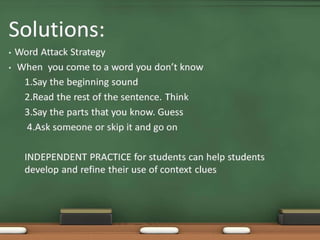
Developing Ability to Use
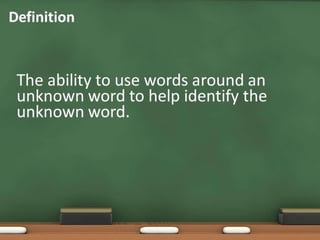
Definition
Assumption: Teachers assume students will learn context clues on their own. Truth:  Disable readers need a considerable amount of instruction and a great deal of practice.
How to  Assess Context Clues
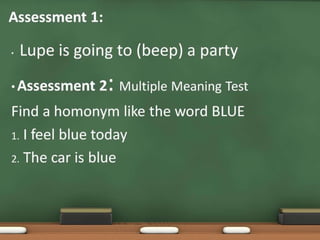
Assessment 1:
 
Problem Solution
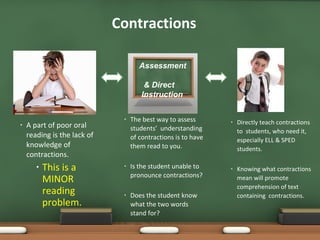
A part of poor oral reading is the lack of knowledge of contractions.  This is a MINOR reading problem. The best way to assess students’  understanding of contractions is to have them read to you.  Is the student unable to pronounce contractions? Does the student know what the two words stand for? Directly teach contractions to  students, who need it, especially ELL & SPED students.  Knowing what contractions mean will promote comprehension of text containing  contractions.   Contractions Assessment  & Direct  Instruction
Activity # 1 Recommendations for  Teaching Contractions Activity # 2 Activity # 3 Activity # 4 LET  US LET’S  Let us go shopping with Mom. Let’s go shopping with Mom.  Provide paragraphs containing contractions and have  students change the contractions  OR VICE-VERSA Contraction Races  Provide newspaper articles and have students underline all contractions and words that could have been contracted.
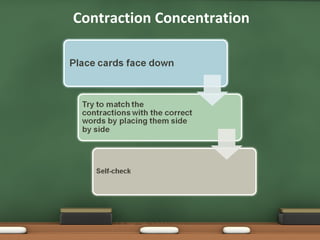
Contraction Concentration
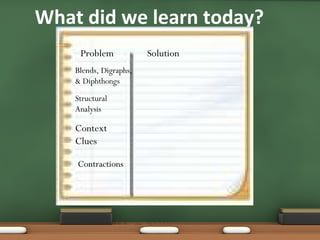
What did we learn today? Problem Solution Structural  Analysis  Blends, Digraphs,  & Diphthongs Context  Clues Contractions

Decoding Skills

  • 1.
    Decoding Skills DevelopingPhonics Knowledge Structural Analysis Contractions and use of Context Clues By PresenterMedia.com Problem Solution CRISS Strategy
  • 2.
    How do yourecognize when a student has trouble with blends, digraphs and diphthongs? Blends, Digraphs and Diphthongs If the student has mastered phonics in the areas of single consonants, consonant blends, consonant digraphs, and long and short vowels, then it may not be necessary to teach the vowel digraphs and diphthongs.
  • 3.
    It is notnecessary to teach the vowel digraphs and diphthongs if the student has mastered certain phonics concepts. It is easy to assess if a student needs explicit teaching in blends, digraphs and diphthongs. It is extremely important that students are provided with activities to immediately apply their newly learned phonics skills. - How do you assess phonics knowledge? - How do you teach phonics knowledge? - What do I have to keep in mind for ELL students? - Most importantly, REINFORCE the new skill. - Suggested Activities to teach the skill REMEMBER:
  • 4.
  • 5.
    What do weknow about structural analysis? Morphology is a field of linguistics focused on the study of the forms and formation of words in a language. A morpheme is the smallest indivisible unit of a language that retains meaning. Any time a student learns a new word and immediately comes up with any number of forms for that word – past tense, plural, a noun form – they are applying the rules of morphology subconsciously to determine what the new form should be. Developing Structural Analysis
  • 6.
    What is thebest way to determine whether a student is having difficulty ? Assessing Structural Analysis Ability
  • 7.
    Structural Analysis AssessmentREFINEMENT Re – fine – ment It also provides a blueprint for instruction in specific aspects where the student is weak.
  • 8.
    ELL and StructuralAnalysis To be successful, these students will need to master the decoding skills of basic sight vocabulary, phonics and context clues before they can receive direct instruction.
  • 9.
    Prefix & SuffixBaseball 1) The pitcher “throws” a root word to the batter. 2) If the batter can add a prefix or a suffix to the root word, he/she hits a single . 3) If the batter can also explain the meaning of the new word, he/she hits a double . 4) If the batter can also properly use the new word in a sentence, he/she hits a triple . 5) If the batter can also add another affix to the new word, he/she hits a home run! GO!
  • 10.
  • 11.
  • 12.
  • 13.
  • 14.
    Assumption: Teachers assumestudents will learn context clues on their own. Truth: Disable readers need a considerable amount of instruction and a great deal of practice.
  • 15.
    How to Assess Context Clues
  • 16.
  • 17.
  • 18.
  • 19.
    A part ofpoor oral reading is the lack of knowledge of contractions. This is a MINOR reading problem. The best way to assess students’ understanding of contractions is to have them read to you. Is the student unable to pronounce contractions? Does the student know what the two words stand for? Directly teach contractions to students, who need it, especially ELL & SPED students. Knowing what contractions mean will promote comprehension of text containing contractions. Contractions Assessment & Direct Instruction
  • 20.
    Activity # 1Recommendations for Teaching Contractions Activity # 2 Activity # 3 Activity # 4 LET US LET’S Let us go shopping with Mom. Let’s go shopping with Mom. Provide paragraphs containing contractions and have students change the contractions OR VICE-VERSA Contraction Races Provide newspaper articles and have students underline all contractions and words that could have been contracted.
  • 21.
  • 22.
    What did welearn today? Problem Solution Structural Analysis Blends, Digraphs, & Diphthongs Context Clues Contractions

Editor's Notes

  • #7 Best way is to ask the stud to read orally, often can decode basic sight words but fail to pronounce acurrate words w/more than 1 syllable. These stud are unable to read above grade 3 or 4.
  • #8 This series of tests measures a student’s ability to use structural analysis skills. The student may not know the prefix re- means “back again” or the suffix meaning: “condition or degree”. The content usually helps but not provide full understanding of “refinement”. Context clues helps with both decoding and obtaining word meaning.