Teaching Students with Language
 and Communication Disabilities

        By S. Jay Kuder

         CHAPTER 13
Assessing Language and
               Communication
      By the end of this chapter students should be able to:

• 1. List the purposes of language assessment.
• 2. Understand what should be included in a comprehensive
  assessment of language and
• how to make assessment decisions.
• 3. List some formal tests for assessing language skills.
• 4. Describe some informal techniques for language
  assessment.
• 5. Explain how to gather and analyze a language sample.
• 6. Describe some informal techniques for assessing specific
  language skills.
• 7. Understand classroom-based techniques for language
  assessment, including response-to-intervention.
Role as a Special Educator
• Many times you will be the first line of
  contact for general classroom teachers
  and parents who have concerns about
  their children.
  – Be familiar with ways to assess the language
    skills of students at your school… SLPs will
    be the “official” guardians of the speech
    domain… but you can and should be a part of
    the process.
Purposes of Language Assessment
•   1. Identification
•   2. Evaluation
•   3. Intervention
•   4. Functional Outcomes
Identifying Children with
            Language Disorders
• Two-Step Process
   – 1. Screening
      • Problems with screeners?
         – Overidentify/Underidentify
   – 2. Determining Nature of the Disability
      • Complete language evaluation
      • Team established to review and create an
        action plan for the student based on results
        gathered from several SOURCES
Assessment for Intervention
• This is a task often forgotten because of the time
  involved…
• How can you truly provide appropriate
  interventions if you do not know HOW a child
  learns?
• How can you prove an intervention is working if
  you cannot see a GENERALIZATION of results?

• VIDEO: A Day in the Life of SLP’s
Core of Language Assessment
•   1. Phonology
•   2. Morphology
•   3. Syntax
•   4. Semantics
•   5. Pragmatics
Phonology
• Looking for the production of speech
  SOUNDS
  – 1. Intelligibility
  – 2. Accuracy of Sound Production

  – Examples of Phonological Processing:
     • A. Detection of rhyme
     • B. Division of words into sounds
     • C. Detection of Beginning and Ending Sounds
Morphology
• Important to determine what word endings
  and prefixes the child is using
  – Can the child use the morpheme (part of a
    word) correctly when is it a nonsense word?


  – Example: This is a wug. Now there are
    two of them. There are two
    _____________.
Syntax 1
• 1. Use of phrase-structure rules:

  – A. Noun
  – B. Verb
  – C. Adjective
  – D. Rules for word order
  – E. Simple vs. Compound sentences
Syntax 2
• Use of transformational rules:

  – A. Understanding and use of questions
  – B. Imperative sentences
  – C. Passive voice
Semantics
• Understanding the meaning of words…
  VOCABULARY

•   Number of words
•   Types of words
•   Speed of processing
•   Figures of speech
•   Proverbs and Humor
Pragmatics 1
• Various types of speech acts:

  – 1. Requesting
  – 2. Protesting
  – 3. Greeting
  – 4. Answering

  – VIDEO: Picnic Time!
Pragmatics 2
• Conversational Rules:

  – 1. Turn-taking
  – 2. Conversational Repairs
  – 3. Topic Setting and Maintenance
  – 4. Awareness of the NEED to vary one’s
    language depending on the audience

  – VIDEO: Turn-taking with Scrabble
Keep in mind when using
       formal assessments…
          • Reliability vs. Validity

• Reliability is the CONSISTENCY of how
  the assessment measures the target skill.

• Validity is the EXTENT to which the
  assessment measures what it says it
  measures.
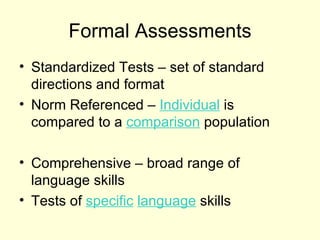
Formal Assessments
• Standardized Tests – set of standard
  directions and format
• Norm Referenced – Individual is
  compared to a comparison population

• Comprehensive – broad range of
  language skills
• Tests of specific language skills
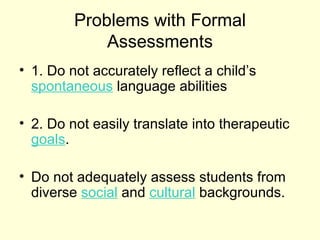
Problems with Formal
             Assessments
• 1. Do not accurately reflect a child’s
  spontaneous language abilities

• 2. Do not easily translate into therapeutic
  goals.

• Do not adequately assess students from
  diverse social and cultural backgrounds.
Sites to find out
       HOW a student learns

    • Two quick and easy ones!!


• Quick School-Age Screener
• Middle School Screener
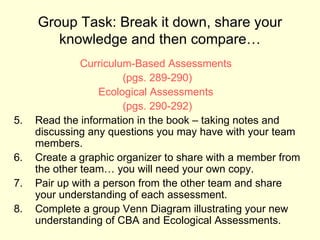
Group Task: Break it down, share your
        knowledge and then compare…
               Curriculum-Based Assessments
                        (pgs. 289-290)
                   Ecological Assessments
                        (pgs. 290-292)
5.   Read the information in the book – taking notes and
     discussing any questions you may have with your team
     members.
6.   Create a graphic organizer to share with a member from
     the other team… you will need your own copy.
7.   Pair up with a person from the other team and share
     your understanding of each assessment.
8.   Complete a group Venn Diagram illustrating your new
     understanding of CBA and Ecological Assessments.

Tslcd ch. 13

  • 1.
    Teaching Students withLanguage and Communication Disabilities By S. Jay Kuder CHAPTER 13
  • 2.
    Assessing Language and Communication By the end of this chapter students should be able to: • 1. List the purposes of language assessment. • 2. Understand what should be included in a comprehensive assessment of language and • how to make assessment decisions. • 3. List some formal tests for assessing language skills. • 4. Describe some informal techniques for language assessment. • 5. Explain how to gather and analyze a language sample. • 6. Describe some informal techniques for assessing specific language skills. • 7. Understand classroom-based techniques for language assessment, including response-to-intervention.
  • 3.
    Role as aSpecial Educator • Many times you will be the first line of contact for general classroom teachers and parents who have concerns about their children. – Be familiar with ways to assess the language skills of students at your school… SLPs will be the “official” guardians of the speech domain… but you can and should be a part of the process.
  • 4.
    Purposes of LanguageAssessment • 1. Identification • 2. Evaluation • 3. Intervention • 4. Functional Outcomes
  • 5.
    Identifying Children with Language Disorders • Two-Step Process – 1. Screening • Problems with screeners? – Overidentify/Underidentify – 2. Determining Nature of the Disability • Complete language evaluation • Team established to review and create an action plan for the student based on results gathered from several SOURCES
  • 6.
    Assessment for Intervention •This is a task often forgotten because of the time involved… • How can you truly provide appropriate interventions if you do not know HOW a child learns? • How can you prove an intervention is working if you cannot see a GENERALIZATION of results? • VIDEO: A Day in the Life of SLP’s
  • 7.
    Core of LanguageAssessment • 1. Phonology • 2. Morphology • 3. Syntax • 4. Semantics • 5. Pragmatics
  • 8.
    Phonology • Looking forthe production of speech SOUNDS – 1. Intelligibility – 2. Accuracy of Sound Production – Examples of Phonological Processing: • A. Detection of rhyme • B. Division of words into sounds • C. Detection of Beginning and Ending Sounds
  • 9.
    Morphology • Important todetermine what word endings and prefixes the child is using – Can the child use the morpheme (part of a word) correctly when is it a nonsense word? – Example: This is a wug. Now there are two of them. There are two _____________.
  • 10.
    Syntax 1 • 1.Use of phrase-structure rules: – A. Noun – B. Verb – C. Adjective – D. Rules for word order – E. Simple vs. Compound sentences
  • 11.
    Syntax 2 • Useof transformational rules: – A. Understanding and use of questions – B. Imperative sentences – C. Passive voice
  • 12.
    Semantics • Understanding themeaning of words… VOCABULARY • Number of words • Types of words • Speed of processing • Figures of speech • Proverbs and Humor
  • 13.
    Pragmatics 1 • Varioustypes of speech acts: – 1. Requesting – 2. Protesting – 3. Greeting – 4. Answering – VIDEO: Picnic Time!
  • 14.
    Pragmatics 2 • ConversationalRules: – 1. Turn-taking – 2. Conversational Repairs – 3. Topic Setting and Maintenance – 4. Awareness of the NEED to vary one’s language depending on the audience – VIDEO: Turn-taking with Scrabble
  • 15.
    Keep in mindwhen using formal assessments… • Reliability vs. Validity • Reliability is the CONSISTENCY of how the assessment measures the target skill. • Validity is the EXTENT to which the assessment measures what it says it measures.
  • 16.
    Formal Assessments • StandardizedTests – set of standard directions and format • Norm Referenced – Individual is compared to a comparison population • Comprehensive – broad range of language skills • Tests of specific language skills
  • 17.
    Problems with Formal Assessments • 1. Do not accurately reflect a child’s spontaneous language abilities • 2. Do not easily translate into therapeutic goals. • Do not adequately assess students from diverse social and cultural backgrounds.
  • 18.
    Sites to findout HOW a student learns • Two quick and easy ones!! • Quick School-Age Screener • Middle School Screener
  • 19.
    Group Task: Breakit down, share your knowledge and then compare… Curriculum-Based Assessments (pgs. 289-290) Ecological Assessments (pgs. 290-292) 5. Read the information in the book – taking notes and discussing any questions you may have with your team members. 6. Create a graphic organizer to share with a member from the other team… you will need your own copy. 7. Pair up with a person from the other team and share your understanding of each assessment. 8. Complete a group Venn Diagram illustrating your new understanding of CBA and Ecological Assessments.