• Word Recognition refers to
the ability to identify, read and
analyze the meaning attached to
the word. It is the basic foundation
skill in reading upon which learning
of advanced reading skills depends.
Word recognition is a twofold
process that includes
• the recognition of printed symbols
by some method so that the word
can be pronounced and
• the attachment to or association of
meaning with the word after it has
been properly pronounced.
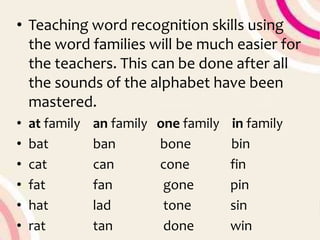
• Teaching word recognition skills using
the word families will be much easier for
the teachers. This can be done after all
the sounds of the alphabet have been
mastered.
• at family an family one family in family
• bat ban bone bin
• cat can cone fin
• fat fan gone pin
• hat lad tone sin
• rat tan done win
Word recognition strategies
for pronunciation
• When you read, you are intent on
getting the message. You don’t
notice the individual letters, group
of letters, or even every word. This
is because you have become a
fluent reader.
• However when you stumble on an
unfamiliar word, you become aware
of the individual letters that are
grouped together to form a word.
You would stop reading because
the word has interfered with the
message.
• For example: I like brust people.
• You should be stumbled on the
nonsense word brust. Imagine that
you do not know that brust is a
nonsense word. What strategies
could you use to pronounce the
word independently?
Strategy 1: Phonic Analysis and
Synthesis
• Phonics is a decoding technique that is
dependent on the students ability to
make the proper letter-sound
correspondences.
• Analysis: involves breaking down
something into its component parts.
• Synthesis: involves building up the
parts of something into a whole
• Analysis: break down brust into the
blend br and the phonogram ust. You
have met the blend br before in such
word as brown and brick. You have met
the phonogram ust before in such words
as just and must. You therefore know the
pronunciations of br and ust.
• Synthesis: blend together the br and ust.
Using this technique, you should be able
to pronounce brust.
Strategy 2: Whole-word or
“Look- and-say” method
• This method has the teacher or any
other individual directing your
attention to a word and then saying
the word. You must make an
association between oral word and
the written word and show this by
actually saying the word. This is also
called the sight method.
Strategy 3: Structural Analysis and
Synthesis (word parts)
• It involves the breaking down (analysis) of
words into word parts and the building up
(synthesis) of word parts such as prefixes,
suffixes, roots (bases) and combining forms.
• Structural analysis helps you figure out the
pronunciation of an unfamiliar word if the
word is composed of familiar word parts such
as prefixes, suffixes, and roots.
• The technique is similar to that used with
phonic analysis and synthesis. For
example, how would you figure out the
pronunciation of the italicized word in
this sentence?
The boss says he is an undependable
employee.
• Structural Analysis: Break down the
word into its parts to isolate the root.
un depend able
• If you had met un before you had met able
before, you should know how to pronounce
them. After you have isolated depend, you
may recognize it as a familiar word and
know how to pronounce it.
• Structural synthesis: blend together un,
depend, and able
• If depend were not familiar root word, you
could apply phonic analysis and after that
blend it together with the prefix un and
suffix able.
Strategy 4: Look up the
pronunciation in the Dictionary
• This is useful, but you may not have
a dictionary handy. By the time you
look up the pronunciation of the
word, you may have lost the trend
of what you were reading.
Strategy 5: Context Clues
• Context refers to the words surrounding
a word that can shed light on its
meaning. Context can be explain in the
form of definitions, examples,
comparisons or contrasts, explanations
and so on, which can help us figure out
word meanings.
• We use context clues to help us gain the
meaning of a word.
• Words with ea
Leaf Beans
A. Write a word to finish each sentence.
Pick the word in which ea has the long e sound as in leaf and
beans.
1. “ I want to ____________,” said the bird.
play seat eat
2. “Let’s make the nest _____________first,” said the mother.
red lean neat
3. “Will you help me ______________ it” ?
do clean speak
• B. Write a sentence using the word neat. Then
draw a picture to go with it.
________________________
________________________
________________________
________________________
Why word recognition important for
struggling readers
• Children who experience difficulties in word
recognition are likely to spend more time
decoding words. As a result, they read fewer
words than more proficient readers and thus
are likely to make smaller gains in reading
comprehension and overall reading
proficiency. Struggling readers benefit from
meaningful, targeted instruction in word
recognition and word study.
Word Recognition Strategies for
Word Meaning
• Your ability to pronounce a word does
not guarantee that you will know its
meaning. If it is not part of your
vocabulary you would not know what
that word means. Since that brust is a
nonsense word and therefore not a
part of your vocabulary, you cannot
associate any meaning with it.
Strategy 1: Context
• By context we mean the words
surrounding a particular word that can
help shed light on its meaning.
• Example:
This krell may be old, but I wouldn’t
wear anything else to the party.
• From the context sentence, you know that
the nonsense word krell must somehow
refer to an item of clothing. Even though
you have never met krell before, the
context sentence does throw light on it.
• You know from the word order or position
of the word( syntax) that krell must be a
noun, and words such as wear and old and
party give you (semantic) clues to the
meaning of the word itself.
Strategy 2: Structural Analysis and
Synthesis for Word Meaning
• Read the sentence:
There are a lot of xenophobia among the citizens.
• From the position of the word xenophobia in
the sentence, you must know that it is a noun.
However there is not enough information to
help you figure out its meaning.
• Structural analysis is useful when the context
clues are not enough and if the word is made
up of a number of word parts.
• Analysis: Break down xenophobia into its
parts. Xeno means “stranger” or “foreign” and
phobia means “fear” or “hatred”.
• Synthesis: put together the word parts that
you can conclude that” xenophobia means
“fear of strangers” or “fear of things that are
foreign.”
• Structural analysis is a powerful too, but it
depends on your knowledge of word parts and
their meanings.
Word recognition

Word recognition

  • 2.
    • Word Recognitionrefers to the ability to identify, read and analyze the meaning attached to the word. It is the basic foundation skill in reading upon which learning of advanced reading skills depends.
  • 3.
    Word recognition isa twofold process that includes • the recognition of printed symbols by some method so that the word can be pronounced and • the attachment to or association of meaning with the word after it has been properly pronounced.
  • 4.
    • Teaching wordrecognition skills using the word families will be much easier for the teachers. This can be done after all the sounds of the alphabet have been mastered. • at family an family one family in family • bat ban bone bin • cat can cone fin • fat fan gone pin • hat lad tone sin • rat tan done win
  • 5.
    Word recognition strategies forpronunciation • When you read, you are intent on getting the message. You don’t notice the individual letters, group of letters, or even every word. This is because you have become a fluent reader.
  • 6.
    • However whenyou stumble on an unfamiliar word, you become aware of the individual letters that are grouped together to form a word. You would stop reading because the word has interfered with the message.
  • 7.
    • For example:I like brust people. • You should be stumbled on the nonsense word brust. Imagine that you do not know that brust is a nonsense word. What strategies could you use to pronounce the word independently?
  • 8.
    Strategy 1: PhonicAnalysis and Synthesis • Phonics is a decoding technique that is dependent on the students ability to make the proper letter-sound correspondences. • Analysis: involves breaking down something into its component parts. • Synthesis: involves building up the parts of something into a whole
  • 9.
    • Analysis: breakdown brust into the blend br and the phonogram ust. You have met the blend br before in such word as brown and brick. You have met the phonogram ust before in such words as just and must. You therefore know the pronunciations of br and ust. • Synthesis: blend together the br and ust. Using this technique, you should be able to pronounce brust.
  • 10.
    Strategy 2: Whole-wordor “Look- and-say” method • This method has the teacher or any other individual directing your attention to a word and then saying the word. You must make an association between oral word and the written word and show this by actually saying the word. This is also called the sight method.
  • 11.
    Strategy 3: StructuralAnalysis and Synthesis (word parts) • It involves the breaking down (analysis) of words into word parts and the building up (synthesis) of word parts such as prefixes, suffixes, roots (bases) and combining forms. • Structural analysis helps you figure out the pronunciation of an unfamiliar word if the word is composed of familiar word parts such as prefixes, suffixes, and roots.
  • 12.
    • The techniqueis similar to that used with phonic analysis and synthesis. For example, how would you figure out the pronunciation of the italicized word in this sentence? The boss says he is an undependable employee. • Structural Analysis: Break down the word into its parts to isolate the root. un depend able
  • 13.
    • If youhad met un before you had met able before, you should know how to pronounce them. After you have isolated depend, you may recognize it as a familiar word and know how to pronounce it. • Structural synthesis: blend together un, depend, and able • If depend were not familiar root word, you could apply phonic analysis and after that blend it together with the prefix un and suffix able.
  • 14.
    Strategy 4: Lookup the pronunciation in the Dictionary • This is useful, but you may not have a dictionary handy. By the time you look up the pronunciation of the word, you may have lost the trend of what you were reading.
  • 15.
    Strategy 5: ContextClues • Context refers to the words surrounding a word that can shed light on its meaning. Context can be explain in the form of definitions, examples, comparisons or contrasts, explanations and so on, which can help us figure out word meanings. • We use context clues to help us gain the meaning of a word.
  • 16.
    • Words withea Leaf Beans A. Write a word to finish each sentence. Pick the word in which ea has the long e sound as in leaf and beans. 1. “ I want to ____________,” said the bird. play seat eat 2. “Let’s make the nest _____________first,” said the mother. red lean neat 3. “Will you help me ______________ it” ? do clean speak
  • 17.
    • B. Writea sentence using the word neat. Then draw a picture to go with it. ________________________ ________________________ ________________________ ________________________
  • 18.
    Why word recognitionimportant for struggling readers • Children who experience difficulties in word recognition are likely to spend more time decoding words. As a result, they read fewer words than more proficient readers and thus are likely to make smaller gains in reading comprehension and overall reading proficiency. Struggling readers benefit from meaningful, targeted instruction in word recognition and word study.
  • 19.
    Word Recognition Strategiesfor Word Meaning • Your ability to pronounce a word does not guarantee that you will know its meaning. If it is not part of your vocabulary you would not know what that word means. Since that brust is a nonsense word and therefore not a part of your vocabulary, you cannot associate any meaning with it.
  • 20.
    Strategy 1: Context •By context we mean the words surrounding a particular word that can help shed light on its meaning. • Example: This krell may be old, but I wouldn’t wear anything else to the party.
  • 21.
    • From thecontext sentence, you know that the nonsense word krell must somehow refer to an item of clothing. Even though you have never met krell before, the context sentence does throw light on it. • You know from the word order or position of the word( syntax) that krell must be a noun, and words such as wear and old and party give you (semantic) clues to the meaning of the word itself.
  • 22.
    Strategy 2: StructuralAnalysis and Synthesis for Word Meaning • Read the sentence: There are a lot of xenophobia among the citizens. • From the position of the word xenophobia in the sentence, you must know that it is a noun. However there is not enough information to help you figure out its meaning. • Structural analysis is useful when the context clues are not enough and if the word is made up of a number of word parts.
  • 23.
    • Analysis: Breakdown xenophobia into its parts. Xeno means “stranger” or “foreign” and phobia means “fear” or “hatred”. • Synthesis: put together the word parts that you can conclude that” xenophobia means “fear of strangers” or “fear of things that are foreign.” • Structural analysis is a powerful too, but it depends on your knowledge of word parts and their meanings.