By Dr. Arlene S. Opina The Dictionary The Best Source of Words
Dictionary also called a  lexicon ,  wordbook , or  vocabulary , is a collection of words in one or more specific languages, listed alphabetically, with usage information, definitions, etymologies, phonetics, pronunciations, and other information.
The Two Kinds of Dictionaries  Descriptive - describe  the language. They include words that are commonly used even if they are nonstandard. They will often include nonstandard spellings. Ex. Merriam-Webster, Times-Mirror, World Book, and Funk and Wagnall's. Prescriptive -  tend to be more concerned about correct or standard English. They  prescribe  the proper usage and spelling of words. Ex. Samuel Johnson's  Dictionary of the English Language  (1755) had social commentary and jokes; American Noah Webster's  An American Dictionary of the English Language  (1828)
Why do we use dictionaries? To learn new words To learn the origin of a word To check the meaning of a word To check the parts of speech of a word To learn multiple meanings of a word To learn to pronounce a word To construct a sentence using the word
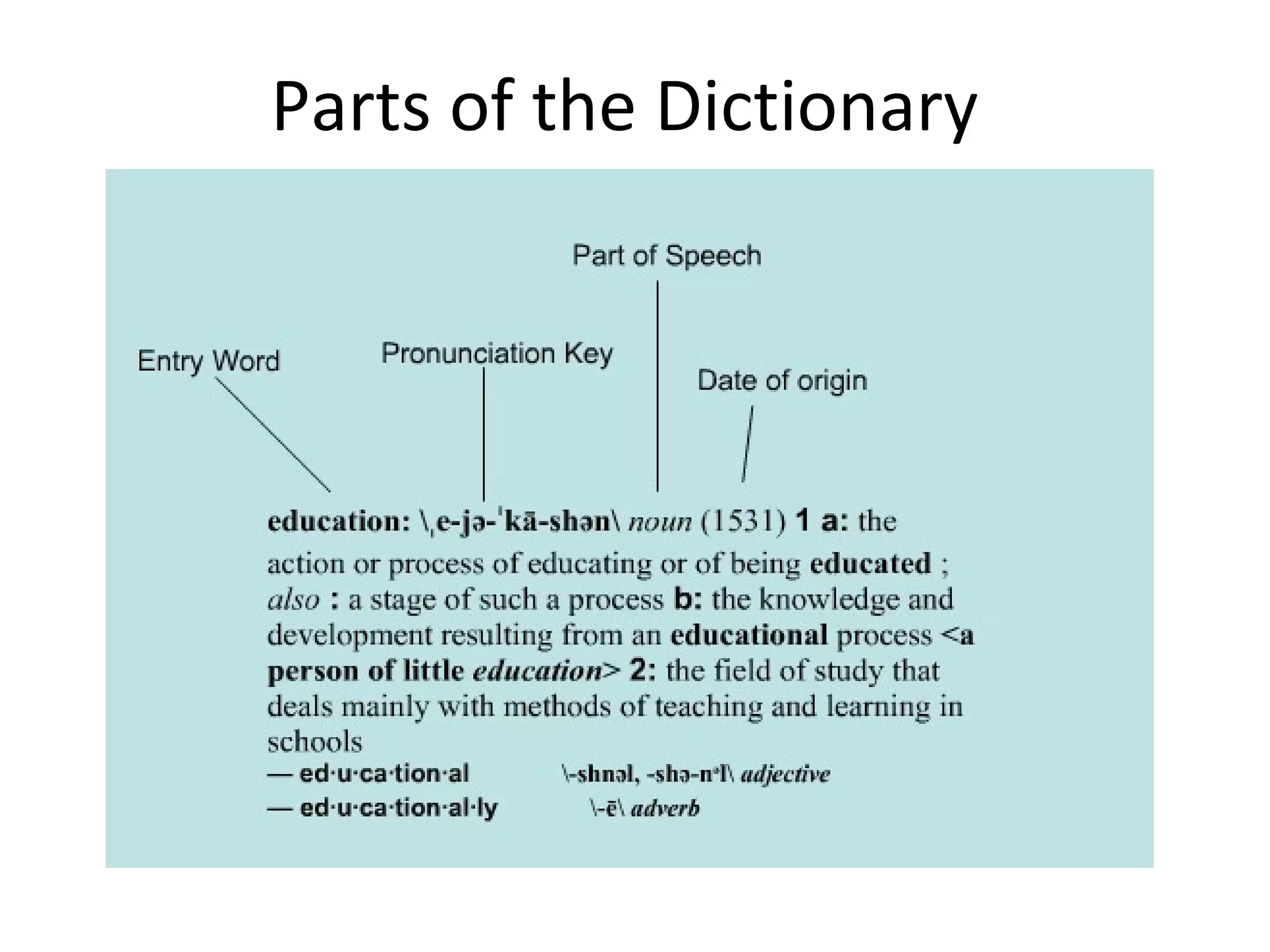
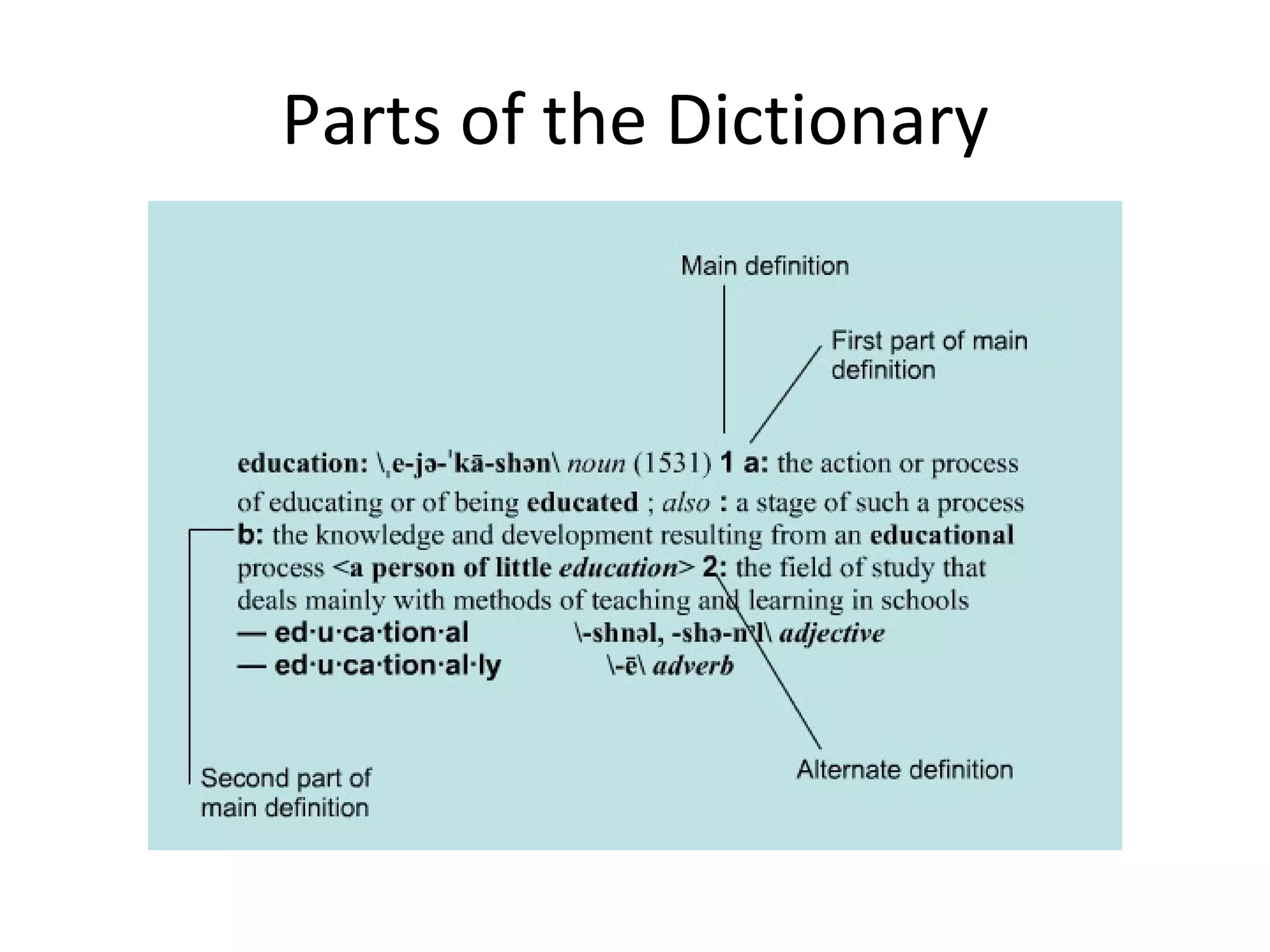
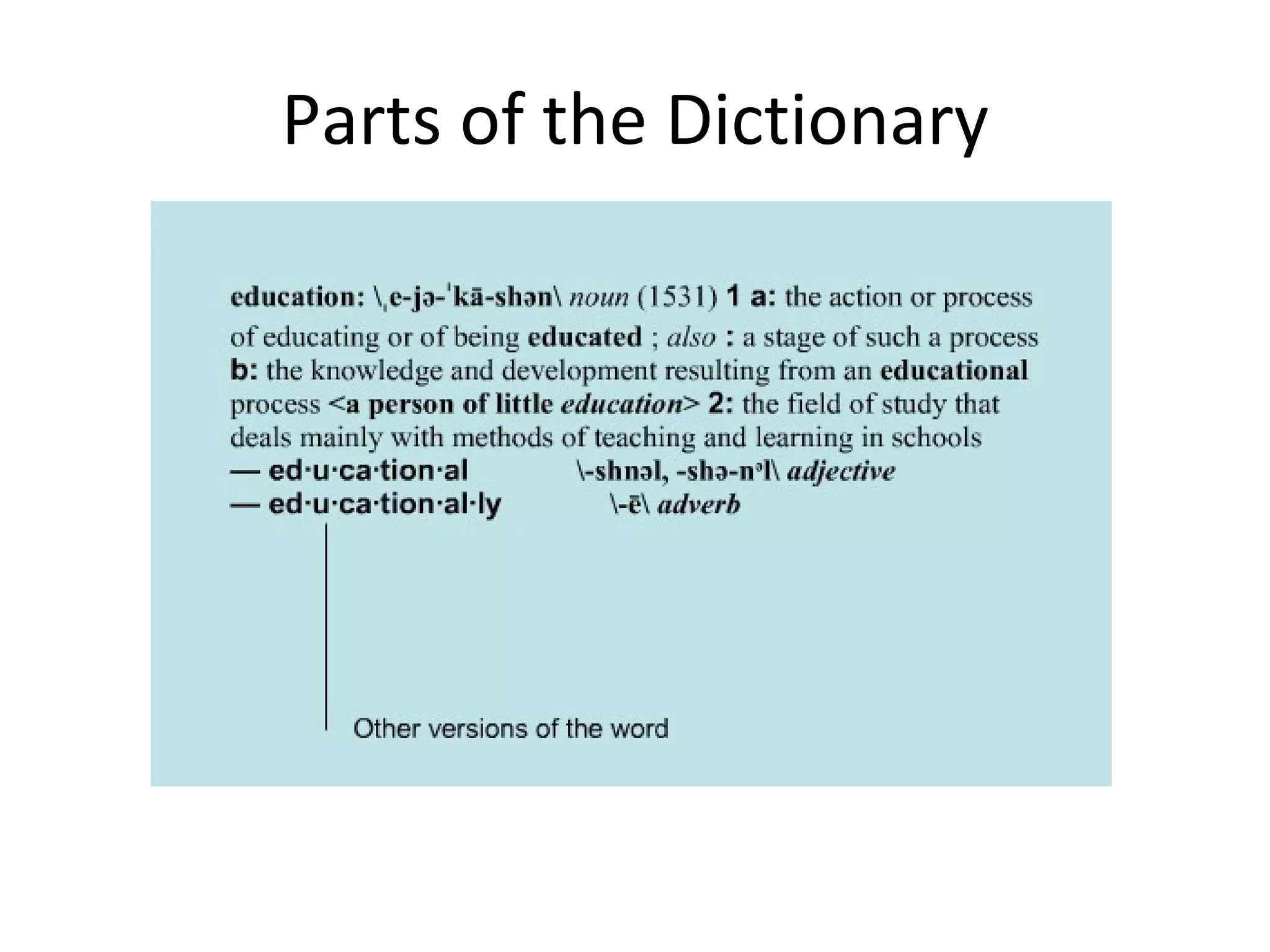
Parts of the Dictionary
Trivia The earliest modern European dictionaries were bilingual dictionaries.  Akkadian empire  cuneiform tablets (with bilingual Sumerian–Akkadian wordlists) -  The oldest known dictionaries, discovered in Ebla (modern Syria) and dated roughly 2300 BCE
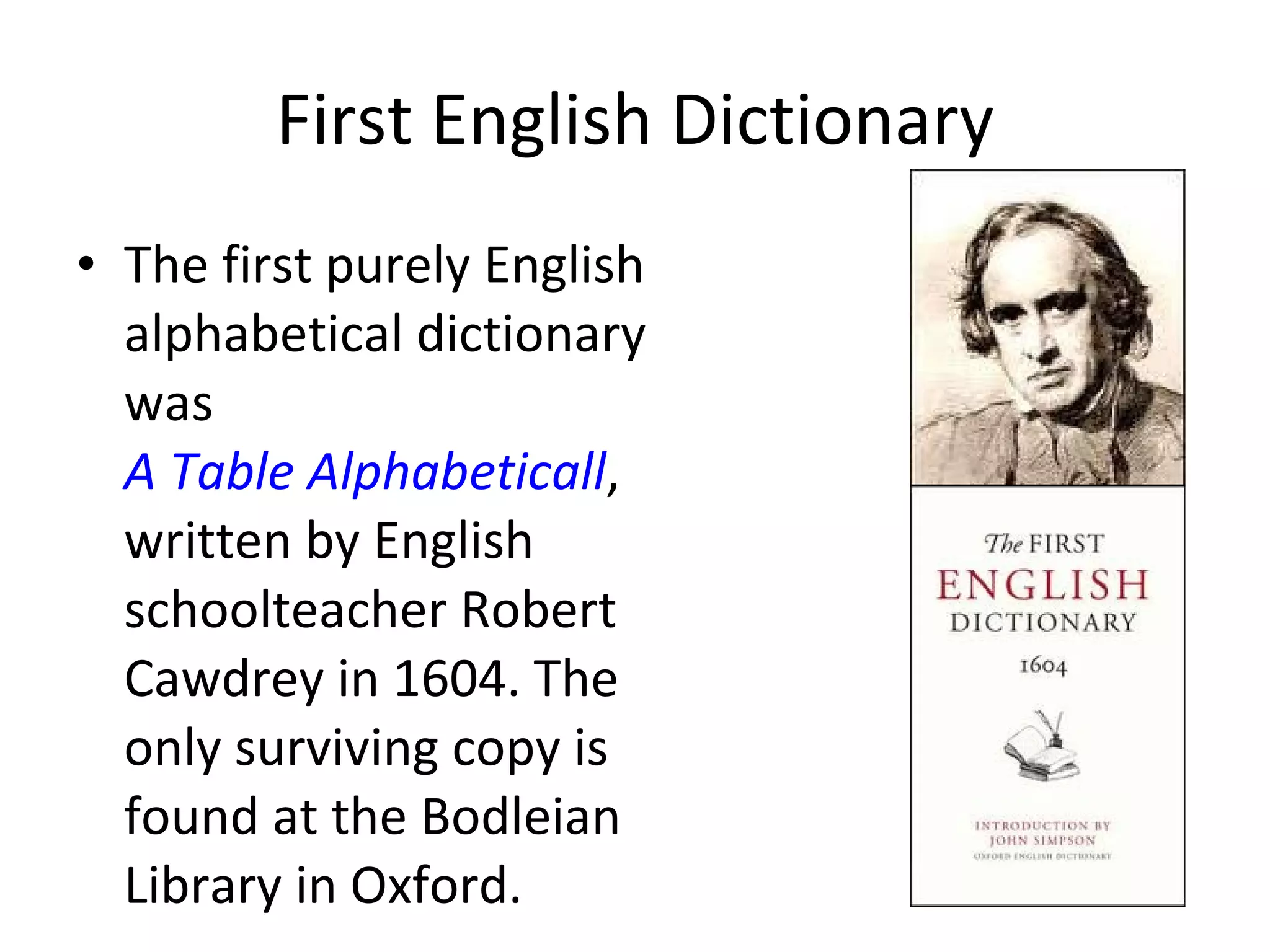
First English Dictionary The first purely English alphabetical dictionary was  A Table Alphabeticall , written by English schoolteacher Robert Cawdrey in 1604. The only surviving copy is found at the Bodleian Library in Oxford.
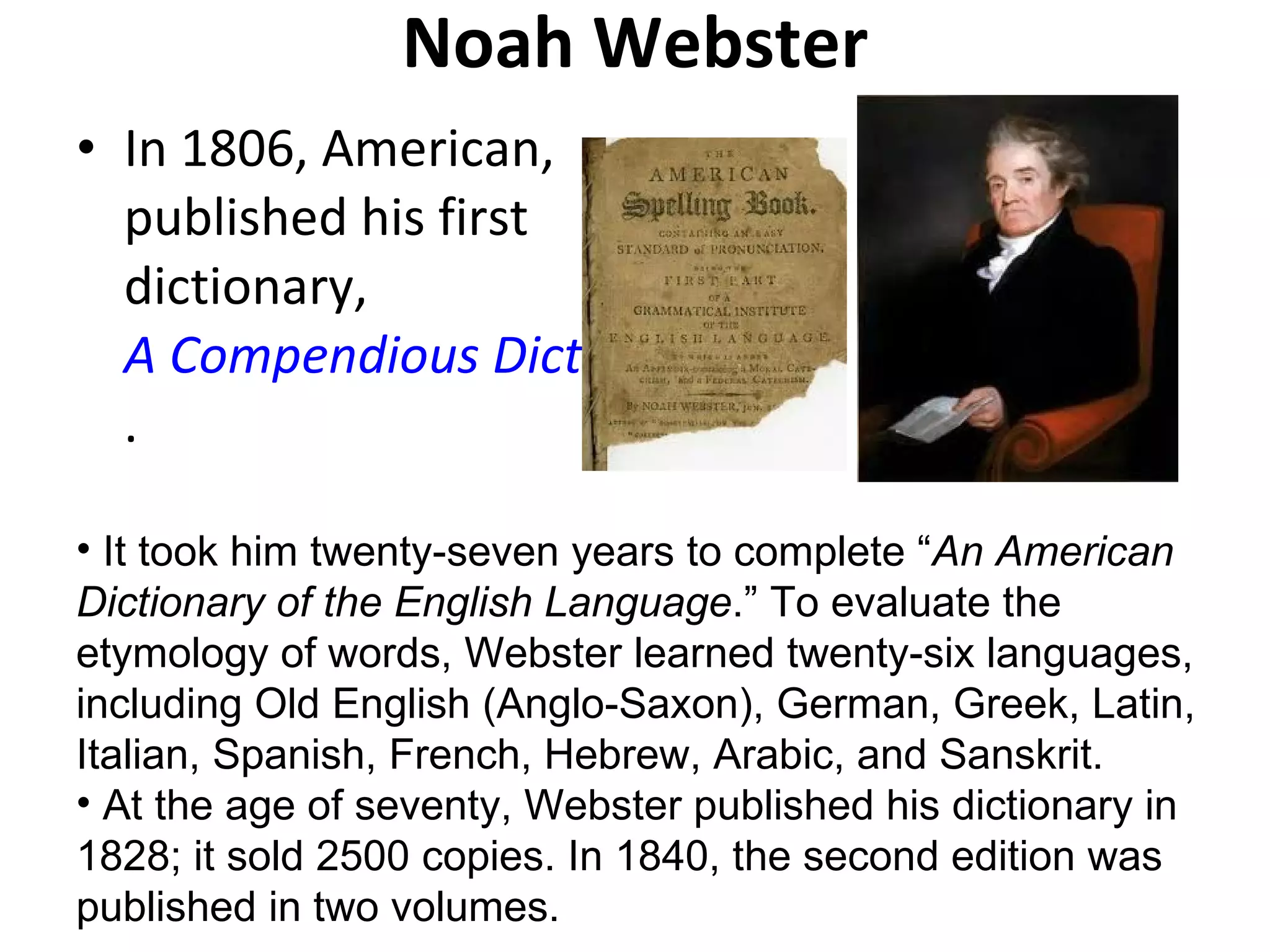
Noah Webster In 1806, American, published his first dictionary,  A Compendious Dictionary of the English Language .  It took him twenty-seven years to complete “ An American Dictionary of the English Language .” To evaluate the etymology of words, Webster learned twenty-six languages, including Old English (Anglo-Saxon), German, Greek, Latin, Italian, Spanish, French, Hebrew, Arabic, and Sanskrit. At the age of seventy, Webster published his dictionary in 1828; it sold 2500 copies. In 1840, the second edition was published in two volumes.
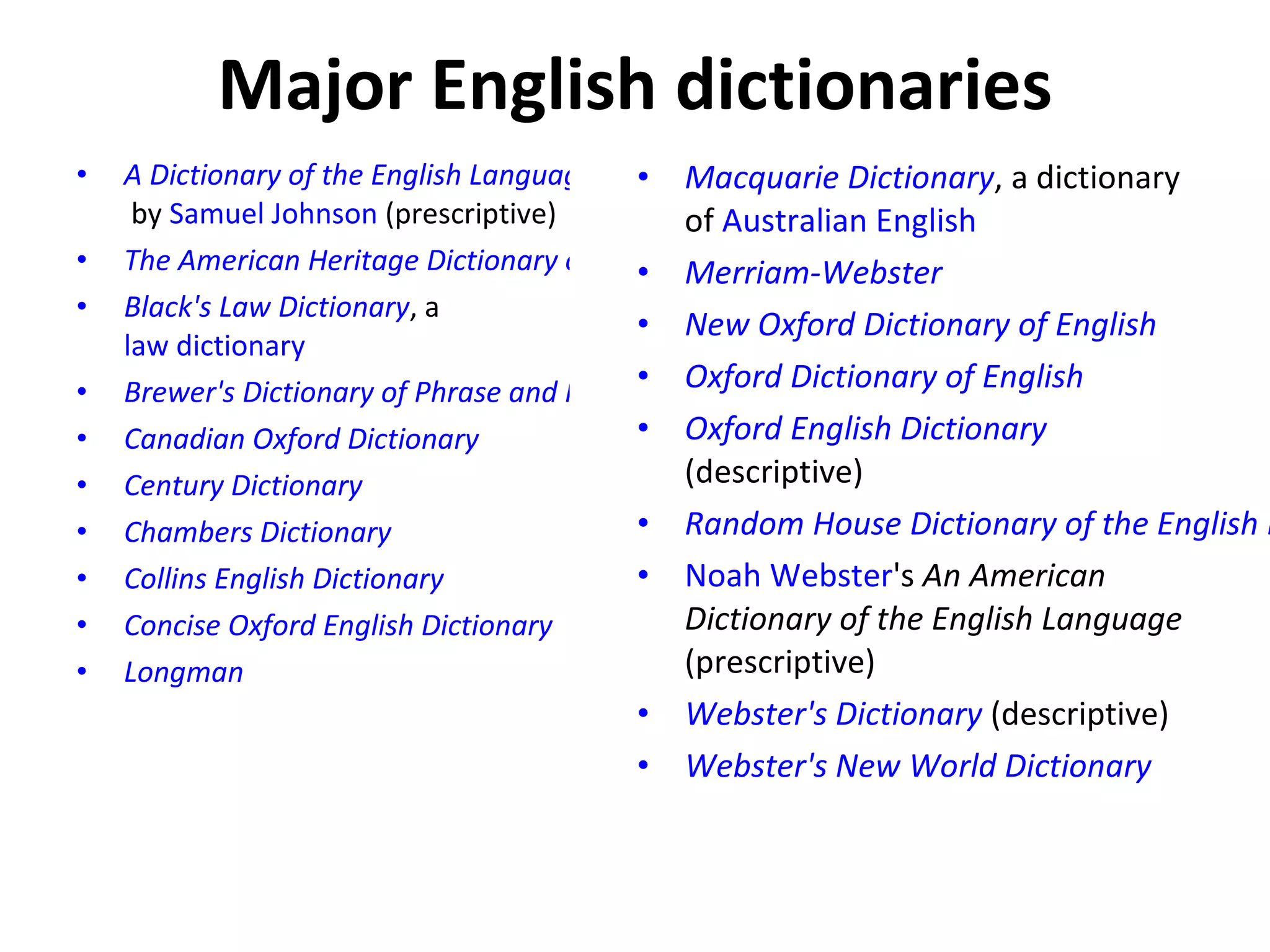
Major English dictionaries A Dictionary of the English Language  by  Samuel Johnson  (prescriptive) The American Heritage Dictionary of the English Language Black's Law Dictionary , a  law dictionary Brewer's Dictionary of Phrase and Fable Canadian Oxford Dictionary Century Dictionary Chambers Dictionary Collins English Dictionary Concise Oxford English Dictionary Longman Macquarie Dictionary , a dictionary of  Australian English Merriam-Webster New Oxford Dictionary of English Oxford Dictionary of English Oxford English Dictionary  (descriptive) Random House Dictionary of the English Language Noah Webster 's  An American Dictionary of the English Language  (prescriptive) Webster's Dictionary  (descriptive) Webster's New World Dictionary
Quizzes http://library.thinkquest.org/5585/dictionary.htm http://www.proprofs.com/quiz-school/story.php?title=dictionary-quiz

The dictionary

  • 1.
    By Dr. ArleneS. Opina The Dictionary The Best Source of Words
  • 2.
    Dictionary also calleda lexicon , wordbook , or vocabulary , is a collection of words in one or more specific languages, listed alphabetically, with usage information, definitions, etymologies, phonetics, pronunciations, and other information.
  • 3.
    The Two Kindsof Dictionaries Descriptive - describe the language. They include words that are commonly used even if they are nonstandard. They will often include nonstandard spellings. Ex. Merriam-Webster, Times-Mirror, World Book, and Funk and Wagnall's. Prescriptive - tend to be more concerned about correct or standard English. They prescribe the proper usage and spelling of words. Ex. Samuel Johnson's Dictionary of the English Language (1755) had social commentary and jokes; American Noah Webster's An American Dictionary of the English Language (1828)
  • 4.
    Why do weuse dictionaries? To learn new words To learn the origin of a word To check the meaning of a word To check the parts of speech of a word To learn multiple meanings of a word To learn to pronounce a word To construct a sentence using the word
  • 5.
    Parts of theDictionary
  • 6.
    Parts of theDictionary
  • 7.
    Parts of theDictionary
  • 8.
    Trivia The earliestmodern European dictionaries were bilingual dictionaries. Akkadian empire cuneiform tablets (with bilingual Sumerian–Akkadian wordlists) - The oldest known dictionaries, discovered in Ebla (modern Syria) and dated roughly 2300 BCE
  • 9.
    First English DictionaryThe first purely English alphabetical dictionary was A Table Alphabeticall , written by English schoolteacher Robert Cawdrey in 1604. The only surviving copy is found at the Bodleian Library in Oxford.
  • 10.
    Noah Webster In1806, American, published his first dictionary, A Compendious Dictionary of the English Language . It took him twenty-seven years to complete “ An American Dictionary of the English Language .” To evaluate the etymology of words, Webster learned twenty-six languages, including Old English (Anglo-Saxon), German, Greek, Latin, Italian, Spanish, French, Hebrew, Arabic, and Sanskrit. At the age of seventy, Webster published his dictionary in 1828; it sold 2500 copies. In 1840, the second edition was published in two volumes.
  • 11.
    Major English dictionariesA Dictionary of the English Language by Samuel Johnson (prescriptive) The American Heritage Dictionary of the English Language Black's Law Dictionary , a law dictionary Brewer's Dictionary of Phrase and Fable Canadian Oxford Dictionary Century Dictionary Chambers Dictionary Collins English Dictionary Concise Oxford English Dictionary Longman Macquarie Dictionary , a dictionary of Australian English Merriam-Webster New Oxford Dictionary of English Oxford Dictionary of English Oxford English Dictionary (descriptive) Random House Dictionary of the English Language Noah Webster 's An American Dictionary of the English Language (prescriptive) Webster's Dictionary (descriptive) Webster's New World Dictionary
  • 12.