Teaching Alphabetics & Fluency in ReadingCETL PresentationApril 22, 2011
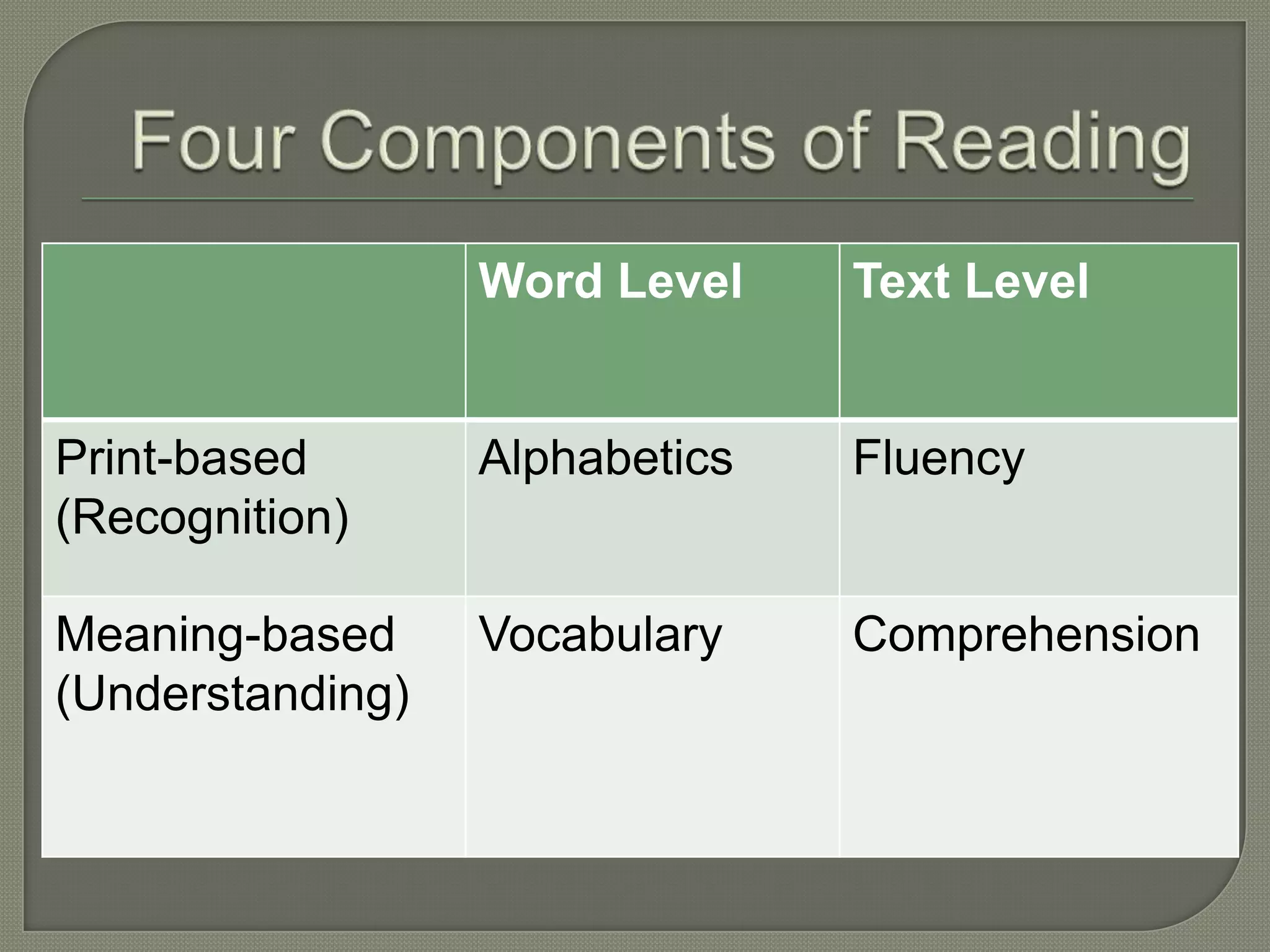
Four Components of ReadingAlphabeticsFluencyVocabularyComprehensionKruidenier (2002); NRP (2000)
Promising PracticesDiagnostic assessmentUse assessment to shape instructionDirect and explicit instructionLearner engagementRelevance of instructionContinuous monitoring
Diagnostic AssessmentAlphabeticsWord lists – Sylvia Greene FluencyReadings – BaderFluency Scale (2 – rate & prosody; 1- accuracy)
Promising PracticesDiagnostic assessmentUse assessment to shape instructionDirect and explicit instructionLearner engagementRelevance of instructionContinuous monitoring
Explicit InstructionExplanation – why, processModeling – how the skill is used; how the procedure worksGuided Practice – supported, scaffolded instructionApplication – students use skill on own; independent with little support
Promising PracticesDiagnostic assessmentUse assessment to shape instructionDirect and explicit instructionLearner engagementRelevance of instructionContinuous monitoring
Effective InstructionActive student engagementNumerous practice opportunitiesStudent reflection on what they are learning.
Promising PracticesDiagnostic assessmentUse assessment to shape instructionDirect and explicit instructionLearner engagementRelevance of instructionContinuous monitoring (of students and instruction)
Four Components of Reading
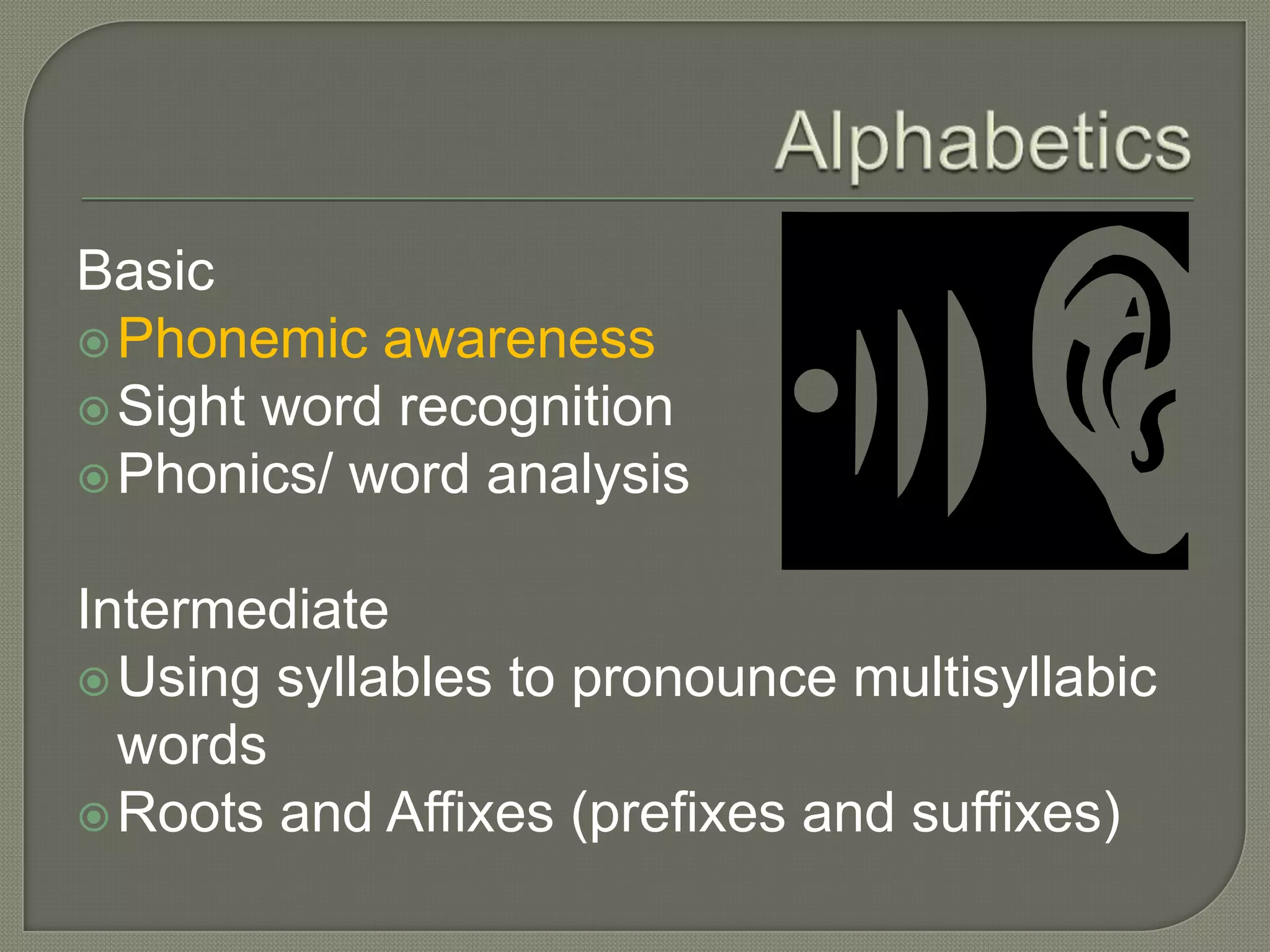
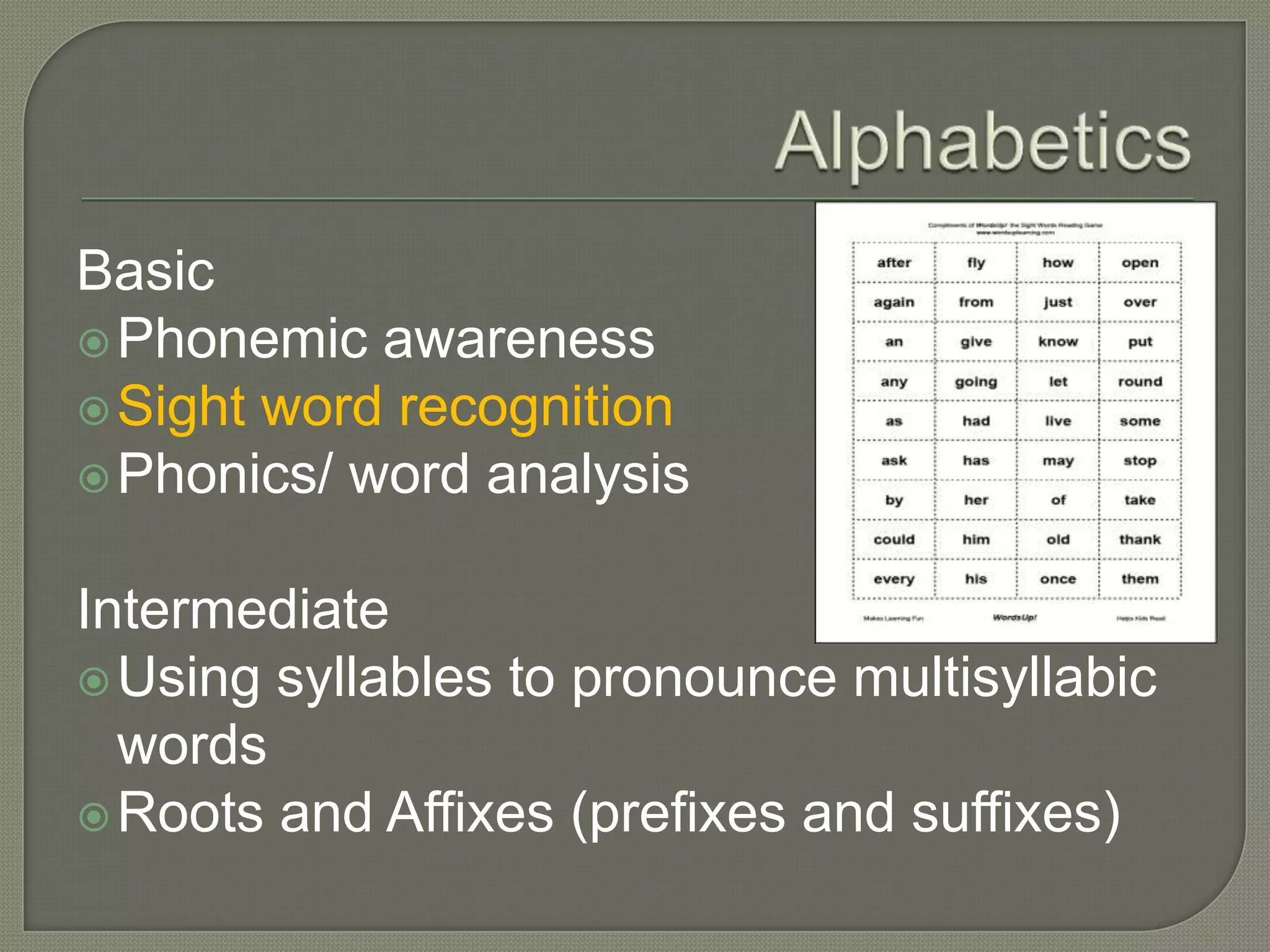
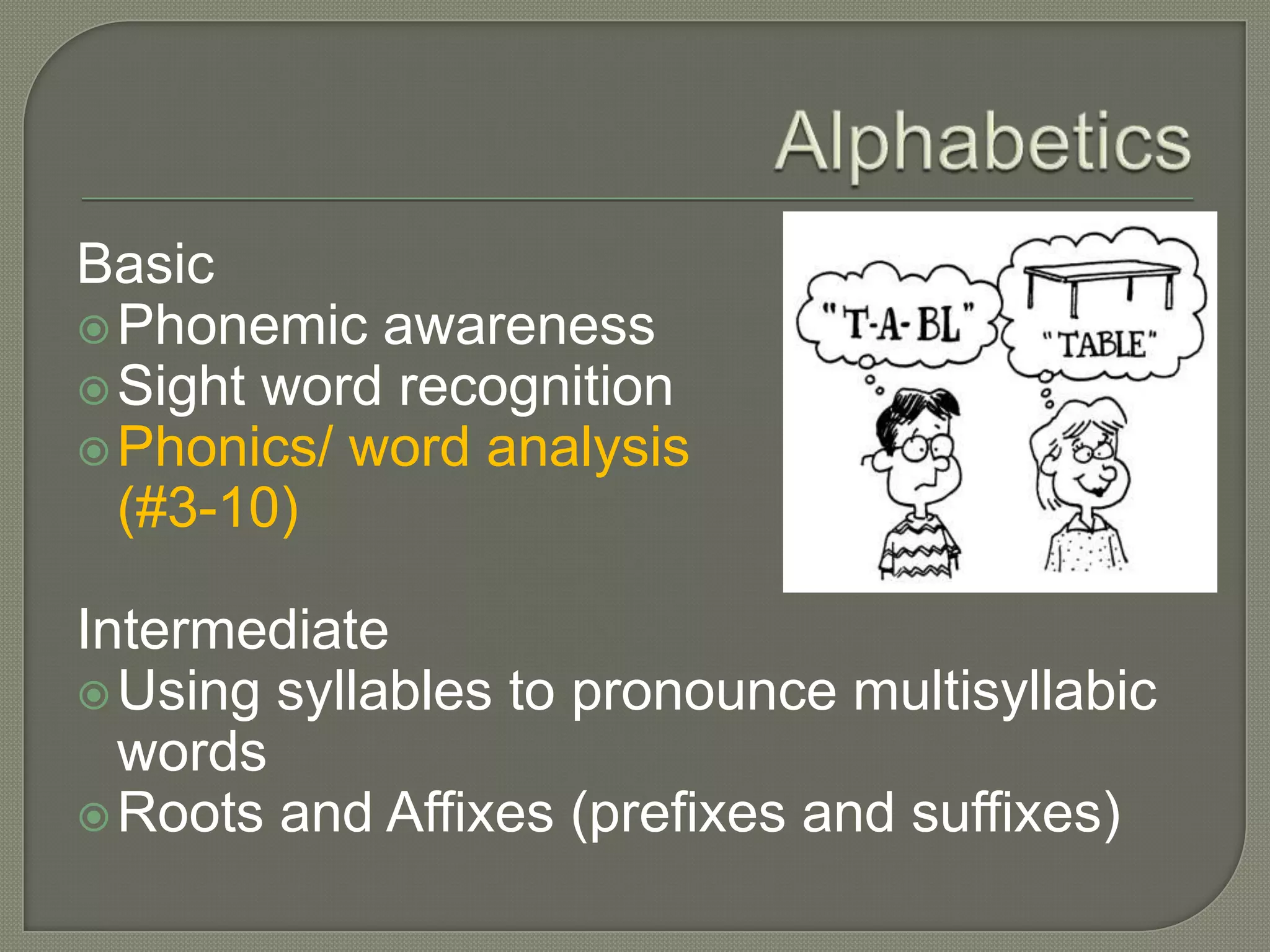
AlphabeticsBasicPhonemic awarenessSight word recognitionPhonics/ word analysisIntermediateUsing syllables to pronounce multisyllabic wordsRoots and Affixes (prefixes and suffixes)
AlphabeticsPhonological Awareness (phonemes #1-2)Knowing that spoken language is composed of soundsThe ability to manipulate and integrate language sounds
PhonemeBasic building block of speechSingle speech soundDistinguishes one word from anotherPeach or pitch?Pin or pen?
Difficulties in Phonological ProcessingDifficulty sequencing sounds in words.Omission of some sounds.Inclusion of some unnecessary sounds.Difficulty hearing word boundaries.Confusion of similar sounds 	(e.g., b/p, f/v)
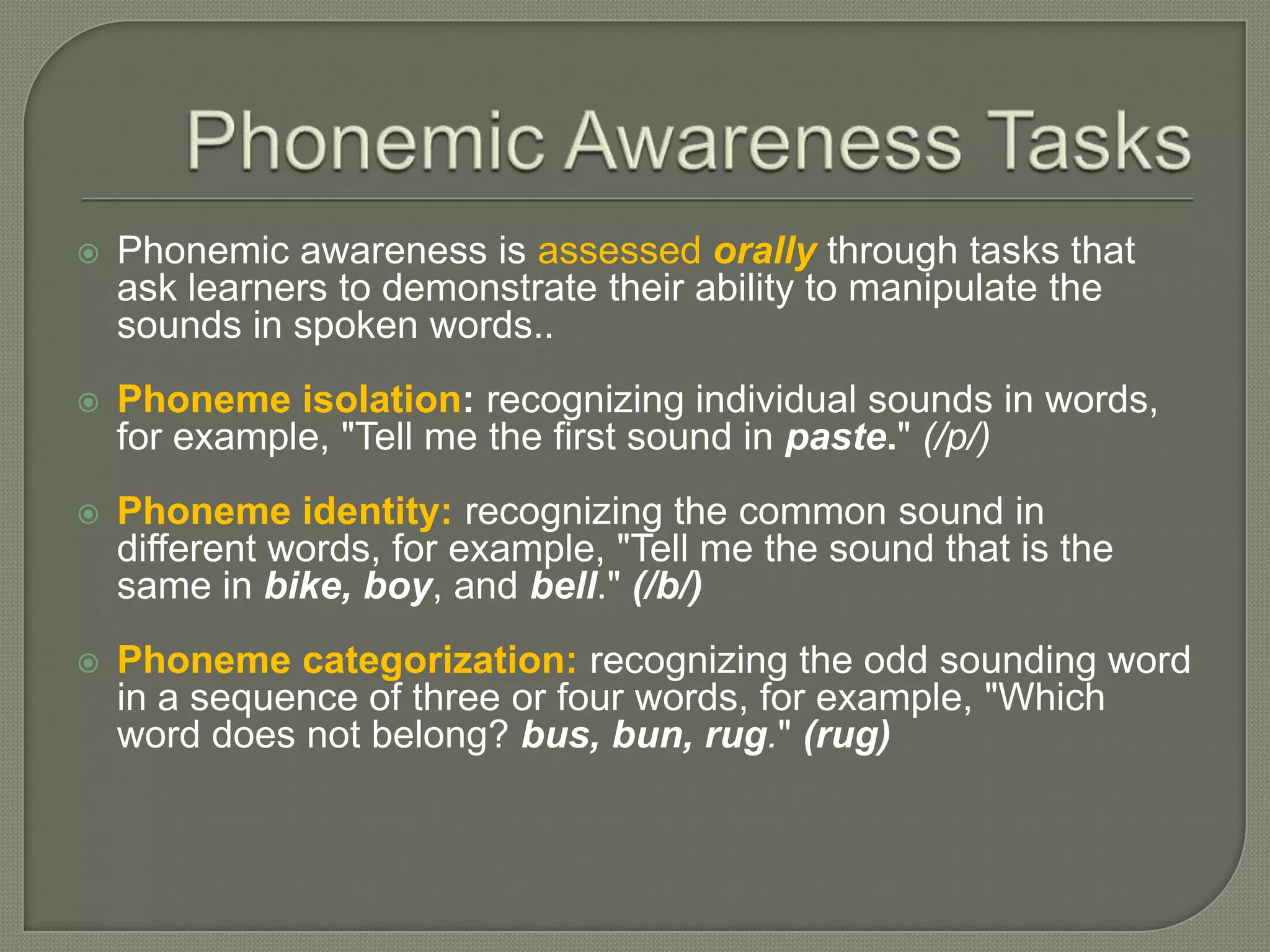
Phonemic Awareness TasksPhonemic awareness is assessed orallythrough tasks that ask learners to demonstrate their ability to manipulate the sounds in spoken words..Phoneme isolation: recognizing individual sounds in words, for example, "Tell me the first sound in paste." (/p/)Phoneme identity:recognizing the common sound in different words, for example, "Tell me the sound that is the same in bike, boy, and bell." (/b/)Phoneme categorization:recognizing the odd sounding word in a sequence of three or four words, for example, "Which word does not belong? bus, bun, rug." (rug)
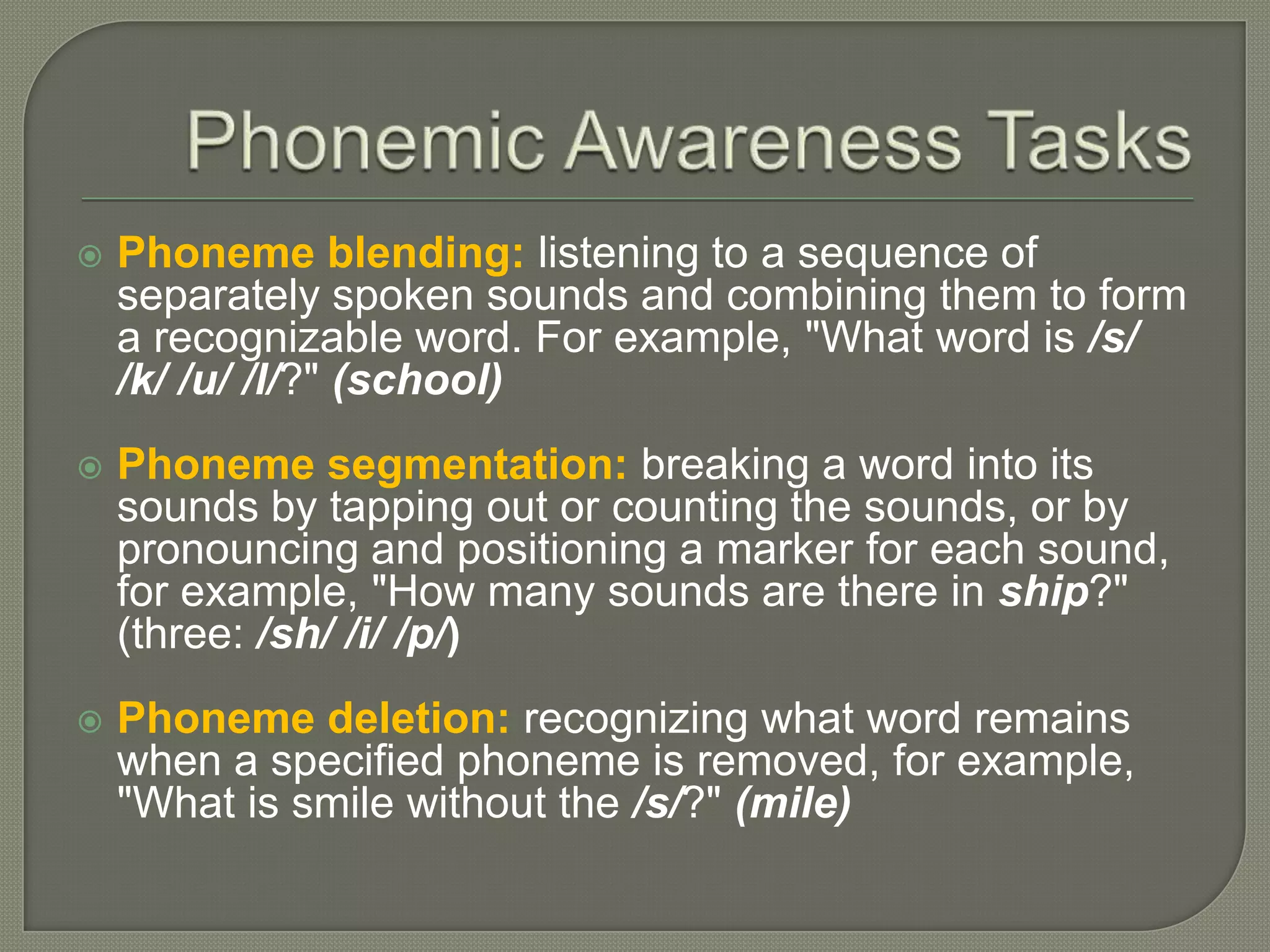
Phonemic Awareness TasksPhoneme blending:listening to a sequence of separately spoken sounds and combining them to form a recognizable word. For example, "What word is /s/ /k/ /u/ /l/?" (school)Phoneme segmentation:breaking a word into its sounds by tapping out or counting the sounds, or by pronouncing and positioning a marker for each sound, for example, "How many sounds are there in ship?" (three: /sh/ /i/ /p/)Phoneme deletion:recognizing what word remains when a specified phoneme is removed, for example, "What is smile without the /s/?" (mile)
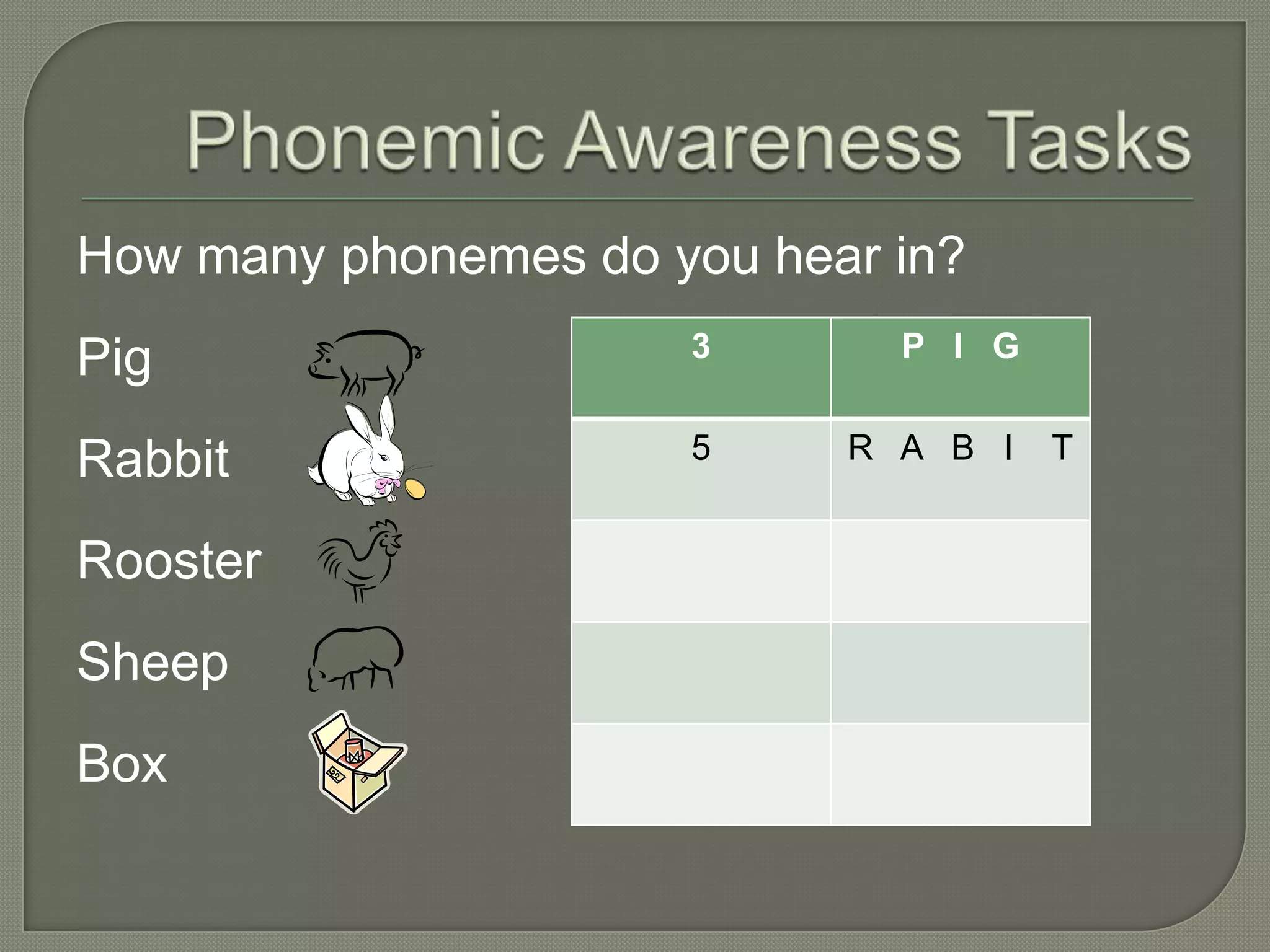
Phonemic Awareness TasksHow many phonemes do you hear in?PigRabbitRoosterSheepBox
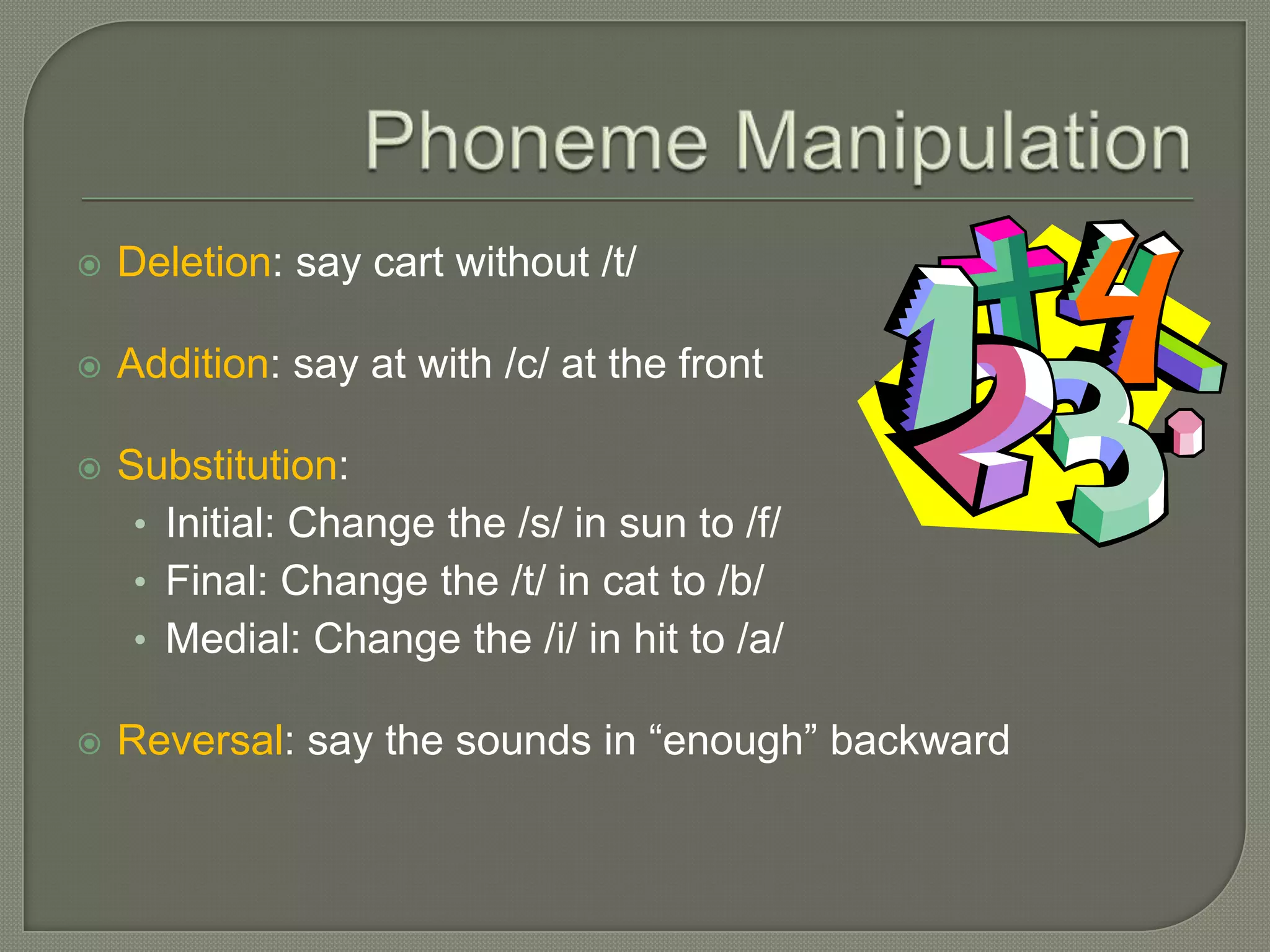
Phoneme ManipulationDeletion: say cart without /t/Addition: say at with /c/ at the frontSubstitution:Initial: Change the /s/ in sun to /f/Final: Change the /t/ in cat to /b/Medial: Change the /i/ in hit to /a/Reversal: say the sounds in “enough” backward
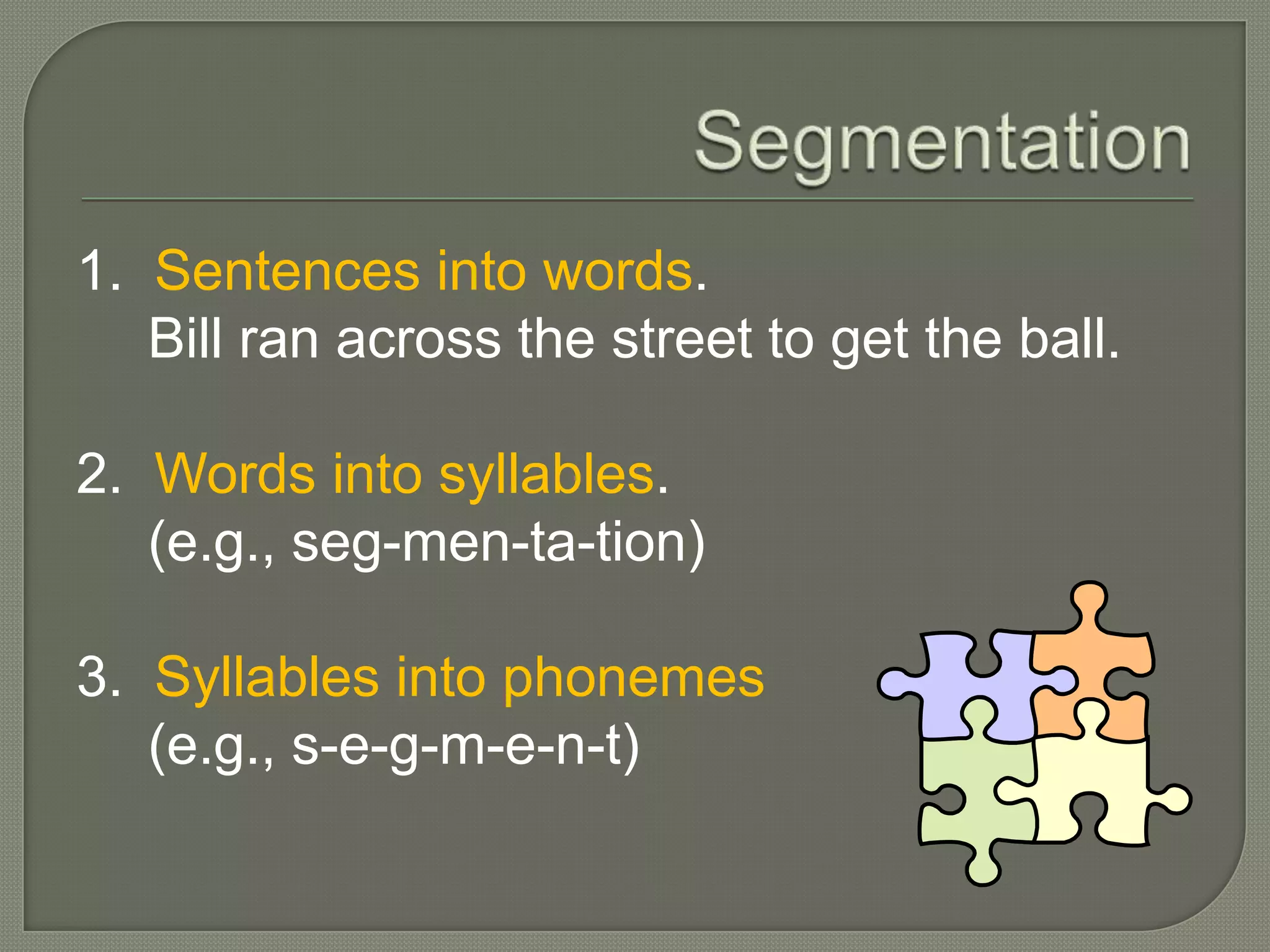
Segmentation1.  Sentences into words.	Bill ran across the street to get the ball.2.  Words into syllables.	(e.g., seg-men-ta-tion)3.  Syllables into phonemes	(e.g., s-e-g-m-e-n-t)
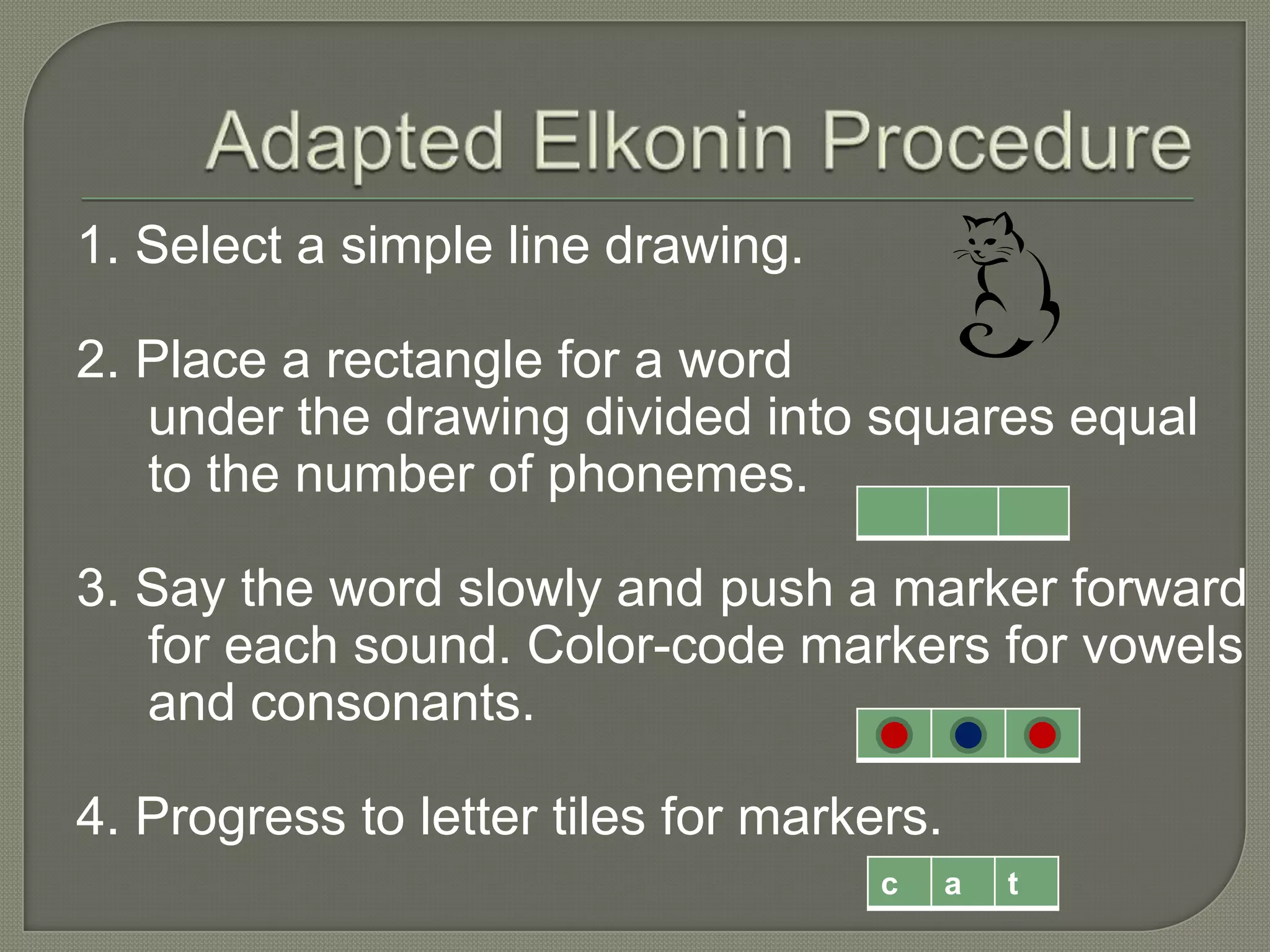
Adapted Elkonin Procedure1. Select a simple line drawing.2. Place a rectangle for a word 	under the drawing divided into squares equal to the number of phonemes.3. Say the word slowly and push a marker forward for each sound. Color-code markers for vowels and consonants.4. Progress to letter tiles for markers.
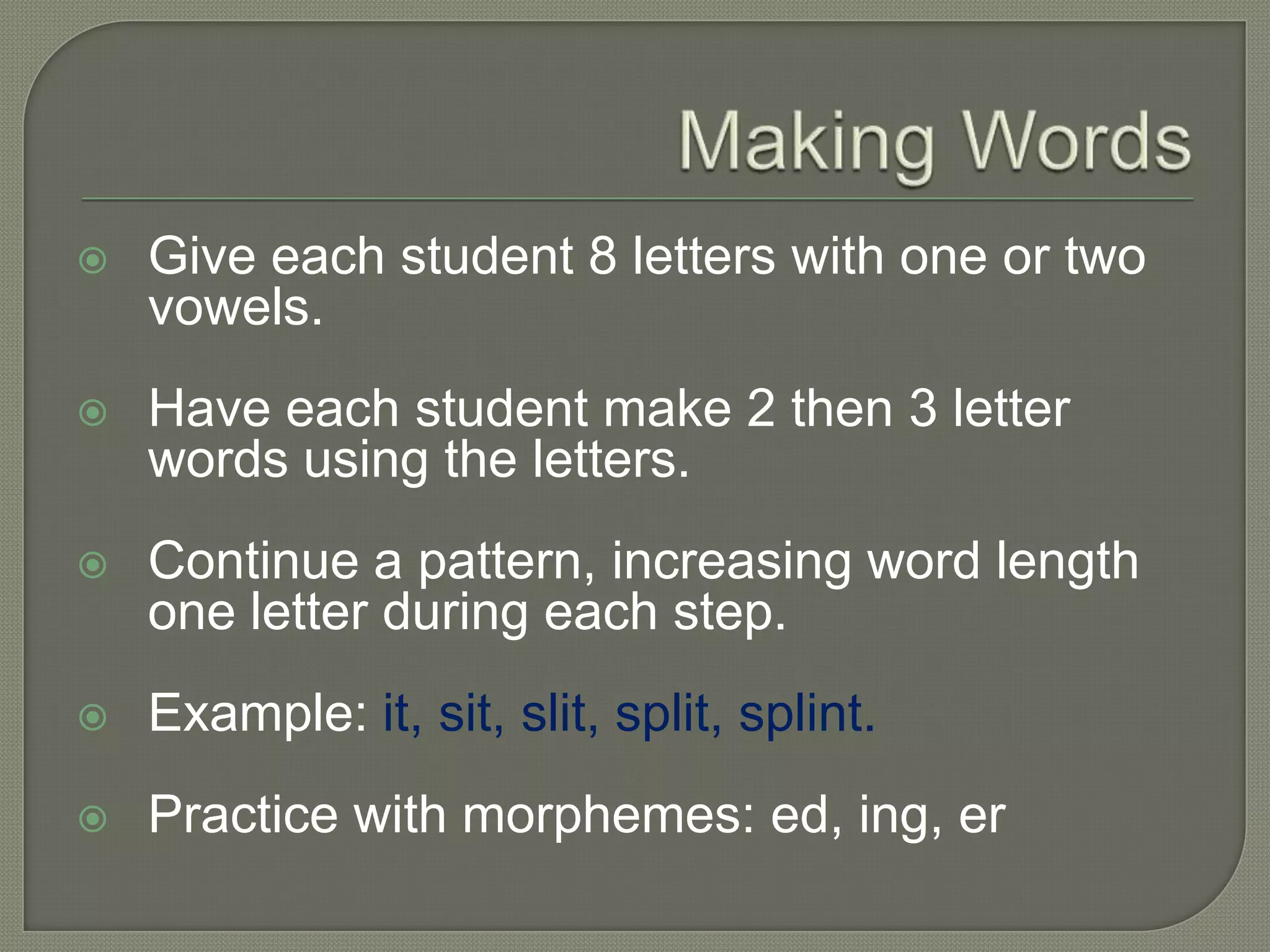
Making WordsGive each student 8 letters with one or two vowels.Have each student make 2 then 3 letter words using the letters.Continue a pattern, increasing word length one letter during each step.Example: it, sit, slit, split, splint.Practice with morphemes: ed, ing, er
Principles of Effective Phonics InstructionEmphasis on phonological awareness activities.Instruction in decoding (grapheme to phoneme)Instruction in encoding 	(phoneme to grapheme)Application of strategies to	 decodable text.
AlphabeticsBasicPhonemic awarenessSight word recognition Phonics/ word analysisIntermediateUsing syllables to pronounce multisyllabic wordsRoots and Affixes (prefixes and suffixes)
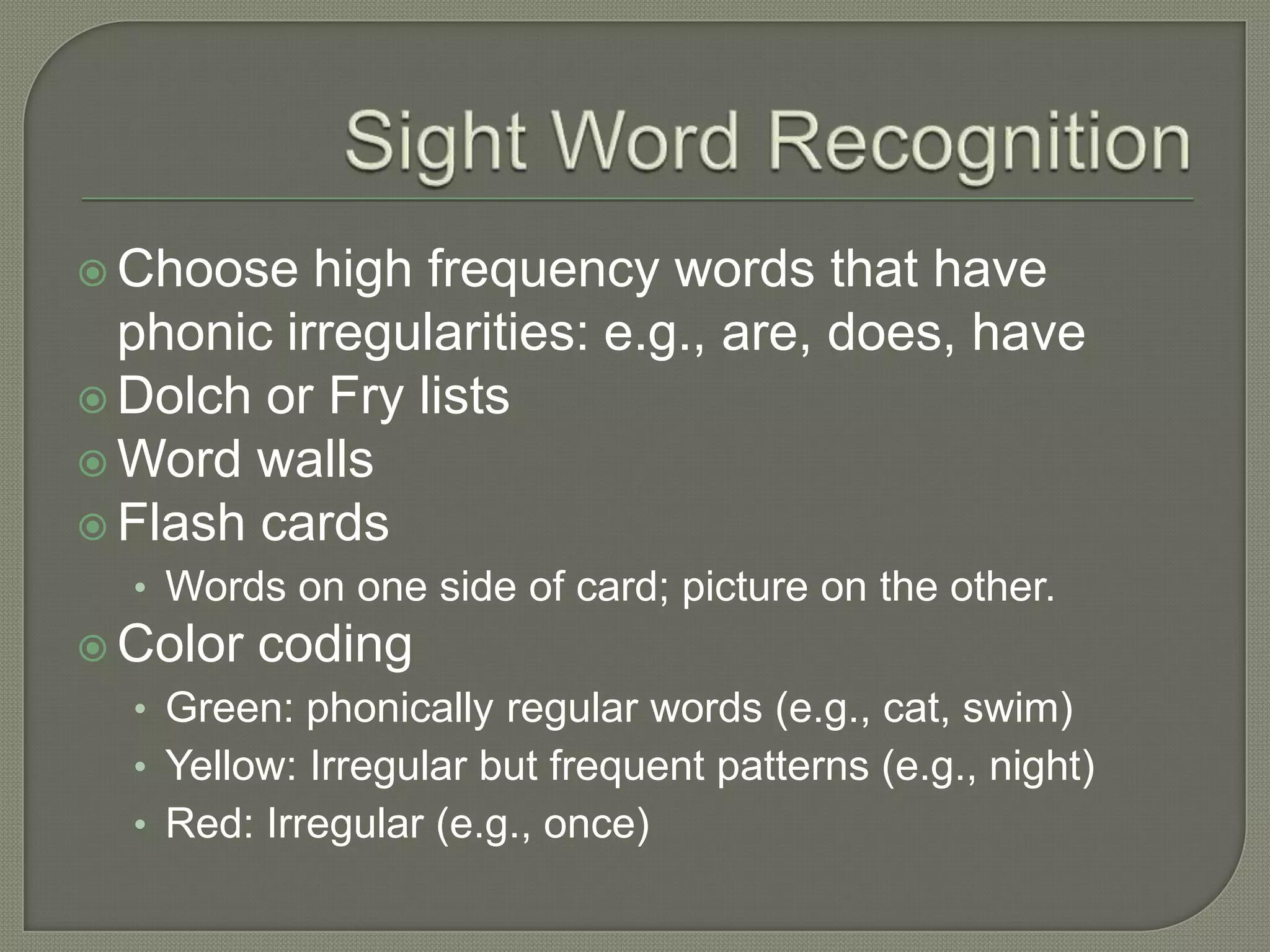
Sight Word RecognitionChoose high frequency words that have phonic irregularities: e.g., are, does, haveDolch or Fry listsWord wallsFlash cards Words on one side of card; picture on the other.Color codingGreen: phonically regular words (e.g., cat, swim)Yellow: Irregular but frequent patterns (e.g., night)Red: Irregular (e.g., once)
AlphabeticsBasicPhonemic awarenessSight word recognitionPhonics/ word analysis 	(#3-10)IntermediateUsing syllables to pronounce multisyllabic wordsRoots and Affixes (prefixes and suffixes)
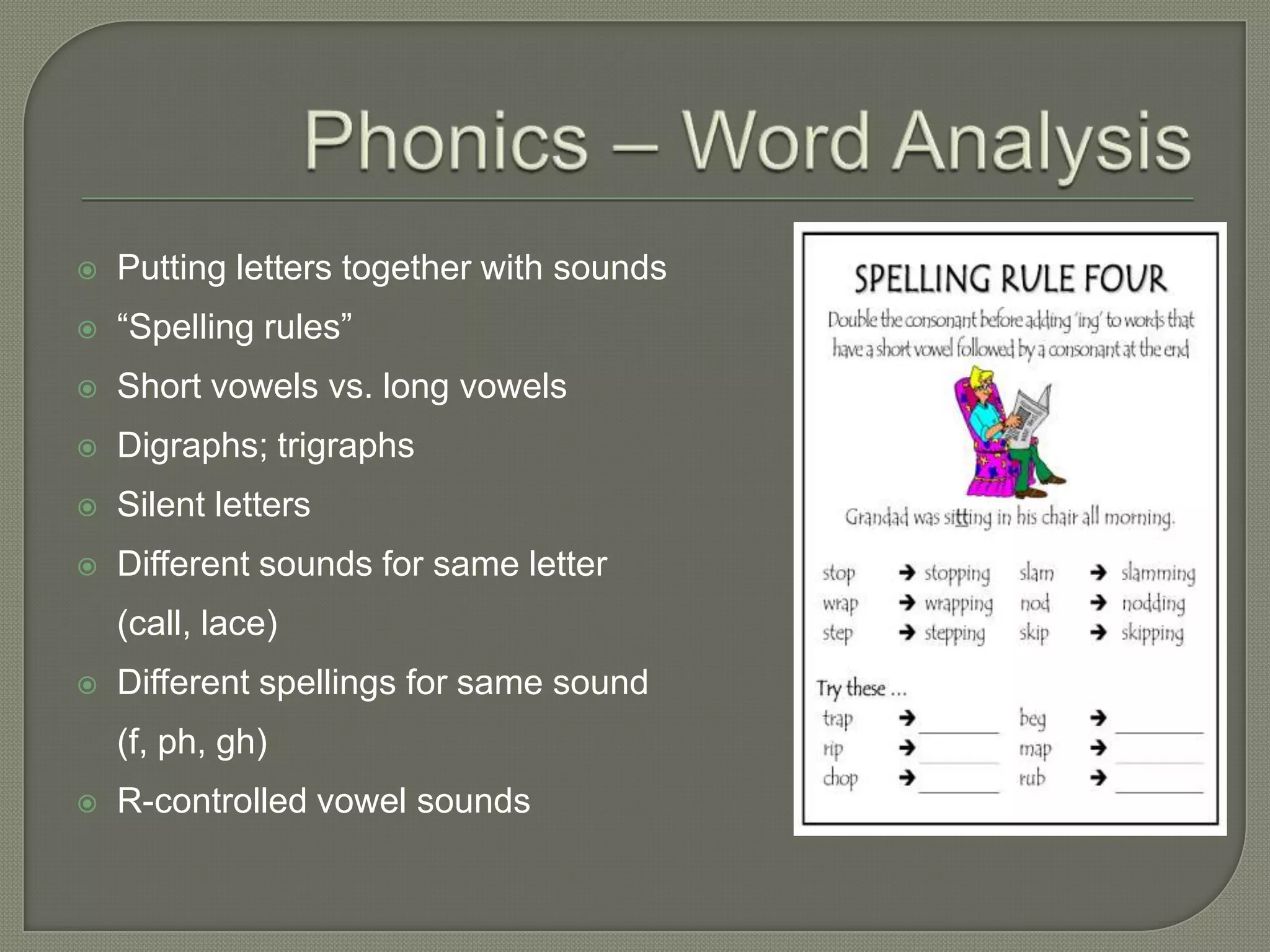
Phonics – Word AnalysisPutting letters together with sounds“Spelling rules”Short vowels vs. long vowelsDigraphs; trigraphsSilent lettersDifferent sounds for same letter 	(call, lace)Different spellings for same sound 	(f, ph, gh)R-controlled vowel sounds
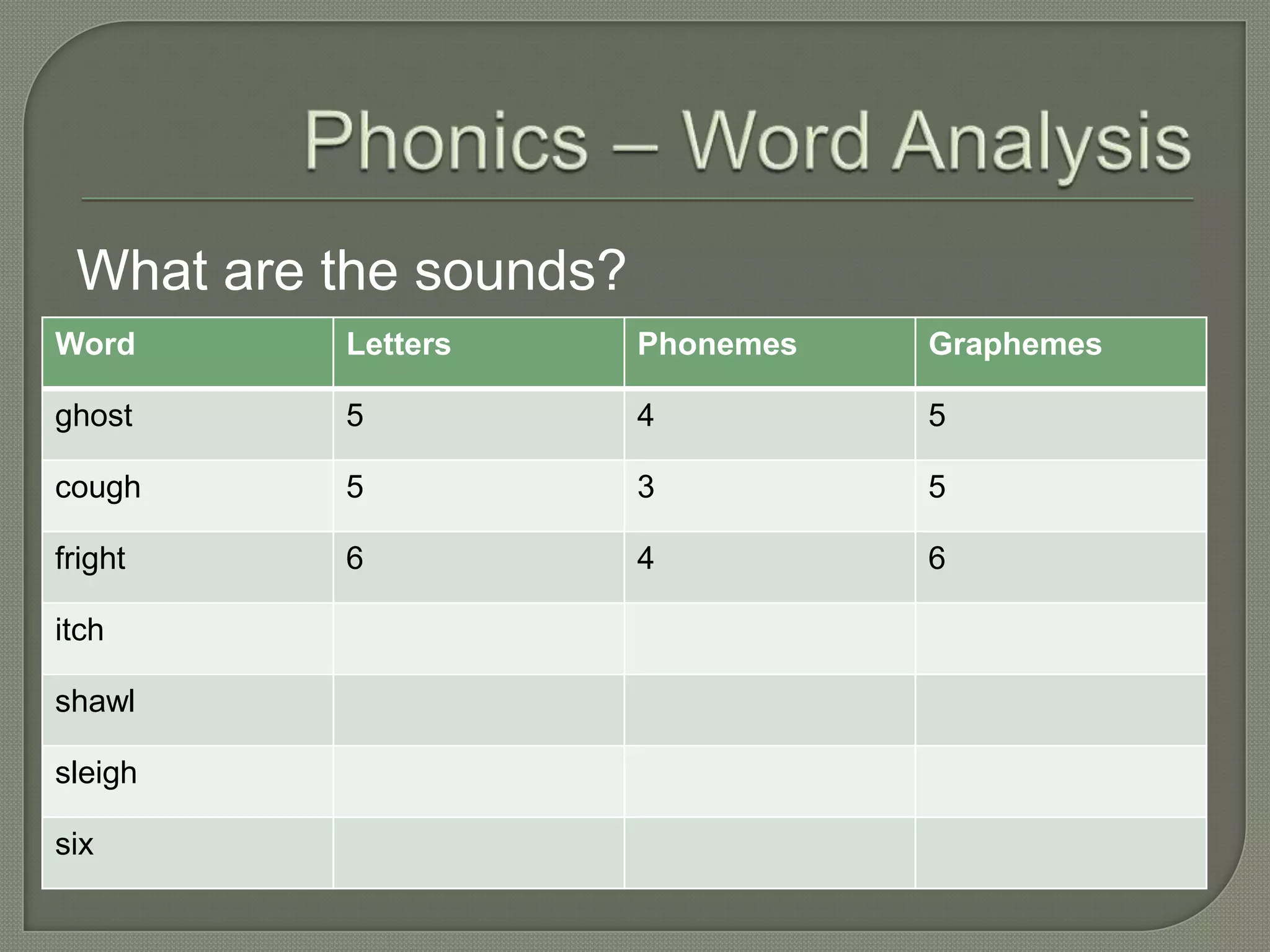
Phonics – Word AnalysisWhat are the sounds?
AlphabeticsBasicPhonemic awarenessSight word recognitionPhonics/ word analysis (#3-10)IntermediateUsing syllables to pronounce multisyllabic wordsRoots and Affixes (prefixes and suffixes)
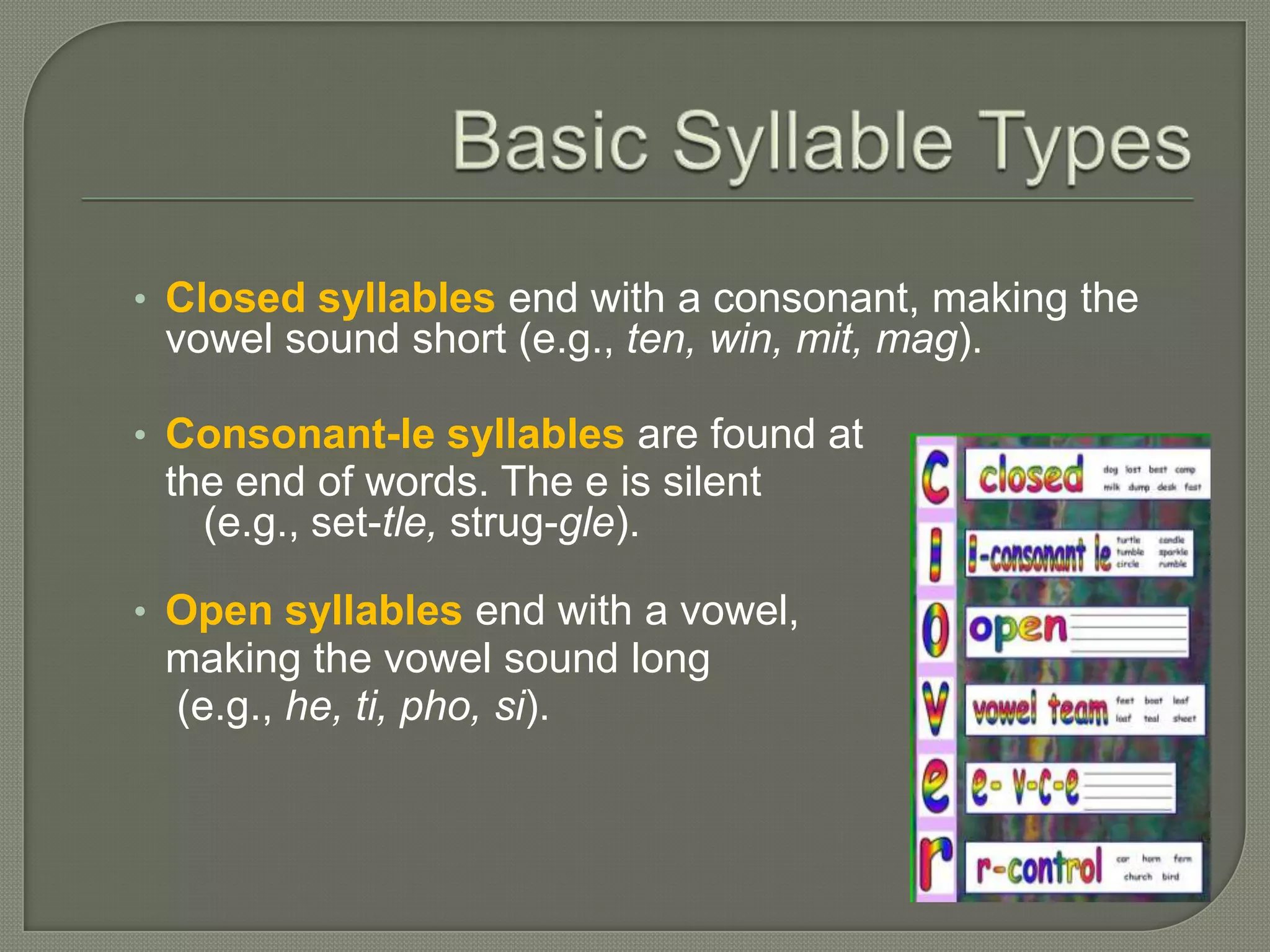
Basic Syllable Types Closed syllablesend with a consonant, making the vowel sound short (e.g., ten, win, mit, mag). Consonant-le syllables arefound at 	the end of words. The e is silent 		(e.g., set-tle, strug-gle).Open syllables end with a vowel, 	making the vowel sound long	 (e.g., he, ti, pho, si).  
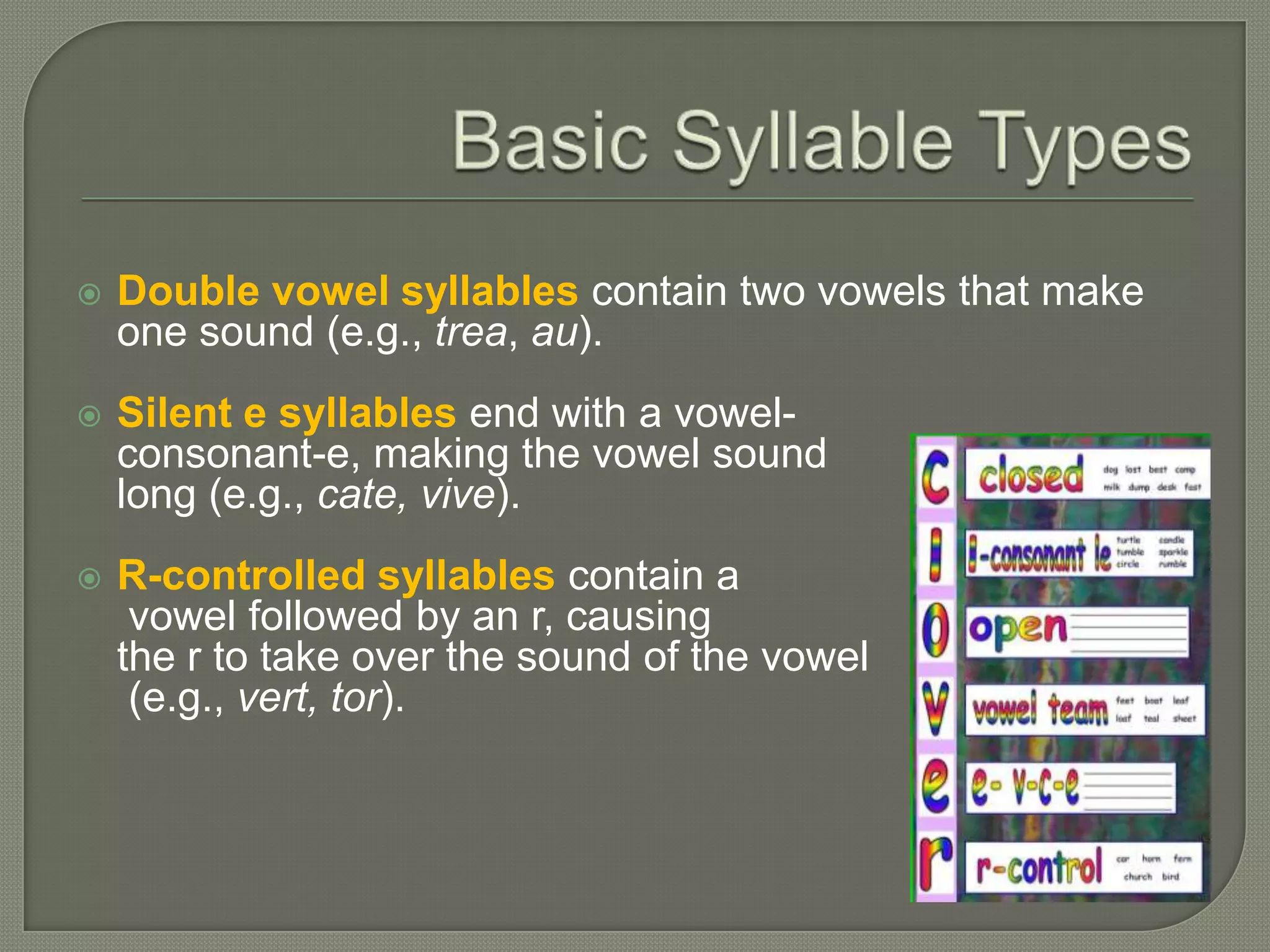
Basic Syllable Types Double vowel syllables contain two vowels that make one sound (e.g., trea, au).Silent e syllables end with a vowel-	consonant-e, making the vowel sound 	long (e.g., cate, vive). R-controlled syllables contain a	 vowel followed by an r, causing 	the r to take over the sound of the vowel	 (e.g., vert, tor). 
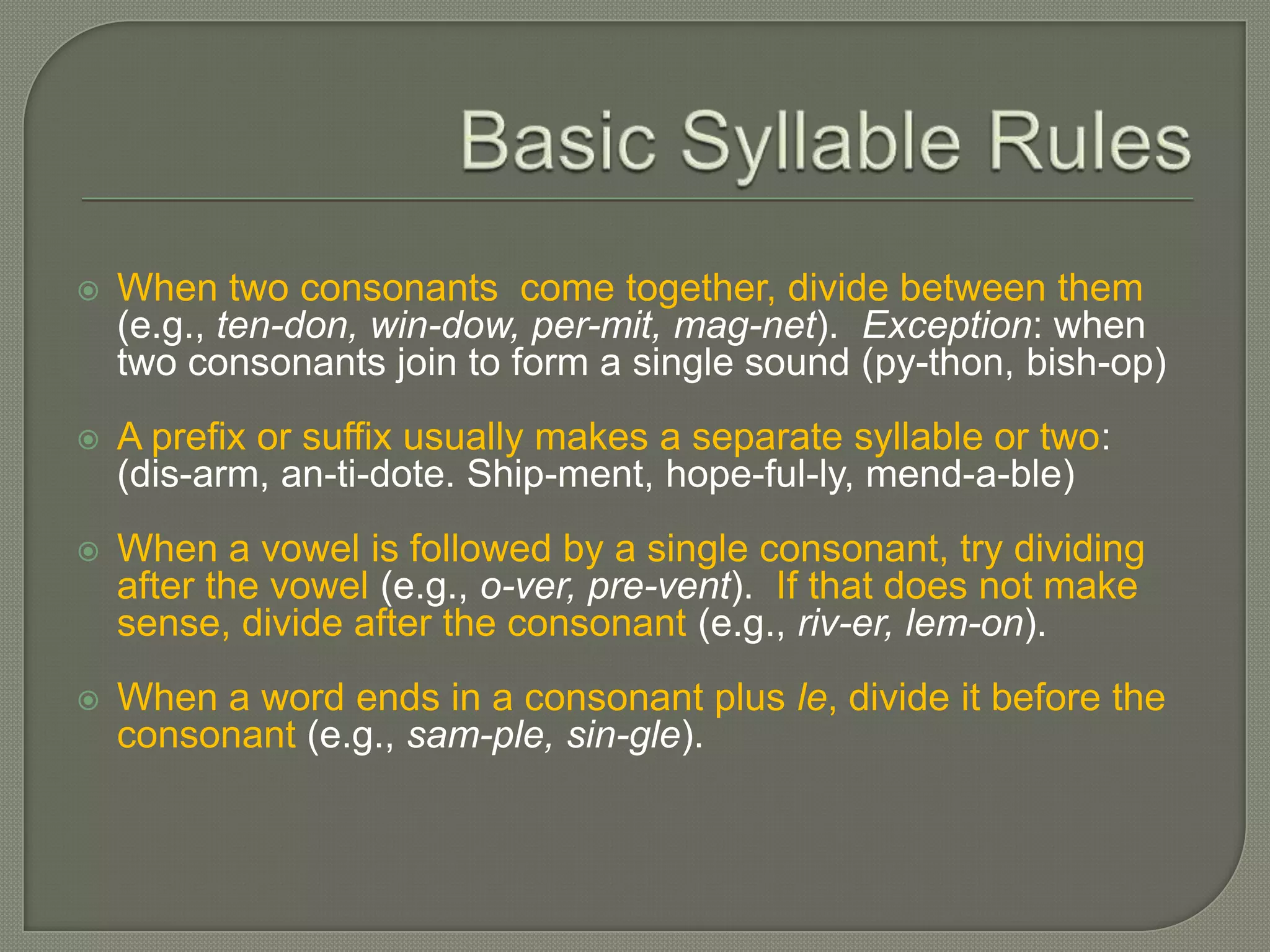
Basic Syllable RulesWhen two consonants  come together, divide between them 	(e.g., ten-don, win-dow, per-mit, mag-net).  Exception: when two consonants join to form a single sound (py-thon, bish-op)A prefix or suffix usually makes a separate syllable or two: 	(dis-arm, an-ti-dote. Ship-ment, hope-ful-ly, mend-a-ble)When a vowel is followed by a single consonant, try dividing after the vowel (e.g., o-ver, pre-vent).  If that does not make sense, divide after the consonant (e.g., riv-er, lem-on).When a word ends in a consonant plus le, divide it before the consonant (e.g., sam-ple, sin-gle). 
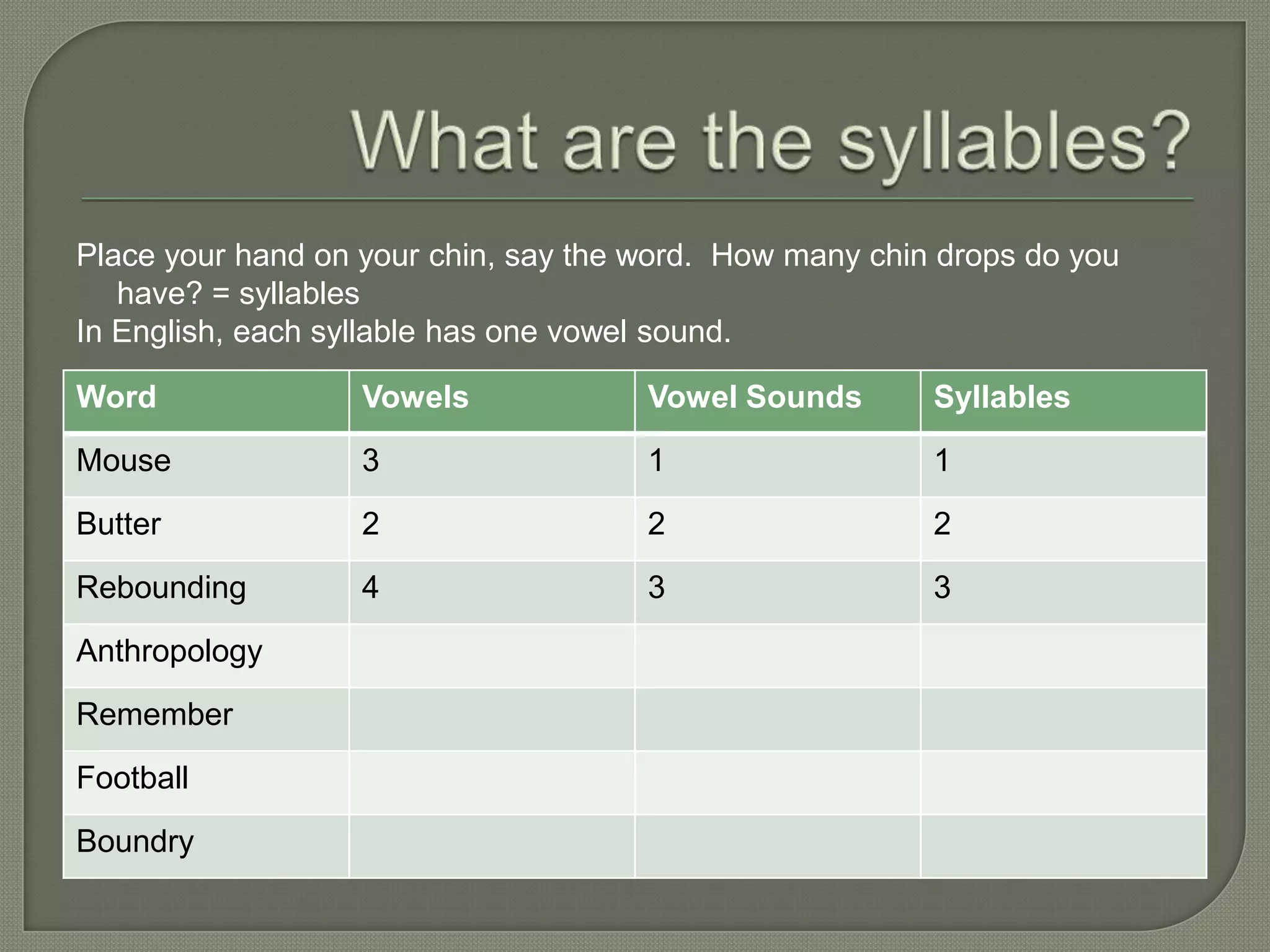
What are the syllables?Place your hand on your chin, say the word.  How many chin drops do you have? = syllablesIn English, each syllable has one vowel sound.
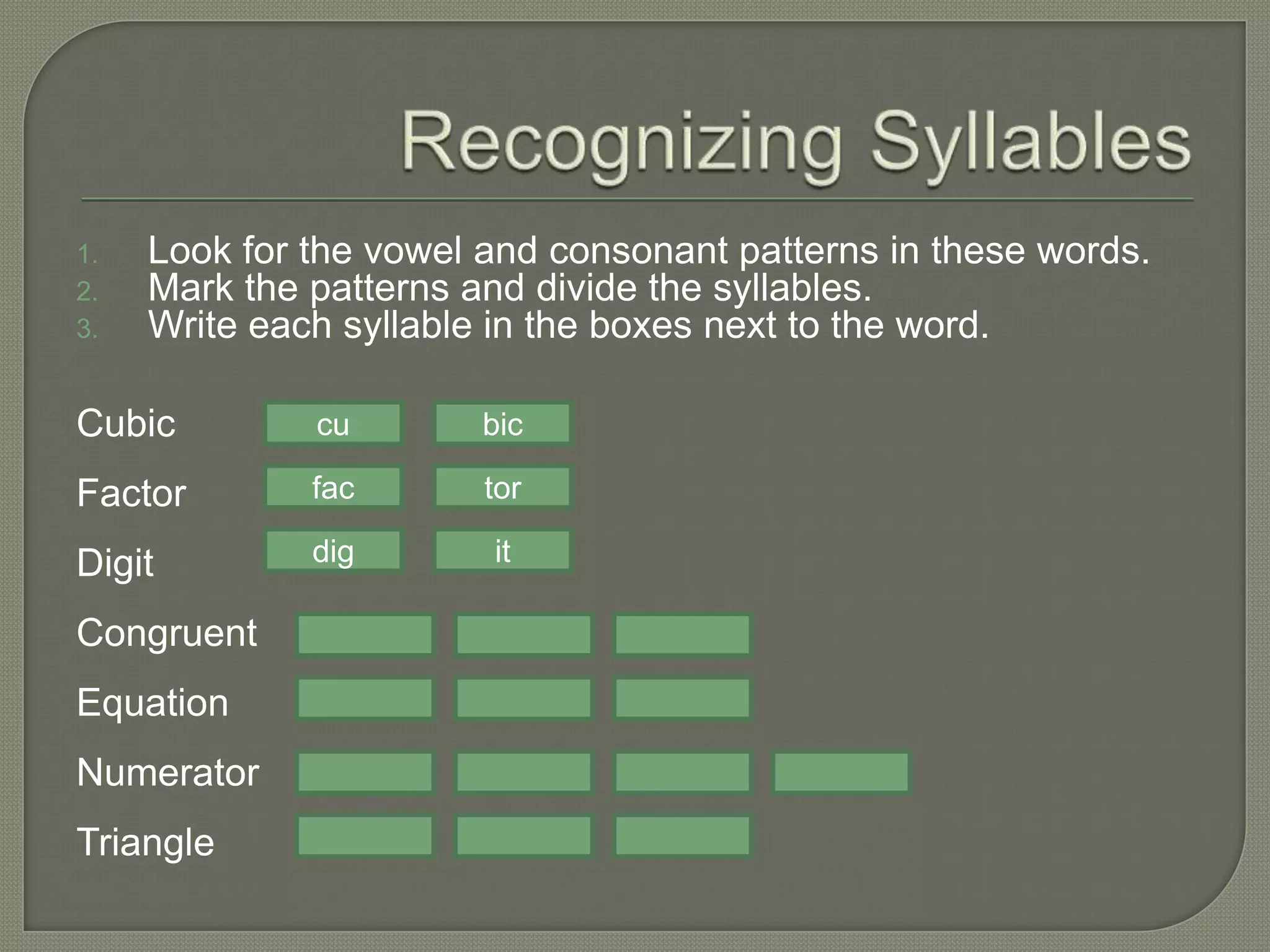
Recognizing SyllablesLook for the vowel and consonant patterns in these words.Mark the patterns and divide the syllables.Write each syllable in the boxes next to the word.CubicFactorDigitCongruentEquationNumeratorTrianglecubicfactordigit
AlphabeticsBasicPhonemic awarenessSight word recognitionPhonics/ word analysis (#3-10)IntermediateUsing syllables to pronounce multisyllabic wordsRoots and Affixes (prefixes and suffixes)
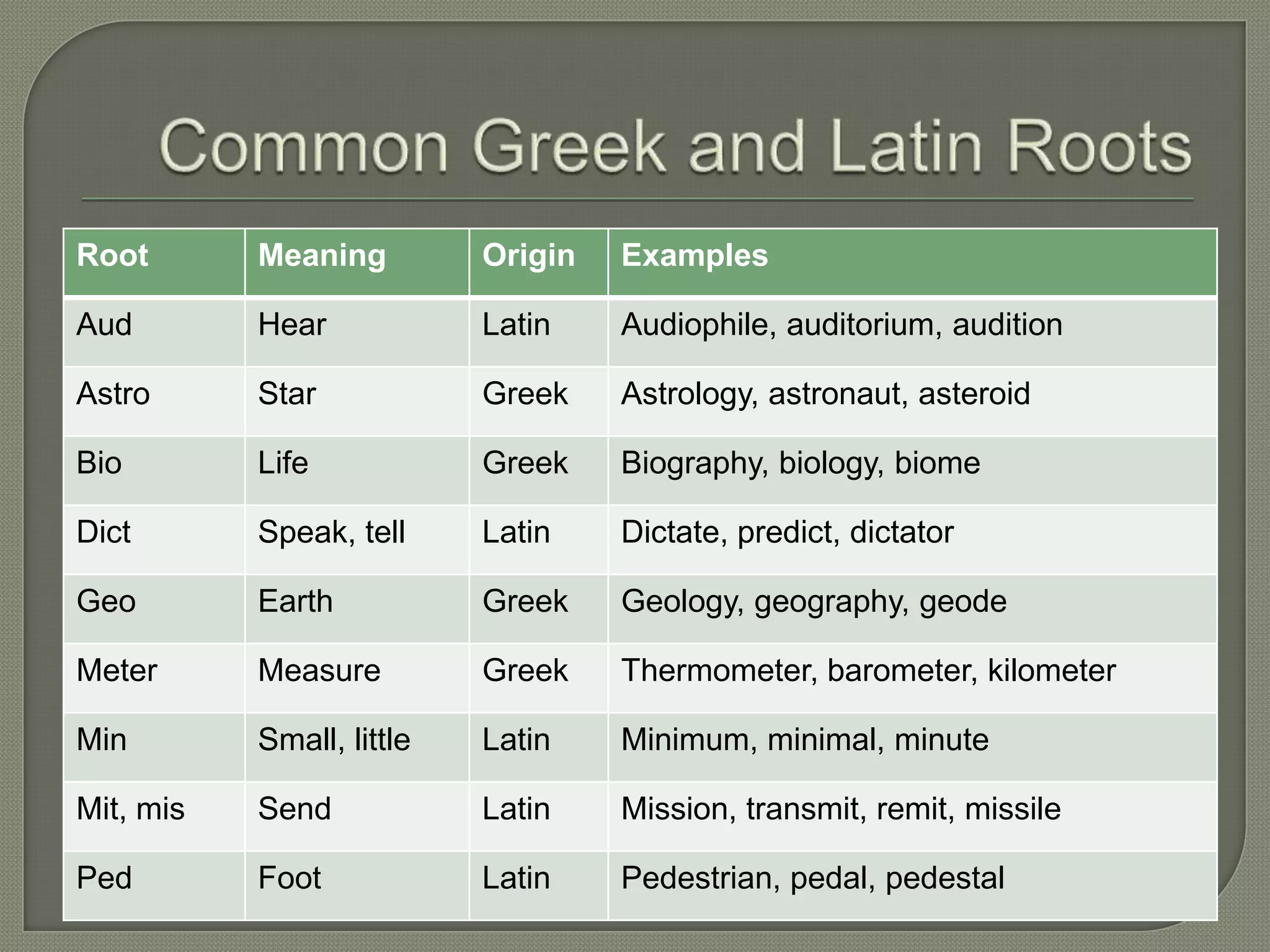
Common Greek and Latin Roots
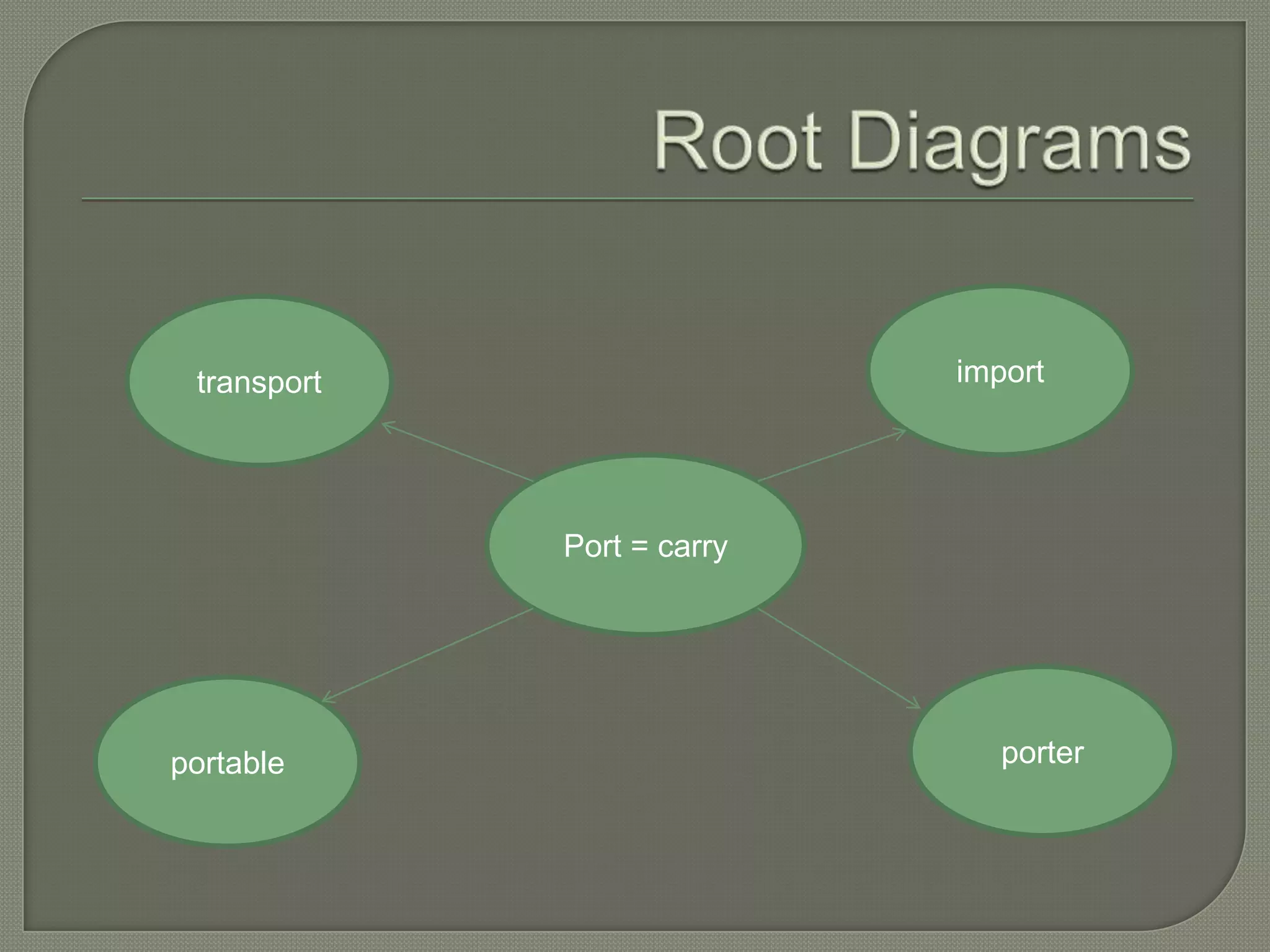
Root DiagramsimporttransportPort = carryporterportable
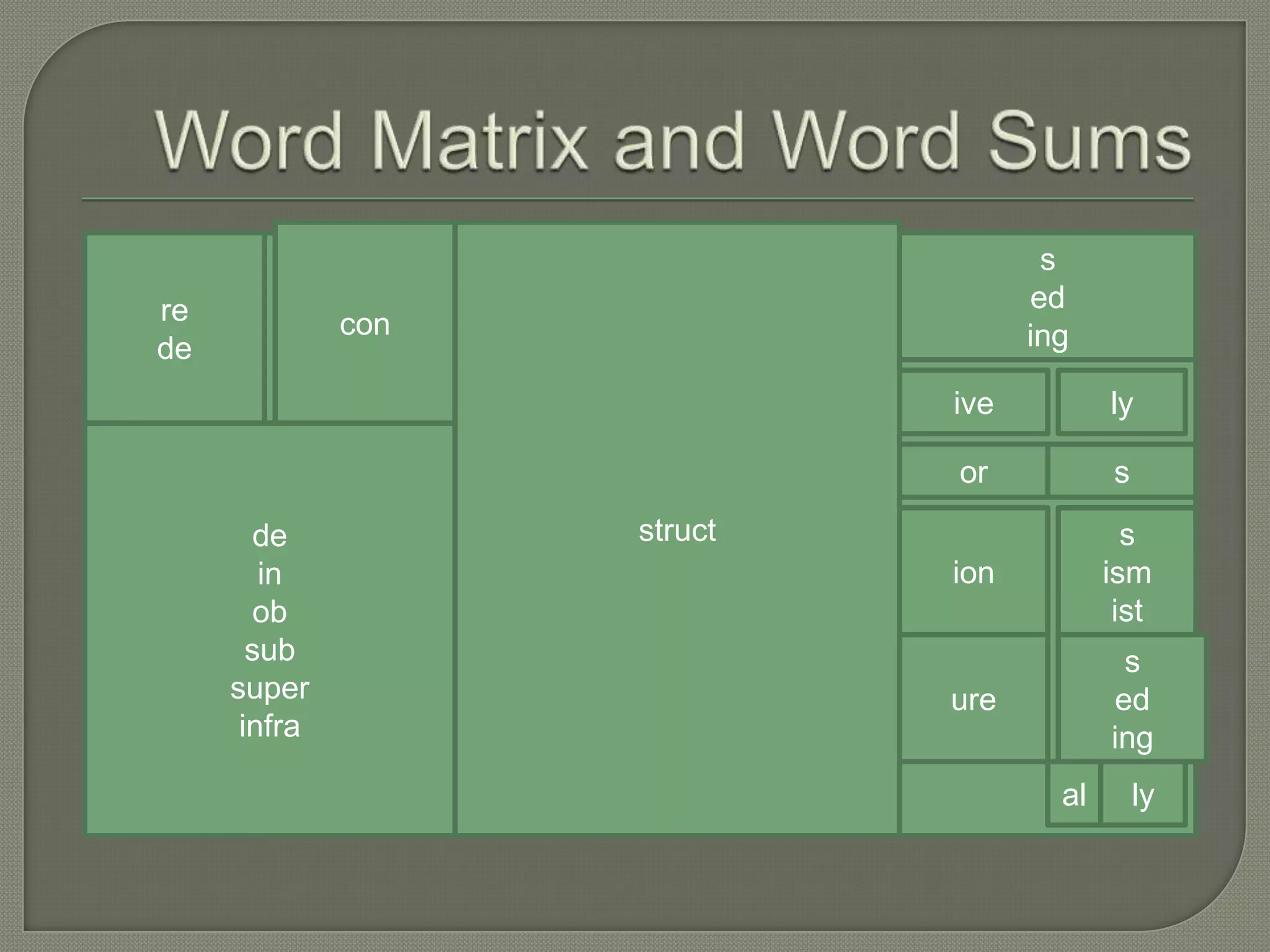
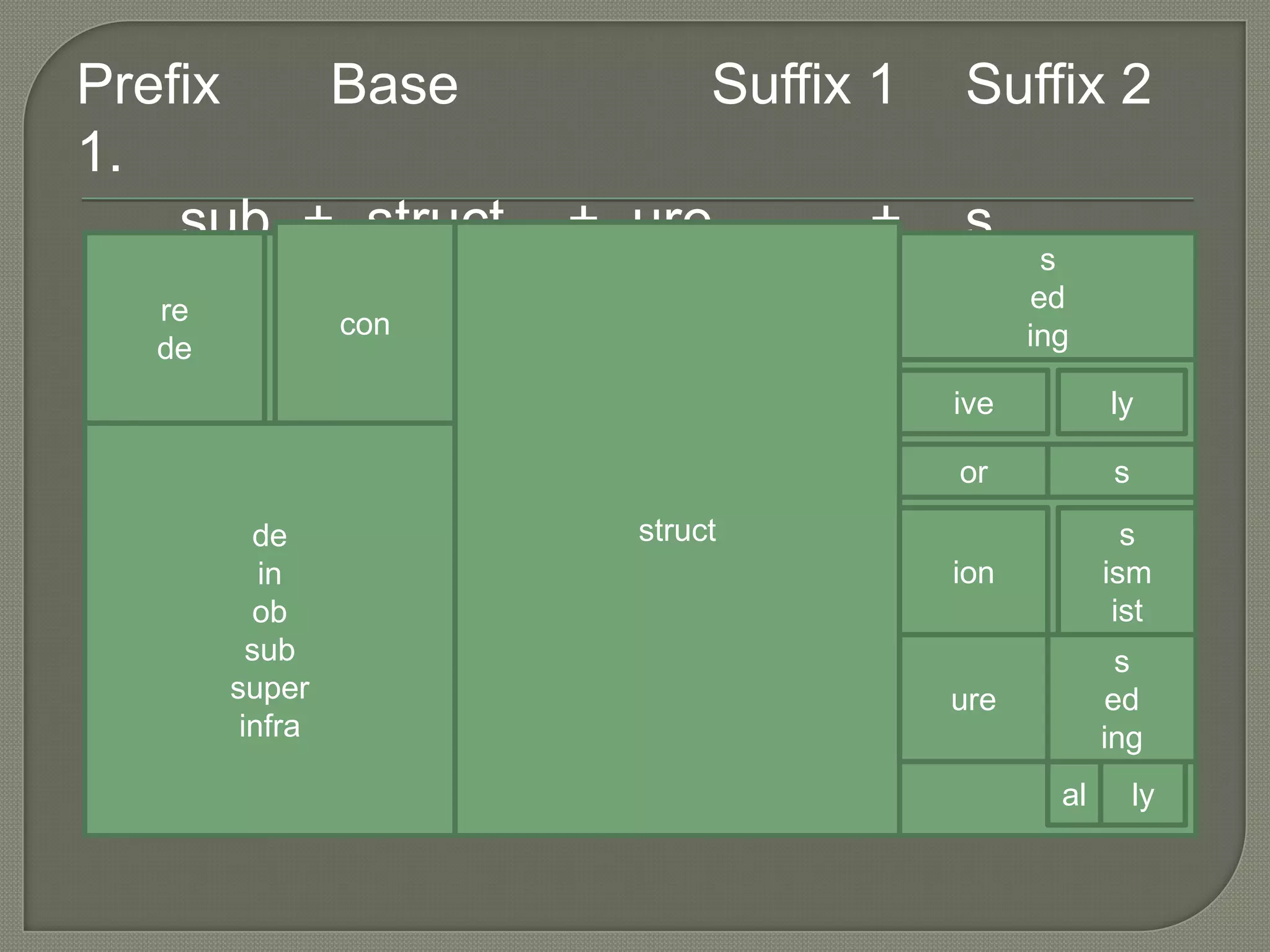
Word Matrix and Word Sumsconstructredesedingivelydeinobsubsuperinfraorsion sismisturesedingally
Prefix	Base		Suffix 1	Suffix 21. __sub_+_struct__+_ure_____+__s_______constructredesedingivelydeinobsubsuperinfraorsion sismisturesedingally
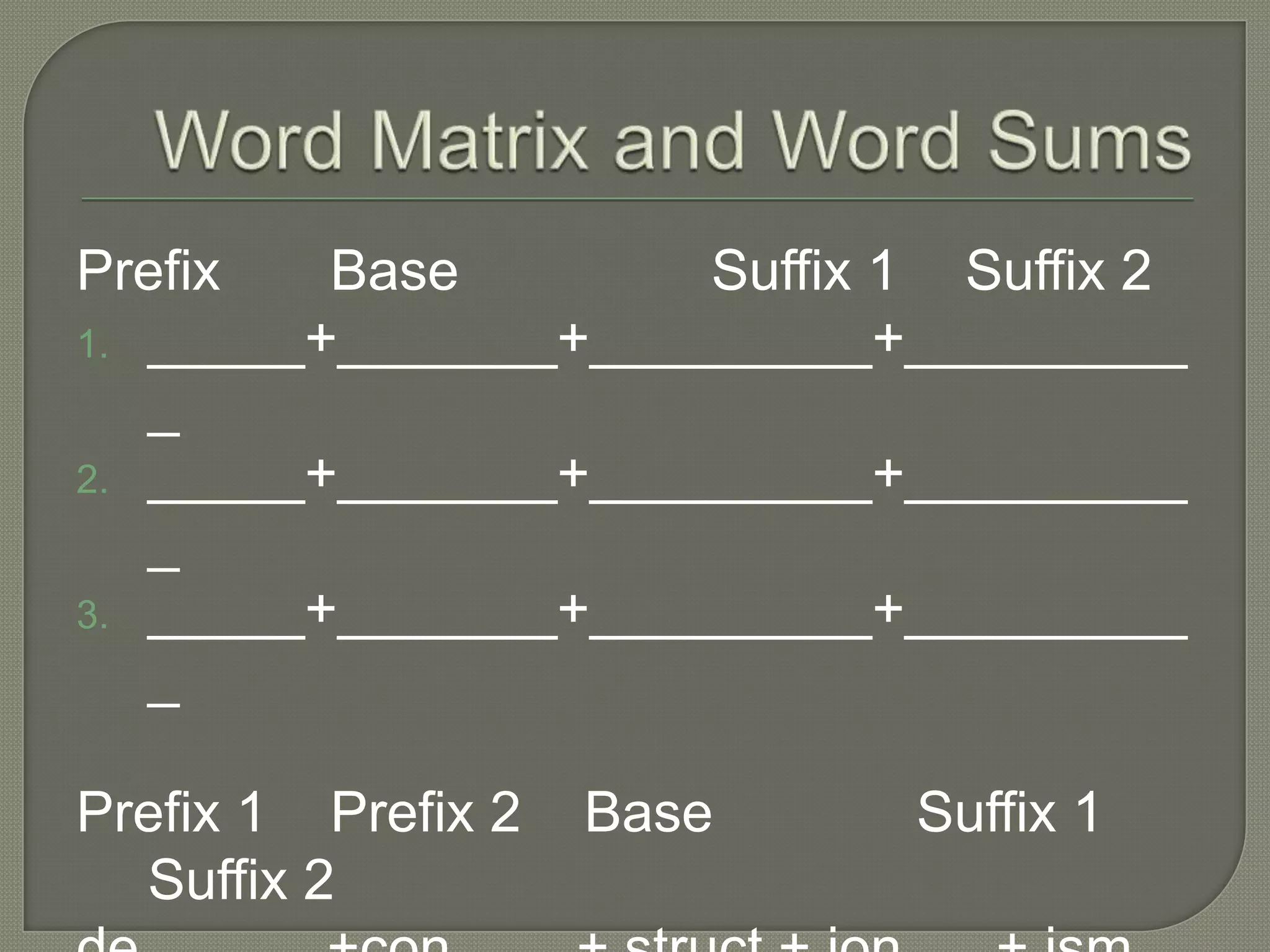
Word Matrix and Word SumsPrefix	Base		Suffix 1	Suffix 2_____+_______+_________+_______________+_______+_________+_______________+_______+_________+__________Prefix 1	Prefix 2	Base	     Suffix 1 Suffix 2de______+con____+ struct + ion___+ ism
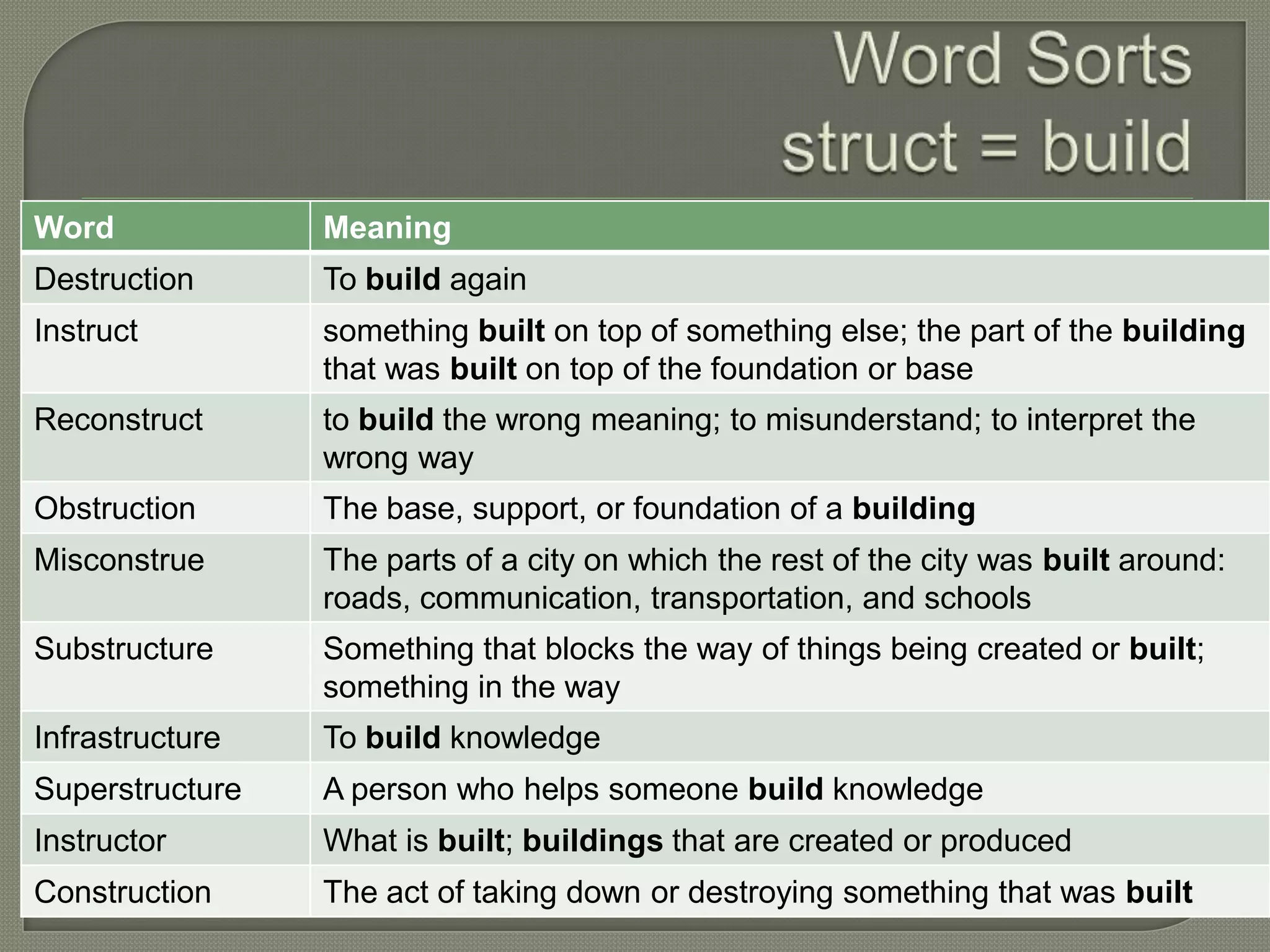
Word Sortsstruct = build
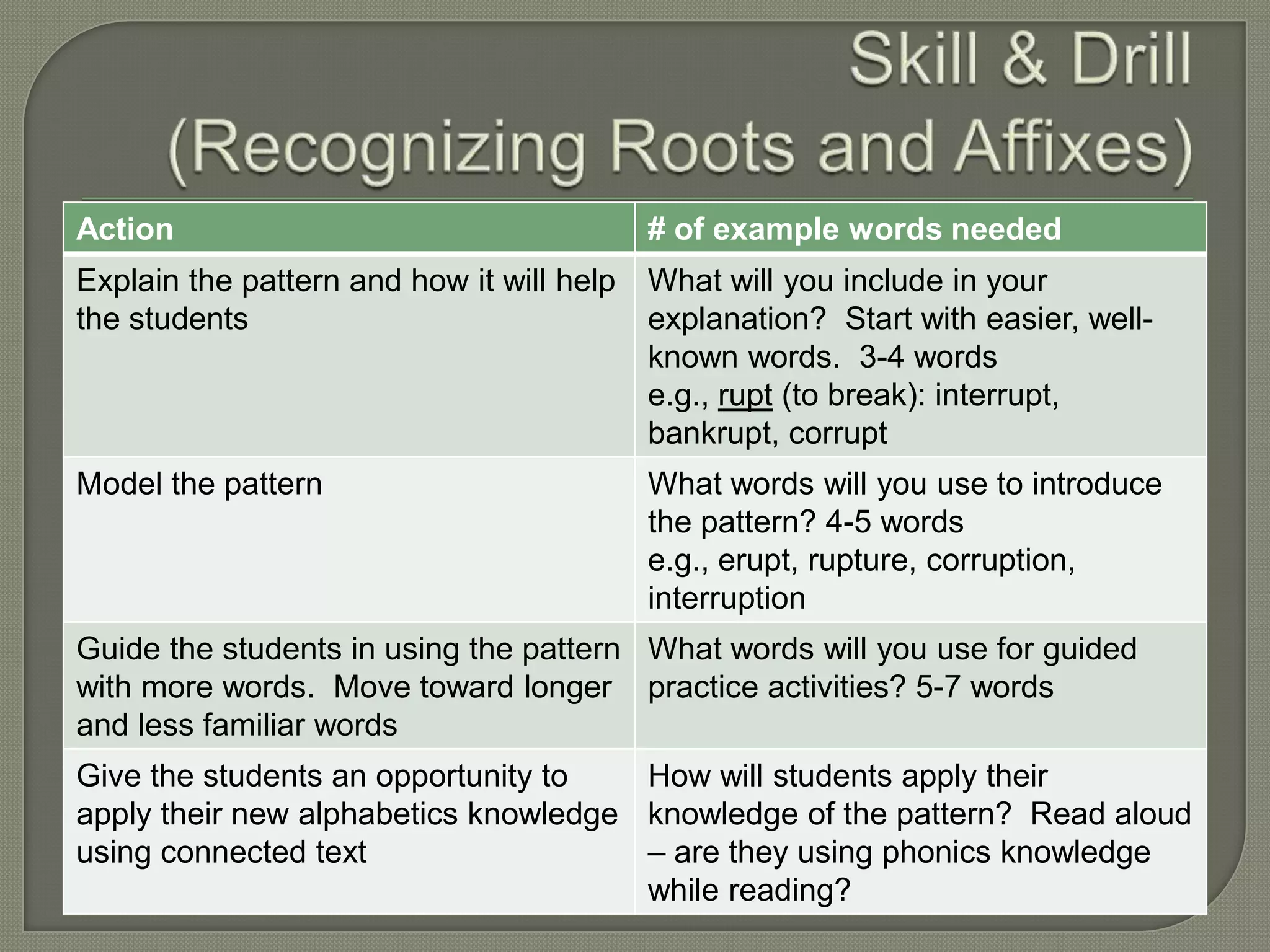
Skill & Drill (Recognizing Roots and Affixes)
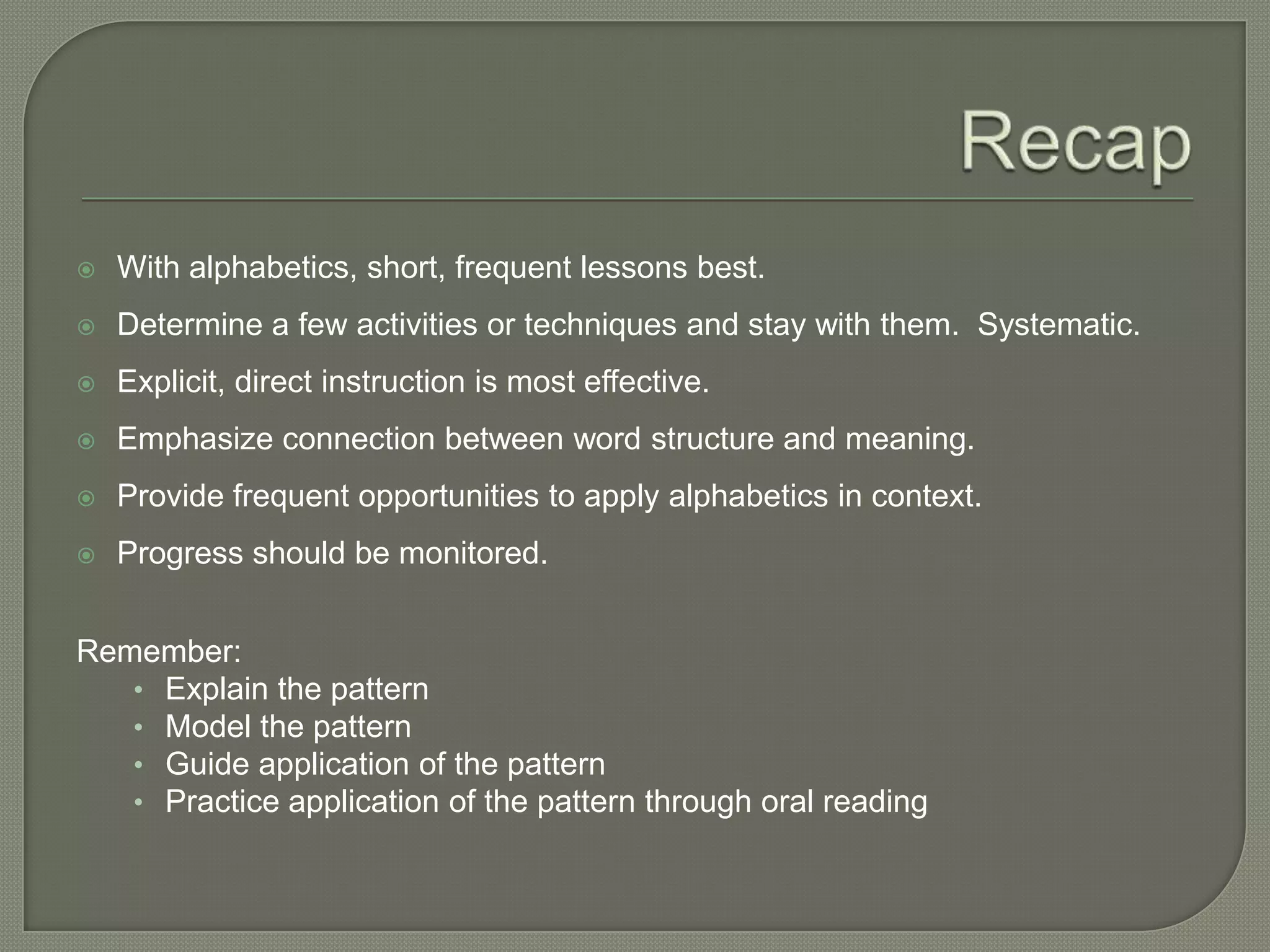
RecapWith alphabetics, short, frequent lessons best.Determine a few activities or techniques and stay with them.  Systematic.Explicit, direct instruction is most effective.Emphasize connection between word structure and meaning.Provide frequent opportunities to apply alphabetics in context.Progress should be monitored.Remember:Explain the patternModel the patternGuide application of the patternPractice application of the pattern through oral reading
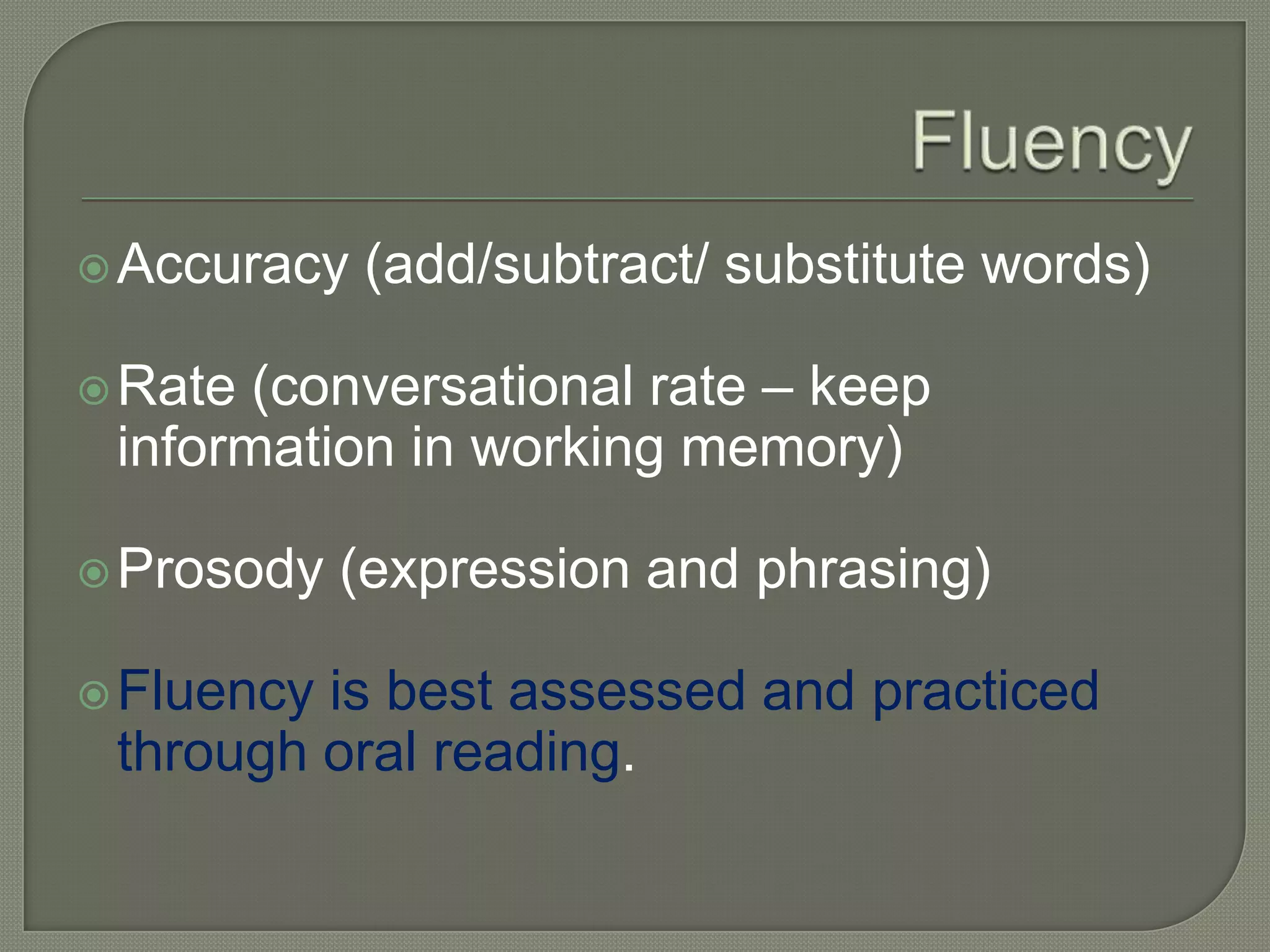
FluencyAccuracy (add/subtract/ substitute words)Rate (conversational rate – keep information in working memory)Prosody (expression and phrasing)Fluency is best assessed and practiced through oral reading.
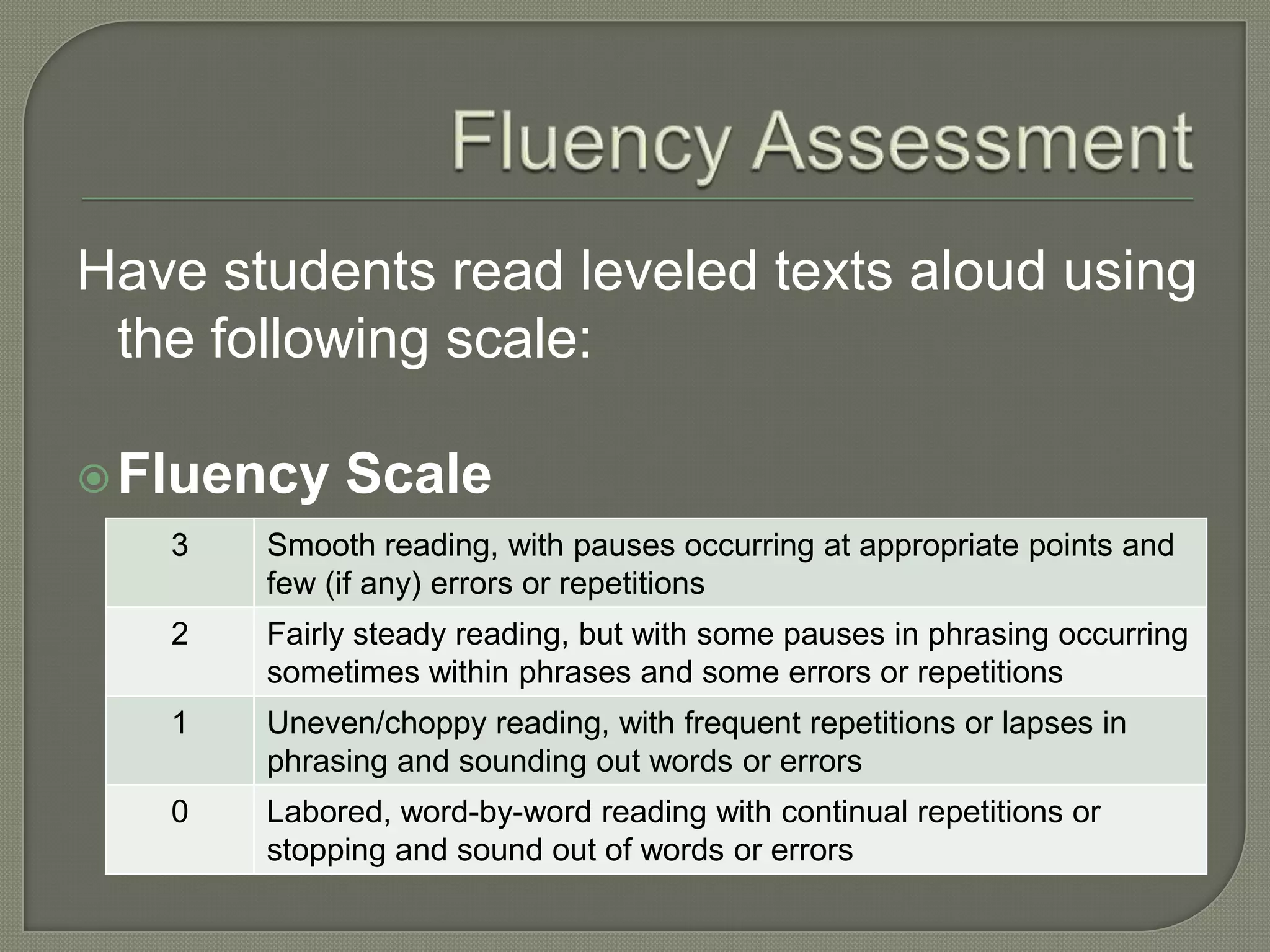
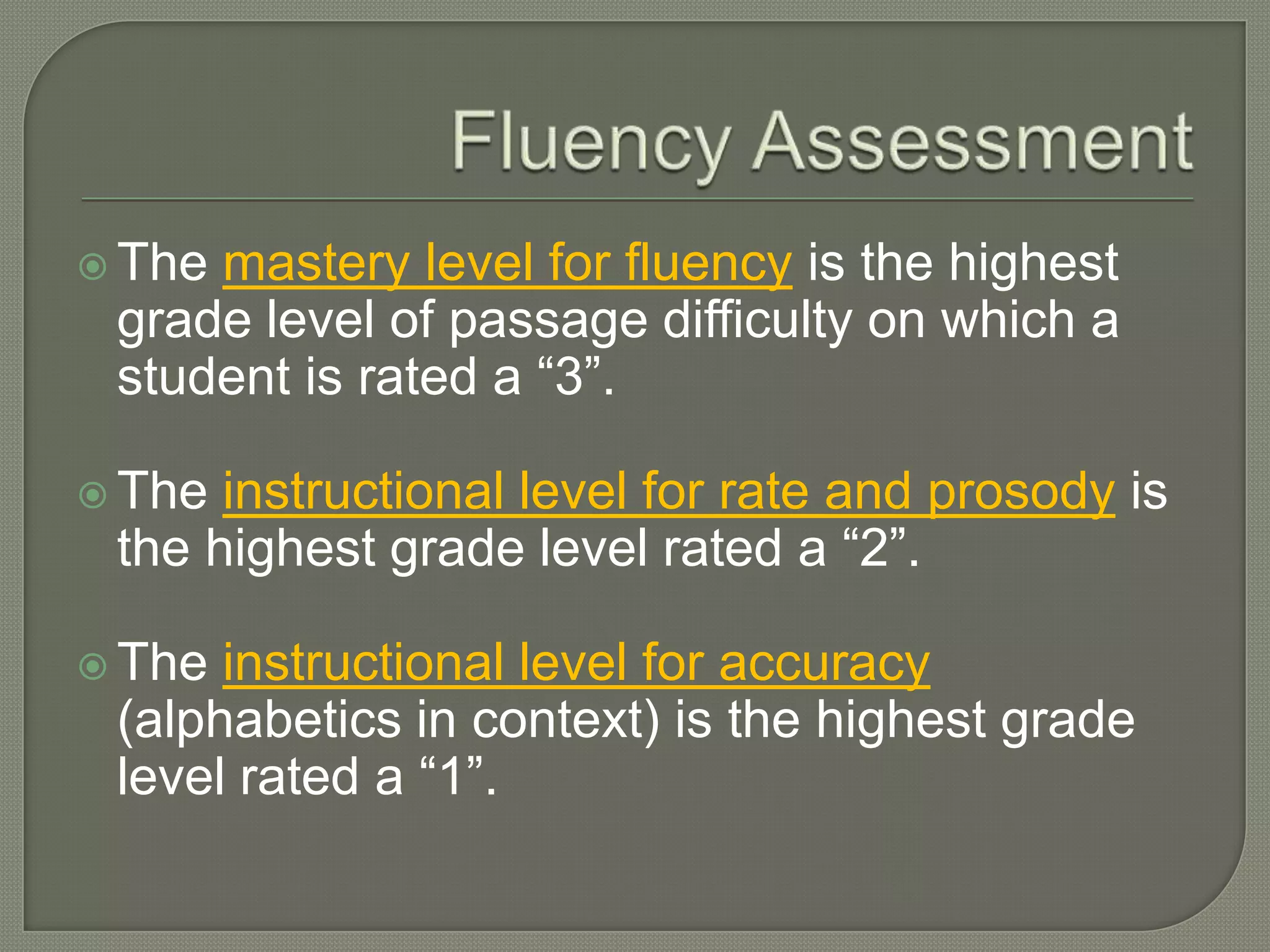
Fluency AssessmentHave students read leveled texts aloud using the following scale:Fluency Scale
Fluency AssessmentThe mastery level for fluencyis the highest grade level of passage difficulty on which a student is rated a “3”.The instructional level for rate and prosodyis the highest grade level rated a “2”.The instructional level for accuracy(alphabetics in context) is the highest grade level rated a “1”.
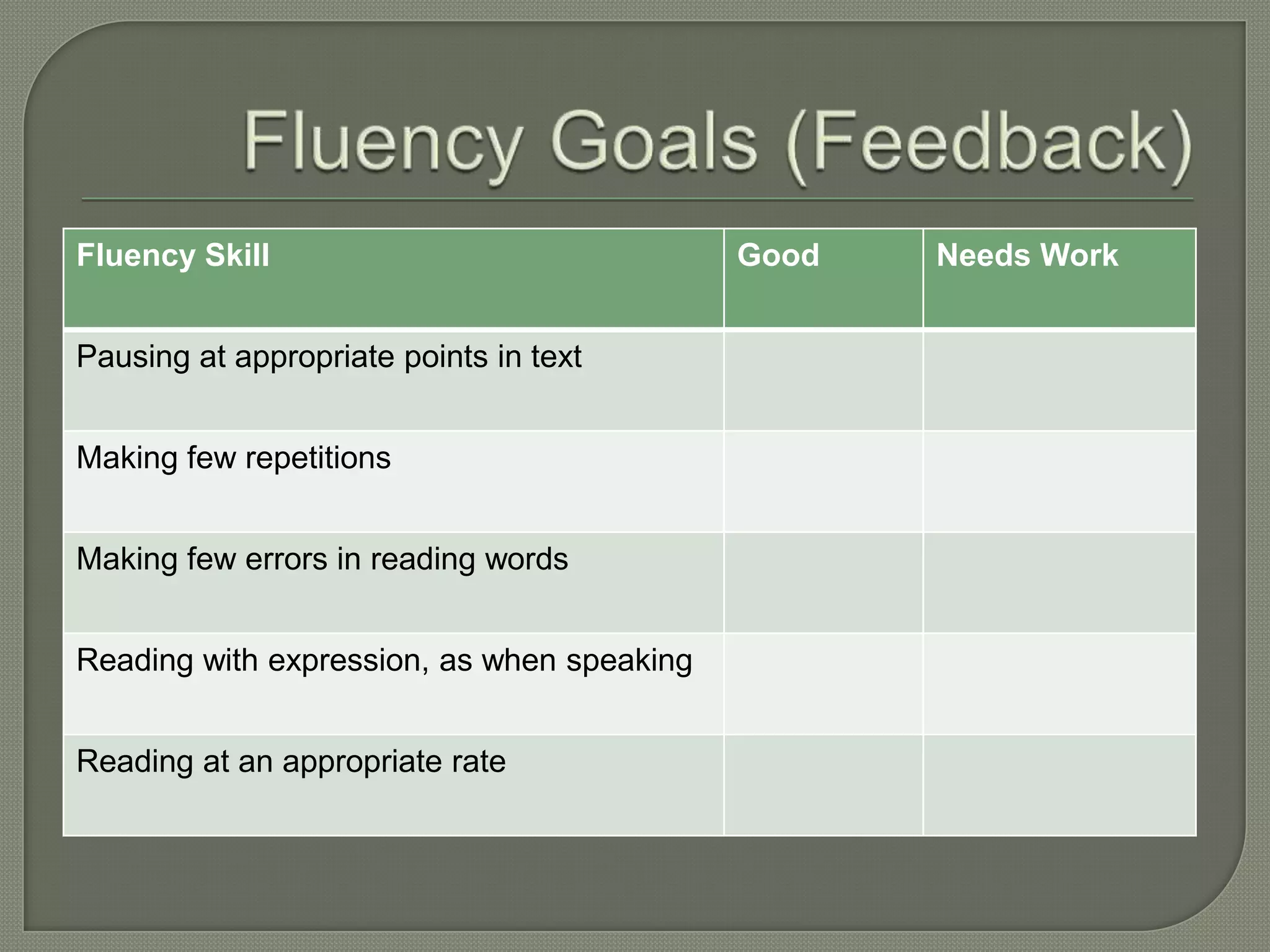
Fluency Goals (Feedback)
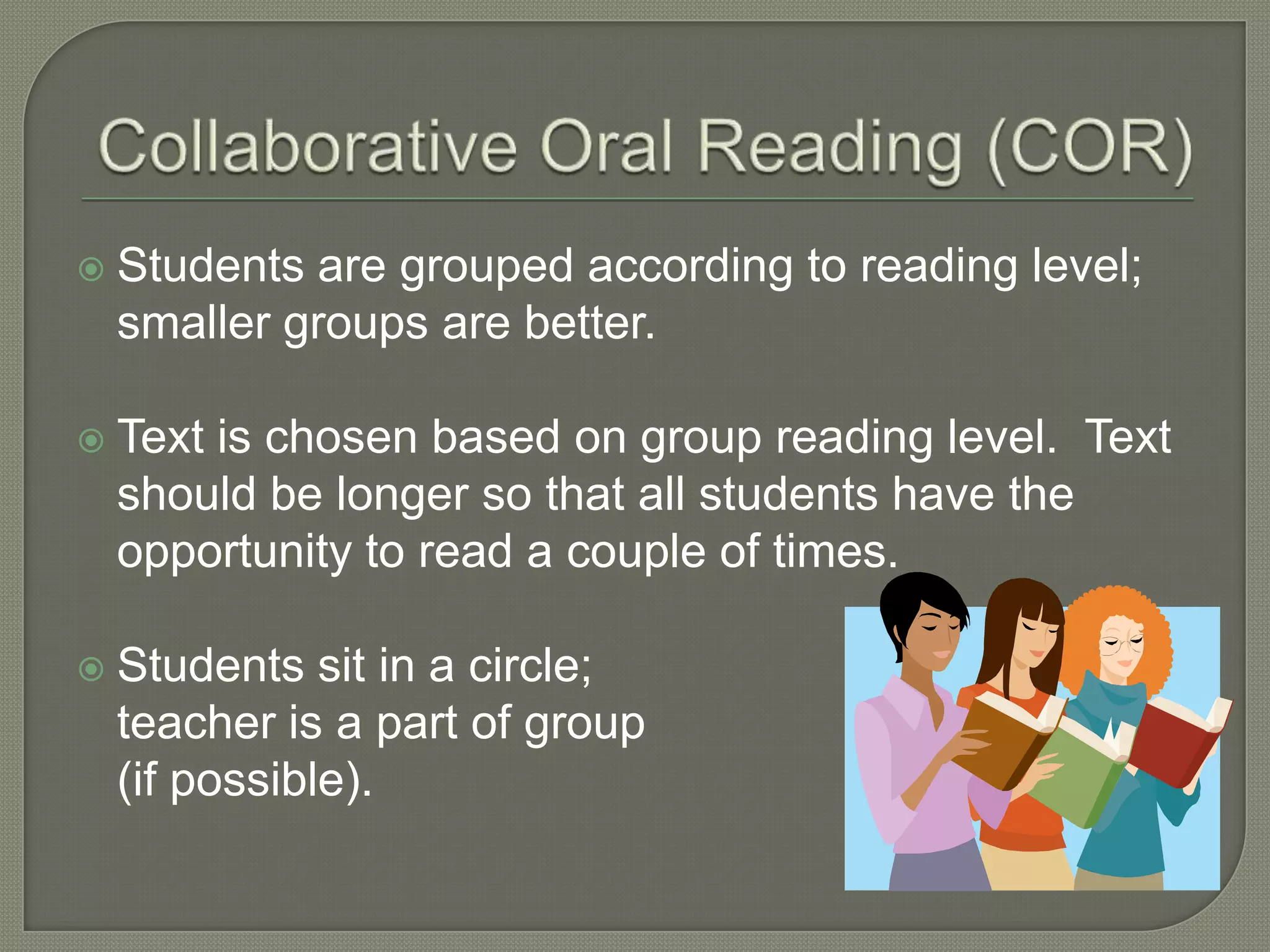
Collaborative Oral Reading (COR)Students are grouped according to reading level; smaller groups are better.Text is chosen based on group reading level.  Text should be longer so that all students have the opportunity to read a couple of times.Students sit in a circle; 	teacher is a part of group	(if possible).
Collaborative Oral Reading (COR)Each student reads 2-4 sentences (student determines length) and then “passes” to the next student (call name or throw a ball).  Everyone must take a turn.From time to time students may stop to discuss reading (brief).  This brief check of comprehension is the application piece of fluency.Teacher is part of reading group and takes turns reading and modeling.
Repeated ReadingThe student – Along with the teacher, set fluency goals.
Performs an unpracticed reading with a short text at the target level.
Hears a fluent reading of the text.
Independently practices reading	 the text.Reads the text for the teacher.Repeated ReadingExample student goals: Better phrasingImproved accuracyUsing intonationEven, conversational rateIn repeated reading:Use short passages
Have students read several passages at level before moving up
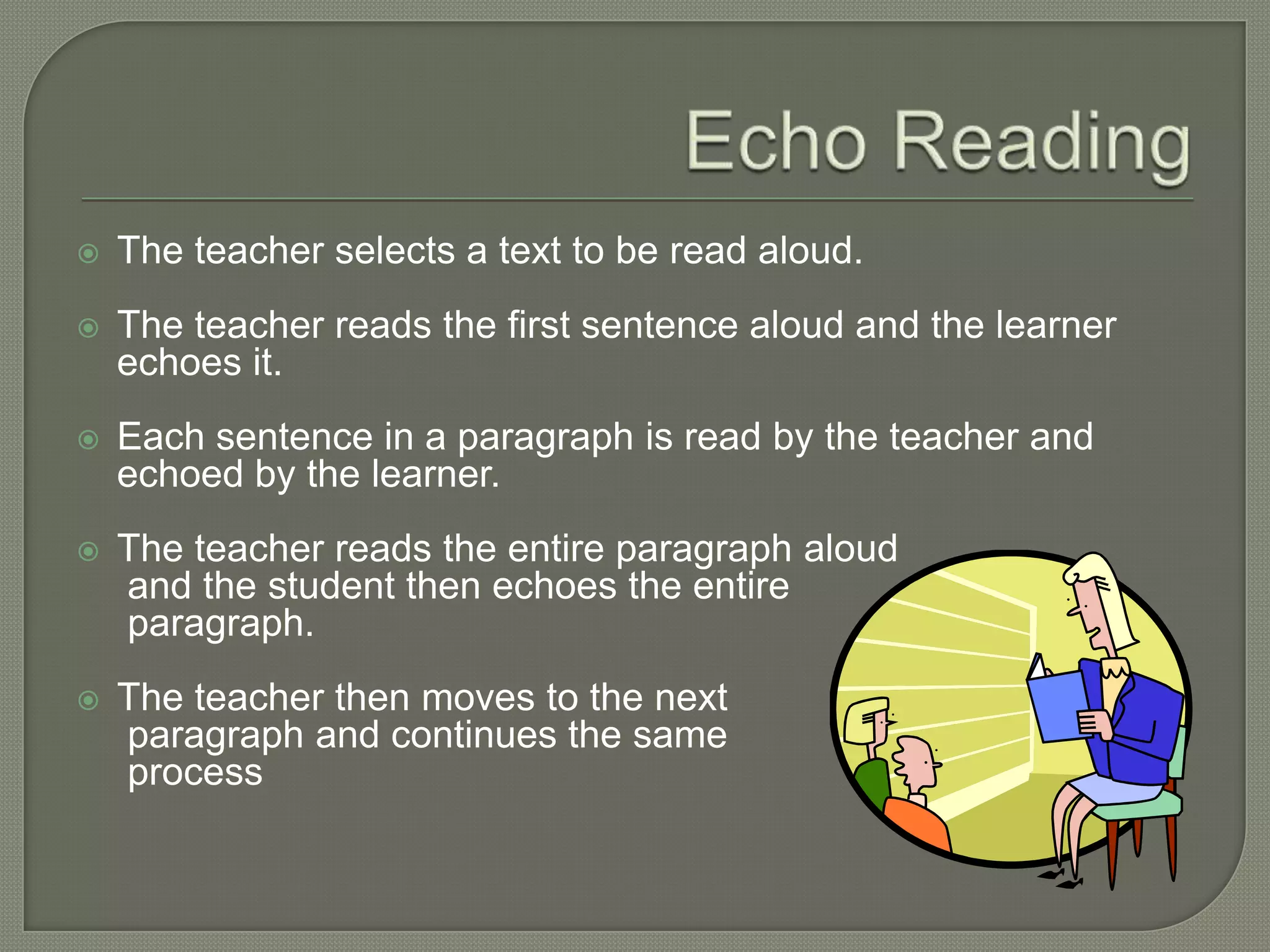
Silent reading before oral reading will help with oral reading fluency.Echo ReadingThe teacher selects a text to be read aloud.The teacher reads the first sentence aloud and the learner echoes it.Each sentence in a paragraph is read by the teacher and echoed by the learner.The teacher reads the entire paragraph aloud	 and the student then echoes the entire 	 paragraph.The teacher then moves to the next	 paragraph and continues the same	 process
Echo ReadingSentence by sentence reading/ reading in chunks.Should be done with smaller groups so that individuals can be heard.Highly supported fluency instructionOnly a practice activity (not an assessment)Very intensive – only do for 10-15 minutes.  Short, frequent practices are better.
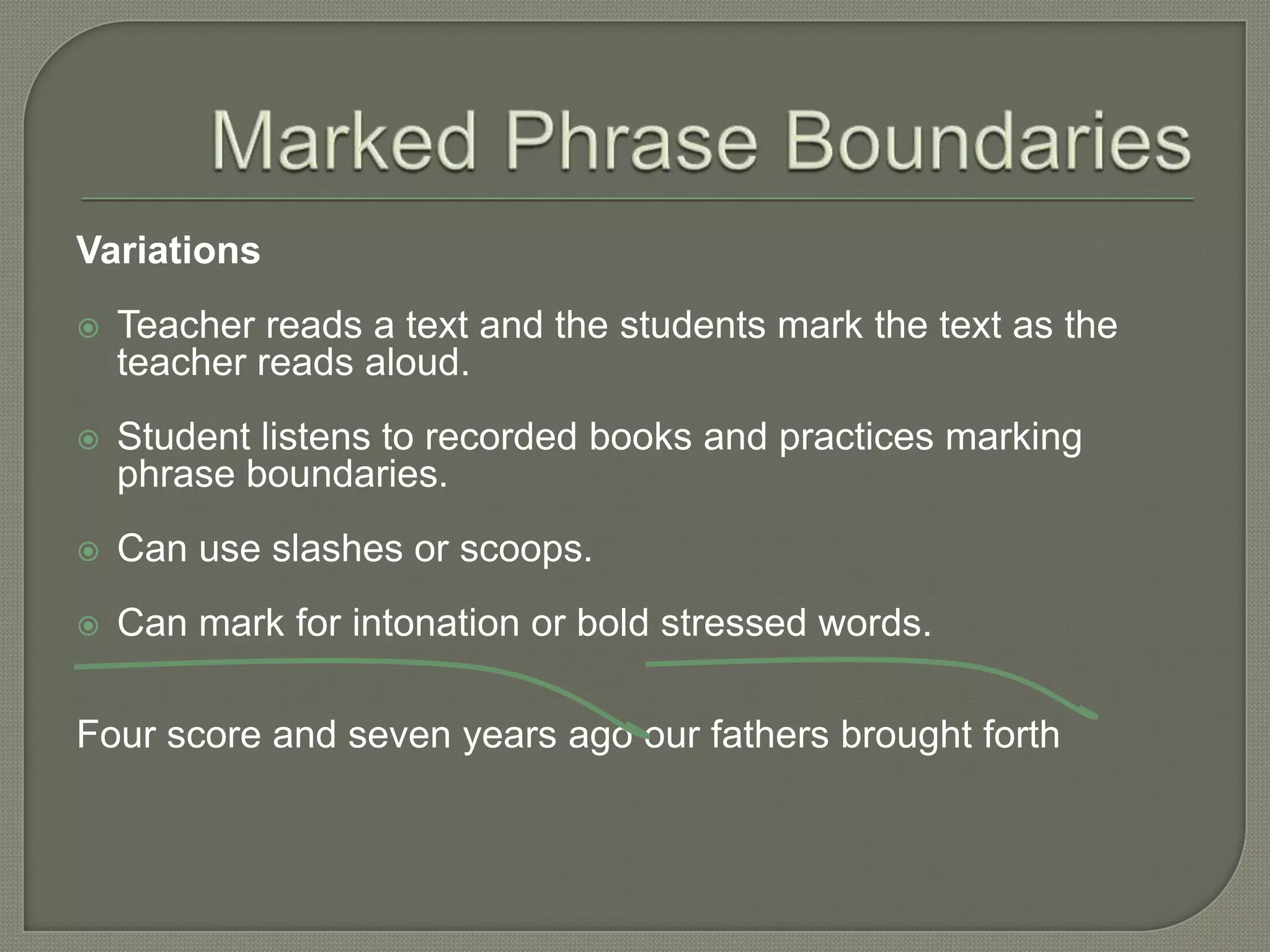
Marked Phrase BoundariesThe teacher marks meaningfully phrases in the text.The teacher models good prosody by reading the marked text.The learner practices reading the marked text aloud and gets feedback.The learner marks a copy of the same text.Eventually, students learn to read the text with no markings.Four score and seven years ago/ our fathers brought forth/ upon this continent/ a new nation/ conceived in liberty/
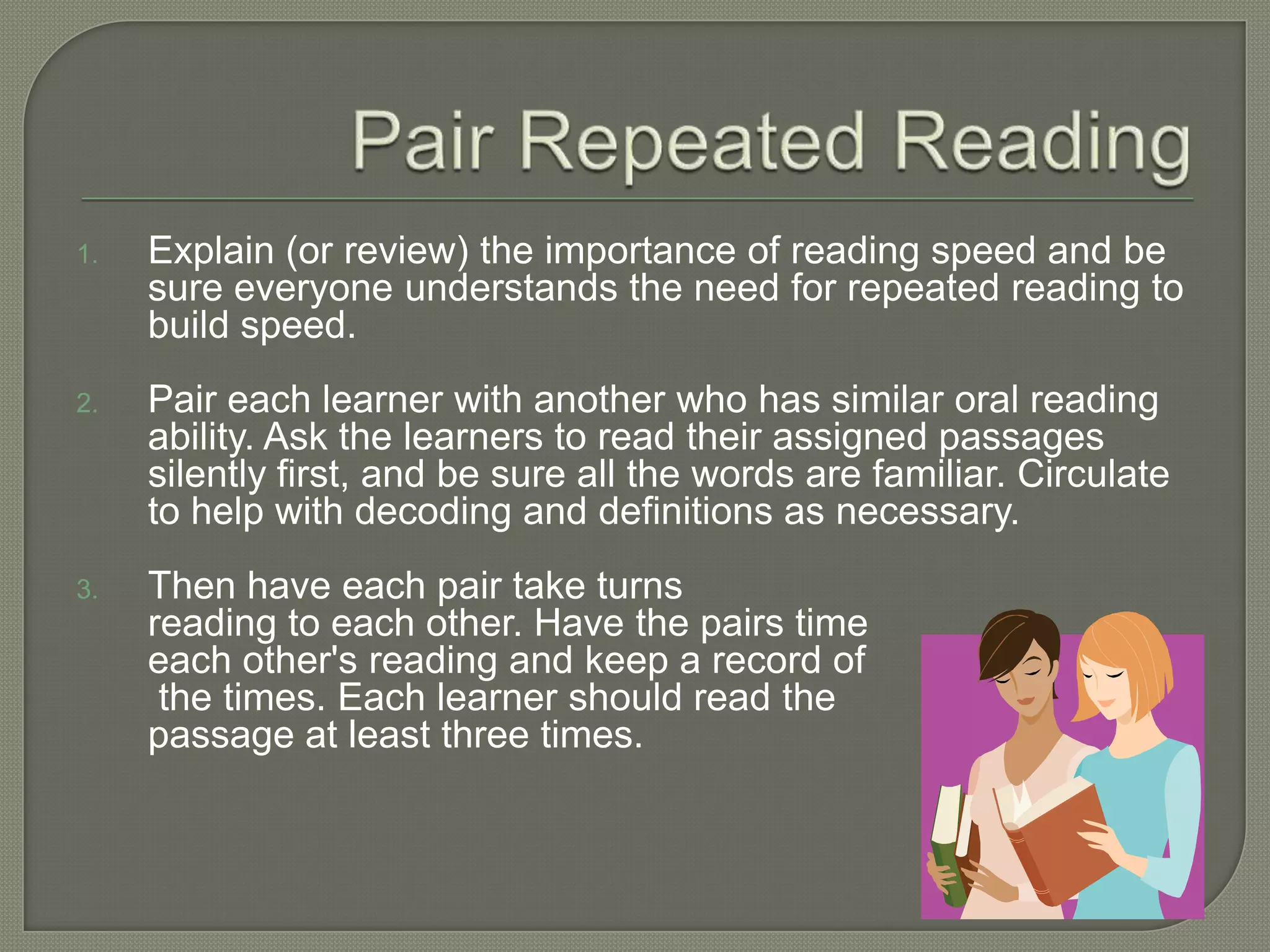
Marked Phrase BoundariesVariationsTeacher reads a text and the students mark the text as the teacher reads aloud.Student listens to recorded books and practices marking phrase boundaries.Can use slashes or scoops.Can mark for intonation or bold stressed words.Four score and seven years ago our fathers brought forth
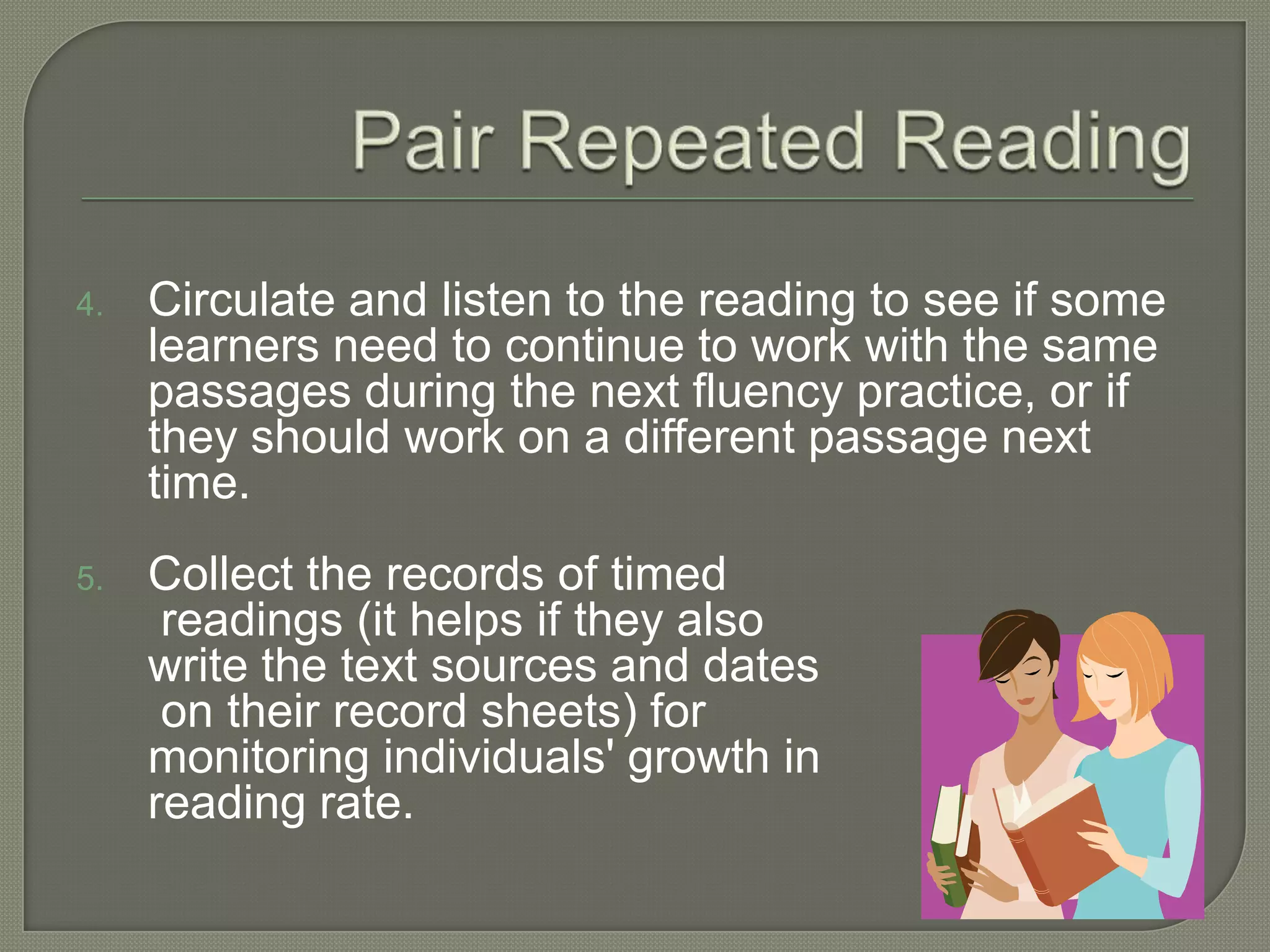
Pair Repeated ReadingExplain (or review) the importance of reading speed and be sure everyone understands the need for repeated reading to build speed. Pair each learner with another who has similar oral reading ability. Ask the learners to read their assigned passages silently first, and be sure all the words are familiar. Circulate to help with decoding and definitions as necessary. Then have each pair take turns 	reading to each other. Have the pairs time 	each other's reading and keep a record of	 the times. Each learner should read the 	passage at least three times.
Pair Repeated ReadingCirculate and listen to the reading to see if some learners need to continue to work with the same passages during the next fluency practice, or if they should work on a different passage next time. Collect the records of timed	 readings (it helps if they also 	write the text sources and dates	 on their record sheets) for 	monitoring individuals' growth in 	reading rate.
Using Recorded ReadingsHave students listen to recording while following along in the book.  Student should subvocalize along with the recording.  The student should read the text multiple times for effective practice.Have students record themselves reading the text.  Have the students 	do multiple recordings so	that they can improve 	their skills.
Teaching alphabetics and fluency in reading

  • 1.
    Teaching Alphabetics &Fluency in ReadingCETL PresentationApril 22, 2011
  • 2.
    Four Components ofReadingAlphabeticsFluencyVocabularyComprehensionKruidenier (2002); NRP (2000)
  • 3.
    Promising PracticesDiagnostic assessmentUseassessment to shape instructionDirect and explicit instructionLearner engagementRelevance of instructionContinuous monitoring
  • 4.
    Diagnostic AssessmentAlphabeticsWord lists– Sylvia Greene FluencyReadings – BaderFluency Scale (2 – rate & prosody; 1- accuracy)
  • 5.
    Promising PracticesDiagnostic assessmentUseassessment to shape instructionDirect and explicit instructionLearner engagementRelevance of instructionContinuous monitoring
  • 6.
    Explicit InstructionExplanation –why, processModeling – how the skill is used; how the procedure worksGuided Practice – supported, scaffolded instructionApplication – students use skill on own; independent with little support
  • 7.
    Promising PracticesDiagnostic assessmentUseassessment to shape instructionDirect and explicit instructionLearner engagementRelevance of instructionContinuous monitoring
  • 8.
    Effective InstructionActive studentengagementNumerous practice opportunitiesStudent reflection on what they are learning.
  • 9.
    Promising PracticesDiagnostic assessmentUseassessment to shape instructionDirect and explicit instructionLearner engagementRelevance of instructionContinuous monitoring (of students and instruction)
  • 10.
  • 11.
    AlphabeticsBasicPhonemic awarenessSight wordrecognitionPhonics/ word analysisIntermediateUsing syllables to pronounce multisyllabic wordsRoots and Affixes (prefixes and suffixes)
  • 12.
    AlphabeticsPhonological Awareness (phonemes#1-2)Knowing that spoken language is composed of soundsThe ability to manipulate and integrate language sounds
  • 13.
    PhonemeBasic building blockof speechSingle speech soundDistinguishes one word from anotherPeach or pitch?Pin or pen?
  • 14.
    Difficulties in PhonologicalProcessingDifficulty sequencing sounds in words.Omission of some sounds.Inclusion of some unnecessary sounds.Difficulty hearing word boundaries.Confusion of similar sounds (e.g., b/p, f/v)
  • 15.
    Phonemic Awareness TasksPhonemicawareness is assessed orallythrough tasks that ask learners to demonstrate their ability to manipulate the sounds in spoken words..Phoneme isolation: recognizing individual sounds in words, for example, "Tell me the first sound in paste." (/p/)Phoneme identity:recognizing the common sound in different words, for example, "Tell me the sound that is the same in bike, boy, and bell." (/b/)Phoneme categorization:recognizing the odd sounding word in a sequence of three or four words, for example, "Which word does not belong? bus, bun, rug." (rug)
  • 16.
    Phonemic Awareness TasksPhonemeblending:listening to a sequence of separately spoken sounds and combining them to form a recognizable word. For example, "What word is /s/ /k/ /u/ /l/?" (school)Phoneme segmentation:breaking a word into its sounds by tapping out or counting the sounds, or by pronouncing and positioning a marker for each sound, for example, "How many sounds are there in ship?" (three: /sh/ /i/ /p/)Phoneme deletion:recognizing what word remains when a specified phoneme is removed, for example, "What is smile without the /s/?" (mile)
  • 17.
    Phonemic Awareness TasksHowmany phonemes do you hear in?PigRabbitRoosterSheepBox
  • 18.
    Phoneme ManipulationDeletion: saycart without /t/Addition: say at with /c/ at the frontSubstitution:Initial: Change the /s/ in sun to /f/Final: Change the /t/ in cat to /b/Medial: Change the /i/ in hit to /a/Reversal: say the sounds in “enough” backward
  • 19.
    Segmentation1. Sentencesinto words. Bill ran across the street to get the ball.2. Words into syllables. (e.g., seg-men-ta-tion)3. Syllables into phonemes (e.g., s-e-g-m-e-n-t)
  • 20.
    Adapted Elkonin Procedure1.Select a simple line drawing.2. Place a rectangle for a word under the drawing divided into squares equal to the number of phonemes.3. Say the word slowly and push a marker forward for each sound. Color-code markers for vowels and consonants.4. Progress to letter tiles for markers.
  • 21.
    Making WordsGive eachstudent 8 letters with one or two vowels.Have each student make 2 then 3 letter words using the letters.Continue a pattern, increasing word length one letter during each step.Example: it, sit, slit, split, splint.Practice with morphemes: ed, ing, er
  • 22.
    Principles of EffectivePhonics InstructionEmphasis on phonological awareness activities.Instruction in decoding (grapheme to phoneme)Instruction in encoding (phoneme to grapheme)Application of strategies to decodable text.
  • 23.
    AlphabeticsBasicPhonemic awarenessSight wordrecognition Phonics/ word analysisIntermediateUsing syllables to pronounce multisyllabic wordsRoots and Affixes (prefixes and suffixes)
  • 24.
    Sight Word RecognitionChoosehigh frequency words that have phonic irregularities: e.g., are, does, haveDolch or Fry listsWord wallsFlash cards Words on one side of card; picture on the other.Color codingGreen: phonically regular words (e.g., cat, swim)Yellow: Irregular but frequent patterns (e.g., night)Red: Irregular (e.g., once)
  • 25.
    AlphabeticsBasicPhonemic awarenessSight wordrecognitionPhonics/ word analysis (#3-10)IntermediateUsing syllables to pronounce multisyllabic wordsRoots and Affixes (prefixes and suffixes)
  • 26.
    Phonics – WordAnalysisPutting letters together with sounds“Spelling rules”Short vowels vs. long vowelsDigraphs; trigraphsSilent lettersDifferent sounds for same letter (call, lace)Different spellings for same sound (f, ph, gh)R-controlled vowel sounds
  • 27.
    Phonics – WordAnalysisWhat are the sounds?
  • 28.
    AlphabeticsBasicPhonemic awarenessSight wordrecognitionPhonics/ word analysis (#3-10)IntermediateUsing syllables to pronounce multisyllabic wordsRoots and Affixes (prefixes and suffixes)
  • 29.
    Basic Syllable Types Closedsyllablesend with a consonant, making the vowel sound short (e.g., ten, win, mit, mag). Consonant-le syllables arefound at the end of words. The e is silent (e.g., set-tle, strug-gle).Open syllables end with a vowel, making the vowel sound long (e.g., he, ti, pho, si).  
  • 30.
    Basic Syllable Types Doublevowel syllables contain two vowels that make one sound (e.g., trea, au).Silent e syllables end with a vowel- consonant-e, making the vowel sound long (e.g., cate, vive). R-controlled syllables contain a vowel followed by an r, causing the r to take over the sound of the vowel (e.g., vert, tor). 
  • 31.
    Basic Syllable RulesWhentwo consonants come together, divide between them (e.g., ten-don, win-dow, per-mit, mag-net). Exception: when two consonants join to form a single sound (py-thon, bish-op)A prefix or suffix usually makes a separate syllable or two: (dis-arm, an-ti-dote. Ship-ment, hope-ful-ly, mend-a-ble)When a vowel is followed by a single consonant, try dividing after the vowel (e.g., o-ver, pre-vent). If that does not make sense, divide after the consonant (e.g., riv-er, lem-on).When a word ends in a consonant plus le, divide it before the consonant (e.g., sam-ple, sin-gle). 
  • 32.
    What are thesyllables?Place your hand on your chin, say the word. How many chin drops do you have? = syllablesIn English, each syllable has one vowel sound.
  • 33.
    Recognizing SyllablesLook forthe vowel and consonant patterns in these words.Mark the patterns and divide the syllables.Write each syllable in the boxes next to the word.CubicFactorDigitCongruentEquationNumeratorTrianglecubicfactordigit
  • 34.
    AlphabeticsBasicPhonemic awarenessSight wordrecognitionPhonics/ word analysis (#3-10)IntermediateUsing syllables to pronounce multisyllabic wordsRoots and Affixes (prefixes and suffixes)
  • 35.
    Common Greek andLatin Roots
  • 36.
  • 37.
    Word Matrix andWord Sumsconstructredesedingivelydeinobsubsuperinfraorsion sismisturesedingally
  • 38.
    Prefix Base Suffix 1 Suffix 21.__sub_+_struct__+_ure_____+__s_______constructredesedingivelydeinobsubsuperinfraorsion sismisturesedingally
  • 39.
    Word Matrix andWord SumsPrefix Base Suffix 1 Suffix 2_____+_______+_________+_______________+_______+_________+_______________+_______+_________+__________Prefix 1 Prefix 2 Base Suffix 1 Suffix 2de______+con____+ struct + ion___+ ism
  • 40.
  • 41.
    Skill & Drill(Recognizing Roots and Affixes)
  • 42.
    RecapWith alphabetics, short,frequent lessons best.Determine a few activities or techniques and stay with them. Systematic.Explicit, direct instruction is most effective.Emphasize connection between word structure and meaning.Provide frequent opportunities to apply alphabetics in context.Progress should be monitored.Remember:Explain the patternModel the patternGuide application of the patternPractice application of the pattern through oral reading
  • 43.
    FluencyAccuracy (add/subtract/ substitutewords)Rate (conversational rate – keep information in working memory)Prosody (expression and phrasing)Fluency is best assessed and practiced through oral reading.
  • 44.
    Fluency AssessmentHave studentsread leveled texts aloud using the following scale:Fluency Scale
  • 45.
    Fluency AssessmentThe masterylevel for fluencyis the highest grade level of passage difficulty on which a student is rated a “3”.The instructional level for rate and prosodyis the highest grade level rated a “2”.The instructional level for accuracy(alphabetics in context) is the highest grade level rated a “1”.
  • 46.
  • 47.
    Collaborative Oral Reading(COR)Students are grouped according to reading level; smaller groups are better.Text is chosen based on group reading level. Text should be longer so that all students have the opportunity to read a couple of times.Students sit in a circle; teacher is a part of group (if possible).
  • 48.
    Collaborative Oral Reading(COR)Each student reads 2-4 sentences (student determines length) and then “passes” to the next student (call name or throw a ball). Everyone must take a turn.From time to time students may stop to discuss reading (brief). This brief check of comprehension is the application piece of fluency.Teacher is part of reading group and takes turns reading and modeling.
  • 49.
    Repeated ReadingThe student– Along with the teacher, set fluency goals.
  • 50.
    Performs an unpracticedreading with a short text at the target level.
  • 51.
    Hears a fluentreading of the text.
  • 52.
    Independently practices reading the text.Reads the text for the teacher.Repeated ReadingExample student goals: Better phrasingImproved accuracyUsing intonationEven, conversational rateIn repeated reading:Use short passages
  • 53.
    Have students readseveral passages at level before moving up
  • 54.
    Silent reading beforeoral reading will help with oral reading fluency.Echo ReadingThe teacher selects a text to be read aloud.The teacher reads the first sentence aloud and the learner echoes it.Each sentence in a paragraph is read by the teacher and echoed by the learner.The teacher reads the entire paragraph aloud and the student then echoes the entire paragraph.The teacher then moves to the next paragraph and continues the same process
  • 55.
    Echo ReadingSentence bysentence reading/ reading in chunks.Should be done with smaller groups so that individuals can be heard.Highly supported fluency instructionOnly a practice activity (not an assessment)Very intensive – only do for 10-15 minutes. Short, frequent practices are better.
  • 56.
    Marked Phrase BoundariesTheteacher marks meaningfully phrases in the text.The teacher models good prosody by reading the marked text.The learner practices reading the marked text aloud and gets feedback.The learner marks a copy of the same text.Eventually, students learn to read the text with no markings.Four score and seven years ago/ our fathers brought forth/ upon this continent/ a new nation/ conceived in liberty/
  • 57.
    Marked Phrase BoundariesVariationsTeacherreads a text and the students mark the text as the teacher reads aloud.Student listens to recorded books and practices marking phrase boundaries.Can use slashes or scoops.Can mark for intonation or bold stressed words.Four score and seven years ago our fathers brought forth
  • 58.
    Pair Repeated ReadingExplain(or review) the importance of reading speed and be sure everyone understands the need for repeated reading to build speed. Pair each learner with another who has similar oral reading ability. Ask the learners to read their assigned passages silently first, and be sure all the words are familiar. Circulate to help with decoding and definitions as necessary. Then have each pair take turns reading to each other. Have the pairs time each other's reading and keep a record of the times. Each learner should read the passage at least three times.
  • 59.
    Pair Repeated ReadingCirculateand listen to the reading to see if some learners need to continue to work with the same passages during the next fluency practice, or if they should work on a different passage next time. Collect the records of timed readings (it helps if they also write the text sources and dates on their record sheets) for monitoring individuals' growth in reading rate.
  • 60.
    Using Recorded ReadingsHavestudents listen to recording while following along in the book. Student should subvocalize along with the recording. The student should read the text multiple times for effective practice.Have students record themselves reading the text. Have the students do multiple recordings so that they can improve their skills.
  • 61.
    ReviewWhat is alphabetics?Whatalphabetics skills should be taught to beginning students?What are some methods to teach these skills?What alphabetics skills should be taught to intermediate students?What are some methods to teach these skills?
  • 62.
    ReviewWhat is fluency?Whatare some methods that teach fluency?What has research shown to be promising practices in teaching alphabetics and fluency?
  • 63.

Editor's Notes

  • #12 Have participants do Alphabetics Worksheet
  • #24 Have participants do Alphabetics Worksheet
  • #25 Phonologically irregular words handout
  • #26 Have participants do Alphabetics Worksheet
  • #29 Have participants do Alphabetics Worksheet
  • #30 Syllable rules handout
  • #31 Syllable rules handout
  • #35 Affixes worksheet
  • #41 Cut and match