


K 12
DIVISION GRADE 3 TRAINING OF
TEACHERS ON THE K to 12
ENHANCED BASIC EDUCATION
CURRICULUM
2014MAY
12-16
DEPARTMENT OF EDUCATION, OLONGAPO CITY
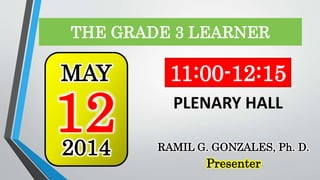
THE GRADE 3 LEARNER
12
MAY
2014
11:00-12:15
RAMIL G. GONZALES, Ph. D.
Presenter
PLENARY HALL
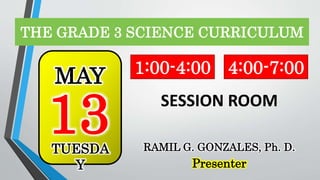
THE GRADE 3 SCIENCE CURRICULUM
13
MAY
TUESDA
Y
1:00-4:00
RAMIL G. GONZALES, Ph. D.
Presenter
4:00-7:00
SESSION ROOM
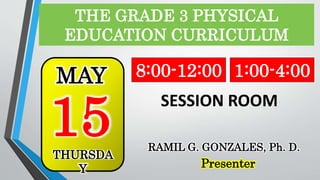
THE GRADE 3 PHYSICAL
EDUCATION CURRICULUM
15
MAY
THURSDA
Y
RAMIL G. GONZALES, Ph. D.
Presenter
8:00-12:00 1:00-4:00
SESSION ROOM
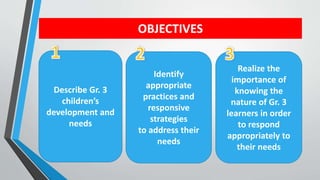
OBJECTIVES
Describe Gr. 3
children’s
development and
needs
Identify
appropriate
practices and
responsive
strategies
to address their
needs
Realize the
importance of
knowing the
nature of Gr. 3
learners in order
to respond
appropriately to
their needs
1 2 3
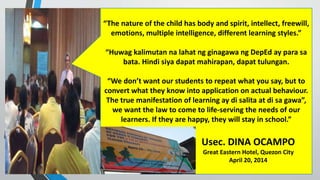
“The nature of the child has body and spirit, intellect, freewill,
emotions, multiple intelligence, different learning styles.”
“Huwag kalimutan na lahat ng ginagawa ng DepEd ay para sa
bata. Hindi siya dapat mahirapan, dapat tulungan.
“We don’t want our students to repeat what you say, but to
convert what they know into application on actual behaviour.
The true manifestation of learning ay di salita at di sa gawa”,
we want the law to come to life-serving the needs of our
learners. If they are happy, they will stay in school.”
Usec. DINA OCAMPO
Great Eastern Hotel, Quezon City
April 20, 2014
How well do we know our Grade 3 learners?
. . . will help us deepen our understanding of the
Gr. 3 learners and how knowing them can ensure a
positive learning climate.
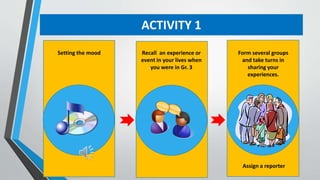
ACTIVITY 1
Form several groups
and take turns in
sharing your
experiences.
Assign a reporter
Recall an experience or
event in your lives when
you were in Gr. 3
Setting the mood
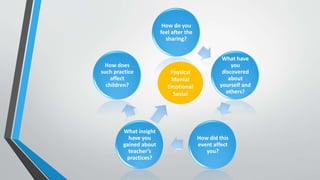
How do you
feel after the
sharing?
What have
you
discovered
about
yourself and
others?
How did this
event affect
you?
What insight
have you
gained about
teacher’s
practices?
How does
such practice
affect
children?
Physical
Mental
Emotional
Social
RA 10410 or the “Early Years Act “ (EYA)
(Approved in March 2013)
• Declared the policy of the State to promote the rights of
children to survival, development and special protection with
full recognition of the nature of childhood and as well as the
need to provide developmentally appropriate experiences to
address their needs
• Support parents in their roles as primary caregivers and as
their children’s first teachers.
• Further, the State hereby recognizes the age from zero (0) to
eight (8) years as the first crucial stage of educational
development (SEC. 2.)
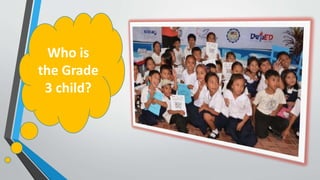
Who is
the Grade
3 child?
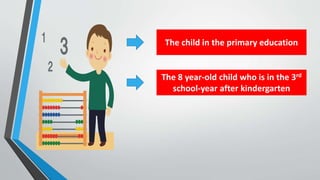
The child in the primary education
The 8 year-old child who is in the 3rd
school-year after kindergarten
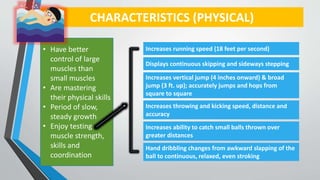
CHARACTERISTICS (PHYSICAL)
• Have better
control of large
muscles than
small muscles
• Are mastering
their physical skills
• Period of slow,
steady growth
• Enjoy testing
muscle strength,
skills and
coordination
Increases running speed (18 feet per second)
Displays continuous skipping and sideways stepping
Increases vertical jump (4 inches onward) & broad
jump (3 ft. up); accurately jumps and hops from
square to square
Increases throwing and kicking speed, distance and
accuracy
Increases ability to catch small balls thrown over
greater distances
Hand dribbling changes from awkward slapping of the
ball to continuous, relaxed, even stroking
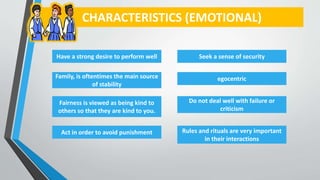
CHARACTERISTICS (EMOTIONAL)
Have a strong desire to perform well
Family, is oftentimes the main source
of stability
Fairness is viewed as being kind to
others so that they are kind to you.
Act in order to avoid punishment
Seek a sense of security
egocentric
Do not deal well with failure or
criticism
Rules and rituals are very important
in their interactions
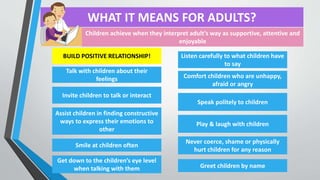
WHAT IT MEANS FOR ADULTS?
Greet children by name
Talk with children about their
feelings
Invite children to talk or interact
Assist children in finding constructive
ways to express their emotions to
other
Smile at children often
Get down to the children’s eye level
when talking with them
Listen carefully to what children have
to say
Comfort children who are unhappy,
afraid or angry
Speak politely to children
Play & laugh with children
Never coerce, shame or physically
hurt children for any reason
Children achieve when they interpret adult’s way as supportive, attentive and
enjoyable
BUILD POSITIVE RELATIONSHIP!
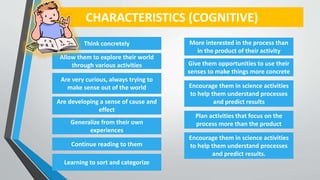
CHARACTERISTICS (COGNITIVE)
Think concretely
Allow them to explore their world
through various activities
Are very curious, always trying to
make sense out of the world
Are developing a sense of cause and
effect
Generalize from their own
experiences
Continue reading to them
Learning to sort and categorize
More interested in the process than
in the product of their activity
Give them opportunities to use their
senses to make things more concrete
Encourage them in science activities
to help them understand processes
and predict results
Plan activities that focus on the
process more than the product
Encourage them in science activities
to help them understand processes
and predict results.
Children development is influenced in variation, by
cultural, linguistic and/or family background- (MTB)
A teacher has “on his/her hand” the
chance to teach each child. Whatever
happens to his/her classroom will
influence the future of his/her individual
student for life
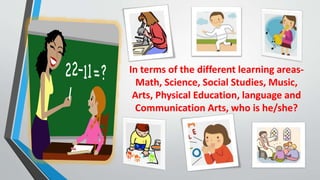
In terms of the different learning areas-
Math, Science, Social Studies, Music,
Arts, Physical Education, language and
Communication Arts, who is he/she?
. . . . WE CAN DEFINE THE GRADE 3 CHILD WITH WHAT
HE/SHE SHOULD BE ABLE TO KNOW AND, TO DO
. . . . .THROUGH IDENTIFYING THE COMPETENCIES
THEY NEED TO MASTER
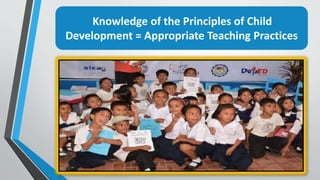
Knowledge of the Principles of Child
Development = Appropriate Teaching Practices
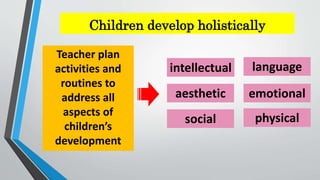
Children develop holistically
Teacher plan
activities and
routines to
address all
aspects of
children’s
development
intellectual language
aesthetic emotional
social physical
Child development follows an
orderly sequence
Teachers think about developmental sequence in
figuring out what next steps will appropriately
challenge children as well as what may not be quite
reasonable to expect now
Children develop at varying rates
Teacher plan activities with multiple learning
objectives to address the wide range of
development represented in class
Daily schedule gives children opportunities to
pursue activities at their own pace
Children learn best when they feel safe &
secure
Teacher develops close, nurturing relationship with
children
Changes in routine are explained in advance so
children can anticipate what will happen
There is 2-way communication between the teacher
and families, and families are welcome in school
Children are active learners
They can move about the room freely most
of the day.
Inactive segments of the day are kept short.
Children learn through a combination of
physical experience, social experience
and reflection
Teacher encourages children to explore and
experiment, pose questions, offer information and
challenge children’s thinking
Provides opportunities to interact with peers and
chance to document and reflect on their ideas
Children learn through mastery and challenge
Teacher helps children figure out alternative
approaches when the task at hand is beyond
children’s current capabilities
Children are allowed to engage in activities within or
slightly beyond their ability to master
Children learn through play
Teacher provide opportunities for children to play on
their own with others; indoor or outdoor; with
natural and manufactured materials
They are joyful and playful as they interact with
children, they enhance children’s play either as
observer or as participants
Recall a particular event or situation
where you did not consider the
child’s needs.
Write specific action/steps on
how you will approach the
situation properly.
MARAMING
SALAMAT
PO !
RAMIL G. GONZALES, Ph. D.
Presenter
K12

K 12- The Grade III Learner

  • 1.
  • 2.
    DIVISION GRADE 3TRAINING OF TEACHERS ON THE K to 12 ENHANCED BASIC EDUCATION CURRICULUM 2014MAY 12-16 DEPARTMENT OF EDUCATION, OLONGAPO CITY
  • 3.
    THE GRADE 3LEARNER 12 MAY 2014 11:00-12:15 RAMIL G. GONZALES, Ph. D. Presenter PLENARY HALL
  • 4.
    THE GRADE 3SCIENCE CURRICULUM 13 MAY TUESDA Y 1:00-4:00 RAMIL G. GONZALES, Ph. D. Presenter 4:00-7:00 SESSION ROOM
  • 5.
    THE GRADE 3PHYSICAL EDUCATION CURRICULUM 15 MAY THURSDA Y RAMIL G. GONZALES, Ph. D. Presenter 8:00-12:00 1:00-4:00 SESSION ROOM
  • 6.
    OBJECTIVES Describe Gr. 3 children’s developmentand needs Identify appropriate practices and responsive strategies to address their needs Realize the importance of knowing the nature of Gr. 3 learners in order to respond appropriately to their needs 1 2 3
  • 7.
    “The nature ofthe child has body and spirit, intellect, freewill, emotions, multiple intelligence, different learning styles.” “Huwag kalimutan na lahat ng ginagawa ng DepEd ay para sa bata. Hindi siya dapat mahirapan, dapat tulungan. “We don’t want our students to repeat what you say, but to convert what they know into application on actual behaviour. The true manifestation of learning ay di salita at di sa gawa”, we want the law to come to life-serving the needs of our learners. If they are happy, they will stay in school.” Usec. DINA OCAMPO Great Eastern Hotel, Quezon City April 20, 2014
  • 8.
    How well dowe know our Grade 3 learners? . . . will help us deepen our understanding of the Gr. 3 learners and how knowing them can ensure a positive learning climate.
  • 9.
    ACTIVITY 1 Form severalgroups and take turns in sharing your experiences. Assign a reporter Recall an experience or event in your lives when you were in Gr. 3 Setting the mood
  • 10.
    How do you feelafter the sharing? What have you discovered about yourself and others? How did this event affect you? What insight have you gained about teacher’s practices? How does such practice affect children? Physical Mental Emotional Social
  • 11.
    RA 10410 orthe “Early Years Act “ (EYA) (Approved in March 2013) • Declared the policy of the State to promote the rights of children to survival, development and special protection with full recognition of the nature of childhood and as well as the need to provide developmentally appropriate experiences to address their needs • Support parents in their roles as primary caregivers and as their children’s first teachers. • Further, the State hereby recognizes the age from zero (0) to eight (8) years as the first crucial stage of educational development (SEC. 2.)
  • 12.
  • 13.
    The child inthe primary education The 8 year-old child who is in the 3rd school-year after kindergarten
  • 14.
    CHARACTERISTICS (PHYSICAL) • Havebetter control of large muscles than small muscles • Are mastering their physical skills • Period of slow, steady growth • Enjoy testing muscle strength, skills and coordination Increases running speed (18 feet per second) Displays continuous skipping and sideways stepping Increases vertical jump (4 inches onward) & broad jump (3 ft. up); accurately jumps and hops from square to square Increases throwing and kicking speed, distance and accuracy Increases ability to catch small balls thrown over greater distances Hand dribbling changes from awkward slapping of the ball to continuous, relaxed, even stroking
  • 15.
    CHARACTERISTICS (EMOTIONAL) Have astrong desire to perform well Family, is oftentimes the main source of stability Fairness is viewed as being kind to others so that they are kind to you. Act in order to avoid punishment Seek a sense of security egocentric Do not deal well with failure or criticism Rules and rituals are very important in their interactions
  • 16.
    WHAT IT MEANSFOR ADULTS? Greet children by name Talk with children about their feelings Invite children to talk or interact Assist children in finding constructive ways to express their emotions to other Smile at children often Get down to the children’s eye level when talking with them Listen carefully to what children have to say Comfort children who are unhappy, afraid or angry Speak politely to children Play & laugh with children Never coerce, shame or physically hurt children for any reason Children achieve when they interpret adult’s way as supportive, attentive and enjoyable BUILD POSITIVE RELATIONSHIP!
  • 17.
    CHARACTERISTICS (COGNITIVE) Think concretely Allowthem to explore their world through various activities Are very curious, always trying to make sense out of the world Are developing a sense of cause and effect Generalize from their own experiences Continue reading to them Learning to sort and categorize More interested in the process than in the product of their activity Give them opportunities to use their senses to make things more concrete Encourage them in science activities to help them understand processes and predict results Plan activities that focus on the process more than the product Encourage them in science activities to help them understand processes and predict results.
  • 18.
    Children development isinfluenced in variation, by cultural, linguistic and/or family background- (MTB) A teacher has “on his/her hand” the chance to teach each child. Whatever happens to his/her classroom will influence the future of his/her individual student for life
  • 19.
    In terms ofthe different learning areas- Math, Science, Social Studies, Music, Arts, Physical Education, language and Communication Arts, who is he/she?
  • 20.
    . . .. WE CAN DEFINE THE GRADE 3 CHILD WITH WHAT HE/SHE SHOULD BE ABLE TO KNOW AND, TO DO . . . . .THROUGH IDENTIFYING THE COMPETENCIES THEY NEED TO MASTER
  • 21.
    Knowledge of thePrinciples of Child Development = Appropriate Teaching Practices
  • 22.
    Children develop holistically Teacherplan activities and routines to address all aspects of children’s development intellectual language aesthetic emotional social physical
  • 23.
    Child development followsan orderly sequence Teachers think about developmental sequence in figuring out what next steps will appropriately challenge children as well as what may not be quite reasonable to expect now
  • 24.
    Children develop atvarying rates Teacher plan activities with multiple learning objectives to address the wide range of development represented in class Daily schedule gives children opportunities to pursue activities at their own pace
  • 25.
    Children learn bestwhen they feel safe & secure Teacher develops close, nurturing relationship with children Changes in routine are explained in advance so children can anticipate what will happen There is 2-way communication between the teacher and families, and families are welcome in school
  • 26.
    Children are activelearners They can move about the room freely most of the day. Inactive segments of the day are kept short.
  • 27.
    Children learn througha combination of physical experience, social experience and reflection Teacher encourages children to explore and experiment, pose questions, offer information and challenge children’s thinking Provides opportunities to interact with peers and chance to document and reflect on their ideas
  • 28.
    Children learn throughmastery and challenge Teacher helps children figure out alternative approaches when the task at hand is beyond children’s current capabilities Children are allowed to engage in activities within or slightly beyond their ability to master
  • 29.
    Children learn throughplay Teacher provide opportunities for children to play on their own with others; indoor or outdoor; with natural and manufactured materials They are joyful and playful as they interact with children, they enhance children’s play either as observer or as participants
  • 30.
    Recall a particularevent or situation where you did not consider the child’s needs. Write specific action/steps on how you will approach the situation properly.
  • 32.
    MARAMING SALAMAT PO ! RAMIL G.GONZALES, Ph. D. Presenter K12