Developed By:- 
1. Vimal Mangukiya (140940106058) 
Guided by:- 
1. Nishtha Delada 
2. Mona Hansoti
Index 
 Introduction 
What is Reading Fluency? 
 Good Reading Fluency 
 Types of Reading Fluency 
 Teacher’s Role in the process 
 Guideline for developing fluency
Introduction 
 Reading is the most important skill which reads to be developed by 
a learner. 
 The art of reading effectively is of immense values. 
We read to implore over knowledge and information 
We read to pass several academy and competitive examination. 
 Reading skills need to be taught with systematic approach and 
methods.
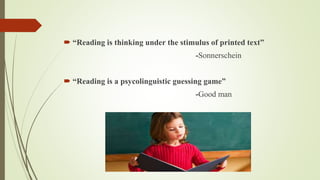
 “Reading is thinking under the stimulus of printed text” 
-Sonnerschein 
 “Reading is a psycolinguistic guessing game” 
-Good man
What is Reading Fluency? 
 Involves the ability to read text smoothly and at a reasonable rate. 
 Fluent readers read effortlessly 
1. Speed 
2. Accuracy 
3. Proper expression as though they are speaking 
 Automatically nature of reading 
 Fluent readers are able to focus on ideas in the text and comprehend 
the author’s message.
Good Reading Fluency 
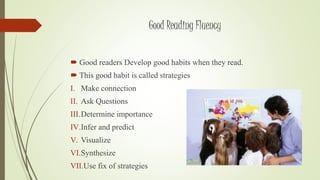
 Good readers Develop good habits when they read. 
 This good habit is called strategies 
I. Make connection 
II. Ask Questions 
III.Determine importance 
IV.Infer and predict 
V. Visualize 
VI.Synthesize 
VII.Use fix of strategies
Types of Reading Fluency 
 Skimming 
 Scanning 
 Sampling 
 Extensive reading 
 Intensive reading 
 Reading comprehension 
 Silent reading 
 Loud reading
 Skimming :- 
Reading from magazine articles and chapters from 
supplementary text book are called Skimming. 
 Scanning :- 
scanning is technique we often use when looking up a word 
telephone book or dictionary, we search for key word for ideas. 
 Sampling :- 
Sampling is a type of reading in which the reader reads together 
and sample the ideas together for a specific purpose.
 Extensive Reading :- 
This is define as a type of reading in a large quantity to research 
for specific information . 
 Intensive Reading:- 
This is one of type of Reading in which reader reads a sorter 
text thoroughly, vigorously and intensively to find out exact and 
specific information. 
 Reading Comprehension:- 
Francoise Grellet define reading comprehension as a type od 
reading in which reader read to understand a text .
 Loud Reading:- 
This is type of reading in which a reader reads the text loudly 
and articulation the sentences and words in the text. 
It define in two parts:- 
1.Aesthefic Reading 
2.Epharent Reading 
 silent Reading :- 
This is a type of reading in which reader reads the text silently 
and contemplates on the text without articulating the words and 
sentences in the text.
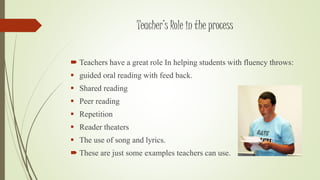
Teacher’s Role in the process 
 Teachers have a great role In helping students with fluency throws: 
 guided oral reading with feed back. 
 Shared reading 
 Peer reading 
 Repetition 
 Reader theaters 
 The use of song and lyrics. 
 These are just some examples teachers can use.
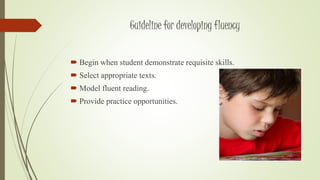
Guideline for developing fluency 
 Begin when student demonstrate requisite skills. 
 Select appropriate texts. 
 Model fluent reading. 
 Provide practice opportunities.
reading fluency

reading fluency

  • 1.
    Developed By:- 1.Vimal Mangukiya (140940106058) Guided by:- 1. Nishtha Delada 2. Mona Hansoti
  • 2.
    Index  Introduction What is Reading Fluency?  Good Reading Fluency  Types of Reading Fluency  Teacher’s Role in the process  Guideline for developing fluency
  • 3.
    Introduction  Readingis the most important skill which reads to be developed by a learner.  The art of reading effectively is of immense values. We read to implore over knowledge and information We read to pass several academy and competitive examination.  Reading skills need to be taught with systematic approach and methods.
  • 4.
     “Reading isthinking under the stimulus of printed text” -Sonnerschein  “Reading is a psycolinguistic guessing game” -Good man
  • 5.
    What is ReadingFluency?  Involves the ability to read text smoothly and at a reasonable rate.  Fluent readers read effortlessly 1. Speed 2. Accuracy 3. Proper expression as though they are speaking  Automatically nature of reading  Fluent readers are able to focus on ideas in the text and comprehend the author’s message.
  • 6.
    Good Reading Fluency  Good readers Develop good habits when they read.  This good habit is called strategies I. Make connection II. Ask Questions III.Determine importance IV.Infer and predict V. Visualize VI.Synthesize VII.Use fix of strategies
  • 7.
    Types of ReadingFluency  Skimming  Scanning  Sampling  Extensive reading  Intensive reading  Reading comprehension  Silent reading  Loud reading
  • 8.
     Skimming :- Reading from magazine articles and chapters from supplementary text book are called Skimming.  Scanning :- scanning is technique we often use when looking up a word telephone book or dictionary, we search for key word for ideas.  Sampling :- Sampling is a type of reading in which the reader reads together and sample the ideas together for a specific purpose.
  • 9.
     Extensive Reading:- This is define as a type of reading in a large quantity to research for specific information .  Intensive Reading:- This is one of type of Reading in which reader reads a sorter text thoroughly, vigorously and intensively to find out exact and specific information.  Reading Comprehension:- Francoise Grellet define reading comprehension as a type od reading in which reader read to understand a text .
  • 10.
     Loud Reading:- This is type of reading in which a reader reads the text loudly and articulation the sentences and words in the text. It define in two parts:- 1.Aesthefic Reading 2.Epharent Reading  silent Reading :- This is a type of reading in which reader reads the text silently and contemplates on the text without articulating the words and sentences in the text.
  • 11.
    Teacher’s Role inthe process  Teachers have a great role In helping students with fluency throws:  guided oral reading with feed back.  Shared reading  Peer reading  Repetition  Reader theaters  The use of song and lyrics.  These are just some examples teachers can use.
  • 12.
    Guideline for developingfluency  Begin when student demonstrate requisite skills.  Select appropriate texts.  Model fluent reading.  Provide practice opportunities.