Trends and Best Practices in Chinese Language
Assessment K-16 (K-16 中文测试信息及趋势 )
Lynn Thompson
Na Liu
Who we are


   Lynn Thompson, Research Associate,
    World Language Assessment Specialist


   Na Liu, Research Associate, Heritage
    Language research and Chinese language
    Assessment Specialist


                                             2
What is the Center for Applied Linguistics


   CAL’s mission is to improve communication
    through better understanding of language
    and culture
   We provide a comprehensive range of
    research-based information, tools, and
    resources related to language and culture


                                                3
Welcome!

Today we will:
2.Provide background on the Center for Applied
Linguistics 介绍应用语言学研究中心和测试
3.Define types and purposes of assessments 定义
  测试的类型及目的
4Describe innovative assessment resources for
K-16 students 介绍适合 K-16 学生的考试
4Respond to your questions! 回答问题!


                                                 4
Next:


4 Provide background on the Center for Applied
  Linguistics
4 Define types and purposes of assessments
4 Describe innovative assessment resources for
  K-16 students
  • Discuss how CAL’s efforts align with best practices in
    language assessment

4. Respond to your questions!


                                                             5
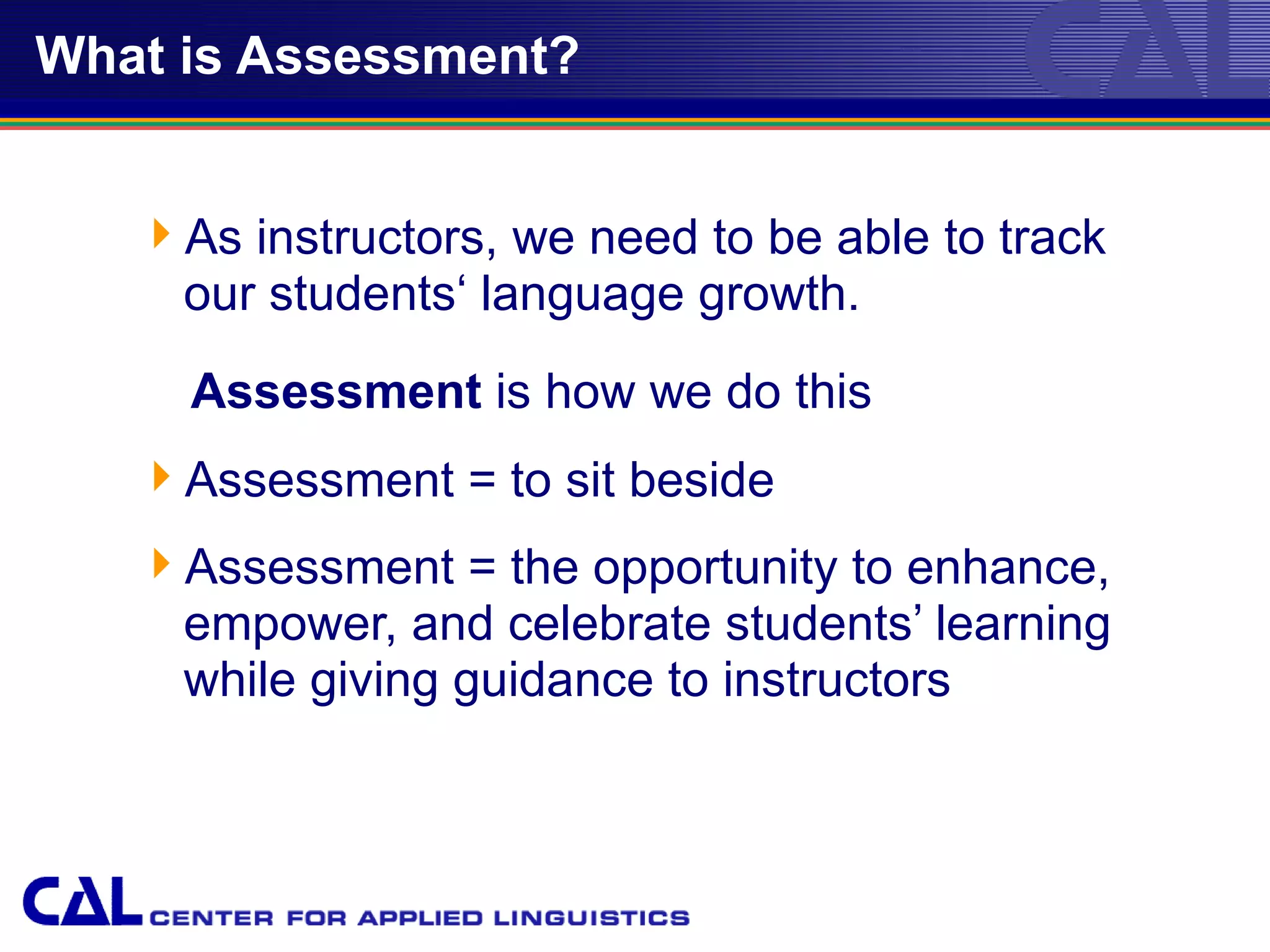
What is Assessment?


   As instructors, we need to be able to track
    our students‘ language growth.
     Assessment is how we do this
   Assessment = to sit beside
   Assessment = the opportunity to enhance,
    empower, and celebrate students’ learning
    while giving guidance to instructors
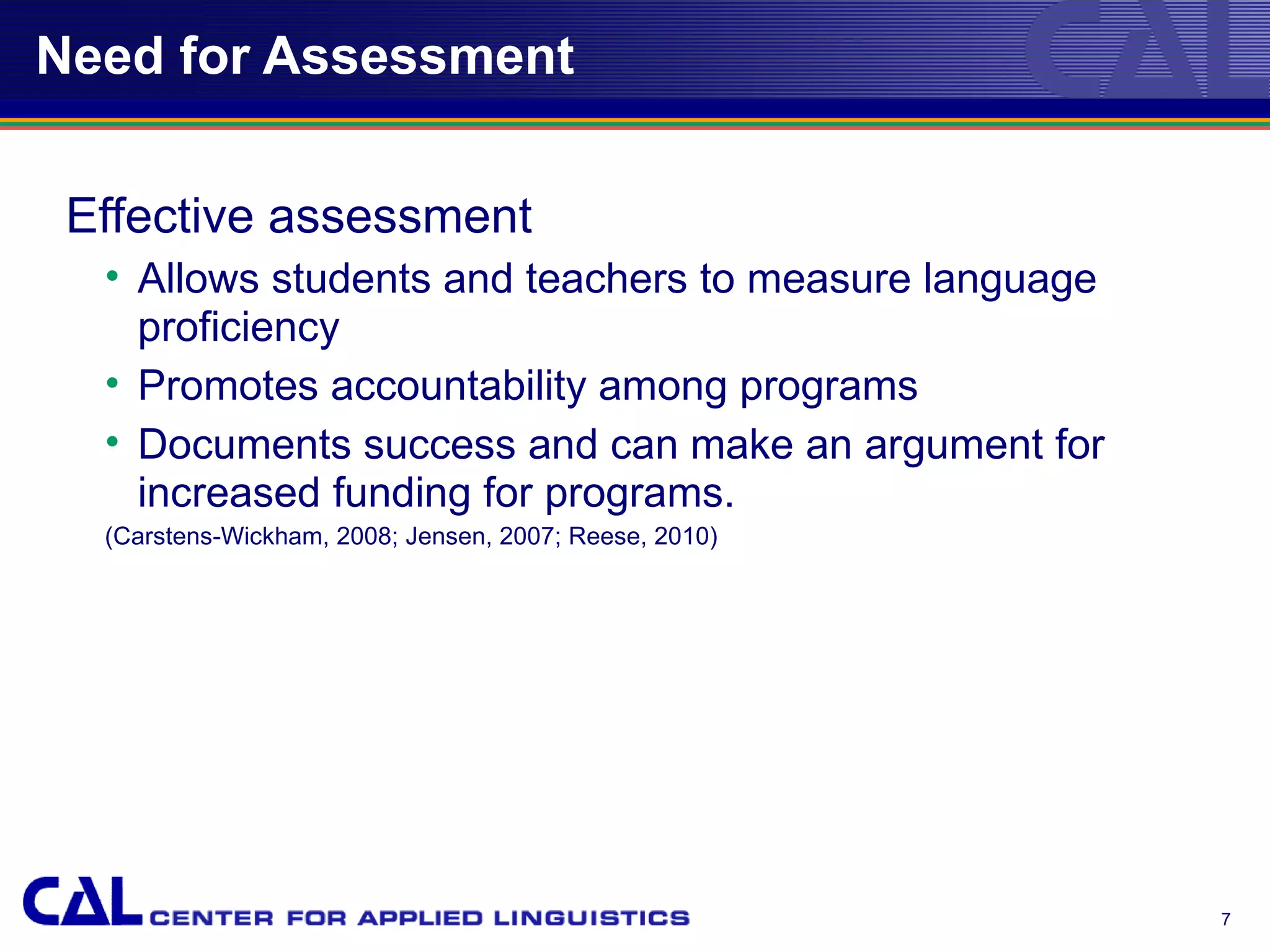
Need for Assessment


 Effective assessment
  • Allows students and teachers to measure language
    proficiency
  • Promotes accountability among programs
  • Documents success and can make an argument for
    increased funding for programs.
  (Carstens-Wickham, 2008; Jensen, 2007; Reese, 2010)


                                                        7
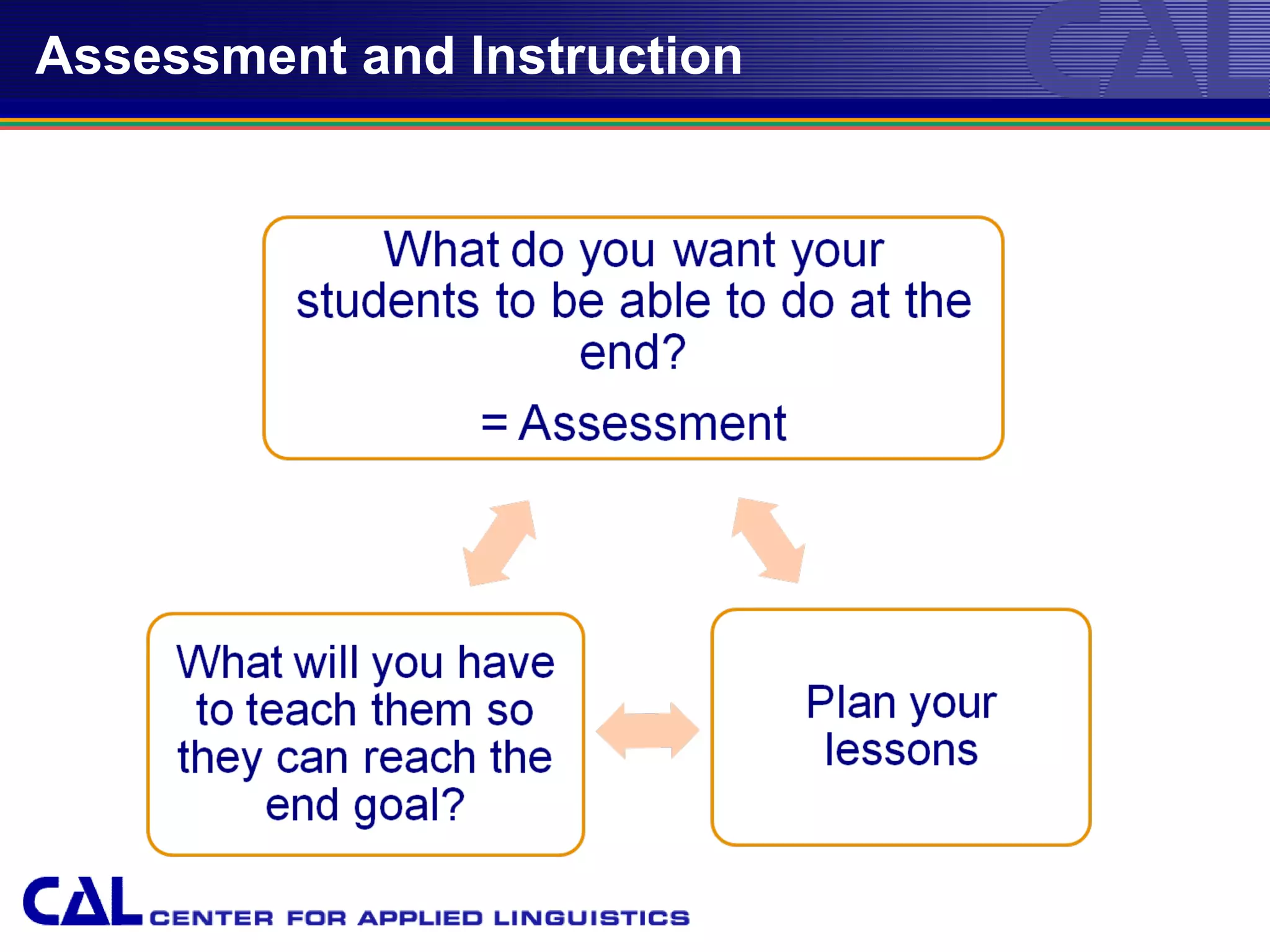
Assessment and Instruction
Types of Assessment


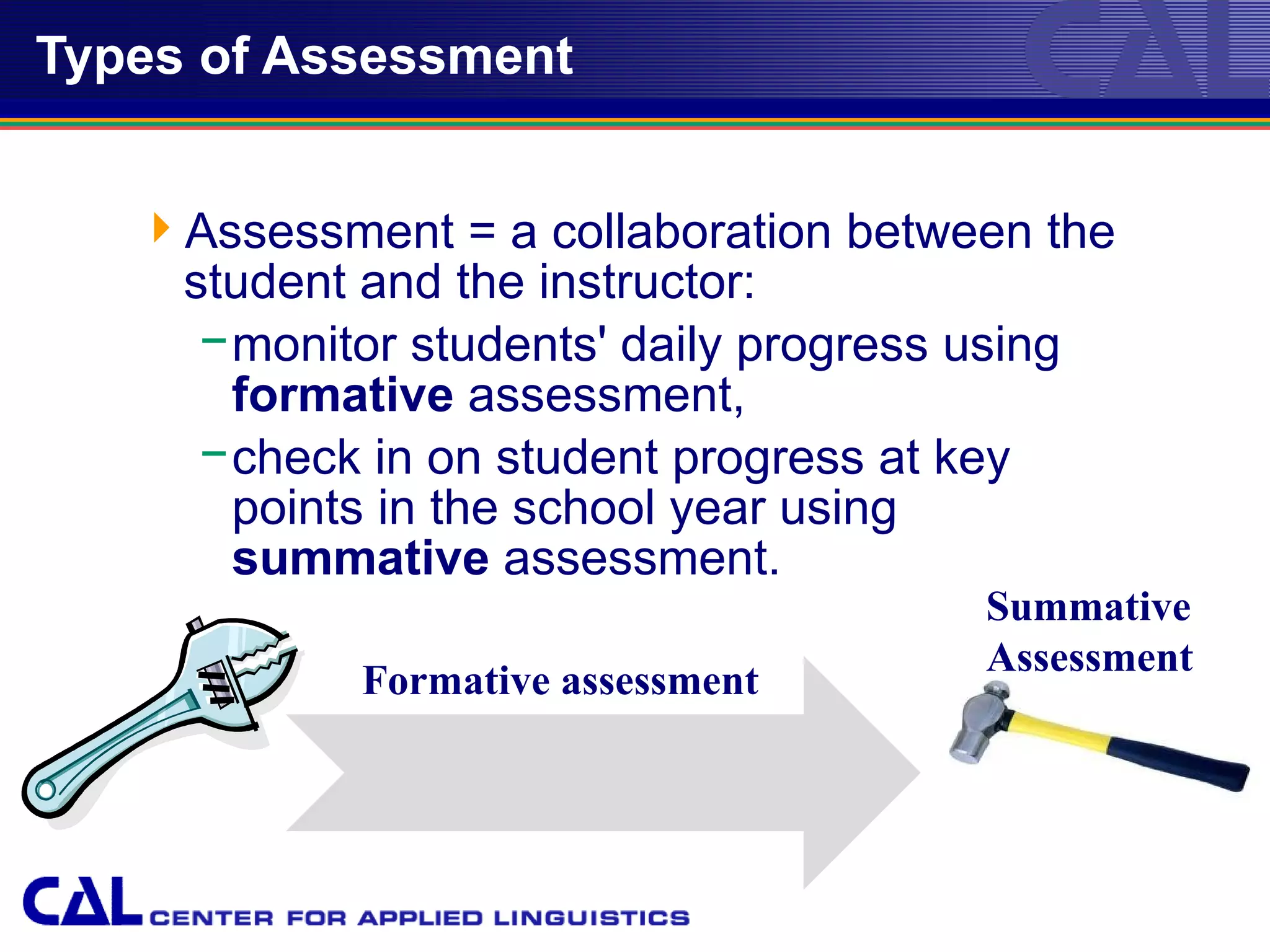
   Assessment = a collaboration between the
    student and the instructor:
     − monitor students' daily progress using
       formative assessment,
     − check in on student progress at key
       points in the school year using
       summative assessment.
                                       Summative
                                       Assessment
            Formative assessment
Formative Assessment


   Formative assessment
    − Used throughout the course of instruction
    − Provides feedback to the teacher,
      learner, or both about the learner's
      progress toward desired educational
      outcomes.
   The results of formative assessments are
    often used in planning subsequent
    instruction.
Summative Assessment

   Summative assessment
    − Generally conducted at the end of a unit
      or at the end of a sequence of units
    − Provides feedback to the teacher,
      learner, or both about the learner's
      progress towards meeting course goals
      or proficiency.
   Thinking of your assessment first helps you
    plan your unit(s), content, and activities that
    will build up to the assessment.
Summative Assessment


   What would a summative assessment for a
    unit on weather look like?
   What would you expect students to be able
    to do?
   What communicative mode(s)?
   How would you rate it?


                                                12
External Summative Assessment


   Why?
   Objective
   Comparative data
   Feedback to teacher/program
   Stakeholders


                                  13
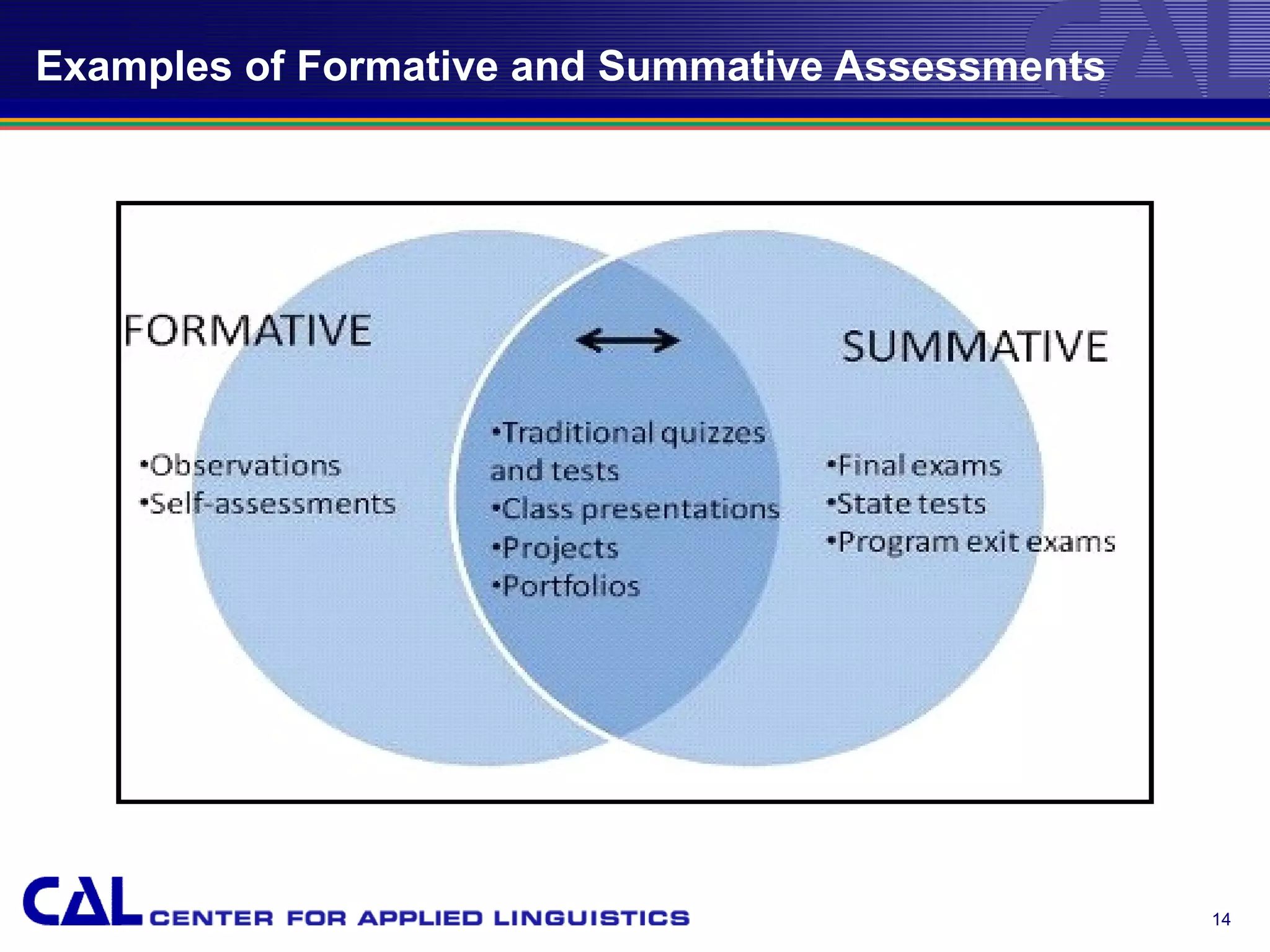
Examples of Formative and Summative Assessments


                                                  14
Audience Survey 1


   With which grade levels do you work?


   What kinds of language assessments do
    you use?


   What kinds of language assessments do
    you wish you had?


                                            15
Next:


4 Provide background on the Center for Applied
  Linguistics and assessment
4 Define types and purposes of assessments
4 Describe innovative assessment resources for
  K-16 students
4 Respond to your questions!


                                                 16
CAL assessment resources for all levels


   Foreign Language Assessment Directory
    (FLAD)
   Understanding Assessment: A Guide for
    Foreign Language Educators


                                            17
Foreign Language Assessment Directory

   Free, searchable directory of information
    on nearly 200 tests in over 90 languages
     • www.cal.org/flad
   Includes information of tests’
     •   Appropriate grade and proficiency levels
     •   Languages
     •   Skills targeted by a test
     •   Information about the test’s development;
     •   The publisher’s or developer’s contact
         information for further inquiries


                                                     18
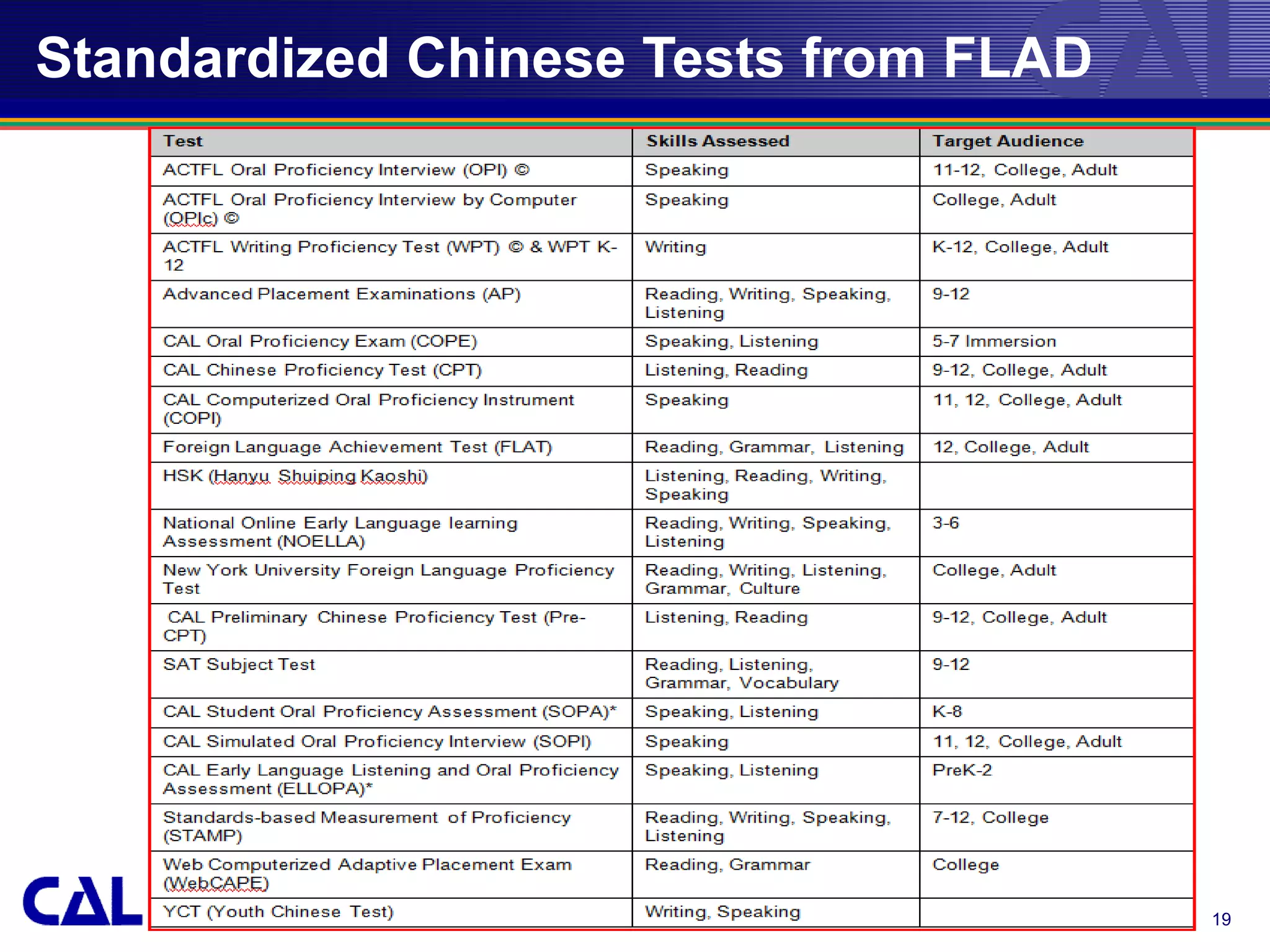
Standardized Chinese Tests from FLAD


                                       19
Understanding Assessment: A Guide for
Foreign Language Educators

    Free, online tutorial for language teachers
     and administrators working with all levels
    Introduces key concepts in language
     testing
    Provides overall guidance in
      • Test selection
      • Using test results


                                                   20
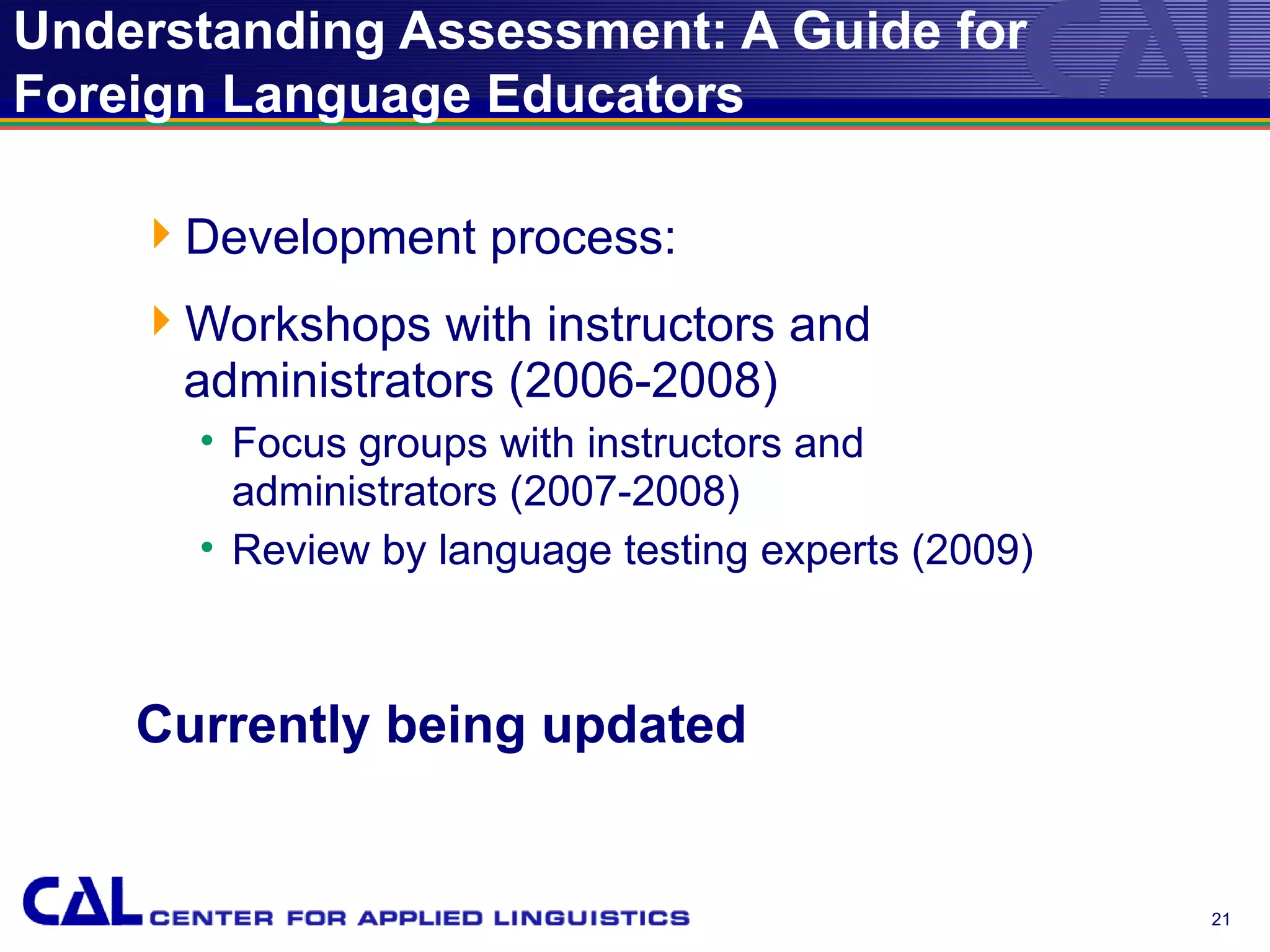
Understanding Assessment: A Guide for
Foreign Language Educators

    Development process:
    Workshops with instructors and
     administrators (2006-2008)
      • Focus groups with instructors and
        administrators (2007-2008)
      • Review by language testing experts (2009)


    Currently being updated


                                                    21
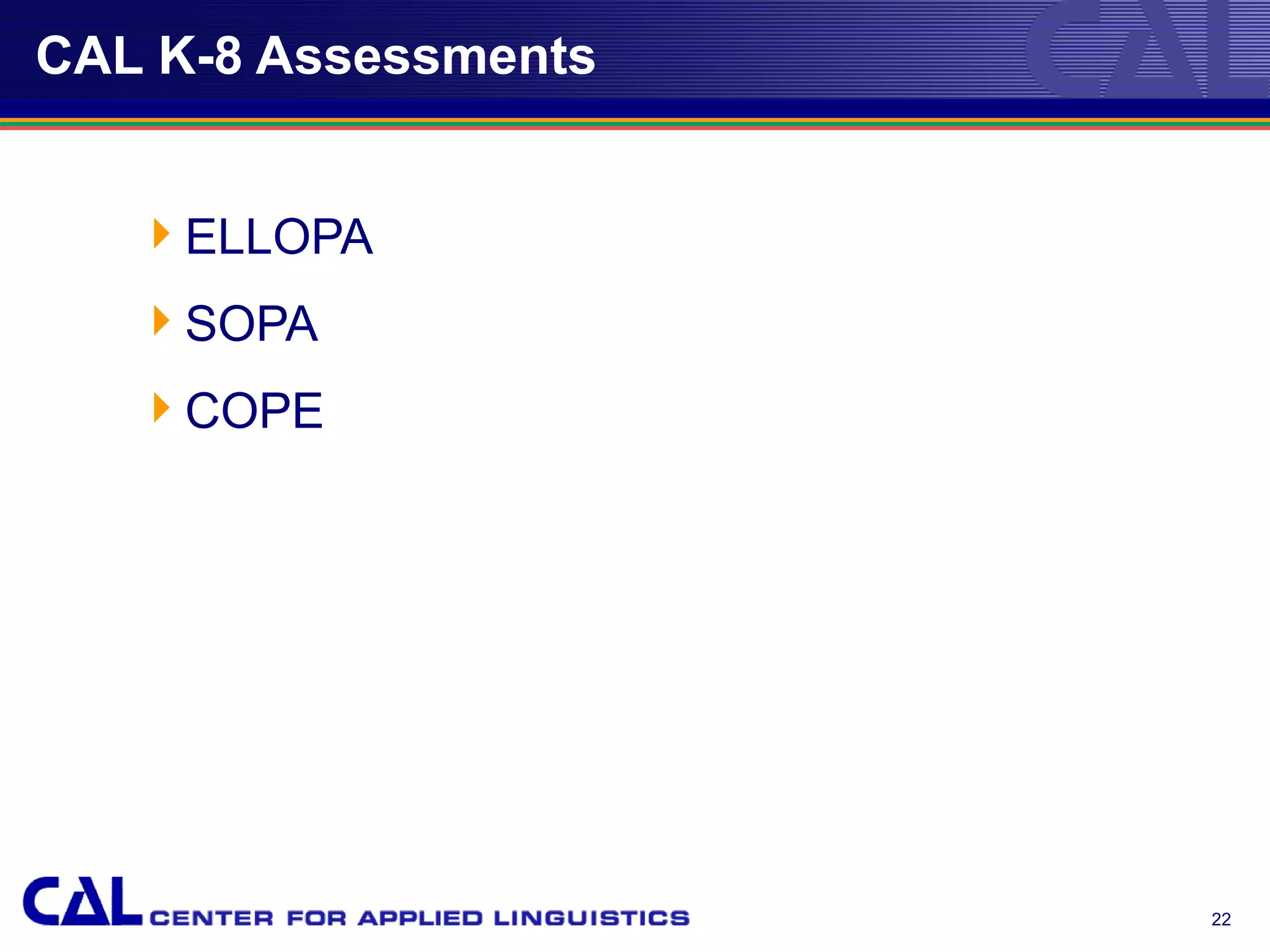
CAL K-8 Assessments


   ELLOPA
   SOPA
   COPE


                      22
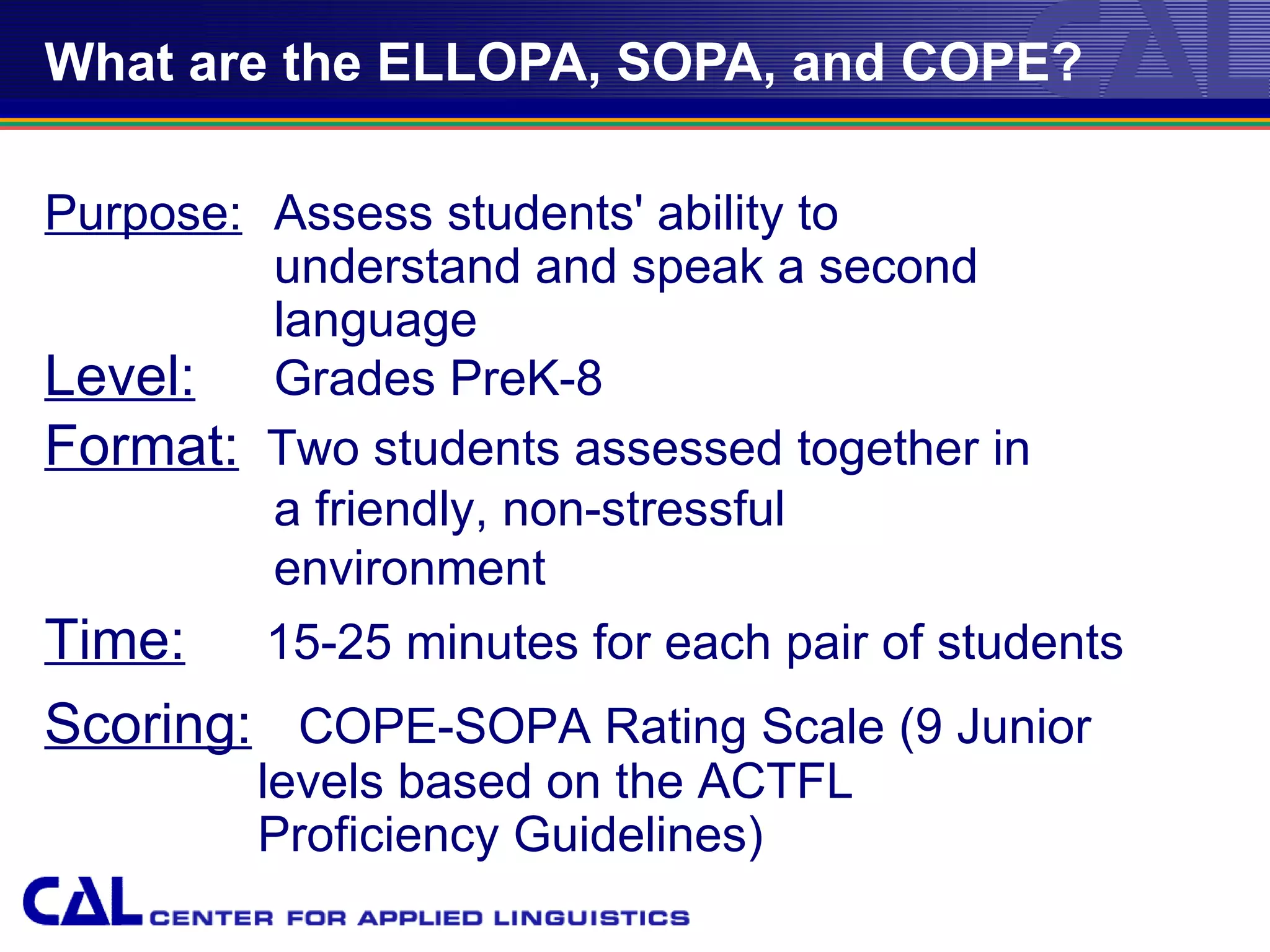
What are the ELLOPA, SOPA, and COPE?

Purpose: Assess students' ability to
         understand and speak a second
         language
Level: Grades PreK-8
Format: Two students assessed together in
         a friendly, non-stressful
         environment
Time: 15-25 minutes for each pair of students
Scoring: COPE-SOPA Rating Scale (9 Junior
        levels based on the ACTFL
        Proficiency Guidelines)
                       04/24/12
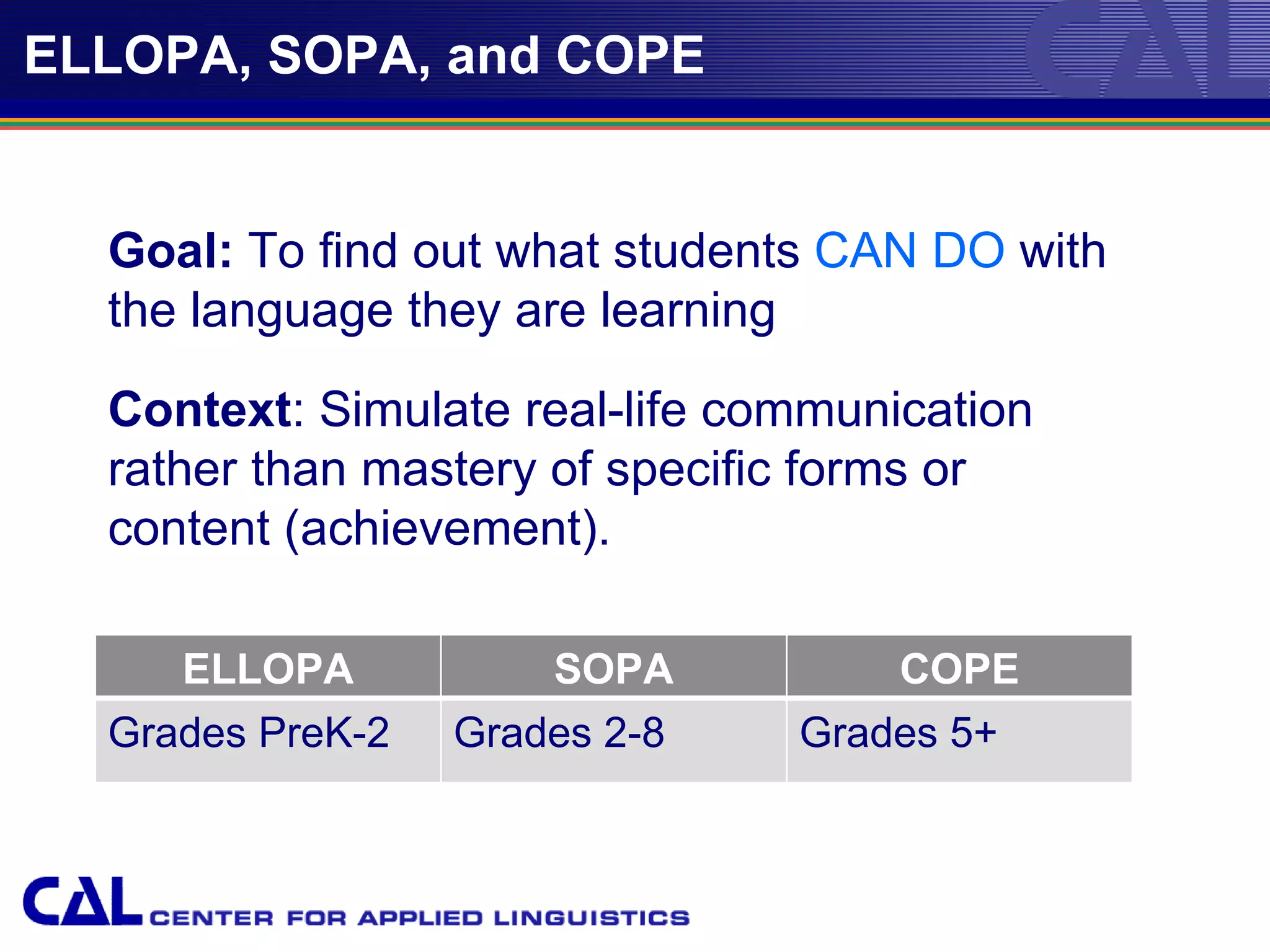
ELLOPA, SOPA, and COPE


  Goal: To find out what students CAN DO with
  the language they are learning

  Context: Simulate real-life communication
  rather than mastery of specific forms or
  content (achievement).

     ELLOPA           SOPA             COPE
  Grades PreK-2   Grades 2-8       Grades 5+


                        04/24/12
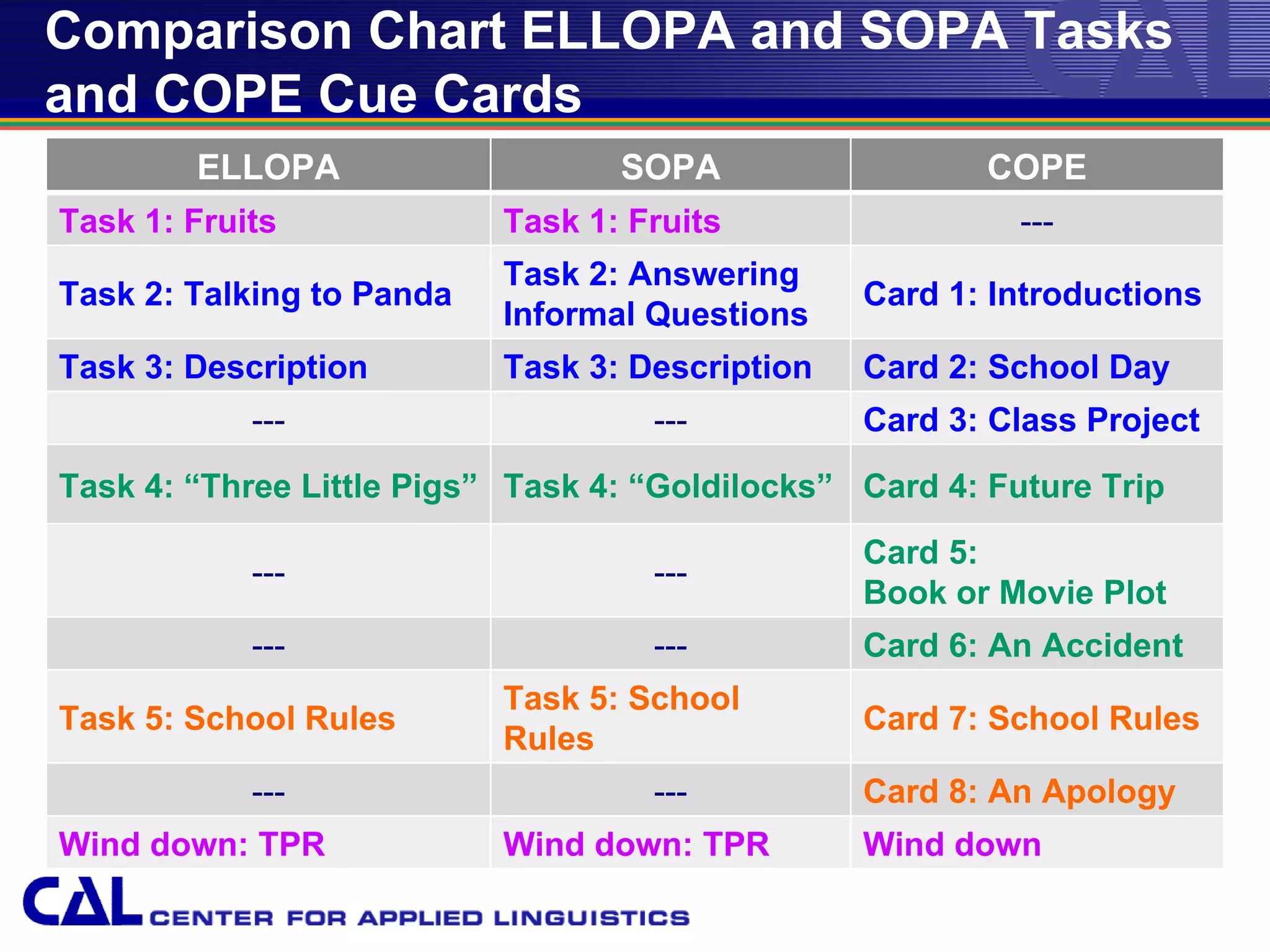
Comparison Chart ELLOPA and SOPA Tasks
and COPE Cue Cards
        ELLOPA                    SOPA                   COPE
Task 1: Fruits             Task 1: Fruits                  ---
                           Task 2: Answering
Task 2: Talking to Panda                         Card 1: Introductions
                           Informal Questions
Task 3: Description        Task 3: Description   Card 2: School Day
            ---                     ---          Card 3: Class Project
Task 4: “Three Little Pigs” Task 4: “Goldilocks” Card 4: Future Trip
                                                 Card 5:
            ---                     ---
                                                 Book or Movie Plot
            ---                     ---          Card 6: An Accident
                           Task 5: School
Task 5: School Rules                             Card 7: School Rules
                           Rules
            ---                     ---          Card 8: An Apology
Wind down: TPR             Wind down: TPR        Wind down
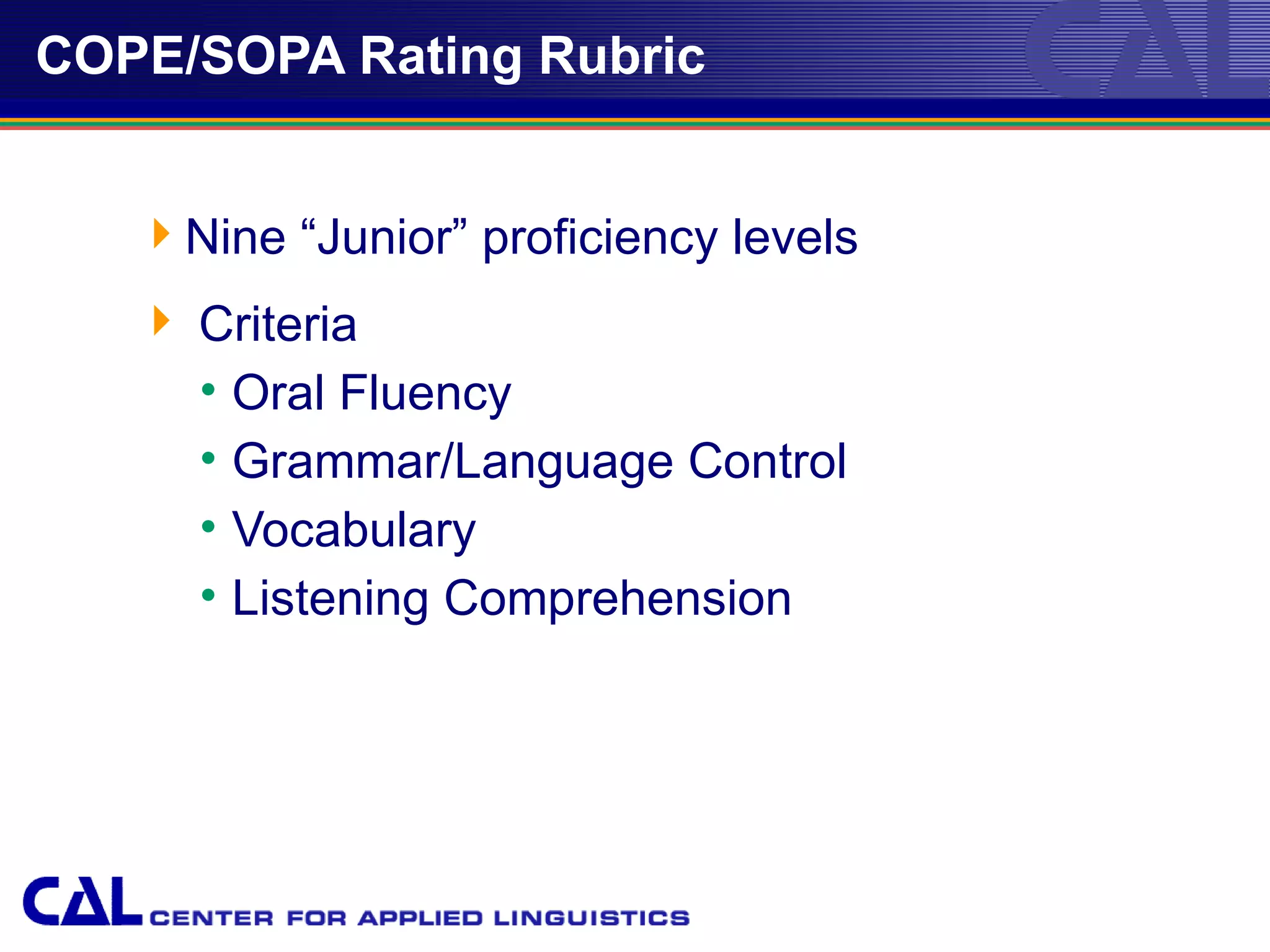
COPE/SOPA Rating Rubric


   Nine “Junior” proficiency levels
    Criteria
     • Oral Fluency
     • Grammar/Language Control
     • Vocabulary
     • Listening Comprehension


                                       26
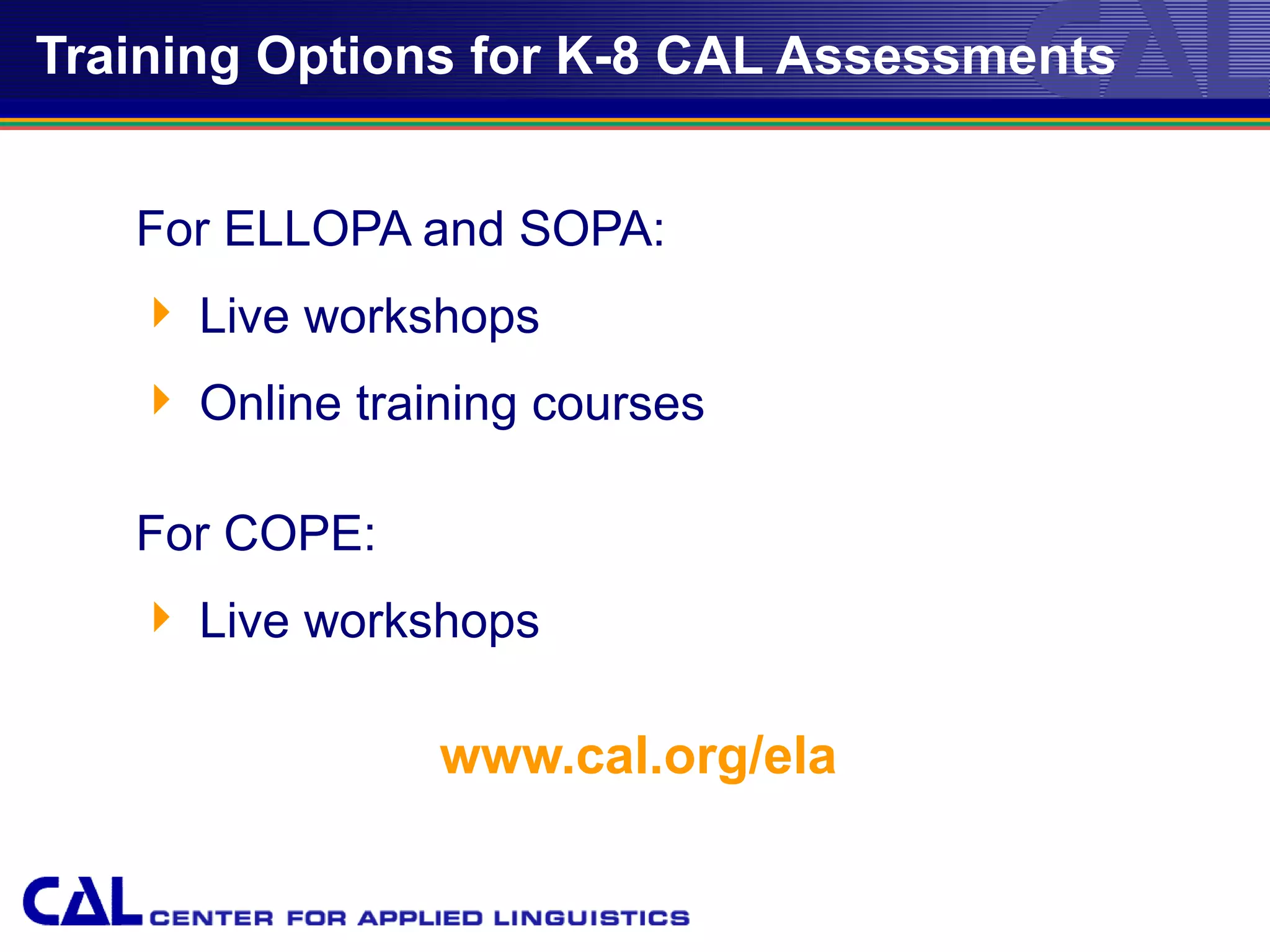
Training Options for K-8 CAL Assessments


   For ELLOPA and SOPA:
    Live workshops
    Online training courses

   For COPE:
    Live workshops

                www.cal.org/ela
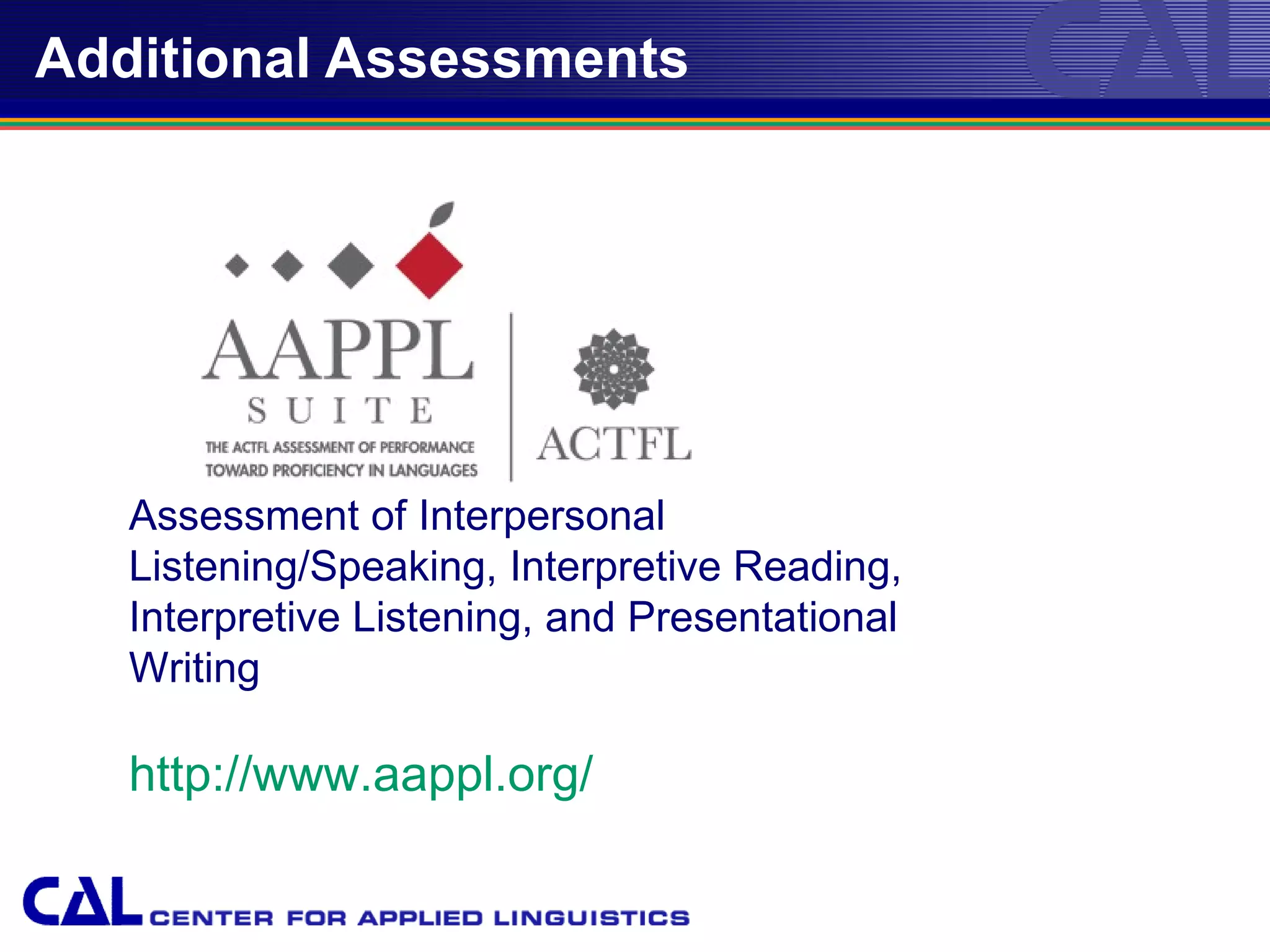
Additional Assessments


   Assessment of Interpersonal
   Listening/Speaking, Interpretive Reading,
   Interpretive Listening, and Presentational
   Writing

   http://www.aappl.org/
Additional Assessments


   NOELLA
   Online assessment of listening, reading,
    writing, and speaking
   Multiple-choice format for listening and
    reading
   Prompt for writing and speaking
   For more information: http://
    casls.uoregon.edu/pages/tools/noella.php


                                               29
Additional Assessments


   YCT (Youth Chinese Test)
   Consists of a writing and a speaking test
   For more information:
   http://english.hanban.org/node_8001.htm


                                                30
Resources available
for 9-16 students and teachers

   Computerized Oral Proficiency Instruments
   Self-access rater training materials for
    teachers and raters


                                                31
Computerized Oral Proficiency Instrument
(COPI)

    A computer-based, semi-adaptive test
    Currently being developed for Chinese
    Tests oral proficiency according to ACTFL
     Proficiency Guidelines – Speaking
     (Revised, 1999)
    Intended for use with native English-
     speaking students in later years of high
     school, college or adults


                                                 32
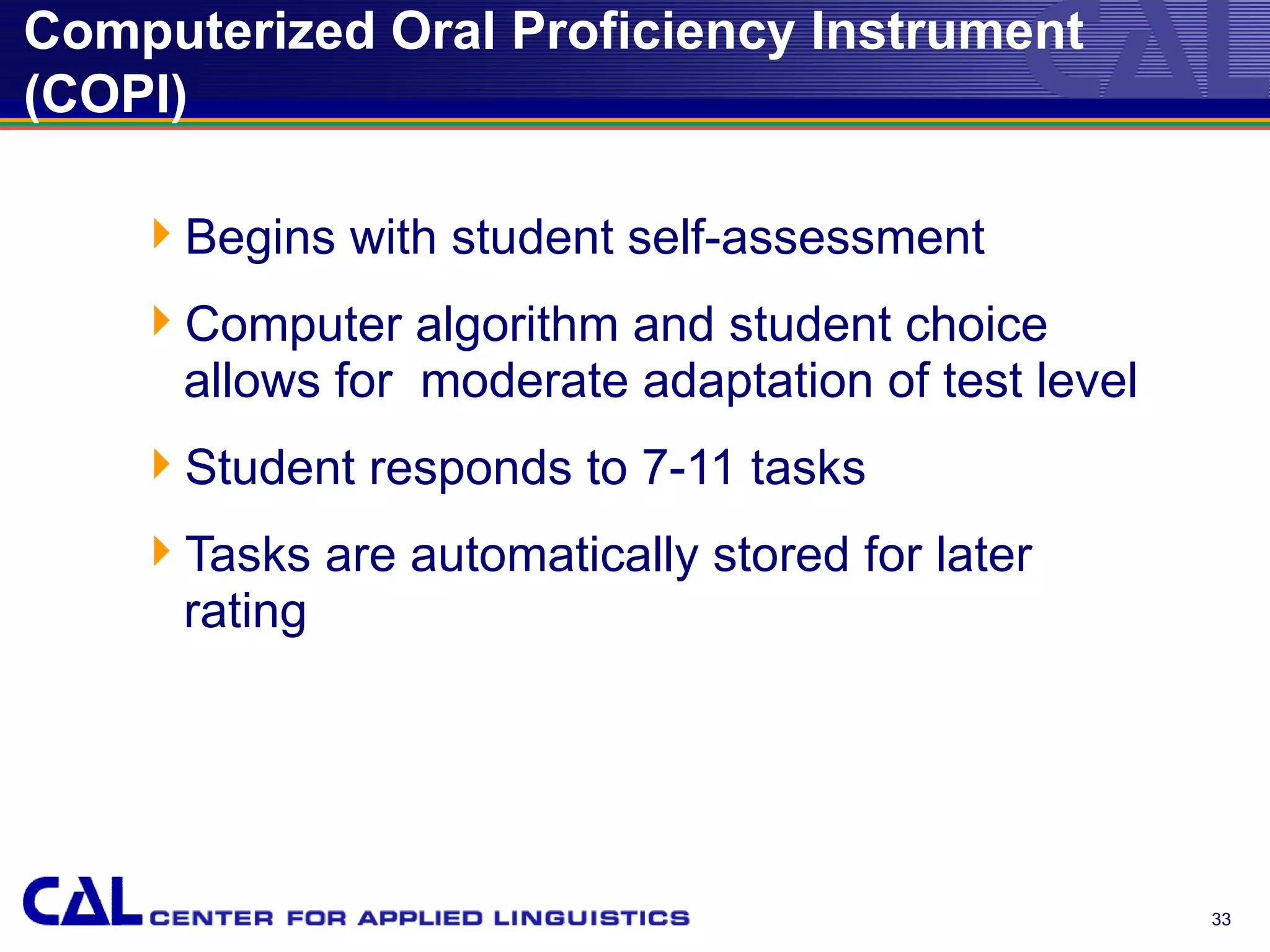
Computerized Oral Proficiency Instrument
(COPI)

    Begins with student self-assessment
    Computer algorithm and student choice
     allows for moderate adaptation of test level
    Student responds to 7-11 tasks
    Tasks are automatically stored for later
     rating


                                                    33
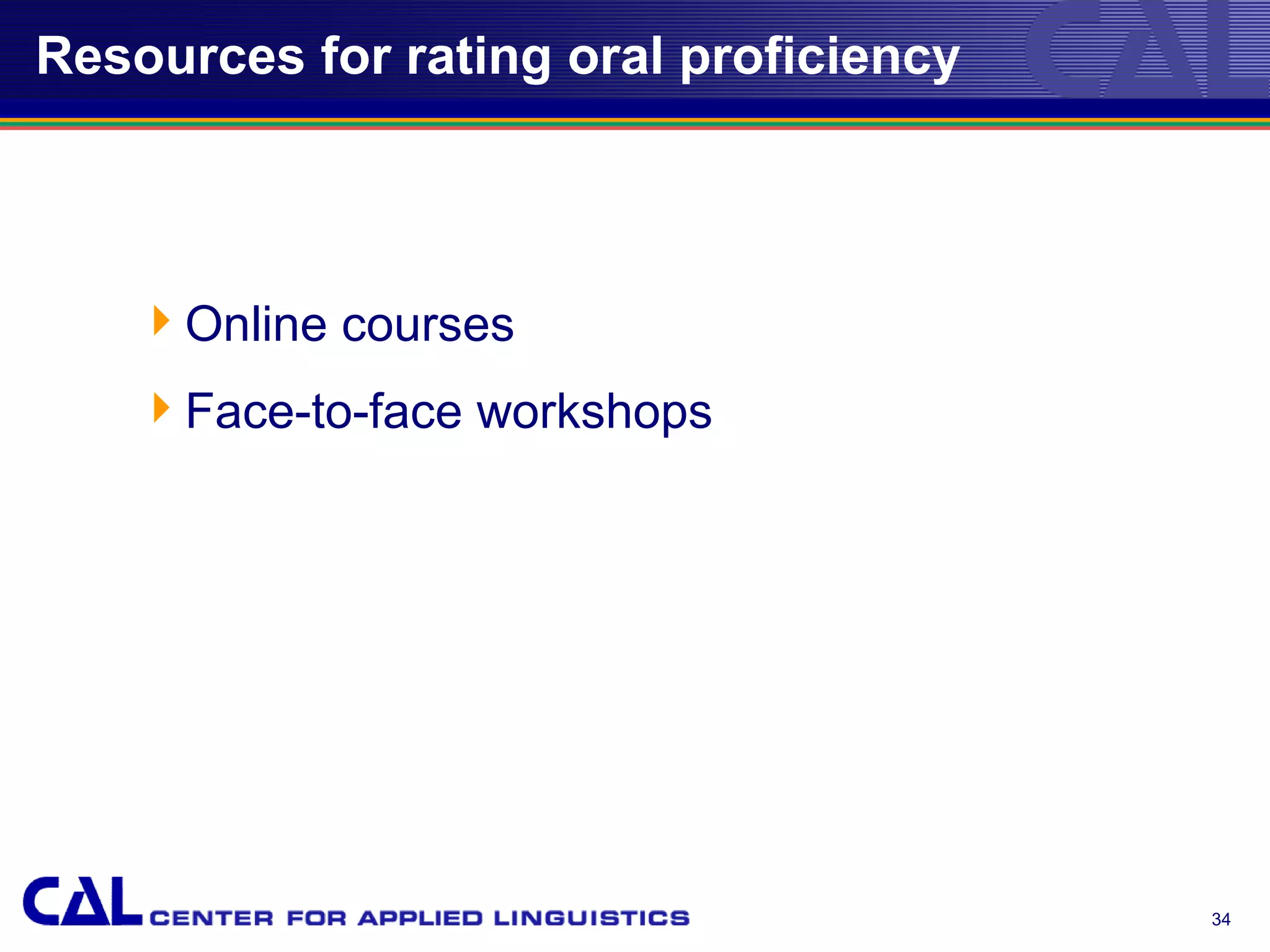
Resources for rating oral proficiency


    Online courses
    Face-to-face workshops


                                        34
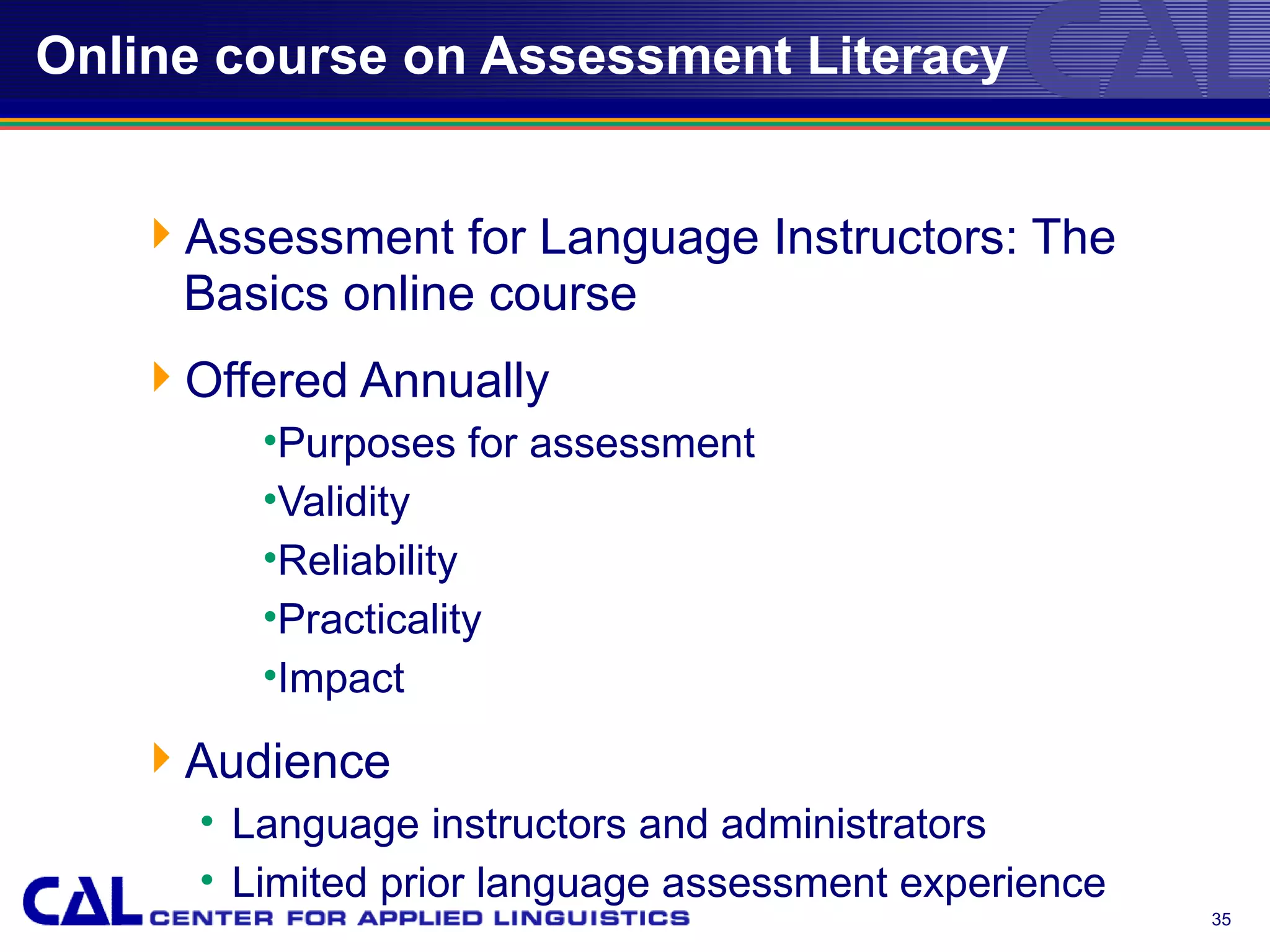
Online course on Assessment Literacy


   Assessment for Language Instructors: The
    Basics online course
   Offered Annually
         •Purposes for assessment
         •Validity
         •Reliability
         •Practicality
         •Impact
   Audience
      • Language instructors and administrators
      • Limited prior language assessment experience
                                                       35
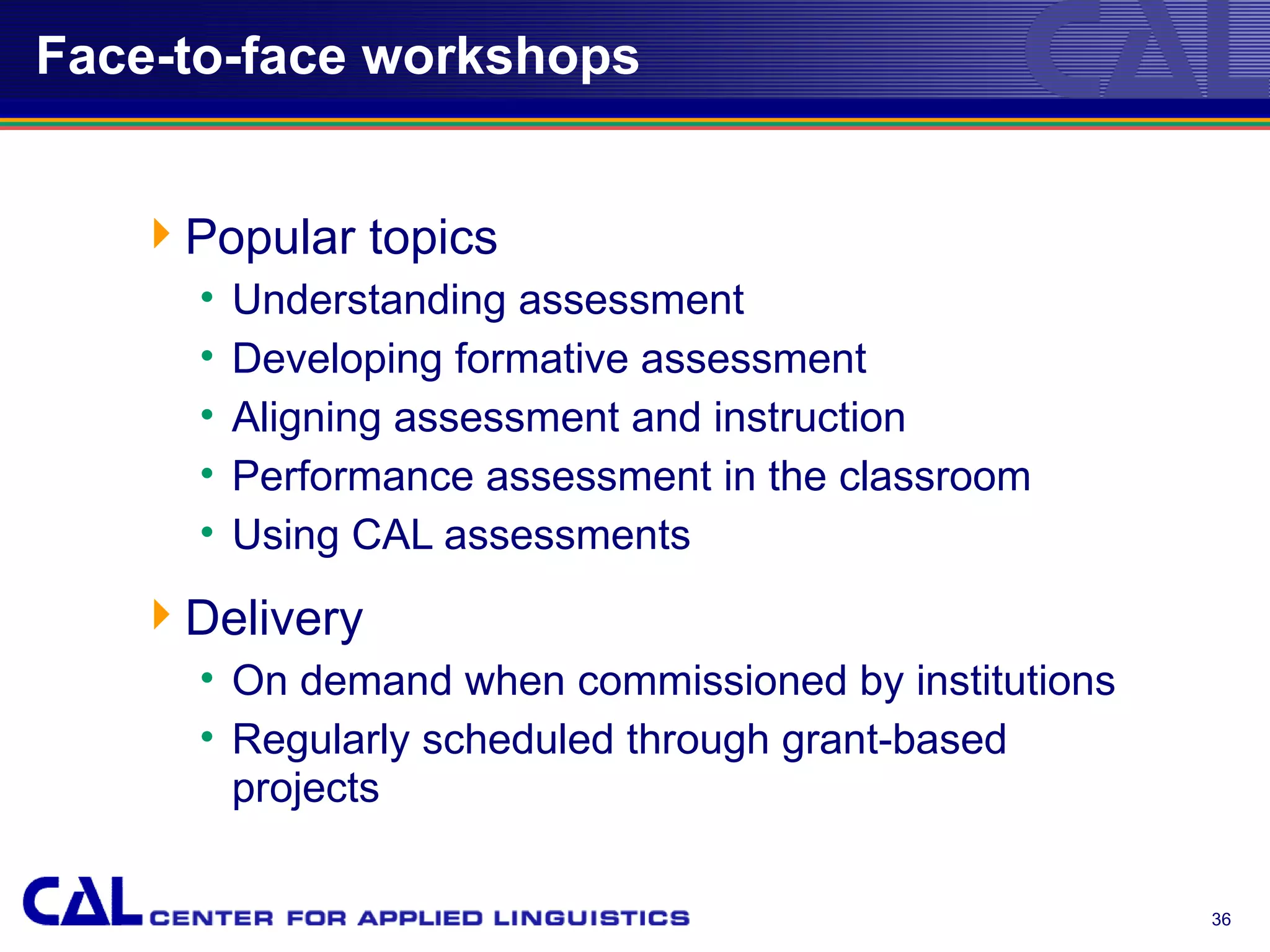
Face-to-face workshops


   Popular topics
     •   Understanding assessment
     •   Developing formative assessment
     •   Aligning assessment and instruction
     •   Performance assessment in the classroom
     •   Using CAL assessments
   Delivery
     • On demand when commissioned by institutions
     • Regularly scheduled through grant-based
       projects

                                                     36
Additional Assessments


   STAMP
   Computer-adaptive test that measures
    student proficiency with language
    according to Benchmark Levels 1 through 5
    which are related to ACTFL Performance
    Guidelines at the novice to intermediate
    levels (appropriate for Grade 7 and above)

     http://www.stamptest.net/stamp0708/stamp
     test/

                                                 37
HSK


  HSK (Basic): Listening, Grammar, and
   Reading
  HSK (Elementary-Intermediate): Listening,
   Grammar, Reading, and Comprehensive
  HSK (Advanced): Listening, Reading, and
   Comprehensive, with writing and speaking
  For more information: http://
   www.hsk.org.cn/index.aspx


                                               38
Resources


   Handout has online assessment
    resources and descriptions of our
    courses and workshops
   http://
    www.ecb.org/worldlanguageassessment
    /


   Contact Lynn Thompson
    lthompson@cal.org
                                          39
Thank You!


   Questions?
   Comments?


   Na Liu nliu@cal.org
   Lynn Thompson lthompson@cal.org
   Margaret E. Malone mmalone@cal.org


                                        40

Trends and best practices in chinese language assessment k–16

  • 1.
    Trends and BestPractices in Chinese Language Assessment K-16 (K-16 中文测试信息及趋势 ) Lynn Thompson Na Liu
  • 2.
    Who we are Lynn Thompson, Research Associate, World Language Assessment Specialist Na Liu, Research Associate, Heritage Language research and Chinese language Assessment Specialist 2
  • 3.
    What is theCenter for Applied Linguistics CAL’s mission is to improve communication through better understanding of language and culture We provide a comprehensive range of research-based information, tools, and resources related to language and culture 3
  • 4.
    Welcome! Today we will: 2.Providebackground on the Center for Applied Linguistics 介绍应用语言学研究中心和测试 3.Define types and purposes of assessments 定义 测试的类型及目的 4Describe innovative assessment resources for K-16 students 介绍适合 K-16 学生的考试 4Respond to your questions! 回答问题! 4
  • 5.
    Next: 4 Provide backgroundon the Center for Applied Linguistics 4 Define types and purposes of assessments 4 Describe innovative assessment resources for K-16 students • Discuss how CAL’s efforts align with best practices in language assessment 4. Respond to your questions! 5
  • 6.
    What is Assessment? As instructors, we need to be able to track our students‘ language growth. Assessment is how we do this Assessment = to sit beside Assessment = the opportunity to enhance, empower, and celebrate students’ learning while giving guidance to instructors
  • 7.
    Need for Assessment Effective assessment • Allows students and teachers to measure language proficiency • Promotes accountability among programs • Documents success and can make an argument for increased funding for programs. (Carstens-Wickham, 2008; Jensen, 2007; Reese, 2010) 7
  • 8.
  • 9.
    Types of Assessment Assessment = a collaboration between the student and the instructor: − monitor students' daily progress using formative assessment, − check in on student progress at key points in the school year using summative assessment. Summative Assessment Formative assessment
  • 10.
    Formative Assessment Formative assessment − Used throughout the course of instruction − Provides feedback to the teacher, learner, or both about the learner's progress toward desired educational outcomes. The results of formative assessments are often used in planning subsequent instruction.
  • 11.
    Summative Assessment Summative assessment − Generally conducted at the end of a unit or at the end of a sequence of units − Provides feedback to the teacher, learner, or both about the learner's progress towards meeting course goals or proficiency. Thinking of your assessment first helps you plan your unit(s), content, and activities that will build up to the assessment.
  • 12.
    Summative Assessment What would a summative assessment for a unit on weather look like? What would you expect students to be able to do? What communicative mode(s)? How would you rate it? 12
  • 13.
    External Summative Assessment Why? Objective Comparative data Feedback to teacher/program Stakeholders 13
  • 14.
    Examples of Formativeand Summative Assessments 14
  • 15.
    Audience Survey 1 With which grade levels do you work? What kinds of language assessments do you use? What kinds of language assessments do you wish you had? 15
  • 16.
    Next: 4 Provide backgroundon the Center for Applied Linguistics and assessment 4 Define types and purposes of assessments 4 Describe innovative assessment resources for K-16 students 4 Respond to your questions! 16
  • 17.
    CAL assessment resourcesfor all levels Foreign Language Assessment Directory (FLAD) Understanding Assessment: A Guide for Foreign Language Educators 17
  • 18.
    Foreign Language AssessmentDirectory Free, searchable directory of information on nearly 200 tests in over 90 languages • www.cal.org/flad Includes information of tests’ • Appropriate grade and proficiency levels • Languages • Skills targeted by a test • Information about the test’s development; • The publisher’s or developer’s contact information for further inquiries 18
  • 19.
  • 20.
    Understanding Assessment: AGuide for Foreign Language Educators Free, online tutorial for language teachers and administrators working with all levels Introduces key concepts in language testing Provides overall guidance in • Test selection • Using test results 20
  • 21.
    Understanding Assessment: AGuide for Foreign Language Educators Development process: Workshops with instructors and administrators (2006-2008) • Focus groups with instructors and administrators (2007-2008) • Review by language testing experts (2009) Currently being updated 21
  • 22.
    CAL K-8 Assessments ELLOPA SOPA COPE 22
  • 23.
    What are theELLOPA, SOPA, and COPE? Purpose: Assess students' ability to understand and speak a second language Level: Grades PreK-8 Format: Two students assessed together in a friendly, non-stressful environment Time: 15-25 minutes for each pair of students Scoring: COPE-SOPA Rating Scale (9 Junior levels based on the ACTFL Proficiency Guidelines) 04/24/12
  • 24.
    ELLOPA, SOPA, andCOPE Goal: To find out what students CAN DO with the language they are learning Context: Simulate real-life communication rather than mastery of specific forms or content (achievement). ELLOPA SOPA COPE Grades PreK-2 Grades 2-8 Grades 5+ 04/24/12
  • 25.
    Comparison Chart ELLOPAand SOPA Tasks and COPE Cue Cards ELLOPA SOPA COPE Task 1: Fruits Task 1: Fruits --- Task 2: Answering Task 2: Talking to Panda Card 1: Introductions Informal Questions Task 3: Description Task 3: Description Card 2: School Day --- --- Card 3: Class Project Task 4: “Three Little Pigs” Task 4: “Goldilocks” Card 4: Future Trip Card 5: --- --- Book or Movie Plot --- --- Card 6: An Accident Task 5: School Task 5: School Rules Card 7: School Rules Rules --- --- Card 8: An Apology Wind down: TPR Wind down: TPR Wind down
  • 26.
    COPE/SOPA Rating Rubric Nine “Junior” proficiency levels  Criteria • Oral Fluency • Grammar/Language Control • Vocabulary • Listening Comprehension 26
  • 27.
    Training Options forK-8 CAL Assessments For ELLOPA and SOPA:  Live workshops  Online training courses For COPE:  Live workshops www.cal.org/ela
  • 28.
    Additional Assessments Assessment of Interpersonal Listening/Speaking, Interpretive Reading, Interpretive Listening, and Presentational Writing http://www.aappl.org/
  • 29.
    Additional Assessments NOELLA Online assessment of listening, reading, writing, and speaking Multiple-choice format for listening and reading Prompt for writing and speaking For more information: http:// casls.uoregon.edu/pages/tools/noella.php 29
  • 30.
    Additional Assessments YCT (Youth Chinese Test) Consists of a writing and a speaking test For more information: http://english.hanban.org/node_8001.htm 30
  • 31.
    Resources available for 9-16students and teachers Computerized Oral Proficiency Instruments Self-access rater training materials for teachers and raters 31
  • 32.
    Computerized Oral ProficiencyInstrument (COPI) A computer-based, semi-adaptive test Currently being developed for Chinese Tests oral proficiency according to ACTFL Proficiency Guidelines – Speaking (Revised, 1999) Intended for use with native English- speaking students in later years of high school, college or adults 32
  • 33.
    Computerized Oral ProficiencyInstrument (COPI) Begins with student self-assessment Computer algorithm and student choice allows for moderate adaptation of test level Student responds to 7-11 tasks Tasks are automatically stored for later rating 33
  • 34.
    Resources for ratingoral proficiency Online courses Face-to-face workshops 34
  • 35.
    Online course onAssessment Literacy Assessment for Language Instructors: The Basics online course Offered Annually •Purposes for assessment •Validity •Reliability •Practicality •Impact Audience • Language instructors and administrators • Limited prior language assessment experience 35
  • 36.
    Face-to-face workshops Popular topics • Understanding assessment • Developing formative assessment • Aligning assessment and instruction • Performance assessment in the classroom • Using CAL assessments Delivery • On demand when commissioned by institutions • Regularly scheduled through grant-based projects 36
  • 37.
    Additional Assessments STAMP Computer-adaptive test that measures student proficiency with language according to Benchmark Levels 1 through 5 which are related to ACTFL Performance Guidelines at the novice to intermediate levels (appropriate for Grade 7 and above) http://www.stamptest.net/stamp0708/stamp test/ 37
  • 38.
    HSK HSK(Basic): Listening, Grammar, and Reading HSK (Elementary-Intermediate): Listening, Grammar, Reading, and Comprehensive HSK (Advanced): Listening, Reading, and Comprehensive, with writing and speaking For more information: http:// www.hsk.org.cn/index.aspx 38
  • 39.
    Resources Handout has online assessment resources and descriptions of our courses and workshops http:// www.ecb.org/worldlanguageassessment / Contact Lynn Thompson lthompson@cal.org 39
  • 40.
    Thank You! Questions? Comments? Na Liu nliu@cal.org Lynn Thompson lthompson@cal.org Margaret E. Malone mmalone@cal.org 40

Editor's Notes