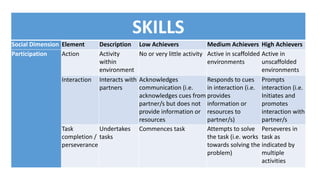
SKILLS
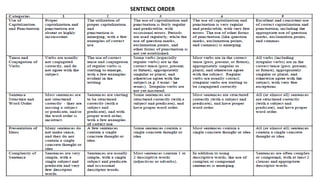
Social Dimension Element Description Low Achievers Medium Achievers High Achievers
Participation Action Activity
within
environment
No or very little activity Active in scaffolded
environments
Active in
unscaffolded
environments
Interaction Interacts with
partners
Acknowledges
communication (i.e.
acknowledges cues from
partner/s but does not
provide information or
resources
Responds to cues
in interaction (i.e.
provides
information or
resources to
partner/s)
Prompts
interaction (i.e.
Initiates and
promotes
interaction with
partner/s
Task
completion /
perseverance
Undertakes
tasks
Commences task Attempts to solve
the task (i.e. works
towards solving the
problem)
Perseveres in
task as
indicated by
multiple
activities
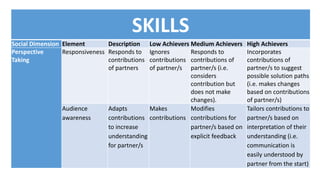
SKILLS
Social Dimension Element Description Low Achievers Medium Achievers High Achievers
Perspective
Taking
Responsiveness Responds to
contributions
of partners
Ignores
contributions
of partner/s
Responds to
contributions of
partner/s (i.e.
considers
contribution but
does not make
changes).
Incorporates
contributions of
partner/s to suggest
possible solution paths
(i.e. makes changes
based on contributions
of partner/s)
Audience
awareness
Adapts
contributions
to increase
understanding
for partner/s
Makes
contributions
Modifies
contributions for
partner/s based on
explicit feedback
Tailors contributions to
partner/s based on
interpretation of their
understanding (i.e.
communication is
easily understood by
partner from the start)
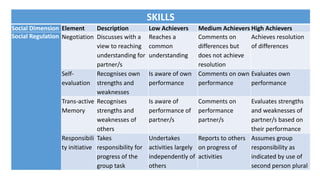
SKILLS
Social Dimension Element Description Low Achievers Medium Achievers High Achievers
Social Regulation Negotiation Discusses with a
view to reaching
understanding for
partner/s
Reaches a
common
understanding
Comments on
differences but
does not achieve
resolution
Achieves resolution
of differences
Self-
evaluation
Recognises own
strengths and
weaknesses
Is aware of own
performance
Comments on own
performance
Evaluates own
performance
Trans-active
Memory
Recognises
strengths and
weaknesses of
others
Is aware of
performance of
partner/s
Comments on
performance
partner/s
Evaluates strengths
and weaknesses of
partner/s based on
their performance
Responsibili
ty initiative
Takes
responsibility for
progress of the
group task
Undertakes
activities largely
independently of
others
Reports to others
on progress of
activities
Assumes group
responsibility as
indicated by use of
second person plural
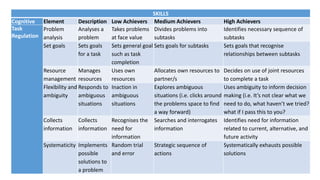
SKILLS
Cognitive Element Description Low Achievers Medium Achievers High Achievers
Task
Regulation
Problem
analysis
Analyses a
problem
Takes problems
at face value
Divides problems into
subtasks
Identifies necessary sequence of
subtasks
Set goals Sets goals
for a task
Sets general goal
such as task
completion
Sets goals for subtasks Sets goals that recognise
relationships between subtasks
Resource
management
Manages
resources
Uses own
resources
Allocates own resources to
partner/s
Decides on use of joint resources
to complete a task
Flexibility and
ambiguity
Responds to
ambiguous
situations
Inaction in
ambiguous
situations
Explores ambiguous
situations (i.e. clicks around
the problems space to find
a way forward)
Uses ambiguity to inform decision
making (i.e. It’s not clear what we
need to do, what haven’t we tried?
what if I pass this to you?
Collects
information
Collects
information
Recognises the
need for
information
Searches and interrogates
information
Identifies need for information
related to current, alternative, and
future activity
Systematicity Implements
possible
solutions to
a problem
Random trial
and error
Strategic sequence of
actions
Systematically exhausts possible
solutions
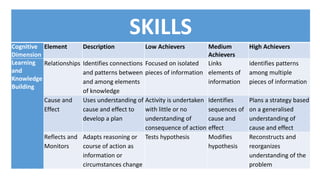
SKILLS
Cognitive
Dimension
Element Description Low Achievers Medium
Achievers
High Achievers
Learning
and
Knowledge
Building
Relationships Identifies connections
and patterns between
and among elements
of knowledge
Focused on isolated
pieces of information
Links
elements of
information
identifies patterns
among multiple
pieces of information
Cause and
Effect
Uses understanding of
cause and effect to
develop a plan
Activity is undertaken
with little or no
understanding of
consequence of action
Identifies
sequences of
cause and
effect
Plans a strategy based
on a generalised
understanding of
cause and effect
Reflects and
Monitors
Adapts reasoning or
course of action as
information or
circumstances change
Tests hypothesis Modifies
hypothesis
Reconstructs and
reorganizes
understanding of the
problem
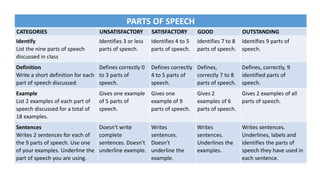
PARTS OF SPEECH
CATEGORIES UNSATISFACTORY SATISFACTORY GOOD OUTSTANDING
Identify
List the nine parts of speech
discussed in class
Identifies 3 or less
parts of speech.
Identifies 4 to 5
parts of speech.
Identifies 7 to 8
parts of speech.
Identifies 9 parts of
speech.
Definition
Write a short definition for each
part of speech discussed.
Defines correctly 0
to 3 parts of
speech.
Defines correctly
4 to 5 parts of
speech.
Defines,
correctly 7 to 8
parts of speech.
Defines, correctly, 9
identified parts of
speech.
Example
List 2 examples of each part of
speech discussed for a total of
18 examples.
Gives one example
of 5 parts of
speech.
Gives one
example of 9
parts of speech.
Gives 2
examples of 6
parts of speech.
Gives 2 examples of all
parts of speech.
Sentences
Writes 2 sentences for each of
the 9 parts of speech. Use one
of your examples. Underline the
part of speech you are using.
Doesn't write
complete
sentences. Doesn't
underline example.
Writes
sentences.
Doesn't
underline the
example.
Writes
sentences.
Underlines the
examples.
Writes sentences.
Underlines, labels and
identifies the parts of
speech they have used in
each sentence.
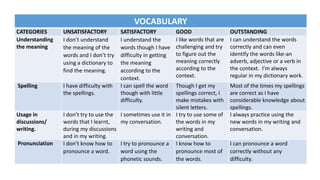
VOCABULARY
CATEGORIES UNSATISFACTORY SATISFACTORY GOOD OUTSTANDING
Understanding
the meaning
I don’t understand
the meaning of the
words and I don’t try
using a dictionary to
find the meaning.
I understand the
words though I have
difficulty in getting
the meaning
according to the
context.
I like words that are
challenging and try
to figure out the
meaning correctly
according to the
context.
I can understand the words
correctly and can even
identify the words like-an
adverb, adjective or a verb in
the context. I’m always
regular in my dictionary work.
Spelling I have difficulty with
the spellings.
I can spell the word
though with little
difficulty.
Though I get my
spellings correct, I
make mistakes with
silent letters.
Most of the times my spellings
are correct as I have
considerable knowledge about
spellings.
Usage in
discussions/
writing.
I don’t try to use the
words that I learnt,
during my discussions
and in my writing.
I sometimes use it in
my conversation.
I try to use some of
the words in my
writing and
conversation.
I always practice using the
new words in my writing and
conversation.
Pronunciation I don’t know how to
pronounce a word.
I try to pronounce a
word using the
phonetic sounds.
I know how to
pronounce most of
the words.
I can pronounce a word
correctly without any
difficulty.
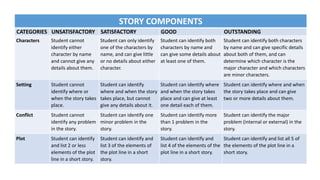
STORY COMPONENTS
CATEGORIES UNSATISFACTORY SATISFACTORY GOOD OUTSTANDING
Characters Student cannot
identify either
character by name
and cannot give any
details about them.
Student can only identify
one of the characters by
name, and can give little
or no details about either
character.
Student can identify both
characters by name and
can give some details about
at least one of them.
Student can identify both characters
by name and can give specific details
about both of them, and can
determine which character is the
major character and which characters
are minor characters.
Setting Student cannot
identify where or
when the story takes
place.
Student can identify
where and when the story
takes place, but cannot
give any details about it.
Student can identify where
and when the story takes
place and can give at least
one detail each of them.
Student can identify where and when
the story takes place and can give
two or more details about them.
Conflict Student cannot
identify any problem
in the story.
Student can identify one
minor problem in the
story.
Student can identify more
than 1 problem in the
story.
Student can identify the major
problem (internal or external) in the
story.
Plot Student can identify
and list 2 or less
elements of the plot
line in a short story.
Student can identify and
list 3 of the elements of
the plot line in a short
story.
Student can identify and
list 4 of the elements of the
plot line in a short story.
Student can identify and list all 5 of
the elements of the plot line in a
short story.
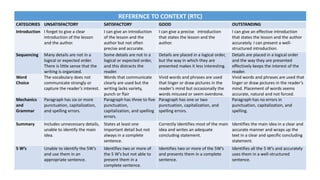
REFERENCE TO CONTEXT (RTC)
CATEGORIES UNSATISFACTORY SATISFACTORY GOOD OUTSTANDING
Introduction I forget to give a clear
introduction of the lesson
and the author.
I can give an introduction
of the lesson and the
author but not often
precise and accurate.
I can give a precise introduction
that states the lesson and the
author.
I can give an effective introduction
that states the lesson and the author
accurately. I can present a well-
structured introduction.
Sequencing Many details are not in a
logical or expected order.
There is little sense that the
writing is organized.
Some details are not in a
logical or expected order,
and this distracts the
reader.
Details are placed in a logical order,
but the way in which they are
presented makes it less interesting.
Details are placed in a logical order
and the way they are presented
effectively keeps the interest of the
reader.
Word
Choice
The vocabulary does not
communicate strongly or
capture the reader’s interest.
Words that communicate
clearly are used but the
writing lacks variety,
punch or flair
Vivid words and phrases are used
that linger or draw pictures in the
reader’s mind but occasionally the
words misused or seem overdone.
Vivid words and phrases are used that
linger or draw pictures in the reader’s
mind. Placement of words seems
accurate, natural and not forced.
Mechanics
and
Grammar
Paragraph has six or more
punctuation, capitalization,
and spelling errors.
Paragraph has three to five
punctuation,
capitalization, and spelling
errors.
Paragraph has one or two
punctuation, capitalization, and
spelling errors.
Paragraph has no errors in
punctuation, capitalization, and
spelling.
Summary Includes unnecessary details,
unable to identify the main
idea.
States at least one
important detail but not
always in a complete
sentence.
Correctly identifies most of the main
idea and writes an adequate
concluding statement.
Identifies the main idea in a clear and
accurate manner and wraps up the
text in a clear and specific concluding
statement.
5 W’s Unable to identify the 5W’s
and use them in an
appropriate sentence.
Identifies two or more of
the 5 W’s but not able to
present them in a
complete sentence.
Identifies two or more of the 5W’s
and presents them in a complete
sentence.
Identifies all the 5 W’s and accurately
uses them in a well-structured
sentence.
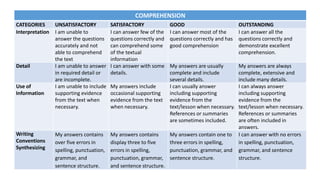
COMPREHENSION
CATEGORIES UNSATISFACTORY SATISFACTORY GOOD OUTSTANDING
Interpretation I am unable to
answer the questions
accurately and not
able to comprehend
the text
I can answer few of the
questions correctly and
can comprehend some
of the textual
information
I can answer most of the
questions correctly and has
good comprehension
I can answer all the
questions correctly and
demonstrate excellent
comprehension.
Detail I am unable to answer
in required detail or
are incomplete.
I can answer with some
details.
My answers are usually
complete and include
several details.
My answers are always
complete, extensive and
include many details.
Use of
Information
I am unable to include
supporting evidence
from the text when
necessary.
My answers include
occasional supporting
evidence from the text
when necessary.
I can usually answer
including supporting
evidence from the
text/lesson when necessary.
References or summaries
are sometimes included.
I can always answer
including supporting
evidence from the
text/lesson when necessary.
References or summaries
are often included in
answers.
Writing
Conventions
Synthesizing
My answers contains
over five errors in
spelling, punctuation,
grammar, and
sentence structure.
My answers contains
display three to five
errors in spelling,
punctuation, grammar,
and sentence structure.
My answers contain one to
three errors in spelling,
punctuation, grammar, and
sentence structure.
I can answer with no errors
in spelling, punctuation,
grammar, and sentence
structure.
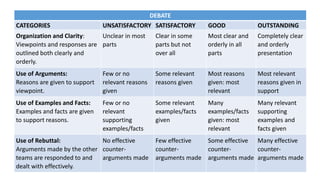
DEBATE
CATEGORIES UNSATISFACTORY SATISFACTORY GOOD OUTSTANDING
Organization and Clarity:
Viewpoints and responses are
outlined both clearly and
orderly.
Unclear in most
parts
Clear in some
parts but not
over all
Most clear and
orderly in all
parts
Completely clear
and orderly
presentation
Use of Arguments:
Reasons are given to support
viewpoint.
Few or no
relevant reasons
given
Some relevant
reasons given
Most reasons
given: most
relevant
Most relevant
reasons given in
support
Use of Examples and Facts:
Examples and facts are given
to support reasons.
Few or no
relevant
supporting
examples/facts
Some relevant
examples/facts
given
Many
examples/facts
given: most
relevant
Many relevant
supporting
examples and
facts given
Use of Rebuttal:
Arguments made by the other
teams are responded to and
dealt with effectively.
No effective
counter-
arguments made
Few effective
counter-
arguments made
Some effective
counter-
arguments made
Many effective
counter-
arguments made
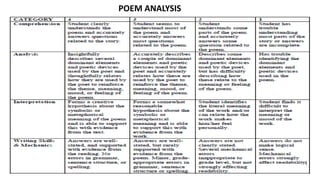
POEM ANALYSIS
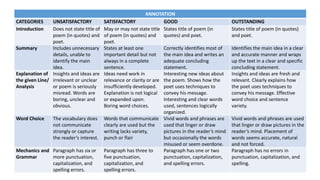
ANNOTATION
CATEGORIES UNSATISFACTORY SATISFACTORY GOOD OUTSTANDING
Introduction Does not state title of
poem (in quotes) and
poet.
May or may not state title
of poem (in quotes) and
poet.
States title of poem (in
quotes) and poet.
States title of poem (in quotes)
and poet.
Summary Includes unnecessary
details, unable to
identify the main
idea.
States at least one
important detail but not
always in a complete
sentence.
Correctly identifies most of
the main idea and writes an
adequate concluding
statement.
Identifies the main idea in a clear
and accurate manner and wraps
up the text in a clear and specific
concluding statement.
Explanation of
the given Line/
Analysis
Insights and ideas are
irrelevant or unclear
or poem is seriously
misread. Words are
boring, unclear and
obvious.
Ideas need work in
relevance or clarity or are
insufficiently developed.
Explanation is not logical
or expanded upon.
Boring word choices.
Interesting new ideas about
the poem. Shows how the
poet uses techniques to
convey his message.
Interesting and clear words
used, sentences logically
organized.
Insights and ideas are fresh and
relevant. Clearly explains how
the poet uses techniques to
convey his message. Effective
word choice and sentence
variety.
Word Choice The vocabulary does
not communicate
strongly or capture
the reader’s interest.
Words that communicate
clearly are used but the
writing lacks variety,
punch or flair
Vivid words and phrases are
used that linger or draw
pictures in the reader’s mind
but occasionally the words
misused or seem overdone.
Vivid words and phrases are used
that linger or draw pictures in the
reader’s mind. Placement of
words seems accurate, natural
and not forced.
Mechanics and
Grammar
Paragraph has six or
more punctuation,
capitalization, and
spelling errors.
Paragraph has three to
five punctuation,
capitalization, and
spelling errors.
Paragraph has one or two
punctuation, capitalization,
and spelling errors.
Paragraph has no errors in
punctuation, capitalization, and
spelling.
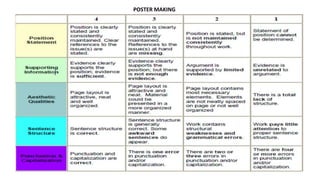
POSTER MAKING
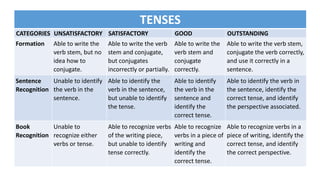
TENSES
CATEGORIES UNSATISFACTORY SATISFACTORY GOOD OUTSTANDING
Formation Able to write the
verb stem, but no
idea how to
conjugate.
Able to write the verb
stem and conjugate,
but conjugates
incorrectly or partially.
Able to write the
verb stem and
conjugate
correctly.
Able to write the verb stem,
conjugate the verb correctly,
and use it correctly in a
sentence.
Sentence
Recognition
Unable to identify
the verb in the
sentence.
Able to identify the
verb in the sentence,
but unable to identify
the tense.
Able to identify
the verb in the
sentence and
identify the
correct tense.
Able to identify the verb in
the sentence, identify the
correct tense, and identify
the perspective associated.
Book
Recognition
Unable to
recognize either
verbs or tense.
Able to recognize verbs
of the writing piece,
but unable to identify
tense correctly.
Able to recognize
verbs in a piece of
writing and
identify the
correct tense.
Able to recognize verbs in a
piece of writing, identify the
correct tense, and identify
the correct perspective.
SENTENCE ORDER
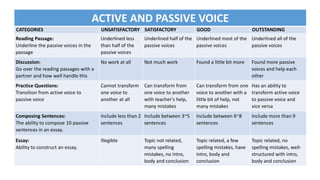
ACTIVE AND PASSIVE VOICE
CATEGORIES UNSATISFACTORY SATISFACTORY GOOD OUTSTANDING
Reading Passage:
Underline the passive voices in the
passage
Underlined less
than half of the
passive voices
Underlined half of the
passive voices
Underlined most of the
passive voices
Underlined all of the
passive voices
Discussion:
Go over the reading passages with a
partner and how well handle this
No work at all Not much work Found a little bit more Found more passive
voices and help each
other
Practice Questions:
Transition from active voice to
passive voice
Cannot transform
one voice to
another at all
Can transform from
one voice to another
with teacher's help,
many mistakes
Can transform from one
voice to another with a
little bit of help, not
many mistakes
Has an ability to
transform active voice
to passive voice and
vice versa
Composing Sentences:
The ability to compose 10 passive
sentences in an essay.
Include less than 2
sentences
Include between 3~5
sentences
Include between 6~8
sentences
Include more than 9
sentences
Essay:
Ability to construct an essay.
Illegible Topic not related,
many spelling
mistakes, no intro,
body and conclusion
Topic related, a few
spelling mistakes, have
intro, body and
conclusion
Topic related, no
spelling mistakes, well-
structured with intro,
body and conclusion
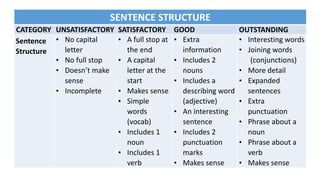
SENTENCE STRUCTURE
CATEGORY UNSATISFACTORY SATISFACTORY GOOD OUTSTANDING
Sentence
Structure
• No capital
letter
• No full stop
• Doesn’t make
sense
• Incomplete
• A full stop at
the end
• A capital
letter at the
start
• Makes sense
• Simple
words
(vocab)
• Includes 1
noun
• Includes 1
verb
• Extra
information
• Includes 2
nouns
• Includes a
describing word
(adjective)
• An interesting
sentence
• Includes 2
punctuation
marks
• Makes sense
• Interesting words
• Joining words
(conjunctions)
• More detail
• Expanded
sentences
• Extra
punctuation
• Phrase about a
noun
• Phrase about a
verb
• Makes sense
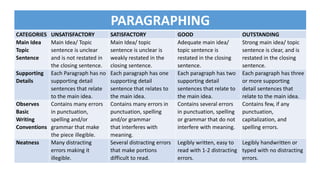
PARAGRAPHING
CATEGORIES UNSATISFACTORY SATISFACTORY GOOD OUTSTANDING
Main Idea
Topic
Sentence
Main Idea/ Topic
sentence is unclear
and is not restated in
the closing sentence.
Main Idea/ topic
sentence is unclear is
weakly restated in the
closing sentence.
Adequate main idea/
topic sentence is
restated in the closing
sentence.
Strong main idea/ topic
sentence is clear, and is
restated in the closing
sentence.
Supporting
Details
Each Paragraph has no
supporting detail
sentences that relate
to the main idea.
Each paragraph has one
supporting detail
sentence that relates to
the main idea.
Each paragraph has two
supporting detail
sentences that relate to
the main idea.
Each paragraph has three
or more supporting
detail sentences that
relate to the main idea.
Observes
Basic
Writing
Conventions
Contains many errors
in punctuation,
spelling and/or
grammar that make
the piece illegible.
Contains many errors in
punctuation, spelling
and/or grammar
that interferes with
meaning.
Contains several errors
in punctuation, spelling
or grammar that do not
interfere with meaning.
Contains few, if any
punctuation,
capitalization, and
spelling errors.
Neatness Many distracting
errors making it
illegible.
Several distracting errors
that make portions
difficult to read.
Legibly written, easy to
read with 1-2 distracting
errors.
Legibly handwritten or
typed with no distracting
errors.
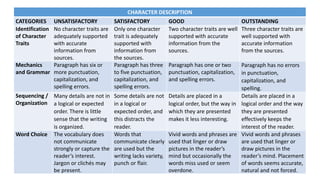
CHARACTER DESCRIPTION
CATEGORIES UNSATISFACTORY SATISFACTORY GOOD OUTSTANDING
Identification
of Character
Traits
No character traits are
adequately supported
with accurate
information from
sources.
Only one character
trait is adequately
supported with
information from
the sources.
Two character traits are well
supported with accurate
information from the
sources.
Three character traits are
well supported with
accurate information
from the sources.
Mechanics
and Grammar
Paragraph has six or
more punctuation,
capitalization, and
spelling errors.
Paragraph has three
to five punctuation,
capitalization, and
spelling errors.
Paragraph has one or two
punctuation, capitalization,
and spelling errors.
Paragraph has no errors
in punctuation,
capitalization, and
spelling.
Sequencing /
Organization
Many details are not in
a logical or expected
order. There is little
sense that the writing
is organized.
Some details are not
in a logical or
expected order, and
this distracts the
reader.
Details are placed in a
logical order, but the way in
which they are presented
makes it less interesting.
Details are placed in a
logical order and the way
they are presented
effectively keeps the
interest of the reader.
Word Choice The vocabulary does
not communicate
strongly or capture the
reader’s interest.
Jargon or clichés may
be present.
Words that
communicate clearly
are used but the
writing lacks variety,
punch or flair.
Vivid words and phrases are
used that linger or draw
pictures in the reader’s
mind but occasionally the
words miss used or seem
overdone.
Vivid words and phrases
are used that linger or
draw pictures in the
reader’s mind. Placement
of words seems accurate,
natural and not forced.
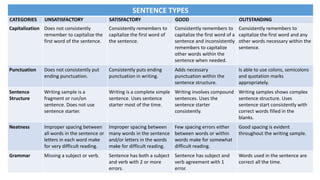
SENTENCE TYPES
CATEGORIES UNSATISFACTORY SATISFACTORY GOOD OUTSTANDING
Capitalization Does not consistently
remember to capitalize the
first word of the sentence.
Consistently remembers to
capitalize the first word of
the sentence.
Consistently remembers to
capitalize the first word of a
sentence and inconsistently
remembers to capitalize
other words within the
sentence when needed.
Consistently remembers to
capitalize the first word and any
other words necessary within the
sentence.
Punctuation Does not consistently put
ending punctuation.
Consistently puts ending
punctuation in writing.
Adds necessary
punctuation within the
sentence structure.
Is able to use colons, semicolons
and quotation marks
appropriately.
Sentence
Structure
Writing sample is a
fragment or run/on
sentence. Does not use
sentence starter.
Writing is a complete simple
sentence. Uses sentence
starter most of the time.
Writing involves compound
sentences. Uses the
sentence starter
consistently.
Writing samples shows complex
sentence structure. Uses
sentence start consistently with
correct words filled in the
blanks.
Neatness Improper spacing between
all words in the sentence or
letters in each word make
for very difficult reading.
Improper spacing between
many words in the sentence
and/or letters in the words
make for difficult reading.
Few spacing errors either
between words or within
words make for somewhat
difficult reading.
Good spacing is evident
throughout the writing sample.
Grammar Missing a subject or verb. Sentence has both a subject
and verb with 2 or more
errors.
Sentence has subject and
verb agreement with 1
error.
Words used in the sentence are
correct all the time.
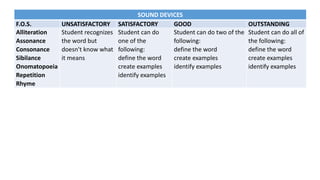
SOUND DEVICES
F.O.S. UNSATISFACTORY SATISFACTORY GOOD OUTSTANDING
Alliteration
Assonance
Consonance
Sibilance
Onomatopoeia
Repetition
Rhyme
Student recognizes
the word but
doesn't know what
it means
Student can do
one of the
following:
define the word
create examples
identify examples
Student can do two of the
following:
define the word
create examples
identify examples
Student can do all of
the following:
define the word
create examples
identify examples
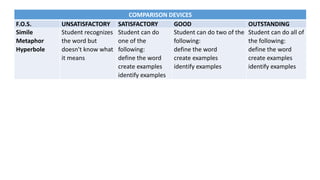
COMPARISON DEVICES
F.O.S. UNSATISFACTORY SATISFACTORY GOOD OUTSTANDING
Simile
Metaphor
Hyperbole
Student recognizes
the word but
doesn't know what
it means
Student can do
one of the
following:
define the word
create examples
identify examples
Student can do two of the
following:
define the word
create examples
identify examples
Student can do all of
the following:
define the word
create examples
identify examples
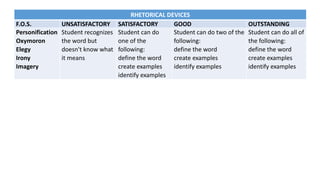
RHETORICAL DEVICES
F.O.S. UNSATISFACTORY SATISFACTORY GOOD OUTSTANDING
Personification
Oxymoron
Elegy
Irony
Imagery
Student recognizes
the word but
doesn't know what
it means
Student can do
one of the
following:
define the word
create examples
identify examples
Student can do two of the
following:
define the word
create examples
identify examples
Student can do all of
the following:
define the word
create examples
identify examples
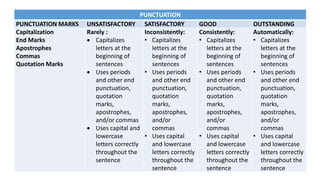
PUNCTUATION
PUNCTUATION MARKS UNSATISFACTORY SATISFACTORY GOOD OUTSTANDING
Capitalization
End Marks
Apostrophes
Commas
Quotation Marks
Rarely :
 Capitalizes
letters at the
beginning of
sentences
 Uses periods
and other end
punctuation,
quotation
marks,
apostrophes,
and/or commas
 Uses capital and
lowercase
letters correctly
throughout the
sentence
Inconsistently:
• Capitalizes
letters at the
beginning of
sentences
• Uses periods
and other end
punctuation,
quotation
marks,
apostrophes,
and/or
commas
• Uses capital
and lowercase
letters correctly
throughout the
sentence
Consistently:
• Capitalizes
letters at the
beginning of
sentences
• Uses periods
and other end
punctuation,
quotation
marks,
apostrophes,
and/or
commas
• Uses capital
and lowercase
letters correctly
throughout the
sentence
Automatically:
• Capitalizes
letters at the
beginning of
sentences
• Uses periods
and other end
punctuation,
quotation
marks,
apostrophes,
and/or
commas
• Uses capital
and lowercase
letters correctly
throughout the
sentence
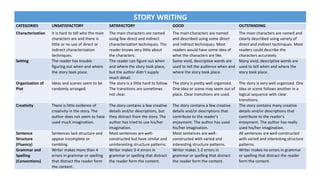
STORY WRITING
CATEGORIES UNSATISFACTORY SATISFACTORY GOOD OUTSTANDING
Characterization It is hard to tell who the main
characters are and there is
little or no use of direct or
indirect characterization
techniques.
The main characters are named
using few direct and indirect
characterization techniques. The
reader knows very little about
the characters.
The main characters are named
and described using some direct
and indirect techniques. Most
readers would have some idea of
what the characters are like.
The main characters are named and
clearly described using variety of
direct and indirect techniques. Most
readers could describe the
characters accurately.
Setting The reader has trouble
figuring out when and where
the story took place.
The reader can figure out when
and where the story took place,
but the author didn't supply
much detail.
Some vivid, descriptive words are
used to tell the audience when and
where the story took place.
Many vivid, descriptive words are
used to tell when and where the
story took place.
Organization of
Plot
Ideas and scenes seem to be
randomly arranged.
The story is a little hard to follow.
The transitions are sometimes
not clear.
The story is pretty well organized.
One idea or scene may seem out of
place. Clear transitions are used.
The story is very well organized. One
idea or scene follows another in a
logical sequence with clear
transitions.
Creativity There is little evidence of
creativity in the story. The
author does not seem to have
used much imagination.
The story contains a few creative
details and/or descriptions, but
they distract from the story. The
author has tried to use his/her
imagination.
The story contains a few creative
details and/or descriptions that
contribute to the reader's
enjoyment. The author has used
his/her imagination.
The story contains many creative
details and/or descriptions that
contribute to the reader's
enjoyment. The author has really
used his/her imagination.
Sentence
Structure
(Fluency)
Sentences lack structure and
appear incomplete or
rambling.
Most sentences are well-
constructed but have similar and
uninteresting structure patterns.
Most sentences are well-
constructed with varied and
interesting structure patterns.
All sentences are well-constructed
with varied and interesting structure
patterns.
Grammar and
Spelling
(Conventions)
Writer makes more than 4
errors in grammar or spelling
that distract the reader form
the content.
Writer makes 3-4 errors in
grammar or spelling that distract
the reader form the content.
Writer makes 1-2 errors in
grammar or spelling that distract
the reader form the content.
Writer makes no errors in grammar
or spelling that distract the reader
form the content.
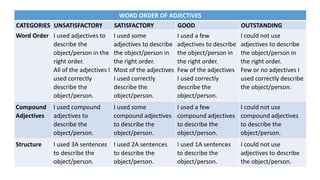
WORD ORDER OF ADJECTIVES
CATEGORIES UNSATISFACTORY SATISFACTORY GOOD OUTSTANDING
Word Order I used adjectives to
describe the
object/person in the
right order.
All of the adjectives I
used correctly
describe the
object/person.
I used some
adjectives to describe
the object/person in
the right order.
Most of the adjectives
I used correctly
describe the
object/person.
I used a few
adjectives to describe
the object/person in
the right order.
Few of the adjectives
I used correctly
describe the
object/person.
I could not use
adjectives to describe
the object/person in
the right order.
Few or no adjectives I
used correctly describe
the object/person.
Compound
Adjectives
I used compound
adjectives to
describe the
object/person.
I used some
compound adjectives
to describe the
object/person.
I used a few
compound adjectives
to describe the
object/person.
I could not use
compound adjectives
to describe the
object/person.
Structure I used 3A sentences
to describe the
object/person.
I used 2A sentences
to describe the
object/person.
I used 1A sentences
to describe the
object/person.
I could not use
adjectives to describe
the object/person.
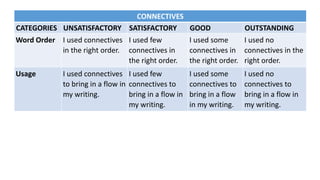
CONNECTIVES
CATEGORIES UNSATISFACTORY SATISFACTORY GOOD OUTSTANDING
Word Order I used connectives
in the right order.
I used few
connectives in
the right order.
I used some
connectives in
the right order.
I used no
connectives in the
right order.
Usage I used connectives
to bring in a flow in
my writing.
I used few
connectives to
bring in a flow in
my writing.
I used some
connectives to
bring in a flow
in my writing.
I used no
connectives to
bring in a flow in
my writing.
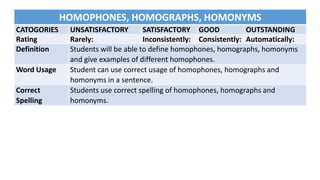
HOMOPHONES, HOMOGRAPHS, HOMONYMS
CATOGORIES UNSATISFACTORY SATISFACTORY GOOD OUTSTANDING
Rating Rarely: Inconsistently: Consistently: Automatically:
Definition Students will be able to define homophones, homographs, homonyms
and give examples of different homophones.
Word Usage Student can use correct usage of homophones, homographs and
homonyms in a sentence.
Correct
Spelling
Students use correct spelling of homophones, homographs and
homonyms.
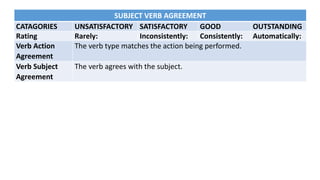
SUBJECT VERB AGREEMENT
CATAGORIES UNSATISFACTORY SATISFACTORY GOOD OUTSTANDING
Rating Rarely: Inconsistently: Consistently: Automatically:
Verb Action
Agreement
The verb type matches the action being performed.
Verb Subject
Agreement
The verb agrees with the subject.
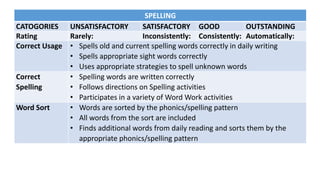
SPELLING
CATOGORIES UNSATISFACTORY SATISFACTORY GOOD OUTSTANDING
Rating Rarely: Inconsistently: Consistently: Automatically:
Correct Usage • Spells old and current spelling words correctly in daily writing
• Spells appropriate sight words correctly
• Uses appropriate strategies to spell unknown words
Correct
Spelling
• Spelling words are written correctly
• Follows directions on Spelling activities
• Participates in a variety of Word Work activities
Word Sort • Words are sorted by the phonics/spelling pattern
• All words from the sort are included
• Finds additional words from daily reading and sorts them by the
appropriate phonics/spelling pattern
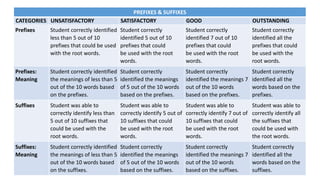
PREFIXES & SUFFIXES
CATEGORIES UNSATISFACTORY SATISFACTORY GOOD OUTSTANDING
Prefixes Student correctly identified
less than 5 out of 10
prefixes that could be used
with the root words.
Student correctly
identified 5 out of 10
prefixes that could
be used with the root
words.
Student correctly
identified 7 out of 10
prefixes that could
be used with the root
words.
Student correctly
identified all the
prefixes that could
be used with the
root words.
Prefixes:
Meaning
Student correctly identified
the meanings of less than 5
out of the 10 words based
on the prefixes.
Student correctly
identified the meanings
of 5 out of the 10 words
based on the prefixes.
Student correctly
identified the meanings 7
out of the 10 words
based on the prefixes.
Student correctly
identified all the
words based on the
prefixes.
Suffixes Student was able to
correctly identify less than
5 out of 10 suffixes that
could be used with the
root words.
Student was able to
correctly identify 5 out of
10 suffixes that could
be used with the root
words.
Student was able to
correctly identify 7 out of
10 suffixes that could
be used with the root
words.
Student was able to
correctly identify all
the suffixes that
could be used with
the root words.
Suffixes:
Meaning
Student correctly identified
the meanings of less than 5
out of the 10 words based
on the suffixes.
Student correctly
identified the meanings
of 5 out of the 10 words
based on the suffixes.
Student correctly
identified the meanings 7
out of the 10 words
based on the suffixes.
Student correctly
identified all the
words based on the
suffixes.
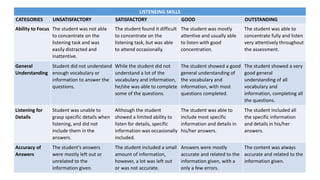
LISTENEING SKILLS
CATEGORIES UNSATISFACTORY SATISFACTORY GOOD OUTSTANDING
Ability to Focus The student was not able
to concentrate on the
listening task and was
easily distracted and
inattentive.
The student found it difficult
to concentrate on the
listening task, but was able
to attend occasionally.
The student was mostly
attentive and usually able
to listen with good
concentration.
The student was able to
concentrate fully and listen
very attentively throughout
the assessment.
General
Understanding
Student did not understand
enough vocabulary or
information to answer the
questions.
While the student did not
understand a lot of the
vocabulary and information,
he/she was able to complete
some of the questions.
The student showed a good
general understanding of
the vocabulary and
information, with most
questions completed.
The student showed a very
good general
understanding of all
vocabulary and
information, completing all
the questions.
Listening for
Details
Student was unable to
grasp specific details when
listening, and did not
include them in the
answers.
Although the student
showed a limited ability to
listen for details, specific
information was occasionally
included.
The student was able to
include most specific
information and details in
his/her answers.
The student included all
the specific information
and details in his/her
answers.
Accuracy of
Answers
The student's answers
were mostly left out or
unrelated to the
information given.
The student included a small
amount of information,
however, a lot was left out
or was not accurate.
Answers were mostly
accurate and related to the
information given, with a
only a few errors.
The content was always
accurate and related to the
information given.
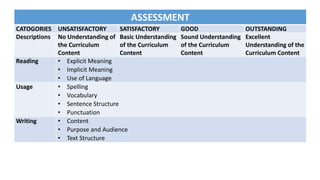
ASSESSMENT
CATOGORIES UNSATISFACTORY SATISFACTORY GOOD OUTSTANDING
Descriptions No Understanding of
the Curriculum
Content
Basic Understanding
of the Curriculum
Content
Sound Understanding
of the Curriculum
Content
Excellent
Understanding of the
Curriculum Content
Reading • Explicit Meaning
• Implicit Meaning
• Use of Language
Usage • Spelling
• Vocabulary
• Sentence Structure
• Punctuation
Writing • Content
• Purpose and Audience
• Text Structure
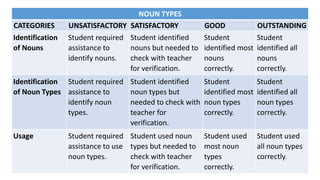
NOUN TYPES
CATEGORIES UNSATISFACTORY SATISFACTORY GOOD OUTSTANDING
Identification
of Nouns
Student required
assistance to
identify nouns.
Student identified
nouns but needed to
check with teacher
for verification.
Student
identified most
nouns
correctly.
Student
identified all
nouns
correctly.
Identification
of Noun Types
Student required
assistance to
identify noun
types.
Student identified
noun types but
needed to check with
teacher for
verification.
Student
identified most
noun types
correctly.
Student
identified all
noun types
correctly.
Usage Student required
assistance to use
noun types.
Student used noun
types but needed to
check with teacher
for verification.
Student used
most noun
types
correctly.
Student used
all noun types
correctly.
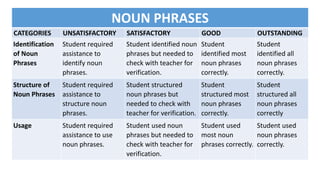
NOUN PHRASES
CATEGORIES UNSATISFACTORY SATISFACTORY GOOD OUTSTANDING
Identification
of Noun
Phrases
Student required
assistance to
identify noun
phrases.
Student identified noun
phrases but needed to
check with teacher for
verification.
Student
identified most
noun phrases
correctly.
Student
identified all
noun phrases
correctly.
Structure of
Noun Phrases
Student required
assistance to
structure noun
phrases.
Student structured
noun phrases but
needed to check with
teacher for verification.
Student
structured most
noun phrases
correctly.
Student
structured all
noun phrases
correctly
Usage Student required
assistance to use
noun phrases.
Student used noun
phrases but needed to
check with teacher for
verification.
Student used
most noun
phrases correctly.
Student used
noun phrases
correctly.
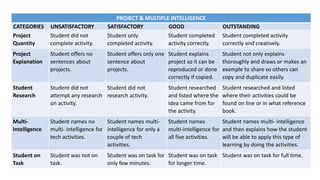
PROJECT & MULTIPLE INTELLIGENCE
CATEGORIES UNSATISFACTORY SATISFACTORY GOOD OUTSTANDING
Project
Quantity
Student did not
complete activity.
Student only
completed activity.
Student completed
activity correctly.
Student completed activity
correctly and creatively.
Project
Explanation
Student offers no
sentences about
projects.
Student offers only one
sentence about
projects.
Student explains
project so it can be
reproduced or done
correctly if copied.
Student not only explains
thoroughly and draws or makes an
example to share so others can
copy and duplicate easily.
Student
Research
Student did not
attempt any research
on activity.
Student did not
research activity.
Student researched
and listed where the
idea came from for
the activity.
Student researched and listed
where their activities could be
found on line or in what reference
book.
Multi-
Intelligence
Student names no
multi- intelligence for
tech activities.
Student names multi-
intelligence for only a
couple of tech
activities.
Student names
multi-intelligence for
all five activities.
Student names multi- intelligence
and then explains how the student
will be able to apply this type of
learning by doing the activities.
Student on
Task
Student was not on
task.
Student was on task for
only few minutes.
Student was on task
for longer time.
Student was on task for full time.
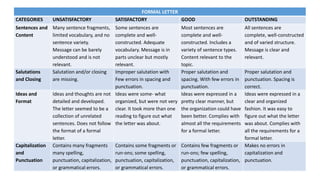
FORMAL LETTER
CATEGORIES UNSATISFACTORY SATISFACTORY GOOD OUTSTANDING
Sentences and
Content
Many sentence fragments,
limited vocabulary, and no
sentence variety.
Message can be barely
understood and is not
relevant.
Some sentences are
complete and well-
constructed. Adequate
vocabulary. Message is in
parts unclear but mostly
relevant.
Most sentences are
complete and well-
constructed. Includes a
variety of sentence types.
Content relevant to the
topic.
All sentences are
complete, well-constructed
and of varied structure.
Message is clear and
relevant.
Salutations
and Closing
Salutation and/or closing
are missing.
Improper salutation with
Few errors in spacing and
punctuation.
Proper salutation and
spacing. With few errors in
punctuation.
Proper salutation and
punctuation. Spacing is
correct.
Ideas and
Format
Ideas and thoughts are not
detailed and developed.
The letter seemed to be a
collection of unrelated
sentences. Does not follow
the format of a formal
letter.
Ideas were some- what
organized, but were not very
clear. It took more than one
reading to figure out what
the letter was about.
Ideas were expressed in a
pretty clear manner, but
the organization could have
been better. Complies with
almost all the requirements
for a formal letter.
Ideas were expressed in a
clear and organized
fashion. It was easy to
figure out what the letter
was about. Complies with
all the requirements for a
formal letter.
Capitalization
and
Punctuation
Contains many fragments
many spelling,
punctuation, capitalization,
or grammatical errors.
Contains some fragments or
run-ons; some spelling,
punctuation, capitalization,
or grammatical errors.
Contains few fragments or
run-ons; few spelling,
punctuation, capitalization,
or grammatical errors.
Makes no errors in
capitalization and
punctuation.
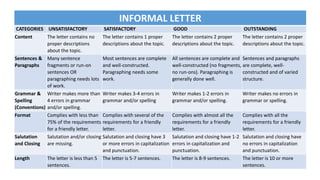
INFORMAL LETTER
CATEGORIES UNSATISFACTORY SATISFACTORY GOOD OUTSTANDING
Content The letter contains no
proper descriptions
about the topic.
The letter contains 1 proper
descriptions about the topic.
The letter contains 2 proper
descriptions about the topic.
The letter contains 2 proper
descriptions about the topic.
Sentences &
Paragraphs
Many sentence
fragments or run-on
sentences OR
paragraphing needs lots
of work.
Most sentences are complete
and well-constructed.
Paragraphing needs some
work.
All sentences are complete and
well-constructed (no fragments,
no run-ons). Paragraphing is
generally done well.
Sentences and paragraphs
are complete, well-
constructed and of varied
structure.
Grammar &
Spelling
(Conventions)
Writer makes more than
4 errors in grammar
and/or spelling.
Writer makes 3-4 errors in
grammar and/or spelling
Writer makes 1-2 errors in
grammar and/or spelling.
Writer makes no errors in
grammar or spelling.
Format Complies with less than
75% of the requirements
for a friendly letter.
Complies with several of the
requirements for a friendly
letter.
Complies with almost all the
requirements for a friendly
letter.
Complies with all the
requirements for a friendly
letter.
Salutation
and Closing
Salutation and/or closing
are missing.
Salutation and closing have 3
or more errors in capitalization
and punctuation.
Salutation and closing have 1-2
errors in capitalization and
punctuation.
Salutation and closing have
no errors in capitalization
and punctuation.
Length The letter is less than 5
sentences.
The letter is 5-7 sentences. The letter is 8-9 sentences. The letter is 10 or more
sentences.
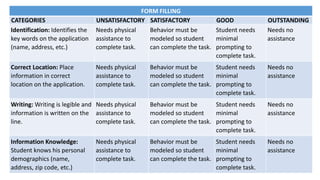
FORM FILLING
CATEGORIES UNSATISFACTORY SATISFACTORY GOOD OUTSTANDING
Identification: Identifies the
key words on the application
(name, address, etc.)
Needs physical
assistance to
complete task.
Behavior must be
modeled so student
can complete the task.
Student needs
minimal
prompting to
complete task.
Needs no
assistance
Correct Location: Place
information in correct
location on the application.
Needs physical
assistance to
complete task.
Behavior must be
modeled so student
can complete the task.
Student needs
minimal
prompting to
complete task.
Needs no
assistance
Writing: Writing is legible and
information is written on the
line.
Needs physical
assistance to
complete task.
Behavior must be
modeled so student
can complete the task.
Student needs
minimal
prompting to
complete task.
Needs no
assistance
Information Knowledge:
Student knows his personal
demographics (name,
address, zip code, etc.)
Needs physical
assistance to
complete task.
Behavior must be
modeled so student
can complete the task.
Student needs
minimal
prompting to
complete task.
Needs no
assistance
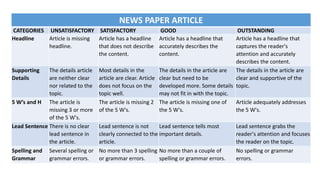
NEWS PAPER ARTICLE
CATEGORIES UNSATISFACTORY SATISFACTORY GOOD OUTSTANDING
Headline Article is missing
headline.
Article has a headline
that does not describe
the content.
Article has a headline that
accurately describes the
content.
Article has a headline that
captures the reader's
attention and accurately
describes the content.
Supporting
Details
The details article
are neither clear
nor related to the
topic.
Most details in the
article are clear. Article
does not focus on the
topic well.
The details in the article are
clear but need to be
developed more. Some details
may not fit in with the topic.
The details in the article are
clear and supportive of the
topic.
5 W’s and H The article is
missing 3 or more
of the 5 W's.
The article is missing 2
of the 5 W's.
The article is missing one of
the 5 W's.
Article adequately addresses
the 5 W's.
Lead Sentence There is no clear
lead sentence in
the article.
Lead sentence is not
clearly connected to the
article.
Lead sentence tells most
important details.
Lead sentence grabs the
reader's attention and focuses
the reader on the topic.
Spelling and
Grammar
Several spelling or
grammar errors.
No more than 3 spelling
or grammar errors.
No more than a couple of
spelling or grammar errors.
No spelling or grammar
errors.
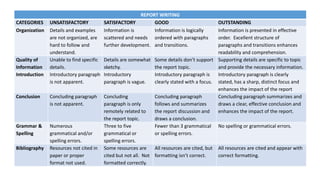
REPORT WRITING
CATEGORIES UNSATISFACTORY SATISFACTORY GOOD OUTSTANDING
Organization Details and examples
are not organized, are
hard to follow and
understand.
Information is
scattered and needs
further development.
Information is logically
ordered with paragraphs
and transitions.
Information is presented in effective
order. Excellent structure of
paragraphs and transitions enhances
readability and comprehension.
Quality of
Information
Unable to find specific
details.
Details are somewhat
sketchy.
Some details don’t support
the report topic.
Supporting details are specific to topic
and provide the necessary information.
Introduction Introductory paragraph
is not apparent.
Introductory
paragraph is vague.
Introductory paragraph is
clearly stated with a focus.
Introductory paragraph is clearly
stated, has a sharp, distinct focus and
enhances the impact of the report
Conclusion Concluding paragraph
is not apparent.
Concluding
paragraph is only
remotely related to
the report topic.
Concluding paragraph
follows and summarizes
the report discussion and
draws a conclusion.
Concluding paragraph summarizes and
draws a clear, effective conclusion and
enhances the impact of the report.
Grammar &
Spelling
Numerous
grammatical and/or
spelling errors.
Three to five
grammatical or
spelling errors.
Fewer than 3 grammatical
or spelling errors.
No spelling or grammatical errors.
Bibliography Resources not cited in
paper or proper
format not used.
Some resources are
cited but not all. Not
formatted correctly.
All resources are cited, but
formatting isn’t correct.
All resources are cited and appear with
correct formatting.
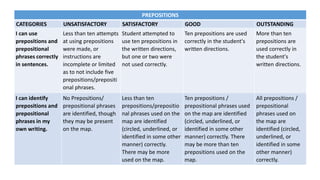
PREPOSITIONS
CATEGORIES UNSATISFACTORY SATISFACTORY GOOD OUTSTANDING
I can use
prepositions and
prepositional
phrases correctly
in sentences.
Less than ten attempts
at using prepositions
were made, or
instructions are
incomplete or limited
as to not include five
prepositions/prepositi
onal phrases.
Student attempted to
use ten prepositions in
the written directions,
but one or two were
not used correctly.
Ten prepositions are used
correctly in the student's
written directions.
More than ten
prepositions are
used correctly in
the student's
written directions.
I can identify
prepositions and
prepositional
phrases in my
own writing.
No Prepositions/
prepositional phrases
are identified, though
they may be present
on the map.
Less than ten
prepositions/prepositio
nal phrases used on the
map are identified
(circled, underlined, or
identified in some other
manner) correctly.
There may be more
used on the map.
Ten prepositions /
prepositional phrases used
on the map are identified
(circled, underlined, or
identified in some other
manner) correctly. There
may be more than ten
prepositions used on the
map.
All prepositions /
prepositional
phrases used on
the map are
identified (circled,
underlined, or
identified in some
other manner)
correctly.
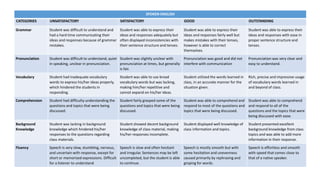
SPOKEN ENGLISH
CATEGORIES UNSATISFACTORY SATISFACTORY GOOD OUTSTANDING
Grammar Student was difficult to understand and
had a hard time communicating their
ideas and responses because of grammar
mistakes.
Student was able to express their
ideas and responses adequately but
often displayed inconsistencies with
their sentence structure and tenses.
Student was able to express their
ideas and responses fairly well but
makes mistakes with their tenses,
however is able to correct
themselves.
Student was able to express their
ideas and responses with ease in
proper sentence structure and
tenses.
Pronunciation Student was difficult to understand, quiet
in speaking, unclear in pronunciation.
Student was slightly unclear with
pronunciation at times, but generally
is fair.
Pronunciation was good and did not
interfere with communication
Pronunciation was very clear and
easy to understand.
Vocabulary Student had inadequate vocabulary
words to express his/her ideas properly,
which hindered the students in
responding.
Student was able to use broad
vocabulary words but was lacking,
making him/her repetitive and
cannot expand on his/her ideas.
Student utilized the words learned in
class, in an accurate manner for the
situation given.
Rich, precise and impressive usage
of vocabulary words learned in
and beyond of class.
Comprehension Student had difficulty understanding the
questions and topics that were being
discussed.
Student fairly grasped some of the
questions and topics that were being
discussed.
Student was able to comprehend and
respond to most of the questions and
topics that were being discussed.
Student was able to comprehend
and respond to all of the
questions and the topics that were
being discussed with ease.
Background
Knowledge
Student was lacking in background
knowledge which hindered his/her
responses to the questions regarding
class materials.
Student showed decent background
knowledge of class material, making
his/her responses incomplete.
Student displayed well knowledge of
class information and topics.
Student presented excellent
background knowledge from class
topics and was able to add more
information in their response.
Fluency Speech is very slow, stumbling, nervous,
and uncertain with response, except for
short or memorized expressions. Difficult
for a listener to understand
Speech is slow and often hesitant
and irregular. Sentences may be left
uncompleted, but the student is able
to continue.
Speech is mostly smooth but with
some hesitation and unevenness
caused primarily by rephrasing and
groping for words.
Speech is effortless and smooth
with speed that comes close to
that of a native speaker.
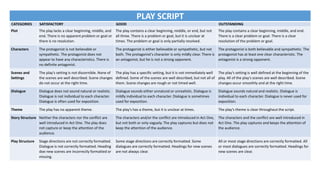
PLAY SCRIPT
CATEGORIES SATISFACTORY GOOD OUTSTANDING
Plot The play lacks a clear beginning, middle, and
end. There is no apparent problem or goal or
there is no resolution.
The play contains a clear beginning, middle, or end, but not
all three. There is a problem or goal, but it is unclear at
times. The problem or goal is only partially resolved.
The play contains a clear beginning, middle, and end.
There is a clear problem or goal. There is a clear
resolution of the problem or goal.
Characters The protagonist is not believable or
sympathetic. The protagonist does not
appear to have any characteristics. There is
no definite antagonist.
The protagonist is either believable or sympathetic, but not
both. The protagonist's character is only mildly clear. There is
an antagonist, but he is not a strong opponent.
The protagonist is both believable and sympathetic. The
protagonist has at least one clear characteristic. The
antagonist is a strong opponent.
Scenes and
Settings
The play's setting is not discernible. None of
the scenes are well described. Scene changes
do not occur at the right time.
The play has a specific setting, but it is not immediately well
defined. Some of the scenes are well described, but not all of
them. Scene changes are rough or not timed well.
The play's setting is well defined at the beginning of the
play. All of the play's scenes are well described. Scene
changes occur smoothly and at the right time.
Dialogue Dialogue does not sound natural or realistic.
Dialogue is not individual to each character.
Dialogue is often used for exposition.
Dialogue sounds either unnatural or unrealistic. Dialogue is
mildly individual to each character. Dialogue is sometimes
used for exposition.
Dialogue sounds natural and realistic. Dialogue is
individual to each character. Dialogue is never used for
exposition.
Theme The play has no apparent theme. The play's has a theme, but it is unclear at times. The play's theme is clear throughout the script.
Story Structure Neither the characters nor the conflict are
well introduced in Act One. The play does
not capture or keep the attention of the
audience.
The characters and/or the conflict are introduced in Act One,
but not both or only vaguely. The play captures but does not
keep the attention of the audience.
The characters and the conflict are well introduced in
Act One. The play captures and keeps the attention of
the audience.
Play Structure Stage directions are not correctly formatted.
Dialogue is not correctly formatted. Heading
doe new scenes are incorrectly formatted or
missing.
Some stage directions are correctly formatted. Some
dialogues are correctly formatted. Headings for new scenes
are not always clear.
All or most stage directions are correctly formatted. All
or most dialogues are correctly formatted. Headings for
new scenes are clear.
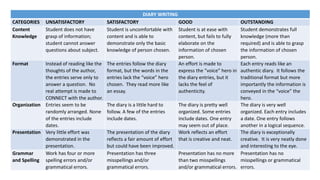
DIARY WRITING
CATEGORIES UNSATISFACTORY SATISFACTORY GOOD OUTSTANDING
Content
Knowledge
Student does not have
grasp of information;
student cannot answer
questions about subject.
Student is uncomfortable with
content and is able to
demonstrate only the basic
knowledge of person chosen.
Student is at ease with
content, but fails to fully
elaborate on the
information of chosen
person.
Student demonstrates full
knowledge (more than
required) and is able to grasp
the information of chosen
person.
Format Instead of reading like the
thoughts of the author,
the entries serve only to
answer a question. No
real attempt is made to
CONNECT with the author.
The entries follow the diary
format, but the words in the
entries lack the “voice” hero
chosen. They read more like
an essay.
An effort is made to
express the “voice” hero in
the diary entries, but it
lacks the feel of
authenticity.
Each entry reads like an
authentic diary. It follows the
traditional format but more
importantly the information is
conveyed in the “voice” the
hero.
Organization Entries seem to be
randomly arranged. None
of the entries include
dates.
The diary is a little hard to
follow. A few of the entries
include dates.
The diary is pretty well
organized. Some entries
include dates. One entry
may seem out of place.
The diary is very well
organized. Each entry includes
a date. One entry follows
another in a logical sequence.
Presentation Very little effort was
demonstrated in the
presentation.
The presentation of the diary
reflects a fair amount of effort
but could have been improved.
Work reflects an effort
that is creative and neat.
The diary is exceptionally
creative. It is very neatly done
and interesting to the eye.
Grammar
and Spelling
Work has four or more
spelling errors and/or
grammatical errors.
Presentation has three
misspellings and/or
grammatical errors.
Presentation has no more
than two misspellings
and/or grammatical errors.
Presentation has no
misspellings or grammatical
errors.
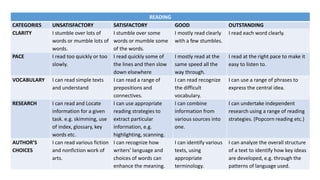
READING
CATEGORIES UNSATISFACTORY SATISFACTORY GOOD OUTSTANDING
CLARITY I stumble over lots of
words or mumble lots of
words.
I stumble over some
words or mumble some
of the words.
I mostly read clearly
with a few stumbles.
I read each word clearly.
PACE I read too quickly or too
slowly.
I read quickly some of
the lines and then slow
down elsewhere
I mostly read at the
same speed all the
way through.
I read at the right pace to make it
easy to listen to.
VOCABULARY I can read simple texts
and understand
I can read a range of
prepositions and
connectives.
I can read recognize
the difficult
vocabulary.
I can use a range of phrases to
express the central idea.
RESEARCH I can read and Locate
information for a given
task. e.g. skimming, use
of index, glossary, key
words etc.
I can use appropriate
reading strategies to
extract particular
information, e.g.
highlighting, scanning.
I can combine
information from
various sources into
one.
I can undertake independent
research using a range of reading
strategies. (Popcorn reading etc.)
AUTHOR’S
CHOICES
I can read various fiction
and nonfiction work of
arts.
I can recognize how
writers’ language and
choices of words can
enhance the meaning.
I can identify various
texts, using
appropriate
terminology.
I can analyze the overall structure
of a text to identify how key ideas
are developed, e.g. through the
patterns of language used.
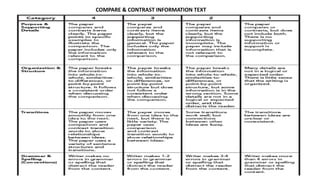
COMPARE & CONTRAST INFORMATION TEXT
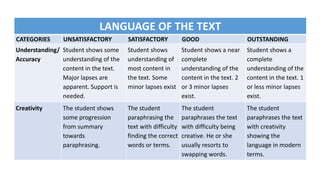
LANGUAGE OF THE TEXT
CATEGORIES UNSATISFACTORY SATISFACTORY GOOD OUTSTANDING
Understanding/
Accuracy
Student shows some
understanding of the
content in the text.
Major lapses are
apparent. Support is
needed.
Student shows
understanding of
most content in
the text. Some
minor lapses exist
Student shows a near
complete
understanding of the
content in the text. 2
or 3 minor lapses
exist.
Student shows a
complete
understanding of the
content in the text. 1
or less minor lapses
exist.
Creativity The student shows
some progression
from summary
towards
paraphrasing.
The student
paraphrasing the
text with difficulty
finding the correct
words or terms.
The student
paraphrases the text
with difficulty being
creative. He or she
usually resorts to
swapping words.
The student
paraphrases the text
with creativity
showing the
language in modern
terms.
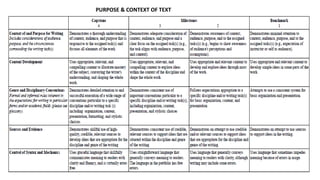
PURPOSE & CONTEXT OF TEXT
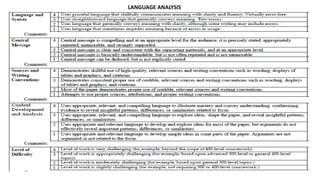
LANGUAGE ANALYSIS
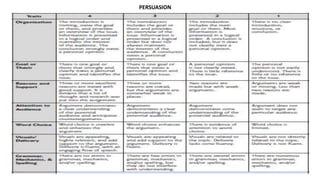
PERSUASION
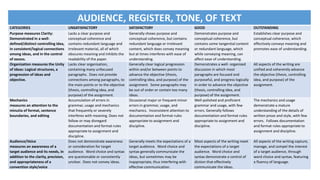
AUDIENCE, REGISTER, TONE, OF TEXT
CATEGORIES UNSATISFACTORY SATISFACTORY GOOD OUTSTANDING
Purpose measures Clarity:
Demonstrated in a well-
defined/distinct controlling idea,
in consistent/logical connections
among ideas, and in the control
of excess.
Lacks a clear purpose and
conceptual coherence and
contains redundant language and
irrelevant material, all of which
obscures meaning and inhibits the
readability of the paper.
Generally shows purpose and
conceptual coherence, but contains
redundant language or irrelevant
content, which does convey meaning
but at times interferes with ease of
understanding.
Demonstrates purpose and
conceptual coherence, but
contains some tangential content
or redundant language, which
while conveying meaning, can
affect ease of understanding.
Establishes clear purpose and
conceptual coherence, which
effectively conveys meaning and
promotes ease of understanding.
Organization measures the Unity
of Ideas: Logical structures, a
progression of ideas and
objective.
Lacks clear organization,
containing many unfocused
paragraphs. Does not provide
connections among paragraphs, to
the main points or to the objective
(thesis, controlling idea, and
purpose) of the assignment.
Generally clear logical progression
within and/or between points to
advance the objective (thesis,
controlling idea, and purpose) of the
assignment. Some paragraphs may
be out of order or contain too many
ideas.
Demonstrates a well- organized
discussion in which most
paragraphs are focused and
purposeful, and progress logically
in order to advance the objective
(thesis, controlling idea, and
purpose) of the assignment.
All aspects of the writing are
unified and coherently advance
the objective (thesis, controlling
idea, and purpose) of the
assignment.
Mechanics
measures an attention to the
minutia of format, sentence
boundaries, and editing
Accumulation of errors in
grammar, usage and mechanics
that frequently or severely
interferes with meaning. Does not
follow or may disregard
documentation and format rules
appropriate to assignment and
discipline.
Occasional major or frequent minor
errors in grammar, usage, and
mechanics. Inconsistent attention to
documentation and format rules
appropriate to assignment and
discipline.
Well-polished and proficient
grammar and usage, with few
errors. Generally follows
documentation and format rules
appropriate to assignment and
discipline.
The mechanics and usage
demonstrate a mature
understanding of the details of
written prose and style, with few
errors. Follows documentation
and format rules appropriate to
assignment and discipline.
Audience/Voice
measures an awareness of a
target audience and its needs, in
addition to the clarity, precision,
and appropriateness of a
convention style/voice
Does not demonstrate awareness
or consideration for target
audience. Word choice and syntax
are questionable or consistently
unclear. Does not convey ideas.
Generally meets the expectations of a
target audience. Word choice and
syntax generally communicate the
ideas, but sometimes may be
inappropriate, thus interfering with
effective communication.
Most aspects of the writing meet
the expectations of a target
audience. Word choice and
syntax demonstrate a control of
diction that effectively
communicate the ideas.
All aspects of the writing capture,
manage, and compel the interest
of a target audience, through
word choice and syntax, featuring
a fluency of language.
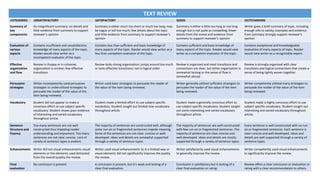
TEXT REVIEW
CATEGORIES UNSATISFACTORY SATISFACTORY GOOD OUTSTANDING
Summary of
key
components
An insignificant summary; no details and
little evidence from summary to support
reviewer’s opinion
Summary is either much too short or much too long; may
be vague or tell too much; few details about the topic
and little evidence from summary to support reviewer’s
opinion
Summary is either a little too long or not long
enough but is not quite as compelling; fewer
details from the movie and evidence from
summary to support reviewer’s opinion
Writer gives a brief summary of topic, including
enough info to satisfy; examples and evidence
from summary strongly support reviewer’s
opinion
Evaluation of
various
aspects
Contains insufficient and unsatisfactory
knowledge of many aspects of the topic.
Reader would view writer as a
incompetent evaluator of the topic.
Contains less than sufficient and basic knowledge of
many aspects of the topic. Reader would view writer as a
less than competent evaluator of the topic.
Contains sufficient and basic knowledge of
many aspects of the topic. Reader would view
writer as a competent evaluator of the topic.
Contains exceptional and knowledgeable
evaluation of many aspects of topic. Reader
would view writer as a recognizable expert.
Effective
organization
and flow
Review is choppy or in cohesive;
organization is unclear; few effective
transitions
Review lacks strong organization; jumps around too much
or lacks effective transitions; not in logical order
Review is organized and most transitions and
connections are clear, but either organization is
somewhat lacking or the sense of flow is
somewhat abrupt
Review is strongly organized with clear
transitions and logical connections that create a
sense of being tightly woven together
Persuasive
strategies
Writer incompetently used persuasive
strategies or underutilized strategies to
persuade the reader of the value of the
item being reviewed.
Writer used basic strategies to persuade the reader of
the value of the item being reviewed.
Writer generally utilized sufficient strategies to
persuade the reader of the value of the item
being reviewed.
Writer competently utilized many strategies to
persuade the reader of the value of the item
being reviewed.
Vocabulary Student did not appear to make a
conscious effort to use subject specific
vocabulary. Student shows poor evidence
of interesting and varied vocabulary
throughout article.
Student made a limited effort to use subject specific
vocabulary. Student sought out limited new vocabulary
throughout article.
Student made a generally conscious effort to
use subject specific vocabulary. Student sought
out some interesting and varied vocabulary
throughout article.
Student made a highly conscious effort to use
subject specific vocabulary. Student sought out
interesting and varied vocabulary throughout
article.
Sentence
Structure and
Fluency
Too many sentences are not well
constructed thus impeding reader
understanding and enjoyment. Too many
sentences are not clear concise. Lack of
variety of sentence types is evident.
The majority of sentences are constructed well, although
some run-on or fragmented sentences impede meaning.
Some of the sentences are not clear, concise or well-
developed. Ideas and details are somewhat supported
through a variety of sentence types.
The majority of sentences are well constructed
with few run-on or fragmented sentences. The
majority of sentences are clear concise and
well-developed. Ideas and details are mostly
supported through a variety of sentence types.
Every sentence is well constructed with no run-
on or fragmented sentences. Each sentence is
clear concise and well-developed. Ideas and
details are well supported through a variety of
sentence types.
Enhancements Writer did not visual enhancements visual
elements or the elements used detracted
from the overall quality the review.
Writer used visual enhancements to in a limited way or
visual elements did not significantly improve the quality
the review.
Writer satisfactorily used visual enhancements
to generally improve the review.
Writer competently used visual enhancements
to significantly improve the review.
Final
evaluation
No conclusion is present. A conclusion is present, but it's weak and lacking of a
clear final evaluation
Conclusion is satisfactory but is lacking of a
clear final evaluation or rating.
Review offers a clear conclusion or evaluation or
rating with a clear recommendation to others.
Rubrics