







Please Do Now…. 
As you enter the room please reflect on the 
following questions as you think about leading 
and spending your time focused on learning. 
Write a sentence or two to respond to each 
question. 
1. How much of my time is spent talking about and actively 
engaging in learning during my daily professional life? 
2. How am I creating ongoing, job-embedded, results driven 
professional learning for staff? 
3. How do you rate yourself as a learner? How would the staff 
and students rate you as a learner? 
“Children need models more than critics.” French proverb 
“Be the change you want to see in the world.” Ghandi
Professional Learning 
Communities 
Promoting 
Collaborative 
Learning
Research shows that the most promising 
strategy for sustained school improvement 
is developing the capacity of schools to 
function as a professional learning 
community.
Four Corners Activity 
“In times of drastic change, it is 
the learners who inherit the 
future. The learned usually find 
themselves beautifully equipped 
to live in a world that no longer 
exists.” 
Erick Hoffer 
“ You cannot have students as 
continuous learners and 
effective collaborators, without 
teachers that have the same 
characteristics.” 
Michael Fullan 
“Separated by their classrooms 
and packed teaching schedules, 
teachers rarely work or talk 
together about teaching 
practices.” 
Linda Darling-Hammond 
“Never doubt that a small group 
of committed, thoughtful people 
can change the world: Indeed 
it’s the only thing that ever has!” 
Margaret Mead
Expected Outcomes 
• Overview the structure and function of a Professional 
Learning Community 
• Understand the role of the Professional Learning 
Community in promoting improvement in teaching and 
learning 
• Identify protocols that facilitate learning in PLCs 
• Reflect on the role of PLCs in promoting a culture of 
teacher-directed professional development focused on 
student learning 
• Review M-DCPS Guidelines for implementing 
PLCs
Agenda – Day 2 
• Creating Successful Collaborative Teams 
• Essential Ingredients of PLCs 
• Protocol 1: Examining Professional Practice 
• Protocol 2: Effective Discussions 
• Protocol 3: Examining Student Work 
• Protocol 4: Addressing Issues and Problems 
• M-DCPS PLC Guidelines 
• Closure
Norms 
• Listen 
• Engage 
• Ask 
• Reflect 
• Nurture
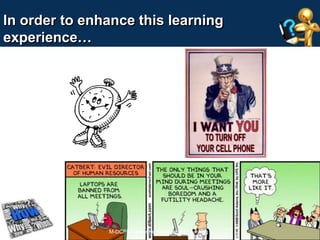
In order to enhance this learning 
experience… 
M-DCPS Center for Professional Learning
Beliefs 
• Teachers are intelligent, capable, and want to do the 
right thing for their students. 
• People are committed to ideas and plans that they have 
helped create. 
• Everyone’s opinion is of equal value, regardless of rank 
or position. 
• Groups can manage their own conflicts, behaviors, and 
relationships if they are given tools and training. 
• Groups make better decisions than any one person 
alone. 
• The process, if well designed and applied with fidelity, 
can be trusted to achieve results. 
Ingrid Bens, Facilitating with Ease!, 2000
Anticipation Guide 
• Read the statements on the anticipation guide. Decide 
if you agree or disagree with each statement. 
• Meet with your team members. Be ready to share your 
opinion and be open to listening to each other’s points 
of view. 
• After sharing and discussing, come to a consensus on 
whether you agree or disagree with each statement. 
No voting—if you can’t come to a consensus you can 
rewrite a statement so that all of you can support the 
same position.
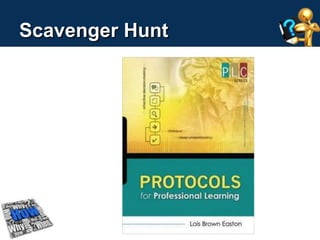
Scavenger Hunt
Please be back 
@ 10:15 
Thank you.
Effective Discussions 
The Last Word Protocol, pp. 82-83 
Step 1: Identifying Significant Ideas (3 minutes) 
Step 2: Sharing, Round 1 (4 minutes) 
Step 3: Sharing, Round 2 (4 minutes) 
Step 4: Sharing, Round 3 (4 minutes) 
Step 5: Open Discussion (optional) 
Step 6: Debriefing (5 minutes) 
*When sharing, 1st participant shares significant idea but does 
not elaborate 
*Other participants have 1 minute to agree or disagree 
*1st participant then has two to 3 minutes to respond to and 
elaborate on what the others in the group have said.
Debrief Protocol 
How was this a useful way to explore 
the ideas in the text and to explore 
your own thinking?
PLC Essential Elements 
1. Shared mission, vision, values, goals 
2. Collaborative teams focused on learning 
3. Collective inquiry 
4. Action oriented and experimentation 
5. Commitment to continuous improvement 
6. Results orientation
M-DCPS PLC Guidelines 
• 5-12 participants 
• Regularly scheduled meetings at least one 
hour in duration (not less than twice monthly) 
• Focus on a common goal related to student 
achievement 
• First meeting is devoted to organizational 
tasks 
• Shared leadership is key 
• Protocols keep the meetings focused and 
facilitate equity 
• Submit M-DCPS form #
M-DCPS Guidelines
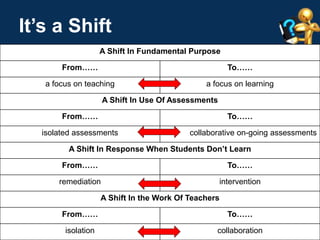
It’s a Shift 
A Shift In Fundamental Purpose 
From…… To…… 
a focus on teaching a focus on learning 
A Shift In Use Of Assessments 
From…… To…… 
isolated assessments collaborative on-going assessments 
A Shift In Response When Students Don’t Learn 
From…… To…… 
remediation intervention 
A Shift In the Work Of Teachers 
From…… To…… 
isolation collaboration
21 
Which Champion Works Within a PLC?
22 
Tiger Woods 
He works in a foursome, but he is 
truly independent. No matter 
which foursome he is with, he does 
not collaborate, help or encourage 
them. Tiger wants to get all the 
glory. 
Room 417
23 
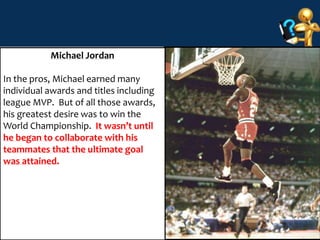
Michael Jordan 
In the pros, Michael earned many 
individual awards and titles including 
league MVP. But of all those awards, 
his greatest desire was to win the 
World Championship. It wasn’t until 
he began to collaborate with his 
teammates that the ultimate goal 
was attained.
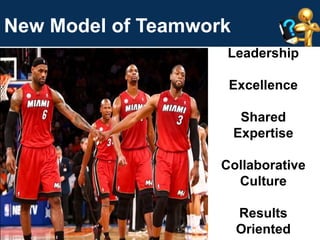
Leadership 
Excellence 
Shared 
Expertise 
Collaborative 
Culture 
Results 
Oriented 
New Model of Teamwork
Time for lunch… 
Please be back by 
12:30 p.m. 
Thank you.
3 Minute Buzz 
Spend the next 3 minutes reflecting on the 
following and write your thoughts on the “Do 
Now” paper: 
1. Something you’ve seen in the first part of 
the session that affirms your thinking. 
2. An idea that’s new to you. 
3. Something you’re uncertain about. 
4. Something you’re hoping to see in the 
remainder of the session. 
M-DCPS Center for Professional Learning
Examining Student Work 
Tuning Protocol, pp. 34-36 
Step 1: Introduction (5 minutes) 
Step 2: Presentation (15 minutes) 
Step 3: Clarifying Questions (5 minutes) 
Step 4: Individual Writing (5 minutes) 
Step 5: Participant Discussion (15 minutes) 
Step 6: Presenter Reflection (15 minutes) 
Step 7: Debriefing (5 minutes) 
*During presentation, participants listen and take notes 
*During the participant discussion, presenter is silent 
*During the presenter reflection, participants silently take 
notes
Debriefing 
1. Did the team honor the norms at all 
times? 
2. What went well? 
3. What could have gone better?
All Things PLC! 
Imagine the local television station has provided 
you with a sixty-second spot on the evening 
news to help the community understand the 
PLC initiative that is underway in your school. 
Develop your presentation, keeping in mind that 
you cannot go over sixty seconds, you do not 
want to leave thirty seconds of “dead” air 
because you have run out of things to say, and 
you do not want to use a log of jargon.
Creating Conditions to Get Started 
Compare and contrast your organization to the story. 
This story teaches two lessons: 
1. An encouraging word to someone who is down can lift them up 
and help them make it through the day. 
2. A destructive word to someone who is down can be what it 
takes to kill them. 
Speak life to those who cross your path!
Addressing Issues & Problems 
SWOT Protocol, pp. 74-76 
Step 1: Introduction (5 minutes) 
Step 2: Presentation (15 minutes) 
Step 3: Clarifying Questions (5 minutes) 
Step 4: Individual Writing (5 minutes) 
Step 5: Participant Discussion (15 minutes) 
Step 6 : Presenter Reflection (15 minutes) 
Step 7: Debriefing (5 minutes) 
*During the presentation, participants quietly take notes 
*During the participant discussion, presenter is 
completely silent
Questions 
• How can we create a professional learning 
culture at our school? 
• What can we do to begin the process and 
get teacher buy in? 
• How can our strengths as the PLST help 
reach the goal and be used most 
effectively?
Debriefing protocol 
1. What did we learn? What helped us to do that 
learning? 
2. Did the conversation move us closer to our goals? 
How? 
3. Did we follow the process as we planned? If not, 
why? How could we improve our process? 
4. How might we build on this conversation?
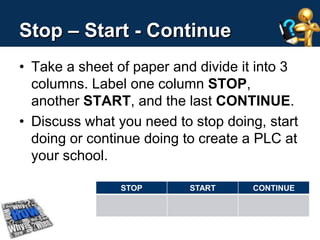
Stop – Start - Continue 
• Take a sheet of paper and divide it into 3 
columns. Label one column STOP, 
another START, and the last CONTINUE. 
• Discuss what you need to stop doing, start 
doing or continue doing to create a PLC at 
your school. 
STOP START CONTINUE
“School improvement happens when a 
school develops a professional learning 
community that focuses on student 
work and changes teaching. In order to 
do that, you need certain kinds of skills, 
capacities, and relationships.” 
Michael Fullan
3-2-1 Reflection 
• What 3 things about professional learning 
communities did you learn or were clarified 
for you? 
• What 2 things about professional learning 
communities you interested in learning 
about or what 2 questions do you still have 
about professional learning communities? 
• What is the 1 thing you feel is the most 
important aspect about professional 
learning communities that you must be 
aware of when planning one at your school?
Resources 
• A Big Picture Look at Professional Learning Communities. Available from www.allthings.plc.info 
• Campbell, M.(2011). The PLC at Work Cartoon Book. Bloomington, IN. Solution Tree Press. 
• Carmichael, D. L., & Martens, R. P. (2012). Midwestern magic: Iowa's statewide initiative engages teachers, 
encourages leadership, and energizes student learning. Journal of Staff Development, 33(3), 22- 
26. 
• DuFour, R., DuFour, R., Eaker, R., Many, T. (2006) Learning by Doing: A Handbook for Professional 
Learning Communities at Work. Bloomingto, IN. Solution Tree Press 
• Ermeling, B. A., & Gallimore, R. (2013). Learning to be a community: Schools need adaptable models to 
create successful programs. Journal of Staff Development, 34(2), 42-45. 
• Hord, S., & Sommers, W. (2008). Leading Professional Learning Communities. Voices from Research and 
Practice. Thousand Oaks, CA. Corwin Press. 
• Kise, J. A. (2012). Give teams a running start: Take steps to build shared vision, trust, and collaboration 
skills. Journal of Staff Development, 33(3), 38-42 
• Moirao, D. R., Morris, S. C., Klein, V., & Jackson, J. W. How Do You Know Your PLC is Working? Available 
from www.thoughtfulclassrooms.com 
• Moirao, D. R., Morris, S. C., Klein, V., & Jackson, J. W. (2012). Team check-up: Use 4 goals to assess a 
professional learning community's effectiveness. Journal of Staff Development, 33(3), 32-36. 
• Thomas, J. (2011). The Road to Developing Communities of Professional Learners. 
• Smith, R., Johnson, M., & Thompson, K. D. (2012). Data, our GPS. Educational Leadership, 69(5), 56-59
THANK YOU

Professional learning communities

  • 1.
    Please Do Now…. As you enter the room please reflect on the following questions as you think about leading and spending your time focused on learning. Write a sentence or two to respond to each question. 1. How much of my time is spent talking about and actively engaging in learning during my daily professional life? 2. How am I creating ongoing, job-embedded, results driven professional learning for staff? 3. How do you rate yourself as a learner? How would the staff and students rate you as a learner? “Children need models more than critics.” French proverb “Be the change you want to see in the world.” Ghandi
  • 2.
    Professional Learning Communities Promoting Collaborative Learning
  • 3.
    Research shows thatthe most promising strategy for sustained school improvement is developing the capacity of schools to function as a professional learning community.
  • 4.
    Four Corners Activity “In times of drastic change, it is the learners who inherit the future. The learned usually find themselves beautifully equipped to live in a world that no longer exists.” Erick Hoffer “ You cannot have students as continuous learners and effective collaborators, without teachers that have the same characteristics.” Michael Fullan “Separated by their classrooms and packed teaching schedules, teachers rarely work or talk together about teaching practices.” Linda Darling-Hammond “Never doubt that a small group of committed, thoughtful people can change the world: Indeed it’s the only thing that ever has!” Margaret Mead
  • 5.
    Expected Outcomes •Overview the structure and function of a Professional Learning Community • Understand the role of the Professional Learning Community in promoting improvement in teaching and learning • Identify protocols that facilitate learning in PLCs • Reflect on the role of PLCs in promoting a culture of teacher-directed professional development focused on student learning • Review M-DCPS Guidelines for implementing PLCs
  • 6.
    Agenda – Day2 • Creating Successful Collaborative Teams • Essential Ingredients of PLCs • Protocol 1: Examining Professional Practice • Protocol 2: Effective Discussions • Protocol 3: Examining Student Work • Protocol 4: Addressing Issues and Problems • M-DCPS PLC Guidelines • Closure
  • 7.
    Norms • Listen • Engage • Ask • Reflect • Nurture
  • 8.
    In order toenhance this learning experience… M-DCPS Center for Professional Learning
  • 9.
    Beliefs • Teachersare intelligent, capable, and want to do the right thing for their students. • People are committed to ideas and plans that they have helped create. • Everyone’s opinion is of equal value, regardless of rank or position. • Groups can manage their own conflicts, behaviors, and relationships if they are given tools and training. • Groups make better decisions than any one person alone. • The process, if well designed and applied with fidelity, can be trusted to achieve results. Ingrid Bens, Facilitating with Ease!, 2000
  • 12.
    Anticipation Guide •Read the statements on the anticipation guide. Decide if you agree or disagree with each statement. • Meet with your team members. Be ready to share your opinion and be open to listening to each other’s points of view. • After sharing and discussing, come to a consensus on whether you agree or disagree with each statement. No voting—if you can’t come to a consensus you can rewrite a statement so that all of you can support the same position.
  • 13.
  • 14.
    Please be back @ 10:15 Thank you.
  • 15.
    Effective Discussions TheLast Word Protocol, pp. 82-83 Step 1: Identifying Significant Ideas (3 minutes) Step 2: Sharing, Round 1 (4 minutes) Step 3: Sharing, Round 2 (4 minutes) Step 4: Sharing, Round 3 (4 minutes) Step 5: Open Discussion (optional) Step 6: Debriefing (5 minutes) *When sharing, 1st participant shares significant idea but does not elaborate *Other participants have 1 minute to agree or disagree *1st participant then has two to 3 minutes to respond to and elaborate on what the others in the group have said.
  • 16.
    Debrief Protocol Howwas this a useful way to explore the ideas in the text and to explore your own thinking?
  • 17.
    PLC Essential Elements 1. Shared mission, vision, values, goals 2. Collaborative teams focused on learning 3. Collective inquiry 4. Action oriented and experimentation 5. Commitment to continuous improvement 6. Results orientation
  • 18.
    M-DCPS PLC Guidelines • 5-12 participants • Regularly scheduled meetings at least one hour in duration (not less than twice monthly) • Focus on a common goal related to student achievement • First meeting is devoted to organizational tasks • Shared leadership is key • Protocols keep the meetings focused and facilitate equity • Submit M-DCPS form #
  • 19.
  • 20.
    It’s a Shift A Shift In Fundamental Purpose From…… To…… a focus on teaching a focus on learning A Shift In Use Of Assessments From…… To…… isolated assessments collaborative on-going assessments A Shift In Response When Students Don’t Learn From…… To…… remediation intervention A Shift In the Work Of Teachers From…… To…… isolation collaboration
  • 21.
    21 Which ChampionWorks Within a PLC?
  • 22.
    22 Tiger Woods He works in a foursome, but he is truly independent. No matter which foursome he is with, he does not collaborate, help or encourage them. Tiger wants to get all the glory. Room 417
  • 23.
    23 Michael Jordan In the pros, Michael earned many individual awards and titles including league MVP. But of all those awards, his greatest desire was to win the World Championship. It wasn’t until he began to collaborate with his teammates that the ultimate goal was attained.
  • 24.
    Leadership Excellence Shared Expertise Collaborative Culture Results Oriented New Model of Teamwork
  • 25.
    Time for lunch… Please be back by 12:30 p.m. Thank you.
  • 27.
    3 Minute Buzz Spend the next 3 minutes reflecting on the following and write your thoughts on the “Do Now” paper: 1. Something you’ve seen in the first part of the session that affirms your thinking. 2. An idea that’s new to you. 3. Something you’re uncertain about. 4. Something you’re hoping to see in the remainder of the session. M-DCPS Center for Professional Learning
  • 28.
    Examining Student Work Tuning Protocol, pp. 34-36 Step 1: Introduction (5 minutes) Step 2: Presentation (15 minutes) Step 3: Clarifying Questions (5 minutes) Step 4: Individual Writing (5 minutes) Step 5: Participant Discussion (15 minutes) Step 6: Presenter Reflection (15 minutes) Step 7: Debriefing (5 minutes) *During presentation, participants listen and take notes *During the participant discussion, presenter is silent *During the presenter reflection, participants silently take notes
  • 29.
    Debriefing 1. Didthe team honor the norms at all times? 2. What went well? 3. What could have gone better?
  • 30.
    All Things PLC! Imagine the local television station has provided you with a sixty-second spot on the evening news to help the community understand the PLC initiative that is underway in your school. Develop your presentation, keeping in mind that you cannot go over sixty seconds, you do not want to leave thirty seconds of “dead” air because you have run out of things to say, and you do not want to use a log of jargon.
  • 31.
    Creating Conditions toGet Started Compare and contrast your organization to the story. This story teaches two lessons: 1. An encouraging word to someone who is down can lift them up and help them make it through the day. 2. A destructive word to someone who is down can be what it takes to kill them. Speak life to those who cross your path!
  • 32.
    Addressing Issues &Problems SWOT Protocol, pp. 74-76 Step 1: Introduction (5 minutes) Step 2: Presentation (15 minutes) Step 3: Clarifying Questions (5 minutes) Step 4: Individual Writing (5 minutes) Step 5: Participant Discussion (15 minutes) Step 6 : Presenter Reflection (15 minutes) Step 7: Debriefing (5 minutes) *During the presentation, participants quietly take notes *During the participant discussion, presenter is completely silent
  • 33.
    Questions • Howcan we create a professional learning culture at our school? • What can we do to begin the process and get teacher buy in? • How can our strengths as the PLST help reach the goal and be used most effectively?
  • 34.
    Debriefing protocol 1.What did we learn? What helped us to do that learning? 2. Did the conversation move us closer to our goals? How? 3. Did we follow the process as we planned? If not, why? How could we improve our process? 4. How might we build on this conversation?
  • 35.
    Stop – Start- Continue • Take a sheet of paper and divide it into 3 columns. Label one column STOP, another START, and the last CONTINUE. • Discuss what you need to stop doing, start doing or continue doing to create a PLC at your school. STOP START CONTINUE
  • 36.
    “School improvement happenswhen a school develops a professional learning community that focuses on student work and changes teaching. In order to do that, you need certain kinds of skills, capacities, and relationships.” Michael Fullan
  • 37.
    3-2-1 Reflection •What 3 things about professional learning communities did you learn or were clarified for you? • What 2 things about professional learning communities you interested in learning about or what 2 questions do you still have about professional learning communities? • What is the 1 thing you feel is the most important aspect about professional learning communities that you must be aware of when planning one at your school?
  • 38.
    Resources • ABig Picture Look at Professional Learning Communities. Available from www.allthings.plc.info • Campbell, M.(2011). The PLC at Work Cartoon Book. Bloomington, IN. Solution Tree Press. • Carmichael, D. L., & Martens, R. P. (2012). Midwestern magic: Iowa's statewide initiative engages teachers, encourages leadership, and energizes student learning. Journal of Staff Development, 33(3), 22- 26. • DuFour, R., DuFour, R., Eaker, R., Many, T. (2006) Learning by Doing: A Handbook for Professional Learning Communities at Work. Bloomingto, IN. Solution Tree Press • Ermeling, B. A., & Gallimore, R. (2013). Learning to be a community: Schools need adaptable models to create successful programs. Journal of Staff Development, 34(2), 42-45. • Hord, S., & Sommers, W. (2008). Leading Professional Learning Communities. Voices from Research and Practice. Thousand Oaks, CA. Corwin Press. • Kise, J. A. (2012). Give teams a running start: Take steps to build shared vision, trust, and collaboration skills. Journal of Staff Development, 33(3), 38-42 • Moirao, D. R., Morris, S. C., Klein, V., & Jackson, J. W. How Do You Know Your PLC is Working? Available from www.thoughtfulclassrooms.com • Moirao, D. R., Morris, S. C., Klein, V., & Jackson, J. W. (2012). Team check-up: Use 4 goals to assess a professional learning community's effectiveness. Journal of Staff Development, 33(3), 32-36. • Thomas, J. (2011). The Road to Developing Communities of Professional Learners. • Smith, R., Johnson, M., & Thompson, K. D. (2012). Data, our GPS. Educational Leadership, 69(5), 56-59
  • 39.