Florida K-12 Reading Endorsement Competency Three   Foundations of Assessment Session One FLaRE Professional Development Competency Three: Foundations of Assessment S1
Agenda Competency 3 Indicators What is Assessment? Using Data Effectively in a Wide Variety of Roles Developing a Shared Language Gathering Information about an Invisible Process Principles of Effective Literacy Assessment 5 Critical Areas of Reading Follow Up FLaRE Professional Development Competency Three: Foundations of Assessment S1
Competency Three Indicators Knowledge   3.2 Understands the role of assessment in planning instruction to meet student learning needs. 3.3 Interprets students’ formal and informal test results. 3.5 Understands the meaning of test reliability and validity, and describe major types of derived scores from standardized tests. 3.8 Understands how to use data to differentiate instruction 3.9 Understands how to interpret data with application of instruction that matches students with appropriate level of intensity of intervention, with appropriate curricular materials, and with appropriate strategies.   FLaRE Professional Development Competency Three: Foundations of Assessment S1
Competency Three Indicators Skills 3.1 Describe or recognize appropriate test formats and types of test items for assessing the major elements of reading growth:  phonemic awareness, phonics, fluency, vocabulary, and reading comprehension. 3.4 Identify measurement concepts and characteristics and uses of norm-referenced and criterion referenced tests. 3.6 Demonstrate knowledge of the characteristics, administration, and interpretation of both quantitative and qualitative instructional assessments. 3.7 Analyze data to identify trends that indicate adequate progress in student reading development. 3.10 Identify appropriate criteria for selecting materials to include in portfolios for monitoring student progress over time. 3.11 Identify interpretive issues that may arise when English language tests are used to assess reading growth in LEP students. 3.12 Identify reading assessment techniques appropriate for diagnosing and monitoring reading progress of LEP students and students with disabilities in the area of reading. FLaRE Professional Development Competency Three: Foundations of Assessment S1
Textbooks FLaRE Professional Development Competency Three: Foundations of Assessment S1
Foundations and Applications of Differentiating Instruction: Competencies Four and Five S1 -
In order to successfully complete the course… Foundations and Applications of Differentiating Instruction: Competencies Four and Five S1 -
Course Completion Based On: Attendance Participation in class discussions Daily postings to course blog Group Presentations Creation of an Assessment Kit Case study FLaRE Professional Development Competency Three: Foundations of Assessment S1
Locating and Correcting Reading Difficulties Group Project  Choose topic of interest Read chapter Present information using a CRISS strategy Each individual will have 20 minutes to present Presentation needs to be interactive Presentation must include: How to Assess Skill  How to Teach Skill ELL students Recommendations – Model 1 activity FLaRE Professional Development Competency Three: Foundations of Assessment S1
Assessment Kit Each participant will develop an  Assessment Kit  including formal and informal assessments, and screening, diagnostic, progress monitoring, and outcome instruments, that support diagnosis of difficulties  in various areas of literacy.  Areas to be included are: phonemic awareness and phonics skills  sight word skills spelling stages writing stage assessments  fluency measures vocabulary knowledge  oral language  comprehension measures ***Due June 29 th   Send as an attachment Share in the morning FLaRE Professional Development Competency Three: Foundations of Assessment S1
Case Study Case study for one individual student analyzing findings from the: FAIR Student Detailed Report Conducting one activity with the class to demonstrate a strategy used to address an area of weakness identified for that individual student. FLaRE Professional Development Competency Three: Foundations of Assessment S1  ***Due June 30 th   Send as an attachment Share in the morning
For any learning endeavor to be successful, the learner must have answers to basic questions: Where am I going? Where am I now? How do I get where I’m going? How will I know when I get there? Am I on the right track for getting there? FLaRE Professional Development Competency Three: Foundations of Assessment S1
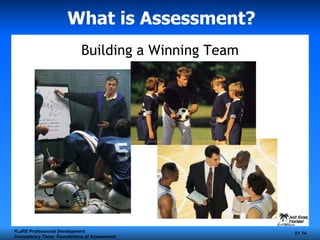
What is Assessment?   Building a Winning Team FLaRE Professional Development Competency Three: Foundations of Assessment S1
Discussion Questions Who gets assigned to what position? Who makes what team? How often does the team need to practice? Does everyone need to practice the same activity? Who sits on the bench? Where are we going to play? Do the players ever change position? What does the team need for uniforms? What does the coach do on the sidelines? Does the coach adjust anything during the game? How does the coach determine success? Is all the practice for success in a single game? What is the next step for this team? Does the coach ever alter practice routines? What determines the team’s practice pace? What determines the team’s practice intensity? How does the team practice successful moves? FLaRE Professional Development Competency Three: Foundations of Assessment S1
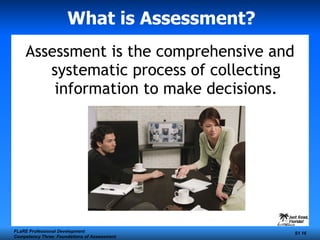
What is Assessment?   Assessment is the comprehensive and systematic process of collecting information to make decisions. FLaRE Professional Development Competency Three: Foundations of Assessment S1
Using Data Effectively in a Wide Variety of Roles FLaRE Professional Development Competency Three: Foundations of Assessment S1  Teacher Principal District Staff Student Parent
Would the football coach, the intensive reading teacher, and the guidance counselor creating student schedules use the same data in the same way, or would they need different data in forms useful for different purposes? Using Data Effectively in a Wide Variety of Roles FLaRE Professional Development Competency Three: Foundations of Assessment S1
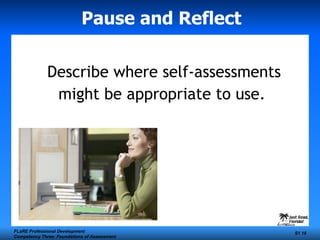
Pause and Reflect   Describe where self-assessments might be appropriate to use.   FLaRE Professional Development Competency Three: Foundations of Assessment S1
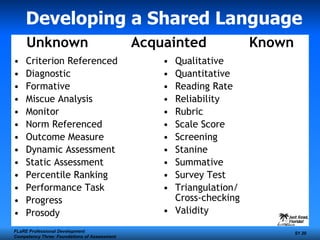
Developing a Shared Language Criterion Referenced Diagnostic Formative Miscue Analysis Monitor Norm Referenced Outcome Measure Dynamic Assessment Static Assessment Percentile Ranking Performance Task Progress Prosody Qualitative  Quantitative Reading Rate Reliability Rubric Scale Score Screening Stanine Summative Survey Test Triangulation/ Cross-checking Validity FLaRE Professional Development Competency Three: Foundations of Assessment S1  Unknown  Acquainted  Known
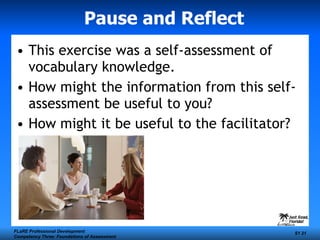
Pause and Reflect This exercise was a self-assessment of vocabulary knowledge.  How might the information from this self-assessment be useful to you?  How might it be useful to the facilitator?   FLaRE Professional Development Competency Three: Foundations of Assessment S1
Gathering Information about an Invisible Process FLaRE Professional Development Competency Three: Foundations of Assessment S1
Pause and Reflect What does this story teach us about the assessment of reading? FLaRE Professional Development Competency Three: Foundations of Assessment S1
Principles of Effective Literacy Assessment Across Academic Content Areas Assessment should be reliable and valid. Assessment should be done on an ongoing basis. Effective assessment is an integral part of instruction. Assessment should inform instruction. Effective assessment identifies students’ strengths and needs.  Assessment should be based on what we know about how students learn to read and write. FLaRE Professional Development Competency Three: Foundations of Assessment S1
Principles of Effective Literacy Assessment Across Academic Content Areas Assessment must reflect different purposes and changing academic demands as students progress to higher grade levels, encountering higher-levels of thinking and critical skills. FLaRE Professional Development Competency Three: Foundations of Assessment S1
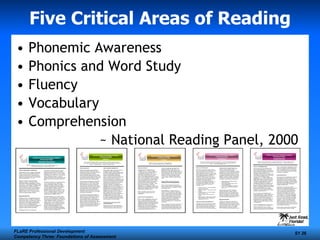
Five Critical Areas of Reading Phonemic Awareness Phonics and Word Study Fluency Vocabulary Comprehension   ~ National Reading Panel, 2000 FLaRE Professional Development Competency Three: Foundations of Assessment S1
Five Critical Areas of Reading Phonemic Awareness:  in-the-head ability to focus on and manipulate the individual sounds in spoken words   Phonics:  the association of sounds and letters used as a source of information to construct meaning from print   Fluency:  ability to read a text quickly, accurately, and with proper expression to construct meaning from print     Vocabulary:  inventory of receptive (presented to us in text or as we listen to others speak) and productive (used in writing or when speaking to others) words used to construct meaning   Comprehension:  the complex cognitive processes involving the transactions between reader, text, and context to construct meaning from print   FLaRE Professional Development Competency Three: Foundations of Assessment S1
Five Critical Areas of Reading The NRP highlighted five critical areas of reading.  What other areas of reading may be taken into account when considering students across academic content areas and grade levels? FLaRE Professional Development Competency Three: Foundations of Assessment S1

Session 1

  • 1.
    Florida K-12 ReadingEndorsement Competency Three Foundations of Assessment Session One FLaRE Professional Development Competency Three: Foundations of Assessment S1
  • 2.
    Agenda Competency 3Indicators What is Assessment? Using Data Effectively in a Wide Variety of Roles Developing a Shared Language Gathering Information about an Invisible Process Principles of Effective Literacy Assessment 5 Critical Areas of Reading Follow Up FLaRE Professional Development Competency Three: Foundations of Assessment S1
  • 3.
    Competency Three IndicatorsKnowledge   3.2 Understands the role of assessment in planning instruction to meet student learning needs. 3.3 Interprets students’ formal and informal test results. 3.5 Understands the meaning of test reliability and validity, and describe major types of derived scores from standardized tests. 3.8 Understands how to use data to differentiate instruction 3.9 Understands how to interpret data with application of instruction that matches students with appropriate level of intensity of intervention, with appropriate curricular materials, and with appropriate strategies. FLaRE Professional Development Competency Three: Foundations of Assessment S1
  • 4.
    Competency Three IndicatorsSkills 3.1 Describe or recognize appropriate test formats and types of test items for assessing the major elements of reading growth: phonemic awareness, phonics, fluency, vocabulary, and reading comprehension. 3.4 Identify measurement concepts and characteristics and uses of norm-referenced and criterion referenced tests. 3.6 Demonstrate knowledge of the characteristics, administration, and interpretation of both quantitative and qualitative instructional assessments. 3.7 Analyze data to identify trends that indicate adequate progress in student reading development. 3.10 Identify appropriate criteria for selecting materials to include in portfolios for monitoring student progress over time. 3.11 Identify interpretive issues that may arise when English language tests are used to assess reading growth in LEP students. 3.12 Identify reading assessment techniques appropriate for diagnosing and monitoring reading progress of LEP students and students with disabilities in the area of reading. FLaRE Professional Development Competency Three: Foundations of Assessment S1
  • 5.
    Textbooks FLaRE ProfessionalDevelopment Competency Three: Foundations of Assessment S1
  • 6.
    Foundations and Applicationsof Differentiating Instruction: Competencies Four and Five S1 -
  • 7.
    Foundations and Applicationsof Differentiating Instruction: Competencies Four and Five S1 -
  • 8.
    In order tosuccessfully complete the course… Foundations and Applications of Differentiating Instruction: Competencies Four and Five S1 -
  • 9.
    Course Completion BasedOn: Attendance Participation in class discussions Daily postings to course blog Group Presentations Creation of an Assessment Kit Case study FLaRE Professional Development Competency Three: Foundations of Assessment S1
  • 10.
    Locating and CorrectingReading Difficulties Group Project Choose topic of interest Read chapter Present information using a CRISS strategy Each individual will have 20 minutes to present Presentation needs to be interactive Presentation must include: How to Assess Skill How to Teach Skill ELL students Recommendations – Model 1 activity FLaRE Professional Development Competency Three: Foundations of Assessment S1
  • 11.
    Assessment Kit Eachparticipant will develop an Assessment Kit including formal and informal assessments, and screening, diagnostic, progress monitoring, and outcome instruments, that support diagnosis of difficulties in various areas of literacy. Areas to be included are: phonemic awareness and phonics skills sight word skills spelling stages writing stage assessments fluency measures vocabulary knowledge oral language comprehension measures ***Due June 29 th Send as an attachment Share in the morning FLaRE Professional Development Competency Three: Foundations of Assessment S1
  • 12.
    Case Study Casestudy for one individual student analyzing findings from the: FAIR Student Detailed Report Conducting one activity with the class to demonstrate a strategy used to address an area of weakness identified for that individual student. FLaRE Professional Development Competency Three: Foundations of Assessment S1 ***Due June 30 th Send as an attachment Share in the morning
  • 13.
    For any learningendeavor to be successful, the learner must have answers to basic questions: Where am I going? Where am I now? How do I get where I’m going? How will I know when I get there? Am I on the right track for getting there? FLaRE Professional Development Competency Three: Foundations of Assessment S1
  • 14.
    What is Assessment? Building a Winning Team FLaRE Professional Development Competency Three: Foundations of Assessment S1
  • 15.
    Discussion Questions Whogets assigned to what position? Who makes what team? How often does the team need to practice? Does everyone need to practice the same activity? Who sits on the bench? Where are we going to play? Do the players ever change position? What does the team need for uniforms? What does the coach do on the sidelines? Does the coach adjust anything during the game? How does the coach determine success? Is all the practice for success in a single game? What is the next step for this team? Does the coach ever alter practice routines? What determines the team’s practice pace? What determines the team’s practice intensity? How does the team practice successful moves? FLaRE Professional Development Competency Three: Foundations of Assessment S1
  • 16.
    What is Assessment? Assessment is the comprehensive and systematic process of collecting information to make decisions. FLaRE Professional Development Competency Three: Foundations of Assessment S1
  • 17.
    Using Data Effectivelyin a Wide Variety of Roles FLaRE Professional Development Competency Three: Foundations of Assessment S1 Teacher Principal District Staff Student Parent
  • 18.
    Would the footballcoach, the intensive reading teacher, and the guidance counselor creating student schedules use the same data in the same way, or would they need different data in forms useful for different purposes? Using Data Effectively in a Wide Variety of Roles FLaRE Professional Development Competency Three: Foundations of Assessment S1
  • 19.
    Pause and Reflect Describe where self-assessments might be appropriate to use. FLaRE Professional Development Competency Three: Foundations of Assessment S1
  • 20.
    Developing a SharedLanguage Criterion Referenced Diagnostic Formative Miscue Analysis Monitor Norm Referenced Outcome Measure Dynamic Assessment Static Assessment Percentile Ranking Performance Task Progress Prosody Qualitative Quantitative Reading Rate Reliability Rubric Scale Score Screening Stanine Summative Survey Test Triangulation/ Cross-checking Validity FLaRE Professional Development Competency Three: Foundations of Assessment S1 Unknown Acquainted Known
  • 21.
    Pause and ReflectThis exercise was a self-assessment of vocabulary knowledge. How might the information from this self-assessment be useful to you? How might it be useful to the facilitator? FLaRE Professional Development Competency Three: Foundations of Assessment S1
  • 22.
    Gathering Information aboutan Invisible Process FLaRE Professional Development Competency Three: Foundations of Assessment S1
  • 23.
    Pause and ReflectWhat does this story teach us about the assessment of reading? FLaRE Professional Development Competency Three: Foundations of Assessment S1
  • 24.
    Principles of EffectiveLiteracy Assessment Across Academic Content Areas Assessment should be reliable and valid. Assessment should be done on an ongoing basis. Effective assessment is an integral part of instruction. Assessment should inform instruction. Effective assessment identifies students’ strengths and needs. Assessment should be based on what we know about how students learn to read and write. FLaRE Professional Development Competency Three: Foundations of Assessment S1
  • 25.
    Principles of EffectiveLiteracy Assessment Across Academic Content Areas Assessment must reflect different purposes and changing academic demands as students progress to higher grade levels, encountering higher-levels of thinking and critical skills. FLaRE Professional Development Competency Three: Foundations of Assessment S1
  • 26.
    Five Critical Areasof Reading Phonemic Awareness Phonics and Word Study Fluency Vocabulary Comprehension ~ National Reading Panel, 2000 FLaRE Professional Development Competency Three: Foundations of Assessment S1
  • 27.
    Five Critical Areasof Reading Phonemic Awareness: in-the-head ability to focus on and manipulate the individual sounds in spoken words   Phonics: the association of sounds and letters used as a source of information to construct meaning from print   Fluency: ability to read a text quickly, accurately, and with proper expression to construct meaning from print     Vocabulary: inventory of receptive (presented to us in text or as we listen to others speak) and productive (used in writing or when speaking to others) words used to construct meaning   Comprehension: the complex cognitive processes involving the transactions between reader, text, and context to construct meaning from print FLaRE Professional Development Competency Three: Foundations of Assessment S1
  • 28.
    Five Critical Areasof Reading The NRP highlighted five critical areas of reading. What other areas of reading may be taken into account when considering students across academic content areas and grade levels? FLaRE Professional Development Competency Three: Foundations of Assessment S1

Editor's Notes

  • #2 Welcome participants and introduce self. Give some of your background; professional and personal to build relationships. Husband 3 sons Bachelors: FIU Social Studies Marsters: Nova ESOL Specialist: UM Reading Miami Springs Lawton Chiles CSS Zone FLaRE Coordinator UCF – Just Read Florida HGHS Emphasize that the instructional practices used during the session can be applied to the classroom regardless of specific subject area. Explain that this is an overview of assessment and not an in-depth in-service which will solve all classroom issues.
  • #3 The purpose of this first session is to prepare participants with foundational knowledge on assessment.
  • #4 Briefly review competency 3 indicators on participant handouts.
  • #9 Attend every class ON TIME No absences…no exceptions! Participate in, and complete, individual and group assignments Class discussion, readings, presentations Post reflections to class blog daily Act professional Cell phones must be on SILENT No text messaging or computer usage while class is in session
  • #15 Divide participants into small groups of 4 or 5 people. Each group should select a sport for this focus activity. Have the group brainstorm ways that a coach in their sport would build a team.
  • #16 A few questions to get the discussion started. Have participants create a chart with their group’s strategies and a brief explanation for each of their decisions. Provide an opportunity for each group to share. Draw attention to the many ways assessment practices are implemented for the groups’ “winning teams.”
  • #17 Summarize discussion: Assessment is the comprehensive and systematic process of collecting information to make decisions.
  • #18 Randomly assign role of teacher, principal, district staff, student, or parent to each participant. 2. Each “role” group will generate a list of ways assessment is used in their assigned role. What kind of information is needed to make the before, during, and after instruction decisions described? Refer participants to Handout S1-2: “Roles of Assessment in Learning Process”. Review and discuss the Roles of Assessment as described in the chart. As Teachers • Parent Conferences • To identify students in need of more instructional assistance • To determine if students are improving with extra assistance • To set up reading groups, select appropriate materials, and make changes as needed As Principals • To identify where extra resources and support are needed in specific classrooms, grade levels • To evaluate the effectiveness of new or continued reading programs, supplementary reading programs, and instructional strategies • To evaluate the effectiveness of building-level strategies for organization and management As District Staff • To identify schools in need of additional resources (personnel, reading program materials, instructional techniques) • To compare student outcomes across grade levels where resources are the same and where different • To enhance professional development opportunities targeting student outcomes and student needs As Students • To make decisions about classes to take • To make career path decisions • For scholarship applications As Parents • To monitor progress of their child
  • #19 The data may be useful in different ways for different assessors. For assessment to be successfully implemented, it must match the demands of the context. Re-examine the roles of assessment in the previous pages to consider the audience for the assessment data and in what form the data would best be understood.
  • #20 Everyone benefits from occasionally engaging in self-assessment.
  • #21 We have just identified key players in a school’s assessment team. The next step to support this team would be to develop a common vocabulary, or shared language. Place posters around the room with each of the terms and the words “Unknown, Acquainted, and Known” across the top of the page. Give each participant color markers. Instruct the participants to put a colored dot on the continuum of “Unknown, Acquainted, and Known” for each term. This should give a quick picture of what assessment terms need reinforcement and what terms will need to be covered with some depth. Refer participants to Handout S1-3-4: “Assessment Terms” for a description of each term.
  • #22 As a large group, discuss answers to the questions on the slide.
  • #23 Read The Seven Mice by Ed Young aloud, following best practices for before reading, during reading, and after reading to actively involve participants.
  • #24 Ask participants to share after reflection.
  • #25 If the principles were not elicited in previous discussions, ensure that the concepts are introduced and discussed.
  • #26 Emphasize the key principle of literacy assessment
  • #27 What do you know about the five critical areas of reading. Write a one-sentence definition of their component on chart paper. Post the sentences around the room and discuss.
  • #28 reinforce or refine understandings of each reading component.
  • #29 Have participants engage in a table discussion on the question. Share responses with the whole group.