Phonemic
Awareness
Prepared by: Mary Grace L. Alilin
What does Phoneme means?
• Phoneme
- a member of the set of the smallest units of
speech that serve to distinguish one utterance
from another in a language or dialect
Origin of Phoneme
• The words “Phoneme” comes from the French
word phonème, from Greek phōnēmat-
, phōnēma which means speech
sound, utterance, and from phōnein to sound
What is Phonemic Awareness?
• Children need to be taught to hear sounds in words
and words are made up of the smallest parts of
sounds or phonemes.
• Phonemic awareness refers to the ability to hear
and manipulate sounds in words. It is not phonics.
It is auditory and does not involve words in print.
• It means recognizing and using individual sounds to
create sounds to create words.
• It is the ability to recognize that a spoken word
consists of sequence of individual sounds;
manipulate individual sounds in the speech stream
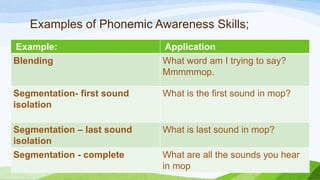
Examples of Phonemic Awareness Skills;
Example: Application
Blending What word am I trying to say?
Mmmmmop.
Segmentation- first sound
isolation
What is the first sound in mop?
Segmentation – last sound
isolation
What is last sound in mop?
Segmentation - complete What are all the sounds you hear
in mop
Remember
• LYON:
The best predictor of reading difficulty on
kindergarten or first grade is the inability to segment
words and syllables into constituent sound units
(phonemic awarenss)
Why is phonemic
important?
Three identified reasons
1. It requires readers to notice how letter represents
sounds.
2. It gives readers a way to approach sounding out
and reading new words.
3. It helps readers understand the alphabetic principle
- that the letters in words are systemically
represented by sounds.
Why is Phonemic difficult?
• Although there are 26 letters in the English
language, there are approximately 40
phonemes, or sound units
NOTE
• The number of phonemes varies across sources.
Sounds are represented in 250 different spellings (/f/ as in ph,
f ). The sounds units (phonemes) are NOT inherently obvious and
must be taught.
The sounds that make up words are “coarcticulated”, that
they are not distinctly separate from each other
Critical features of
phonemic awareness
• Phonemic awareness is critical component of
reading instruction but not an entire program.
• It absolutely needs to be taught, but should only be
10-15 minutes per day of your reading instruction.
• If you focus on just few steps of phonemic
awareness, but research has found that blending and
segmentation are the two skills that must be taught.
• Instruction must focus on BLENDING and
SEGMENTING words at the phoneme, or sound level.
• This is an AUDITORY TASK.
• Phonemic awareness can be best taught and can
have better results with small group of children.
• In critical phonemic awareness, pupils should learn:
a. Sound Isolation – Example: the first sound in
SUN is /sss/
b. Blending- Example: /sss/-/uuu/-/nnn/ is SUN
c. Segmenting – Example: The sounds in SUN are:
/sss/ - /uuu/-/nnn/
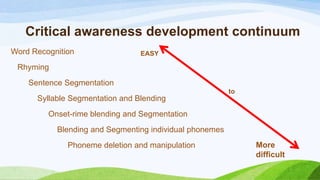
Critical awareness development continuum
Word Recognition
Rhyming
Sentence Segmentation
Syllable Segmentation and Blending
Onset-rime blending and Segmentation
Blending and Segmenting individual phonemes
Phoneme deletion and manipulation
EASY
to
More
difficult
~FIN~
Thanks for
Listening.
God Bless
You Prepared by:
Mary Grace L. Alilin

Phonemic awareness

  • 1.
  • 2.
    What does Phonememeans? • Phoneme - a member of the set of the smallest units of speech that serve to distinguish one utterance from another in a language or dialect
  • 3.
    Origin of Phoneme •The words “Phoneme” comes from the French word phonème, from Greek phōnēmat- , phōnēma which means speech sound, utterance, and from phōnein to sound
  • 4.
    What is PhonemicAwareness? • Children need to be taught to hear sounds in words and words are made up of the smallest parts of sounds or phonemes. • Phonemic awareness refers to the ability to hear and manipulate sounds in words. It is not phonics. It is auditory and does not involve words in print.
  • 5.
    • It meansrecognizing and using individual sounds to create sounds to create words. • It is the ability to recognize that a spoken word consists of sequence of individual sounds; manipulate individual sounds in the speech stream
  • 6.
    Examples of PhonemicAwareness Skills; Example: Application Blending What word am I trying to say? Mmmmmop. Segmentation- first sound isolation What is the first sound in mop? Segmentation – last sound isolation What is last sound in mop? Segmentation - complete What are all the sounds you hear in mop
  • 7.
    Remember • LYON: The bestpredictor of reading difficulty on kindergarten or first grade is the inability to segment words and syllables into constituent sound units (phonemic awarenss)
  • 8.
  • 9.
    Three identified reasons 1.It requires readers to notice how letter represents sounds. 2. It gives readers a way to approach sounding out and reading new words. 3. It helps readers understand the alphabetic principle - that the letters in words are systemically represented by sounds.
  • 10.
    Why is Phonemicdifficult? • Although there are 26 letters in the English language, there are approximately 40 phonemes, or sound units
  • 11.
    NOTE • The numberof phonemes varies across sources. Sounds are represented in 250 different spellings (/f/ as in ph, f ). The sounds units (phonemes) are NOT inherently obvious and must be taught. The sounds that make up words are “coarcticulated”, that they are not distinctly separate from each other
  • 12.
  • 13.
    • Phonemic awarenessis critical component of reading instruction but not an entire program. • It absolutely needs to be taught, but should only be 10-15 minutes per day of your reading instruction.
  • 14.
    • If youfocus on just few steps of phonemic awareness, but research has found that blending and segmentation are the two skills that must be taught. • Instruction must focus on BLENDING and SEGMENTING words at the phoneme, or sound level. • This is an AUDITORY TASK.
  • 15.
    • Phonemic awarenesscan be best taught and can have better results with small group of children. • In critical phonemic awareness, pupils should learn: a. Sound Isolation – Example: the first sound in SUN is /sss/ b. Blending- Example: /sss/-/uuu/-/nnn/ is SUN c. Segmenting – Example: The sounds in SUN are: /sss/ - /uuu/-/nnn/
  • 16.
    Critical awareness developmentcontinuum Word Recognition Rhyming Sentence Segmentation Syllable Segmentation and Blending Onset-rime blending and Segmentation Blending and Segmenting individual phonemes Phoneme deletion and manipulation EASY to More difficult
  • 17.
  • 18.
    Thanks for Listening. God Bless YouPrepared by: Mary Grace L. Alilin