Decision Making
Definition
 Performance deficiency
   – Actual performance being less than desired performance.
 Performance opportunity
   – Actual performance being better than desired
     performance.
 Problem solving
   – The process of identifying a discrepancy between actual
     and desired performance and taking action to resolve it.
 Decision
    – A choice among possible alternative course of action.


                                                                2
 Problem-solving approaches or styles:
   – Problem avoiders.
      • Inactive in information gathering and solving problems.
   – Problem solvers.
      • Reactive in gathering information and solving problems.
   – Problem seekers.
      • Proactive in anticipating problems and opportunities and
        taking appropriate action to gain an advantage.


                                                                   3
 Systematic versus intuitive thinking.
   – Systematic thinking approaches problems in a rational, step-by-
     step, and analytical fashion.
   – Intuitive thinking approaches problems in a flexible and
     spontaneous fashion.
   – Multidimensional thinking applies both intuitive and systematic
     thinking.
   – Effective multidimensional thinking requires skill at strategic
     opportunism.


                                                                       4
 Cognitive styles.
   – Sensation Thinkers emphasize the impersonal rather than
     the personal and take a realistic approach to problem
     solving.
   – Intuitive Thinkers are comfortable with abstraction and
     tend to be idealistic. spontaneous fashion.
   – Intuitive Feelers prefer broad and global issues and are
     comfortable with intangibles.
   – Sensation Feelers emphasize analysis and human relations
     and tend to be realistic and prefer facts.


                                                                5
TYPES OF MANAGERIAL DECISIONS


 Programmed decisions.
  – Apply solutions that are readily available from past experiences to
    solve structured problems.
  – Structured problems are ones that are familiar, straightforward,
    and clear with respect to information needs.
  – Best applied to routine problems that can be anticipated.


                                                                          6
 Nonprogrammed decisions.
  – Develop novel solutions to meet the demands
    of unique situation that present unstructured
    problems.
  – Unstructured problems are ones that are full of
    ambiguities and information deficiencies.
  – Commonly faced by higher-level management.


                                                    7
 Crisis decision making.
  – A crisis involves an unexpected problem
    that can lead to disaster if not resolved
    quickly and appropriately.
  – Rules for crisis management:
     •   Figure out what is going on.
     •   Remember that speed matters.
     •   Remember that slow counts, too.
     •   Respect the danger of the unfamiliar.
     •   Value the skeptic.
     •   Be ready to “fight fire with fire.”

                                                 8
DECISION CONDITIONS


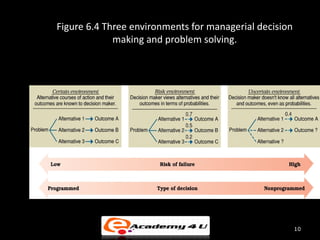
 Decision environments:
  – Certain environments.
     • Offer complete information about possible action alternatives
        and their outcomes.
  – Risk environments.
     • Lack complete information about action alternatives and their
        consequences, but offer some estimates of probabilities of
        outcomes for possible action alternatives.
  – Uncertain environments
     • Information is so poor that probabilities cannot be assigned to
        likely outcomes of known action alternatives.


                                                                   9
Figure 6.4 Three environments for managerial decision
             making and problem solving.


                                                        10
THE DECISION-MAKING PROCESS


 Decision-making process
 a set of activities that begin with the identification of a
   problem, include making a decision, and end with the
   evaluation of results.


                                                                11
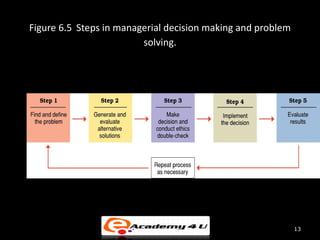
Five-step decision-making process:
– Identify and define the problem.
– Generate and evaluate possible solutions.
– Choose a preferred course of action and conduct
  the “ethics double check.”
– Implement the decision.
– Evaluate results.

                                                    12
Figure 6.5 Steps in managerial decision making and problem
                         solving.


                                                             13
 Step 1 — identify and define the problem.
  – Focuses on information gathering, information
    processing, and deliberation.
  – Decision objectives should be established.
  – Common mistakes in defining problems:
     • Defining the problem too broadly or too narrowly.
     • Focusing on symptoms instead of causes.
     • Choosing the wrong problem.


                                                      14
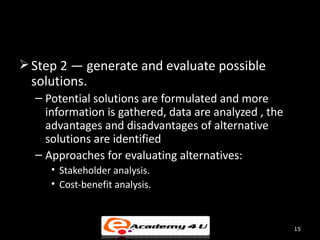
 Step 2 — generate and evaluate possible
 solutions.
  – Potential solutions are formulated and more
    information is gathered, data are analyzed , the
    advantages and disadvantages of alternative
    solutions are identified
  – Approaches for evaluating alternatives:
     • Stakeholder analysis.
     • Cost-benefit analysis.


                                                       15
 Step 2 — generate and evaluate possible solutions
  (cont.).
   – Criteria for evaluating alternatives:
       •   Benefits.
       •   Costs.
       •   Timeliness.
       •   Acceptability.
       •   Ethical soundness.
   – Common mistakes:
       • Selecting a particular solution too quickly.
       • Choosing a convenient alternative that may have damaging side
         effects or may not be as good as other alternatives.


                                                                         16
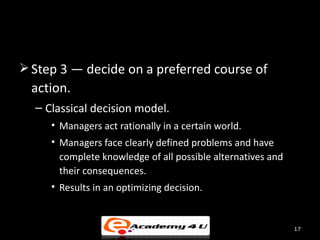
 Step 3 — decide on a preferred course of
  action.
  – Classical decision model.
     • Managers act rationally in a certain world.
     • Managers face clearly defined problems and have
       complete knowledge of all possible alternatives and
       their consequences.
     • Results in an optimizing decision.


                                                             17
 Step 3 — decide on a preferred course of
  action (cont.).
  – Behavioral decision model
     • Managers act in terms of what they perceive about a
       given situation.
     • Recognizes limits to human information-processing
       capabilities.
        – Cognitive limitations.
        – Bounded rationality.
        – Results in a satisficing decision.


                                                             18
 Step 4 — implement the decision solution.
   – Involves taking action to make sure the solution
     decided upon becomes a reality.
   – Managers need to have willingness and ability to
     implement action plans.
   – Lack-of-participation error should be avoided.


                                                        19
Figure 6.6 Differences in the classical and behavioral models
               of managerial decision making.


                                                        20
 Step 5 — evaluate results.
   – Involves comparing actual and desired results.
   – Positive and negative consequences of chosen
     course of action should be examined.
   – If actual results fall short of desired results, the
     manager returns to earlier steps in the decision-
     making process.


                                                            21
INDIVIDUAL VERSUS GROUP DECISION MAKING


 Potential advantages of group decision
  making:
  – Greater amounts of information, knowledge, and
    expertise are available.
  – More action alternatives are considered.
  – Increased understanding and acceptance of
    outcomes.
  – Increased commitment to implement final plans.


                                                     22
 Potential disadvantages of group
  decision making:
  – Pressure to conform.
  – Minority domination may occur.
  – Decision making takes longer.


                                     23
 When group decision making works best:
  – Individual lacks expertise or information.
  – Problem is unclear and hard to define.
  – Acceptance by others needed for effective
    implementation
  – Time is sufficient for group involvement.


                                                 24

Decision making

  • 1.
  • 2.
    Definition  Performance deficiency – Actual performance being less than desired performance.  Performance opportunity – Actual performance being better than desired performance.  Problem solving – The process of identifying a discrepancy between actual and desired performance and taking action to resolve it.  Decision – A choice among possible alternative course of action. 2
  • 3.
     Problem-solving approachesor styles: – Problem avoiders. • Inactive in information gathering and solving problems. – Problem solvers. • Reactive in gathering information and solving problems. – Problem seekers. • Proactive in anticipating problems and opportunities and taking appropriate action to gain an advantage. 3
  • 4.
     Systematic versusintuitive thinking. – Systematic thinking approaches problems in a rational, step-by- step, and analytical fashion. – Intuitive thinking approaches problems in a flexible and spontaneous fashion. – Multidimensional thinking applies both intuitive and systematic thinking. – Effective multidimensional thinking requires skill at strategic opportunism. 4
  • 5.
     Cognitive styles. – Sensation Thinkers emphasize the impersonal rather than the personal and take a realistic approach to problem solving. – Intuitive Thinkers are comfortable with abstraction and tend to be idealistic. spontaneous fashion. – Intuitive Feelers prefer broad and global issues and are comfortable with intangibles. – Sensation Feelers emphasize analysis and human relations and tend to be realistic and prefer facts. 5
  • 6.
    TYPES OF MANAGERIALDECISIONS  Programmed decisions. – Apply solutions that are readily available from past experiences to solve structured problems. – Structured problems are ones that are familiar, straightforward, and clear with respect to information needs. – Best applied to routine problems that can be anticipated. 6
  • 7.
     Nonprogrammed decisions. – Develop novel solutions to meet the demands of unique situation that present unstructured problems. – Unstructured problems are ones that are full of ambiguities and information deficiencies. – Commonly faced by higher-level management. 7
  • 8.
     Crisis decisionmaking. – A crisis involves an unexpected problem that can lead to disaster if not resolved quickly and appropriately. – Rules for crisis management: • Figure out what is going on. • Remember that speed matters. • Remember that slow counts, too. • Respect the danger of the unfamiliar. • Value the skeptic. • Be ready to “fight fire with fire.” 8
  • 9.
    DECISION CONDITIONS  Decisionenvironments: – Certain environments. • Offer complete information about possible action alternatives and their outcomes. – Risk environments. • Lack complete information about action alternatives and their consequences, but offer some estimates of probabilities of outcomes for possible action alternatives. – Uncertain environments • Information is so poor that probabilities cannot be assigned to likely outcomes of known action alternatives. 9
  • 10.
    Figure 6.4 Threeenvironments for managerial decision making and problem solving. 10
  • 11.
    THE DECISION-MAKING PROCESS Decision-making process  a set of activities that begin with the identification of a problem, include making a decision, and end with the evaluation of results. 11
  • 12.
    Five-step decision-making process: –Identify and define the problem. – Generate and evaluate possible solutions. – Choose a preferred course of action and conduct the “ethics double check.” – Implement the decision. – Evaluate results. 12
  • 13.
    Figure 6.5 Stepsin managerial decision making and problem solving. 13
  • 14.
     Step 1— identify and define the problem. – Focuses on information gathering, information processing, and deliberation. – Decision objectives should be established. – Common mistakes in defining problems: • Defining the problem too broadly or too narrowly. • Focusing on symptoms instead of causes. • Choosing the wrong problem. 14
  • 15.
     Step 2— generate and evaluate possible solutions. – Potential solutions are formulated and more information is gathered, data are analyzed , the advantages and disadvantages of alternative solutions are identified – Approaches for evaluating alternatives: • Stakeholder analysis. • Cost-benefit analysis. 15
  • 16.
     Step 2— generate and evaluate possible solutions (cont.). – Criteria for evaluating alternatives: • Benefits. • Costs. • Timeliness. • Acceptability. • Ethical soundness. – Common mistakes: • Selecting a particular solution too quickly. • Choosing a convenient alternative that may have damaging side effects or may not be as good as other alternatives. 16
  • 17.
     Step 3— decide on a preferred course of action. – Classical decision model. • Managers act rationally in a certain world. • Managers face clearly defined problems and have complete knowledge of all possible alternatives and their consequences. • Results in an optimizing decision. 17
  • 18.
     Step 3— decide on a preferred course of action (cont.). – Behavioral decision model • Managers act in terms of what they perceive about a given situation. • Recognizes limits to human information-processing capabilities. – Cognitive limitations. – Bounded rationality. – Results in a satisficing decision. 18
  • 19.
     Step 4— implement the decision solution. – Involves taking action to make sure the solution decided upon becomes a reality. – Managers need to have willingness and ability to implement action plans. – Lack-of-participation error should be avoided. 19
  • 20.
    Figure 6.6 Differencesin the classical and behavioral models of managerial decision making. 20
  • 21.
     Step 5— evaluate results. – Involves comparing actual and desired results. – Positive and negative consequences of chosen course of action should be examined. – If actual results fall short of desired results, the manager returns to earlier steps in the decision- making process. 21
  • 22.
    INDIVIDUAL VERSUS GROUPDECISION MAKING  Potential advantages of group decision making: – Greater amounts of information, knowledge, and expertise are available. – More action alternatives are considered. – Increased understanding and acceptance of outcomes. – Increased commitment to implement final plans. 22
  • 23.
     Potential disadvantagesof group decision making: – Pressure to conform. – Minority domination may occur. – Decision making takes longer. 23
  • 24.
     When groupdecision making works best: – Individual lacks expertise or information. – Problem is unclear and hard to define. – Acceptance by others needed for effective implementation – Time is sufficient for group involvement. 24