BASIC MOTIVATION CONCEPTS
AFTER STUDYING THIS CHAPTER,
              YOU SHOULD BE ABLE TO:
1. Outline the motivation process.
2. Describe Maslow’s need hierarchy.
3. Contrast Theory X and Theory Y.
4. Differentiate motivators from hygiene factors.
5. List the characteristics that high achievers prefer in a
   job.
6. Summarize the types of goals that increase
   performance.
AFTER STUDYING THIS CHAPTER,
          YOU SHOULD BE ABLE TO:


7. State the impact of underrewarding
   employees.
8. Clarify key relationships in expectancy
   theory.
9. Explain how the contemporary theories
   of motivation complement each other.
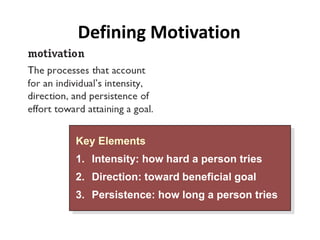
Defining Motivation


Key Elements
1. Intensity: how hard a person tries
2. Direction: toward beneficial goal
3. Persistence: how long a person tries
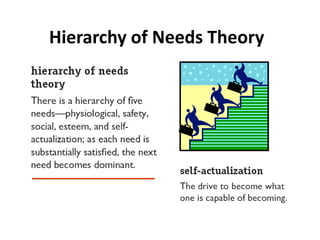
Hierarchy of Needs Theory
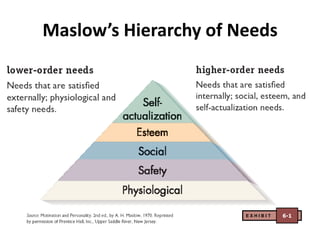
Maslow’s Hierarchy of Needs


                       EXHIBIT   6-1
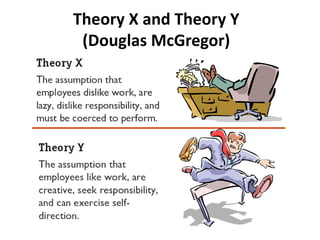
Theory X and Theory Y
 (Douglas McGregor)
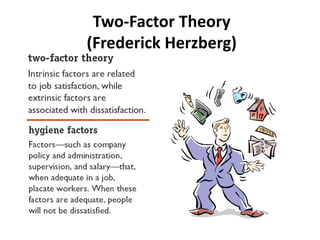
Two-Factor Theory
(Frederick Herzberg)
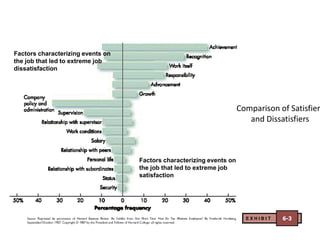
Factors characterizing events on
the job that led to extreme job
dissatisfaction


                                                                      Comparison of Satisfier
                                                                         and Dissatisfiers


                                   Factors characterizing events on
                                   the job that led to extreme job
                                   satisfaction


                                                                        EXHIBIT   6-3
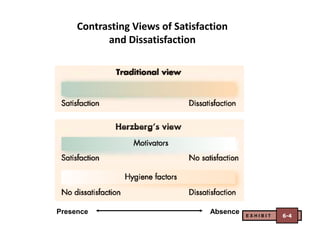
Contrasting Views of Satisfaction
           and Dissatisfaction


Presence                          Absence   EXHIBIT   6-4
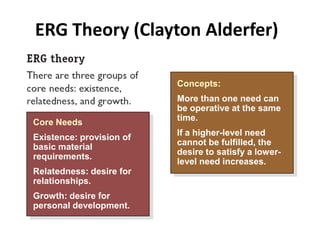
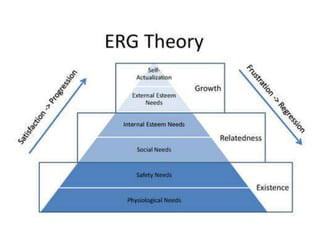
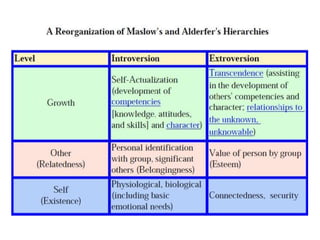
ERG Theory (Clayton Alderfer)

                          Concepts:
                          More than one need can
                          be operative at the same
                          time.
Core Needs
                          If a higher-level need
Existence: provision of
                          cannot be fulfilled, the
basic material
                          desire to satisfy a lower-
requirements.
                          level need increases.
Relatedness: desire for
relationships.
Growth: desire for
personal development.
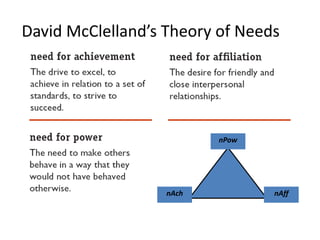
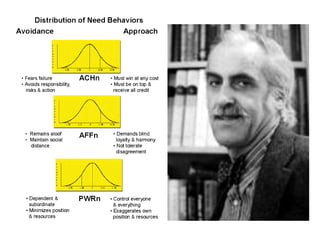
David McClelland’s Theory of Needs


                          nPow


                   nAch          nAff
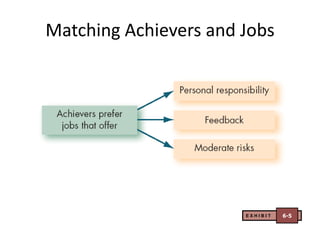
Matching Achievers and Jobs


                       EXHIBIT   6-5
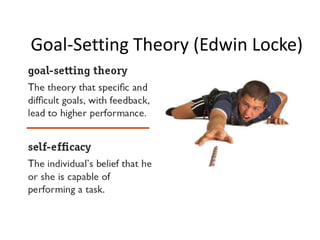
Goal-Setting Theory (Edwin Locke)
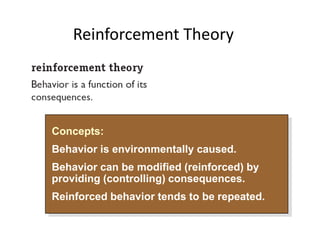
Reinforcement Theory


Concepts:
Behavior is environmentally caused.
Behavior can be modified (reinforced) by
providing (controlling) consequences.
Reinforced behavior tends to be repeated.
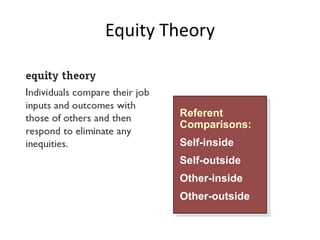
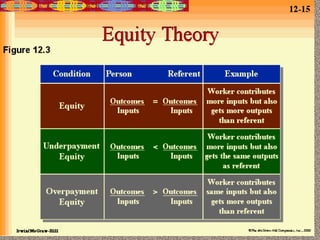
Equity Theory


        Referent
        Comparisons:
        Self-inside
        Self-outside
        Other-inside
        Other-outside
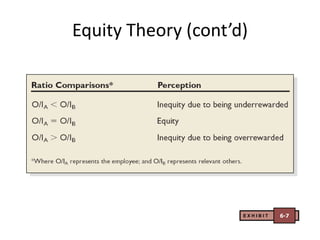
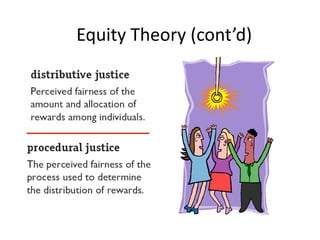
Equity Theory (cont’d)


                     EXHIBIT   6-7
Equity Theory (cont’d)

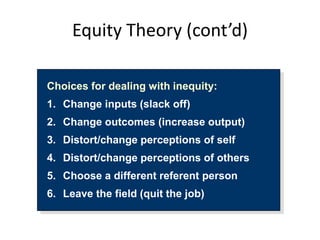
Choices for dealing with inequity:
1. Change inputs (slack off)
2. Change outcomes (increase output)
3. Distort/change perceptions of self
4. Distort/change perceptions of others
5. Choose a different referent person
6. Leave the field (quit the job)
Equity Theory (cont’d)

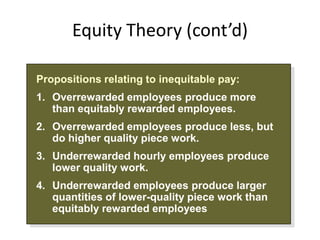
Propositions relating to inequitable pay:
1. Overrewarded employees produce more
   than equitably rewarded employees.
2. Overrewarded employees produce less, but
   do higher quality piece work.
3. Underrewarded hourly employees produce
   lower quality work.
4. Underrewarded employees produce larger
   quantities of lower-quality piece work than
   equitably rewarded employees
Equity Theory (cont’d)
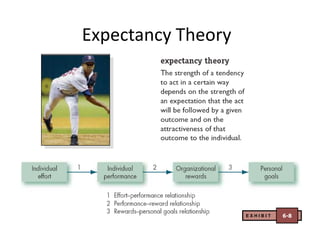
Expectancy Theory


                    EXHIBIT   6-8
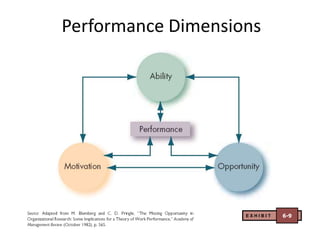
Performance Dimensions


                    EXHIBIT   6-9
FOR BETTER 1ndONEsia


Sang Merah Putih akhirnya berkibar di Puncak Everest
(8.848 mdpl) setelah Tim Ekspedisi Tujuh Puncak Dunia
(Seven Summits) yang melalui jalur utara yaitu Tibet berhasil
mencapai puncak, Sabtu (19/5/2012).

Basic motivation concepts

  • 1.
  • 2.
    AFTER STUDYING THISCHAPTER, YOU SHOULD BE ABLE TO: 1. Outline the motivation process. 2. Describe Maslow’s need hierarchy. 3. Contrast Theory X and Theory Y. 4. Differentiate motivators from hygiene factors. 5. List the characteristics that high achievers prefer in a job. 6. Summarize the types of goals that increase performance.
  • 3.
    AFTER STUDYING THISCHAPTER, YOU SHOULD BE ABLE TO: 7. State the impact of underrewarding employees. 8. Clarify key relationships in expectancy theory. 9. Explain how the contemporary theories of motivation complement each other.
  • 5.
    Defining Motivation Key Elements 1.Intensity: how hard a person tries 2. Direction: toward beneficial goal 3. Persistence: how long a person tries
  • 7.
  • 8.
    Maslow’s Hierarchy ofNeeds EXHIBIT 6-1
  • 10.
    Theory X andTheory Y (Douglas McGregor)
  • 11.
  • 12.
    Factors characterizing eventson the job that led to extreme job dissatisfaction Comparison of Satisfier and Dissatisfiers Factors characterizing events on the job that led to extreme job satisfaction EXHIBIT 6-3
  • 13.
    Contrasting Views ofSatisfaction and Dissatisfaction Presence Absence EXHIBIT 6-4
  • 15.
    ERG Theory (ClaytonAlderfer) Concepts: More than one need can be operative at the same time. Core Needs If a higher-level need Existence: provision of cannot be fulfilled, the basic material desire to satisfy a lower- requirements. level need increases. Relatedness: desire for relationships. Growth: desire for personal development.
  • 18.
    David McClelland’s Theoryof Needs nPow nAch nAff
  • 20.
    Matching Achievers andJobs EXHIBIT 6-5
  • 21.
  • 22.
    Reinforcement Theory Concepts: Behavior isenvironmentally caused. Behavior can be modified (reinforced) by providing (controlling) consequences. Reinforced behavior tends to be repeated.
  • 23.
    Equity Theory Referent Comparisons: Self-inside Self-outside Other-inside Other-outside
  • 24.
  • 25.
    Equity Theory (cont’d) Choicesfor dealing with inequity: 1. Change inputs (slack off) 2. Change outcomes (increase output) 3. Distort/change perceptions of self 4. Distort/change perceptions of others 5. Choose a different referent person 6. Leave the field (quit the job)
  • 26.
    Equity Theory (cont’d) Propositionsrelating to inequitable pay: 1. Overrewarded employees produce more than equitably rewarded employees. 2. Overrewarded employees produce less, but do higher quality piece work. 3. Underrewarded hourly employees produce lower quality work. 4. Underrewarded employees produce larger quantities of lower-quality piece work than equitably rewarded employees
  • 27.
  • 29.
    Expectancy Theory EXHIBIT 6-8
  • 30.
  • 31.
    FOR BETTER 1ndONEsia SangMerah Putih akhirnya berkibar di Puncak Everest (8.848 mdpl) setelah Tim Ekspedisi Tujuh Puncak Dunia (Seven Summits) yang melalui jalur utara yaitu Tibet berhasil mencapai puncak, Sabtu (19/5/2012).